EPISTAXIS
Dr. AVINASH MALEKAR
GMC Nagpur
Epistaxis, derived from the Greek term
epistazein, is defined as bleeding from the
nose
HISTORY
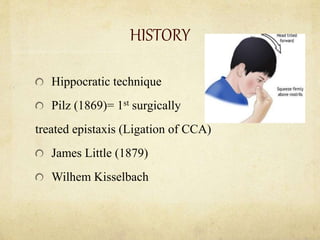
Hippocratic technique
Pilz (1869)= 1st surgically
treated epistaxis (Ligation of CCA)
James Little (1879)
Wilhem Kisselbach
Saiffert (1928)= via maxillary sinus ligated
internal maxillary artery
Woodruff (1949)
Sokoloff= first undertook angiographic
embolisation for epistaxis in 1972
Vascular supply of nasal cavity
Various anastomoses on the ipsilateral side between
the internal and external carotid systems exist as well
as crossover to the contralateral side
Knowledge of these anastomosis is important in
addressing most distal site of bleeding
Vascular supply of nasal cavity
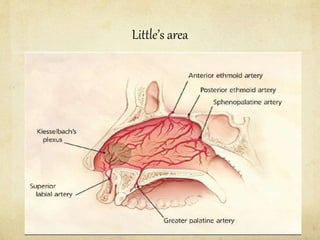
Anterior and Posterior ethmoidal arteries
Sphenopalatine artery
Common bleeding sites
1. Little’s area
2. Woodruff’s plexus
3. Retrocolumellar vein
Little’s area
Woodruff plexus
Retrocolumellar vein
Run 2mm behind and parallel to columella
Common cause of venous epistaxis in children
Classification of epistaxis
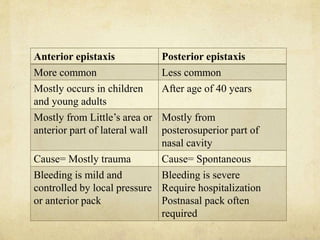
Anterior epistaxis Posterior epistaxis
More common Less common
Mostly occurs in children
and young adults
After age of 40 years
Mostly from Little’s area or
anterior part of lateral wall
Mostly from
posterosuperior part of
nasal cavity
Cause= Mostly trauma Cause= Spontaneous
Bleeding is mild and
controlled by local pressure
or anterior pack
Bleeding is severe
Require hospitalization
Postnasal pack often
required
Epistaxis
Anterior epistaxis Posterior epistaxis
Local causes
Systemic causes
Hypertension: No direct causal relationship
Altered clotting abilities= Drugs (NSAIDs, apsirin,
clopidogrel), Liver disease
Inherited blood diatheses= Hemophilia (Factor VIII
deficiency), Von Willebrand’s disease
Hereditary hemorrhagic telengiectasia (HHT)
- Autosomal dominant
- widespread cutaneous, mucosal and visceral
telengiectasia
Approach to a patient with epistaxis
A} History of epistaxis
- Onset - Frequency
- Duration - Quantity
- Uni/Bilateral - Previous episodes
- Hematemesis/Hemoptysis
B} History of
- Trauma - Exanthematous fever
- Foreign body - Bleeding disorders
- Hypertension - Drug intake
C} Examination of nose and PNS
D} Systemic examination
E} Blood investigations= BT,CT, Coagulation
profile
F} Radiological investigations= X ray, CT scan
G} Biopsy
E} Endoscopy
Management of epistaxis
1. Establish the site of bleeding
2. Stop the bleeding
3. Treat the cause
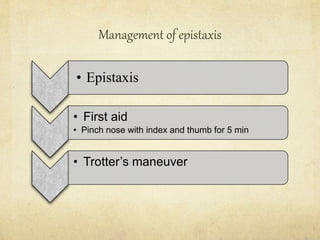
Management of epistaxis
• Epistaxis
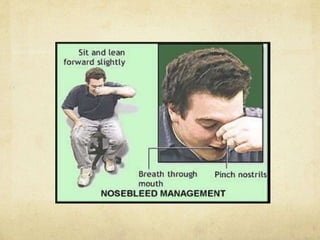
• First aid
• Pinch nose with index and thumb for 5 min
• Trotter’s maneuver
If bleeding
continues
• Allay anxiety
• Ice packs over nose
• Quick examination of nose nasopharynx
• Systemic examination
• Exclude general causes
• Anterior/Posterior rhinoscopy/ endoscopy
If bleeding
size
localised
• Cauterization
Silver nitrate
Bipolar diathermy
Cauterization
Chemical
Silver nitrate
Thermal
Bipolar suction dithermy
If bleeding
still continues
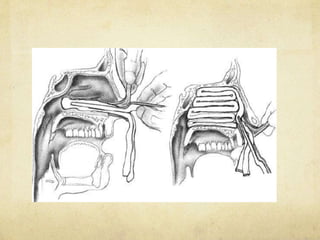
• Anterior nasal packing
Merocel nasal tampon
• Send blood for Hb, blood counts,
BT, CT, PT, aPTT, Blood group
Bleeding
continues
• Posterior nasal packing
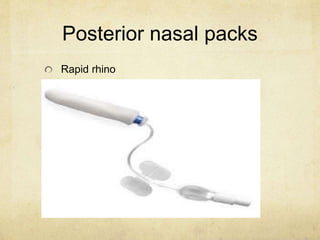
Posterior nasal packs
Bivona nasal pack Foley’s catheter
Posterior nasal packs
Rapid rhino
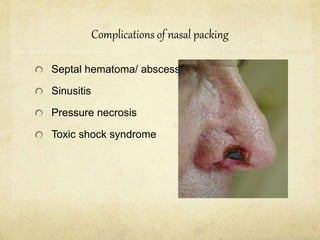
Complications of nasal packing
Septal hematoma/ abscess
Sinusitis
Pressure necrosis
Toxic shock syndrome
Bleeding
continues
• Blood transfusion
• Surgical Mx
• Ligation of arteries (Sphenopalatine artery,
Anterior and posterior ethmoid artery, maxillary
artery ligation, ECA ligation)
• Septal surgeries
• Embolization
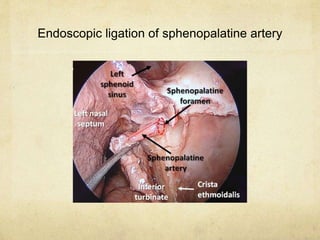
Endoscopic ligation of sphenopalatine artery
Anterior and posterior ethmoidal artery
ligation
Lynch incision (curvilinear
incision halfway between
medial canthus and tip of
the nasal dorsum
Maxillary artery ligation
Sublabial approach -
Antrostomy formed
Mucosa of posterior wall
of antrum elevated
Window made through
pterygopalatine fossa
Ligation of maxillary
artery done
External carotid artery ligation
Horizontal skin incision is made between the hyoid
bone and the superior border of the thyroid cartilage
Subplatysmal skin flaps are then raised, and the
sternocleidomastoid muscle is retracted posteriorly.
Carotid sheath is opened and its contents exposed
Usually ligated just distal to the superior thyroid
artery
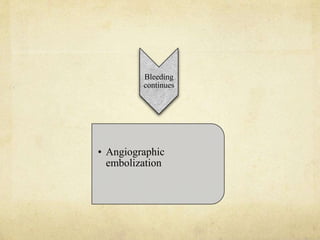
Bleeding
continues
• Angiographic
embolization
Epistaxis in children
Causes
Common Less common
Idiopathic
Infection
Trauma: Nose
picking
Vestibulitis
Nasal allergy
Local= septal
deformity, tumors
Systemic=
coagulopathies
HHT
Guidelines for Management of epistaxis in
children
Expectant treatment in mild cases= Pinching nose, allay
anxiety of child and parents
Petrolium jelly used as primary treatment= forms water
resistant film over affected area
Nasal barrier cream (Chlorhexidine, neomycin)offer
limited benefit
If cautery is considered: Silver nitrate is optimum method
Electrocautery should rarely considered
Laser therapy, fibrin glue and septoplasty have limited
role based on individual basis
Neither systemic or local tranexamic acid has any
place in treatment of childhood epistaxis
Endoscopic ligation of arteries have limited role in
children
References
Scott-Brown's Otorhinolaryngology: Head
and Neck Surgery 7Ed
Cummings otolaryngology, Head and neck
surgery 5th Ed
Ballenger’s otorhinolaryngology, Head and
neck suregry
Thank you

Epistaxis

  • 1.
  • 2.
    Epistaxis, derived fromthe Greek term epistazein, is defined as bleeding from the nose
  • 3.
    HISTORY Hippocratic technique Pilz (1869)=1st surgically treated epistaxis (Ligation of CCA) James Little (1879) Wilhem Kisselbach
  • 4.
    Saiffert (1928)= viamaxillary sinus ligated internal maxillary artery Woodruff (1949) Sokoloff= first undertook angiographic embolisation for epistaxis in 1972
  • 5.
    Vascular supply ofnasal cavity Various anastomoses on the ipsilateral side between the internal and external carotid systems exist as well as crossover to the contralateral side Knowledge of these anastomosis is important in addressing most distal site of bleeding
  • 6.
    Vascular supply ofnasal cavity
  • 7.
    Anterior and Posteriorethmoidal arteries
  • 8.
  • 9.
    Common bleeding sites 1.Little’s area 2. Woodruff’s plexus 3. Retrocolumellar vein
  • 10.
  • 11.
  • 12.
    Retrocolumellar vein Run 2mmbehind and parallel to columella Common cause of venous epistaxis in children
  • 13.
  • 14.
    Anterior epistaxis Posteriorepistaxis More common Less common Mostly occurs in children and young adults After age of 40 years Mostly from Little’s area or anterior part of lateral wall Mostly from posterosuperior part of nasal cavity Cause= Mostly trauma Cause= Spontaneous Bleeding is mild and controlled by local pressure or anterior pack Bleeding is severe Require hospitalization Postnasal pack often required
  • 15.
  • 16.
  • 17.
    Systemic causes Hypertension: Nodirect causal relationship Altered clotting abilities= Drugs (NSAIDs, apsirin, clopidogrel), Liver disease Inherited blood diatheses= Hemophilia (Factor VIII deficiency), Von Willebrand’s disease Hereditary hemorrhagic telengiectasia (HHT) - Autosomal dominant - widespread cutaneous, mucosal and visceral telengiectasia
  • 18.
    Approach to apatient with epistaxis A} History of epistaxis - Onset - Frequency - Duration - Quantity - Uni/Bilateral - Previous episodes - Hematemesis/Hemoptysis B} History of - Trauma - Exanthematous fever - Foreign body - Bleeding disorders - Hypertension - Drug intake
  • 19.
    C} Examination ofnose and PNS D} Systemic examination E} Blood investigations= BT,CT, Coagulation profile F} Radiological investigations= X ray, CT scan G} Biopsy E} Endoscopy
  • 20.
    Management of epistaxis 1.Establish the site of bleeding 2. Stop the bleeding 3. Treat the cause
  • 21.
    Management of epistaxis •Epistaxis • First aid • Pinch nose with index and thumb for 5 min • Trotter’s maneuver
  • 23.
    If bleeding continues • Allayanxiety • Ice packs over nose • Quick examination of nose nasopharynx • Systemic examination • Exclude general causes • Anterior/Posterior rhinoscopy/ endoscopy If bleeding size localised • Cauterization Silver nitrate Bipolar diathermy
  • 24.
  • 25.
    If bleeding still continues •Anterior nasal packing
  • 27.
  • 28.
    • Send bloodfor Hb, blood counts, BT, CT, PT, aPTT, Blood group Bleeding continues • Posterior nasal packing
  • 30.
    Posterior nasal packs Bivonanasal pack Foley’s catheter
  • 31.
  • 32.
    Complications of nasalpacking Septal hematoma/ abscess Sinusitis Pressure necrosis Toxic shock syndrome
  • 33.
    Bleeding continues • Blood transfusion •Surgical Mx • Ligation of arteries (Sphenopalatine artery, Anterior and posterior ethmoid artery, maxillary artery ligation, ECA ligation) • Septal surgeries • Embolization
  • 34.
    Endoscopic ligation ofsphenopalatine artery
  • 35.
    Anterior and posteriorethmoidal artery ligation Lynch incision (curvilinear incision halfway between medial canthus and tip of the nasal dorsum
  • 36.
    Maxillary artery ligation Sublabialapproach - Antrostomy formed Mucosa of posterior wall of antrum elevated Window made through pterygopalatine fossa Ligation of maxillary artery done
  • 37.
    External carotid arteryligation Horizontal skin incision is made between the hyoid bone and the superior border of the thyroid cartilage Subplatysmal skin flaps are then raised, and the sternocleidomastoid muscle is retracted posteriorly. Carotid sheath is opened and its contents exposed Usually ligated just distal to the superior thyroid artery
  • 38.
  • 39.
    Epistaxis in children Causes CommonLess common Idiopathic Infection Trauma: Nose picking Vestibulitis Nasal allergy Local= septal deformity, tumors Systemic= coagulopathies HHT
  • 40.
    Guidelines for Managementof epistaxis in children Expectant treatment in mild cases= Pinching nose, allay anxiety of child and parents Petrolium jelly used as primary treatment= forms water resistant film over affected area Nasal barrier cream (Chlorhexidine, neomycin)offer limited benefit If cautery is considered: Silver nitrate is optimum method Electrocautery should rarely considered
  • 41.
    Laser therapy, fibringlue and septoplasty have limited role based on individual basis Neither systemic or local tranexamic acid has any place in treatment of childhood epistaxis Endoscopic ligation of arteries have limited role in children
  • 42.
    References Scott-Brown's Otorhinolaryngology: Head andNeck Surgery 7Ed Cummings otolaryngology, Head and neck surgery 5th Ed Ballenger’s otorhinolaryngology, Head and neck suregry
  • 43.