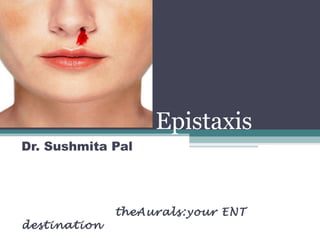
Epistaxis
Dr. Sushmita Pal
theAurals:your ENT
destination
From a Greek term “epistazo” which means “to bleed
from nose”.
Anatomy
Why nose?
• Situated in a vulnerable position as it protrudes
on the face
• Has a very rich blood supply
• Vasculature runs just under the mucosa
• Exposed to the drying effect of inspiratory
current
Epidemiology
• Lifelong incidence of epistaxis in general
population is about 60%
• Fewer than 60% seek medical attention
• Peaks in young children (2 – 10 y) and older
individuals (50 – 80 y)
• Males 58%, females 42%
Blood Supply
• Superior part of the nose (Internal carotid artery)
▫ Ophthalmic artery
 Anterior ethmoidal artery
 Posterior ethmoidal artery
• Inferior part of the nose (External carotid artery)
▫ Maxillary artery
 Greater palatine artery
 Sphenopalatine artery
▫ Facial artery
 Superior labial artery  vestibule of the nose
Kiesselbach’s Plexus
• Little’s area
• Anteroinferior part of the nasal septum
• Anastomosis between upper and lower arteries
▫ Anterior ethmoidal artery
▫ Posterior ethmoidal artery
▫ Sphenopalatine artery
▫ Greater palatine artery
▫ Septal branch of superior labial artery
Woodruff’s Plexus
• Lateral wall of inferior meatus
• Blood vessels have very little muscle tissue
within their walls, therefore hemostasis is poor
• Anastomosis between:
▫ Pharyngeal artery
▫ Posterior nasal artery
▫ Sphenopalatine artery
▫ Posterior septal artery
Pathophysiology
• Occurs when mucosa is eroded
• Vessels become exposed and subsequently break
Classification
• Anterior
▫ 90% of all cases of epistaxis
▫ Kiesselbach’s plexus
▫ Younger population
▫ Typically less severe
▫ A constant ooze, rather than profuse pumping of
blood
• Posterior
▫ Woodruff’s plexus
▫ Older population
▫ Profuse, prolonged and more difficult to control
▫ Associated with bleeding from both nostrils
▫ Greater flow of blood into the mouth
▫ Greater risk of airway compromise and aspiration
of blood
Etiology
• Most are idiopathic
• Local causes
▫ Spontaneous
▫ Trauma
 Nose picking/blowing, sneezing, fractures, barotraumas
▫ Foreign bodies
▫ Iatrogenic
 FESS, rhinoplasty, nasal cannula
▫ Inflammation/infection
▫ Tumors
 Polyps, nasopharyngeal carcinoma/angiofibroma
▫ Hereditary telengiectasia
▫ Leech infestation
• Systemic causes
▫ Cardiovascular conditions
 Hypertension
 Increased venous pressure
 Mitral valve stenosis, heart failure, mediastinal tumors
▫ Coagulopathies
 Hemophilia, von Willebrand’s disease
 Hepatic cirrhosis
 Anticoagulant therapy
 Thrombocytopenia
▫ Fever (rare)
 Influenza
▫ Drugs
 NSAIDs, aspirin, coumadin, warfarin, isotretinoin, etc
▫ Infection
 Tuberculosis, syphilis
▫ Alcohol
▫ Anemia
▫ Uremia
▫ Connective tissue disorders
 SLE
▫ Hematological malignancy
▫ Vasculitis
 Wegener’s granulomatosis
▫ Vitamin C or K deficiencies
▫ Osler-Weber-Rendu syndrome
▫ Pregnancy
▫ Vicarious menstruation
History
• Age
• Onset, duration, severity, frequency
• Bilateral or unilateral
• Preceding factors: exercise, sleep, migraine, trauma
• Bleeding from other sites
• Aggravating and relieving factors
• Nasal discharge
• Medical conditions
• Current medications
• Smoking and drinking habits
• Previous epistaxis, recurrent bleeding, easy bruising
• Family history of bleeding disorders
Physical Examination
• Vital signs
• Nasal cavity
• Fiberoptic endoscopy (rigid or flexible)
• Skin examination
Management
• Control significant bleeding or hemodynamic
instability before obtaining a lengthy history
• Steps:
▫ First aid and resuscitation
▫ Assess blood loss
▫ Localize bleeding
▫ Control bleeding
▫ Prevention
First Aid & Resuscitation
• Address ABC
• Neck should not be hyperextended to prevent
blood flow into the stomach or possible
aspiration
• Trotter’s triad
@ Blood in mouth should not be swallowed
@ Mouth breathing
@ Direct pressure over the cartilaginous part of
the nose
@ 5 – 10 minutes is usually sufficient
• Gauze moistened with epinephrine may be
placed to promote vasoconstriction
• Vital signs and signs of shock
• Patient with significant hemorrhage should
receive an IV line and crystalloid infusion and
reptilase/ethamsylate in bolus or infusion
• Cross match for 2 units packed RBC
• Continuous cardiac monitoring and pulse
oximetry
Localization of Bleeding
• Pledgets soaked with anesthetic-vasoconstrictor
solution are inserted into the nasal cavity to
anesthetize and shrink nasal mucosa
• Allow them to remain for 10 – 15 minutes
• Visualize cavity with speculum + good light
source
• Aspirate excess blood and clots
• If the bleeding originated from Little’s area, it is
clearly visible
• Rigid endoscope is used to localize posterior
bleeding
▫ Superior optics
▫ Allow endoscopic suction and cauterization
• Points suggesting posterior source:
▫ Anterior surface cannot be visualized
▫ Bilateral bleeding
▫ Constant dripping of blood in the posterior
pharynx
▫ Bleeding in the pharynx with the anterior nasal
packing in place
Control of Bleeding
• Topical vasoconstrictors
▫ Otrivin (xylomethazoline)
▫ Cocaine
• Chemical cauterization with silver nitrate stick
▫ Rolled over mucosa until a grey eschar forms
▫ Only one side should be cauterized to prevent
septal necrosis or perforation
• Thermal cauterization with an electrocautery
device for more aggressive bleeding under LA or
GA
Anterior Nasal Packing
• Roller gauze soaked with petroleum jelly and
an antibiotic ointment
• Success rate 85%
Posterior Nasal Packing
• Indications:
▫ Failure of anterior packing
▫ High suspicion of posterior bleeding
▫ Older patient with atherosclerosis
▫ Patient with bleeding diathesis
• Contraindications
▫ Facial trauma
▫ Shock
▫ Altered mental status
• Uncomfortable and difficulty in breathing
• Risk of hypoventilation and hypoxia
• Admission, bed rest, sedation
• Supplemental oxygen:
▫ Elderly patients
▫ Cardiac disorders
▫ COPD
• Monitor blood pressure and hemoglobin level
• Control coexistent hypertension
• Foley catheter
• Double-balloon catheter
• Gauze method
Surgical Intervention
• Indications:
▫ Bleeding continues despite adequate packing and
resuscitation
▫ Nasal anomaly (septal deviation)
▫ Patient’s refusal or intolerance to packing
• Arterial ligation
▫ External carotid artery
▫ Internal maxillary artery transorally or
transnasally
▫ Ethmoidal arteries
▫ Most commonly ligated vessel is
SPHENOPALATINE ARTERY
• Angiography and vessel embolization
Prevention
Control of hypertension
Correction of bleeding disorders
Humidifier or vaporizers
Nasal saline sprays, ointment, vaseline
• Avoid hard nose blowing or sneezing
• Sneeze with mouth open
• Avoid nose picking
• Control the use of medications
Complications of Epistaxis $ Nasal
packing
• Rhinosinusitis
• Cardiovascular compromise
• Septal perforation
• Toxic shock syndrome
• Hypoxia
• Aspiration pneumonia
• CVA associated with embolization
• Recurrent epistaxis
• Re-bleeding on nasal pack removal
Thank You

Epistaxis

  • 1.
  • 2.
    From a Greekterm “epistazo” which means “to bleed from nose”.
  • 3.
  • 6.
    Why nose? • Situatedin a vulnerable position as it protrudes on the face • Has a very rich blood supply • Vasculature runs just under the mucosa • Exposed to the drying effect of inspiratory current
  • 7.
    Epidemiology • Lifelong incidenceof epistaxis in general population is about 60% • Fewer than 60% seek medical attention • Peaks in young children (2 – 10 y) and older individuals (50 – 80 y) • Males 58%, females 42%
  • 8.
    Blood Supply • Superiorpart of the nose (Internal carotid artery) ▫ Ophthalmic artery  Anterior ethmoidal artery  Posterior ethmoidal artery • Inferior part of the nose (External carotid artery) ▫ Maxillary artery  Greater palatine artery  Sphenopalatine artery ▫ Facial artery  Superior labial artery  vestibule of the nose
  • 10.
    Kiesselbach’s Plexus • Little’sarea • Anteroinferior part of the nasal septum • Anastomosis between upper and lower arteries ▫ Anterior ethmoidal artery ▫ Posterior ethmoidal artery ▫ Sphenopalatine artery ▫ Greater palatine artery ▫ Septal branch of superior labial artery
  • 11.
    Woodruff’s Plexus • Lateralwall of inferior meatus • Blood vessels have very little muscle tissue within their walls, therefore hemostasis is poor • Anastomosis between: ▫ Pharyngeal artery ▫ Posterior nasal artery ▫ Sphenopalatine artery ▫ Posterior septal artery
  • 13.
    Pathophysiology • Occurs whenmucosa is eroded • Vessels become exposed and subsequently break
  • 14.
    Classification • Anterior ▫ 90%of all cases of epistaxis ▫ Kiesselbach’s plexus ▫ Younger population ▫ Typically less severe ▫ A constant ooze, rather than profuse pumping of blood
  • 15.
    • Posterior ▫ Woodruff’splexus ▫ Older population ▫ Profuse, prolonged and more difficult to control ▫ Associated with bleeding from both nostrils ▫ Greater flow of blood into the mouth ▫ Greater risk of airway compromise and aspiration of blood
  • 16.
    Etiology • Most areidiopathic • Local causes ▫ Spontaneous ▫ Trauma  Nose picking/blowing, sneezing, fractures, barotraumas ▫ Foreign bodies ▫ Iatrogenic  FESS, rhinoplasty, nasal cannula ▫ Inflammation/infection ▫ Tumors  Polyps, nasopharyngeal carcinoma/angiofibroma ▫ Hereditary telengiectasia ▫ Leech infestation
  • 17.
    • Systemic causes ▫Cardiovascular conditions  Hypertension  Increased venous pressure  Mitral valve stenosis, heart failure, mediastinal tumors ▫ Coagulopathies  Hemophilia, von Willebrand’s disease  Hepatic cirrhosis  Anticoagulant therapy  Thrombocytopenia ▫ Fever (rare)  Influenza ▫ Drugs  NSAIDs, aspirin, coumadin, warfarin, isotretinoin, etc
  • 18.
    ▫ Infection  Tuberculosis,syphilis ▫ Alcohol ▫ Anemia ▫ Uremia ▫ Connective tissue disorders  SLE ▫ Hematological malignancy ▫ Vasculitis  Wegener’s granulomatosis ▫ Vitamin C or K deficiencies ▫ Osler-Weber-Rendu syndrome ▫ Pregnancy ▫ Vicarious menstruation
  • 19.
    History • Age • Onset,duration, severity, frequency • Bilateral or unilateral • Preceding factors: exercise, sleep, migraine, trauma • Bleeding from other sites • Aggravating and relieving factors • Nasal discharge • Medical conditions • Current medications • Smoking and drinking habits • Previous epistaxis, recurrent bleeding, easy bruising • Family history of bleeding disorders
  • 20.
    Physical Examination • Vitalsigns • Nasal cavity • Fiberoptic endoscopy (rigid or flexible) • Skin examination
  • 21.
    Management • Control significantbleeding or hemodynamic instability before obtaining a lengthy history • Steps: ▫ First aid and resuscitation ▫ Assess blood loss ▫ Localize bleeding ▫ Control bleeding ▫ Prevention
  • 22.
    First Aid &Resuscitation • Address ABC • Neck should not be hyperextended to prevent blood flow into the stomach or possible aspiration • Trotter’s triad @ Blood in mouth should not be swallowed @ Mouth breathing @ Direct pressure over the cartilaginous part of the nose @ 5 – 10 minutes is usually sufficient • Gauze moistened with epinephrine may be placed to promote vasoconstriction
  • 23.
    • Vital signsand signs of shock • Patient with significant hemorrhage should receive an IV line and crystalloid infusion and reptilase/ethamsylate in bolus or infusion • Cross match for 2 units packed RBC • Continuous cardiac monitoring and pulse oximetry
  • 24.
    Localization of Bleeding •Pledgets soaked with anesthetic-vasoconstrictor solution are inserted into the nasal cavity to anesthetize and shrink nasal mucosa • Allow them to remain for 10 – 15 minutes • Visualize cavity with speculum + good light source • Aspirate excess blood and clots • If the bleeding originated from Little’s area, it is clearly visible
  • 26.
    • Rigid endoscopeis used to localize posterior bleeding ▫ Superior optics ▫ Allow endoscopic suction and cauterization • Points suggesting posterior source: ▫ Anterior surface cannot be visualized ▫ Bilateral bleeding ▫ Constant dripping of blood in the posterior pharynx ▫ Bleeding in the pharynx with the anterior nasal packing in place
  • 28.
    Control of Bleeding •Topical vasoconstrictors ▫ Otrivin (xylomethazoline) ▫ Cocaine • Chemical cauterization with silver nitrate stick ▫ Rolled over mucosa until a grey eschar forms ▫ Only one side should be cauterized to prevent septal necrosis or perforation • Thermal cauterization with an electrocautery device for more aggressive bleeding under LA or GA
  • 30.
    Anterior Nasal Packing •Roller gauze soaked with petroleum jelly and an antibiotic ointment • Success rate 85%
  • 33.
    Posterior Nasal Packing •Indications: ▫ Failure of anterior packing ▫ High suspicion of posterior bleeding ▫ Older patient with atherosclerosis ▫ Patient with bleeding diathesis • Contraindications ▫ Facial trauma ▫ Shock ▫ Altered mental status
  • 34.
    • Uncomfortable anddifficulty in breathing • Risk of hypoventilation and hypoxia • Admission, bed rest, sedation • Supplemental oxygen: ▫ Elderly patients ▫ Cardiac disorders ▫ COPD • Monitor blood pressure and hemoglobin level • Control coexistent hypertension
  • 35.
  • 36.
  • 37.
  • 38.
    Surgical Intervention • Indications: ▫Bleeding continues despite adequate packing and resuscitation ▫ Nasal anomaly (septal deviation) ▫ Patient’s refusal or intolerance to packing
  • 39.
    • Arterial ligation ▫External carotid artery ▫ Internal maxillary artery transorally or transnasally ▫ Ethmoidal arteries ▫ Most commonly ligated vessel is SPHENOPALATINE ARTERY • Angiography and vessel embolization
  • 40.
    Prevention Control of hypertension Correctionof bleeding disorders Humidifier or vaporizers Nasal saline sprays, ointment, vaseline • Avoid hard nose blowing or sneezing • Sneeze with mouth open • Avoid nose picking • Control the use of medications
  • 41.
    Complications of Epistaxis$ Nasal packing • Rhinosinusitis • Cardiovascular compromise • Septal perforation • Toxic shock syndrome • Hypoxia • Aspiration pneumonia • CVA associated with embolization • Recurrent epistaxis • Re-bleeding on nasal pack removal
  • 42.