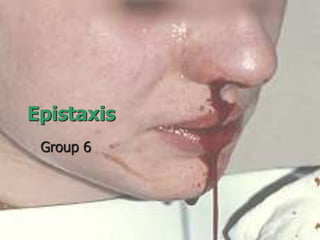
Epistaxis
Group 6
Epistaxis
 Is an acute haemorrhage from the nostril,
nasal cavity or nasopharynx.
 Another name for nose-bleeding.
 Fairly common and seen in all ages.
 Presents as an emergency
 Is a sign not a disease per se.
Why bleeding from the
nose?
 It is a highly vascularised organ to
provide required heating and
humidification of incoming air.
 Vasculature runs just under mucosa
(pseudo-stratified ciliated columnar
epithelium)
 Arterial to venous anastomoses
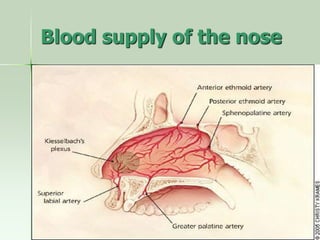
Blood supply of the nose
 The nose is supplied by both the
external and the internal carotid
systems, on both the septum and the
lateral walls.
 Nasal septum
– Internal carotid system
 Supplied by the anterior and posterior
ethmoidal arteries, both being branches of
the ophthalmic artery.
Blood supply of the nose
Cont…..
– External carotid system:
 Sphenopalatine artery (branch of maxillary
artery), gives nasopalatine and posterior
nasal septal branches.
 Septal branch of greater palatine artery
(branch of maxillary artery)
 Septal branch of superior labial artery (branch
of facial artery)
Cont…
 Lateral walls
– Internal carotid system
 Anterior ethmoidal branches of ophthalmic
artery
 Posterior ethmoidal
– External carotid system
 Posterior lateral nasal → from sphenopalatine artery
 Greater palatine artery → from maxillary artery
 Nasal branch of anterior → from infraorbital br. Of
superior dental maxillary artery
 Branches of facial artery to nasal vestibule
Little’s area
 It is situated on the anterior inferior part of the nasal
septum just above the vestibule.
 Four arteries- anterior ethmoidal, septal branch of
superior labial, septal branch of sphenopalatine and the
greater palatine anastomose here to form a vascular
plexus called the Kiesselbach’s plexus.
 This area is exposed to drying effect of inspiratory
current and to finger nail trauma and is the usual site for
epistaxis in children and young adults
 Retrocolumellar vein:
– This vein runs vertically downwards just behind the
columella, crosses the floor of nose and joints venous
plexus on the lateral nasal wall. This is a common site of
venous bleeding in young people.
Blood supply of the nose
Aetiology
 Classified as:
A) Local
B) Systemic and
C) Idiopathic
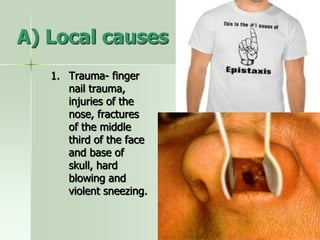
A) Local causes
1. Trauma- finger
nail trauma,
injuries of the
nose, fractures
of the middle
third of the face
and base of
skull, hard
blowing and
violent sneezing.
Local causes
2. Infections and allergies
 Acute: viral rhinitis, nasal diphtheria, acute
sinusitis.
 Chronic: all crust forming diseases, atrophic
rhinitis, rhinitis sicca, tuberculosis, syphilis
septal perforation, granulomatous lession of
the nose, e.g. rhinosporidosis
Local causes…
3. Foreign body
– Non-living: any neglected foreign body, rhinolith
– Living: maggots, leeches
4. Neoplasm of the nose and paranasal sinuses
– Benign: haemangioma and papilloma
– Malignant: carcinoma or sarcoma
5. Atmospheric changes: high altitudes, sudden
decompression (Caisson’s disease)
6. Deviated nasal septum
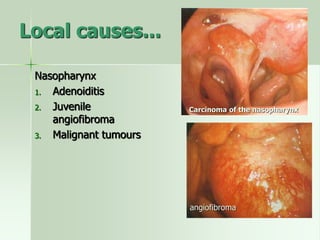
Local causes...
Nasopharynx
1. Adenoiditis
2. Juvenile
angiofibroma
3. Malignant tumours
Carcinoma of the nasopharynx
angiofibroma
B) Most common systemic
causes
 Systemic arterial
hypertension
 Endocrine Causes:
pregnancy,
pheochromocytoma
 Hereditary
hemorrhagic
telangectasias
 Osler Rendu Weber
Syndrome
 Anticoagulants (ASA,
NSAIDS)
 Hepatic disease
 Blood diseases and
coagulopathies such
as
Thrombocytopenia,
ITP, Leukemia,
Hemophilia
 Platelet dysfunction
C) Idiopathic
 Many times the cause of epistaxis is
not clear.
Sites of epistaxis
1. Little’s area in 90% of the cases
2. Above the level of middle turbinate
3. Below the level of middle turbinate
4. Posterior part of nasal cavity
5. Diffuse, both from septum and lateral
nasal wall
6. Nasopharynx
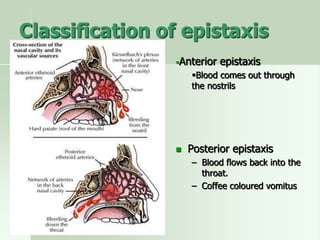
Classification of epistaxis
Anterior epistaxis
Blood comes out through
the nostrils
 Posterior epistaxis
– Blood flows back into the
throat.
– Coffee coloured vomitus
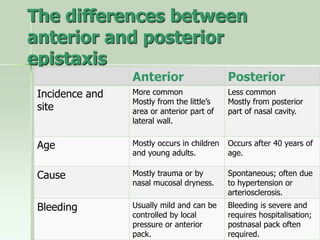
The differences between
anterior and posterior
epistaxis
Anterior Posterior
Incidence and
site
More common
Mostly from the little’s
area or anterior part of
lateral wall.
Less common
Mostly from posterior
part of nasal cavity.
Age Mostly occurs in children
and young adults.
Occurs after 40 years of
age.
Cause Mostly trauma or by
nasal mucosal dryness.
Spontaneous; often due
to hypertension or
arteriosclerosis.
Bleeding Usually mild and can be
controlled by local
pressure or anterior
pack.
Bleeding is severe and
requires hospitalisation;
postnasal pack often
required.
Pathogenesis
 The pathogenesis of epistaxis is quite various:
1. Local causes;
– local traumas (usually a blunt trauma, e.g. a punch,
possibly accompanied by a nasal fracture)
– exposition to environmental irritants → severe local
inflammatory reaction → some local changes, such
as vasodilatation, increased permeability, increased
blood flow and increased blood pressure → an
increased risk of capillary ruptures
– frequent use of nasal sprays, in particular
corticosteroid nasal sprays reduce inflammation, but
they enhance protein catabolism → an increased
capillary fragility
Pathogenesis cont….
2. Systemic causes;
 Hypertension → increased risk of capillary
ruptures
 vitamin C deficiency (required for the synthesis
of collagen, an important component of
connective tissue) → defective connective tissue
→ fragile capillaries, resulting in abnormal
bleeding
 heart failure (particularly, right-sided failure) →
an increase in systemic venous pressure and also
in systemic capillary pressure → raises the risk of
capillary ruptures
Cont….
 Hyperthermia → an extreme peripheral
vasodilatation (in order to increase heat
dissipation)→ raised risk of capillary
ruptures
 alcohol → inhibits the vasomotor centre →
a persistent peripheral vasodilatation in case
of chronic abuse → an increased risk of
capillary ruptures
 Impaired system of coagulation →
decreased ability to stop bleeding when a
blood vessel is broken.
Clinical presentation
 Bleeding from the nose (continuous or
intermittent)
 Haemoptysis
 Haematemesis
 Anxiety
 Shock in severe cases
Complications
 Severe bleeding
 Hypoxia
 Sinusitis
 Otitis media
 Necrosis of the colemulla or nasal ala
 Haemorrhagic anaemia
 Possibility of airway obstruction
 Shock
 Septal hematoma or abscess
 Septal perforation
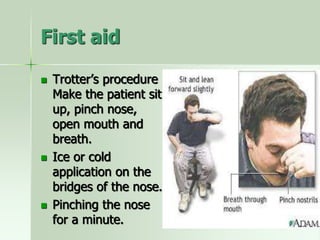
First aid
 Trotter’s procedure
Make the patient sit
up, pinch nose,
open mouth and
breath.
 Ice or cold
application on the
bridges of the nose.
 Pinching the nose
for a minute.
Diagnosis
 Laboratory investigations are not usually necessary,
although they may be required in certain specific
circumstances:
– Haematocrit or FBC is obtained if there is concern
about anaemia from excessive blood loss or clotting
abnormality
– Coagulation studies (PT, activated partial
thromboplastin time, platelet function tests) are only
required in the presence of atypical persistence,
recurrence, or recalcitrance to treatment
– Urea, serum creatinine, and LFTs are usually only
performed if there is concern about the patient's
general medical condition. Impaired liver function
may result in impaired clotting.
Cont…
 Imaging is also not normally necessary but is
indicated, following control of bleeding, in specific
circumstances:
– If a tumour is suspected, MRI of the head is
obtained, it has the ability to differentiate
between soft tissue of neoplasm versus fluid
(e.g., blood or mucus)
– CT scan of the paranasal sinuses is the imaging
modality of choice when epistaxis is secondary
to facial trauma, but it is often unable to
differentiate sinusitis from neoplasm
Cont….
 Further specialist investigations for
acute epistaxis
– Nasal endoscopy and nasopharyngoscopy
are indicated when an obvious epistaxis is
not seen.
– They also provide the opportunity for
therapeutic intervention in the form of
endonasal cautery or laser ablation.
Management
 In any case of epistaxis, it is important to know :
1. Mode of onset.
2. Duration and frequency of bleeding.
3. Amount of blood loss.
4. Side of nose from where bleeding is occurring.
5. Whether bleeding is of anterior or posterior type.
6. Any known bleeding tendency in the patient or family.
7. History of known medical ailment (hypertension,
leukaemias, mitral valve disease, cirrhosis, nephritis).
8. History of drug intake ( e.g. analgesics, anticoagulant)
Treatment of anterior
epistaxis
 Cauterization
1. Chemical
 Silver Nitrate stick, chromic acid bead.
2. Electrical
 Use of an electric rod to stop bleeding.
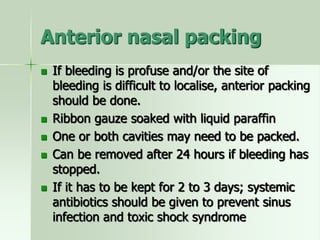
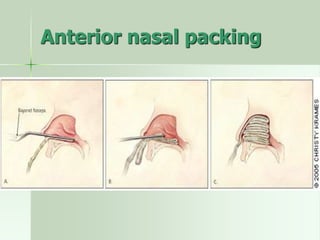
Anterior nasal packing
 If bleeding is profuse and/or the site of
bleeding is difficult to localise, anterior packing
should be done.
 Ribbon gauze soaked with liquid paraffin
 One or both cavities may need to be packed.
 Can be removed after 24 hours if bleeding has
stopped.
 If it has to be kept for 2 to 3 days; systemic
antibiotics should be given to prevent sinus
infection and toxic shock syndrome
Anterior nasal packing
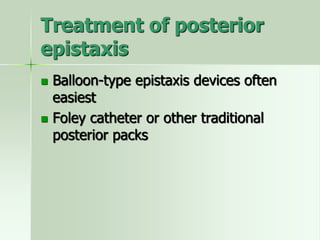
Treatment of posterior
epistaxis
 Balloon-type epistaxis devices often
easiest
 Foley catheter or other traditional
posterior packs
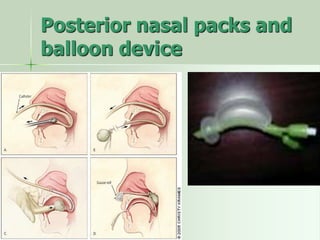
Posterior nasal packs and
balloon device
Vessel ligation
 External carotid. Ligation of external
carotid artery above the origin of
superior thyroid artery.
 Maxillary artery. Ligation in
uncontrollable posterior epistaxis.
 Ethmoidal arteries. In anteriosuperior
bleeding above the middle turbinate.
Systemic management
 Antihypertensives
 Fresh blood transfusion
 Antibiotics
 Sedatives
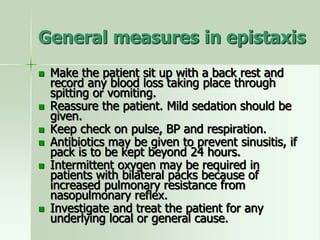
General measures in epistaxis
 Make the patient sit up with a back rest and
record any blood loss taking place through
spitting or vomiting.
 Reassure the patient. Mild sedation should be
given.
 Keep check on pulse, BP and respiration.
 Antibiotics may be given to prevent sinusitis, if
pack is to be kept beyond 24 hours.
 Intermittent oxygen may be required in
patients with bilateral packs because of
increased pulmonary resistance from
nasopulmonary reflex.
 Investigate and treat the patient for any
underlying local or general cause.
Preventive measures
 Keep allergic rhinitis under control. Use saline
nasal spray frequently to cleanse and
moisturize the nose.
 Avoid forceful nose blowing
 Avoid digital manipulation of the nose with
fingers or other objects
 Use saline-based gel intranasally for mucosal
dryness
 Consider using a humidifier in the bedroom
 Keep vasoconstricting spray at home to use
only prn (pro re nata) epistaxis
Bibliography
 Myers T (ed). (2009), Mosby’s Dictionary of
Medicine, Nursing and Health Professions, 8th Edn,
Canada, Elsevier Mosby
 Shier.D., Butler. J. and Lewis.R. Hole’s Anatomy
and Physiology. (12th edition).New York. McGraw-
Hill Publisher
 Kumar V., Abbas A.K., Fausto N. and Aster J. C.
(2010). Robins and Cotran Pathologic Basis of
Disease. (8th edn). Philadelphia. Saunders Elsevier.

Epistaxis

  • 1.
  • 2.
    Epistaxis  Is anacute haemorrhage from the nostril, nasal cavity or nasopharynx.  Another name for nose-bleeding.  Fairly common and seen in all ages.  Presents as an emergency  Is a sign not a disease per se.
  • 3.
    Why bleeding fromthe nose?  It is a highly vascularised organ to provide required heating and humidification of incoming air.  Vasculature runs just under mucosa (pseudo-stratified ciliated columnar epithelium)  Arterial to venous anastomoses
  • 4.
    Blood supply ofthe nose  The nose is supplied by both the external and the internal carotid systems, on both the septum and the lateral walls.  Nasal septum – Internal carotid system  Supplied by the anterior and posterior ethmoidal arteries, both being branches of the ophthalmic artery.
  • 5.
    Blood supply ofthe nose Cont….. – External carotid system:  Sphenopalatine artery (branch of maxillary artery), gives nasopalatine and posterior nasal septal branches.  Septal branch of greater palatine artery (branch of maxillary artery)  Septal branch of superior labial artery (branch of facial artery)
  • 6.
    Cont…  Lateral walls –Internal carotid system  Anterior ethmoidal branches of ophthalmic artery  Posterior ethmoidal – External carotid system  Posterior lateral nasal → from sphenopalatine artery  Greater palatine artery → from maxillary artery  Nasal branch of anterior → from infraorbital br. Of superior dental maxillary artery  Branches of facial artery to nasal vestibule
  • 7.
    Little’s area  Itis situated on the anterior inferior part of the nasal septum just above the vestibule.  Four arteries- anterior ethmoidal, septal branch of superior labial, septal branch of sphenopalatine and the greater palatine anastomose here to form a vascular plexus called the Kiesselbach’s plexus.  This area is exposed to drying effect of inspiratory current and to finger nail trauma and is the usual site for epistaxis in children and young adults  Retrocolumellar vein: – This vein runs vertically downwards just behind the columella, crosses the floor of nose and joints venous plexus on the lateral nasal wall. This is a common site of venous bleeding in young people.
  • 8.
  • 9.
    Aetiology  Classified as: A)Local B) Systemic and C) Idiopathic
  • 10.
    A) Local causes 1.Trauma- finger nail trauma, injuries of the nose, fractures of the middle third of the face and base of skull, hard blowing and violent sneezing.
  • 11.
    Local causes 2. Infectionsand allergies  Acute: viral rhinitis, nasal diphtheria, acute sinusitis.  Chronic: all crust forming diseases, atrophic rhinitis, rhinitis sicca, tuberculosis, syphilis septal perforation, granulomatous lession of the nose, e.g. rhinosporidosis
  • 12.
    Local causes… 3. Foreignbody – Non-living: any neglected foreign body, rhinolith – Living: maggots, leeches 4. Neoplasm of the nose and paranasal sinuses – Benign: haemangioma and papilloma – Malignant: carcinoma or sarcoma 5. Atmospheric changes: high altitudes, sudden decompression (Caisson’s disease) 6. Deviated nasal septum
  • 13.
    Local causes... Nasopharynx 1. Adenoiditis 2.Juvenile angiofibroma 3. Malignant tumours Carcinoma of the nasopharynx angiofibroma
  • 14.
    B) Most commonsystemic causes  Systemic arterial hypertension  Endocrine Causes: pregnancy, pheochromocytoma  Hereditary hemorrhagic telangectasias  Osler Rendu Weber Syndrome  Anticoagulants (ASA, NSAIDS)  Hepatic disease  Blood diseases and coagulopathies such as Thrombocytopenia, ITP, Leukemia, Hemophilia  Platelet dysfunction
  • 15.
    C) Idiopathic  Manytimes the cause of epistaxis is not clear.
  • 16.
    Sites of epistaxis 1.Little’s area in 90% of the cases 2. Above the level of middle turbinate 3. Below the level of middle turbinate 4. Posterior part of nasal cavity 5. Diffuse, both from septum and lateral nasal wall 6. Nasopharynx
  • 17.
    Classification of epistaxis Anteriorepistaxis Blood comes out through the nostrils  Posterior epistaxis – Blood flows back into the throat. – Coffee coloured vomitus
  • 18.
    The differences between anteriorand posterior epistaxis Anterior Posterior Incidence and site More common Mostly from the little’s area or anterior part of lateral wall. Less common Mostly from posterior part of nasal cavity. Age Mostly occurs in children and young adults. Occurs after 40 years of age. Cause Mostly trauma or by nasal mucosal dryness. Spontaneous; often due to hypertension or arteriosclerosis. Bleeding Usually mild and can be controlled by local pressure or anterior pack. Bleeding is severe and requires hospitalisation; postnasal pack often required.
  • 19.
    Pathogenesis  The pathogenesisof epistaxis is quite various: 1. Local causes; – local traumas (usually a blunt trauma, e.g. a punch, possibly accompanied by a nasal fracture) – exposition to environmental irritants → severe local inflammatory reaction → some local changes, such as vasodilatation, increased permeability, increased blood flow and increased blood pressure → an increased risk of capillary ruptures – frequent use of nasal sprays, in particular corticosteroid nasal sprays reduce inflammation, but they enhance protein catabolism → an increased capillary fragility
  • 20.
    Pathogenesis cont…. 2. Systemiccauses;  Hypertension → increased risk of capillary ruptures  vitamin C deficiency (required for the synthesis of collagen, an important component of connective tissue) → defective connective tissue → fragile capillaries, resulting in abnormal bleeding  heart failure (particularly, right-sided failure) → an increase in systemic venous pressure and also in systemic capillary pressure → raises the risk of capillary ruptures
  • 21.
    Cont….  Hyperthermia →an extreme peripheral vasodilatation (in order to increase heat dissipation)→ raised risk of capillary ruptures  alcohol → inhibits the vasomotor centre → a persistent peripheral vasodilatation in case of chronic abuse → an increased risk of capillary ruptures  Impaired system of coagulation → decreased ability to stop bleeding when a blood vessel is broken.
  • 22.
    Clinical presentation  Bleedingfrom the nose (continuous or intermittent)  Haemoptysis  Haematemesis  Anxiety  Shock in severe cases
  • 23.
    Complications  Severe bleeding Hypoxia  Sinusitis  Otitis media  Necrosis of the colemulla or nasal ala  Haemorrhagic anaemia  Possibility of airway obstruction  Shock  Septal hematoma or abscess  Septal perforation
  • 24.
    First aid  Trotter’sprocedure Make the patient sit up, pinch nose, open mouth and breath.  Ice or cold application on the bridges of the nose.  Pinching the nose for a minute.
  • 25.
    Diagnosis  Laboratory investigationsare not usually necessary, although they may be required in certain specific circumstances: – Haematocrit or FBC is obtained if there is concern about anaemia from excessive blood loss or clotting abnormality – Coagulation studies (PT, activated partial thromboplastin time, platelet function tests) are only required in the presence of atypical persistence, recurrence, or recalcitrance to treatment – Urea, serum creatinine, and LFTs are usually only performed if there is concern about the patient's general medical condition. Impaired liver function may result in impaired clotting.
  • 26.
    Cont…  Imaging isalso not normally necessary but is indicated, following control of bleeding, in specific circumstances: – If a tumour is suspected, MRI of the head is obtained, it has the ability to differentiate between soft tissue of neoplasm versus fluid (e.g., blood or mucus) – CT scan of the paranasal sinuses is the imaging modality of choice when epistaxis is secondary to facial trauma, but it is often unable to differentiate sinusitis from neoplasm
  • 27.
    Cont….  Further specialistinvestigations for acute epistaxis – Nasal endoscopy and nasopharyngoscopy are indicated when an obvious epistaxis is not seen. – They also provide the opportunity for therapeutic intervention in the form of endonasal cautery or laser ablation.
  • 28.
    Management  In anycase of epistaxis, it is important to know : 1. Mode of onset. 2. Duration and frequency of bleeding. 3. Amount of blood loss. 4. Side of nose from where bleeding is occurring. 5. Whether bleeding is of anterior or posterior type. 6. Any known bleeding tendency in the patient or family. 7. History of known medical ailment (hypertension, leukaemias, mitral valve disease, cirrhosis, nephritis). 8. History of drug intake ( e.g. analgesics, anticoagulant)
  • 29.
    Treatment of anterior epistaxis Cauterization 1. Chemical  Silver Nitrate stick, chromic acid bead. 2. Electrical  Use of an electric rod to stop bleeding.
  • 30.
    Anterior nasal packing If bleeding is profuse and/or the site of bleeding is difficult to localise, anterior packing should be done.  Ribbon gauze soaked with liquid paraffin  One or both cavities may need to be packed.  Can be removed after 24 hours if bleeding has stopped.  If it has to be kept for 2 to 3 days; systemic antibiotics should be given to prevent sinus infection and toxic shock syndrome
  • 31.
  • 32.
    Treatment of posterior epistaxis Balloon-type epistaxis devices often easiest  Foley catheter or other traditional posterior packs
  • 33.
    Posterior nasal packsand balloon device
  • 34.
    Vessel ligation  Externalcarotid. Ligation of external carotid artery above the origin of superior thyroid artery.  Maxillary artery. Ligation in uncontrollable posterior epistaxis.  Ethmoidal arteries. In anteriosuperior bleeding above the middle turbinate.
  • 35.
    Systemic management  Antihypertensives Fresh blood transfusion  Antibiotics  Sedatives
  • 36.
    General measures inepistaxis  Make the patient sit up with a back rest and record any blood loss taking place through spitting or vomiting.  Reassure the patient. Mild sedation should be given.  Keep check on pulse, BP and respiration.  Antibiotics may be given to prevent sinusitis, if pack is to be kept beyond 24 hours.  Intermittent oxygen may be required in patients with bilateral packs because of increased pulmonary resistance from nasopulmonary reflex.  Investigate and treat the patient for any underlying local or general cause.
  • 37.
    Preventive measures  Keepallergic rhinitis under control. Use saline nasal spray frequently to cleanse and moisturize the nose.  Avoid forceful nose blowing  Avoid digital manipulation of the nose with fingers or other objects  Use saline-based gel intranasally for mucosal dryness  Consider using a humidifier in the bedroom  Keep vasoconstricting spray at home to use only prn (pro re nata) epistaxis
  • 38.
    Bibliography  Myers T(ed). (2009), Mosby’s Dictionary of Medicine, Nursing and Health Professions, 8th Edn, Canada, Elsevier Mosby  Shier.D., Butler. J. and Lewis.R. Hole’s Anatomy and Physiology. (12th edition).New York. McGraw- Hill Publisher  Kumar V., Abbas A.K., Fausto N. and Aster J. C. (2010). Robins and Cotran Pathologic Basis of Disease. (8th edn). Philadelphia. Saunders Elsevier.