EPISTAXIS
By DR JAYABASKAR.J
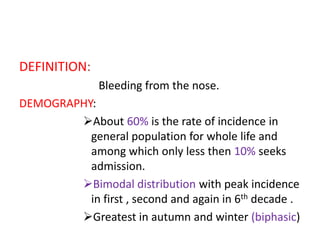
DEFINITION:
Bleeding from the nose.
DEMOGRAPHY:
About 60% is the rate of incidence in
general population for whole life and
among which only less then 10% seeks
admission.
Bimodal distribution with peak incidence
in first , second and again in 6th decade .
Greatest in autumn and winter (biphasic)
ANATOMY OF NASAL VASCULAR
SYSTEM
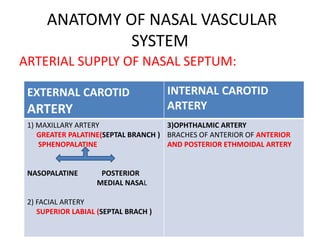
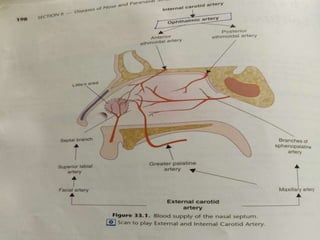
ARTERIAL SUPPLY OF NASAL SEPTUM:
EXTERNAL CAROTID
ARTERY
INTERNAL CAROTID
ARTERY
1) MAXILLARY ARTERY
GREATER PALATINE(SEPTAL BRANCH )
SPHENOPALATINE
NASOPALATINE POSTERIOR
MEDIAL NASAL
2) FACIAL ARTERY
SUPERIOR LABIAL (SEPTAL BRACH )
3)OPHTHALMIC ARTERY
BRACHES OF ANTERIOR OF ANTERIOR
AND POSTERIOR ETHMOIDAL ARTERY
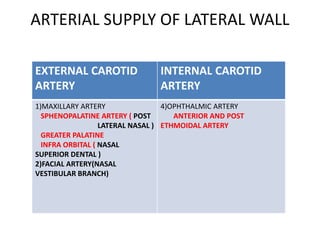
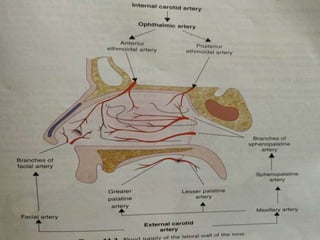
ARTERIAL SUPPLY OF LATERAL WALL
EXTERNAL CAROTID
ARTERY
INTERNAL CAROTID
ARTERY
1)MAXILLARY ARTERY
SPHENOPALATINE ARTERY ( POST
LATERAL NASAL )
GREATER PALATINE
INFRA ORBITAL ( NASAL
SUPERIOR DENTAL )
2)FACIAL ARTERY(NASAL
VESTIBULAR BRANCH)
4)OPHTHALMIC ARTERY
ANTERIOR AND POST
ETHMOIDAL ARTERY
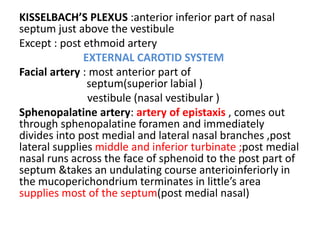
KISSELBACH’S PLEXUS :anterior inferior part of nasal
septum just above the vestibule
Except : post ethmoid artery
EXTERNAL CAROTID SYSTEM
Facial artery : most anterior part of
septum(superior labial )
vestibule (nasal vestibular )
Sphenopalatine artery: artery of epistaxis , comes out
through sphenopalatine foramen and immediately
divides into post medial and lateral nasal branches ,post
lateral supplies middle and inferior turbinate ;post medial
nasal runs across the face of sphenoid to the post part of
septum &takes an undulating course anterioinferiorly in
the mucoperichondrium terminates in little’s area
supplies most of the septum(post medial nasal)
Greater palatine : anterioinferior part of septum and
nasal floor.
INTERNAL CAROTID SYSTEM
Ophthalmic artery –anterior and post ethmoid inside the
orbit,
Anterior ethmoid : runs under superior oblique m/s to
ant ethmoid canal in which it traverses the ethmoid and
nasal cavities supplies nasal roof ,olfactory cleft , superior
turbinate and terminal meningeal branch to ethmoid
fovea .
Post ethmoid: smaller ,only in 80% ,runs above superior
oblique m/s enters post ethmoid foramen (5mm ant to
optic canal,10 to 15 mm behind ant ethmoid foramen )
accompanied by sphenoethmoidal nerve and nasociliary
nerve and supplies post superior nasal cavity ,olfactory
sulcus and sphenoethmoid recess.
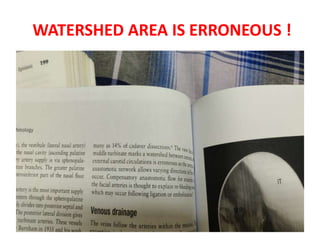
WATERSHED AREA IS ERRONEOUS !
Venous system
• Veins follows the arteries within mucosa.
Veins of the lateral wall drains through
sphenopalatine foramen into pterygoid venous
plexus and into internal jugular vein
Anteriorly : superior labial and greater palatine
drains into facial vein ultimately into external
jugular .
woodruff’s plexus : venous plexus lying inferior to
post end of inferior turbinate
Retro-columellar vein : 2mm behind and parallel to
collumella .
Facts
Mc site : LITTLE’S AREA
mc venous epistaxis in children : from
retrocolumellar vein
Septum >> lateral wall
Anterior > posterior
From both anterior and posterior epistaxis its
predominantly of septal origin .
U/L >> B/L
LEFT(50%) – RIGHT (48%)
MALE (55%) –FEMALE (45%)
CLASSIFICATION :
 Primary ( no proven casual factors )
 Secondary ( proven casual factors)
 Childhood (<16 years)
 Adulthood (>16 years )
 Anterior s (source of bleeding ant to
pyriform aperture includes anterior
septum , vestibule , mucocutaneous
junction )
 Posterior (post to pyriform aperture
includes post septum , lateral wall) .
Causes of epistaxis
Local causes Systemic causes
 Trauma (finger nail ,#middle 3rd
of face and base of skull , hard
blow to nose )
 Post operative :severe in case of
injury to inferior turbinate
,anterior ethmoid artery
(FESS),ICA during post ethmoid
or sphenoid sx.
 Infections : Acute : rhinitis ,
diptheria , sinusitis ,adenoiditis.
chronic :all crust forming disease
and granulomatous disease.
 Foreign body
 Tumours : JNA,HPC,other
Pregnancy ,
hypertension ,
Atherosclerosis,
Mitral stenosis
Hemorrhagic disorders
Liver disease
Kidney disease
Drug induced
Mediastinal compression
Acute general infections
Vicarious menstruation
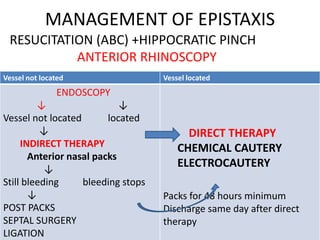
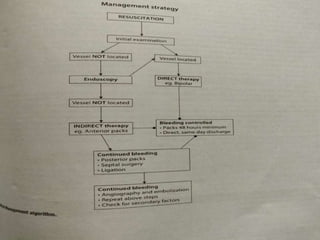
MANAGEMENT OF EPISTAXIS
RESUCITATION (ABC) +HIPPOCRATIC PINCH
ANTERIOR RHINOSCOPY
Vessel not located Vessel located
ENDOSCOPY
↓ ↓
Vessel not located located
↓
INDIRECT THERAPY
Anterior nasal packs
↓
Still bleeding bleeding stops
↓
POST PACKS
SEPTAL SURGERY
LIGATION
DIRECT THERAPY
CHEMICAL CAUTERY
ELECTROCAUTERY
Packs for 48 hours minimum
Discharge same day after direct
therapy
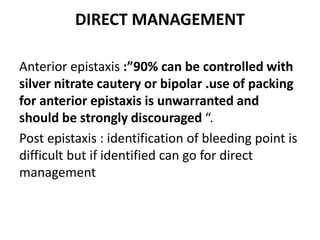
DIRECT MANAGEMENT
Anterior epistaxis :”90% can be controlled with
silver nitrate cautery or bipolar .use of packing
for anterior epistaxis is unwarranted and
should be strongly discouraged “.
Post epistaxis : identification of bleeding point is
difficult but if identified can go for direct
management
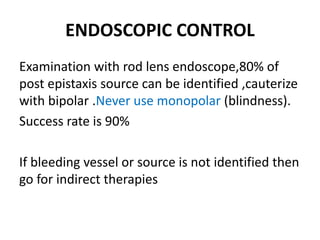
ENDOSCOPIC CONTROL
Examination with rod lens endoscope,80% of
post epistaxis source can be identified ,cauterize
with bipolar .Never use monopolar (blindness).
Success rate is 90%
If bleeding vessel or source is not identified then
go for indirect therapies
INDIRECT THERAPIES
NASAL PACKING:
ANTERIOR :ribbon gauze impregnated with
petroleum jelly or bismuth iodide liquid paraffin
should be inserted for entire length of nasal
cavity .
gauze measurements :1 meter length ,2.5cm
wide in adults and 1.25cm in children for each
nasal cavity .
Methods of packing :
Few cm of gauze folded upon itself and inserted
along the floor of the nose and then whole of the
nasal cavity is packed by layering the gauze from
floor to roof and from backwards to front .
Once inserted pack should left in situ for 24 to 72
hours .
Packing is usually considered an indication of
antibiotics.
Drawback :40% re-bleeding or continued bleeding
is observed.
COMPLICATIONS :sinusitis, septal and alar necrosis ,
toxic shock syndrome, hypoxia , myocardial
infarction
Posterior nasal packing :
Rubber catheter is passed through nose and its end
is brought out from mouth , Bellocq pack (cone
shaped rolled gauze prepared by tying three silk ties
) ends of silk threads tied to catheter .and now
withdraw the catheter from nose so that pack
follows silk threads and guided into nasopharynx
with index finger.
The securing tapes are tied over padding positioned
to protect pressure necrosis of columella and make
the third end hangs into oropharynx .
Easier alternative : foley catheter of size 12f or 14f
inserted along floor of nose until nasopharynx is
reached and inflated with 10 to 15ml of distilled
water and pulled forward to engage in post choana
and ant packing is then inserted
Complications : painful, requires hospitalization ,
sinusitis, hypoxia ,necrosis of septum and columella
. Should be kept insitu for atleast 48 hours .
Systemic medical therapies
Tranexamic acid and epsilon aminocaproic acid
Reduce the risk of re-bleeding ,doesn’t increase
the risk of thrombosis.
Only adjuvant therapy.
contraindication:
pre existing thromboembolic disease
SURGICAL MANAGEMENT
Ligation technique :
Indications : source cannot be located or controlled by above
techniques
Hierarchy of ligation
SPENOPALATINE ARTERY
INTERNAL MAXILLARY ARTERY
EXTERNAL CAROTID ARTERY
ANTERIOR AND POST ETHMOID
ESPAL
PRODUCRE OF CHOICE
Incision :8mm anterior to and under posterior
end of middle turbinate and mucosal flap is
raised and traced down to sphenopalatine
foramen( u shaped notch in vertical portion of
palatine bone). Landmark Is crista-ethmoidalis.
Ligated with hemostatic clamp and divided or
cauterized with bipolar
Advantage : less chance of re anastomoses .
IMAL
Anterior Transoral (sublabial) or combined (ant and
medial ).
The mucosa of posterior wall of antrum is elevated and
a widow is made through into pterygopalatine fossa
and branches of internal maxillary are identified
pulsating within the fat of the fossa and dissected out
and hemostatic clips were applied ,proximal internal
maxillary,sphenopalatine,descending palatine artery
are identified , ligated and divided individually.
Endoscopic trans antral ligation carried out via medial
middle meatus antrostomy is indicated when
sphenopalatine was damaged during espal.
Complications: sinusitis ,injury to infra orbital nerve
oro-antral fistula .
ECAL
Longitudinal skin crease incision parallel with anterior
border of sternomastoid then identify bifurcation of
carotid and external carotid is ligated after double
checking .
EAL
As adjuvant therapy and its best reserved for ethmoid
fracture(FRONTOETHMOID #) and iatrigenic injury to
ethmoid arteries(FESS) .medial canthal incision(LYNCH
INCISION) is most relaible and preferred(no need to enter
bulbar fascia ) against identification against anterior
lacrimal crest and laterally retract the bulbar fascia
,identify ligate and divide .
complications: orbital tension hematoma ,blindness
SEPTAL SURGERY
INDICATIONS : prominent septal deviation or
vomero-palantine spur
Methods : SMR or SEPTOPLASTY and access the
bleeding point .
The rationale is that rising the
mucoperichondrial flap interrupts blood supply
to septum and hence controls bleeding
EMBOLISATION
Reserved for failed ligations
Approach is through transfemoral seldinger
angiography to identify bleeding points .
Contraindications : AV malformations, fistula ,
aneurysms
Complications : skin necrosis ,CVA ,groin
Hematomas .
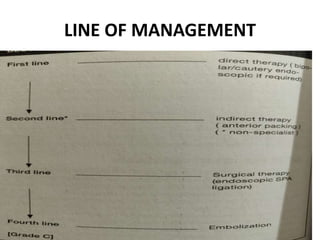
LINE OF MANAGEMENT
Special cases
Warfarin :
packing is superior with vit k injection and
direct therapies seldom works
HHT
Mild : coagulation laser
Moderate : septodermoplasty,
antifibrinolytics
Severe : nasal closure ( youngs’s surgery)
Recent advance : local injection of bevacizumab
(under trails )
Take home
Always tries to find source and go for direct therapy.
Mc site of posterior epistaxis is also from septum.
Watershed area is erroneous .
REFERENCE:
1) 8th edition of scott-brown’s
otorhinolaryngology head & neck surgery.
2)7th edition of PL Dhingra /Shruthi dhingra

Epistaxis.ppt

  • 1.
  • 2.
    DEFINITION: Bleeding from thenose. DEMOGRAPHY: About 60% is the rate of incidence in general population for whole life and among which only less then 10% seeks admission. Bimodal distribution with peak incidence in first , second and again in 6th decade . Greatest in autumn and winter (biphasic)
  • 3.
    ANATOMY OF NASALVASCULAR SYSTEM ARTERIAL SUPPLY OF NASAL SEPTUM: EXTERNAL CAROTID ARTERY INTERNAL CAROTID ARTERY 1) MAXILLARY ARTERY GREATER PALATINE(SEPTAL BRANCH ) SPHENOPALATINE NASOPALATINE POSTERIOR MEDIAL NASAL 2) FACIAL ARTERY SUPERIOR LABIAL (SEPTAL BRACH ) 3)OPHTHALMIC ARTERY BRACHES OF ANTERIOR OF ANTERIOR AND POSTERIOR ETHMOIDAL ARTERY
  • 4.
    ARTERIAL SUPPLY OFLATERAL WALL EXTERNAL CAROTID ARTERY INTERNAL CAROTID ARTERY 1)MAXILLARY ARTERY SPHENOPALATINE ARTERY ( POST LATERAL NASAL ) GREATER PALATINE INFRA ORBITAL ( NASAL SUPERIOR DENTAL ) 2)FACIAL ARTERY(NASAL VESTIBULAR BRANCH) 4)OPHTHALMIC ARTERY ANTERIOR AND POST ETHMOIDAL ARTERY
  • 5.
    KISSELBACH’S PLEXUS :anteriorinferior part of nasal septum just above the vestibule Except : post ethmoid artery EXTERNAL CAROTID SYSTEM Facial artery : most anterior part of septum(superior labial ) vestibule (nasal vestibular ) Sphenopalatine artery: artery of epistaxis , comes out through sphenopalatine foramen and immediately divides into post medial and lateral nasal branches ,post lateral supplies middle and inferior turbinate ;post medial nasal runs across the face of sphenoid to the post part of septum &takes an undulating course anterioinferiorly in the mucoperichondrium terminates in little’s area supplies most of the septum(post medial nasal)
  • 6.
    Greater palatine :anterioinferior part of septum and nasal floor. INTERNAL CAROTID SYSTEM Ophthalmic artery –anterior and post ethmoid inside the orbit, Anterior ethmoid : runs under superior oblique m/s to ant ethmoid canal in which it traverses the ethmoid and nasal cavities supplies nasal roof ,olfactory cleft , superior turbinate and terminal meningeal branch to ethmoid fovea . Post ethmoid: smaller ,only in 80% ,runs above superior oblique m/s enters post ethmoid foramen (5mm ant to optic canal,10 to 15 mm behind ant ethmoid foramen ) accompanied by sphenoethmoidal nerve and nasociliary nerve and supplies post superior nasal cavity ,olfactory sulcus and sphenoethmoid recess.
  • 9.
    WATERSHED AREA ISERRONEOUS !
  • 10.
    Venous system • Veinsfollows the arteries within mucosa. Veins of the lateral wall drains through sphenopalatine foramen into pterygoid venous plexus and into internal jugular vein Anteriorly : superior labial and greater palatine drains into facial vein ultimately into external jugular . woodruff’s plexus : venous plexus lying inferior to post end of inferior turbinate Retro-columellar vein : 2mm behind and parallel to collumella .
  • 11.
    Facts Mc site :LITTLE’S AREA mc venous epistaxis in children : from retrocolumellar vein Septum >> lateral wall Anterior > posterior From both anterior and posterior epistaxis its predominantly of septal origin . U/L >> B/L LEFT(50%) – RIGHT (48%) MALE (55%) –FEMALE (45%)
  • 12.
    CLASSIFICATION :  Primary( no proven casual factors )  Secondary ( proven casual factors)  Childhood (<16 years)  Adulthood (>16 years )  Anterior s (source of bleeding ant to pyriform aperture includes anterior septum , vestibule , mucocutaneous junction )  Posterior (post to pyriform aperture includes post septum , lateral wall) .
  • 13.
    Causes of epistaxis Localcauses Systemic causes  Trauma (finger nail ,#middle 3rd of face and base of skull , hard blow to nose )  Post operative :severe in case of injury to inferior turbinate ,anterior ethmoid artery (FESS),ICA during post ethmoid or sphenoid sx.  Infections : Acute : rhinitis , diptheria , sinusitis ,adenoiditis. chronic :all crust forming disease and granulomatous disease.  Foreign body  Tumours : JNA,HPC,other Pregnancy , hypertension , Atherosclerosis, Mitral stenosis Hemorrhagic disorders Liver disease Kidney disease Drug induced Mediastinal compression Acute general infections Vicarious menstruation
  • 14.
    MANAGEMENT OF EPISTAXIS RESUCITATION(ABC) +HIPPOCRATIC PINCH ANTERIOR RHINOSCOPY Vessel not located Vessel located ENDOSCOPY ↓ ↓ Vessel not located located ↓ INDIRECT THERAPY Anterior nasal packs ↓ Still bleeding bleeding stops ↓ POST PACKS SEPTAL SURGERY LIGATION DIRECT THERAPY CHEMICAL CAUTERY ELECTROCAUTERY Packs for 48 hours minimum Discharge same day after direct therapy
  • 16.
    DIRECT MANAGEMENT Anterior epistaxis:”90% can be controlled with silver nitrate cautery or bipolar .use of packing for anterior epistaxis is unwarranted and should be strongly discouraged “. Post epistaxis : identification of bleeding point is difficult but if identified can go for direct management
  • 17.
    ENDOSCOPIC CONTROL Examination withrod lens endoscope,80% of post epistaxis source can be identified ,cauterize with bipolar .Never use monopolar (blindness). Success rate is 90% If bleeding vessel or source is not identified then go for indirect therapies
  • 18.
    INDIRECT THERAPIES NASAL PACKING: ANTERIOR:ribbon gauze impregnated with petroleum jelly or bismuth iodide liquid paraffin should be inserted for entire length of nasal cavity . gauze measurements :1 meter length ,2.5cm wide in adults and 1.25cm in children for each nasal cavity .
  • 19.
    Methods of packing: Few cm of gauze folded upon itself and inserted along the floor of the nose and then whole of the nasal cavity is packed by layering the gauze from floor to roof and from backwards to front . Once inserted pack should left in situ for 24 to 72 hours . Packing is usually considered an indication of antibiotics. Drawback :40% re-bleeding or continued bleeding is observed. COMPLICATIONS :sinusitis, septal and alar necrosis , toxic shock syndrome, hypoxia , myocardial infarction
  • 20.
    Posterior nasal packing: Rubber catheter is passed through nose and its end is brought out from mouth , Bellocq pack (cone shaped rolled gauze prepared by tying three silk ties ) ends of silk threads tied to catheter .and now withdraw the catheter from nose so that pack follows silk threads and guided into nasopharynx with index finger. The securing tapes are tied over padding positioned to protect pressure necrosis of columella and make the third end hangs into oropharynx .
  • 21.
    Easier alternative :foley catheter of size 12f or 14f inserted along floor of nose until nasopharynx is reached and inflated with 10 to 15ml of distilled water and pulled forward to engage in post choana and ant packing is then inserted Complications : painful, requires hospitalization , sinusitis, hypoxia ,necrosis of septum and columella . Should be kept insitu for atleast 48 hours .
  • 22.
    Systemic medical therapies Tranexamicacid and epsilon aminocaproic acid Reduce the risk of re-bleeding ,doesn’t increase the risk of thrombosis. Only adjuvant therapy. contraindication: pre existing thromboembolic disease
  • 23.
    SURGICAL MANAGEMENT Ligation technique: Indications : source cannot be located or controlled by above techniques Hierarchy of ligation SPENOPALATINE ARTERY INTERNAL MAXILLARY ARTERY EXTERNAL CAROTID ARTERY ANTERIOR AND POST ETHMOID
  • 24.
    ESPAL PRODUCRE OF CHOICE Incision:8mm anterior to and under posterior end of middle turbinate and mucosal flap is raised and traced down to sphenopalatine foramen( u shaped notch in vertical portion of palatine bone). Landmark Is crista-ethmoidalis. Ligated with hemostatic clamp and divided or cauterized with bipolar Advantage : less chance of re anastomoses .
  • 25.
    IMAL Anterior Transoral (sublabial)or combined (ant and medial ). The mucosa of posterior wall of antrum is elevated and a widow is made through into pterygopalatine fossa and branches of internal maxillary are identified pulsating within the fat of the fossa and dissected out and hemostatic clips were applied ,proximal internal maxillary,sphenopalatine,descending palatine artery are identified , ligated and divided individually. Endoscopic trans antral ligation carried out via medial middle meatus antrostomy is indicated when sphenopalatine was damaged during espal. Complications: sinusitis ,injury to infra orbital nerve oro-antral fistula .
  • 26.
    ECAL Longitudinal skin creaseincision parallel with anterior border of sternomastoid then identify bifurcation of carotid and external carotid is ligated after double checking . EAL As adjuvant therapy and its best reserved for ethmoid fracture(FRONTOETHMOID #) and iatrigenic injury to ethmoid arteries(FESS) .medial canthal incision(LYNCH INCISION) is most relaible and preferred(no need to enter bulbar fascia ) against identification against anterior lacrimal crest and laterally retract the bulbar fascia ,identify ligate and divide . complications: orbital tension hematoma ,blindness
  • 27.
    SEPTAL SURGERY INDICATIONS :prominent septal deviation or vomero-palantine spur Methods : SMR or SEPTOPLASTY and access the bleeding point . The rationale is that rising the mucoperichondrial flap interrupts blood supply to septum and hence controls bleeding
  • 28.
    EMBOLISATION Reserved for failedligations Approach is through transfemoral seldinger angiography to identify bleeding points . Contraindications : AV malformations, fistula , aneurysms Complications : skin necrosis ,CVA ,groin Hematomas .
  • 29.
  • 30.
    Special cases Warfarin : packingis superior with vit k injection and direct therapies seldom works HHT Mild : coagulation laser Moderate : septodermoplasty, antifibrinolytics Severe : nasal closure ( youngs’s surgery) Recent advance : local injection of bevacizumab (under trails )
  • 31.
    Take home Always triesto find source and go for direct therapy. Mc site of posterior epistaxis is also from septum. Watershed area is erroneous . REFERENCE: 1) 8th edition of scott-brown’s otorhinolaryngology head & neck surgery. 2)7th edition of PL Dhingra /Shruthi dhingra