Sanger Sequencing: Introduction, Principle, and Protocol
What Is Sanger Sequencing?
Sanger sequencing, also known as the “chain termination method,” was
developed by the English biochemist Frederick Sanger and his
colleagues in 1977.
• This method is designed for determining the sequence of nucleotide
bases in a piece of DNA (commonly less than 1,000 bp in length).
• Sanger sequencing with 99.99% base accuracy is considered the
“gold standard” for validating DNA sequences, including those
already sequenced through next-generation sequencing (NGS).
Dr. Shiny C Thomas, Department of Biosciences, ADBU
• Sanger sequencing was used in the Human Genome Project to determine the
sequences of relatively small fragments of human DNA (900 bp or less).
• These fragments were used to assemble larger DNA fragments and,
eventually, entire chromosomes.
Sanger Sequencing VS NGS
The development of NGS technologies has accelerated genomics research.
• NGS can simultaneously sequence more than 100 genes and whole genomes
with low-input DNA.
• Sanger sequencing remains widely used in the sequencing field as it offers
several prominent advantages: (i) cost-efficiency for sequencing single genes
and (ii) 99.99% accuracy, especially suitable for verification sequencing for
site-directed mutagenesis or cloned inserts.
How Does Sanger Sequencing Work?
• In Sanger sequencing, a DNA primer complementary to the template DNA
(the DNA to be sequenced) is used to be a starting point for DNA synthesis. In
the presence of the four deoxynucleotide triphosphates (dNTPs: A, G, C, and
T), the polymerase extends the primer by adding the complementary dNTP
to the template DNA strand.
• To determine which nucleotide is incorporated into the chain of nucleotides,
four dideoxynucleotide triphosphates (ddNTPs: ddATP, ddGTP, ddCTP, and
ddTTP) labeled with a distinct fluorescent dye are used to terminate the
synthesis reaction.
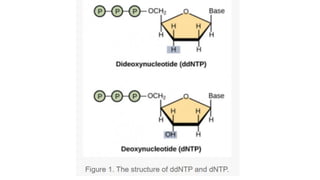
• Compared to dNTPs, ddNTPs has an oxygen atom removed from the
ribonucleotide, hence cannot form a link with the next nucleotide.
• Following synthesis, the reaction products are loaded into four lanes of a single
gel depending on the diverse chain-terminating nucleotide and subjected to
gel electrophoresis.
• According to their sizes, the sequence of the DNA is thus determined.
Sanger Sequencing Steps
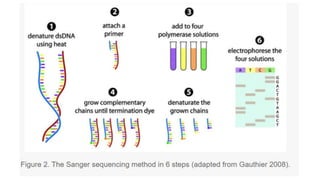
The Sanger sequencing method consists of 6 steps:
(1) The double-stranded DNA (dsDNA) is denatured into two single-stranded
DNA (ssDNA).
(2) A primer that corresponds to one end of the sequence is attached.
(3) Four polymerase solutions with four types of dNTPs but only one type of
ddNTP are added.
(4) The DNA synthesis reaction initiates and the chain extends until a
termination nucleotide is randomly incorporated.
(5) The resulting DNA fragments are denatured into ssDNA.
(6) The denatured fragments are separated by gel electrophoresis and the
sequence is determined.
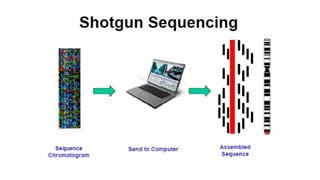
Shotgun Sequencing
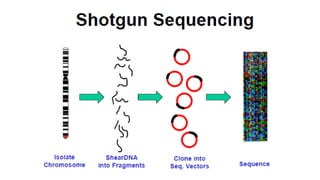
• High throughput sequencing method that employs
automated sequencing of random DNA fragments
• Automated DNA sequencing yields sequences of 500 to
1000 bp in length
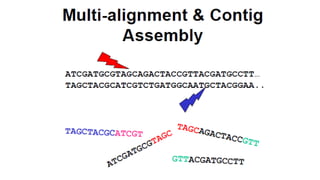
• To determine longer sequences you obtain fragmentary
sequences and then join them together by overlapping
• Overlapping is an alignment problem, but different
from those we have discussed up to now
Multiple Sequence Alignment
• A general method to align and compare more than 2
sequences
• Typically done as a hierarchical clustering/alignment
process where you match the two most similar sequences
and then use the combined consensus sequence to
identify the next closest sequence with which to align

Sanger-Shortgun sequencing.pdf

  • 1.
    Sanger Sequencing: Introduction,Principle, and Protocol What Is Sanger Sequencing? Sanger sequencing, also known as the “chain termination method,” was developed by the English biochemist Frederick Sanger and his colleagues in 1977. • This method is designed for determining the sequence of nucleotide bases in a piece of DNA (commonly less than 1,000 bp in length). • Sanger sequencing with 99.99% base accuracy is considered the “gold standard” for validating DNA sequences, including those already sequenced through next-generation sequencing (NGS). Dr. Shiny C Thomas, Department of Biosciences, ADBU
  • 2.
    • Sanger sequencingwas used in the Human Genome Project to determine the sequences of relatively small fragments of human DNA (900 bp or less). • These fragments were used to assemble larger DNA fragments and, eventually, entire chromosomes. Sanger Sequencing VS NGS The development of NGS technologies has accelerated genomics research. • NGS can simultaneously sequence more than 100 genes and whole genomes with low-input DNA. • Sanger sequencing remains widely used in the sequencing field as it offers several prominent advantages: (i) cost-efficiency for sequencing single genes and (ii) 99.99% accuracy, especially suitable for verification sequencing for site-directed mutagenesis or cloned inserts.
  • 3.
    How Does SangerSequencing Work? • In Sanger sequencing, a DNA primer complementary to the template DNA (the DNA to be sequenced) is used to be a starting point for DNA synthesis. In the presence of the four deoxynucleotide triphosphates (dNTPs: A, G, C, and T), the polymerase extends the primer by adding the complementary dNTP to the template DNA strand. • To determine which nucleotide is incorporated into the chain of nucleotides, four dideoxynucleotide triphosphates (ddNTPs: ddATP, ddGTP, ddCTP, and ddTTP) labeled with a distinct fluorescent dye are used to terminate the synthesis reaction.
  • 4.
    • Compared todNTPs, ddNTPs has an oxygen atom removed from the ribonucleotide, hence cannot form a link with the next nucleotide. • Following synthesis, the reaction products are loaded into four lanes of a single gel depending on the diverse chain-terminating nucleotide and subjected to gel electrophoresis. • According to their sizes, the sequence of the DNA is thus determined.
  • 6.
    Sanger Sequencing Steps TheSanger sequencing method consists of 6 steps: (1) The double-stranded DNA (dsDNA) is denatured into two single-stranded DNA (ssDNA). (2) A primer that corresponds to one end of the sequence is attached. (3) Four polymerase solutions with four types of dNTPs but only one type of ddNTP are added. (4) The DNA synthesis reaction initiates and the chain extends until a termination nucleotide is randomly incorporated. (5) The resulting DNA fragments are denatured into ssDNA. (6) The denatured fragments are separated by gel electrophoresis and the sequence is determined.
  • 8.
    Shotgun Sequencing • Highthroughput sequencing method that employs automated sequencing of random DNA fragments • Automated DNA sequencing yields sequences of 500 to 1000 bp in length • To determine longer sequences you obtain fragmentary sequences and then join them together by overlapping • Overlapping is an alignment problem, but different from those we have discussed up to now
  • 12.
    Multiple Sequence Alignment •A general method to align and compare more than 2 sequences • Typically done as a hierarchical clustering/alignment process where you match the two most similar sequences and then use the combined consensus sequence to identify the next closest sequence with which to align