TYPES OF
EPIDEMIOLOGICAL
DESIGNS
R.Malarvizhi
Epidemiology
Definition:
By John M. Last in 1988 as,
“ The study of the distribution and
determinants of health –related states or
events in specified populations, and the
application of this study to the control of
health problems.”
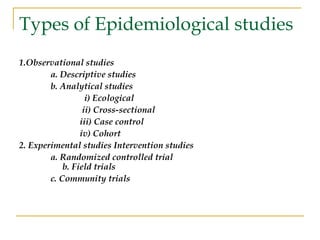
Types of Epidemiological studies
1.Observational studies
a. Descriptive studies
b. Analytical studies
i) Ecological
ii) Cross-sectional
iii) Case control
iv) Cohort
2. Experimental studies Intervention studies
a. Randomized controlled trial
b. Field trials
c. Community trials
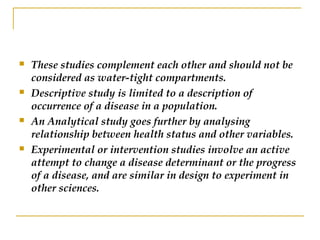
 These studies complement each other and should not be
considered as water-tight compartments.
 Descriptive study is limited to a description of
occurrence of a disease in a population.
 An Analytical study goes further by analysing
relationship between health status and other variables.
 Experimental or intervention studies involve an active
attempt to change a disease determinant or the progress
of a disease, and are similar in design to experiment in
other sciences.
Observational studies
1. Descriptive studies
 First phase of an epidemiological
investigation.
 Concerned with distribution of disease or
health-related characteristics in human
populations and identifying the
characteristics with which the disease in
question seems to be associated
Procedures in Descriptive Studies
1. Defining the population to be studied
2. Defining the disease under study (operational definition)
3. Describe the disease by
 Time
 Place
 person
1. Measurement of disease
2. Comparing with known indices
3. Formulation of an aetiological hypothesis
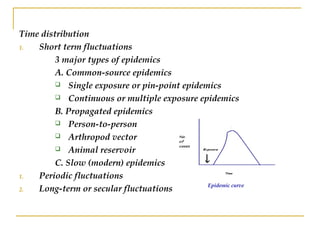
Time distribution
1. Short term fluctuations
3 major types of epidemics
A. Common-source epidemics
 Single exposure or pin-point epidemics
 Continuous or multiple exposure epidemics
B. Propagated epidemics
 Person-to-person
 Arthropod vector
 Animal reservoir
C. Slow (modern) epidemics
1. Periodic fluctuations
2. Long-term or secular fluctuations Epidemic curve
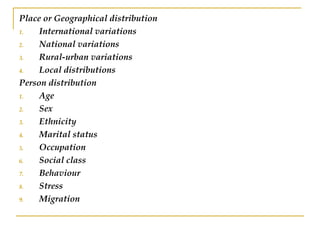
Place or Geographical distribution
1. International variations
2. National variations
3. Rural-urban variations
4. Local distributions
Person distribution
1. Age
2. Sex
3. Ethnicity
4. Marital status
5. Occupation
6. Social class
7. Behaviour
8. Stress
9. Migration
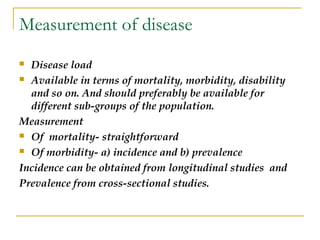
Measurement of disease
 Disease load
 Available in terms of mortality, morbidity, disability
and so on. And should preferably be available for
different sub-groups of the population.
Measurement
 Of mortality- straightforward
 Of morbidity- a) incidence and b) prevalence
Incidence can be obtained from longitudinal studies and
Prevalence from cross-sectional studies.
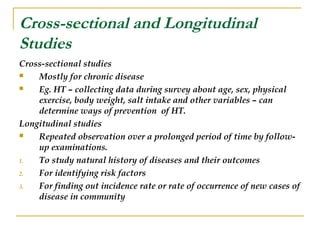
Cross-sectional and Longitudinal
Studies
Cross-sectional studies
 Mostly for chronic disease
 Eg. HT – collecting data during survey about age, sex, physical
exercise, body weight, salt intake and other variables – can
determine ways of prevention of HT.
Longitudinal studies
 Repeated observation over a prolonged period of time by follow-
up examinations.
1. To study natural history of diseases and their outcomes
2. For identifying risk factors
3. For finding out incidence rate or rate of occurrence of new cases of
disease in community
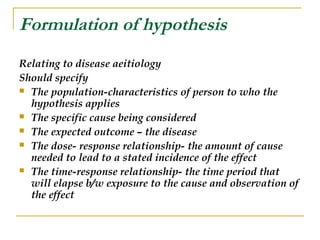
Formulation of hypothesis
Relating to disease aeitiology
Should specify
 The population-characteristics of person to who the
hypothesis applies
 The specific cause being considered
 The expected outcome – the disease
 The dose- response relationship- the amount of cause
needed to lead to a stated incidence of the effect
 The time-response relationship- the time period that
will elapse b/w exposure to the cause and observation of
the effect
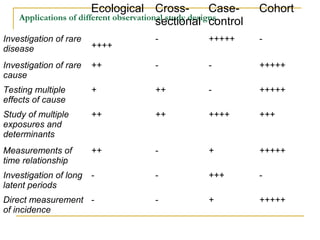
Applications of different observational study designs
Ecological Cross-
sectional
Case-
control
Cohort
Investigation of rare
disease ++++
- +++++ -
Investigation of rare
cause
++ - - +++++
Testing multiple
effects of cause
+ ++ - +++++
Study of multiple
exposures and
determinants
++ ++ ++++ +++
Measurements of
time relationship
++ - + +++++
Investigation of long
latent periods
- - +++ -
Direct measurement
of incidence
- - + +++++
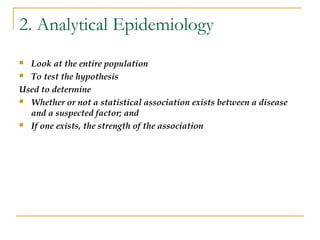
2. Analytical Epidemiology
 Look at the entire population
 To test the hypothesis
Used to determine
 Whether or not a statistical association exists between a disease
and a suspected factor; and
 If one exists, the strength of the association
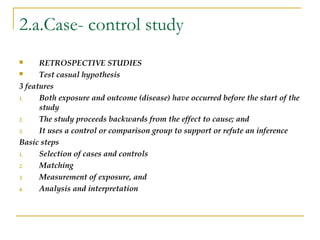
2.a.Case- control study
 RETROSPECTIVE STUDIES
 Test casual hypothesis
3 features
1. Both exposure and outcome (disease) have occurred before the start of the
study
2. The study proceeds backwards from the effect to cause; and
3. It uses a control or comparison group to support or refute an inference
Basic steps
1. Selection of cases and controls
2. Matching
3. Measurement of exposure, and
4. Analysis and interpretation
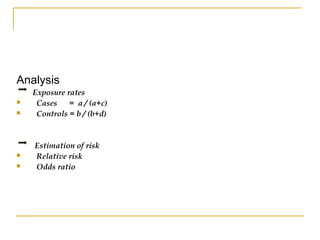
Analysis
Exposure rates
 Cases = a / (a+c)
 Controls = b / (b+d)
Estimation of risk
 Relative risk
 Odds ratio
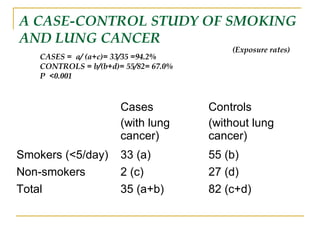
A CASE-CONTROL STUDY OF SMOKING
AND LUNG CANCER
Cases
(with lung
cancer)
Controls
(without lung
cancer)
Smokers (<5/day) 33 (a) 55 (b)
Non-smokers 2 (c) 27 (d)
Total 35 (a+b) 82 (c+d)
CASES = a/ (a+c)= 33/35 =94.2%
CONTROLS = b/(b+d)= 55/82= 67.0%
P <0.001
(Exposure rates)
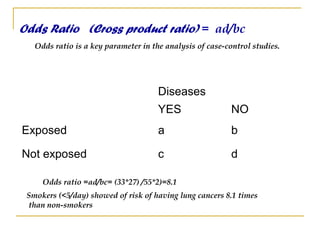
Odds Ratio (Cross product ratio) = ad/bc
Diseases
YES NO
Exposed a b
Not exposed c d
Odds ratio =ad/bc= (33*27) /55*2)=8.1
Smokers (<5/day) showed of risk of having lung cancers 8.1 times
than non-smokers
Odds ratio is a key parameter in the analysis of case-control studies.
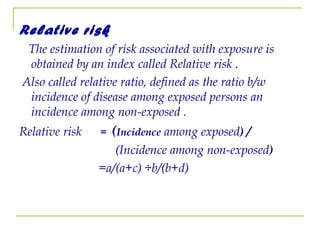
Relative risk
The estimation of risk associated with exposure is
obtained by an index called Relative risk .
Also called relative ratio, defined as the ratio b/w
incidence of disease among exposed persons an
incidence among non-exposed .
Relative risk = (Incidence among exposed) /
(Incidence among non-exposed)
=a/(a+c) ÷b/(b+d)
2.b.Cohort study
 “Cohort” is defined as a group of people who share a
common characteristic or experience within a defined
time period.
 Eg. People who are exposed to a particular vaccine or
drug (as in vaccine or drug trials) [EXPOSURE
COHORTS]
 Prospective study/ Longitudinal study/ Incidence
study/ Forward looking study
 For obtaining additional evidence to refute or support
the existence of an association between suspected
cause or disease
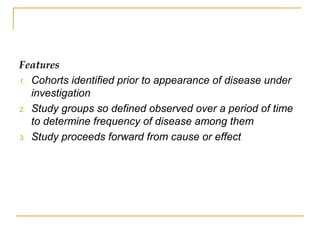
Features
1. Cohorts identified prior to appearance of disease under
investigation
2. Study groups so defined observed over a period of time
to determine frequency of disease among them
3. Study proceeds forward from cause or effect
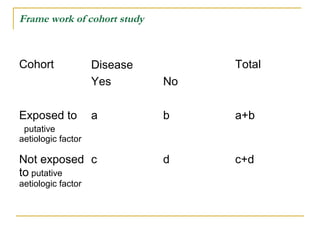
Frame work of cohort study
Cohort Disease Total
Yes No
Exposed to
putative
aetiologic factor
a b a+b
Not exposed
to putative
aetiologic factor
c d c+d
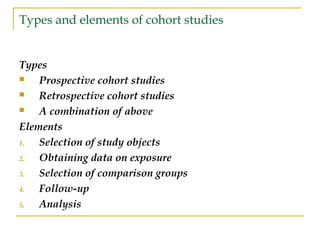
Types and elements of cohort studies
Types
 Prospective cohort studies
 Retrospective cohort studies
 A combination of above
Elements
1. Selection of study objects
2. Obtaining data on exposure
3. Selection of comparison groups
4. Follow-up
5. Analysis
Experimental studies
Experimental studies are of 2 types
 Randomized control trials (i. e , those involving a
process of random allocation); and
 Non-randomized or “non-experimental” trials (i. e,
those departing from strict randomization for practical
purposes , but in such a manner that non-randomization
does not seriously affect the theoretical basis of
conclusions).
Randomized control-studies
Basic steps
1. Drawing up a protocol
2. Selecting reference and experimental populations
3. Randomization
4. Manipulation or intervention
5. Follow-up
6. Assessment of outcome
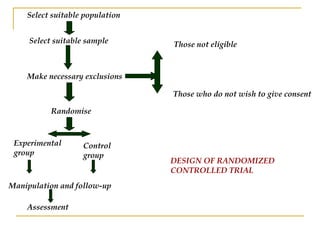
Select suitable population
Select suitable sample
Make necessary exclusions
Randomise
Experimental
group
Control
group
Those not eligible
Those who do not wish to give consent
Manipulation and follow-up
Assessment
DESIGN OF RANDOMIZED
CONTROLLED TRIAL
Other experimental studies
 Field trials or community intervention
studies are done with HEALTHY people as
unit of study.
 Community trials are done with
COMMUNITIES as unit of study.
Thank you

Types of epidemiological designs

  • 1.
  • 2.
    Epidemiology Definition: By John M.Last in 1988 as, “ The study of the distribution and determinants of health –related states or events in specified populations, and the application of this study to the control of health problems.”
  • 3.
    Types of Epidemiologicalstudies 1.Observational studies a. Descriptive studies b. Analytical studies i) Ecological ii) Cross-sectional iii) Case control iv) Cohort 2. Experimental studies Intervention studies a. Randomized controlled trial b. Field trials c. Community trials
  • 4.
     These studiescomplement each other and should not be considered as water-tight compartments.  Descriptive study is limited to a description of occurrence of a disease in a population.  An Analytical study goes further by analysing relationship between health status and other variables.  Experimental or intervention studies involve an active attempt to change a disease determinant or the progress of a disease, and are similar in design to experiment in other sciences.
  • 5.
  • 6.
    1. Descriptive studies First phase of an epidemiological investigation.  Concerned with distribution of disease or health-related characteristics in human populations and identifying the characteristics with which the disease in question seems to be associated
  • 7.
    Procedures in DescriptiveStudies 1. Defining the population to be studied 2. Defining the disease under study (operational definition) 3. Describe the disease by  Time  Place  person 1. Measurement of disease 2. Comparing with known indices 3. Formulation of an aetiological hypothesis
  • 8.
    Time distribution 1. Shortterm fluctuations 3 major types of epidemics A. Common-source epidemics  Single exposure or pin-point epidemics  Continuous or multiple exposure epidemics B. Propagated epidemics  Person-to-person  Arthropod vector  Animal reservoir C. Slow (modern) epidemics 1. Periodic fluctuations 2. Long-term or secular fluctuations Epidemic curve
  • 9.
    Place or Geographicaldistribution 1. International variations 2. National variations 3. Rural-urban variations 4. Local distributions Person distribution 1. Age 2. Sex 3. Ethnicity 4. Marital status 5. Occupation 6. Social class 7. Behaviour 8. Stress 9. Migration
  • 10.
    Measurement of disease Disease load  Available in terms of mortality, morbidity, disability and so on. And should preferably be available for different sub-groups of the population. Measurement  Of mortality- straightforward  Of morbidity- a) incidence and b) prevalence Incidence can be obtained from longitudinal studies and Prevalence from cross-sectional studies.
  • 11.
    Cross-sectional and Longitudinal Studies Cross-sectionalstudies  Mostly for chronic disease  Eg. HT – collecting data during survey about age, sex, physical exercise, body weight, salt intake and other variables – can determine ways of prevention of HT. Longitudinal studies  Repeated observation over a prolonged period of time by follow- up examinations. 1. To study natural history of diseases and their outcomes 2. For identifying risk factors 3. For finding out incidence rate or rate of occurrence of new cases of disease in community
  • 12.
    Formulation of hypothesis Relatingto disease aeitiology Should specify  The population-characteristics of person to who the hypothesis applies  The specific cause being considered  The expected outcome – the disease  The dose- response relationship- the amount of cause needed to lead to a stated incidence of the effect  The time-response relationship- the time period that will elapse b/w exposure to the cause and observation of the effect
  • 13.
    Applications of differentobservational study designs Ecological Cross- sectional Case- control Cohort Investigation of rare disease ++++ - +++++ - Investigation of rare cause ++ - - +++++ Testing multiple effects of cause + ++ - +++++ Study of multiple exposures and determinants ++ ++ ++++ +++ Measurements of time relationship ++ - + +++++ Investigation of long latent periods - - +++ - Direct measurement of incidence - - + +++++
  • 14.
    2. Analytical Epidemiology Look at the entire population  To test the hypothesis Used to determine  Whether or not a statistical association exists between a disease and a suspected factor; and  If one exists, the strength of the association
  • 15.
    2.a.Case- control study RETROSPECTIVE STUDIES  Test casual hypothesis 3 features 1. Both exposure and outcome (disease) have occurred before the start of the study 2. The study proceeds backwards from the effect to cause; and 3. It uses a control or comparison group to support or refute an inference Basic steps 1. Selection of cases and controls 2. Matching 3. Measurement of exposure, and 4. Analysis and interpretation
  • 16.
    Analysis Exposure rates  Cases= a / (a+c)  Controls = b / (b+d) Estimation of risk  Relative risk  Odds ratio
  • 17.
    A CASE-CONTROL STUDYOF SMOKING AND LUNG CANCER Cases (with lung cancer) Controls (without lung cancer) Smokers (<5/day) 33 (a) 55 (b) Non-smokers 2 (c) 27 (d) Total 35 (a+b) 82 (c+d) CASES = a/ (a+c)= 33/35 =94.2% CONTROLS = b/(b+d)= 55/82= 67.0% P <0.001 (Exposure rates)
  • 18.
    Odds Ratio (Crossproduct ratio) = ad/bc Diseases YES NO Exposed a b Not exposed c d Odds ratio =ad/bc= (33*27) /55*2)=8.1 Smokers (<5/day) showed of risk of having lung cancers 8.1 times than non-smokers Odds ratio is a key parameter in the analysis of case-control studies.
  • 19.
    Relative risk The estimationof risk associated with exposure is obtained by an index called Relative risk . Also called relative ratio, defined as the ratio b/w incidence of disease among exposed persons an incidence among non-exposed . Relative risk = (Incidence among exposed) / (Incidence among non-exposed) =a/(a+c) ÷b/(b+d)
  • 20.
    2.b.Cohort study  “Cohort”is defined as a group of people who share a common characteristic or experience within a defined time period.  Eg. People who are exposed to a particular vaccine or drug (as in vaccine or drug trials) [EXPOSURE COHORTS]  Prospective study/ Longitudinal study/ Incidence study/ Forward looking study  For obtaining additional evidence to refute or support the existence of an association between suspected cause or disease
  • 21.
    Features 1. Cohorts identifiedprior to appearance of disease under investigation 2. Study groups so defined observed over a period of time to determine frequency of disease among them 3. Study proceeds forward from cause or effect
  • 22.
    Frame work ofcohort study Cohort Disease Total Yes No Exposed to putative aetiologic factor a b a+b Not exposed to putative aetiologic factor c d c+d
  • 23.
    Types and elementsof cohort studies Types  Prospective cohort studies  Retrospective cohort studies  A combination of above Elements 1. Selection of study objects 2. Obtaining data on exposure 3. Selection of comparison groups 4. Follow-up 5. Analysis
  • 24.
  • 25.
    Experimental studies areof 2 types  Randomized control trials (i. e , those involving a process of random allocation); and  Non-randomized or “non-experimental” trials (i. e, those departing from strict randomization for practical purposes , but in such a manner that non-randomization does not seriously affect the theoretical basis of conclusions).
  • 26.
    Randomized control-studies Basic steps 1.Drawing up a protocol 2. Selecting reference and experimental populations 3. Randomization 4. Manipulation or intervention 5. Follow-up 6. Assessment of outcome
  • 27.
    Select suitable population Selectsuitable sample Make necessary exclusions Randomise Experimental group Control group Those not eligible Those who do not wish to give consent Manipulation and follow-up Assessment DESIGN OF RANDOMIZED CONTROLLED TRIAL
  • 28.
    Other experimental studies Field trials or community intervention studies are done with HEALTHY people as unit of study.  Community trials are done with COMMUNITIES as unit of study.
  • 29.