Case control
Addisu W. (MPH, Epi &Bo)
Case Control Study
• Also known as Case-referent study
• Definition
– Subjects are selected on the basis of whether
they do (cases) or do not (controls) have a
particular disease under study
– Groups are then compared with respect to the
proportion having a history of an exposure or
characteristics of interest.
2
When is it desirable to use the case–
control method?
• Situations in which a case–control study is
desirable
– Exposure data are difficult or expensive to obtain.
– The disease is rare.
– The disease has a long induction and latent period.
– Little is known about the disease.
– The underlying population is dynamic
Case control study cont.…
• Is case-control a retrospective study?
– If all the cases of the disease have been
diagnosed at the time the investigators initiates the
study, it is a retrospective case control study
– If the study is begun and all new cases that are
diagnosed within the next period of time are
included, the study is a prospective
– Hence, the use of the term retrospective to refer to
all case-control studies is inappropriate
5
Selection of cases
• The criteria that are used to make such decisions
are usually based on a combination of:
– signs and symptoms,
– physical and pathological examinations, and
– results of diagnostic tests.
 Which and how many criteria are used to define a
case have important implications for determining
accurately who has the disease.
Selection of cases…
• For example, if only chest pain to define cases of MI,
– most but not all heart attack cases would be
included (people with “silent” heart attacks would be
missed),
– people with other conditions that produce chest
pain (such as indigestion) would be included
mistakenly
• It is better to be restrictive because it leads to fewer
classification errors
Selection of cases…
 Important considerations in case definition and
selection
– Criteria for case definition should lead to accurate
classification of diseased and non-diseased subjects.
– Efficient and accurate sources should be used to
identify cases.
– Incident cases are preferable to prevalent cases for
causal research.
– spectrum of disease: mild, moderate and severe
groups
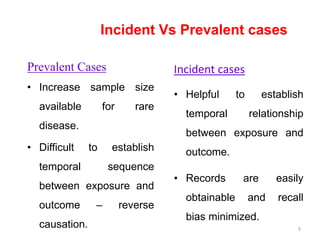
Incident Vs Prevalent cases
Prevalent Cases
• Increase sample size
available for rare
disease.
• Difficult to establish
temporal sequence
between exposure and
outcome – reverse
causation.
Incident cases
• Helpful to establish
temporal relationship
between exposure and
outcome.
• Records are easily
obtainable and recall
bias minimized.
9
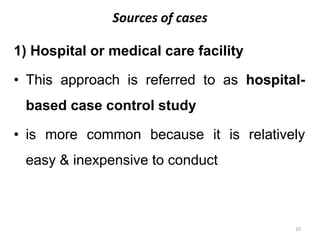
Sources of cases
1) Hospital or medical care facility
• This approach is referred to as hospital-
based case control study
• is more common because it is relatively
easy & inexpensive to conduct
10
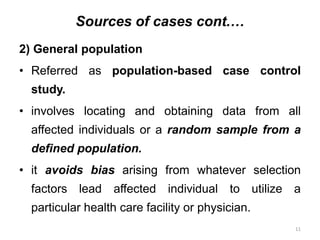
Sources of cases cont.…
2) General population
• Referred as population-based case control
study.

• involves locating and obtaining data from all
affected individuals or a random sample from a
defined population.
• it avoids bias arising from whatever selection
factors lead affected individual to utilize a
particular health care facility or physician.
11
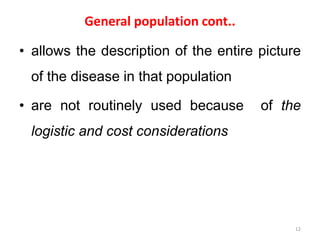
General population cont..
• allows the description of the entire picture
of the disease in that population
• are not routinely used because of the
logistic and cost considerations
12
Selection of Controls
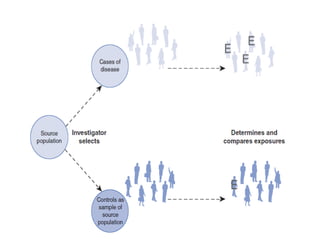
• Controls are a sample of the population that produced the
cases.
• Another term for the control group is Referent group because
it “refers to” the exposure distribution in the source population
• The guiding principle for the valid selection of cases and
controls is that they represent the same base population.
• Controls must be sampled independently of exposure status.
– exposed and unexposed controls should have the same
probability of selection.
Selection of Controls
• Involves consideration of a number of
issues including :
the characteristics and source of the cases
the need to obtain comparable information
from cases and controls
practical and economic considerations.
• The control subjects should be selected to
be comparable to the cases 14
Sources of controls
1) Hospital
• To use hospital/clinic controls, two general principle should be full
filled.
1) The illnesses in the control group should be unrelated to the
exposure under study.
• Eg. a case–control study of cigarette smoking and MI should
not use emphysema patients as controls because cigarette
smoking is known to be a cause of emphysema.
2) The illness of the controls should have the same referral
pattern to the healthcare facility as that of the cases.
Sources of controls….
• Are patients who have been admitted for
conditions other than the disease being studied.
Advantages:
 easily identified and readily available in sufficient
numbers
 minimal cost and effort involved in their assembly
16
Advantages cont.…
 more likely than healthy individuals to be aware of
antecedent exposures or events
 likely to have been subject to the same intangible
selection factors that influenced the cases to come to
this particular physician or hospital
 more likely to be willing to cooperate than healthy
individuals, thus minimizing bias due to non-response
17
Disadvantages:
Thus, the experience of these other patients
may not accurately represent the exposure
distribution in the population from which the
cases derived
they are ill and therefore differ from healthy
individuals
18
Sources of controls….
2) General Population Controls
 When cases are identified from a well-defined population (such as
residents of a geographic area), population controls are typically
selected as the referent group
– Tax lists, voter registration lists, driver’s license rosters,
telephone directories, and national identity registries
 When the cases have been chosen from a hospitalized population
but the use of hospitalized controls is not scientifically desirable or
feasible, the comparison group may be selected from the general
population.
 The use of general population controls assures the greatest level of
comparability
19
Limitations of general population controls
more costly and time consuming
population lists are not always available
it is difficult to contact healthy people with busy
work and leisure activity schedules
may not recall exposures with the same level
of accuracy as those who have developed the
disease
tend to be less motivated to participate
20
Sources of controls….
3) Special controls
 Consists of special groups such as friends, neighbor, relatives,
or spouses of cases
Advantage:
 they are healthy
 more likely to be cooperative
 Offer a degree of control of important confounding factors related to:
 ethnic background,
 socioeconomic status,
 environment
21
Limitation of special controls
 These controls could possibly share the habits of the cases
(such as smoking or drinking), if the study factor itself is one for
cases and control, which can lead to biased results if the study
hypothesis involves these exposures, an underestimate of the
true effect of the exposure of interest may result.
 For example, in a study of alcohol use and esophageal cancer
risk, cases might nominate their drinking partners as controls.
 This would make the exposure histories of case and controls
similar and bias the results toward the null.
22
Limitation of special controls
• cases may be unable to nominate people to serve
as controls, particularly if they have few
appropriate friends, are widowed, or are only or
adopted children.
• cases may be unwilling to nominate anyone
because they do not want to reveal their illness or
their participation in a study.
23
How many control groups?
• Ideally a single control group
• However, it is often difficult, especially with
hospitalized controls, to be confident that the
comparison group is appropriate and that the
conditions for which the controls are
hospitalized are not also in some way related
to the exposure under study.
• In this circumstance it may be useful to use
several control groups
24
How many control groups? Cont..
• The use of multiple control groups is also
indicated when there is concern that one
selected group has a specific deficiency
that could be overcome by the inclusion of
another control group.
25
How many control groups? Cont..
A second control series could be added
consisting of individuals selected from the
general population
Next step:
how many individuals
the manner in which individual subjects will
be selected.
26
How many control groups? Cont..
when the number of available cases and
controls is large and the cost of obtaining
information from both groups is comparable,
the optimal control-to-case ratio is 1:1.
When the sample size of cases is limited, or
when the cost of obtaining information is
greater for cases, the control-to-case ratio can
be altered to achieve the desired sample size.
27
How many control groups? Cont..
 As the number of controls per case increases, the
power of the study also increases.
 not generally recommended that this ratio increase
beyond 4:1
 When the entire population of potential eligible
controls is known, a random sample of the required
sample can be chosen
 regardless of the specific method of selection
employed, it is important to follow clearly defined,
objective, and reproducible procedures.
28
Ascertainment of disease and exposure
status
• Any potential source should have the
ability to provide accurate as well as
comparable information for all study
groups.
29
Sources of information for disease status
• review of death certificates, case registries
that maintain ongoing surveillance
• Office records of physicians
• Hospital admission or discharge records
• pathology department log books
30
Sources of information about the exposure
from study subjects themselves, by either
interview or mail questionnaire
from a surrogate, such as spouses of
participants or mothers of children
From records (e.g. medical records).
31
Analysis
Compare between cases and controls with
respect to the frequency of an exposure
this comparison is made primarily by the OR.
If the case control study is population
based, or if estimates of disease incidence
are available from an outside source, rates
of disease for those exposed and non-
exposed can be computed and compared
directly 32
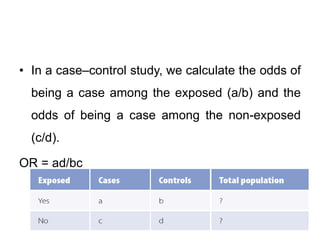
• In a case–control study, we calculate the odds of
being a case among the exposed (a/b) and the
odds of being a case among the non-exposed
(c/d).
OR = ad/bc
Analysis cont...
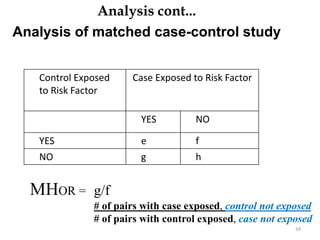
Analysis of matched case-control study
Control Exposed
to Risk Factor
Case Exposed to Risk Factor
YES NO
YES e f
NO g h
MHOR = g/f
# of pairs with case exposed, control not exposed
# of pairs with control exposed, case not exposed
34
Analysis cont…
• test the significance and calculate CI .
• cases and controls must also be compared
to ensure similarity with respect to other
baseline differences
35
Strengths of case control study
 is relatively quick and inexpensive compared with other
analytic designs
 is particularly well suited to the evaluation of diseases
with long latent periods
 Is optimal for the evaluation of rare diseases
 can examine multiple etiologic factors for a single
disease
36
Limitations of case control study
Inefficient for the evaluation of rare exposures
Can not directly compute incidence rates of disease in
exposed and non-exposed individuals, unless study is
population based
In some situations, the temporal relationship between
exposure and disease may be difficult to establish
Is particularly prone to bias compared with other analytic
designs, in particular selection and recall bias
37
Cohort Study
Cohort studies
• Definitions of cohort
– The term cohort comes from the Latin word cohors, meaning
a group of soldiers.
• cohort
1) Any designated group of persons who are followed or
traced over a period of time.
2) A group of individuals with a common characteristic or
experience
39
Cohort study cont.…
• describe an epidemiologic investigation that
follows groups with common characteristics
• Other terms used instead of cohort study are:
Follow up study
Incidence study
Longitudinal study
41
Cohort study cont.…
Types of Populations Studied
1. Dynamic population.
 Individuals may enter or leave at any time
 Smoking cigarettes, drinking alcohol, having a certain
occupation, or living in a specific geographic area.
 Incidence rate is the most suitable measure of
disease frequency
Cohort study cont.…
2.Fixed cohort
 Is defined by an irrevocable event (e.g. eating
contaminated food)
 Groups are followed from a defined starting point
(usually marked by the event) to a defined ending point
 Incidence rates are the appropriate measure of disease
frequency when the population experiences losses to
follow up.
43
Types of cohort cont…
3. Closed cohort
 Is defined by an irrevocable event
 Has defined starting & ending points for follow up
 Has no losses to follow-up
 Cumulative incidence or average risk is used as a
measure of disease frequency because there are no
losses to follow-up
44
Characterization of Exposure
• Regardless of what type of cohort study is conducted, participants
are grouped according to their exposure and followed over time to
compare the incidence of symptoms, disease, or death.
• Usually, two groups are compared, such as an exposed and an
unexposed group.
• The exposed group is called the index group, and the unexposed
group is termed the referent or comparison group.
• It is necessary for the investigator to specify a minimum amount of
exposure to qualify for the exposed group.
Characterization of Exposure…
• It is necessary for the investigator to specify a minimum
amount of exposure to qualify for the exposed group.
– Eg. Studies of cigarette smoking may use a lifetime history of
smoking at least 100 cigarettes to qualify for membership in the
exposed smoking group.
• When investigators are unable to find truly unexposed
people to serve in the comparison group, people with low
exposure are usually selected.
Follow-Up and Outcome Assessment
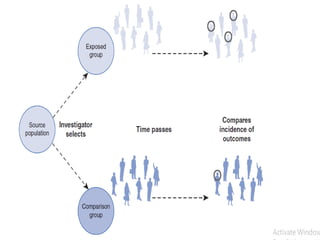
• During the follow-up period, the exposed and unexposed
groups are monitored for the outcomes under study.
• The outcome of interest depend on the research question
and may include precursors or first occurrence of disease,
disease recurrence, or death
– Eg. a cohort study of nurses examined their risk of infertility,
that is, the inability to conceive after 12 months of trying to
become pregnant
Follow-Up and Outcome
Assessment…
• At the start of follow-up, members of the cohort are at risk
for but have not yet experienced the outcome(s) of interest.
• By the end of the follow-up period, a proportion of the
cohort (up to 100%) will have experienced the outcome(s)
under study.
• The length of the follow-up period can range from a few
hours for infectious diseases to several decades for diseases
such as cancer or cardiovascular disease.
Follow-Up and Outcome
Assessment…
• Follow-up rates should be as high as possible
to ensure the validity of the study.
– Most epidemiologists are satisfied with follow-up
rates higher than 90%.
Types of cohort studies
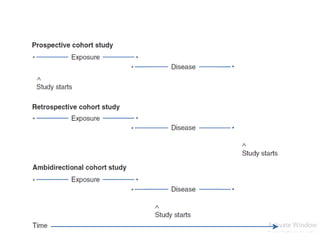
 Three types depending on the temporal relationship
between the initiation of the study and the
occurrence of the disease
 These are:
Prospective (looking forward in time)
Retrospective (looking backward in time)
Ambidirectional (looking backward and forward in time)
50
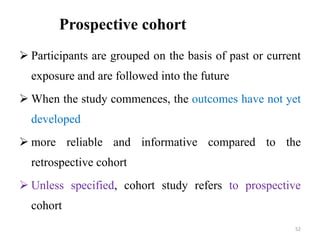
Prospective cohort
 Participants are grouped on the basis of past or current
exposure and are followed into the future
 When the study commences, the outcomes have not yet
developed
 more reliable and informative compared to the
retrospective cohort
 Unless specified, cohort study refers to prospective
cohort
52
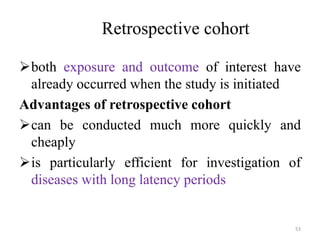
Retrospective cohort
both exposure and outcome of interest have
already occurred when the study is initiated
Advantages of retrospective cohort
can be conducted much more quickly and
cheaply
is particularly efficient for investigation of
diseases with long latency periods
53
Retrospective cohort…
• Incomplete and possibly non-comparable
information available from records for all
study subjects.
• Often information on potential confounding
factors is not available from such records
54
Ambidirectional cohort study
• Has both prospective & retrospective
components
• Data are collected both retrospectively and
prospectively on the same cohort
• Is most useful for exposures having both short
term and long term effects
• E.g. a chemical that may increase the risk of
birth defects within a few years of exposure
as well as a cancer risk after 1 or 2 decades 55
How does an epidemiologist decide whether to conduct a
prospective, retrospective, or ambidirectional cohort study?
• The answer depends on
– the research question,
– the practical constraints of time and money, and
– the availability of suitable study populations and records.
– the complementary advantages and disadvantages of
retrospective and prospective cohort studies.
• Retrospective cohort studies are more efficient than prospective studies
for investigating diseases that take a long time to develop and come to
diagnosis.
• The two main types of cohorts.
– special cohort
• is assembled to study the health effects of rare exposures,
such as uncommon occupational chemicals, unusual diets or
lifestyles, natural or man-made disasters, or medical
procedures
– general cohort
• assembled for common exposures, such as use of oral
contraceptives, dietary factors such as vitamin use, and habits
such as cigarette smoking and alcohol consumption. 57
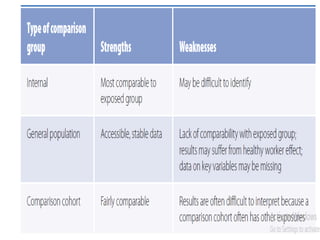
Selection of the comparison group
• The three sources for the comparison group in
a cohort study are
– an internal comparison,
– the general population, and
– a comparison cohort
Selection of the comparison group
• the groups being compared should be as
similar as possible with the exposed group
• ensure that the information that can be
obtained from the non-exposed group is
adequate for comparison with the exposed
population
59
Sources of exposure information
1)Preexisting records
In some circumstances this may be the only
way to obtain such data accurately
61
Advantages
• Information is usually available for a high
proportion of the cohort & is relatively
inexpensive to obtain
• allow objective and unbiased classification of
exposure status
62
Disadvantages
• The level of detail present in such records may
be insufficient
• Such records frequently do not contain data on
potential confounding variables.
63
Sources of exposure information
2) information supplied by the study subjects themselves
• particularly useful for collecting information on
exposures that are not routinely recorded
• a potential for bias always exists in the use of
such data since it cannot be obtained as
objectively as from preexisting records.
• stigma associated with certain exposures may
influence a respondent’s answer
64
Sources of exposure information
3)Direct physical examination or testing
• For some exposures or characteristics direct
physical examination and/or blood testing
may be necessary
• provide an objective and unbiased means of
classifying study subjects with respect to
exposure
65
Sources of outcome data
Depend on the specific resources available as well as
the particular disease under investigation
1)Death certificates
2) Records
3) Directly from the study participants
-For those who report an event of interest, additional
information such as hospital records can be obtained
to confirm the diagnosis
66
Sources of outcome data cont…
4) periodic direct medical examinations
Allows collection of objective information
67
Analysis
• calculation of incidence rates of the outcome
among the cohorts
• relative and absolute measures of association
can be calculated; RR,AR,PAR…etc
• groups must also be compared to ensure
similarity
68
Strengths of the cohort study design
• Is of particular value when the exposure is rare
• Can examine multiple effects of a single exposure
• Can elucidate temporal relationship between exposure
and disease
• If prospective, minimizes bias in the ascertainment of
exposure
• Allows direct measurement of incidence of disease in
the exposed and non-exposed groups
69
Limitations of cohort study design
Inefficient for the evaluation of rare diseases
If prospective, can be extremely expensive
and time consuming
 If retrospective, requires the availability of
adequate records
validity of the results can be seriously affected
by loses to follow-up
70
Thank you!!!

4.1 case-control and cohort.pdf

  • 1.
    Case control Addisu W.(MPH, Epi &Bo)
  • 2.
    Case Control Study •Also known as Case-referent study • Definition – Subjects are selected on the basis of whether they do (cases) or do not (controls) have a particular disease under study – Groups are then compared with respect to the proportion having a history of an exposure or characteristics of interest. 2
  • 4.
    When is itdesirable to use the case– control method? • Situations in which a case–control study is desirable – Exposure data are difficult or expensive to obtain. – The disease is rare. – The disease has a long induction and latent period. – Little is known about the disease. – The underlying population is dynamic
  • 5.
    Case control studycont.… • Is case-control a retrospective study? – If all the cases of the disease have been diagnosed at the time the investigators initiates the study, it is a retrospective case control study – If the study is begun and all new cases that are diagnosed within the next period of time are included, the study is a prospective – Hence, the use of the term retrospective to refer to all case-control studies is inappropriate 5
  • 6.
    Selection of cases •The criteria that are used to make such decisions are usually based on a combination of: – signs and symptoms, – physical and pathological examinations, and – results of diagnostic tests.  Which and how many criteria are used to define a case have important implications for determining accurately who has the disease.
  • 7.
    Selection of cases… •For example, if only chest pain to define cases of MI, – most but not all heart attack cases would be included (people with “silent” heart attacks would be missed), – people with other conditions that produce chest pain (such as indigestion) would be included mistakenly • It is better to be restrictive because it leads to fewer classification errors
  • 8.
    Selection of cases… Important considerations in case definition and selection – Criteria for case definition should lead to accurate classification of diseased and non-diseased subjects. – Efficient and accurate sources should be used to identify cases. – Incident cases are preferable to prevalent cases for causal research. – spectrum of disease: mild, moderate and severe groups
  • 9.
    Incident Vs Prevalentcases Prevalent Cases • Increase sample size available for rare disease. • Difficult to establish temporal sequence between exposure and outcome – reverse causation. Incident cases • Helpful to establish temporal relationship between exposure and outcome. • Records are easily obtainable and recall bias minimized. 9
  • 10.
    Sources of cases 1)Hospital or medical care facility • This approach is referred to as hospital- based case control study • is more common because it is relatively easy & inexpensive to conduct 10
  • 11.
    Sources of casescont.… 2) General population • Referred as population-based case control study. • involves locating and obtaining data from all affected individuals or a random sample from a defined population. • it avoids bias arising from whatever selection factors lead affected individual to utilize a particular health care facility or physician. 11
  • 12.
    General population cont.. •allows the description of the entire picture of the disease in that population • are not routinely used because of the logistic and cost considerations 12
  • 13.
    Selection of Controls •Controls are a sample of the population that produced the cases. • Another term for the control group is Referent group because it “refers to” the exposure distribution in the source population • The guiding principle for the valid selection of cases and controls is that they represent the same base population. • Controls must be sampled independently of exposure status. – exposed and unexposed controls should have the same probability of selection.
  • 14.
    Selection of Controls •Involves consideration of a number of issues including : the characteristics and source of the cases the need to obtain comparable information from cases and controls practical and economic considerations. • The control subjects should be selected to be comparable to the cases 14
  • 15.
    Sources of controls 1)Hospital • To use hospital/clinic controls, two general principle should be full filled. 1) The illnesses in the control group should be unrelated to the exposure under study. • Eg. a case–control study of cigarette smoking and MI should not use emphysema patients as controls because cigarette smoking is known to be a cause of emphysema. 2) The illness of the controls should have the same referral pattern to the healthcare facility as that of the cases.
  • 16.
    Sources of controls…. •Are patients who have been admitted for conditions other than the disease being studied. Advantages:  easily identified and readily available in sufficient numbers  minimal cost and effort involved in their assembly 16
  • 17.
    Advantages cont.…  morelikely than healthy individuals to be aware of antecedent exposures or events  likely to have been subject to the same intangible selection factors that influenced the cases to come to this particular physician or hospital  more likely to be willing to cooperate than healthy individuals, thus minimizing bias due to non-response 17
  • 18.
    Disadvantages: Thus, the experienceof these other patients may not accurately represent the exposure distribution in the population from which the cases derived they are ill and therefore differ from healthy individuals 18
  • 19.
    Sources of controls…. 2)General Population Controls  When cases are identified from a well-defined population (such as residents of a geographic area), population controls are typically selected as the referent group – Tax lists, voter registration lists, driver’s license rosters, telephone directories, and national identity registries  When the cases have been chosen from a hospitalized population but the use of hospitalized controls is not scientifically desirable or feasible, the comparison group may be selected from the general population.  The use of general population controls assures the greatest level of comparability 19
  • 20.
    Limitations of generalpopulation controls more costly and time consuming population lists are not always available it is difficult to contact healthy people with busy work and leisure activity schedules may not recall exposures with the same level of accuracy as those who have developed the disease tend to be less motivated to participate 20
  • 21.
    Sources of controls…. 3)Special controls  Consists of special groups such as friends, neighbor, relatives, or spouses of cases Advantage:  they are healthy  more likely to be cooperative  Offer a degree of control of important confounding factors related to:  ethnic background,  socioeconomic status,  environment 21
  • 22.
    Limitation of specialcontrols  These controls could possibly share the habits of the cases (such as smoking or drinking), if the study factor itself is one for cases and control, which can lead to biased results if the study hypothesis involves these exposures, an underestimate of the true effect of the exposure of interest may result.  For example, in a study of alcohol use and esophageal cancer risk, cases might nominate their drinking partners as controls.  This would make the exposure histories of case and controls similar and bias the results toward the null. 22
  • 23.
    Limitation of specialcontrols • cases may be unable to nominate people to serve as controls, particularly if they have few appropriate friends, are widowed, or are only or adopted children. • cases may be unwilling to nominate anyone because they do not want to reveal their illness or their participation in a study. 23
  • 24.
    How many controlgroups? • Ideally a single control group • However, it is often difficult, especially with hospitalized controls, to be confident that the comparison group is appropriate and that the conditions for which the controls are hospitalized are not also in some way related to the exposure under study. • In this circumstance it may be useful to use several control groups 24
  • 25.
    How many controlgroups? Cont.. • The use of multiple control groups is also indicated when there is concern that one selected group has a specific deficiency that could be overcome by the inclusion of another control group. 25
  • 26.
    How many controlgroups? Cont.. A second control series could be added consisting of individuals selected from the general population Next step: how many individuals the manner in which individual subjects will be selected. 26
  • 27.
    How many controlgroups? Cont.. when the number of available cases and controls is large and the cost of obtaining information from both groups is comparable, the optimal control-to-case ratio is 1:1. When the sample size of cases is limited, or when the cost of obtaining information is greater for cases, the control-to-case ratio can be altered to achieve the desired sample size. 27
  • 28.
    How many controlgroups? Cont..  As the number of controls per case increases, the power of the study also increases.  not generally recommended that this ratio increase beyond 4:1  When the entire population of potential eligible controls is known, a random sample of the required sample can be chosen  regardless of the specific method of selection employed, it is important to follow clearly defined, objective, and reproducible procedures. 28
  • 29.
    Ascertainment of diseaseand exposure status • Any potential source should have the ability to provide accurate as well as comparable information for all study groups. 29
  • 30.
    Sources of informationfor disease status • review of death certificates, case registries that maintain ongoing surveillance • Office records of physicians • Hospital admission or discharge records • pathology department log books 30
  • 31.
    Sources of informationabout the exposure from study subjects themselves, by either interview or mail questionnaire from a surrogate, such as spouses of participants or mothers of children From records (e.g. medical records). 31
  • 32.
    Analysis Compare between casesand controls with respect to the frequency of an exposure this comparison is made primarily by the OR. If the case control study is population based, or if estimates of disease incidence are available from an outside source, rates of disease for those exposed and non- exposed can be computed and compared directly 32
  • 33.
    • In acase–control study, we calculate the odds of being a case among the exposed (a/b) and the odds of being a case among the non-exposed (c/d). OR = ad/bc
  • 34.
    Analysis cont... Analysis ofmatched case-control study Control Exposed to Risk Factor Case Exposed to Risk Factor YES NO YES e f NO g h MHOR = g/f # of pairs with case exposed, control not exposed # of pairs with control exposed, case not exposed 34
  • 35.
    Analysis cont… • testthe significance and calculate CI . • cases and controls must also be compared to ensure similarity with respect to other baseline differences 35
  • 36.
    Strengths of casecontrol study  is relatively quick and inexpensive compared with other analytic designs  is particularly well suited to the evaluation of diseases with long latent periods  Is optimal for the evaluation of rare diseases  can examine multiple etiologic factors for a single disease 36
  • 37.
    Limitations of casecontrol study Inefficient for the evaluation of rare exposures Can not directly compute incidence rates of disease in exposed and non-exposed individuals, unless study is population based In some situations, the temporal relationship between exposure and disease may be difficult to establish Is particularly prone to bias compared with other analytic designs, in particular selection and recall bias 37
  • 38.
  • 39.
    Cohort studies • Definitionsof cohort – The term cohort comes from the Latin word cohors, meaning a group of soldiers. • cohort 1) Any designated group of persons who are followed or traced over a period of time. 2) A group of individuals with a common characteristic or experience 39
  • 41.
    Cohort study cont.… •describe an epidemiologic investigation that follows groups with common characteristics • Other terms used instead of cohort study are: Follow up study Incidence study Longitudinal study 41
  • 42.
    Cohort study cont.… Typesof Populations Studied 1. Dynamic population.  Individuals may enter or leave at any time  Smoking cigarettes, drinking alcohol, having a certain occupation, or living in a specific geographic area.  Incidence rate is the most suitable measure of disease frequency
  • 43.
    Cohort study cont.… 2.Fixedcohort  Is defined by an irrevocable event (e.g. eating contaminated food)  Groups are followed from a defined starting point (usually marked by the event) to a defined ending point  Incidence rates are the appropriate measure of disease frequency when the population experiences losses to follow up. 43
  • 44.
    Types of cohortcont… 3. Closed cohort  Is defined by an irrevocable event  Has defined starting & ending points for follow up  Has no losses to follow-up  Cumulative incidence or average risk is used as a measure of disease frequency because there are no losses to follow-up 44
  • 45.
    Characterization of Exposure •Regardless of what type of cohort study is conducted, participants are grouped according to their exposure and followed over time to compare the incidence of symptoms, disease, or death. • Usually, two groups are compared, such as an exposed and an unexposed group. • The exposed group is called the index group, and the unexposed group is termed the referent or comparison group. • It is necessary for the investigator to specify a minimum amount of exposure to qualify for the exposed group.
  • 46.
    Characterization of Exposure… •It is necessary for the investigator to specify a minimum amount of exposure to qualify for the exposed group. – Eg. Studies of cigarette smoking may use a lifetime history of smoking at least 100 cigarettes to qualify for membership in the exposed smoking group. • When investigators are unable to find truly unexposed people to serve in the comparison group, people with low exposure are usually selected.
  • 47.
    Follow-Up and OutcomeAssessment • During the follow-up period, the exposed and unexposed groups are monitored for the outcomes under study. • The outcome of interest depend on the research question and may include precursors or first occurrence of disease, disease recurrence, or death – Eg. a cohort study of nurses examined their risk of infertility, that is, the inability to conceive after 12 months of trying to become pregnant
  • 48.
    Follow-Up and Outcome Assessment… •At the start of follow-up, members of the cohort are at risk for but have not yet experienced the outcome(s) of interest. • By the end of the follow-up period, a proportion of the cohort (up to 100%) will have experienced the outcome(s) under study. • The length of the follow-up period can range from a few hours for infectious diseases to several decades for diseases such as cancer or cardiovascular disease.
  • 49.
    Follow-Up and Outcome Assessment… •Follow-up rates should be as high as possible to ensure the validity of the study. – Most epidemiologists are satisfied with follow-up rates higher than 90%.
  • 50.
    Types of cohortstudies  Three types depending on the temporal relationship between the initiation of the study and the occurrence of the disease  These are: Prospective (looking forward in time) Retrospective (looking backward in time) Ambidirectional (looking backward and forward in time) 50
  • 52.
    Prospective cohort  Participantsare grouped on the basis of past or current exposure and are followed into the future  When the study commences, the outcomes have not yet developed  more reliable and informative compared to the retrospective cohort  Unless specified, cohort study refers to prospective cohort 52
  • 53.
    Retrospective cohort both exposureand outcome of interest have already occurred when the study is initiated Advantages of retrospective cohort can be conducted much more quickly and cheaply is particularly efficient for investigation of diseases with long latency periods 53
  • 54.
    Retrospective cohort… • Incompleteand possibly non-comparable information available from records for all study subjects. • Often information on potential confounding factors is not available from such records 54
  • 55.
    Ambidirectional cohort study •Has both prospective & retrospective components • Data are collected both retrospectively and prospectively on the same cohort • Is most useful for exposures having both short term and long term effects • E.g. a chemical that may increase the risk of birth defects within a few years of exposure as well as a cancer risk after 1 or 2 decades 55
  • 56.
    How does anepidemiologist decide whether to conduct a prospective, retrospective, or ambidirectional cohort study? • The answer depends on – the research question, – the practical constraints of time and money, and – the availability of suitable study populations and records. – the complementary advantages and disadvantages of retrospective and prospective cohort studies. • Retrospective cohort studies are more efficient than prospective studies for investigating diseases that take a long time to develop and come to diagnosis.
  • 57.
    • The twomain types of cohorts. – special cohort • is assembled to study the health effects of rare exposures, such as uncommon occupational chemicals, unusual diets or lifestyles, natural or man-made disasters, or medical procedures – general cohort • assembled for common exposures, such as use of oral contraceptives, dietary factors such as vitamin use, and habits such as cigarette smoking and alcohol consumption. 57 Selection of the comparison group
  • 58.
    Selection of thecomparison group • The three sources for the comparison group in a cohort study are – an internal comparison, – the general population, and – a comparison cohort
  • 59.
    Selection of thecomparison group • the groups being compared should be as similar as possible with the exposed group • ensure that the information that can be obtained from the non-exposed group is adequate for comparison with the exposed population 59
  • 61.
    Sources of exposureinformation 1)Preexisting records In some circumstances this may be the only way to obtain such data accurately 61
  • 62.
    Advantages • Information isusually available for a high proportion of the cohort & is relatively inexpensive to obtain • allow objective and unbiased classification of exposure status 62
  • 63.
    Disadvantages • The levelof detail present in such records may be insufficient • Such records frequently do not contain data on potential confounding variables. 63
  • 64.
    Sources of exposureinformation 2) information supplied by the study subjects themselves • particularly useful for collecting information on exposures that are not routinely recorded • a potential for bias always exists in the use of such data since it cannot be obtained as objectively as from preexisting records. • stigma associated with certain exposures may influence a respondent’s answer 64
  • 65.
    Sources of exposureinformation 3)Direct physical examination or testing • For some exposures or characteristics direct physical examination and/or blood testing may be necessary • provide an objective and unbiased means of classifying study subjects with respect to exposure 65
  • 66.
    Sources of outcomedata Depend on the specific resources available as well as the particular disease under investigation 1)Death certificates 2) Records 3) Directly from the study participants -For those who report an event of interest, additional information such as hospital records can be obtained to confirm the diagnosis 66
  • 67.
    Sources of outcomedata cont… 4) periodic direct medical examinations Allows collection of objective information 67
  • 68.
    Analysis • calculation ofincidence rates of the outcome among the cohorts • relative and absolute measures of association can be calculated; RR,AR,PAR…etc • groups must also be compared to ensure similarity 68
  • 69.
    Strengths of thecohort study design • Is of particular value when the exposure is rare • Can examine multiple effects of a single exposure • Can elucidate temporal relationship between exposure and disease • If prospective, minimizes bias in the ascertainment of exposure • Allows direct measurement of incidence of disease in the exposed and non-exposed groups 69
  • 70.
    Limitations of cohortstudy design Inefficient for the evaluation of rare diseases If prospective, can be extremely expensive and time consuming  If retrospective, requires the availability of adequate records validity of the results can be seriously affected by loses to follow-up 70
  • 71.