Presented By 
Dr. Fredrick Stephen 
P.G in Community Medicine 
MGMC&RI, Pondicherry
Definition 
Cohort study is a type of analytical study which is usually undertaken to 
obtain additional evidence to refute or support the existence of an 
association between suspected cause and disease. 
 Synonyms 
Longitudinal study 
 Panel study 
 Prospective study 
 Forward looking study 
 Incidence study
• What Is Cohort 
 Ancient Roman legion, A band of warriors. 
 A group of people who share a common 
Characteristic or experience within a 
defined time period e.g. age , occupation, 
pregnancy etc
INDICATION OF A COHORT STUDY 
 When there is good evidence of exposure and disease. 
 When exposure is rare but incidence of disease is higher 
among exposed 
 When follow-up is easy, cohort is stable 
 When ample funds are available 
 When attrition is minimal.
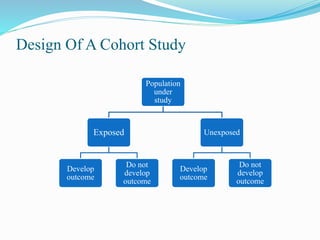
Design Of A Cohort Study 
Population 
under 
study 
Exposed 
Develop 
outcome 
Do not 
develop 
outcome 
Unexposed 
Develop 
outcome 
Do not 
develop 
outcome
Framework of a cohort 
Cohort 
Disease Total 
YES NO 
Exposed to putative 
aetiologic factor 
a b a+b 
Not Exposed to 
putative aetiologic 
factor 
c d c+d 
Incidence in exposed a/a+b 
Incidence in unexposed c/c+d
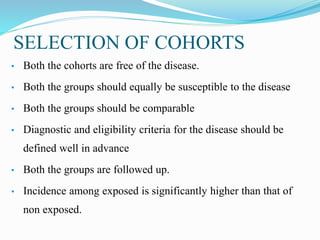
SELECTION OF COHORTS 
• Both the cohorts are free of the disease. 
• Both the groups should equally be susceptible to the disease 
• Both the groups should be comparable 
• Diagnostic and eligibility criteria for the disease should be 
defined well in advance 
• Both the groups are followed up. 
• Incidence among exposed is significantly higher than that of 
non exposed.
Elements Of Cohort Study 
 Selection of study subjects 
 Obtaining data on exposure 
 Selection of comparison group 
 Follow up 
 Analysis
Types of Cohort Study 
• Prospective cohort study 
• Retrospective (historical) cohort study 
• Combination of Retrospective and Prospective cohort 
study 
• Nested Cohort
Cohort study 
Advantages Disadvantages 
 Can often show temporality of 
relationship 
 Less bias due to prospective 
evaluation of exposures 
 Can evaluate multiple diseases 
 can establish cause - effect 
 good when exposure is rare 
 We can find out incidence rate and 
Relative risk. 
 losses to follow-up 
 often requires large sample 
 ineffective for rare diseases 
 long time to complete 
 expensive 
 Changes in diagnostic criteria 
over time. 
 Need motivated cohort of 
people who will be repeatedly 
evaluated
Biases in cohort study 
• Analytic bias 
• Cross over bias 
• Surveillance bias 
• Information bias 
• Loss to follow up bias 
• Interviewer bias 
• Non-response bias
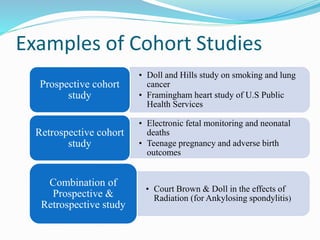
Examples of Cohort Studies 
• Doll and Hills study on smoking and lung 
cancer 
• Framingham heart study of U.S Public 
Health Services 
Prospective cohort 
study 
• Electronic fetal monitoring and neonatal 
deaths 
• Teenage pregnancy and adverse birth 
outcomes 
Retrospective cohort 
study 
• Court Brown & Doll in the effects of 
Radiation (for Ankylosing spondylitis) 
Combination of 
Prospective & 
Retrospective study
Thank you

Cohort Study

  • 1.
    Presented By Dr.Fredrick Stephen P.G in Community Medicine MGMC&RI, Pondicherry
  • 2.
    Definition Cohort studyis a type of analytical study which is usually undertaken to obtain additional evidence to refute or support the existence of an association between suspected cause and disease.  Synonyms Longitudinal study  Panel study  Prospective study  Forward looking study  Incidence study
  • 3.
    • What IsCohort  Ancient Roman legion, A band of warriors.  A group of people who share a common Characteristic or experience within a defined time period e.g. age , occupation, pregnancy etc
  • 4.
    INDICATION OF ACOHORT STUDY  When there is good evidence of exposure and disease.  When exposure is rare but incidence of disease is higher among exposed  When follow-up is easy, cohort is stable  When ample funds are available  When attrition is minimal.
  • 5.
    Design Of ACohort Study Population under study Exposed Develop outcome Do not develop outcome Unexposed Develop outcome Do not develop outcome
  • 6.
    Framework of acohort Cohort Disease Total YES NO Exposed to putative aetiologic factor a b a+b Not Exposed to putative aetiologic factor c d c+d Incidence in exposed a/a+b Incidence in unexposed c/c+d
  • 7.
    SELECTION OF COHORTS • Both the cohorts are free of the disease. • Both the groups should equally be susceptible to the disease • Both the groups should be comparable • Diagnostic and eligibility criteria for the disease should be defined well in advance • Both the groups are followed up. • Incidence among exposed is significantly higher than that of non exposed.
  • 8.
    Elements Of CohortStudy  Selection of study subjects  Obtaining data on exposure  Selection of comparison group  Follow up  Analysis
  • 9.
    Types of CohortStudy • Prospective cohort study • Retrospective (historical) cohort study • Combination of Retrospective and Prospective cohort study • Nested Cohort
  • 10.
    Cohort study AdvantagesDisadvantages  Can often show temporality of relationship  Less bias due to prospective evaluation of exposures  Can evaluate multiple diseases  can establish cause - effect  good when exposure is rare  We can find out incidence rate and Relative risk.  losses to follow-up  often requires large sample  ineffective for rare diseases  long time to complete  expensive  Changes in diagnostic criteria over time.  Need motivated cohort of people who will be repeatedly evaluated
  • 11.
    Biases in cohortstudy • Analytic bias • Cross over bias • Surveillance bias • Information bias • Loss to follow up bias • Interviewer bias • Non-response bias
  • 12.
    Examples of CohortStudies • Doll and Hills study on smoking and lung cancer • Framingham heart study of U.S Public Health Services Prospective cohort study • Electronic fetal monitoring and neonatal deaths • Teenage pregnancy and adverse birth outcomes Retrospective cohort study • Court Brown & Doll in the effects of Radiation (for Ankylosing spondylitis) Combination of Prospective & Retrospective study
  • 13.