COHORT STUDY
• COHORTS ARE MAINLY GROUPS.
• COHORT STUDY DESIGN IDENTIFIES A PEOPLE EXPOSED TO A PARTICULAR FACTOR AND A
COMPARISON GROUP THAT WAS NOT EXPOSED TO THAT FACTOR AND MEASURES AND COMPARES
THE INCIDENCE OF DISEASE IN THE TWO GROUPS.
• FOR EXAMPLE,
TWO GROUPS OF PEOPLE EXPOSED TO SMOKING AND NOT EXPOSED TO SMOKING WERE
COMPARED WITH EACH OTHER TO MEASURE AND COMPARE THE INCIDENCE OF CHD.
EXAMPLE OF COHORT
COMPARISON OF SMOKING EXPOSED GROUP WITH UNEXPOSED GROUP FOR
HAVING CHD.
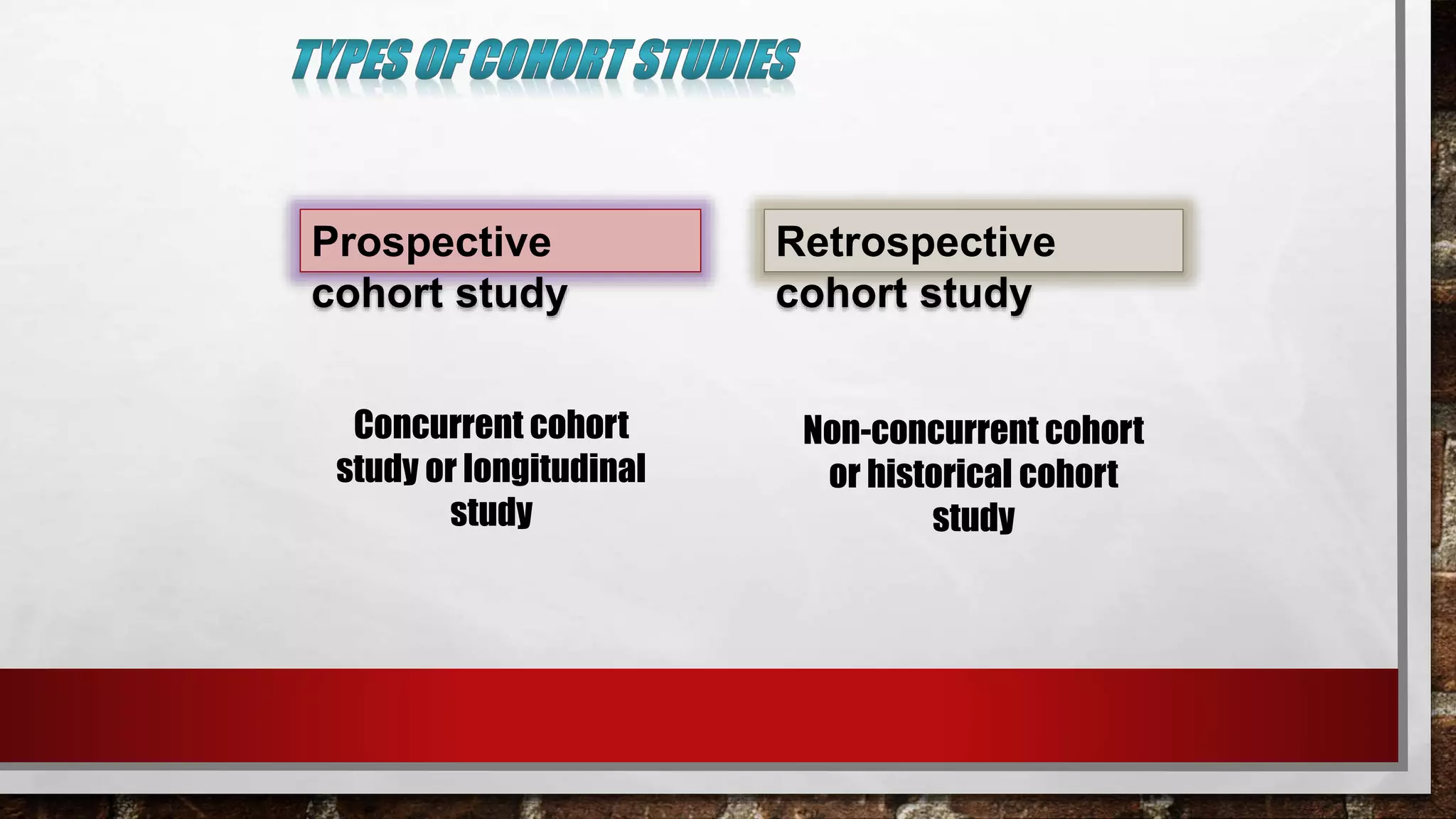
Prospective
cohort study
Retrospective
cohort study
Concurrent cohort
study or longitudinal
study
Non-concurrent cohort
or historical cohort
study
• The common strategy of cohort studies is to start with a reference
population (or a representative sample thereof), some of whom have
certain characteristics or attributes relevant to the study (exposed
group), with others who do not have those characteristics
(unexposed group).
• Both groups should, at the outset of the study, be free from the
condition under consideration. Both groups are then observed over a
specified period to find out the risk each group has of developing the
condition(s) of interest.
• A retrospective cohort study is one in which the outcome have all occurred before the start of investigation.
• Investigator goes back to the past to select study group from existing records of the past employment,
medical and other records and traces them forward through time from the past date fixed on the records usually
to the present.
• Known with the name of Historical Cohort and noncurrent cohort
Ramingham Study
The study started with a defined population Investigators (USPHS and NHLBI) started by
identifying a new population and did not use existing data to identify the population and
the exposure groups
There were several hypotheses to be tested Different exposures and different outcomes
For each exposure, investigators identified the “exposed” and the “not exposed” groups
For each exposure, the participants were followed for the development of disease
Different exposures were studied, as well as different diseases
The Framingham Heart Study is a long-term, ongoing cardiovascular cohort study on residents of the
town of Framingham, Massachusetts.
The study began in 1948 with 5,209 adult subjects from Framingham, and is now on its third generation
of participants. Prior to it almost nothing was known about the "epidemiology of hypertensive or
arteriosclerotic cardiovascular disease". Much of the now-common knowledge concerning heart disease,
such as the effects of diet, exercise, and common medications such as aspirin, is based on this longitudinal
study.
It is a project of the National Heart, Lung, and Blood Institute, in collaboration with (since 1971) Boston
University. Various health professionals from the hospitals and universities of Greater Boston staff the
project.
Objectives
To study the impact of several factors on incidence of
cardiovascular diseases
Exposures
Blood pressure, smoking, body weight, diabetes,
exercise, etc.
Multiple Outcomes
Coronary heart disease, stroke, congestive heart
failure, peripheral arterial disease
TYPES OF POTENTIAL BIAS IN COHORT STUDIES
1. SELECTION BIAS
•IS INTRODUCED BY THE SELECTION OF INDIVIDUALS,
GROUPS OR DATA FOR ANALYSIS IN SUCH A WAY THAT
PROPER RANDOMIZATION IS NOT ACHIEVED, THEREBY
ENSURING THAT THE SAMPLE OBTAINED IS NOT
REPRESENTATIVE OF THE POPULATION INTENDED TO BE
ANALYZED.
•SELECT PARTICIPANTS INTO EXPOSED AND NOT
EXPOSED GROUPS.
INFORMATION BIAS
• INFORMATION BIAS RESULTS FROM SYSTEMATIC DIFFERENCES IN THE WAY DATA ON EXPOSURE OR
OUTCOME ARE OBTAINED FROM THE VARIOUS STUDY GROUPS.
• THIS MAY MEAN THAT INDIVIDUALS ARE ASSIGNED TO THE WRONG OUTCOME CATEGORY, LEADING TO AN
INCORRECT ESTIMATE OF THE ASSOCIATION BETWEEN EXPOSURE AND OUTCOME.
• LOSS TO FOLLOW-UP DIFFERS BETWEEN EXPOSED AND NOT EXPOSED.
3. MISCLASSIFICATION BIAS
• MISCLASSIFY EXPOSURE STATUS OR DISEASE STATUS.
A) DIFFERENTIAL MISCLASSIFICATION
• SYSTEMIC ERROR
• MISCLASSIFICATION OF EXPOSURE DIFFERS BETWEEN CASES AND CONTROLS AND OUTCOME DIFFERS
BETWEEN EXPOSED AND UNEXPOSED.
B) NON-DIFFERENTIAL MISCLASSIFICATION
• RANDOM ERROR
• MISCLASSIFICATION OF EXPOSURE IS SIMILAR BETWEEN CASES AND CONTROLS AND OUTCOME IS
SIMILAR BETWEEN EXPOSED AND UNEXPOSED.
Steps of cohort studies
Selection of Study Populations
Obtaining Data on Exposure
Selection Of Comparison Group
Follow Up
Analysis
The usual procedure is to locate or identify the cohort, Which may be a total Population in an area or
sample. Cohort can be :
 Community Cohort of Specific age and Sex
 Exposure Cohort : Smokers
 Birth Cohort
 Occupational Cohort
 Treated Cohort :Cases treated with Surgery
 From Cohort Members: Personal Interview
 Review Of Records : Certain kind of information like dose of radiation
 Medical Examination : In some cases information needs to be obtained from medical examination
 Environmental Survey of location where Cohort lives
Selection of Study Objects
Obtaining Data on Exposure
Single Cohort enters the
study and its members on the
basis of information obtained
can be classified Into several
Comparison according to
degree of exposure
Selection Of Comparison Group
 The length of follow up that is needed for some studies to reach a satisfactory end point.
 At the start of study ,method should be determined depending on the outcome of study to obtain data for
assessing outcome
Data analyzed in terms of
 Incidence rate of outcome among exposed and non exposed
 Estimation of Risk
Follow Up
Analysis
exposure
is known
When exposure is rare
and Incidence of disease
among exposed is high
Time between exposure
and disease is relatively
short
Adequate
funding
is
available
Investigator
has a long
life
expectancy
Strengths
• Multiple outcomes can be measured for any one exposure.
• Can look at multiple exposures.
• Exposure is measured before the onset of disease
• Good for measuring rare exposures
• Demonstrate direction of causality.
• Can measure incidence and prevalence.
Weaknesses
• Costly and time consuming.
• Prone to bias due to loss to follow-up.
• Prone to confounding.
• Participants may move between one exposure category.
• Knowledge of exposure status may bias classification of the
outcome.
• Being in the study may alter participant's behaviour.
• Poor choice for the study of a rare disease.
• Classification of individuals (exposure or outcome status) can be
affected by changes in diagnostic procedures.
A CASE
A STUDY OF 22 707 CHINESE MEN IN TAIWAN WAS SET UP TO INVESTIGATE THE ASSOCIATION BETWEEN THE
HEPATITIS B SURFACE ANTIGEN (HBSAG) AND THE DEVELOPMENT OF PRIMARY HEPATOCELLULAR CARCINOMA.
THE STUDY WAS CONDUCTED AMONG MALE GOVERNMENT EMPLOYEES WHO WERE ENROLLED THROUGH
ROUTINE HEALTH CARE SERVICES. ALL PARTICIPANTS COMPLETED A HEALTH QUESTIONNAIRE AND PROVIDED A
BLOOD SAMPLE AT THE TIME OF THEIR ENTRY INTO THE STUDY. PARTICIPANTS WERE THEN FOLLOWED UP FOR AN
AVERAGE OF 3.3 YEARS (BEASLEY ET AL., 1981).
EXAMPLE OF FAMOUS COHORT STUDIES
• BRITISH DOCTORS STUDY ON SMOKING AND LUNG CANCER
• THE FRAMINGHAM HEART STUDY
• ORAL CONTRACEPTIVES STUDY
COHORT STUDY

COHORT STUDY

  • 2.
    COHORT STUDY • COHORTSARE MAINLY GROUPS. • COHORT STUDY DESIGN IDENTIFIES A PEOPLE EXPOSED TO A PARTICULAR FACTOR AND A COMPARISON GROUP THAT WAS NOT EXPOSED TO THAT FACTOR AND MEASURES AND COMPARES THE INCIDENCE OF DISEASE IN THE TWO GROUPS. • FOR EXAMPLE, TWO GROUPS OF PEOPLE EXPOSED TO SMOKING AND NOT EXPOSED TO SMOKING WERE COMPARED WITH EACH OTHER TO MEASURE AND COMPARE THE INCIDENCE OF CHD.
  • 3.
    EXAMPLE OF COHORT COMPARISONOF SMOKING EXPOSED GROUP WITH UNEXPOSED GROUP FOR HAVING CHD.
  • 4.
    Prospective cohort study Retrospective cohort study Concurrentcohort study or longitudinal study Non-concurrent cohort or historical cohort study
  • 5.
    • The commonstrategy of cohort studies is to start with a reference population (or a representative sample thereof), some of whom have certain characteristics or attributes relevant to the study (exposed group), with others who do not have those characteristics (unexposed group). • Both groups should, at the outset of the study, be free from the condition under consideration. Both groups are then observed over a specified period to find out the risk each group has of developing the condition(s) of interest.
  • 6.
    • A retrospectivecohort study is one in which the outcome have all occurred before the start of investigation. • Investigator goes back to the past to select study group from existing records of the past employment, medical and other records and traces them forward through time from the past date fixed on the records usually to the present. • Known with the name of Historical Cohort and noncurrent cohort
  • 8.
    Ramingham Study The studystarted with a defined population Investigators (USPHS and NHLBI) started by identifying a new population and did not use existing data to identify the population and the exposure groups There were several hypotheses to be tested Different exposures and different outcomes For each exposure, investigators identified the “exposed” and the “not exposed” groups For each exposure, the participants were followed for the development of disease Different exposures were studied, as well as different diseases
  • 9.
    The Framingham HeartStudy is a long-term, ongoing cardiovascular cohort study on residents of the town of Framingham, Massachusetts. The study began in 1948 with 5,209 adult subjects from Framingham, and is now on its third generation of participants. Prior to it almost nothing was known about the "epidemiology of hypertensive or arteriosclerotic cardiovascular disease". Much of the now-common knowledge concerning heart disease, such as the effects of diet, exercise, and common medications such as aspirin, is based on this longitudinal study. It is a project of the National Heart, Lung, and Blood Institute, in collaboration with (since 1971) Boston University. Various health professionals from the hospitals and universities of Greater Boston staff the project.
  • 10.
    Objectives To study theimpact of several factors on incidence of cardiovascular diseases Exposures Blood pressure, smoking, body weight, diabetes, exercise, etc. Multiple Outcomes Coronary heart disease, stroke, congestive heart failure, peripheral arterial disease
  • 11.
    TYPES OF POTENTIALBIAS IN COHORT STUDIES 1. SELECTION BIAS •IS INTRODUCED BY THE SELECTION OF INDIVIDUALS, GROUPS OR DATA FOR ANALYSIS IN SUCH A WAY THAT PROPER RANDOMIZATION IS NOT ACHIEVED, THEREBY ENSURING THAT THE SAMPLE OBTAINED IS NOT REPRESENTATIVE OF THE POPULATION INTENDED TO BE ANALYZED. •SELECT PARTICIPANTS INTO EXPOSED AND NOT EXPOSED GROUPS.
  • 12.
    INFORMATION BIAS • INFORMATIONBIAS RESULTS FROM SYSTEMATIC DIFFERENCES IN THE WAY DATA ON EXPOSURE OR OUTCOME ARE OBTAINED FROM THE VARIOUS STUDY GROUPS. • THIS MAY MEAN THAT INDIVIDUALS ARE ASSIGNED TO THE WRONG OUTCOME CATEGORY, LEADING TO AN INCORRECT ESTIMATE OF THE ASSOCIATION BETWEEN EXPOSURE AND OUTCOME. • LOSS TO FOLLOW-UP DIFFERS BETWEEN EXPOSED AND NOT EXPOSED.
  • 13.
    3. MISCLASSIFICATION BIAS •MISCLASSIFY EXPOSURE STATUS OR DISEASE STATUS. A) DIFFERENTIAL MISCLASSIFICATION • SYSTEMIC ERROR • MISCLASSIFICATION OF EXPOSURE DIFFERS BETWEEN CASES AND CONTROLS AND OUTCOME DIFFERS BETWEEN EXPOSED AND UNEXPOSED. B) NON-DIFFERENTIAL MISCLASSIFICATION • RANDOM ERROR • MISCLASSIFICATION OF EXPOSURE IS SIMILAR BETWEEN CASES AND CONTROLS AND OUTCOME IS SIMILAR BETWEEN EXPOSED AND UNEXPOSED.
  • 14.
    Steps of cohortstudies Selection of Study Populations Obtaining Data on Exposure Selection Of Comparison Group Follow Up Analysis
  • 15.
    The usual procedureis to locate or identify the cohort, Which may be a total Population in an area or sample. Cohort can be :  Community Cohort of Specific age and Sex  Exposure Cohort : Smokers  Birth Cohort  Occupational Cohort  Treated Cohort :Cases treated with Surgery  From Cohort Members: Personal Interview  Review Of Records : Certain kind of information like dose of radiation  Medical Examination : In some cases information needs to be obtained from medical examination  Environmental Survey of location where Cohort lives Selection of Study Objects Obtaining Data on Exposure
  • 16.
    Single Cohort entersthe study and its members on the basis of information obtained can be classified Into several Comparison according to degree of exposure Selection Of Comparison Group
  • 17.
     The lengthof follow up that is needed for some studies to reach a satisfactory end point.  At the start of study ,method should be determined depending on the outcome of study to obtain data for assessing outcome Data analyzed in terms of  Incidence rate of outcome among exposed and non exposed  Estimation of Risk Follow Up Analysis
  • 18.
    exposure is known When exposureis rare and Incidence of disease among exposed is high Time between exposure and disease is relatively short Adequate funding is available Investigator has a long life expectancy
  • 19.
    Strengths • Multiple outcomescan be measured for any one exposure. • Can look at multiple exposures. • Exposure is measured before the onset of disease • Good for measuring rare exposures • Demonstrate direction of causality. • Can measure incidence and prevalence.
  • 20.
    Weaknesses • Costly andtime consuming. • Prone to bias due to loss to follow-up. • Prone to confounding. • Participants may move between one exposure category. • Knowledge of exposure status may bias classification of the outcome. • Being in the study may alter participant's behaviour. • Poor choice for the study of a rare disease. • Classification of individuals (exposure or outcome status) can be affected by changes in diagnostic procedures.
  • 21.
    A CASE A STUDYOF 22 707 CHINESE MEN IN TAIWAN WAS SET UP TO INVESTIGATE THE ASSOCIATION BETWEEN THE HEPATITIS B SURFACE ANTIGEN (HBSAG) AND THE DEVELOPMENT OF PRIMARY HEPATOCELLULAR CARCINOMA. THE STUDY WAS CONDUCTED AMONG MALE GOVERNMENT EMPLOYEES WHO WERE ENROLLED THROUGH ROUTINE HEALTH CARE SERVICES. ALL PARTICIPANTS COMPLETED A HEALTH QUESTIONNAIRE AND PROVIDED A BLOOD SAMPLE AT THE TIME OF THEIR ENTRY INTO THE STUDY. PARTICIPANTS WERE THEN FOLLOWED UP FOR AN AVERAGE OF 3.3 YEARS (BEASLEY ET AL., 1981).
  • 22.
    EXAMPLE OF FAMOUSCOHORT STUDIES • BRITISH DOCTORS STUDY ON SMOKING AND LUNG CANCER • THE FRAMINGHAM HEART STUDY • ORAL CONTRACEPTIVES STUDY

Editor's Notes

  • #19 When good evidence suggests an association of a disease with a certain exposure or exposures.
  • #20 Multiple outcomes can be measured for any one exposure. • Can look at multiple exposures. • Exposure is measured before the onset of disease (in prospective cohort studies). • Good for measuring rare exposures, for example among different occupations. • Demonstrate direction of causality. • Can measure incidence and prevalence.