Experimental Epidemiology
Maj Dr Naveen Phuyal
MBBS, MD
Randomized Control Trial
Maj Dr Naveen Phuyal
MBBS, MD
โ€ข The ideal design to use in epidemiological
research settings is an experimental design.
โ€ข Experimental epidemiology is a model
epidemiological method.
โ€ข 1920s: Experimental epidemiology meant
study of epidemics among colonies of
experimental animals such as rats and mice.
How does it differ from cohort
studies?
โ€ข The conditions in which the studies are carried
out are under direct control of the investigator.
โ€ข Involves some action, intervention or
manipulation such as deliberate application or
withdrawal in an experimental group and a
control group
โ€ข Observes and compares the outcome of
experiment in both groups
Aims of experimental studies
โ€ข To provide scientific proof of etiological factors
which may permit modification or control of
disease
โ€ข To provide a method of measuring the
effectiveness and efficiency of health services
for the prevention, control and treatment of
disease and improve the health of the
community
Experimental studies have all advantages
and disadvantages of cohort studies plus
โ€ข Costlier
โ€ข Ethical issues
โ€ข Feasibility
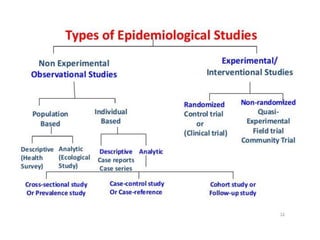
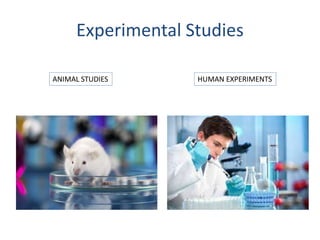
Experimental Studies
ANIMAL STUDIES HUMAN EXPERIMENTS
Animal Studies
โ€ข Animals have played
important role in menโ€™s
quest for knowledge
about himself.
โ€ข Animal studies have
contributed to all
branches of medicine.
Application
โ€ข To confirm etiological
hypothesis and study
pathogenic phenomena
โ€ข Testing efficacy of
preventive and
therapeutic measures
such as vaccines or drugs
โ€ข Completing the natural
history of disease
Animal Studies
Advantage
โ€ข Can be bred easily
โ€ข Multiply rapidly
โ€ข Genetic experiments
Disadvantage
โ€ข Not all human disease can
be reproduced in animals
โ€ข All conclusions drawn may
not strictly apply to humans
Human Experiments
โ€ข Human experiments will always be needed to
investigate disease etiology and evaluate the
preventive and therapeutic measures
โ€ข All who drink of this treatment recover in a
short time, Except those whom it does not
help, who all die, It is obvious, therefore, that
it fails only in incurable cases.
Galen[1] (129โ€“c. 199 ce)
Sir Francis Galton 1883
โ€ข It was asserted by some that men possess the faculty of
obtaining results over which they have little or no direct
personal control, by means of devout and earnest prayer,
while others doubt the truth of this assertion.
โ€ข The question regards a matter of fact, that has to be
determined by observation and not by authority; and it is
one that appears to be a very suitable topic for statistical
inquiry. โ€ฆ
โ€ข Are prayers answered or are they not? โ€ฆ Do sick persons,
who pray or are prayed for, recover on the average more
rapidly than others?
Are prayers answered or are they not?
โ€ข 1965: Joyce and Welldon double blind
randomized trial of efficacy of prayer
โ€ข 1988: randomized double blind control trial in
CCU
Ambroise Pare , 1537 Unplanned trial
โ€ข At length my oil lacked and I was constrained to apply in its place a
digestive made of yolks of eggs, oil of roses and turpentine.
โ€ข That night I could not sleep at my ease, fearing that by lack of
cauterization I would find the wounded upon which I had not used
the said oil, dead from the poison.
โ€ข I raised myself early to visit them, when beyond my hope I found
those to whom I had applied the digestive medicament feeling but
little pain, their wounds neither swollen nor inflamed, and having
slept through the night.
โ€ข The others to whom I had applied the boiling oil were feverish with
much pain and swelling about their wounds. Then I determined
never again to burn thus so cruelly the poor wounded.
James Lind 1747, Planned trial
โ€ข I took 12 patients in the scurvy on board the
Salisbury at sea.
โ€ข The cases were as similar as I could have them
โ€ฆ they lay together in one place and had one
diet common to them all.
โ€ข Two of these were ordered a quart of cider per day. โ€ฆ
Two others took 25 gutts of elixir vitriol. โ€ฆ Two others
took two spoonfuls of vinegar. โ€ฆ Two were put under a
course of sea water. โ€ฆ Two others had two oranges
and one lemon given them each day. โ€ฆ Two others
took the bigness of nutmeg.
โ€ข The most sudden and visible good effects were
perceived from the use of oranges and lemons, one of
those who had taken them being at the end of 6 days
fit for duty. โ€ฆ The other โ€ฆ was appointed nurse to the
rest of the sick.
Types of experimental studies
1. Clinical (therapeutic) trial- patient suffering from
disease
2. Field trial (preventive trial)- healthy individuals
in the community
3. Community intervention trial- cluster of human
beings
4. Health service evaluation trial
5. Risk factor trial
6. Cessation experiments
Randomized Control Trial
Maj Dr Naveen Phuyal
MBBS, MD
NON RANDOMIZED TRIALS
โ€ข Ethical, administrative and other reasons for
which RCT not possible
โ€“ Direct experimentation not possible : smoking and
Lung CA
โ€“ Some preventive measure can be only be
applicable to small groups in a community (
flouridation)
โ€“ When disease frequency is low and natural history
is long ( Cervical Ca)
โ€ข A crude approach
โ€ข Degree of comparability is low
โ€ข Chances of spurious results higher
โ€ข Validity becomes extra statistical judgment
โ€ข Vital decisions in public health have been
made by non-experimental studies
Non-randomized trials
โ€ข Uncontrolled trials (trials with no comparison groups). Eg.
Pap smear test reduces mortality from Cx CA
โ€ข Natural experiments
โ€“ cigerrete smoking: smokers vs non smokers
โ€“ Natural disasters, atomic bombings, mogrants , social groups,
โ€“ โ€œThe Great Experimentโ€
โ€ข Before and after comparison studies (eg. James Lind and
scurvy)
โ€“ Using a control group
โ€“ Without a control group
7. experimental epidemiology

7. experimental epidemiology

  • 1.
    Experimental Epidemiology Maj DrNaveen Phuyal MBBS, MD
  • 2.
    Randomized Control Trial MajDr Naveen Phuyal MBBS, MD
  • 3.
    โ€ข The idealdesign to use in epidemiological research settings is an experimental design. โ€ข Experimental epidemiology is a model epidemiological method.
  • 4.
    โ€ข 1920s: Experimentalepidemiology meant study of epidemics among colonies of experimental animals such as rats and mice.
  • 5.
    How does itdiffer from cohort studies? โ€ข The conditions in which the studies are carried out are under direct control of the investigator. โ€ข Involves some action, intervention or manipulation such as deliberate application or withdrawal in an experimental group and a control group โ€ข Observes and compares the outcome of experiment in both groups
  • 6.
    Aims of experimentalstudies โ€ข To provide scientific proof of etiological factors which may permit modification or control of disease โ€ข To provide a method of measuring the effectiveness and efficiency of health services for the prevention, control and treatment of disease and improve the health of the community
  • 7.
    Experimental studies haveall advantages and disadvantages of cohort studies plus โ€ข Costlier โ€ข Ethical issues โ€ข Feasibility
  • 8.
  • 9.
    Animal Studies โ€ข Animalshave played important role in menโ€™s quest for knowledge about himself. โ€ข Animal studies have contributed to all branches of medicine. Application โ€ข To confirm etiological hypothesis and study pathogenic phenomena โ€ข Testing efficacy of preventive and therapeutic measures such as vaccines or drugs โ€ข Completing the natural history of disease
  • 10.
    Animal Studies Advantage โ€ข Canbe bred easily โ€ข Multiply rapidly โ€ข Genetic experiments Disadvantage โ€ข Not all human disease can be reproduced in animals โ€ข All conclusions drawn may not strictly apply to humans
  • 11.
    Human Experiments โ€ข Humanexperiments will always be needed to investigate disease etiology and evaluate the preventive and therapeutic measures
  • 12.
    โ€ข All whodrink of this treatment recover in a short time, Except those whom it does not help, who all die, It is obvious, therefore, that it fails only in incurable cases. Galen[1] (129โ€“c. 199 ce)
  • 13.
    Sir Francis Galton1883 โ€ข It was asserted by some that men possess the faculty of obtaining results over which they have little or no direct personal control, by means of devout and earnest prayer, while others doubt the truth of this assertion. โ€ข The question regards a matter of fact, that has to be determined by observation and not by authority; and it is one that appears to be a very suitable topic for statistical inquiry. โ€ฆ โ€ข Are prayers answered or are they not? โ€ฆ Do sick persons, who pray or are prayed for, recover on the average more rapidly than others?
  • 14.
    Are prayers answeredor are they not? โ€ข 1965: Joyce and Welldon double blind randomized trial of efficacy of prayer โ€ข 1988: randomized double blind control trial in CCU
  • 15.
    Ambroise Pare ,1537 Unplanned trial โ€ข At length my oil lacked and I was constrained to apply in its place a digestive made of yolks of eggs, oil of roses and turpentine. โ€ข That night I could not sleep at my ease, fearing that by lack of cauterization I would find the wounded upon which I had not used the said oil, dead from the poison. โ€ข I raised myself early to visit them, when beyond my hope I found those to whom I had applied the digestive medicament feeling but little pain, their wounds neither swollen nor inflamed, and having slept through the night. โ€ข The others to whom I had applied the boiling oil were feverish with much pain and swelling about their wounds. Then I determined never again to burn thus so cruelly the poor wounded.
  • 16.
    James Lind 1747,Planned trial โ€ข I took 12 patients in the scurvy on board the Salisbury at sea. โ€ข The cases were as similar as I could have them โ€ฆ they lay together in one place and had one diet common to them all.
  • 17.
    โ€ข Two ofthese were ordered a quart of cider per day. โ€ฆ Two others took 25 gutts of elixir vitriol. โ€ฆ Two others took two spoonfuls of vinegar. โ€ฆ Two were put under a course of sea water. โ€ฆ Two others had two oranges and one lemon given them each day. โ€ฆ Two others took the bigness of nutmeg. โ€ข The most sudden and visible good effects were perceived from the use of oranges and lemons, one of those who had taken them being at the end of 6 days fit for duty. โ€ฆ The other โ€ฆ was appointed nurse to the rest of the sick.
  • 18.
    Types of experimentalstudies 1. Clinical (therapeutic) trial- patient suffering from disease 2. Field trial (preventive trial)- healthy individuals in the community 3. Community intervention trial- cluster of human beings 4. Health service evaluation trial 5. Risk factor trial 6. Cessation experiments
  • 19.
    Randomized Control Trial MajDr Naveen Phuyal MBBS, MD
  • 21.
  • 22.
    โ€ข Ethical, administrativeand other reasons for which RCT not possible โ€“ Direct experimentation not possible : smoking and Lung CA โ€“ Some preventive measure can be only be applicable to small groups in a community ( flouridation) โ€“ When disease frequency is low and natural history is long ( Cervical Ca)
  • 23.
    โ€ข A crudeapproach โ€ข Degree of comparability is low โ€ข Chances of spurious results higher โ€ข Validity becomes extra statistical judgment โ€ข Vital decisions in public health have been made by non-experimental studies
  • 24.
    Non-randomized trials โ€ข Uncontrolledtrials (trials with no comparison groups). Eg. Pap smear test reduces mortality from Cx CA โ€ข Natural experiments โ€“ cigerrete smoking: smokers vs non smokers โ€“ Natural disasters, atomic bombings, mogrants , social groups, โ€“ โ€œThe Great Experimentโ€ โ€ข Before and after comparison studies (eg. James Lind and scurvy) โ€“ Using a control group โ€“ Without a control group

Editor's Notes

  • #14ย anthropologist
  • #16ย Although this was not a randomized trial, it was a form of unplanned trial, which has been carried out many times when a therapy thought to be the best available has been in short supply and has not been available for all of the patients who needed it.
  • #17ย Interestingly, the idea of a dietary cause of scurvy proved unacceptable in Lind's day. Only 47 years later did the British Admiralty permit him to repeat his experimentโ€”this time on an entire fleet of ships. The results were so dramatic that, in 1795, the Admiralty made lemon juice a required part of the standard diet of British seamen and later changed this to lime juice. Scurvy essentially disappeared from British sailors, who, even today, are referred to as โ€œlimeys.โ€