
MBBS.USMLE, DPH, Dip-Card, M.Phil, FCPS
Professor Community Medicine
Gujranwal Medical College Gujranwala
Ex-Professor Community Medicine
UmulQurrah University Makka Saudi Arabia
DR Muhammad Tauseef Javed
4/24/2022 1
4/24/2022 DR M TAUSEEF JAVED 2
Study designs in
epidemiology
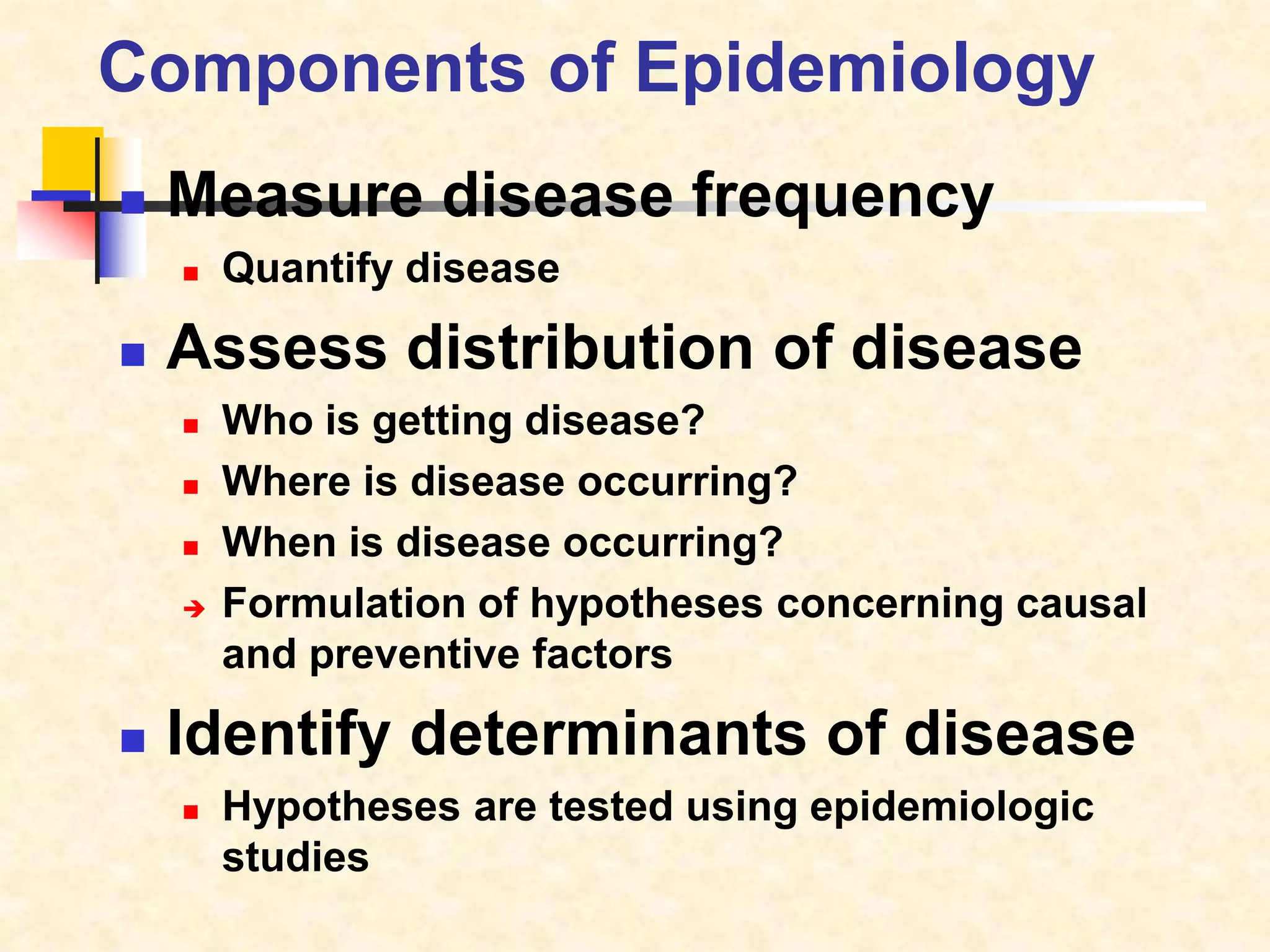
Components of Epidemiology
 Measure disease frequency
 Quantify disease
 Assess distribution of disease
 Who is getting disease?
 Where is disease occurring?
 When is disease occurring?
 Formulation of hypotheses concerning causal
and preventive factors
 Identify determinants of disease
 Hypotheses are tested using epidemiologic
studies
Basic Research Study
Designs and their
Application to Epidemiology
4/24/2022 DR M TAUSEEF JAVED 5
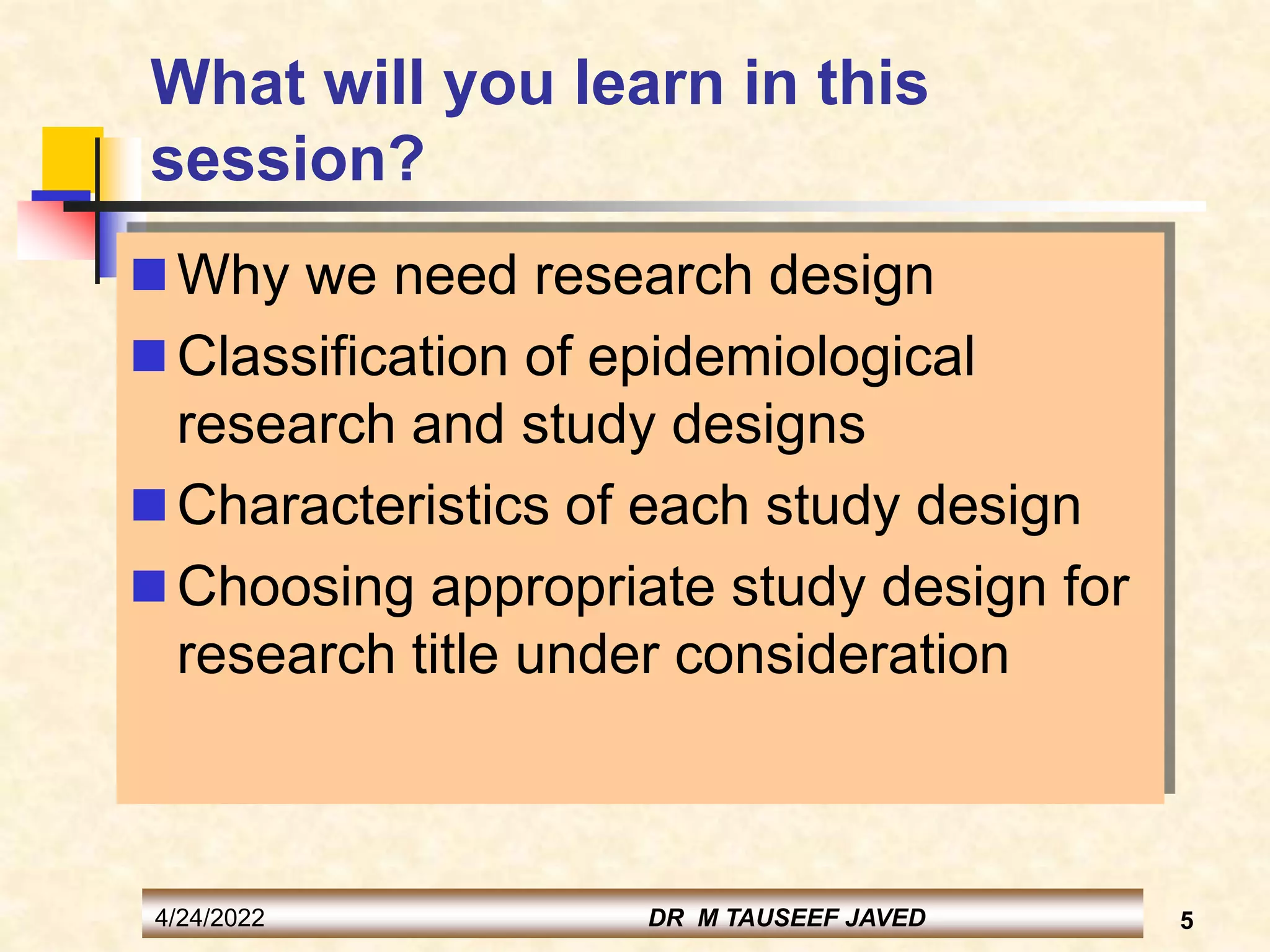
Why we need research design
Classification of epidemiological
research and study designs
Characteristics of each study design
Choosing appropriate study design for
research title under consideration
What will you learn in this
session?
Big Picture
 To prevent and control disease
 In a coordinated plan, look to
 identify hypotheses on what is
related to disease and may be
causing it
 formally test these hypotheses
• Study designs direct how the
investigation is conducted
Study design: Definition
A study design is a specific plan
or protocol for conducting the
study, which allows the
investigator to translate the
conceptual hypothesis into an
operational one.
4/24/2022 DR M TAUSEEF JAVED 8
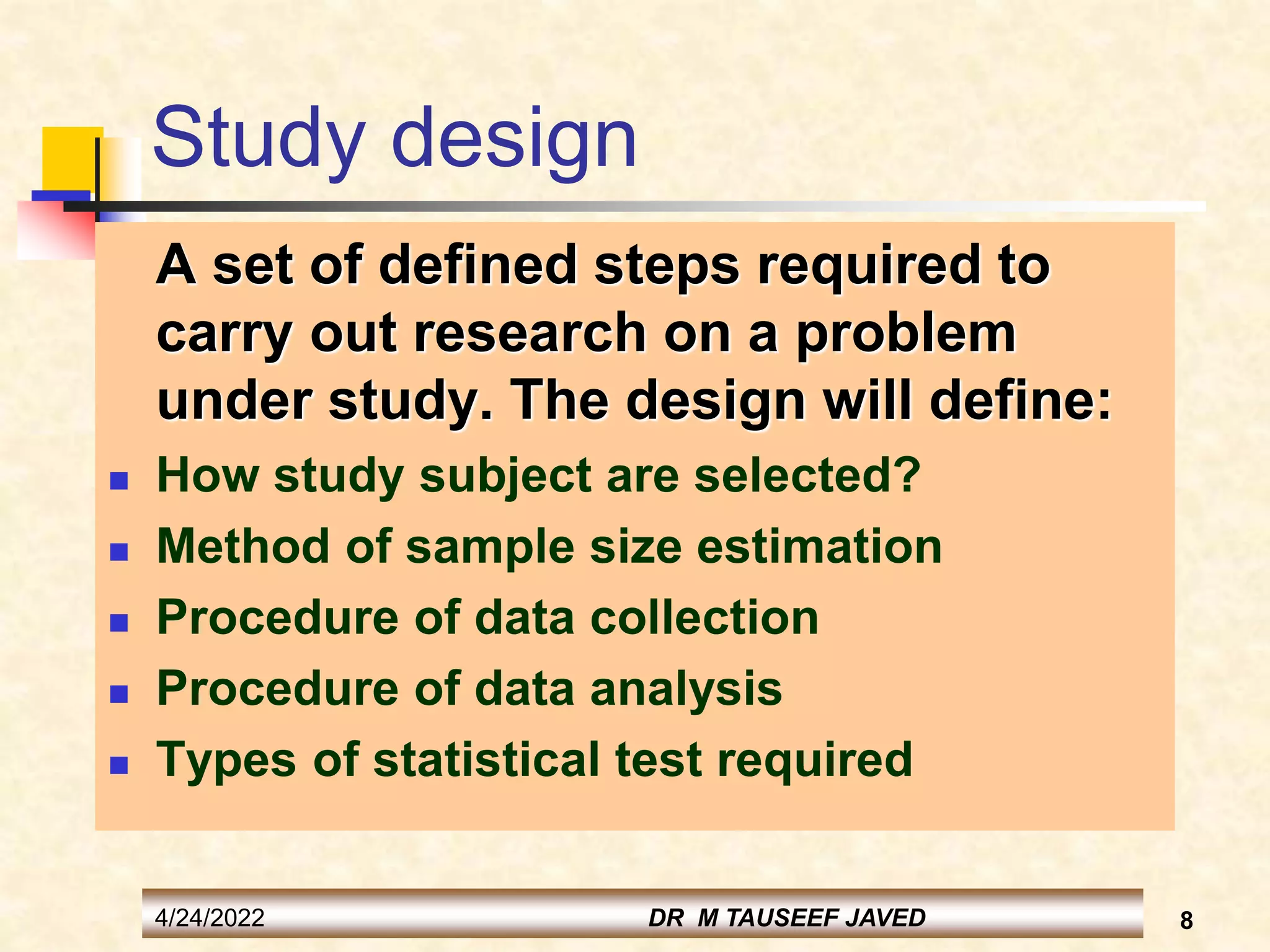
Study design
A set of defined steps required to
carry out research on a problem
under study. The design will define:
 How study subject are selected?
 Method of sample size estimation
 Procedure of data collection
 Procedure of data analysis
 Types of statistical test required
Comparison (I)
Qualitative
 Understanding
 Interview/observation
 Discovering frameworks
 Textual (words)
 Theory generating
 Quality of informant more
important than sample size
 Subjective
 Embedded knowledge
 Models of analysis: fidelity
to text or words of
interviewees
Quantitative
 Prediction
 Survey/questionnaires
 Existing frameworks
 Numerical
 Theory testing (experimental)
 Sample size core issue in
reliability of data
 Objective
 Public
 Model of analysis:parametric,
non-parametric
Comparison (II)
Quantitative
 Methods
 Observational
 Experimental
 Mixed
 Sampling: Random
(simple, stratified,
cluster, etc) or
purposive
 Quality Assurance:
 Reliability: Internal and
External
 Validity: Construct,
Content, Face
Qualitative
 Methods
 Focus Groups
 Interviews
 Surveys
 Self-reports
 Observations
 Document analysis
 Sampling: Purposive
 Quality Assurance:
 Trustworthiness:
Credibility,
Confirmability,
Dependability,
Transferability
 Authenticity: Fairness,
Ontological, Educative,
Tactical, Catalytic
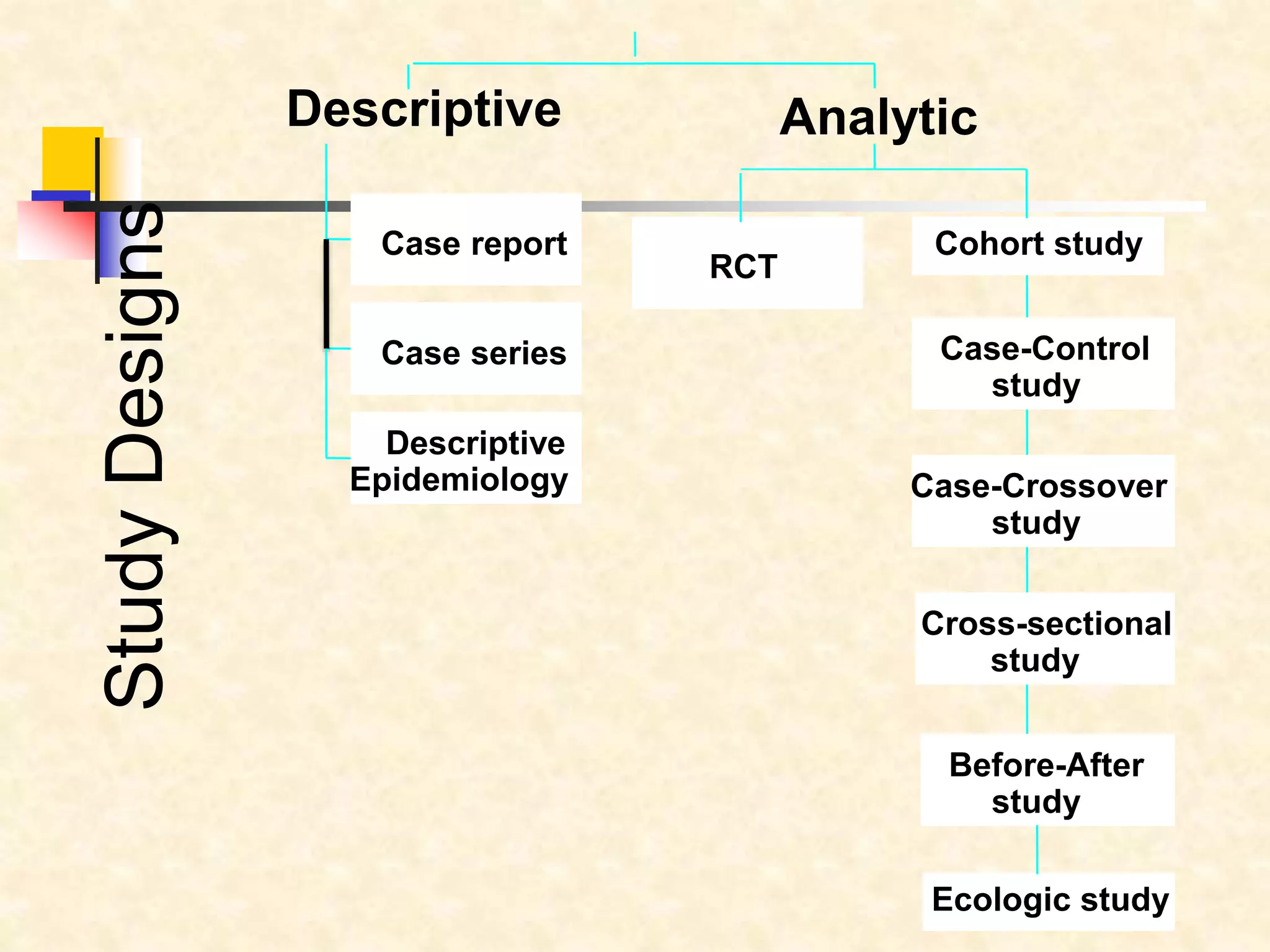
Case report
Case series
Descriptive
Epidemiology
Descriptive
RCT
Before-After
study
Cross-sectional
study
Case-Crossover
study
Case-Control
study
Cohort study
Analytic
Ecologic study
4/24/2022 DR M TAUSEEF JAVED 12
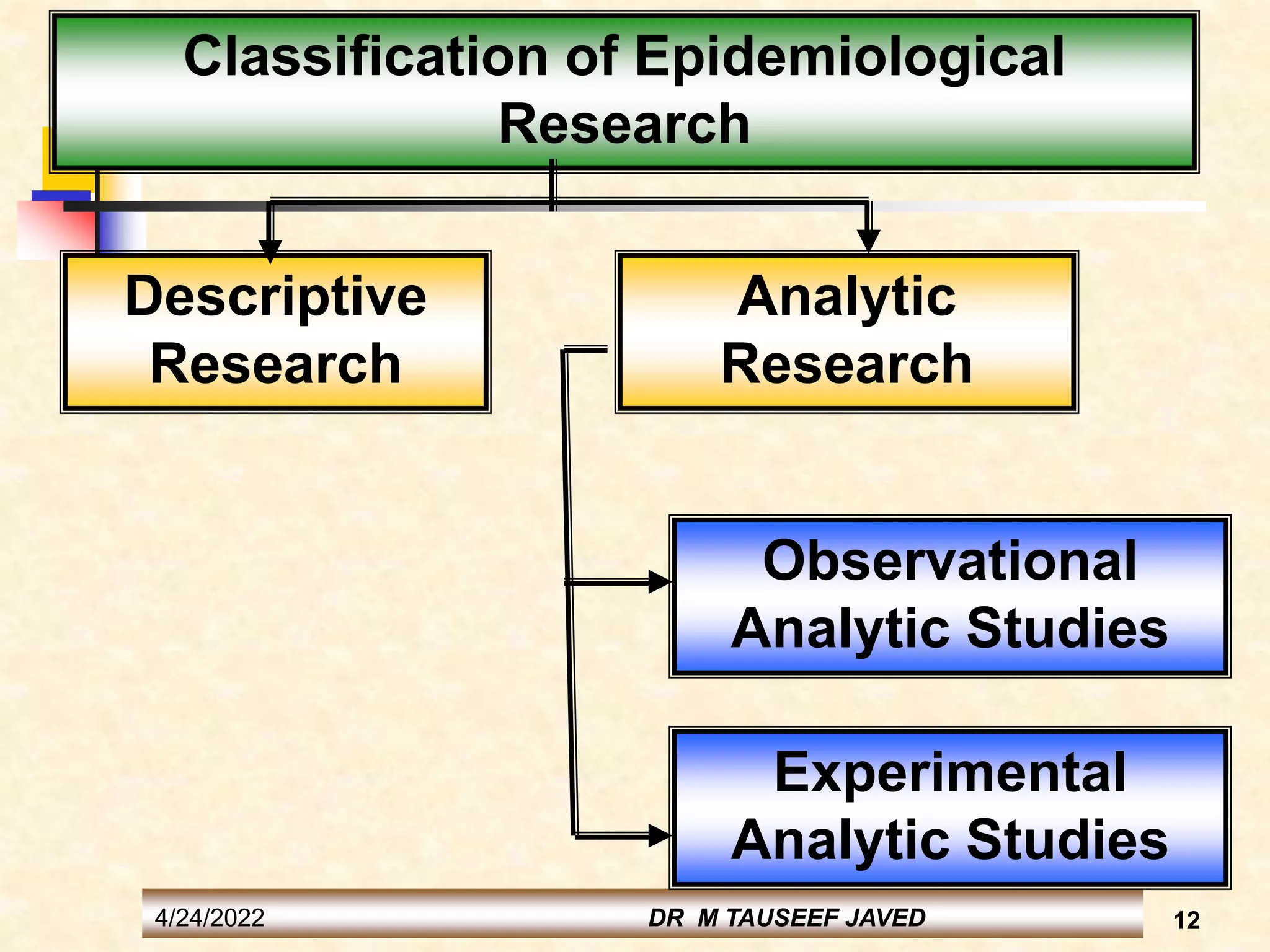
Classification of Epidemiological
Research
Descriptive
Research
Analytic
Research
Observational
Analytic Studies
Experimental
Analytic Studies
4/24/2022 DR M TAUSEEF JAVED 13
Objectives at various levels
DESCRIPTIVE STUDIES
1. Knowing the frequency of disease
2. Knowing the distribution
3. Developing the hypothesis
OBSERVATIONAL
ANALYTICAL
1. Testing the hypothesis
2. Establishing association
EXPERIMENTAL OR
INTERVENTIONAL STUDIES
1. Strengthening association
2. Establishing the cause
Study Types Objectives
4/24/2022 DR M TAUSEEF JAVED 14
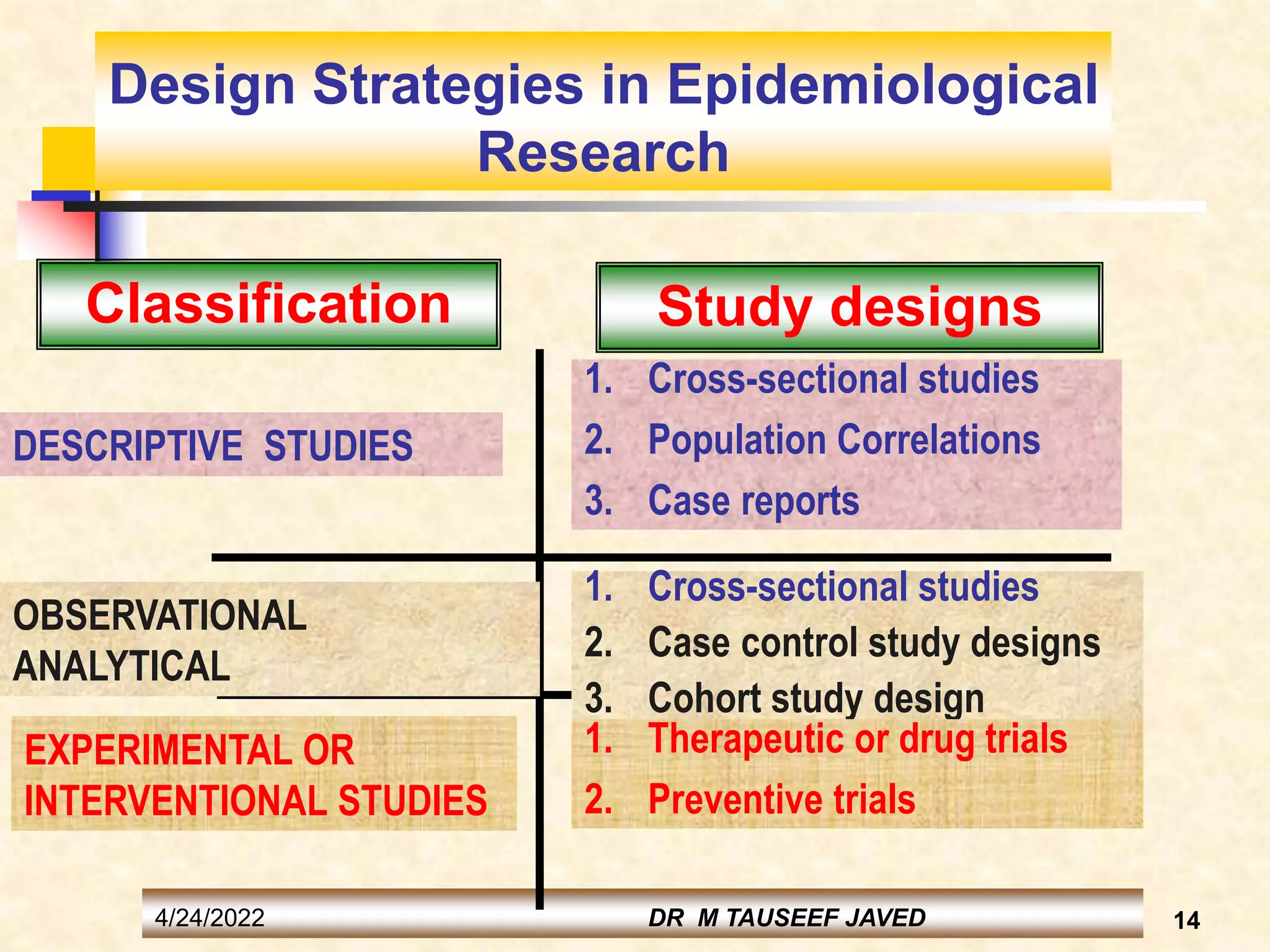
Design Strategies in Epidemiological
Research
DESCRIPTIVE STUDIES
1. Cross-sectional studies
2. Population Correlations
3. Case reports
OBSERVATIONAL
ANALYTICAL
1. Cross-sectional studies
2. Case control study designs
3. Cohort study design
EXPERIMENTAL OR
INTERVENTIONAL STUDIES
1. Therapeutic or drug trials
2. Preventive trials
Classification Study designs
Timeframe of Studies
 Prospective Study - looks forward,
looks to the future, examines future
events, follows a condition,
concern or disease into the future
time
Study begins here
Timeframe of Studies
 Retrospective Study - “to look
back”, looks back in time to study
events that have already occurred
time
Study begins here
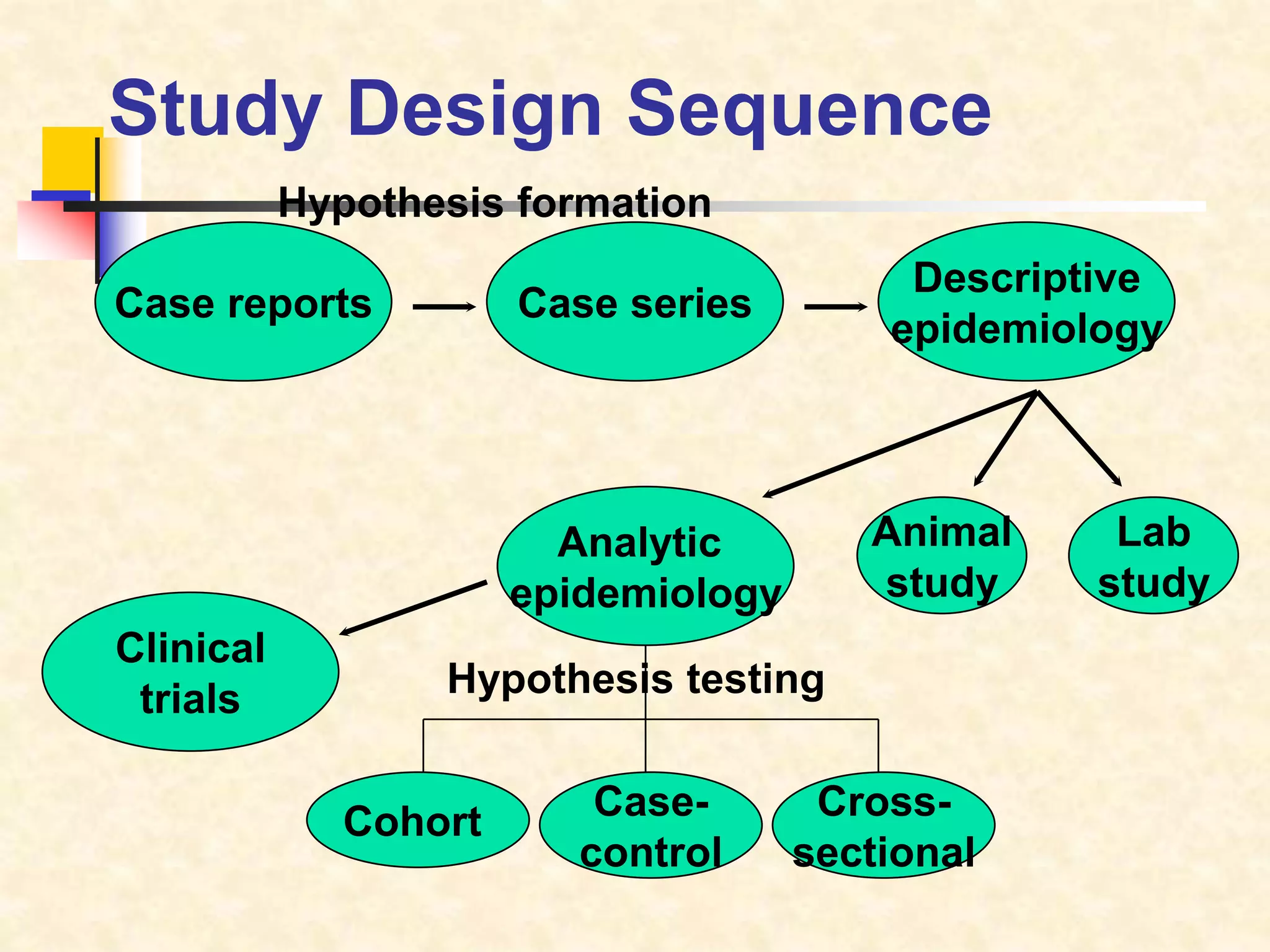
Study Design Sequence
Case reports Case series
Descriptive
epidemiology
Analytic
epidemiology
Clinical
trials
Animal
study
Lab
study
Cohort Case-
control
Cross-
sectional
Hypothesis formation
Hypothesis testing
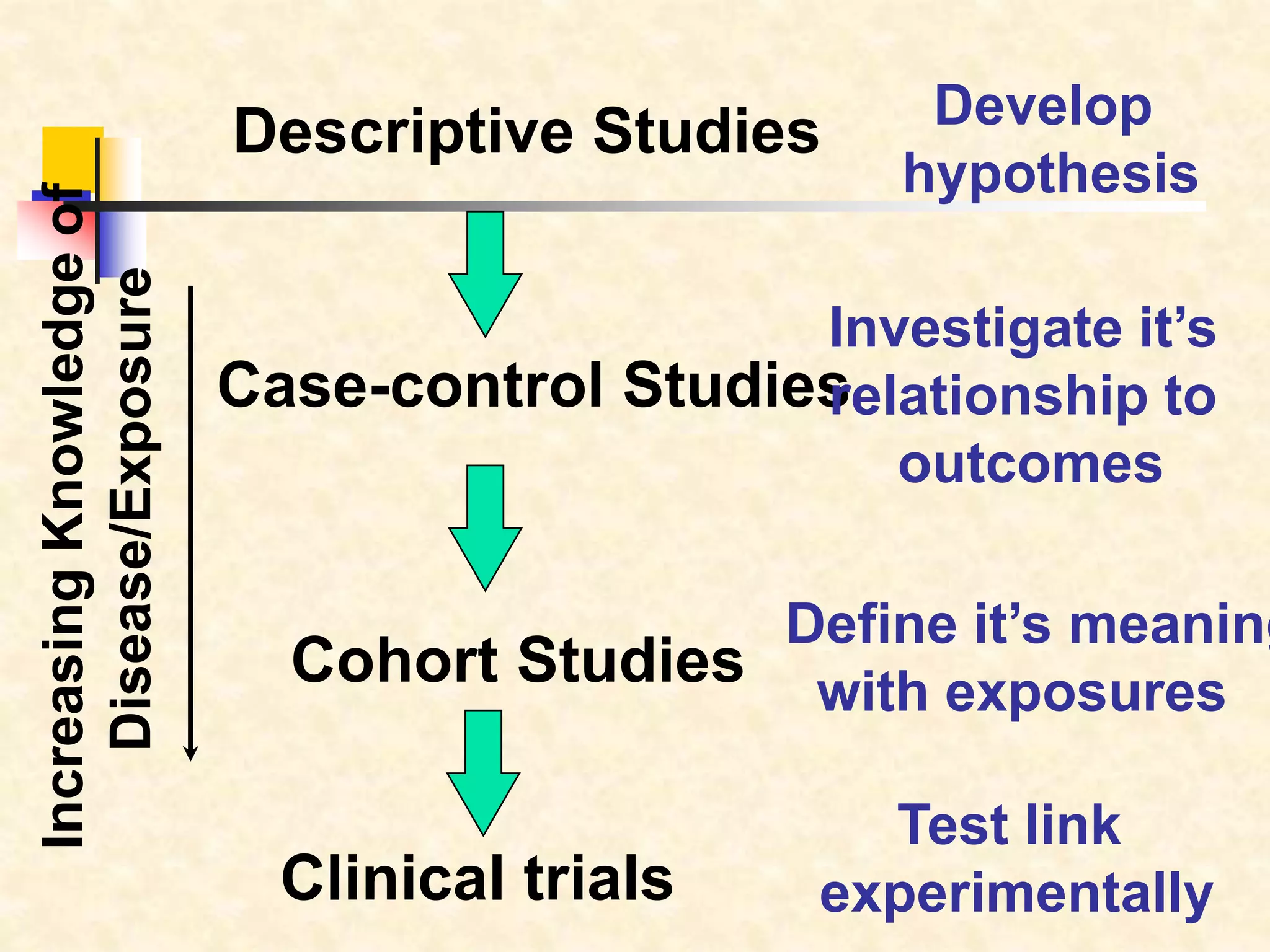
Descriptive Studies
Case-control Studies
Cohort Studies
Develop
hypothesis
Investigate it’s
relationship to
outcomes
Define it’s meaning
with exposures
Clinical trials
Test link
experimentally
Increasing
Knowledge
of
Disease/Exposure
4/24/2022 DR M TAUSEEF JAVED 19
Assessment of disease profile
among the school children
Study of Immunization Status in
children under 5 years
Evaluation of blood glucose and
cholesterol levels in obese
Prevalence of hepatitis B and C
among in high risk groups
Descriptive study statements
4/24/2022 DR M TAUSEEF JAVED 20
1. Defining the problem under study
2. Defining the population under study
(Concept of denominator)
3. Taking the sample of population
4. Collecting the Data
5. Analyzing interpretation of data
6. Drawing the conclusion
7. Generation of hypothesis
Steps for descriptive research
4/24/2022 DR M TAUSEEF JAVED 21
1. Theoretical definitions
2. Clinical definitions
3. Provisional diagnosis
4. Laboratory diagnosis
What are Operational Definitions
 What is the case definition of tuberculosis?
 What is the case definition of Hepatitis B?
Defining the problem under
study
4/24/2022 DR M TAUSEEF JAVED 22
Defining the population under study
 Geographical bound population
 Age specific population
 Disease specific population
 Occupation specific population
 Hospitalized patients
 Vaccinated un-vaccinated
 Male or Female population
4/24/2022 DR M TAUSEEF JAVED 23
Data Collection Procedure
1. Development of data collection
forms or questionnaire
2. Interview
3. Recording observation /clinical
examinations
4. Examination of records
4/24/2022 DR M TAUSEEF JAVED 24
Primary and Secondary Data
Data specifically collected for the
problem under study is primary data
Using already collected data or other
data sources for research purpose
4/24/2022 DR M TAUSEEF JAVED 25
Primary Data
Merits Demerits
1. Data forms are objectively
designed
2. No chances of missing
information's
3. Data is uniform
4. Data is easy to analyze
5. Data is valid hence
research is valid
1. Data is not readily
available
2. Cost and logistics
3. Data collection is time-
consuming
4/24/2022 DR M TAUSEEF JAVED 26
Secondary Data Sources
 Census data
 Birth and death records
 Clinical records
 Employment records
 HMIS data
 Surveys
4/24/2022 DR M TAUSEEF JAVED 27
Secondary Data
Merits Demerits
1. Readily available data
2. Saving of time in data
collection
3. Saving the cost of data
collection
1. Data is not objectively
collected
2. Required information may
be missing
3. Data is not uniform
4. Poor quality data
5. Difficult to analyze
6. Data is less valid hence
research is less valid
4/24/2022 DR M TAUSEEF JAVED 28
Data Analysis
 Finding the frequency
 Finding the percentages
 Tabulation
 Graphical presentation
4/24/2022 DR M TAUSEEF JAVED 29
Frequency Distribution
Scabies Frequency Percentage
Urban 20 20.00
Slums 56 56.00
Rural 24 24.00
Total 100 100.00%
Dr. M. Ashraf Majrooh
4/24/2022 DR M TAUSEEF JAVED 30
Arranging the data by person,place
and time
 Frequency among male & female
 Frequency among white & black
 Frequency among rural & urban
 Frequency in Asia & Europe
 Frequency in winter & summer
 Month-wise frequencies
 Year-wise frequencies
4/24/2022 DR M TAUSEEF JAVED 31
Drawing the conclusion
 Frequency is more in male than
female
 Frequency is more in urban or rural
 Frequency is more in winter than
summer
4/24/2022 DR M TAUSEEF JAVED 32
Hypothesis Formulation
 Method of difference
Difference of frequencies in two sets of
circumstances
 Method of agreement
A single factor is common in number
circumstances in which disease occurs
with high frequencies
 Method of Concomitant variations
Frequency of factor varies with frequency of
disease
Case Reports
 Detailed presentation of a single
case or handful of cases
 Generally report a new or unique
finding
 e.g. previous undescribed disease
 e.g. unexpected link between
diseases
 e.g. unexpected new therapeutic
effect
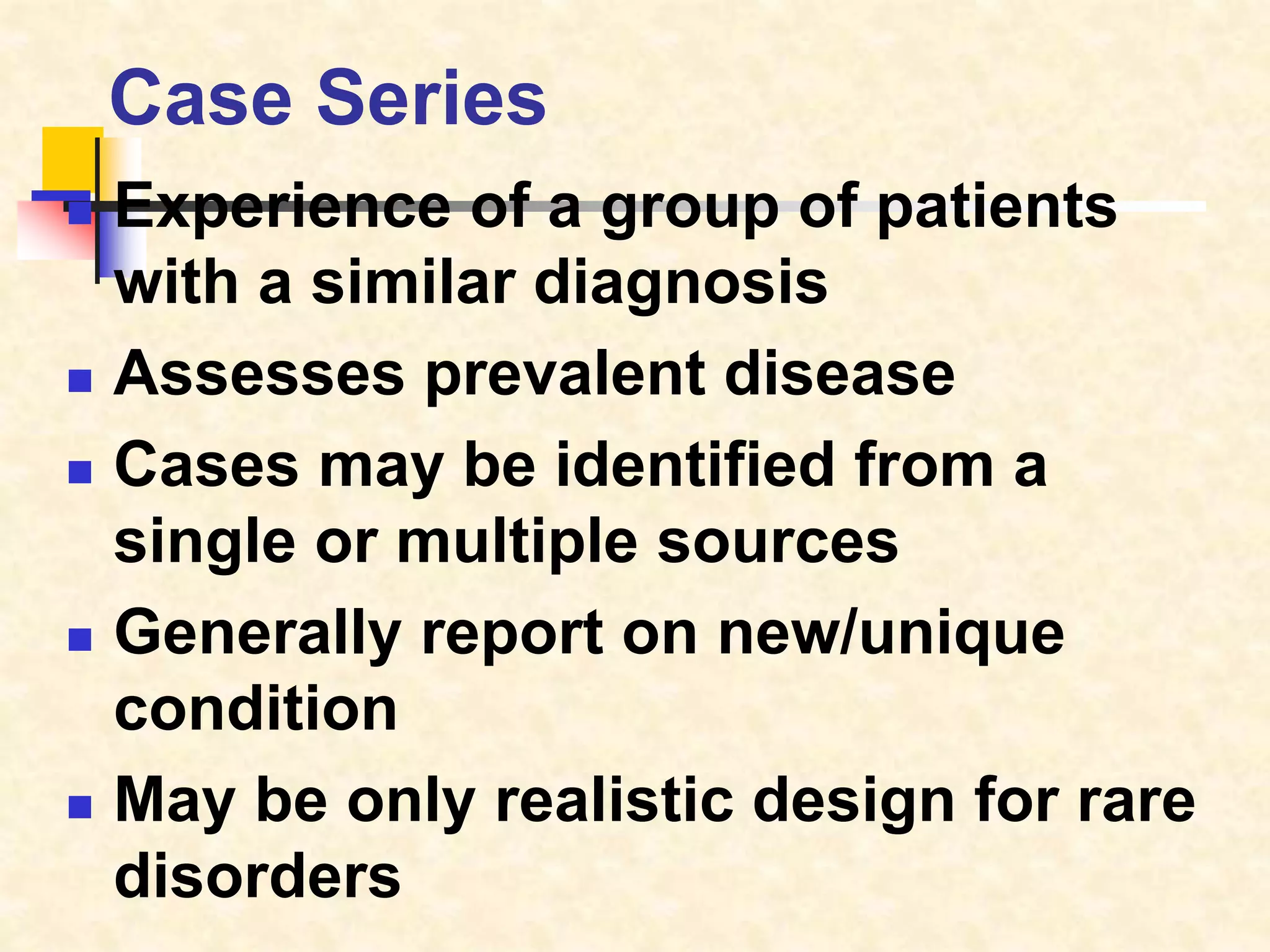
Case Series
 Experience of a group of patients
with a similar diagnosis
 Assesses prevalent disease
 Cases may be identified from a
single or multiple sources
 Generally report on new/unique
condition
 May be only realistic design for rare
disorders
Case Series
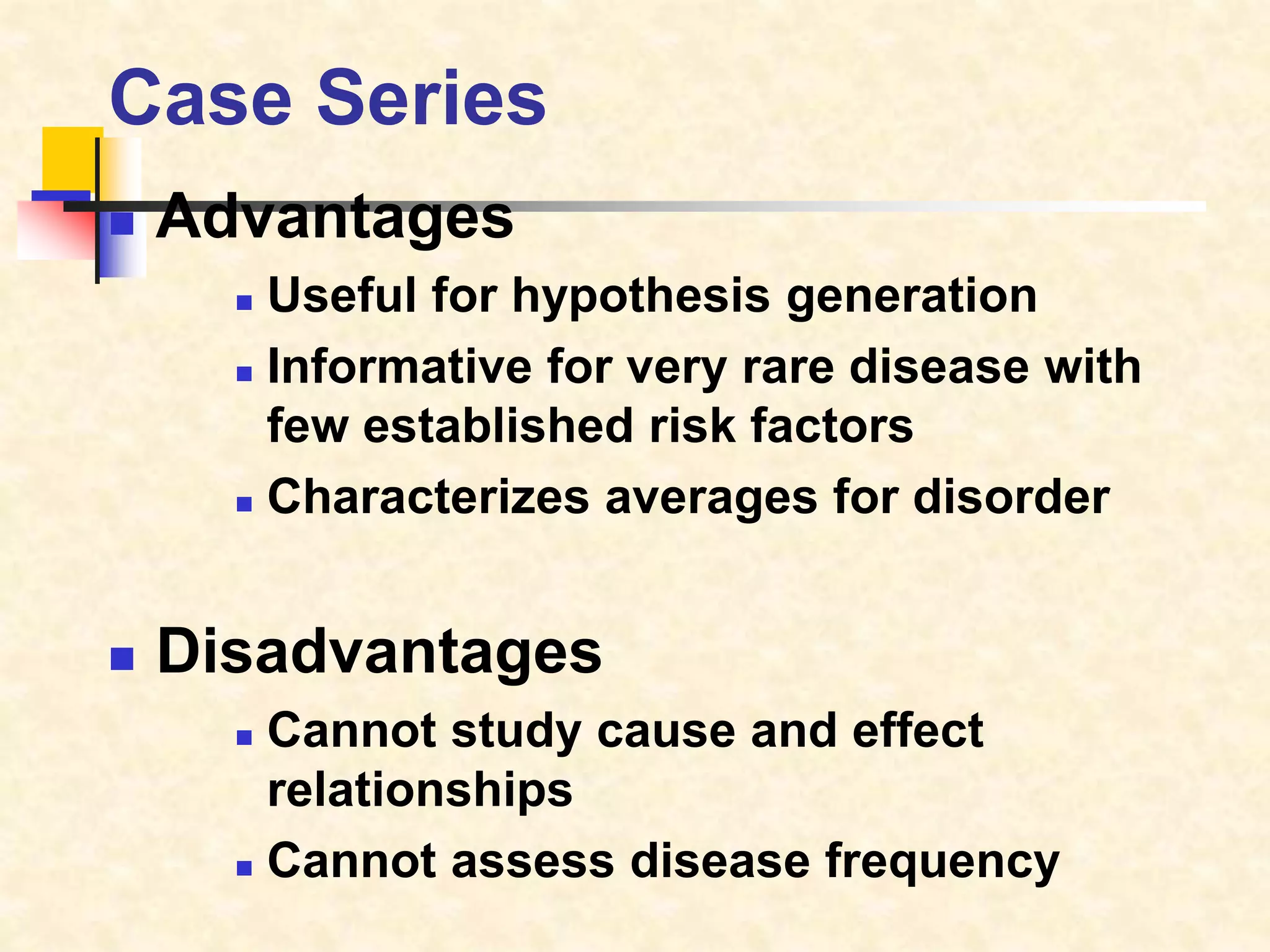
 Advantages
 Useful for hypothesis generation
 Informative for very rare disease with
few established risk factors
 Characterizes averages for disorder
 Disadvantages
 Cannot study cause and effect
relationships
 Cannot assess disease frequency
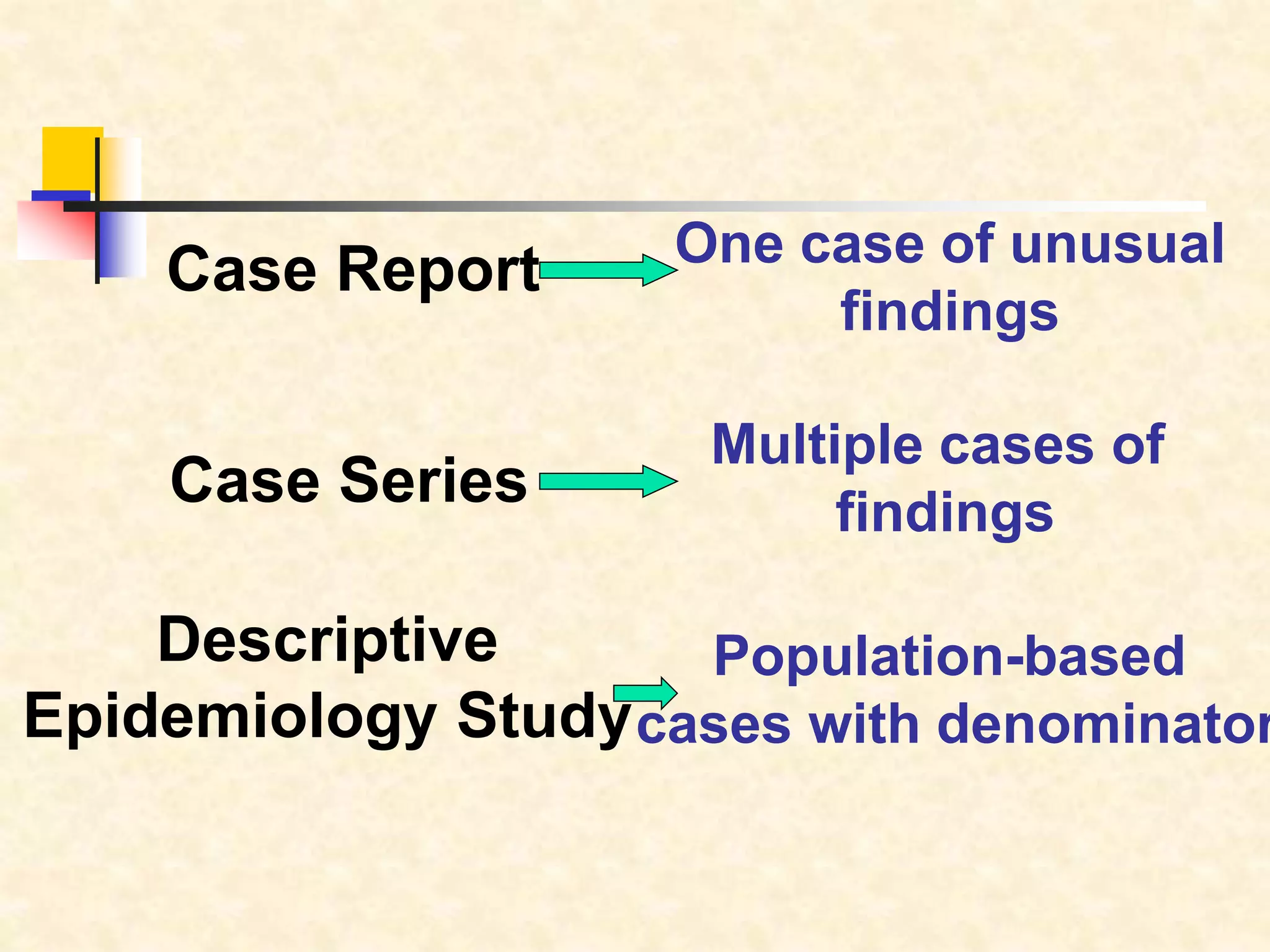
Case Report
Case Series
Descriptive
Epidemiology Study
One case of unusual
findings
Multiple cases of
findings
Population-based
cases with denominator
4/24/2022 DR M TAUSEEF JAVED 37
 The population is examined in single point of time
or it is snap-short of the situation
 Both the exposure and the disease are assessed
at the same time
 Population as whole or representative sample of
the population is studied
 The studies are unable to explain the time
association of the disease
 These studies are less time consuming as
compared to longitudinal studies
 Important cross-sectional surveys in Pakistan
were, PIHS, MICS, PDS etc.
Salient features of cross-
sectional studies
Thanks for your kind
attention
and listening
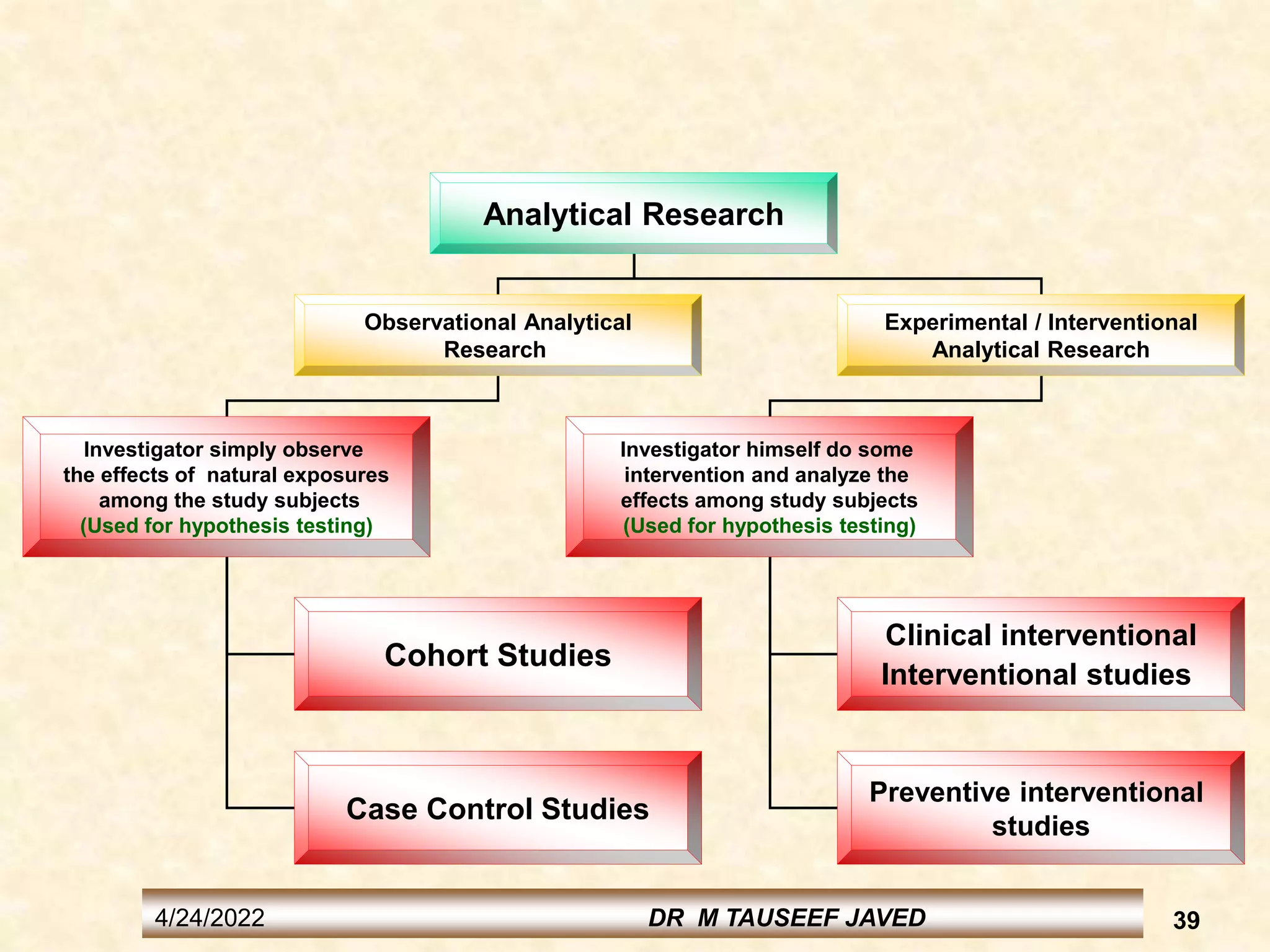
Analytical Research
Observational Analytical
Research
Experimental / Interventional
Analytical Research
Investigator simply observe
the effects of natural exposures
among the study subjects
(Used for hypothesis testing)
Investigator himself do some
intervention and analyze the
effects among study subjects
(Used for hypothesis testing)
Cohort Studies
Case Control Studies
Clinical interventional
Interventional studies
Preventive interventional
studies
4/24/2022 39
DR M TAUSEEF JAVED
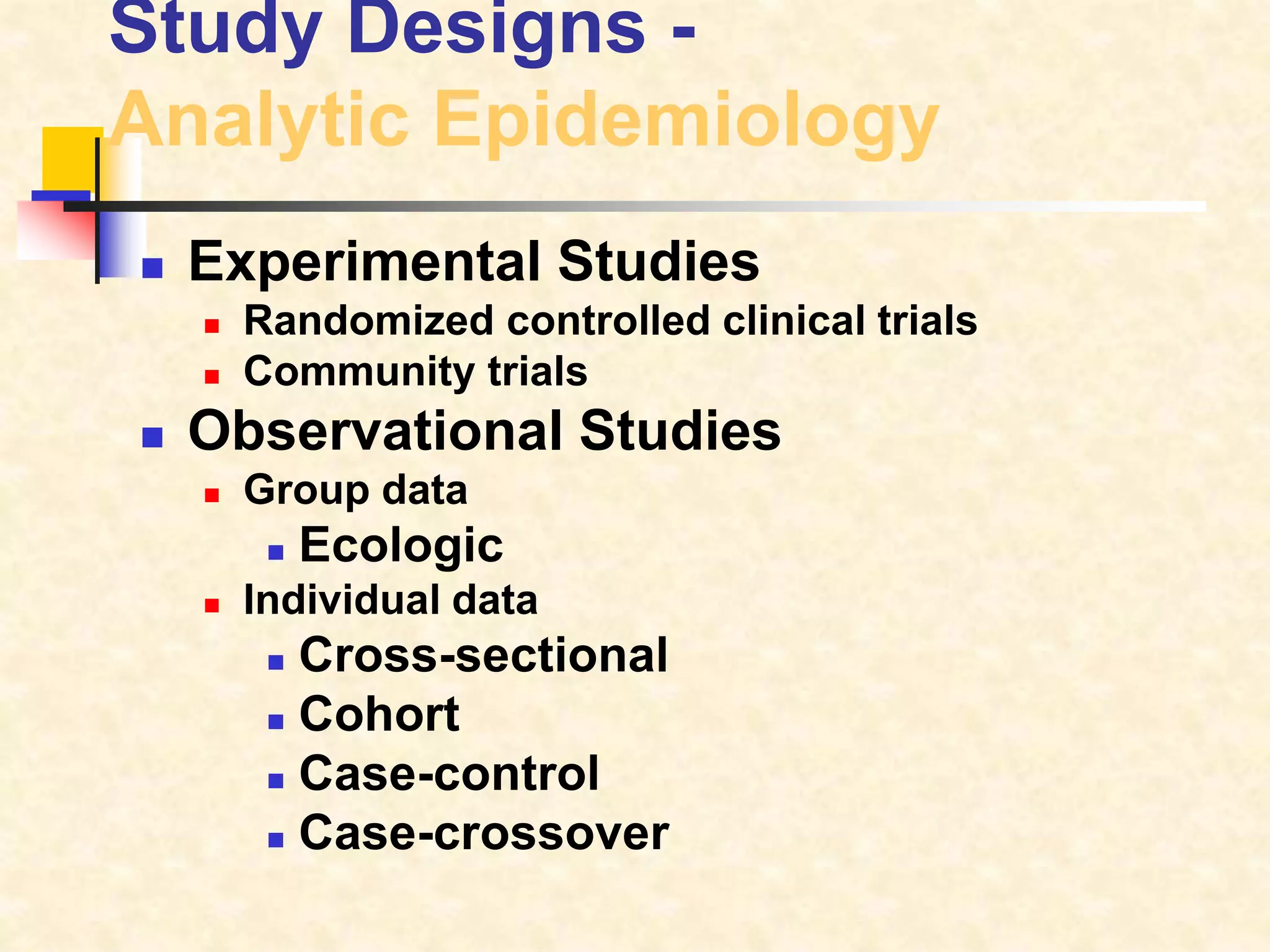
Study Designs -
Analytic Epidemiology
 Experimental Studies
 Randomized controlled clinical trials
 Community trials
 Observational Studies
 Group data
 Ecologic
 Individual data
 Cross-sectional
 Cohort
 Case-control
 Case-crossover
4/24/2022 DR M TAUSEEF JAVED 41
Observational Analytic
Study Designs
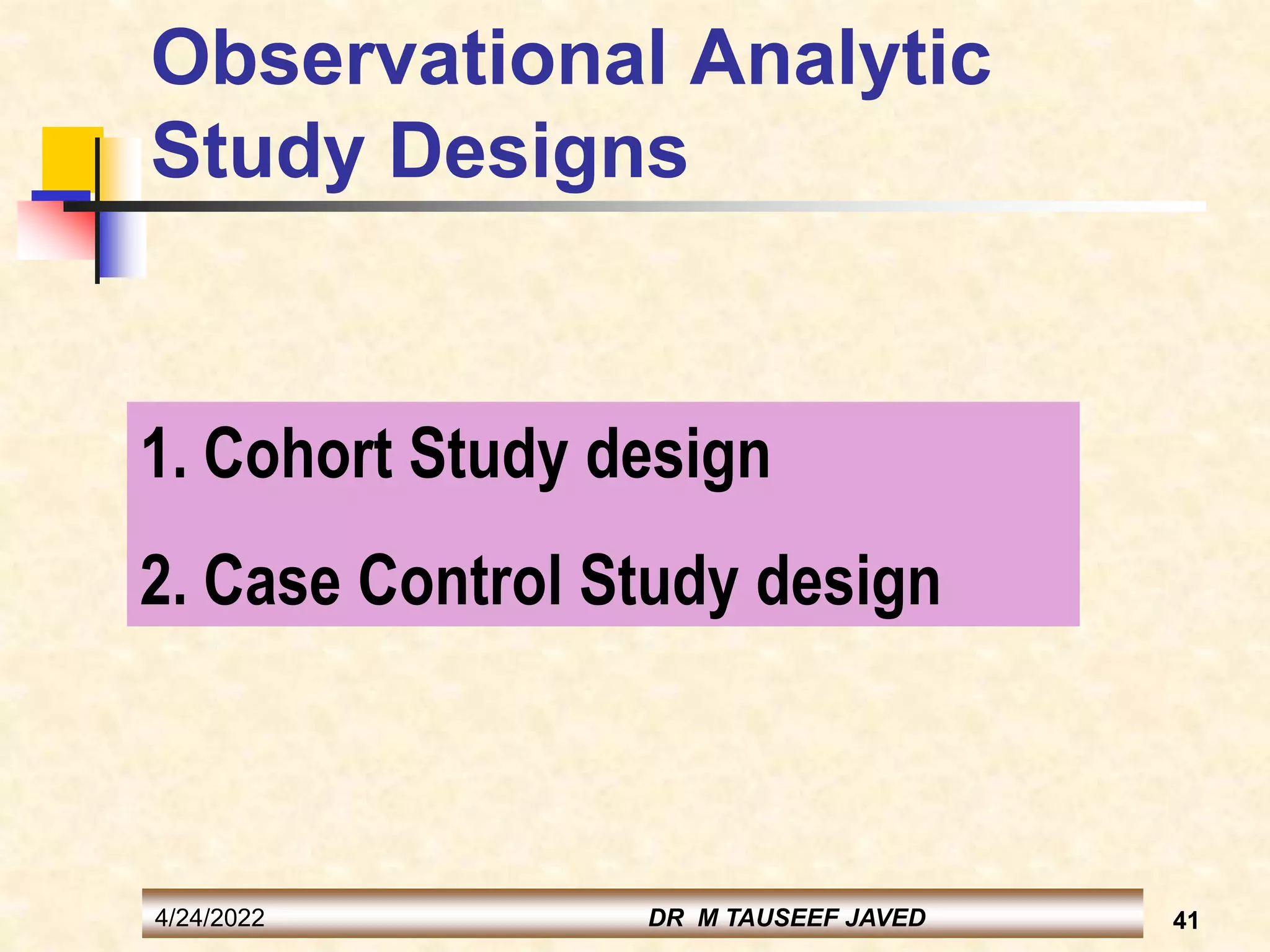
1. Cohort Study design
2. Case Control Study design
4/24/2022 DR M TAUSEEF JAVED 42
What is cohort?
A group of people sharing a common
event or characteristic
The name of the cohort is given on the
basis of event the people share
 Birth cohort
 Enrolment cohort
 Atomic explosion cohort
 Occupational cohorts
4/24/2022 DR M TAUSEEF JAVED 43
Consider the following
statements
 Hypertension is more common
among the obese persons?
 Physical activity is protective factor
against CHD?
 Ionizing radiation causes blood
cancer, infertility, congenital
anomalies?
4/24/2022 DR M TAUSEEF JAVED 44
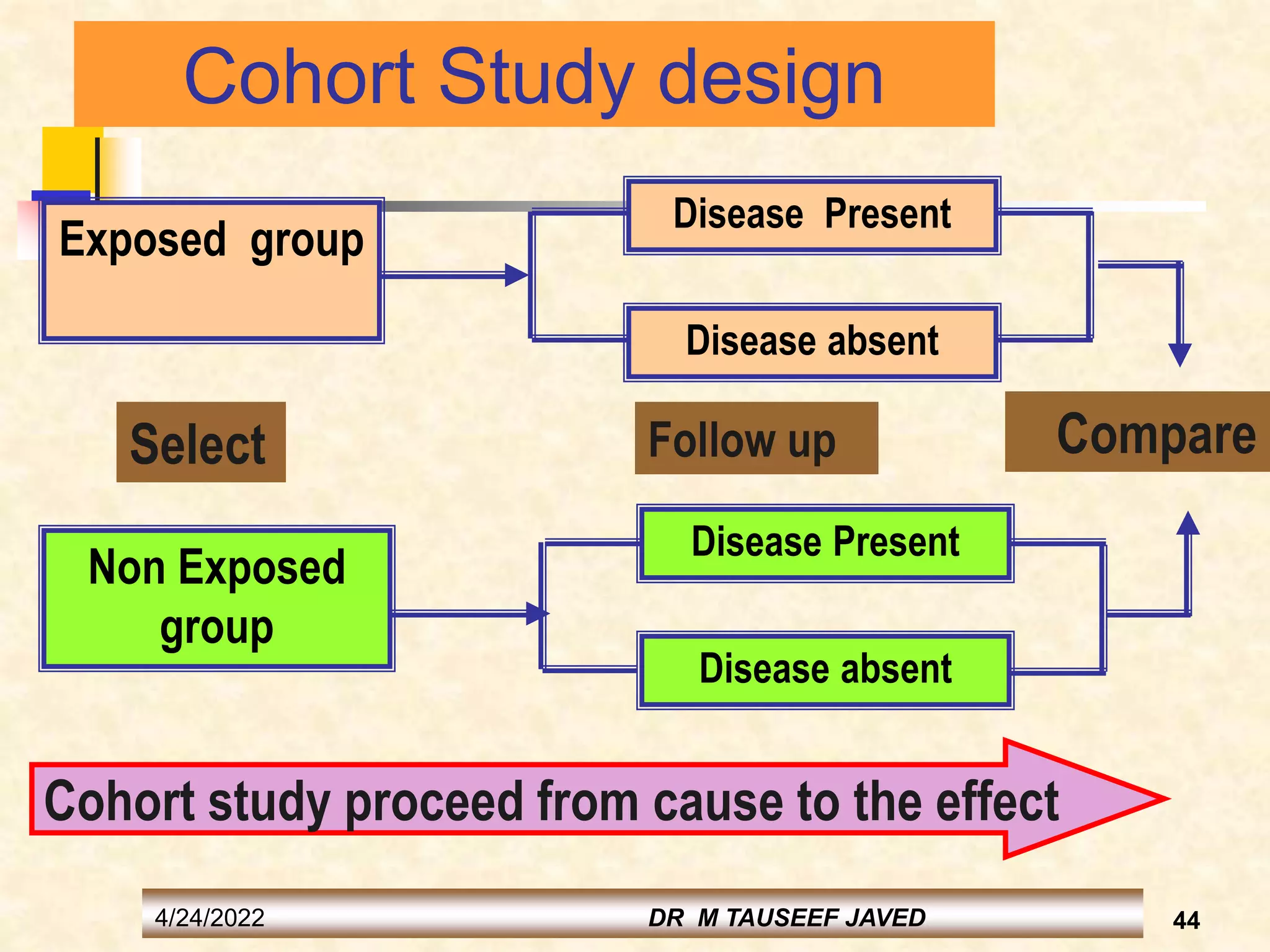
Cohort Study design
Compare
Non Exposed
group
Disease Present
Disease absent
Exposed group
Disease Present
Disease absent
Select
Cohort study proceed from cause to the effect
Follow up
4/24/2022 DR M TAUSEEF JAVED 45
Steps of Cohort Study
1. Selection of exposed population
2. Selection of comparison group
3. Defining and measuring of
exposure
4. Follow-up of both groups
5. Assessment of outcome (Effects)
6. Analysis
7. Scope and limitations
4/24/2022 DR M TAUSEEF JAVED 46
Selection of Exposed
Population
 What do you mean by exposure?
 Give some examples of exposures?
4/24/2022 DR M TAUSEEF JAVED 47
Exposure Groups
Same population is segregated between
exposed and non exposed groups
♣ Smokers and non-smokers
♣ Diabetic verses non- diabetic
♣ Active verses sedentary workers
♣ Special exposure groups
♣ Rubber processing
♣ Uranium mining, coal-mining
4/24/2022 DR M TAUSEEF JAVED 48
Exposure Groups
Comparison within the same population
with different levels of exposures
 Non-smokers
 Casual smokers
 Regular smokers
 Chain smokers
Multiple Comparison groups
4/24/2022 DR M TAUSEEF JAVED 49
Sources of exposure
information
 Information from records
 Interview of cohort members
 Medical examination
 Biochemical assessment
 Information and measurement from
environment
4/24/2022 DR M TAUSEEF JAVED 50
Categorization of exposure
status
 Length of employment e.g. 5,10,15, years
 Numbers of cigarette per day
 Distance from the source
 Biological levels of exposure, cholesterol
level, blood sugar level, blood pressure
 Environmental levels, Chemical levels,
Radiation levels
4/24/2022 DR M TAUSEEF JAVED 51
Assessment and measurement of
outcome or effect of exposure
Effect with fatal
outcome
 Medical certificate
 Hospital records
 Physician autopsy
 Visual certainty
 Postmortem
Non-fatal outcome
 Physician records
 Hospital records
 Discharge certificates
 Special registrations
 Pathological reports
 Periodic medical
examination of cohort
4/24/2022 DR M TAUSEEF JAVED 52
Analysis of Cohort study
♣ Disease Rate or Incidence among the exposed
♣ Disease Rate or Incidence among the non-
exposed
RELATIVE RISK (Risk Ratio)
Incidence of disease among the exposed
(having the risk factor)
Incidence among the non-exposed
(not having the risk factor)
Relative Risk =
4/24/2022 DR M TAUSEEF JAVED 53
Interpretation of Relative Risk
 What do you understand by RR= 1 ?
 What do you understand by RR= 3 ?
 What is your opinion if RR is less
than 1
4/24/2022 DR M TAUSEEF JAVED 54
Scope of cohort study design
 It is important to study the rare exposures
 Can examine multiple effect of a single
exposure
 Can elucidate time relationship between
exposure and the disease
 Allows direct measurement of incidence of
disease in exposed and non-exposed
group
4/24/2022 DR M TAUSEEF JAVED 55
Limitations
 Is inefficient design for evaluation of
rare diseases
 If prospective it is extremely
expensive and time consuming
 If retrospective it requires the
availability of adequate records
4/24/2022 DR M TAUSEEF JAVED 56
Case Control Study design
Non-diseased
Exposure Present
Exposure absent
Diseased
Exposure Present
Exposure absent
Compare
Case control study proceed from effect to the cause
Select
Trace back
4/24/2022 DR M TAUSEEF JAVED 57
Case Control Study Steps
1. Definition of cases
2. Selection of cases
3. Selection of Controls
4. Ascertainment of exposure status
5. Analysis
6. Conclusion and interpretation
4/24/2022 DR M TAUSEEF JAVED 58
Defining the cases
 How will you define poliomyelitis?
 What is acute flaccid paralysis (AFP)
 Is AFP is Poliomyelitis
 What is WHO Criteria of
poliomyelitis?
 Case definition of Tuberculosis
 Cases should be representative of all
diseased
4/24/2022 DR M TAUSEEF JAVED 59
Selection of Cases
 Preferably new cases or incident
cases
 Prevalent cases (cases already
present)
 Random selection
 Convenient selection
4/24/2022 DR M TAUSEEF JAVED 60
Control
Control must be Ideally matching
with the cases by age, sex and other
characteristics except the control
must not be suffering from diseases
4/24/2022 DR M TAUSEEF JAVED 61
Criteria for control
 Marching by all respect with cases
except not having disease
 Hospital controls
 Neighborhoods controls
 Friends and relatives
 Controls from general population
4/24/2022 DR M TAUSEEF JAVED 62
Methods of selection of control
 Random Selection
 Convenient Selection
 What should be the ratio between
cases and control?
4/24/2022 DR M TAUSEEF JAVED 63
Ascertainment of Exposure
1. Setting the criteria for exposure
2. Methods of measuring the
exposures
a) Observation
b) Interviews
c) Questionnaire
d) Examination of records
4/24/2022 DR M TAUSEEF JAVED 64
Analysis
1. Exposure Rates among the
disease (Cases)
2. Exposure Rates among the non-
disease (Control)
3. Odd’s Ratio
4/24/2022 DR M TAUSEEF JAVED 65
Limitations
 Is an inefficient design for evaluation
of rare exposure
 Incidence rate cannot be computed
 Time relationship cannot be
estimated
 This study design is more prone to
bias
4/24/2022 DR M TAUSEEF JAVED 66
Scope of case control study design
 It is quick and inexpensive as
compared to other analytic study
designs
 It is particularly suitable for evaluation
of diseases with long latent periods
 It is optimum design for rare diseases
4/24/2022 DR M TAUSEEF JAVED 67
Experimental Analytic Studies
Experimental analytic are exposure
based and the exposure is introduced
by the Investigator
Objectives
 Scientific proof of etiological or risk factor
 Effectiveness/ efficacy of drugs, vaccine and
health services
 Completion of natural history of disease
4/24/2022 DR M TAUSEEF JAVED 68
Experimental analytic
research
Randomized
Control Trials
1. Non-randomized
Trials
2. Uncontrolled
Trials
Can you give example of randomized control and
non-randomized trials?
4/24/2022 DR M TAUSEEF JAVED 69
Steps of experimental /
interventional research
1. Drawing a study protocol
2. Selection of Reference population
3. Selection of Study population
4. Randomization
5. Intervention or Manipulating
6. Follow up
7. Assessment of Outcome
8. Analysis and interpretation of results
4/24/2022 DR M TAUSEEF JAVED 70
Research protocol?
 A lay down procedure for conduction of
study it addresses the
Design issues
Inclusion criteria and exclusion criteria
Blinding (Single, double, or triple blinding)
Outcome criteria
Duration of follow-up
Ethical issues
Dr. M Ashraf Majrooh
4/24/2022 DR M TAUSEEF JAVED 71
Reference population?
 The population to which the results
of the study are to be applied
All human being if study is
universally applicable
Geographically bound population
Age specific population
Gender specific population
Other characteristics
4/24/2022 DR M TAUSEEF JAVED 72
Study population?
 The selected individuals which are
actually enrolled for experimental
study
Eligible population
Eligible but not willing for participation
Eligible and willing for participation
If you lay down some inclusion criteria, the cases
fulfilling that criteria will be eligible
The subject who give consent are the willing subjects
4/24/2022 DR M TAUSEEF JAVED 73
Experimental population
potentially eligible
Unwilling
Completed screening Ineligible
Reference Population
Study subjects
(Willing and eligible)
4/24/2022 DR M TAUSEEF JAVED 74
Grouping and Randomization
1. Experimental Group
2. Control Group
Interventions/treatments are assigned
randomly
Every individual in study population has the
equal probability to go in to experimental and
control groups is the Randomization
Step-4
Experimental population
potentially eligible Unwilling
Completed screening Ineligible
Willing and eligible
participants
Reference Population
Control
Group
Experimental
Group
4/24/2022 75
DR M TAUSEEF JAVED
4/24/2022 DR M TAUSEEF JAVED 76
Study Population
Control
Group
Experimental
Group
Is it Randomization?
4/24/2022 DR M TAUSEEF JAVED 77
Randomization
Study Population
Control
Group
Experimental
Group
4/24/2022 DR M TAUSEEF JAVED 78
Advantages of randomization
 To provide the comparability by age sex
and other characteristics
 Prevent potential bias from investigator
side
 Confounding variables are equally
distributed
 Give more authenticity to study
4/24/2022 DR M TAUSEEF JAVED 79
What is intervention or
manipulation?
 Clinical Trials
 Preventive Trials
 Behavioral modification or risk
factor trials
 Cessation Trials
4/24/2022 DR M TAUSEEF JAVED 80
Follow up and compliance
 By history and clinical examinations
 Disputable outcomes (Subjective
symptoms) relief of pain,
 Non-disputably out comes
(Systemic findings)
4/24/2022 DR M TAUSEEF JAVED 81
Ascertainment of outcome
 Positive outcome
If we are looking for beneficial outcome of
and intervention
 Negative Outcome
If we are looking for adverse effects of an
intervention
4/24/2022 DR M TAUSEEF JAVED 82
Analysis
 Incidence of outcome in experimental
group
 Incidence of outcome in control group
 If incidence of outcome are significantly
more among the experimental group our
hypothesis is correct and vice versa
4/24/2022 DR M TAUSEEF JAVED 83
RR from 2x2 Table
c
c + d
Incidence
among Control =
a
a + b
Incidence among
experimental group =
a/ a+ b
c / c + d
Relative Risk =
4/24/2022 DR M TAUSEEF JAVED 84
What is blinding?
 The subjects are not knowing the group
to which they are belonging This is
single blind (It is not possible for every
trial)
 Neither the subject nor doctor is aware
about the groups (Double blind trials)
 The subject, the doctor and the person
doing the analysis are not aware about
the groups in triple blind trials
4/24/2022 DR M TAUSEEF JAVED 85
Important Issues in experimental
studies
Ethical Issues
Consent Issues
Sufficiently large willing population
required
Maintenance of Compliance
Issues in measurement of outcome
Issues of early termination of trials
Cost Issues
4/24/2022 DR M TAUSEEF JAVED 86
Ethical Issues in human experiments
 The substance already known to be
harmful are not allowed for exposure
 The therapy which are known to be
beneficial are not be disallowed
 Written consent is required from the
subject to be enrolled for study
4/24/2022 DR M TAUSEEF JAVED 87
Assignment (Choosing study design)
 Every participant will phrase 5 research
statements
 Participants will be divided in to groups
 Discuss with each other and choose most
suitable study design for each statement
 Give the important steps of selected study
designs
 Presentation from each group
Thanks for your kind
attention
and listening

Epidemiological study designs

  • 1.
    MBBS.USMLE, DPH, Dip-Card,M.Phil, FCPS Professor Community Medicine Gujranwal Medical College Gujranwala Ex-Professor Community Medicine UmulQurrah University Makka Saudi Arabia DR Muhammad Tauseef Javed 4/24/2022 1
  • 2.
    4/24/2022 DR MTAUSEEF JAVED 2 Study designs in epidemiology
  • 3.
    Components of Epidemiology Measure disease frequency  Quantify disease  Assess distribution of disease  Who is getting disease?  Where is disease occurring?  When is disease occurring?  Formulation of hypotheses concerning causal and preventive factors  Identify determinants of disease  Hypotheses are tested using epidemiologic studies
  • 4.
    Basic Research Study Designsand their Application to Epidemiology
  • 5.
    4/24/2022 DR MTAUSEEF JAVED 5 Why we need research design Classification of epidemiological research and study designs Characteristics of each study design Choosing appropriate study design for research title under consideration What will you learn in this session?
  • 6.
    Big Picture  Toprevent and control disease  In a coordinated plan, look to  identify hypotheses on what is related to disease and may be causing it  formally test these hypotheses • Study designs direct how the investigation is conducted
  • 7.
    Study design: Definition Astudy design is a specific plan or protocol for conducting the study, which allows the investigator to translate the conceptual hypothesis into an operational one.
  • 8.
    4/24/2022 DR MTAUSEEF JAVED 8 Study design A set of defined steps required to carry out research on a problem under study. The design will define:  How study subject are selected?  Method of sample size estimation  Procedure of data collection  Procedure of data analysis  Types of statistical test required
  • 9.
    Comparison (I) Qualitative  Understanding Interview/observation  Discovering frameworks  Textual (words)  Theory generating  Quality of informant more important than sample size  Subjective  Embedded knowledge  Models of analysis: fidelity to text or words of interviewees Quantitative  Prediction  Survey/questionnaires  Existing frameworks  Numerical  Theory testing (experimental)  Sample size core issue in reliability of data  Objective  Public  Model of analysis:parametric, non-parametric
  • 10.
    Comparison (II) Quantitative  Methods Observational  Experimental  Mixed  Sampling: Random (simple, stratified, cluster, etc) or purposive  Quality Assurance:  Reliability: Internal and External  Validity: Construct, Content, Face Qualitative  Methods  Focus Groups  Interviews  Surveys  Self-reports  Observations  Document analysis  Sampling: Purposive  Quality Assurance:  Trustworthiness: Credibility, Confirmability, Dependability, Transferability  Authenticity: Fairness, Ontological, Educative, Tactical, Catalytic
  • 11.
  • 12.
    4/24/2022 DR MTAUSEEF JAVED 12 Classification of Epidemiological Research Descriptive Research Analytic Research Observational Analytic Studies Experimental Analytic Studies
  • 13.
    4/24/2022 DR MTAUSEEF JAVED 13 Objectives at various levels DESCRIPTIVE STUDIES 1. Knowing the frequency of disease 2. Knowing the distribution 3. Developing the hypothesis OBSERVATIONAL ANALYTICAL 1. Testing the hypothesis 2. Establishing association EXPERIMENTAL OR INTERVENTIONAL STUDIES 1. Strengthening association 2. Establishing the cause Study Types Objectives
  • 14.
    4/24/2022 DR MTAUSEEF JAVED 14 Design Strategies in Epidemiological Research DESCRIPTIVE STUDIES 1. Cross-sectional studies 2. Population Correlations 3. Case reports OBSERVATIONAL ANALYTICAL 1. Cross-sectional studies 2. Case control study designs 3. Cohort study design EXPERIMENTAL OR INTERVENTIONAL STUDIES 1. Therapeutic or drug trials 2. Preventive trials Classification Study designs
  • 15.
    Timeframe of Studies Prospective Study - looks forward, looks to the future, examines future events, follows a condition, concern or disease into the future time Study begins here
  • 16.
    Timeframe of Studies Retrospective Study - “to look back”, looks back in time to study events that have already occurred time Study begins here
  • 17.
    Study Design Sequence Casereports Case series Descriptive epidemiology Analytic epidemiology Clinical trials Animal study Lab study Cohort Case- control Cross- sectional Hypothesis formation Hypothesis testing
  • 18.
    Descriptive Studies Case-control Studies CohortStudies Develop hypothesis Investigate it’s relationship to outcomes Define it’s meaning with exposures Clinical trials Test link experimentally Increasing Knowledge of Disease/Exposure
  • 19.
    4/24/2022 DR MTAUSEEF JAVED 19 Assessment of disease profile among the school children Study of Immunization Status in children under 5 years Evaluation of blood glucose and cholesterol levels in obese Prevalence of hepatitis B and C among in high risk groups Descriptive study statements
  • 20.
    4/24/2022 DR MTAUSEEF JAVED 20 1. Defining the problem under study 2. Defining the population under study (Concept of denominator) 3. Taking the sample of population 4. Collecting the Data 5. Analyzing interpretation of data 6. Drawing the conclusion 7. Generation of hypothesis Steps for descriptive research
  • 21.
    4/24/2022 DR MTAUSEEF JAVED 21 1. Theoretical definitions 2. Clinical definitions 3. Provisional diagnosis 4. Laboratory diagnosis What are Operational Definitions  What is the case definition of tuberculosis?  What is the case definition of Hepatitis B? Defining the problem under study
  • 22.
    4/24/2022 DR MTAUSEEF JAVED 22 Defining the population under study  Geographical bound population  Age specific population  Disease specific population  Occupation specific population  Hospitalized patients  Vaccinated un-vaccinated  Male or Female population
  • 23.
    4/24/2022 DR MTAUSEEF JAVED 23 Data Collection Procedure 1. Development of data collection forms or questionnaire 2. Interview 3. Recording observation /clinical examinations 4. Examination of records
  • 24.
    4/24/2022 DR MTAUSEEF JAVED 24 Primary and Secondary Data Data specifically collected for the problem under study is primary data Using already collected data or other data sources for research purpose
  • 25.
    4/24/2022 DR MTAUSEEF JAVED 25 Primary Data Merits Demerits 1. Data forms are objectively designed 2. No chances of missing information's 3. Data is uniform 4. Data is easy to analyze 5. Data is valid hence research is valid 1. Data is not readily available 2. Cost and logistics 3. Data collection is time- consuming
  • 26.
    4/24/2022 DR MTAUSEEF JAVED 26 Secondary Data Sources  Census data  Birth and death records  Clinical records  Employment records  HMIS data  Surveys
  • 27.
    4/24/2022 DR MTAUSEEF JAVED 27 Secondary Data Merits Demerits 1. Readily available data 2. Saving of time in data collection 3. Saving the cost of data collection 1. Data is not objectively collected 2. Required information may be missing 3. Data is not uniform 4. Poor quality data 5. Difficult to analyze 6. Data is less valid hence research is less valid
  • 28.
    4/24/2022 DR MTAUSEEF JAVED 28 Data Analysis  Finding the frequency  Finding the percentages  Tabulation  Graphical presentation
  • 29.
    4/24/2022 DR MTAUSEEF JAVED 29 Frequency Distribution Scabies Frequency Percentage Urban 20 20.00 Slums 56 56.00 Rural 24 24.00 Total 100 100.00% Dr. M. Ashraf Majrooh
  • 30.
    4/24/2022 DR MTAUSEEF JAVED 30 Arranging the data by person,place and time  Frequency among male & female  Frequency among white & black  Frequency among rural & urban  Frequency in Asia & Europe  Frequency in winter & summer  Month-wise frequencies  Year-wise frequencies
  • 31.
    4/24/2022 DR MTAUSEEF JAVED 31 Drawing the conclusion  Frequency is more in male than female  Frequency is more in urban or rural  Frequency is more in winter than summer
  • 32.
    4/24/2022 DR MTAUSEEF JAVED 32 Hypothesis Formulation  Method of difference Difference of frequencies in two sets of circumstances  Method of agreement A single factor is common in number circumstances in which disease occurs with high frequencies  Method of Concomitant variations Frequency of factor varies with frequency of disease
  • 33.
    Case Reports  Detailedpresentation of a single case or handful of cases  Generally report a new or unique finding  e.g. previous undescribed disease  e.g. unexpected link between diseases  e.g. unexpected new therapeutic effect
  • 34.
    Case Series  Experienceof a group of patients with a similar diagnosis  Assesses prevalent disease  Cases may be identified from a single or multiple sources  Generally report on new/unique condition  May be only realistic design for rare disorders
  • 35.
    Case Series  Advantages Useful for hypothesis generation  Informative for very rare disease with few established risk factors  Characterizes averages for disorder  Disadvantages  Cannot study cause and effect relationships  Cannot assess disease frequency
  • 36.
    Case Report Case Series Descriptive EpidemiologyStudy One case of unusual findings Multiple cases of findings Population-based cases with denominator
  • 37.
    4/24/2022 DR MTAUSEEF JAVED 37  The population is examined in single point of time or it is snap-short of the situation  Both the exposure and the disease are assessed at the same time  Population as whole or representative sample of the population is studied  The studies are unable to explain the time association of the disease  These studies are less time consuming as compared to longitudinal studies  Important cross-sectional surveys in Pakistan were, PIHS, MICS, PDS etc. Salient features of cross- sectional studies
  • 38.
    Thanks for yourkind attention and listening
  • 39.
    Analytical Research Observational Analytical Research Experimental/ Interventional Analytical Research Investigator simply observe the effects of natural exposures among the study subjects (Used for hypothesis testing) Investigator himself do some intervention and analyze the effects among study subjects (Used for hypothesis testing) Cohort Studies Case Control Studies Clinical interventional Interventional studies Preventive interventional studies 4/24/2022 39 DR M TAUSEEF JAVED
  • 40.
    Study Designs - AnalyticEpidemiology  Experimental Studies  Randomized controlled clinical trials  Community trials  Observational Studies  Group data  Ecologic  Individual data  Cross-sectional  Cohort  Case-control  Case-crossover
  • 41.
    4/24/2022 DR MTAUSEEF JAVED 41 Observational Analytic Study Designs 1. Cohort Study design 2. Case Control Study design
  • 42.
    4/24/2022 DR MTAUSEEF JAVED 42 What is cohort? A group of people sharing a common event or characteristic The name of the cohort is given on the basis of event the people share  Birth cohort  Enrolment cohort  Atomic explosion cohort  Occupational cohorts
  • 43.
    4/24/2022 DR MTAUSEEF JAVED 43 Consider the following statements  Hypertension is more common among the obese persons?  Physical activity is protective factor against CHD?  Ionizing radiation causes blood cancer, infertility, congenital anomalies?
  • 44.
    4/24/2022 DR MTAUSEEF JAVED 44 Cohort Study design Compare Non Exposed group Disease Present Disease absent Exposed group Disease Present Disease absent Select Cohort study proceed from cause to the effect Follow up
  • 45.
    4/24/2022 DR MTAUSEEF JAVED 45 Steps of Cohort Study 1. Selection of exposed population 2. Selection of comparison group 3. Defining and measuring of exposure 4. Follow-up of both groups 5. Assessment of outcome (Effects) 6. Analysis 7. Scope and limitations
  • 46.
    4/24/2022 DR MTAUSEEF JAVED 46 Selection of Exposed Population  What do you mean by exposure?  Give some examples of exposures?
  • 47.
    4/24/2022 DR MTAUSEEF JAVED 47 Exposure Groups Same population is segregated between exposed and non exposed groups ♣ Smokers and non-smokers ♣ Diabetic verses non- diabetic ♣ Active verses sedentary workers ♣ Special exposure groups ♣ Rubber processing ♣ Uranium mining, coal-mining
  • 48.
    4/24/2022 DR MTAUSEEF JAVED 48 Exposure Groups Comparison within the same population with different levels of exposures  Non-smokers  Casual smokers  Regular smokers  Chain smokers Multiple Comparison groups
  • 49.
    4/24/2022 DR MTAUSEEF JAVED 49 Sources of exposure information  Information from records  Interview of cohort members  Medical examination  Biochemical assessment  Information and measurement from environment
  • 50.
    4/24/2022 DR MTAUSEEF JAVED 50 Categorization of exposure status  Length of employment e.g. 5,10,15, years  Numbers of cigarette per day  Distance from the source  Biological levels of exposure, cholesterol level, blood sugar level, blood pressure  Environmental levels, Chemical levels, Radiation levels
  • 51.
    4/24/2022 DR MTAUSEEF JAVED 51 Assessment and measurement of outcome or effect of exposure Effect with fatal outcome  Medical certificate  Hospital records  Physician autopsy  Visual certainty  Postmortem Non-fatal outcome  Physician records  Hospital records  Discharge certificates  Special registrations  Pathological reports  Periodic medical examination of cohort
  • 52.
    4/24/2022 DR MTAUSEEF JAVED 52 Analysis of Cohort study ♣ Disease Rate or Incidence among the exposed ♣ Disease Rate or Incidence among the non- exposed RELATIVE RISK (Risk Ratio) Incidence of disease among the exposed (having the risk factor) Incidence among the non-exposed (not having the risk factor) Relative Risk =
  • 53.
    4/24/2022 DR MTAUSEEF JAVED 53 Interpretation of Relative Risk  What do you understand by RR= 1 ?  What do you understand by RR= 3 ?  What is your opinion if RR is less than 1
  • 54.
    4/24/2022 DR MTAUSEEF JAVED 54 Scope of cohort study design  It is important to study the rare exposures  Can examine multiple effect of a single exposure  Can elucidate time relationship between exposure and the disease  Allows direct measurement of incidence of disease in exposed and non-exposed group
  • 55.
    4/24/2022 DR MTAUSEEF JAVED 55 Limitations  Is inefficient design for evaluation of rare diseases  If prospective it is extremely expensive and time consuming  If retrospective it requires the availability of adequate records
  • 56.
    4/24/2022 DR MTAUSEEF JAVED 56 Case Control Study design Non-diseased Exposure Present Exposure absent Diseased Exposure Present Exposure absent Compare Case control study proceed from effect to the cause Select Trace back
  • 57.
    4/24/2022 DR MTAUSEEF JAVED 57 Case Control Study Steps 1. Definition of cases 2. Selection of cases 3. Selection of Controls 4. Ascertainment of exposure status 5. Analysis 6. Conclusion and interpretation
  • 58.
    4/24/2022 DR MTAUSEEF JAVED 58 Defining the cases  How will you define poliomyelitis?  What is acute flaccid paralysis (AFP)  Is AFP is Poliomyelitis  What is WHO Criteria of poliomyelitis?  Case definition of Tuberculosis  Cases should be representative of all diseased
  • 59.
    4/24/2022 DR MTAUSEEF JAVED 59 Selection of Cases  Preferably new cases or incident cases  Prevalent cases (cases already present)  Random selection  Convenient selection
  • 60.
    4/24/2022 DR MTAUSEEF JAVED 60 Control Control must be Ideally matching with the cases by age, sex and other characteristics except the control must not be suffering from diseases
  • 61.
    4/24/2022 DR MTAUSEEF JAVED 61 Criteria for control  Marching by all respect with cases except not having disease  Hospital controls  Neighborhoods controls  Friends and relatives  Controls from general population
  • 62.
    4/24/2022 DR MTAUSEEF JAVED 62 Methods of selection of control  Random Selection  Convenient Selection  What should be the ratio between cases and control?
  • 63.
    4/24/2022 DR MTAUSEEF JAVED 63 Ascertainment of Exposure 1. Setting the criteria for exposure 2. Methods of measuring the exposures a) Observation b) Interviews c) Questionnaire d) Examination of records
  • 64.
    4/24/2022 DR MTAUSEEF JAVED 64 Analysis 1. Exposure Rates among the disease (Cases) 2. Exposure Rates among the non- disease (Control) 3. Odd’s Ratio
  • 65.
    4/24/2022 DR MTAUSEEF JAVED 65 Limitations  Is an inefficient design for evaluation of rare exposure  Incidence rate cannot be computed  Time relationship cannot be estimated  This study design is more prone to bias
  • 66.
    4/24/2022 DR MTAUSEEF JAVED 66 Scope of case control study design  It is quick and inexpensive as compared to other analytic study designs  It is particularly suitable for evaluation of diseases with long latent periods  It is optimum design for rare diseases
  • 67.
    4/24/2022 DR MTAUSEEF JAVED 67 Experimental Analytic Studies Experimental analytic are exposure based and the exposure is introduced by the Investigator Objectives  Scientific proof of etiological or risk factor  Effectiveness/ efficacy of drugs, vaccine and health services  Completion of natural history of disease
  • 68.
    4/24/2022 DR MTAUSEEF JAVED 68 Experimental analytic research Randomized Control Trials 1. Non-randomized Trials 2. Uncontrolled Trials Can you give example of randomized control and non-randomized trials?
  • 69.
    4/24/2022 DR MTAUSEEF JAVED 69 Steps of experimental / interventional research 1. Drawing a study protocol 2. Selection of Reference population 3. Selection of Study population 4. Randomization 5. Intervention or Manipulating 6. Follow up 7. Assessment of Outcome 8. Analysis and interpretation of results
  • 70.
    4/24/2022 DR MTAUSEEF JAVED 70 Research protocol?  A lay down procedure for conduction of study it addresses the Design issues Inclusion criteria and exclusion criteria Blinding (Single, double, or triple blinding) Outcome criteria Duration of follow-up Ethical issues Dr. M Ashraf Majrooh
  • 71.
    4/24/2022 DR MTAUSEEF JAVED 71 Reference population?  The population to which the results of the study are to be applied All human being if study is universally applicable Geographically bound population Age specific population Gender specific population Other characteristics
  • 72.
    4/24/2022 DR MTAUSEEF JAVED 72 Study population?  The selected individuals which are actually enrolled for experimental study Eligible population Eligible but not willing for participation Eligible and willing for participation If you lay down some inclusion criteria, the cases fulfilling that criteria will be eligible The subject who give consent are the willing subjects
  • 73.
    4/24/2022 DR MTAUSEEF JAVED 73 Experimental population potentially eligible Unwilling Completed screening Ineligible Reference Population Study subjects (Willing and eligible)
  • 74.
    4/24/2022 DR MTAUSEEF JAVED 74 Grouping and Randomization 1. Experimental Group 2. Control Group Interventions/treatments are assigned randomly Every individual in study population has the equal probability to go in to experimental and control groups is the Randomization Step-4
  • 75.
    Experimental population potentially eligibleUnwilling Completed screening Ineligible Willing and eligible participants Reference Population Control Group Experimental Group 4/24/2022 75 DR M TAUSEEF JAVED
  • 76.
    4/24/2022 DR MTAUSEEF JAVED 76 Study Population Control Group Experimental Group Is it Randomization?
  • 77.
    4/24/2022 DR MTAUSEEF JAVED 77 Randomization Study Population Control Group Experimental Group
  • 78.
    4/24/2022 DR MTAUSEEF JAVED 78 Advantages of randomization  To provide the comparability by age sex and other characteristics  Prevent potential bias from investigator side  Confounding variables are equally distributed  Give more authenticity to study
  • 79.
    4/24/2022 DR MTAUSEEF JAVED 79 What is intervention or manipulation?  Clinical Trials  Preventive Trials  Behavioral modification or risk factor trials  Cessation Trials
  • 80.
    4/24/2022 DR MTAUSEEF JAVED 80 Follow up and compliance  By history and clinical examinations  Disputable outcomes (Subjective symptoms) relief of pain,  Non-disputably out comes (Systemic findings)
  • 81.
    4/24/2022 DR MTAUSEEF JAVED 81 Ascertainment of outcome  Positive outcome If we are looking for beneficial outcome of and intervention  Negative Outcome If we are looking for adverse effects of an intervention
  • 82.
    4/24/2022 DR MTAUSEEF JAVED 82 Analysis  Incidence of outcome in experimental group  Incidence of outcome in control group  If incidence of outcome are significantly more among the experimental group our hypothesis is correct and vice versa
  • 83.
    4/24/2022 DR MTAUSEEF JAVED 83 RR from 2x2 Table c c + d Incidence among Control = a a + b Incidence among experimental group = a/ a+ b c / c + d Relative Risk =
  • 84.
    4/24/2022 DR MTAUSEEF JAVED 84 What is blinding?  The subjects are not knowing the group to which they are belonging This is single blind (It is not possible for every trial)  Neither the subject nor doctor is aware about the groups (Double blind trials)  The subject, the doctor and the person doing the analysis are not aware about the groups in triple blind trials
  • 85.
    4/24/2022 DR MTAUSEEF JAVED 85 Important Issues in experimental studies Ethical Issues Consent Issues Sufficiently large willing population required Maintenance of Compliance Issues in measurement of outcome Issues of early termination of trials Cost Issues
  • 86.
    4/24/2022 DR MTAUSEEF JAVED 86 Ethical Issues in human experiments  The substance already known to be harmful are not allowed for exposure  The therapy which are known to be beneficial are not be disallowed  Written consent is required from the subject to be enrolled for study
  • 87.
    4/24/2022 DR MTAUSEEF JAVED 87 Assignment (Choosing study design)  Every participant will phrase 5 research statements  Participants will be divided in to groups  Discuss with each other and choose most suitable study design for each statement  Give the important steps of selected study designs  Presentation from each group
  • 88.
    Thanks for yourkind attention and listening