BioChemicalEngineering
The enzyme substrate complex and enzyme action
By:
AdnanALIjatoi 14CH20
12/03/2017 1
Contents:
• Aims and objectives
• Enzyme
• Enzyme substrate
• Enzyme substrate complex
• Enzyme action
• Quotation
• END
12/03/2017 2
Aims and Objectives
• You will be aware about enzyme, substrate and their
actions
• Concept behind the enzyme substrate complex and
enzyme action
12/03/2017 3
Enzyme:
• Enzymes are biological molecules (proteins) that act as catalysts
and help complex reactions occur everywhere in life.
• Enzymes are made from amino acids, and they are proteins.
When an enzyme is formed, it is made by stringing together
between 100 and 1,000 amino acids in a very specific and unique
order. The chain of amino acids then folds into a unique shape.
• Enzymes are biological molecules (typically proteins) that
significantly speed up the rate of virtually all of the chemical
reactions that take place within cells. They are vital for life and
serve a wide range of important functions in the body, such as
aiding in digestion and metabolism.
12/03/2017 4
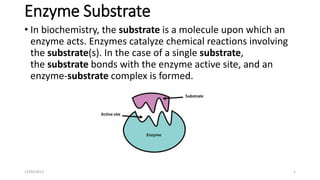
Enzyme Substrate
• In biochemistry, the substrate is a molecule upon which an
enzyme acts. Enzymes catalyze chemical reactions involving
the substrate(s). In the case of a single substrate,
the substrate bonds with the enzyme active site, and an
enzyme-substrate complex is formed.
12/03/2017 5
Enzyme substrate complex
• A non-covalent complex composed of a substrate bound to
the active site of the enzyme.
• The enzyme-substrate complex is formed during a chemical
reaction. The substrate may still dissociate from the enzyme.
The enzyme may then be recycled and combined with
another substrate to form the complex.
• The substrate bonds to a small area of the enzyme termed
the active site. When the enzyme is bonded to the substrate,
we call this the enzyme-substrate complex. Once the
reaction is complete, the enzyme releases the product and is
ready to bond with another substrate.
12/03/2017 6
Continue..
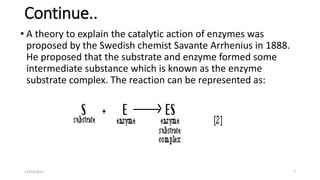
• A theory to explain the catalytic action of enzymes was
proposed by the Swedish chemist Savante Arrhenius in 1888.
He proposed that the substrate and enzyme formed some
intermediate substance which is known as the enzyme
substrate complex. The reaction can be represented as:
12/03/2017 7
Continue..
• Enzymes are only able to function if they bond with the
correct substrate.
• Enzymes are highly selective; they'll activate with one
and only one particular substrate.
• how do they know whether or not the molecule next to
them is the substrate that they want?
• Two models attempt to explain this.
1.Lock and Key Model
2. Induced Fit Model
12/03/2017 8
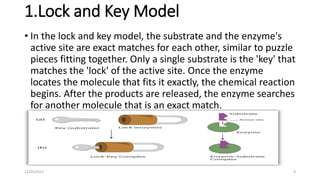
1.Lock and Key Model
• In the lock and key model, the substrate and the enzyme's
active site are exact matches for each other, similar to puzzle
pieces fitting together. Only a single substrate is the 'key' that
matches the 'lock' of the active site. Once the enzyme
locates the molecule that fits it exactly, the chemical reaction
begins. After the products are released, the enzyme searches
for another molecule that is an exact match.
12/03/2017 9
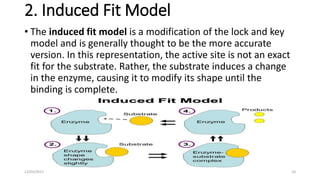
2. Induced Fit Model
• The induced fit model is a modification of the lock and key
model and is generally thought to be the more accurate
version. In this representation, the active site is not an exact
fit for the substrate. Rather, the substrate induces a change
in the enzyme, causing it to modify its shape until the
binding is complete.
12/03/2017 10
Enzyme Action
• Enzymes accelerate the rates of reactions while experiencing no
permanent chemical modification as a result of their participation.
• Enzymes can accelerate, often by several orders of magnitude, reactions
that under the mild conditions of cellular concentrations, temperature, p H,
and pressure would proceed imperceptibly (or not at all) in the absence of
the enzyme.
• The efficiency of an enzyme's activity is often measured by the turnover
rate, which measures the number of molecules of compound upon which
the enzyme works per molecule of enzyme per second.
• Carbonic anhydrase, which removes carbon dioxide from the blood by
binding it to water, has a turnover rate of 106. That means that one
molecule of the enzyme can cause a million molecules of carbon dioxide to
react in one second.
• Most enzymatic reactions occur within a relatively narrow temperature
range (usually from about 30°C to 40°C)
12/03/2017 11
Four Steps of Enzyme Action
• 1. The enzyme and the substrate are in the same area. Some
situations have more than one substrate molecule that the enzyme
will change.
• 2. The enzyme grabs on to the substrate at a special area called the active
site. The combination is called the enzyme/substrate complex. Enzymes are very,
very specific and don't just grab on to any molecule. The active site is a specially
shaped area of the enzyme that fits around the substrate. The active site is like
the grasping claw of the robot on the assembly line. It can only pick up one or
two parts.
• 3. A process called catalysis happens. Catalysis is when the substrate is changed.
It could be broken down or combined with another molecule to make something
new. It will break or build chemical bonds. When done, you will have
the enzyme/products complex.
• 4. The enzyme releases the product. When the enzyme lets go, it returns to its
original shape. It is then ready to work on another molecule of substrate
12/03/2017 12
Question may be asked that Can WE
Control Them?
• There are many factors that can regulate enzyme activity,
including temperature, activators, pH levels, and inhibitors.
12/03/2017 13
QUOTATION
Looking at Mirror Everyday
Un-cover many things about ourselves
AdnanALIJatoi
12/03/2017 14

Enzyme substrate complex

  • 1.
    BioChemicalEngineering The enzyme substratecomplex and enzyme action By: AdnanALIjatoi 14CH20 12/03/2017 1
  • 2.
    Contents: • Aims andobjectives • Enzyme • Enzyme substrate • Enzyme substrate complex • Enzyme action • Quotation • END 12/03/2017 2
  • 3.
    Aims and Objectives •You will be aware about enzyme, substrate and their actions • Concept behind the enzyme substrate complex and enzyme action 12/03/2017 3
  • 4.
    Enzyme: • Enzymes arebiological molecules (proteins) that act as catalysts and help complex reactions occur everywhere in life. • Enzymes are made from amino acids, and they are proteins. When an enzyme is formed, it is made by stringing together between 100 and 1,000 amino acids in a very specific and unique order. The chain of amino acids then folds into a unique shape. • Enzymes are biological molecules (typically proteins) that significantly speed up the rate of virtually all of the chemical reactions that take place within cells. They are vital for life and serve a wide range of important functions in the body, such as aiding in digestion and metabolism. 12/03/2017 4
  • 5.
    Enzyme Substrate • Inbiochemistry, the substrate is a molecule upon which an enzyme acts. Enzymes catalyze chemical reactions involving the substrate(s). In the case of a single substrate, the substrate bonds with the enzyme active site, and an enzyme-substrate complex is formed. 12/03/2017 5
  • 6.
    Enzyme substrate complex •A non-covalent complex composed of a substrate bound to the active site of the enzyme. • The enzyme-substrate complex is formed during a chemical reaction. The substrate may still dissociate from the enzyme. The enzyme may then be recycled and combined with another substrate to form the complex. • The substrate bonds to a small area of the enzyme termed the active site. When the enzyme is bonded to the substrate, we call this the enzyme-substrate complex. Once the reaction is complete, the enzyme releases the product and is ready to bond with another substrate. 12/03/2017 6
  • 7.
    Continue.. • A theoryto explain the catalytic action of enzymes was proposed by the Swedish chemist Savante Arrhenius in 1888. He proposed that the substrate and enzyme formed some intermediate substance which is known as the enzyme substrate complex. The reaction can be represented as: 12/03/2017 7
  • 8.
    Continue.. • Enzymes areonly able to function if they bond with the correct substrate. • Enzymes are highly selective; they'll activate with one and only one particular substrate. • how do they know whether or not the molecule next to them is the substrate that they want? • Two models attempt to explain this. 1.Lock and Key Model 2. Induced Fit Model 12/03/2017 8
  • 9.
    1.Lock and KeyModel • In the lock and key model, the substrate and the enzyme's active site are exact matches for each other, similar to puzzle pieces fitting together. Only a single substrate is the 'key' that matches the 'lock' of the active site. Once the enzyme locates the molecule that fits it exactly, the chemical reaction begins. After the products are released, the enzyme searches for another molecule that is an exact match. 12/03/2017 9
  • 10.
    2. Induced FitModel • The induced fit model is a modification of the lock and key model and is generally thought to be the more accurate version. In this representation, the active site is not an exact fit for the substrate. Rather, the substrate induces a change in the enzyme, causing it to modify its shape until the binding is complete. 12/03/2017 10
  • 11.
    Enzyme Action • Enzymesaccelerate the rates of reactions while experiencing no permanent chemical modification as a result of their participation. • Enzymes can accelerate, often by several orders of magnitude, reactions that under the mild conditions of cellular concentrations, temperature, p H, and pressure would proceed imperceptibly (or not at all) in the absence of the enzyme. • The efficiency of an enzyme's activity is often measured by the turnover rate, which measures the number of molecules of compound upon which the enzyme works per molecule of enzyme per second. • Carbonic anhydrase, which removes carbon dioxide from the blood by binding it to water, has a turnover rate of 106. That means that one molecule of the enzyme can cause a million molecules of carbon dioxide to react in one second. • Most enzymatic reactions occur within a relatively narrow temperature range (usually from about 30°C to 40°C) 12/03/2017 11
  • 12.
    Four Steps ofEnzyme Action • 1. The enzyme and the substrate are in the same area. Some situations have more than one substrate molecule that the enzyme will change. • 2. The enzyme grabs on to the substrate at a special area called the active site. The combination is called the enzyme/substrate complex. Enzymes are very, very specific and don't just grab on to any molecule. The active site is a specially shaped area of the enzyme that fits around the substrate. The active site is like the grasping claw of the robot on the assembly line. It can only pick up one or two parts. • 3. A process called catalysis happens. Catalysis is when the substrate is changed. It could be broken down or combined with another molecule to make something new. It will break or build chemical bonds. When done, you will have the enzyme/products complex. • 4. The enzyme releases the product. When the enzyme lets go, it returns to its original shape. It is then ready to work on another molecule of substrate 12/03/2017 12
  • 13.
    Question may beasked that Can WE Control Them? • There are many factors that can regulate enzyme activity, including temperature, activators, pH levels, and inhibitors. 12/03/2017 13
  • 14.
    QUOTATION Looking at MirrorEveryday Un-cover many things about ourselves AdnanALIJatoi 12/03/2017 14