Introduction
• Enzymes are found distributed widely in the
living systems and are a major factor in the
growth, maintenance and propagation of living
system.
• Willstatter and colleagues in 1920 carried out
the early attempts of purification of enzymes.
• The First Enzyme to be crystallized was Urease in
1926 by Sumner.
Need of Isolation of Enzyme
• Required for study about the various
aspects of that enzyme.
• Required for researches and as diagnostic
components.
• They employed in forensics, food
processing and Industrial applications,
fermentation.
• Required for leaching of ores.
Methods of Isolation
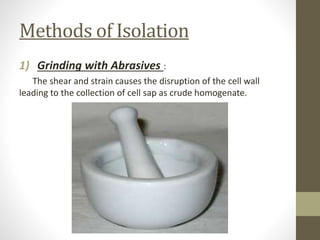
1) Grinding with Abrasives :
The shear and strain causes the disruption of the cell wall
leading to the collection of cell sap as crude homogenate.
Methods of Isolation
• Alternate Freezing
and Thawing :
Freezing water
molecules form ice
which expand in size
and cause a strain on
the cell leading to
disruption.
• Use of Appropriate
Hydrolytic Enzymes :
Proteases and
lipases are used to
cause localized removal
of membrane particles
leading to formation of
pores or holes.
Methods of Isolation
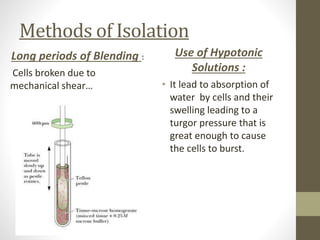
Long periods of Blending :
Cells broken due to
mechanical shear…
Use of Hypotonic
Solutions :
• It lead to absorption of
water by cells and their
swelling leading to a
turgor pressure that is
great enough to cause
the cells to burst.
Methods of Isolation
Alteration of pH of The
Solution :
• The cell membrane
proteins to coagulate
leading to formation of
pores through which the
cell sap oozes out as
homogenate.
Organic Solvents :
• Organic solvents such as
acetone, ether .. are
employed to dissolve the
lipid constituents leading
to formation of pores.
Methods of Purification of Enzymes
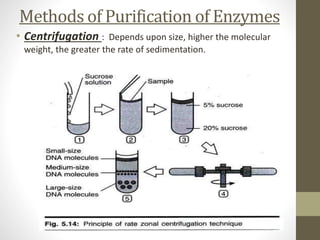
• Centrifugation : Depends upon size, higher the molecular
weight, the greater the rate of sedimentation.
Gel Filteration / Gel permeation
chromatography
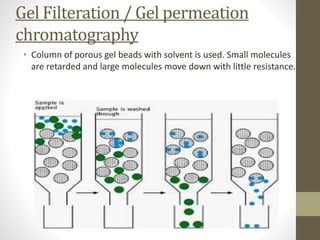
• Column of porous gel beads with solvent is used. Small molecules
are retarded and large molecules move down with little resistance.
Affinity Chromatography
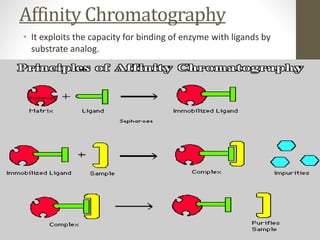
• It exploits the capacity for binding of enzyme with ligands by
substrate analog.
Methods Based on Change in
Solubility
Change in pH :
• An enzyme is least
soluble at its isoelectric
point since at this pH the
repulsive forces within
enzyme cease to exist
and tend to
precipitate……
Change in Ionic
Strength :
• Enzymes often
precipitate on addition
of high amount of salts.
At high salt
concentrations, the conc.
Of water is greatly
reduced.
• Ammonium Sulfate if
widely used salt due to
many advantages..
Some other methods of Enzyme
Purification..
• Sumner’s Method For Isolation of Urease.
• Northrop’s Procedure For Isolation of
Pepsin.
• Fractional Precipitation By Heat.
• Electrophoresis.
• Homogenization by Potter-Elvehjem
Homogenizer or High-Speed Blender.
Methods of enzyme isolation and purification

Methods of enzyme isolation and purification

  • 2.
    Introduction • Enzymes arefound distributed widely in the living systems and are a major factor in the growth, maintenance and propagation of living system. • Willstatter and colleagues in 1920 carried out the early attempts of purification of enzymes. • The First Enzyme to be crystallized was Urease in 1926 by Sumner.
  • 3.
    Need of Isolationof Enzyme • Required for study about the various aspects of that enzyme. • Required for researches and as diagnostic components. • They employed in forensics, food processing and Industrial applications, fermentation. • Required for leaching of ores.
  • 4.
    Methods of Isolation 1)Grinding with Abrasives : The shear and strain causes the disruption of the cell wall leading to the collection of cell sap as crude homogenate.
  • 5.
    Methods of Isolation •Alternate Freezing and Thawing : Freezing water molecules form ice which expand in size and cause a strain on the cell leading to disruption. • Use of Appropriate Hydrolytic Enzymes : Proteases and lipases are used to cause localized removal of membrane particles leading to formation of pores or holes.
  • 6.
    Methods of Isolation Longperiods of Blending : Cells broken due to mechanical shear… Use of Hypotonic Solutions : • It lead to absorption of water by cells and their swelling leading to a turgor pressure that is great enough to cause the cells to burst.
  • 7.
    Methods of Isolation Alterationof pH of The Solution : • The cell membrane proteins to coagulate leading to formation of pores through which the cell sap oozes out as homogenate. Organic Solvents : • Organic solvents such as acetone, ether .. are employed to dissolve the lipid constituents leading to formation of pores.
  • 8.
    Methods of Purificationof Enzymes • Centrifugation : Depends upon size, higher the molecular weight, the greater the rate of sedimentation.
  • 9.
    Gel Filteration /Gel permeation chromatography • Column of porous gel beads with solvent is used. Small molecules are retarded and large molecules move down with little resistance.
  • 10.
    Affinity Chromatography • Itexploits the capacity for binding of enzyme with ligands by substrate analog.
  • 11.
    Methods Based onChange in Solubility Change in pH : • An enzyme is least soluble at its isoelectric point since at this pH the repulsive forces within enzyme cease to exist and tend to precipitate…… Change in Ionic Strength : • Enzymes often precipitate on addition of high amount of salts. At high salt concentrations, the conc. Of water is greatly reduced. • Ammonium Sulfate if widely used salt due to many advantages..
  • 12.
    Some other methodsof Enzyme Purification.. • Sumner’s Method For Isolation of Urease. • Northrop’s Procedure For Isolation of Pepsin. • Fractional Precipitation By Heat. • Electrophoresis. • Homogenization by Potter-Elvehjem Homogenizer or High-Speed Blender.