ENZYME
KINETICS
Ahmed Nawaz 13ch153
Waleed Shaikh 13CH03
Talal Ashraf 13CH10
Muzamill Hussain 13CH19
Inayat Morio 13CH136
Contents: • Enzyme
• Enzyme Kinetics
• Parametric Analysis of enzyme
catalysis
• Enzyme specific to substrate
• Key And Lock Model
• Michaelis Menten Kinetics Model for
Enzyme
Enzymes
• Enzymes are usually protein molecules that manipulate other
molecules — the enzymes' substrates.
• These target molecules bind to an enzyme's active site and are
transformed into products through a series of steps known as the
enzymatic mechanism.
• These mechanisms can be divided into single-substrate and
multiple-substrate mechanisms.
Introduction
Enzyme
Kinetics
• Enzyme kinetics is the study of the chemical
reactions that are catalyzed by enzymes.
• In enzyme kinetics, the reaction rate is
measured and the effects of varying the
conditions of the reaction is investigated.
• Studying an enzyme's kinetics in this way can
reveal the catalytic mechanism of this
enzyme, its role in metabolism, how it activity
is controlled, and how a drug or an agonist
might inhibit the enzyme.
Parametric
Analysis of
Enzyme
Catalysis
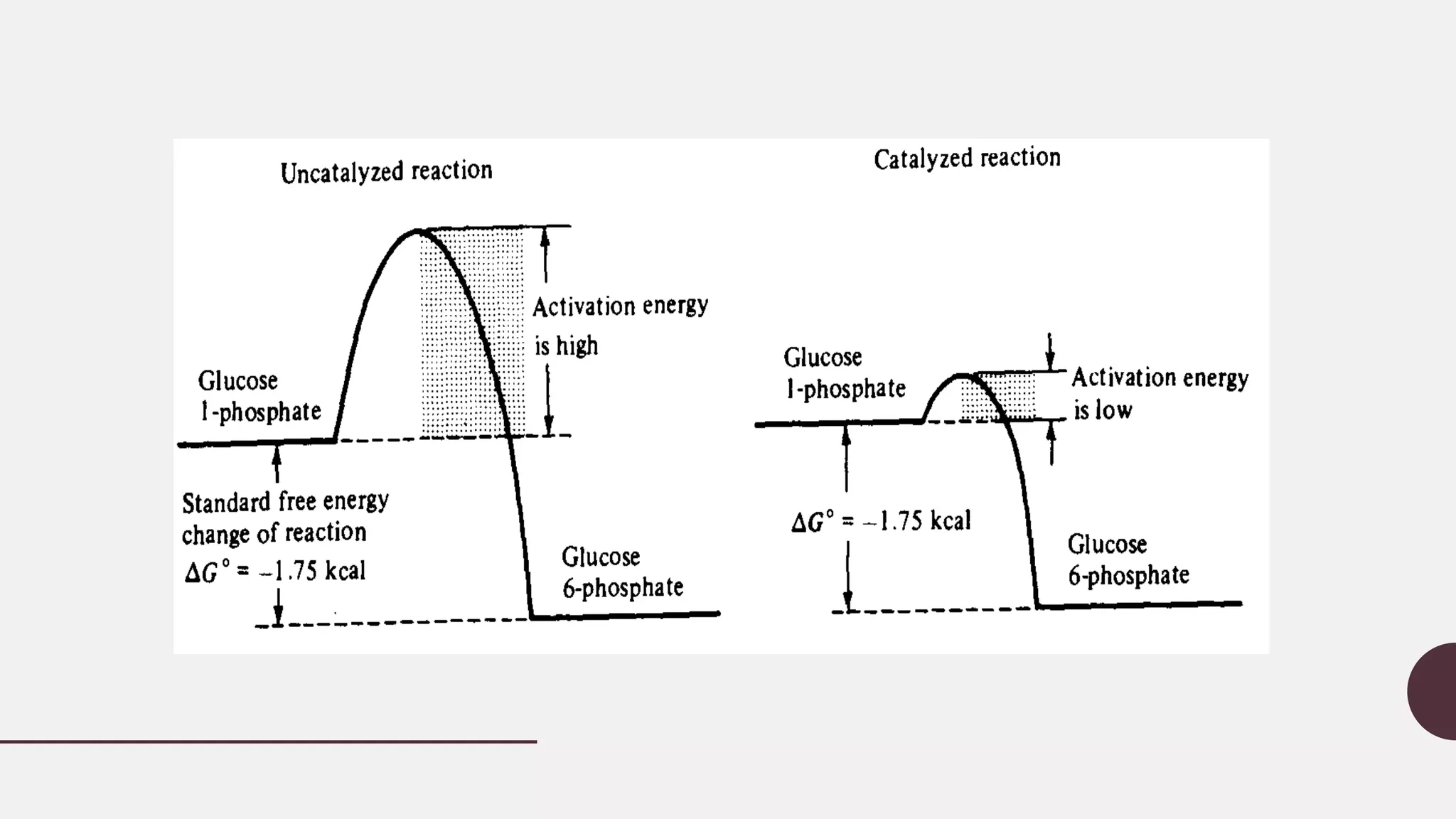
• It is often asserted that enzymes are more active, i.e.,
allow reactions to go faster, than non biological
catalysts.
• At the ambient temperatures where enzymes are most
active they are able to catalyze reactions faster than
the majority of artificial catalysts.
• When the reaction temperature is increased, solid
(synthetic) catalysts may become as active as
enzymes.
• The enzyme activity does not increase continuously as
the temperature is raised. Instead, the enzyme usually
loses activity at quite a low temperature, often only
slightly above that at which it is typically found.
How are
enzymes
specific to
substrates?
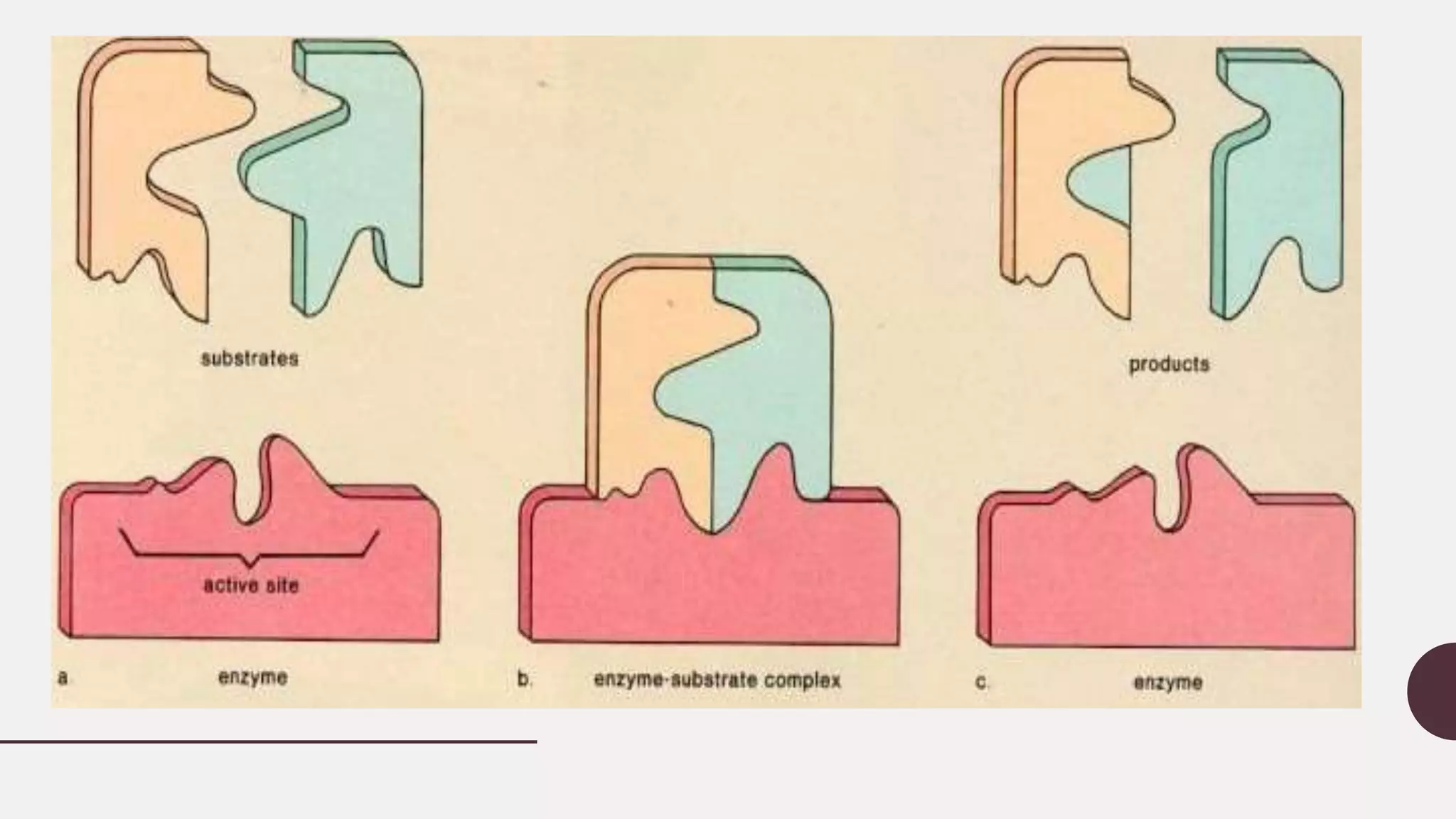
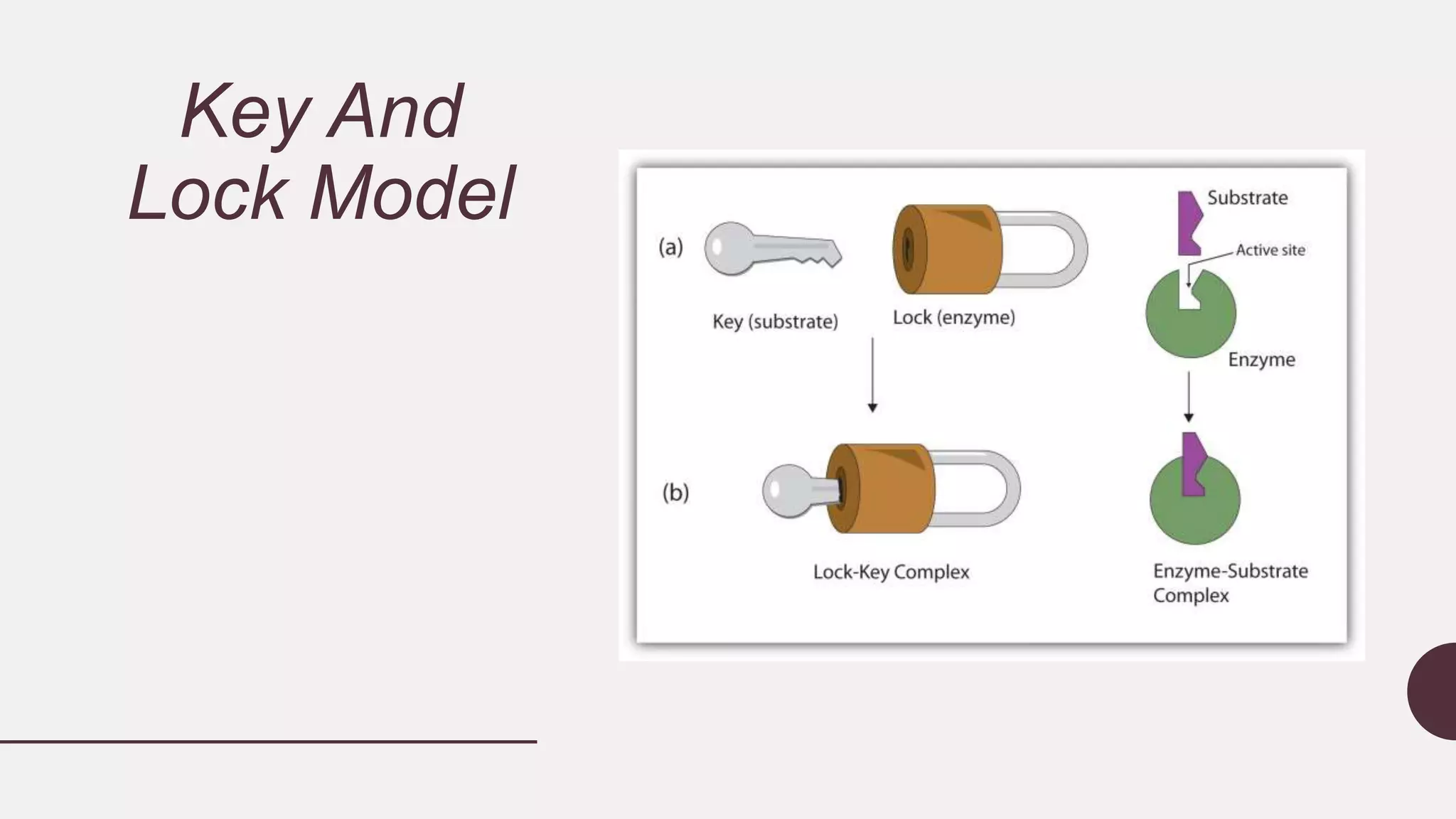
• Enzymes are specific to substrates as they
have an active site which only allow certain
substrates to bind to the active site.This is
due to the shape of the active site and any
other substrates cannot bind to the active
site.
There is a model which is well known in the
biology field of the lock and key model.This is
because you have to have the correct key to
insert it into the lock.This goes the same as
an enzymes active site and the substrate.
Key And
Lock Model
Michaelis–
Menten
kinetics
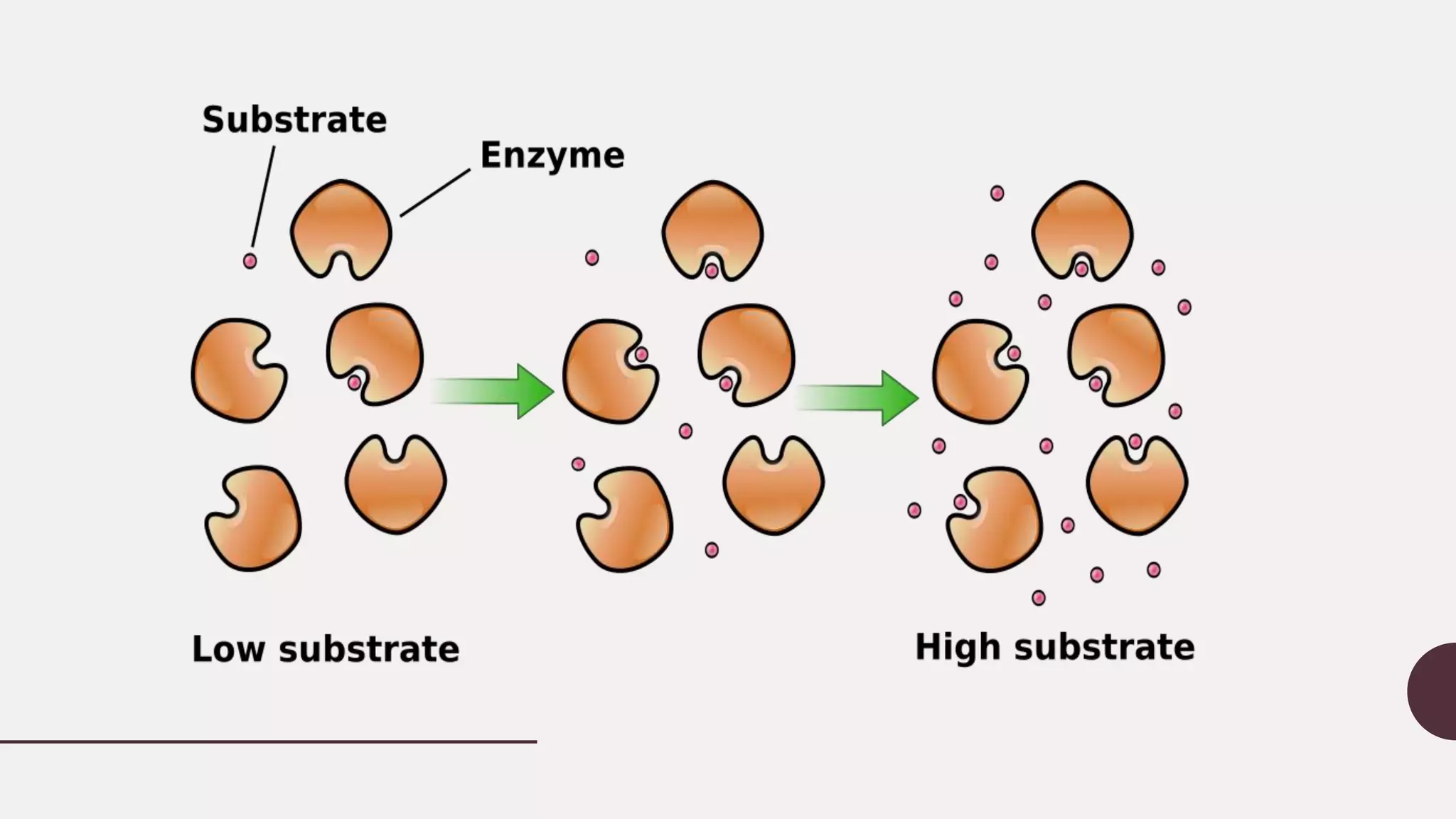
• As enzyme-catalyzed reactions are
saturable, their rate of catalysis does
not show a linear response to
increasing substrate. If the initial
rate of the reaction is measured over
a range of substrate concentrations
(denoted as [S]), the reaction rate (v)
increases as [S] increases, as shown
on the right. However, as [S] gets
higher, the enzyme becomes
saturated with substrate and the
rate reaches Vmax, the enzyme's
maximum rate.
Mathematical
Model For
Enzyme Kinetics
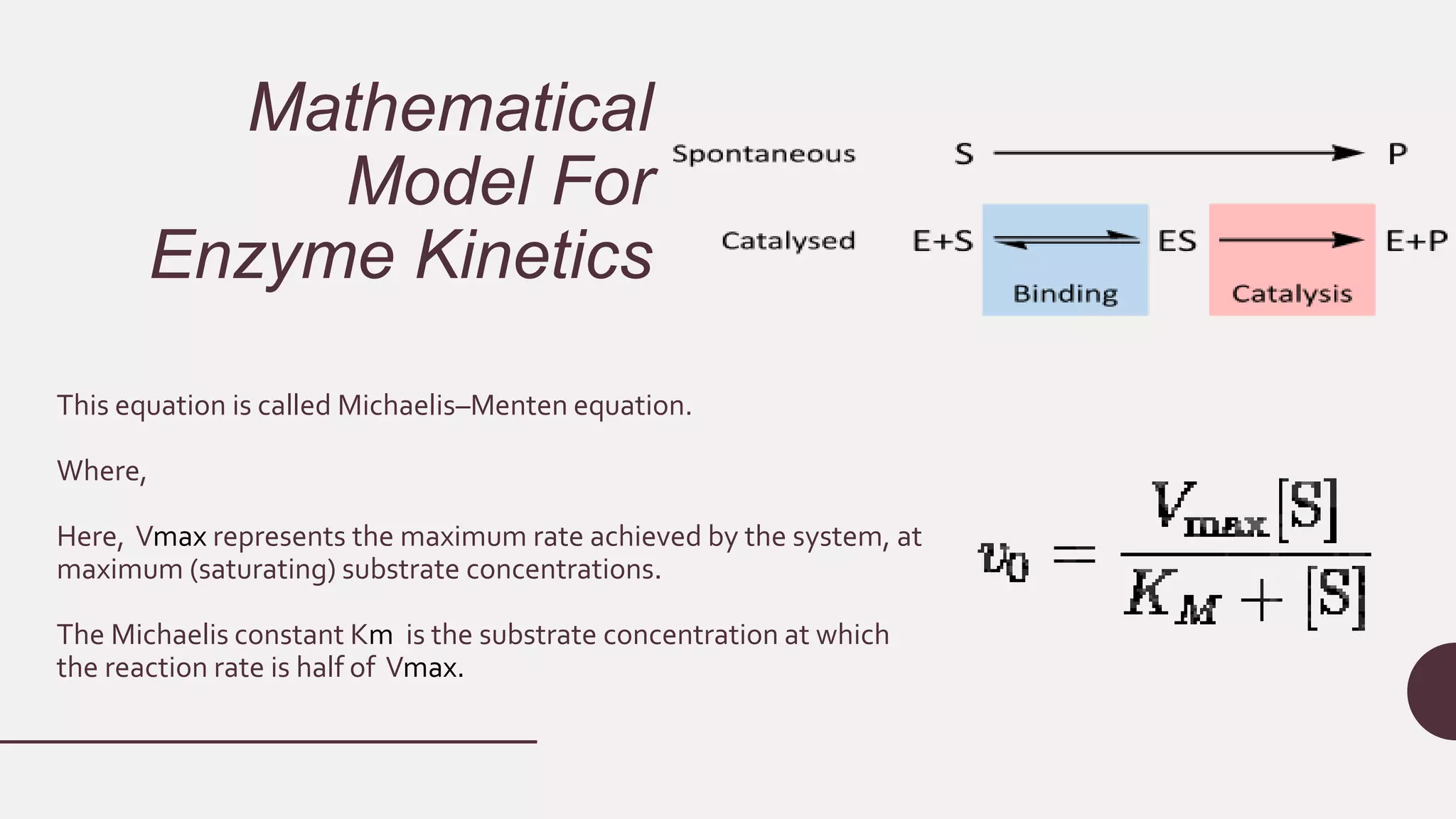
This equation is called Michaelis–Menten equation.
Where,
Here, Vmax represents the maximum rate achieved by the system, at
maximum (saturating) substrate concentrations.
The Michaelis constant Km is the substrate concentration at which
the reaction rate is half of Vmax.

Enzyme kinetics presentation

  • 2.
    ENZYME KINETICS Ahmed Nawaz 13ch153 WaleedShaikh 13CH03 Talal Ashraf 13CH10 Muzamill Hussain 13CH19 Inayat Morio 13CH136
  • 3.
    Contents: • Enzyme •Enzyme Kinetics • Parametric Analysis of enzyme catalysis • Enzyme specific to substrate • Key And Lock Model • Michaelis Menten Kinetics Model for Enzyme
  • 4.
    Enzymes • Enzymes areusually protein molecules that manipulate other molecules — the enzymes' substrates. • These target molecules bind to an enzyme's active site and are transformed into products through a series of steps known as the enzymatic mechanism. • These mechanisms can be divided into single-substrate and multiple-substrate mechanisms.
  • 6.
    Introduction Enzyme Kinetics • Enzyme kineticsis the study of the chemical reactions that are catalyzed by enzymes. • In enzyme kinetics, the reaction rate is measured and the effects of varying the conditions of the reaction is investigated. • Studying an enzyme's kinetics in this way can reveal the catalytic mechanism of this enzyme, its role in metabolism, how it activity is controlled, and how a drug or an agonist might inhibit the enzyme.
  • 8.
    Parametric Analysis of Enzyme Catalysis • Itis often asserted that enzymes are more active, i.e., allow reactions to go faster, than non biological catalysts. • At the ambient temperatures where enzymes are most active they are able to catalyze reactions faster than the majority of artificial catalysts. • When the reaction temperature is increased, solid (synthetic) catalysts may become as active as enzymes. • The enzyme activity does not increase continuously as the temperature is raised. Instead, the enzyme usually loses activity at quite a low temperature, often only slightly above that at which it is typically found.
  • 9.
    How are enzymes specific to substrates? •Enzymes are specific to substrates as they have an active site which only allow certain substrates to bind to the active site.This is due to the shape of the active site and any other substrates cannot bind to the active site. There is a model which is well known in the biology field of the lock and key model.This is because you have to have the correct key to insert it into the lock.This goes the same as an enzymes active site and the substrate.
  • 10.
  • 12.
    Michaelis– Menten kinetics • As enzyme-catalyzedreactions are saturable, their rate of catalysis does not show a linear response to increasing substrate. If the initial rate of the reaction is measured over a range of substrate concentrations (denoted as [S]), the reaction rate (v) increases as [S] increases, as shown on the right. However, as [S] gets higher, the enzyme becomes saturated with substrate and the rate reaches Vmax, the enzyme's maximum rate.
  • 13.
    Mathematical Model For Enzyme Kinetics Thisequation is called Michaelis–Menten equation. Where, Here, Vmax represents the maximum rate achieved by the system, at maximum (saturating) substrate concentrations. The Michaelis constant Km is the substrate concentration at which the reaction rate is half of Vmax.