12/3/12
1
LECTURE 2: ENZYMEKINETICS
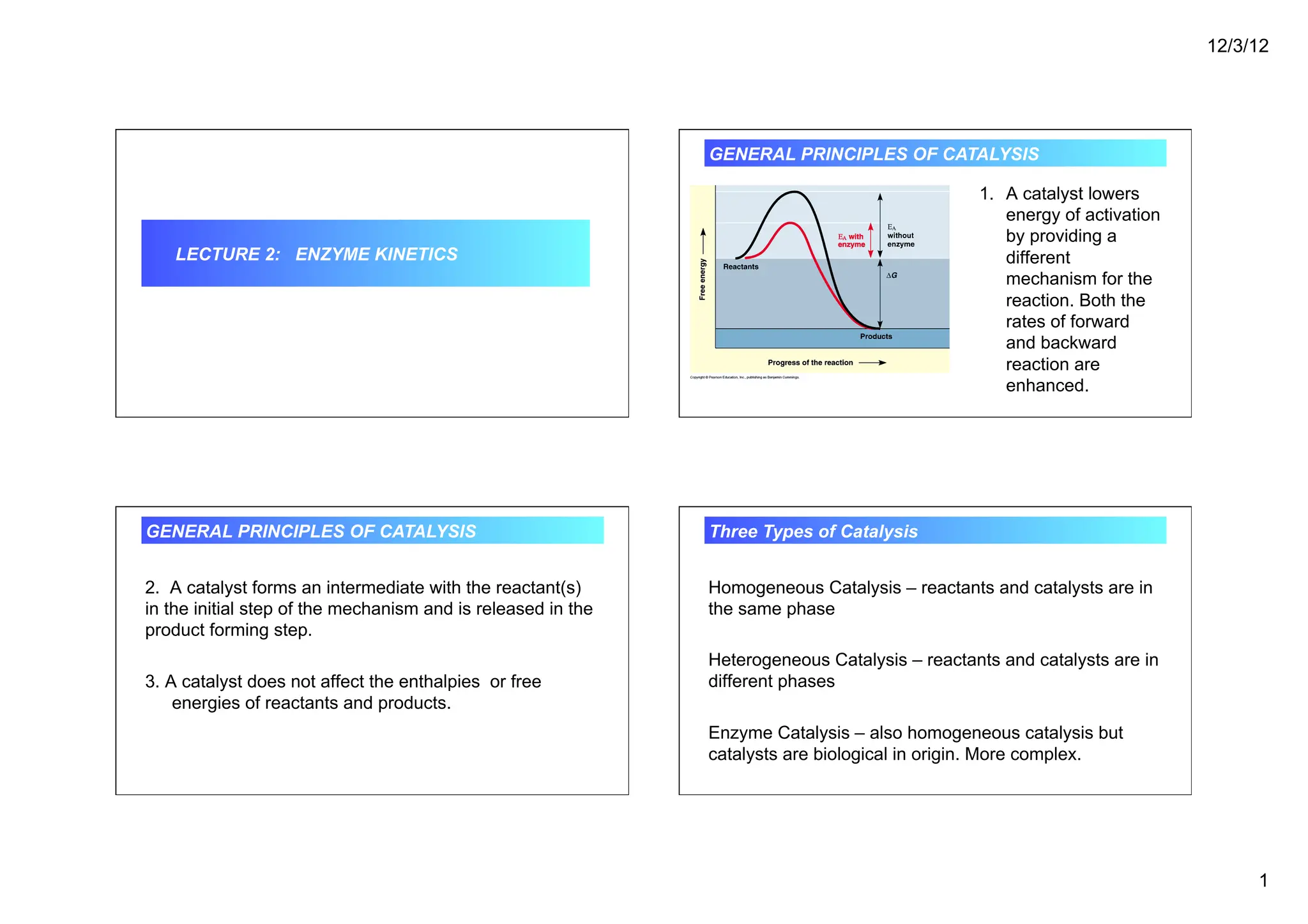
1. A catalyst lowers
energy of activation
by providing a
different
mechanism for the
reaction. Both the
rates of forward
and backward
reaction are
enhanced.
GENERAL PRINCIPLES OF CATALYSIS
2. A catalyst forms an intermediate with the reactant(s)
in the initial step of the mechanism and is released in the
product forming step.
3. A catalyst does not affect the enthalpies or free
energies of reactants and products.
GENERAL PRINCIPLES OF CATALYSIS
Homogeneous Catalysis – reactants and catalysts are in
the same phase
Heterogeneous Catalysis – reactants and catalysts are in
different phases
Enzyme Catalysis – also homogeneous catalysis but
catalysts are biological in origin. More complex.
Three Types of Catalysis
2.
12/3/12
2
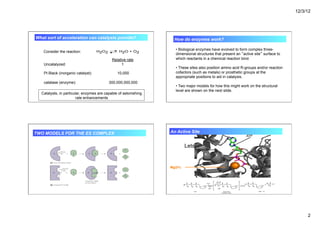
Consider the reaction:
Relativerate
Uncatalyzed: 1
Pt Black (inorganic catalyst): 10,000
catalase (enzyme): 300,000,000,000
Catalysts, in particular, enzymes are capable of astonishing
rate enhancements
What sort of acceleration can catalysts provide?
• Biological enzymes have evolved to form complex three-
dimensional structures that present an “active site” surface to
which reactants in a chemical reaction bind.
• These sites also position amino acid R-groups and/or reaction
cofactors (such as metals) or prosthetic groups at the
appropriate positions to aid in catalysis.
• Two major models for how this might work on the structural
level are shown on the next slide.
How do enzymes work?
TWO MODELS FOR THE ES COMPLEX
Lets take a look at a real active site!
Mg(2+)
ATP
An Active Site
3.
12/3/12
3
[P]
time
[S]
time
Accumulation of productover time (Δ[P]/Δt) Loss of substrate over time (Δ[P]/Δt)
ENZYME ACTIVITY MEASUREMENT How does [enzyme] influence observed
reaction velocity?
[P]
time
Assumes that [E] is limiting and that the
uncatalyzed reaction rate is ~0
1 x [enzyme]
Δ[P]/Δt = 1
2 x [enzyme]
Δ[P]/Δt = 2
0.5 x [enzyme]
Δ[P]/Δt = 0.5
How specific are enzymes for a given substrate?
• The answer depends upon the enzyme you’re talking about.
Most enzymes are highly specific, acting on only a small number
of substrates that are highly similar in structure. Others, such as
alkaline phosphatase mentioned in your notes, are less specific.
• Specificity arises from structural and chemical complementarity
between the substrate and its enzyme.
ENZYME SPECIFICITY Specificity of enzymes (an example)
Asp with Mg(2+),
Lys with Phosphates
Mg (2+)
Hydrogen
Bonds
Gln with
Adenine
Ionic
Bonds
4.
12/3/12
4
Metals, coenzymes, andprosthetics groups
Many enzymes bind non-protein cellular components that are used as key
factors in the enzyme activity. These fall into three basic categories:
(1) Metals: Metals (e.g. Mg, Ca, Zn, Fe etc.) are thought to be bound to ~1/3
of all proteins and can play key roles in activity. An example is the Mg(2+) in
the ATPase on the previous slide. These ions can confer a wider array of
chemical properties to proteins over those of the 20 natural amino acids.
Metals, cofactors, and prosthetics groups
(2 & 3) Coenzymes and prosthetic groups: Low-molecular organic
compounds that bind either weakly (coenzymes) or tightly (prosthetic groups)
to the protein. Examples that you will see in this course include, for example,
iron-sulfur clusters, heme, and coenzyme A.
Formula for a simple enzyme-catalyzed
reaction
E + S ES P + E
E - free enzyme
S - Substrate
ES - Enzyme-Substrate complex
P - product
What are we measuring?
Increasing
[S]
5.
12/3/12
5
Initial Velocity
Measured atthe
very beginning of
a reaction when
very little P has
been made.
FOR ENZYME-CATALYZED REACTION
E + S ES P + E
k1 is rate constant for formation of ES
k-1 is rate constant for conversion of ES to E+S
k2 is rate constant for product formation. For
this reaction, k2= kcat
Initial velocity assumption: measure activity before
appreciable P accumulates: v0 = k2 [ES]
ENZYME-CATALYZED REACTION EXHIBIT
SATURATION KINETICS
E + S ES P + E
At high [S], the
enzyme is said to
be saturated with
respect to
substrate
SUBSTRATE SATURATION OF AN ENZYME
A. Low [S] B. 50% [S] or Km C. High, saturating [S]
6.
12/3/12
6
STEADY STATE
The moreES present, the faster
ES will dissociate into E + P or E
+ S.
Therefore, when the reaction is
started by mixing enzymes and
substrates, the [ES] builds up at
first, but quickly reaches a
STEADY STATE, in which [ES]
remains constant. This steady
state will persist until almost all
of the substrate has been
consumed.
THE MICHAELIS-MENTEN EQUATION
E + S ES P + E
If you assume that the formation of ES equals its breakdown, making
[ES] constant (steady state), then:
k1 [E][S] = k-1 [ES] + k2 [ES]
MEANING OF KM
"
• An important relationship that can be derived from the Michaelis-Menten
equation is the following: If vo is set equal to 1/2 Vmax, then the relation
Vmax /2 = Vmax[S]/Km + [S] can be simplied to Km + [S] = 2[S], or Km = [S].!
• This means that at one half of the maximal velocity, the substrate
concentration at this velocity will be equal to the Km. "
• This relationship has been shown experimentally to be valid for many
enzymes much more complex in regards to the number of substrates and
catalytic steps than the simple single substrate model used to derive it. "
MEANING OF Km"
• The significance of Km will change based on the different rate constants and
which step is the slowest (also called the rate-limiting step). "
• In the simplest assumption, the rate of ES breakdown to product (k2) is the
rate-determining step of the reaction, so k-1 >> k2 and Km = k-1/k1. "
• This relation is also called a dissociation constant for the ES complex and
can be used as a relative measure of the affinity of a substrate for an
enzyme ."
"
• However if k2 >> k-1 or k2 and k-1 are similar, then Km remains more complex
and cannot be used as a measure of substrate affinity. "
7.
12/3/12
7
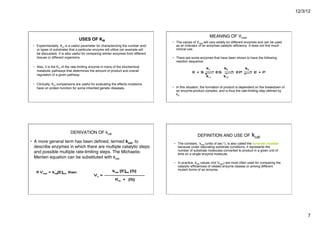
USES OF KM
!
•Experimentally, Km is a useful parameter for characterizing the number and/
or types of substrates that a particular enzyme will utilize (an example will
be discussed). It is also useful for comparing similar enzymes from different
tissues or different organisms. "
• Also, it is the Km of the rate-limiting enzyme in many of the biochemical
metabolic pathways that determines the amount of product and overall
regulation of a given pathway. "
• Clinically, Km comparisons are useful for evaluating the effects mutations
have on protein function for some inherited genetic diseases. "
MEANING OF Vmax
• The values of Vmax will vary widely for different enzymes and can be used
as an indicator of an enzymes catalytic efficiency. It does not find much
clinical use. "
• There are some enzymes that have been shown to have the following
reaction sequence:"
• In this situation, the formation of product is dependent on the breakdown of
an enzyme-product complex, and is thus the rate-limiting step defined by
k3."
DERIVATION OF kcat
"
• A more general term has been defined, termed kcat, to
describe enzymes in which there are multiple catalytic steps
and possible multiple rate-limiting steps. The Michaelis-
Menten equation can be substituted with kcat"
DEFINITION AND USE OF kcat
"
• The constant, kcat (units of sec-1), is also called the turnover number
because under saturating substrate conditions, it represents the
number of substrate molecules converted to product in a given unit of
time on a single enzyme molecule. "
• In practice, kcat values (not Vmax) are most often used for comparing the
catalytic efficiencies of related enzyme classes or among different
mutant forms of an enzyme. "
8.
12/3/12
8
Important Conclusions ofMichaels - Menten Kinetics
• when [S]= KM, the equation reduces to
• when [S] >> KM, the equation reduces to
• when [S] << KM, the equation reduces to
Important Conclusions of Michaels - Menten Kinetics
ENZYME KINETICS – PROBLEM SOLVING - Km
Km is the [S] at 1/2 Vmax
• Km is a constant for a
given enzyme
• Km is an estimate of the
equilibrium constant for S
binding to E
• Small Km means tight
binding; high Km means
weak binding
Km is a measure of [S] required
for effective catalysis to occur
ENZYME KINETICS – PROBLEM SOLVING - Vmax
• Vmax is a constant for a given
enzyme
• Vmax is the theoretical maximal rate
of the reaction - but it is NEVER
achieved
• To reach Vmax would require that ALL
enzyme molecules have tightly
bound substrate
THEORITICAL MAXIMUM VELOCITY
9.
12/3/12
9
MEASURING Km andVmax - LINEWEAVER-BURKE EQ
• Curve-fitting algorithms can be used to
determine Km and Vmax from v vs. [S]
plots
• Michaelis-Menten equation can be
rearranged to the “double reciprocal”
plot and Km and Vmax can be
graphically determined
ENZYME KINETICS – SAMPLE PROBLEM
The following data were obtained from an enzyme kinetics experiment.
Graph the data using a Lineweaver-Burk plot and determine, by inspection
of the graph, the values for Km and Vmax.
[S] (µM) V (nmol/min)
_______ ___________
0.20 1.43
0.26 1.67
0.33 2.08
1.00 3.33
ENZYME KINETICS – SAMPLE PROBLEM
An enzymatic assay was carried under two different sets of conditions out
using a pure substrate S. The results are tabulated below.
[S]/ Vo
10-5 M Condition A Condition B
1.5 0.21 0.08
2.0 0.25 0.1
3.0 0.28 0.12
4.0 0.33 0.13
8.0 0.44 0.16
16.0 0.40 0.18
a. Plot the data using the Lineweaver-Burke plot
b. Calculate the values of Vmax and Km for both sets of conditions
c. Suggest possible reasons why the two sets of results might be different.
ENZYME KINETICS – Catalytic EFFICIENCY
TURNOVER NUMBER
• The kcat is a direct measure of the catalytic conversion of product under
saturating substrate conditions.
• kcat, the turnover number, is the maximum number of substrate molecules
converted to product per enzymemolecule per unit of time. Values of kcat
range from less than 1/sec to many millions per sec.
CATALYTIC EFFICIENCY
• It shows what the enzyme can accomplish when abundant enzyme sites
are available.
• It is the kcat/KM value that allows direct comparison of the effectiveness of
an enzyme toward different substrates.
10.
12/3/12
10
ENZYME KINETICS –SAMPLE PROBLEM
Calculate the specificity constant for an enzyme if its kcat = 1.4 x 10⁴ s-1 Km =
90 µM.
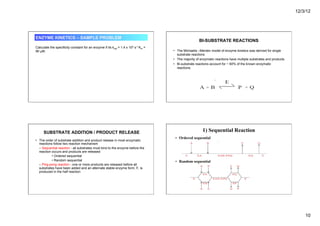
BI-SUBSTRATE REACTIONS
• The Michaelis –Menten model of enzyme kinetics was derived for single
substrate reactions
• The majority of enzymatic reactions have multiple substrates and products
• Bi-substrate reactions account for ~ 60% of the known enzymatic
reactions.
SUBSTRATE ADDITION / PRODUCT RELEASE
• The order of substrate addition and product release in most enzymatic
reactions follow two reaction mechanism
– Sequential reaction - all substrates must bind to the enzyme before the
reaction occurs and products are released
• Ordered sequential
• Random sequential
– Ping-pong reaction - one or more products are released before all
substrates have been added and an alternate stable enzyme form, F, is
produced in the half reaction
1) Sequential Reaction
• Ordered sequential
• Random sequential
11.
12/3/12
11
2) Ping-pong Reaction
InitialVelocity Plots
• sequential reaction exhibits an
intersecting pattern of lines
Order and random substrate
additions cannot be distinguished
in this type of plot
• Ping-pong reaction shows
parallel or non-
intersecting lines
Influence of enzyme concentration
v = k3 [E], as
[S]>>[E]
Influence of temperature
Optimum temperature,most of
them are in the range from 35 to
45℃ .
12.
12/3/12
12
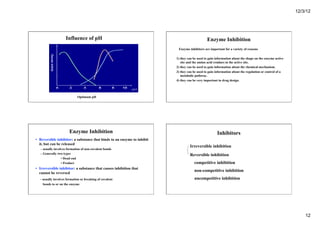
Influence of pH
OptimumpH
Enzyme Inhibition
Enzyme inhibitors are important for a variety of reasons
1) they can be used to gain information about the shape on the enzyme active
site and the amino acid residues in the active site.
2) they can be used to gain information about the chemical mechanism.
3) they can be used to gain information about the regulation or control of a
metabolic pathway.
4) they can be very important in drug design.
Enzyme Inhibition
• Reversible inhibitor: a substance that binds to an enzyme to inhibit
it, but can be released
– usually involves formation of non-covalent bonds
– Generally two types
• Dead end
• Product
• Irreversible inhibitor: a substance that causes inhibition that
cannot be reversed
– usually involves formation or breaking of covalent
bonds to or on the enzyme
Inhibitors
Irreversible inhibition
Reversible inhibition
competitive inhibition
non-competitive inhibition
uncompetitive inhibition
13.
12/3/12
13
Irreversible inhibition
• Irreversibleinhibition:
The inhibitor combine with essential group of enzyme active
center by covalent bond, resulting in enzymatic activity loss.
Inhibition Patterns
• An inhibitor may bind at the same site as one of the substrates
– these inhibitors structurally resemble the substrate
• An inhibitor may bind at an alternate site affecting catalytic activity
without affecting substrate binding
• Many inhibitors do both
• Most common types
– Competitive
– Mixed or Non-competitive
– Uncompetitive
Inhibitors act in a variety of mechanisms
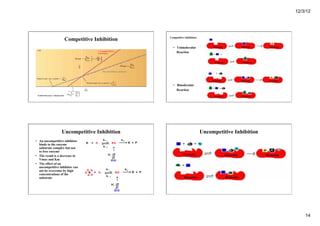
Competitive Inhibition
• Competitive inhibitor competes with a substrate for the enzyme -
substrate binding site
Malonate is a
competitive
inhibitor of
succinate for
succinate
dehydrogenase
• A competitive inhibitor reduces the amount of free enzyme
available for substrate binding thus increasing the Km for the
substrate
• The effect of a competitive inhibitor can be overcome with
high concentrations of the substrate
Competitive Inhibition
14.
12/3/12
14
Competitive Inhibition
• Unimolecular
Reaction
•Bimolecular
Reaction
Competitive Inhibition
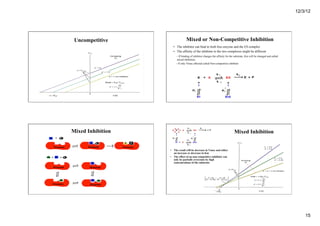
Uncompetitive Inhibition
• An uncompetitive inhibitor
binds to the enzyme
substrate complex but not
to free enzyme
• The result is a decrease in
Vmax and Km
• The effect of an
uncompetitive inhibitor can
not be overcome by high
concentrations of the
substrate
Uncompetitive Inhibition
15.
12/3/12
15
Uncompetitive Mixed orNon-Competitive Inhibition
• The inhibitor can bind to both free enzyme and the ES complex
• The affinity of the inhibitor to the two complexes might be different
– If binding of inhibitor changes the affinity for the substrate, Km will be changed and called
mixed inhibition
– If only Vmax affected called Non-competitive inhibitor
Mixed Inhibition
• The result will be decrease in Vmax and either
an increase or decrease in Km
• The effect of an non-competitive inhibitor can
only be partially overcome by high
concentrations of the substrate
Mixed Inhibition
16.
12/3/12
16
Non-Competitive
ENZYME KINETICS –PROBLEM SOLVING - Km
Km is the [S] at 1/2 Vmax
• Km is a constant for a
given enzyme
• Km is an estimate of the
equilibrium constant for S
binding to E
• Small Km means tight
binding; high Km means
weak binding
Km is a measure of [S] required
for effective catalysis to occur
ENZYME KINETICS – PROBLEM SOLVING - Vmax
• Vmax is a constant for a given
enzyme
• Vmax is the theoretical maximal rate
of the reaction - but it is NEVER
achieved
• To reach Vmax would require that ALL
enzyme molecules have tightly
bound substrate
THEORITICAL MAXIMUM VELOCITY
MEASURING Km and Vmax - LINEWEAVER-BURKE EQ
• Curve-fitting algorithms can be used to
determine Km and Vmax from v vs. [S]
plots
• Michaelis-Menten equation can be
rearranged to the “double reciprocal”
plot and Km and Vmax can be
graphically determined
17.
12/3/12
17
ENZYME KINETICS –SAMPLE PROBLEM
The following data were obtained from an enzyme kinetics experiment.
Graph the data using a Lineweaver-Burk plot and determine, by inspection
of the graph, the values for Km and Vmax.
[S] (µM) V (nmol/min)
_______ ___________
0.20 1.43
0.26 1.67
0.33 2.08
1.00 3.33
ENZYME KINETICS – SAMPLE PROBLEM
An enzymatic assay was carried under two different sets of conditions out
using a pure substrate S. The results are tabulated below.
[S]/ Vo
10-5 M Condition A Condition B
1.5 0.21 0.08
2.0 0.25 0.1
3.0 0.28 0.12
4.0 0.33 0.13
8.0 0.44 0.16
16.0 0.40 0.18
a. Plot the data using the Lineweaver-Burke plot
b. Calculate the values of Vmax and Km for both sets of conditions
c. Suggest possible reasons why the two sets of results might be different.
ENZYME KINETICS – Catalytic EFFICIENCY
TURNOVER NUMBER
• The kcat is a direct measure of the catalytic conversion of product under
saturating substrate conditions.
• kcat, the turnover number, is the maximum number of substrate molecules
converted to product per enzymemolecule per unit of time. Values of kcat
range from less than 1/sec to many millions per sec.
CATALYTIC EFFICIENCY
• It shows what the enzyme can accomplish when abundant enzyme sites
are available.
• It is the kcat/KM value that allows direct comparison of the effectiveness of
an enzyme toward different substrates.
ENZYME KINETICS – SAMPLE PROBLEM
Calculate the specificity constant for an enzyme if its kcat = 1.4 x 10⁴ s-1 Km =
90 µM.
18.
12/3/12
18
Competitive Inhibition
Typically, Iis a substrate analog.
Effects of Competitive Inhibitor on Enzyme Kinetics
Kapp
M = KM(1 + [I]/KI) > KM
Vapp
max = Vmax
KI (inhibitor dissociation constant)
= koff/kon
A Substrate and Its Competitive Inhibitor Some HIV Protease Inhibitors
19.
12/3/12
19
Mixed (Noncompetitive) InhibitionEffects of Mixed (Noncompetitive) Inhibitor on Enzyme
Kinetics
Kapp
M = KM
Vapp
max = Vmax/(1 + [I]/KI) < Vmax
These inhibitors affect kcat only.
Uncompetitive Inhibition
Effects of Uncompetitive Inhibitor on Enzyme Kinetics
•Not the same as noncompetitive (mixed) inhibition.
•In uncompetitive inhibition, inhibitor only binds ES
and not E alone.
Kapp
M = KM/(1 + [I]/KI) < KM
Vapp
max = Vmax/(1 + [I]/KI) < Vmax
20.
12/3/12
20
Irreversible Inhibition
k1
←
→
k-1
k2
E +I E·I → E-I
Plot:
ln(residual enzyme activity) vs. time
If [I]>>[E], conditions are pseudo-first order and
slope is -kobs (pseudo-first order inactivation rate
constant)
kinact (second-order inactivation constant) = k1k2/
k-1 = kobs/[I]
Slope = -kobs
Irreversible Inhibition by Adduct Formation
(diisopropylfluorophosphate)
Irreversible Inhibition of Chymotrypsin by TPCK
(N-tosyl-L-phenylalanine
chloromethylketone)
ENZYME KINETICS – SAMPLE PROBLEM
A chemist measured the initial rate of enzyme catalyzed reaction in the
absence and presence of inhibitor A and, in a separate procedure inhibitor
B. In each case, the inhibitors’s concentration was 8.0 mM. The data are
shown below.
[S] /M V (M/s) V (M/s) V (M/s)
No Inhibitor A Inhibitor B
Inhibitor
______ ___________ ___________ ___________
5.0 x 10⁻⁴ 1.25 x 10⁻⁶ 5.8 x 10⁻⁷ 3.8 x 10⁻⁷
1.0 x 10⁻³ 2.0 x 10⁻⁶ 1.04 x 10⁻⁶ 6.3 x 10⁻⁷
2.5 x 10⁻³ 3.13 x 10⁻⁶ 2.00 x 10⁻⁶ 1.00 x 10⁻⁶
5.0 x 10⁻³ 3.85 x 10⁻⁶ 2.78 x 10⁻⁶ 1.25 x 10⁻⁶
1.0 x 10⁻² 4.55 x 10⁻⁶ 3.57 x 10⁻⁶ 1.43 x 10⁻⁶
21.
12/3/12
21
ENZYME KINETICS –SAMPLE PROBLEM
The effect of an inhibitor on an enzyme was tested and the experiment gave
the results below. Plot the data and determine, by inspection of the graph,
what type of inhibition is involved.
[S] µM V (µmol/min) V (µmol/min) V (µmol/min)
with 0.0 nM with 25 nM with 50 nM
Inhibitor Inhibitor Inhibitor
______ ___________ ___________ ___________
0.4 0.22 0.21 0.20
0.67 0.29 0.26 0.24
1.00 0.32 0.30 0.28
2.00 0.40 0.36 0.32

![12/3/12
3
[P]
time
[S]
time
Accumulation of product over time (Δ[P]/Δt) Loss of substrate over time (Δ[P]/Δt)
ENZYME ACTIVITY MEASUREMENT How does [enzyme] influence observed
reaction velocity?
[P]
time
Assumes that [E] is limiting and that the
uncatalyzed reaction rate is ~0
1 x [enzyme]
Δ[P]/Δt = 1
2 x [enzyme]
Δ[P]/Δt = 2
0.5 x [enzyme]
Δ[P]/Δt = 0.5
How specific are enzymes for a given substrate?
• The answer depends upon the enzyme you’re talking about.
Most enzymes are highly specific, acting on only a small number
of substrates that are highly similar in structure. Others, such as
alkaline phosphatase mentioned in your notes, are less specific.
• Specificity arises from structural and chemical complementarity
between the substrate and its enzyme.
ENZYME SPECIFICITY Specificity of enzymes (an example)
Asp with Mg(2+),
Lys with Phosphates
Mg (2+)
Hydrogen
Bonds
Gln with
Adenine
Ionic
Bonds](https://image.slidesharecdn.com/lecture-2-enzyme-kinetics-260204091847-24295e96/85/lecture-2-enzyme-kinetics-pdf-in-enzyme-3-320.jpg)
![12/3/12
4
Metals, coenzymes, and prosthetics groups
Many enzymes bind non-protein cellular components that are used as key
factors in the enzyme activity. These fall into three basic categories:
(1) Metals: Metals (e.g. Mg, Ca, Zn, Fe etc.) are thought to be bound to ~1/3
of all proteins and can play key roles in activity. An example is the Mg(2+) in
the ATPase on the previous slide. These ions can confer a wider array of
chemical properties to proteins over those of the 20 natural amino acids.
Metals, cofactors, and prosthetics groups
(2 & 3) Coenzymes and prosthetic groups: Low-molecular organic
compounds that bind either weakly (coenzymes) or tightly (prosthetic groups)
to the protein. Examples that you will see in this course include, for example,
iron-sulfur clusters, heme, and coenzyme A.
Formula for a simple enzyme-catalyzed
reaction
E + S ES P + E
E - free enzyme
S - Substrate
ES - Enzyme-Substrate complex
P - product
What are we measuring?
Increasing
[S]](https://image.slidesharecdn.com/lecture-2-enzyme-kinetics-260204091847-24295e96/85/lecture-2-enzyme-kinetics-pdf-in-enzyme-4-320.jpg)
![12/3/12
5
Initial Velocity
Measured at the
very beginning of
a reaction when
very little P has
been made.
FOR ENZYME-CATALYZED REACTION
E + S ES P + E
k1 is rate constant for formation of ES
k-1 is rate constant for conversion of ES to E+S
k2 is rate constant for product formation. For
this reaction, k2= kcat
Initial velocity assumption: measure activity before
appreciable P accumulates: v0 = k2 [ES]
ENZYME-CATALYZED REACTION EXHIBIT
SATURATION KINETICS
E + S ES P + E
At high [S], the
enzyme is said to
be saturated with
respect to
substrate
SUBSTRATE SATURATION OF AN ENZYME
A. Low [S] B. 50% [S] or Km C. High, saturating [S]](https://image.slidesharecdn.com/lecture-2-enzyme-kinetics-260204091847-24295e96/85/lecture-2-enzyme-kinetics-pdf-in-enzyme-5-320.jpg)
![12/3/12
6
STEADY STATE
The more ES present, the faster
ES will dissociate into E + P or E
+ S.
Therefore, when the reaction is
started by mixing enzymes and
substrates, the [ES] builds up at
first, but quickly reaches a
STEADY STATE, in which [ES]
remains constant. This steady
state will persist until almost all
of the substrate has been
consumed.
THE MICHAELIS-MENTEN EQUATION
E + S ES P + E
If you assume that the formation of ES equals its breakdown, making
[ES] constant (steady state), then:
k1 [E][S] = k-1 [ES] + k2 [ES]
MEANING OF KM
"
• An important relationship that can be derived from the Michaelis-Menten
equation is the following: If vo is set equal to 1/2 Vmax, then the relation
Vmax /2 = Vmax[S]/Km + [S] can be simplied to Km + [S] = 2[S], or Km = [S].!
• This means that at one half of the maximal velocity, the substrate
concentration at this velocity will be equal to the Km. "
• This relationship has been shown experimentally to be valid for many
enzymes much more complex in regards to the number of substrates and
catalytic steps than the simple single substrate model used to derive it. "
MEANING OF Km"
• The significance of Km will change based on the different rate constants and
which step is the slowest (also called the rate-limiting step). "
• In the simplest assumption, the rate of ES breakdown to product (k2) is the
rate-determining step of the reaction, so k-1 >> k2 and Km = k-1/k1. "
• This relation is also called a dissociation constant for the ES complex and
can be used as a relative measure of the affinity of a substrate for an
enzyme ."
"
• However if k2 >> k-1 or k2 and k-1 are similar, then Km remains more complex
and cannot be used as a measure of substrate affinity. "](https://image.slidesharecdn.com/lecture-2-enzyme-kinetics-260204091847-24295e96/85/lecture-2-enzyme-kinetics-pdf-in-enzyme-6-320.jpg)
![12/3/12
8
Important Conclusions of Michaels - Menten Kinetics
• when [S]= KM, the equation reduces to
• when [S] >> KM, the equation reduces to
• when [S] << KM, the equation reduces to
Important Conclusions of Michaels - Menten Kinetics
ENZYME KINETICS – PROBLEM SOLVING - Km
Km is the [S] at 1/2 Vmax
• Km is a constant for a
given enzyme
• Km is an estimate of the
equilibrium constant for S
binding to E
• Small Km means tight
binding; high Km means
weak binding
Km is a measure of [S] required
for effective catalysis to occur
ENZYME KINETICS – PROBLEM SOLVING - Vmax
• Vmax is a constant for a given
enzyme
• Vmax is the theoretical maximal rate
of the reaction - but it is NEVER
achieved
• To reach Vmax would require that ALL
enzyme molecules have tightly
bound substrate
THEORITICAL MAXIMUM VELOCITY](https://image.slidesharecdn.com/lecture-2-enzyme-kinetics-260204091847-24295e96/85/lecture-2-enzyme-kinetics-pdf-in-enzyme-8-320.jpg)
![12/3/12
9
MEASURING Km and Vmax - LINEWEAVER-BURKE EQ
• Curve-fitting algorithms can be used to
determine Km and Vmax from v vs. [S]
plots
• Michaelis-Menten equation can be
rearranged to the “double reciprocal”
plot and Km and Vmax can be
graphically determined
ENZYME KINETICS – SAMPLE PROBLEM
The following data were obtained from an enzyme kinetics experiment.
Graph the data using a Lineweaver-Burk plot and determine, by inspection
of the graph, the values for Km and Vmax.
[S] (µM) V (nmol/min)
_______ ___________
0.20 1.43
0.26 1.67
0.33 2.08
1.00 3.33
ENZYME KINETICS – SAMPLE PROBLEM
An enzymatic assay was carried under two different sets of conditions out
using a pure substrate S. The results are tabulated below.
[S]/ Vo
10-5 M Condition A Condition B
1.5 0.21 0.08
2.0 0.25 0.1
3.0 0.28 0.12
4.0 0.33 0.13
8.0 0.44 0.16
16.0 0.40 0.18
a. Plot the data using the Lineweaver-Burke plot
b. Calculate the values of Vmax and Km for both sets of conditions
c. Suggest possible reasons why the two sets of results might be different.
ENZYME KINETICS – Catalytic EFFICIENCY
TURNOVER NUMBER
• The kcat is a direct measure of the catalytic conversion of product under
saturating substrate conditions.
• kcat, the turnover number, is the maximum number of substrate molecules
converted to product per enzymemolecule per unit of time. Values of kcat
range from less than 1/sec to many millions per sec.
CATALYTIC EFFICIENCY
• It shows what the enzyme can accomplish when abundant enzyme sites
are available.
• It is the kcat/KM value that allows direct comparison of the effectiveness of
an enzyme toward different substrates.](https://image.slidesharecdn.com/lecture-2-enzyme-kinetics-260204091847-24295e96/85/lecture-2-enzyme-kinetics-pdf-in-enzyme-9-320.jpg)
![12/3/12
11
2) Ping-pong Reaction
Initial Velocity Plots
• sequential reaction exhibits an
intersecting pattern of lines
Order and random substrate
additions cannot be distinguished
in this type of plot
• Ping-pong reaction shows
parallel or non-
intersecting lines
Influence of enzyme concentration
v = k3 [E], as
[S]>>[E]
Influence of temperature
Optimum temperature,most of
them are in the range from 35 to
45℃ .](https://image.slidesharecdn.com/lecture-2-enzyme-kinetics-260204091847-24295e96/85/lecture-2-enzyme-kinetics-pdf-in-enzyme-11-320.jpg)

![12/3/12
16
Non-Competitive
ENZYME KINETICS – PROBLEM SOLVING - Km
Km is the [S] at 1/2 Vmax
• Km is a constant for a
given enzyme
• Km is an estimate of the
equilibrium constant for S
binding to E
• Small Km means tight
binding; high Km means
weak binding
Km is a measure of [S] required
for effective catalysis to occur
ENZYME KINETICS – PROBLEM SOLVING - Vmax
• Vmax is a constant for a given
enzyme
• Vmax is the theoretical maximal rate
of the reaction - but it is NEVER
achieved
• To reach Vmax would require that ALL
enzyme molecules have tightly
bound substrate
THEORITICAL MAXIMUM VELOCITY
MEASURING Km and Vmax - LINEWEAVER-BURKE EQ
• Curve-fitting algorithms can be used to
determine Km and Vmax from v vs. [S]
plots
• Michaelis-Menten equation can be
rearranged to the “double reciprocal”
plot and Km and Vmax can be
graphically determined](https://image.slidesharecdn.com/lecture-2-enzyme-kinetics-260204091847-24295e96/85/lecture-2-enzyme-kinetics-pdf-in-enzyme-16-320.jpg)
![12/3/12
17
ENZYME KINETICS – SAMPLE PROBLEM
The following data were obtained from an enzyme kinetics experiment.
Graph the data using a Lineweaver-Burk plot and determine, by inspection
of the graph, the values for Km and Vmax.
[S] (µM) V (nmol/min)
_______ ___________
0.20 1.43
0.26 1.67
0.33 2.08
1.00 3.33
ENZYME KINETICS – SAMPLE PROBLEM
An enzymatic assay was carried under two different sets of conditions out
using a pure substrate S. The results are tabulated below.
[S]/ Vo
10-5 M Condition A Condition B
1.5 0.21 0.08
2.0 0.25 0.1
3.0 0.28 0.12
4.0 0.33 0.13
8.0 0.44 0.16
16.0 0.40 0.18
a. Plot the data using the Lineweaver-Burke plot
b. Calculate the values of Vmax and Km for both sets of conditions
c. Suggest possible reasons why the two sets of results might be different.
ENZYME KINETICS – Catalytic EFFICIENCY
TURNOVER NUMBER
• The kcat is a direct measure of the catalytic conversion of product under
saturating substrate conditions.
• kcat, the turnover number, is the maximum number of substrate molecules
converted to product per enzymemolecule per unit of time. Values of kcat
range from less than 1/sec to many millions per sec.
CATALYTIC EFFICIENCY
• It shows what the enzyme can accomplish when abundant enzyme sites
are available.
• It is the kcat/KM value that allows direct comparison of the effectiveness of
an enzyme toward different substrates.
ENZYME KINETICS – SAMPLE PROBLEM
Calculate the specificity constant for an enzyme if its kcat = 1.4 x 10⁴ s-1 Km =
90 µM.](https://image.slidesharecdn.com/lecture-2-enzyme-kinetics-260204091847-24295e96/85/lecture-2-enzyme-kinetics-pdf-in-enzyme-17-320.jpg)
![12/3/12
18
Competitive Inhibition
Typically, I is a substrate analog.
Effects of Competitive Inhibitor on Enzyme Kinetics
Kapp
M = KM(1 + [I]/KI) > KM
Vapp
max = Vmax
KI (inhibitor dissociation constant)
= koff/kon
A Substrate and Its Competitive Inhibitor Some HIV Protease Inhibitors](https://image.slidesharecdn.com/lecture-2-enzyme-kinetics-260204091847-24295e96/85/lecture-2-enzyme-kinetics-pdf-in-enzyme-18-320.jpg)
![12/3/12
19
Mixed (Noncompetitive) Inhibition Effects of Mixed (Noncompetitive) Inhibitor on Enzyme
Kinetics
Kapp
M = KM
Vapp
max = Vmax/(1 + [I]/KI) < Vmax
These inhibitors affect kcat only.
Uncompetitive Inhibition
Effects of Uncompetitive Inhibitor on Enzyme Kinetics
•Not the same as noncompetitive (mixed) inhibition.
•In uncompetitive inhibition, inhibitor only binds ES
and not E alone.
Kapp
M = KM/(1 + [I]/KI) < KM
Vapp
max = Vmax/(1 + [I]/KI) < Vmax](https://image.slidesharecdn.com/lecture-2-enzyme-kinetics-260204091847-24295e96/85/lecture-2-enzyme-kinetics-pdf-in-enzyme-19-320.jpg)
![12/3/12
20
Irreversible Inhibition
k1
←
→
k-1
k2
E + I E·I → E-I
Plot:
ln(residual enzyme activity) vs. time
If [I]>>[E], conditions are pseudo-first order and
slope is -kobs (pseudo-first order inactivation rate
constant)
kinact (second-order inactivation constant) = k1k2/
k-1 = kobs/[I]
Slope = -kobs
Irreversible Inhibition by Adduct Formation
(diisopropylfluorophosphate)
Irreversible Inhibition of Chymotrypsin by TPCK
(N-tosyl-L-phenylalanine
chloromethylketone)
ENZYME KINETICS – SAMPLE PROBLEM
A chemist measured the initial rate of enzyme catalyzed reaction in the
absence and presence of inhibitor A and, in a separate procedure inhibitor
B. In each case, the inhibitors’s concentration was 8.0 mM. The data are
shown below.
[S] /M V (M/s) V (M/s) V (M/s)
No Inhibitor A Inhibitor B
Inhibitor
______ ___________ ___________ ___________
5.0 x 10⁻⁴ 1.25 x 10⁻⁶ 5.8 x 10⁻⁷ 3.8 x 10⁻⁷
1.0 x 10⁻³ 2.0 x 10⁻⁶ 1.04 x 10⁻⁶ 6.3 x 10⁻⁷
2.5 x 10⁻³ 3.13 x 10⁻⁶ 2.00 x 10⁻⁶ 1.00 x 10⁻⁶
5.0 x 10⁻³ 3.85 x 10⁻⁶ 2.78 x 10⁻⁶ 1.25 x 10⁻⁶
1.0 x 10⁻² 4.55 x 10⁻⁶ 3.57 x 10⁻⁶ 1.43 x 10-6](https://image.slidesharecdn.com/lecture-2-enzyme-kinetics-260204091847-24295e96/85/lecture-2-enzyme-kinetics-pdf-in-enzyme-20-320.jpg)
![12/3/12
21
ENZYME KINETICS – SAMPLE PROBLEM
The effect of an inhibitor on an enzyme was tested and the experiment gave
the results below. Plot the data and determine, by inspection of the graph,
what type of inhibition is involved.
[S] µM V (µmol/min) V (µmol/min) V (µmol/min)
with 0.0 nM with 25 nM with 50 nM
Inhibitor Inhibitor Inhibitor
______ ___________ ___________ ___________
0.4 0.22 0.21 0.20
0.67 0.29 0.26 0.24
1.00 0.32 0.30 0.28
2.00 0.40 0.36 0.32](https://image.slidesharecdn.com/lecture-2-enzyme-kinetics-260204091847-24295e96/85/lecture-2-enzyme-kinetics-pdf-in-enzyme-21-320.jpg)


