MECHANISM OF ENZYME
ACTION – TRYPSIN,
CHYMOTRIPSIN & UREASE
RANA SAHA
1st SEMESTER, M.S. (PHARM.)
MEDICINAL CHEMISTRY
NIPER, KOLKATA
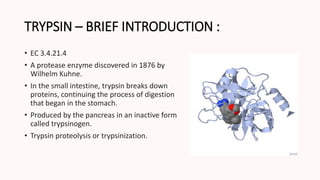
TRYPSIN – BRIEF INTRODUCTION :
• EC 3.4.21.4
• A protease enzyme discovered in 1876 by
Wilhelm Kuhne.
• In the small intestine, trypsin breaks down
proteins, continuing the process of digestion
that began in the stomach.
• Produced by the pancreas in an inactive form
called trypsinogen.
• Trypsin proteolysis or trypsinization.
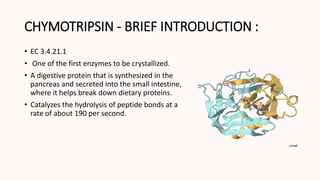
CHYMOTRIPSIN - BRIEF INTRODUCTION :
• EC 3.4.21.1
• One of the first enzymes to be crystallized.
• A digestive protein that is synthesized in the
pancreas and secreted into the small intestine,
where it helps break down dietary proteins.
• Catalyzes the hydrolysis of peptide bonds at a
rate of about 190 per second.
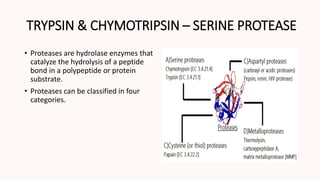
TRYPSIN & CHYMOTRIPSIN – SERINE PROTEASE
• Proteases are hydrolase enzymes that
catalyze the hydrolysis of a peptide
bond in a polypeptide or protein
substrate.
• Proteases can be classified in four
categories.
STRUCTURE OF CHYMOTRYPSIN
• α-chymotrypsin, the mature, active
form of the pancreatic enzyme.
• The residues of the catalytic triad and
disulfide bonds are shown as sticks.
• The mature enzyme consists of three
separate polypeptide chains.
MECHANISM OF ENZYMATIC ACTION OF
TRYPSIN & CHYMOTRYPSIN
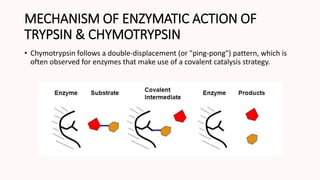
• Chymotrypsin follows a double-displacement (or "ping-pong") pattern, which is
often observed for enzymes that make use of a covalent catalysis strategy.
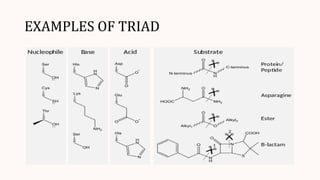
CATALYTIC TRIAD
• A catalytic triad is a set of three coordinated amino acids that can be found in the
active site of hydrolase and transferase enzymes (e.g. proteases, esterases,
lipases).
• Catalytic triads perform covalent catalysis using a residue as a nucleophile.
• The nucleophile is most commonly a serine or cysteine amino acid.
• The reactivity of the nucleophilic residue is increased by the functional groups of
the other triad members.
EXAMPLES OF TRIAD
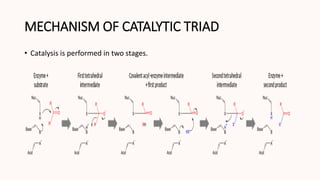
MECHANISM OF CATALYTIC TRIAD
• Catalysis is performed in two stages.
THE ROLE OF CATALYTIC TRIAD IN THE SERINE
PROTEASE MECHANISM
• Chymotrypsin, a common serine protease, hosts a trio of histidine, aspartate, and
serine residues as its catalytic triad.
• In addition to the triad, the active site of chymotrypsin also features an oxyanion
hole.
• In addition to disrupting the peptide bond with a serine, chymotrypsin does three
other important things: activate the amide bond for the nucleophilic attack,
activate water to make it a good nucleophile, and protonate the amine to make it
a good leaving group.
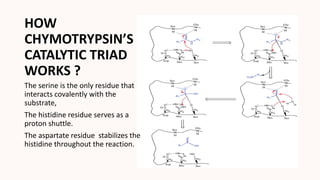
HOW
CHYMOTRYPSIN’S
CATALYTIC TRIAD
WORKS ?
The serine is the only residue that
interacts covalently with the
substrate,
The histidine residue serves as a
proton shuttle.
The aspartate residue stabilizes the
histidine throughout the reaction.
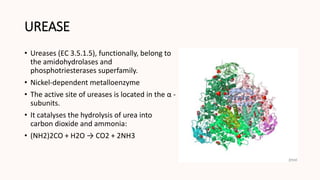
UREASE
• Ureases (EC 3.5.1.5), functionally, belong to
the amidohydrolases and
phosphotriesterases superfamily.
• Nickel-dependent metalloenzyme
• The active site of ureases is located in the α -
subunits.
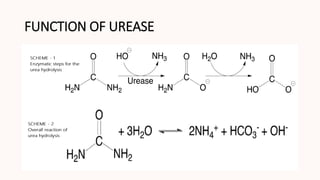
• It catalyses the hydrolysis of urea into
carbon dioxide and ammonia:
• (NH2)2CO + H2O → CO2 + 2NH3
FUNCTION OF UREASE
HOW DOES UREASE WORK ?
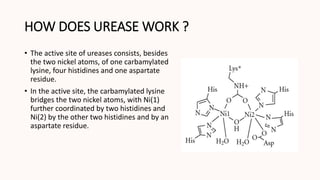
• The active site of ureases consists, besides
the two nickel atoms, of one carbamylated
lysine, four histidines and one aspartate
residue.
• In the active site, the carbamylated lysine
bridges the two nickel atoms, with Ni(1)
further coordinated by two histidines and
Ni(2) by the other two histidines and by an
aspartate residue.
UREA HYDROLYSIS
CATALYZED BY
UREASE – HOT
RESEARCH TOPIC
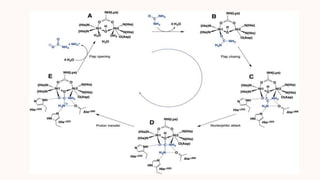
The exact mechanism for urea hydrolysis
catalyzed by urease has been a research hot
topic in the last decades.
And there are some questions yet to be
answered, mostly on –
The role of each accessory protein in the
activation process like UreD, UreF, UreG, and
UreE involved in the assembly of urease’s
active metallocentre, and
the sequence of events and oligomerization
state of each protein in the activation
complex.
REFERENCE
1. Lehninger Principles of Biochemistry: 6th Edition
2. Harper's Illustrated Biochemistry, 31st Edition
3. Fundamentals of Biochemistry, Textbook by Charlotte W. Pratt and Donald Voet
4. Biochemistry, Ninth Edition, Lubert Stryer; Jeremy Berg; John Tymoczko;
Gregory Gatto
5. Journal of Advanced Research, Volume 13, September 2018, Pages 3-17
6. The structure-based reaction mechanism of urease, a nickel dependent
enzyme: tale of a long debate - Journal of Biological Inorganic Chemistry,
volume 25, page. 829–845, (2020)
THANK YOU.

Trypsin, chymotripsin & urease

  • 1.
    MECHANISM OF ENZYME ACTION– TRYPSIN, CHYMOTRIPSIN & UREASE RANA SAHA 1st SEMESTER, M.S. (PHARM.) MEDICINAL CHEMISTRY NIPER, KOLKATA
  • 2.
    TRYPSIN – BRIEFINTRODUCTION : • EC 3.4.21.4 • A protease enzyme discovered in 1876 by Wilhelm Kuhne. • In the small intestine, trypsin breaks down proteins, continuing the process of digestion that began in the stomach. • Produced by the pancreas in an inactive form called trypsinogen. • Trypsin proteolysis or trypsinization.
  • 3.
    CHYMOTRIPSIN - BRIEFINTRODUCTION : • EC 3.4.21.1 • One of the first enzymes to be crystallized. • A digestive protein that is synthesized in the pancreas and secreted into the small intestine, where it helps break down dietary proteins. • Catalyzes the hydrolysis of peptide bonds at a rate of about 190 per second.
  • 4.
    TRYPSIN & CHYMOTRIPSIN– SERINE PROTEASE • Proteases are hydrolase enzymes that catalyze the hydrolysis of a peptide bond in a polypeptide or protein substrate. • Proteases can be classified in four categories.
  • 5.
    STRUCTURE OF CHYMOTRYPSIN •α-chymotrypsin, the mature, active form of the pancreatic enzyme. • The residues of the catalytic triad and disulfide bonds are shown as sticks. • The mature enzyme consists of three separate polypeptide chains.
  • 6.
    MECHANISM OF ENZYMATICACTION OF TRYPSIN & CHYMOTRYPSIN • Chymotrypsin follows a double-displacement (or "ping-pong") pattern, which is often observed for enzymes that make use of a covalent catalysis strategy.
  • 7.
    CATALYTIC TRIAD • Acatalytic triad is a set of three coordinated amino acids that can be found in the active site of hydrolase and transferase enzymes (e.g. proteases, esterases, lipases). • Catalytic triads perform covalent catalysis using a residue as a nucleophile. • The nucleophile is most commonly a serine or cysteine amino acid. • The reactivity of the nucleophilic residue is increased by the functional groups of the other triad members.
  • 8.
  • 9.
    MECHANISM OF CATALYTICTRIAD • Catalysis is performed in two stages.
  • 10.
    THE ROLE OFCATALYTIC TRIAD IN THE SERINE PROTEASE MECHANISM • Chymotrypsin, a common serine protease, hosts a trio of histidine, aspartate, and serine residues as its catalytic triad. • In addition to the triad, the active site of chymotrypsin also features an oxyanion hole. • In addition to disrupting the peptide bond with a serine, chymotrypsin does three other important things: activate the amide bond for the nucleophilic attack, activate water to make it a good nucleophile, and protonate the amine to make it a good leaving group.
  • 11.
    HOW CHYMOTRYPSIN’S CATALYTIC TRIAD WORKS ? Theserine is the only residue that interacts covalently with the substrate, The histidine residue serves as a proton shuttle. The aspartate residue stabilizes the histidine throughout the reaction.
  • 12.
    UREASE • Ureases (EC3.5.1.5), functionally, belong to the amidohydrolases and phosphotriesterases superfamily. • Nickel-dependent metalloenzyme • The active site of ureases is located in the α - subunits. • It catalyses the hydrolysis of urea into carbon dioxide and ammonia: • (NH2)2CO + H2O → CO2 + 2NH3
  • 13.
  • 14.
    HOW DOES UREASEWORK ? • The active site of ureases consists, besides the two nickel atoms, of one carbamylated lysine, four histidines and one aspartate residue. • In the active site, the carbamylated lysine bridges the two nickel atoms, with Ni(1) further coordinated by two histidines and Ni(2) by the other two histidines and by an aspartate residue.
  • 16.
    UREA HYDROLYSIS CATALYZED BY UREASE– HOT RESEARCH TOPIC The exact mechanism for urea hydrolysis catalyzed by urease has been a research hot topic in the last decades. And there are some questions yet to be answered, mostly on – The role of each accessory protein in the activation process like UreD, UreF, UreG, and UreE involved in the assembly of urease’s active metallocentre, and the sequence of events and oligomerization state of each protein in the activation complex.
  • 17.
    REFERENCE 1. Lehninger Principlesof Biochemistry: 6th Edition 2. Harper's Illustrated Biochemistry, 31st Edition 3. Fundamentals of Biochemistry, Textbook by Charlotte W. Pratt and Donald Voet 4. Biochemistry, Ninth Edition, Lubert Stryer; Jeremy Berg; John Tymoczko; Gregory Gatto 5. Journal of Advanced Research, Volume 13, September 2018, Pages 3-17 6. The structure-based reaction mechanism of urease, a nickel dependent enzyme: tale of a long debate - Journal of Biological Inorganic Chemistry, volume 25, page. 829–845, (2020)
  • 18.