Sharq Elneil College
School of Medical Laboratory
          Sciences
 Department of Microbiology
Medical Bacteriology course


      Proteeae
 U.Mahadi Hassan Mahmoud
     Bsc, Msc, MIBMS Microbiology
Proteus
Proteus
The   sub-family include:
  Proteus.
    P.mirabilis
    P.vulgaris
  Morganella.  M.morgani
  Providencia. P. rettgeri
General characters:
 Member of enterobacteriaceae.
 Saprophytes (life in water & soil).

 Some are commensal in human

  intestine.
 Non-sporing.

 Non-capsulated.

The main 2 species:
    • P. mirabilis.
    • P. vulgaris.
Morphology & stain
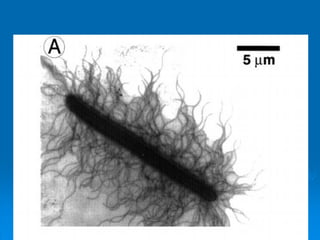
Gram negative bacilli, poleomorphic.
Culture characters
 Non-fastidious.
 MacConkey    agar: pale yellow colonies
  (NLF), moderate in size, moist and low
  convex.
 CLED: pale blue-green colonies (NLF).
 Blood agar & nutrient agar: grow and
  produced swarming cover all the plate
  (characteristic).
 Produced fishy smell.
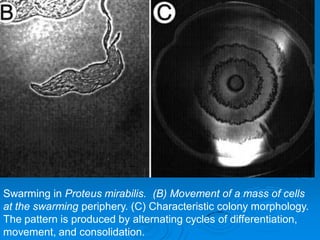
Swarming in Proteus mirabilis. (B) Movement of a mass of cells
at the swarming periphery. (C) Characteristic colony morphology.
The pattern is produced by alternating cycles of differentiation,
movement, and consolidation.
How to prevent swarming
 Increase the agar concentration (from 1.2-
  1.5% to 6%).
 CLED (electrolytes deficiency).
 To add chemicals: chloral hydrate, Na-
  azide & paranitroglycerol.
 MacConkey agar (Bile salt).
Viability
Easy  to killed by heat.
Easy to killed by lab-
 disinfectant.
Sensitive to most antimicrobial
 agent used for
 enterobacteriaceae.
Biochemical reaction
 Urease   test: +ve (with 4 hours).
 PPA test: +ve.
 Motility test: +ve.
 H2S production test: +ve.
 MR: +ve              VP: -ve
 Ferment: glucose & maltose.
 Not ferment: lactose.
 Indole & Citrate test: vairable (P.
  mirabilis –ve indole test)
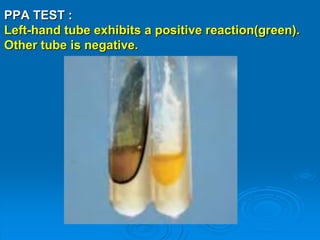
PPA TEST :
Left-hand tube exhibits a positive reaction(green).
Other tube is negative.
Antigenic structure
 Possess   O- antigen (classification
  & identification).
 Possess H-antigen.
 Do not possess K-antigen.
Pathogenicity
 Cause   opportunistic infection.
  UTI following catheter & surgery.
  Wound infection.

  Otitis media.

  Septicemia (complication of UTI &

   wound infection).
  Pneumonia (very rare).
Dienes phenomenon
 Test  used for identification of Proteus
  & differentiation of species.
 If inoculate two strains of Proteus as
  spot on non-inhibitory culture media
  in different polar and after incubation;
  if the strains are different, the
  swarming will be separated by line
  and if they are identical there is no
  line of separation.
 This test help in epidemiology.
Weil-flex reaction
 There   are cross reaction between
  certain species of Proteus and
  Rickettsia (which cause typhus fever &
  it is grow only on Tissue culture).
 When treated pt serum of person
  infected with typhus fever with Proteus
  Ag from spp (OX19, OXK and OX2)
  will give +ve reaction.
LAB- Diagnosis
 Specimen:    according to the side of
  infection ( Pus, swabs, blood, urine,
  sputum……etc).
 Direct Gram stain (same specimen).
 Culture & incubation.
 Colonial morphology.
 Indirect Gram stain.
 Biochemical reaction.
Antimicrobial susceptibility
 Antibiotics   with activity against P. mirabilis
  include
 ampicillin cephalosporins and
  aminoglycosides.
 Some strains of P. mirabilis are beta
  lactamase producing and therefore
  resistant to ampicillin.
 Proteus species are resistant to polymyxin
  and nitrofurantoin
Proteus mahadi ppt

Proteus mahadi ppt

  • 1.
    Sharq Elneil College Schoolof Medical Laboratory Sciences Department of Microbiology Medical Bacteriology course Proteeae U.Mahadi Hassan Mahmoud Bsc, Msc, MIBMS Microbiology
  • 3.
  • 4.
    Proteus The sub-family include:  Proteus. P.mirabilis P.vulgaris  Morganella. M.morgani  Providencia. P. rettgeri
  • 5.
    General characters:  Memberof enterobacteriaceae.  Saprophytes (life in water & soil).  Some are commensal in human intestine.  Non-sporing.  Non-capsulated. The main 2 species: • P. mirabilis. • P. vulgaris.
  • 6.
    Morphology & stain Gramnegative bacilli, poleomorphic.
  • 7.
    Culture characters  Non-fastidious. MacConkey agar: pale yellow colonies (NLF), moderate in size, moist and low convex.  CLED: pale blue-green colonies (NLF).  Blood agar & nutrient agar: grow and produced swarming cover all the plate (characteristic).  Produced fishy smell.
  • 9.
    Swarming in Proteusmirabilis. (B) Movement of a mass of cells at the swarming periphery. (C) Characteristic colony morphology. The pattern is produced by alternating cycles of differentiation, movement, and consolidation.
  • 12.
    How to preventswarming  Increase the agar concentration (from 1.2- 1.5% to 6%).  CLED (electrolytes deficiency).  To add chemicals: chloral hydrate, Na- azide & paranitroglycerol.  MacConkey agar (Bile salt).
  • 13.
    Viability Easy tokilled by heat. Easy to killed by lab- disinfectant. Sensitive to most antimicrobial agent used for enterobacteriaceae.
  • 14.
    Biochemical reaction  Urease test: +ve (with 4 hours).  PPA test: +ve.  Motility test: +ve.  H2S production test: +ve.  MR: +ve VP: -ve  Ferment: glucose & maltose.  Not ferment: lactose.  Indole & Citrate test: vairable (P. mirabilis –ve indole test)
  • 16.
    PPA TEST : Left-handtube exhibits a positive reaction(green). Other tube is negative.
  • 17.
    Antigenic structure  Possess O- antigen (classification & identification).  Possess H-antigen.  Do not possess K-antigen.
  • 18.
    Pathogenicity  Cause opportunistic infection.  UTI following catheter & surgery.  Wound infection.  Otitis media.  Septicemia (complication of UTI & wound infection).  Pneumonia (very rare).
  • 19.
    Dienes phenomenon  Test used for identification of Proteus & differentiation of species.  If inoculate two strains of Proteus as spot on non-inhibitory culture media in different polar and after incubation; if the strains are different, the swarming will be separated by line and if they are identical there is no line of separation.  This test help in epidemiology.
  • 21.
    Weil-flex reaction  There are cross reaction between certain species of Proteus and Rickettsia (which cause typhus fever & it is grow only on Tissue culture).  When treated pt serum of person infected with typhus fever with Proteus Ag from spp (OX19, OXK and OX2) will give +ve reaction.
  • 22.
    LAB- Diagnosis  Specimen: according to the side of infection ( Pus, swabs, blood, urine, sputum……etc).  Direct Gram stain (same specimen).  Culture & incubation.  Colonial morphology.  Indirect Gram stain.  Biochemical reaction.
  • 23.
    Antimicrobial susceptibility  Antibiotics with activity against P. mirabilis include  ampicillin cephalosporins and aminoglycosides.  Some strains of P. mirabilis are beta lactamase producing and therefore resistant to ampicillin.  Proteus species are resistant to polymyxin and nitrofurantoin