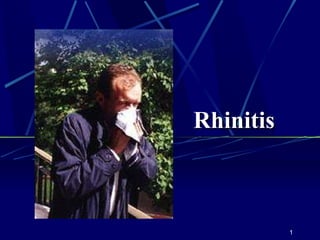
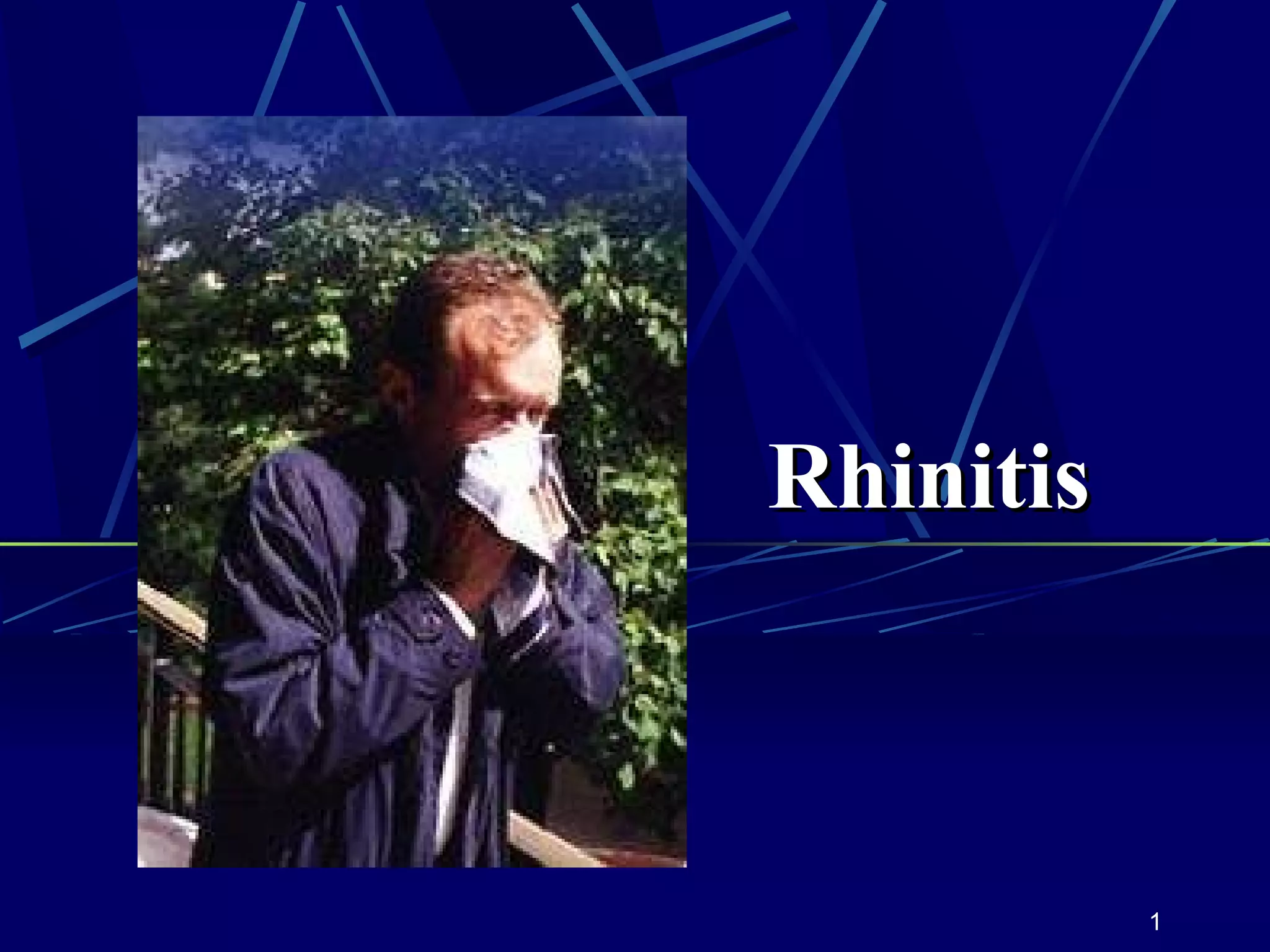
Rhinitis
Definition of Rhinitis Rhinitis is inflammation of the lining of the nasal cavity. As the lining of the nasal cavity and the para nasal sinuses is continuous, inflammatory process tend to involve both areas to a greater or lesser extent.
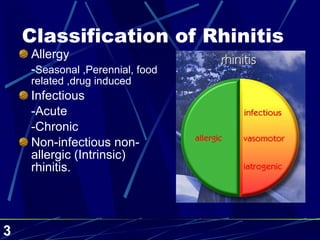
Classification of Rhinitis Allergy - Seasonal ,Perennial, food related ,drug induced Infectious -Acute -Chronic Non-infectious non-allergic (Intrinsic) rhinitis.
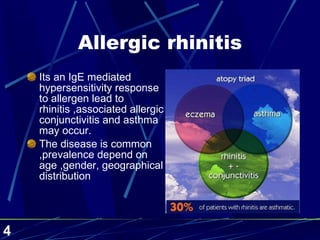
Allergic rhinitis Its an IgE mediated hypersensitivity response to allergen lead to rhinitis ,associated allergic conjunctivitis and asthma may occur. The disease is common ,prevalence depend on age ,gender, geographical distribution
Pathological change Local mucosal change -edema -infiltration with eosinophils and plasma cells -watery discharge -vascular dilatation -polypi -Superadded infection Involvement of sinuses -generalized thickening  -polypi in the sinuses( single or multiple) -fluid effusion in the sinuses
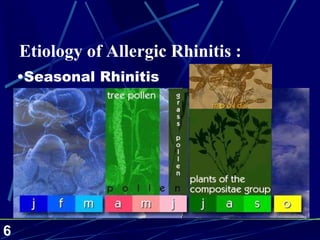
Seasonal Rhinitis Etiology of Allergic Rhinitis  :
Clinical features: -  Sneezing , may be in paroxysm. Rhinorrhea  nasal obstruction and loss of smell Itchiness of nose ,eye,palate Tearing ,itching ,redness of eyes Burning sensation in the throat. symptom related to asthma (cough,shortness of breath, wheeze)
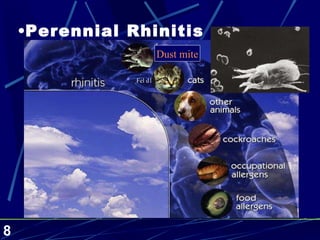
Perennial Rhinitis Dust mite Fel d1
Clinical features: -  Rhinorrhea may be more viscous nasal obstruction and loss of smell and taste Associated sinusitis ,Eustachian tube dysfunction Sneezing less common Nasal congestion, postnasal drip
Occupational allergins Rhinitis may occur as a consequence of allergins inhaled in work place frequently associated with asthma Biological agent include flour (in baker ,grain worker), laboratory animal ,wood dust,biological washing powder,latex Chemical agent -paint manufacturer and painter (spray) -platinum salt in platinum refiner -drugs in pharmaceutical worker
Food induced rhinitis It’s a rare cause of allergic rhinitis, symptom of rhinitis often associated with urticaria, angioedema and GIT symptom Food may occasionally provoke IgE induced rhinitis  In children Milk, egg, cheese, In adult nuts ,fish, shellfish, citrus fruit
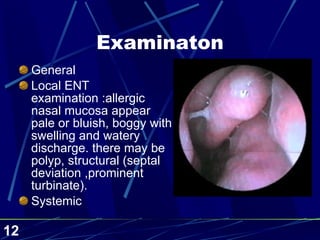
Examinaton General Local ENT examination :allergic nasal mucosa appear pale or bluish, boggy with swelling and watery discharge. there may be polyp, structural (septal deviation ,prominent turbinate). Systemic
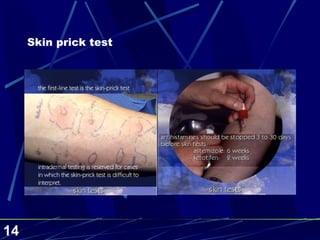
Investigations 1-  Skin Tests : it’s a primary tool in the investigation of allergy .its positive in seasonal rhinitis ,less than 50%in others it consist of pricking skin ,with special needle few drops of allergin . Appearance of wheal and flare in 15-20 min ,the size of wheal is usually equal or greater than 3mm and interpreted by positive and negative control  Antihistamine should be discontinued 3-6 days before test  Intradermal test is rarely used because of extensive tissue reaction or anaphylaxis
Skin prick test
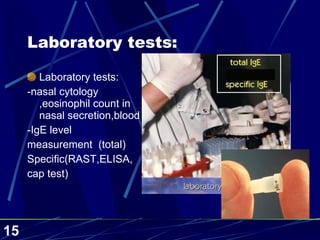
Laboratory tests: Laboratory tests: -nasal cytology ,eosinophil count in nasal secretion,blood -IgE level measurement  (total) Specific(RAST,ELISA, cap test)
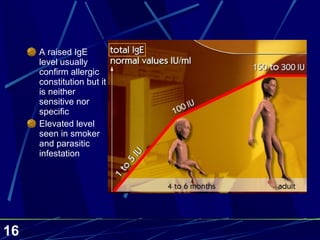
A raised IgE level usually confirm allergic constitution but it is neither sensitive nor specific  Elevated level seen in smoker and parasitic infestation
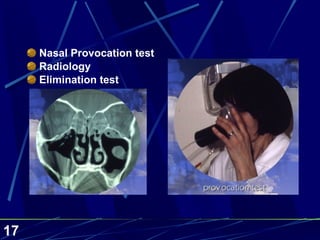
Nasal Provocation test Radiology Elimination test
treatment Avoidance of allergins . Drugs . Immunotherapy (desensitization) . Surgery   .
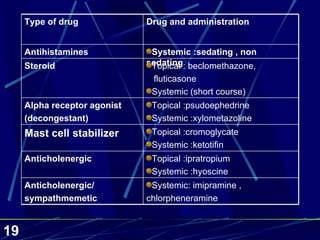
Type of drug Drug and administration Antihistamines  Systemic :sedating , non sedating Steroid Topical : beclomethazone, fluticasone Systemic (short course) Alpha receptor agonist (decongestant) Topical :psudoephedrine Systemic :xylometazoline Mast cell stabilizer Topical :cromoglycate Systemic :ketotifin Anticholenergic Topical :ipratropium  Systemic :hyoscine Anticholenergic/ sympathmemetic Systemic: imipramine , chlorpheneramine
Desensitization  :  it consist of injection of allergin in increasing dose S.C to be tolerated by the subject. Sublingual allergin available ,its popular but less effective .
surgery Polypectomy Reduction surgery of inferior turbinate
Drug Induced Rhinitis Aspirin  sensitivity is an important cause of rhinitis which may be severe and prolonged. Aspirin induced rhinitis is frequently associated with nasal polyposis and late onset asthma. Aspirin sensitivity is frequently, although not always, associated with sensitivity to other NSAIDs. The mechanism is unknown. Antihypertensive drugs like  propranolol  and other beta-blockers, adrenergic neuron blocking drugs and  ACE inhibitors  may provoke rhinitis with predominantly nasal congestion and rhinorrhea.
Rhinitis Medicamentosa The condition is the result of over medication with local nasal decongestants casusing rebound phenomenon occurs resulting in turbinate hypertrophy. If the decongestant treatment is repeated the condition become rapidly self-perpetuating and a chronic nasal obstruction unresponsive to decongestant results. The treatment is immediate cessation of the decongestant with replacement by nasal or systemic steroid. If this is not successful then inferior turbinectomy may be required.
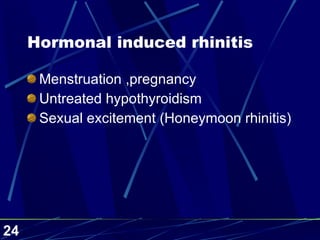
Hormonal induced rhinitis Menstruation ,pregnancy Untreated hypothyroidism Sexual excitement (Honeymoon rhinitis)
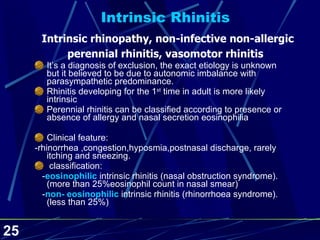
Intrinsic Rhinitis   Intrinsic rhinopathy, non-infective non-allergic perennial rhinitis, vasomotor rhinitis It’s a diagnosis of exclusion, the exact etiology is unknown but it believed to be due to autonomic imbalance with parasympathetic predominance. Rhinitis developing for the 1 st  time in adult is more likely intrinsic Perennial rhinitis can be classified according to presence or absence of allergy and nasal secretion eosinophilia Clinical feature: -rhinorrhea ,congestion,hyposmia,postnasal discharge, rarely itching and sneezing. classification: - eosinophilic  intrinsic rhinitis (nasal obstruction syndrome). (more than 25%eosinophil count in nasal smear) - non- eosinophilic  intrinsic rhinitis (rhinorrhoea syndrome). (less than 25%)
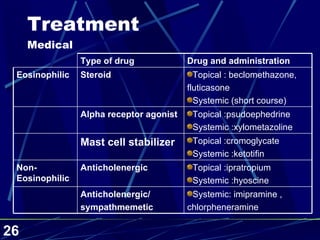
Treatment  Medical Type of drug Drug and administration Eosinophilic Steroid Topical : beclomethazone, fluticasone Systemic (short course) Alpha receptor agonist Topical :psudoephedrine Systemic :xylometazoline Mast cell stabilizer Topical :cromoglycate Systemic :ketotifin Non-Eosinophilic Anticholenergic Topical :ipratropium  Systemic :hyoscine Anticholenergic/ sympathmemetic Systemic: imipramine , chlorpheneramine
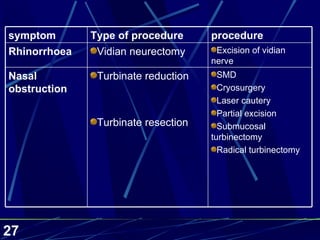
symptom Type of procedure procedure Rhinorrhoea Vidian neurectomy Excision of vidian nerve Nasal obstruction Turbinate reduction Turbinate resection SMD Cryosurgery Laser cautery Partial excision Submucosal turbinectomy Radical turbinectomy
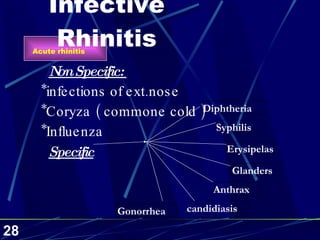
Infective Rhinitis Non Specific:  *infections of ext.nose *Coryza ( commone cold ) *Influenza  Specific Erysipelas Glanders Anthrax candidiasis Gonorrhea Diphtheria Syphilis Acute rhinitis
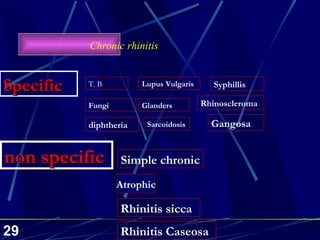
Chronic rhinitis  Glanders Rhinoscleroma diphtheria Sarcoidosis Lupus Vulgaris T. B Gangosa Specific Syphillis Fungi Rhinitis sicca Rhinitis Caseosa Atrophic Simple chronic non specific
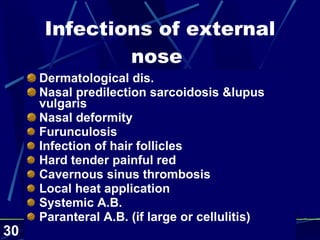
Infections of external nose  Dermatological dis. Nasal predilection sarcoidosis &lupus vulgaris Nasal deformity   Furunculosis Infection of hair follicles  Hard tender painful red  Cavernous sinus thrombosis Local heat application Systemic A.B. Paranteral A.B. (if large or cellulitis)
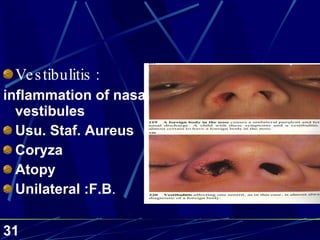
Vestibulitis  : inflammation of nasal vestibules Usu. Staf. Aureus Coryza Atopy Unilateral :F.B .
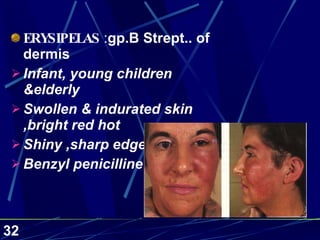
ERYSIPELAS  : gp.B Strept.. of dermis Infant, young children &elderly Swollen & indurated skin ,bright red hot  Shiny ,sharp edges Benzyl penicilline
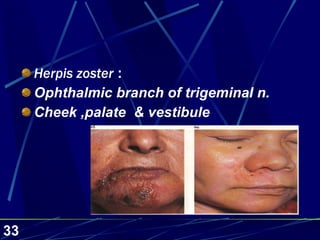
Herpis zoster  : Ophthalmic branch of trigeminal n. Cheek ,palate  & vestibule
Thank you

E.N.T 5th year, 3rd lecture (Dr. Yousif Chalabi)

  • 1.
  • 2.
    Definition of RhinitisRhinitis is inflammation of the lining of the nasal cavity. As the lining of the nasal cavity and the para nasal sinuses is continuous, inflammatory process tend to involve both areas to a greater or lesser extent.
  • 3.
    Classification of RhinitisAllergy - Seasonal ,Perennial, food related ,drug induced Infectious -Acute -Chronic Non-infectious non-allergic (Intrinsic) rhinitis.
  • 4.
    Allergic rhinitis Itsan IgE mediated hypersensitivity response to allergen lead to rhinitis ,associated allergic conjunctivitis and asthma may occur. The disease is common ,prevalence depend on age ,gender, geographical distribution
  • 5.
    Pathological change Localmucosal change -edema -infiltration with eosinophils and plasma cells -watery discharge -vascular dilatation -polypi -Superadded infection Involvement of sinuses -generalized thickening -polypi in the sinuses( single or multiple) -fluid effusion in the sinuses
  • 6.
    Seasonal Rhinitis Etiologyof Allergic Rhinitis :
  • 7.
    Clinical features: - Sneezing , may be in paroxysm. Rhinorrhea nasal obstruction and loss of smell Itchiness of nose ,eye,palate Tearing ,itching ,redness of eyes Burning sensation in the throat. symptom related to asthma (cough,shortness of breath, wheeze)
  • 8.
  • 9.
    Clinical features: - Rhinorrhea may be more viscous nasal obstruction and loss of smell and taste Associated sinusitis ,Eustachian tube dysfunction Sneezing less common Nasal congestion, postnasal drip
  • 10.
    Occupational allergins Rhinitismay occur as a consequence of allergins inhaled in work place frequently associated with asthma Biological agent include flour (in baker ,grain worker), laboratory animal ,wood dust,biological washing powder,latex Chemical agent -paint manufacturer and painter (spray) -platinum salt in platinum refiner -drugs in pharmaceutical worker
  • 11.
    Food induced rhinitisIt’s a rare cause of allergic rhinitis, symptom of rhinitis often associated with urticaria, angioedema and GIT symptom Food may occasionally provoke IgE induced rhinitis In children Milk, egg, cheese, In adult nuts ,fish, shellfish, citrus fruit
  • 12.
    Examinaton General LocalENT examination :allergic nasal mucosa appear pale or bluish, boggy with swelling and watery discharge. there may be polyp, structural (septal deviation ,prominent turbinate). Systemic
  • 13.
    Investigations 1- Skin Tests : it’s a primary tool in the investigation of allergy .its positive in seasonal rhinitis ,less than 50%in others it consist of pricking skin ,with special needle few drops of allergin . Appearance of wheal and flare in 15-20 min ,the size of wheal is usually equal or greater than 3mm and interpreted by positive and negative control Antihistamine should be discontinued 3-6 days before test Intradermal test is rarely used because of extensive tissue reaction or anaphylaxis
  • 14.
  • 15.
    Laboratory tests: Laboratorytests: -nasal cytology ,eosinophil count in nasal secretion,blood -IgE level measurement (total) Specific(RAST,ELISA, cap test)
  • 16.
    A raised IgElevel usually confirm allergic constitution but it is neither sensitive nor specific Elevated level seen in smoker and parasitic infestation
  • 17.
    Nasal Provocation testRadiology Elimination test
  • 18.
    treatment Avoidance ofallergins . Drugs . Immunotherapy (desensitization) . Surgery .
  • 19.
    Type of drugDrug and administration Antihistamines Systemic :sedating , non sedating Steroid Topical : beclomethazone, fluticasone Systemic (short course) Alpha receptor agonist (decongestant) Topical :psudoephedrine Systemic :xylometazoline Mast cell stabilizer Topical :cromoglycate Systemic :ketotifin Anticholenergic Topical :ipratropium Systemic :hyoscine Anticholenergic/ sympathmemetic Systemic: imipramine , chlorpheneramine
  • 20.
    Desensitization : it consist of injection of allergin in increasing dose S.C to be tolerated by the subject. Sublingual allergin available ,its popular but less effective .
  • 21.
    surgery Polypectomy Reductionsurgery of inferior turbinate
  • 22.
    Drug Induced RhinitisAspirin sensitivity is an important cause of rhinitis which may be severe and prolonged. Aspirin induced rhinitis is frequently associated with nasal polyposis and late onset asthma. Aspirin sensitivity is frequently, although not always, associated with sensitivity to other NSAIDs. The mechanism is unknown. Antihypertensive drugs like propranolol and other beta-blockers, adrenergic neuron blocking drugs and ACE inhibitors may provoke rhinitis with predominantly nasal congestion and rhinorrhea.
  • 23.
    Rhinitis Medicamentosa Thecondition is the result of over medication with local nasal decongestants casusing rebound phenomenon occurs resulting in turbinate hypertrophy. If the decongestant treatment is repeated the condition become rapidly self-perpetuating and a chronic nasal obstruction unresponsive to decongestant results. The treatment is immediate cessation of the decongestant with replacement by nasal or systemic steroid. If this is not successful then inferior turbinectomy may be required.
  • 24.
    Hormonal induced rhinitisMenstruation ,pregnancy Untreated hypothyroidism Sexual excitement (Honeymoon rhinitis)
  • 25.
    Intrinsic Rhinitis Intrinsic rhinopathy, non-infective non-allergic perennial rhinitis, vasomotor rhinitis It’s a diagnosis of exclusion, the exact etiology is unknown but it believed to be due to autonomic imbalance with parasympathetic predominance. Rhinitis developing for the 1 st time in adult is more likely intrinsic Perennial rhinitis can be classified according to presence or absence of allergy and nasal secretion eosinophilia Clinical feature: -rhinorrhea ,congestion,hyposmia,postnasal discharge, rarely itching and sneezing. classification: - eosinophilic intrinsic rhinitis (nasal obstruction syndrome). (more than 25%eosinophil count in nasal smear) - non- eosinophilic intrinsic rhinitis (rhinorrhoea syndrome). (less than 25%)
  • 26.
    Treatment MedicalType of drug Drug and administration Eosinophilic Steroid Topical : beclomethazone, fluticasone Systemic (short course) Alpha receptor agonist Topical :psudoephedrine Systemic :xylometazoline Mast cell stabilizer Topical :cromoglycate Systemic :ketotifin Non-Eosinophilic Anticholenergic Topical :ipratropium Systemic :hyoscine Anticholenergic/ sympathmemetic Systemic: imipramine , chlorpheneramine
  • 27.
    symptom Type ofprocedure procedure Rhinorrhoea Vidian neurectomy Excision of vidian nerve Nasal obstruction Turbinate reduction Turbinate resection SMD Cryosurgery Laser cautery Partial excision Submucosal turbinectomy Radical turbinectomy
  • 28.
    Infective Rhinitis NonSpecific: *infections of ext.nose *Coryza ( commone cold ) *Influenza Specific Erysipelas Glanders Anthrax candidiasis Gonorrhea Diphtheria Syphilis Acute rhinitis
  • 29.
    Chronic rhinitis Glanders Rhinoscleroma diphtheria Sarcoidosis Lupus Vulgaris T. B Gangosa Specific Syphillis Fungi Rhinitis sicca Rhinitis Caseosa Atrophic Simple chronic non specific
  • 30.
    Infections of externalnose Dermatological dis. Nasal predilection sarcoidosis &lupus vulgaris Nasal deformity Furunculosis Infection of hair follicles Hard tender painful red Cavernous sinus thrombosis Local heat application Systemic A.B. Paranteral A.B. (if large or cellulitis)
  • 31.
    Vestibulitis :inflammation of nasal vestibules Usu. Staf. Aureus Coryza Atopy Unilateral :F.B .
  • 32.
    ERYSIPELAS :gp.B Strept.. of dermis Infant, young children &elderly Swollen & indurated skin ,bright red hot Shiny ,sharp edges Benzyl penicilline
  • 33.
    Herpis zoster : Ophthalmic branch of trigeminal n. Cheek ,palate & vestibule
  • 34.