Allergic rhinitis-and
Vasomotor rhinitis
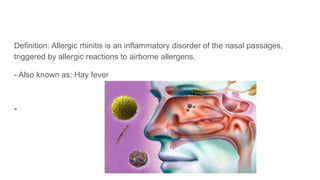
Definition: Allergic rhinitis is an inflammatory disorder of the nasal passages,
triggered by allergic reactions to airborne allergens.
- Also known as: Hay fever
*
- Allergens:
- Pollen (trees, grasses, weeds)
- Dust mites
- Mold
- Pet dander
- Insect parts
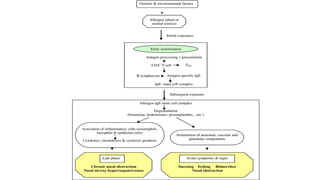
- Genetic predisposition
- Environmental factors
Types
1. Seasonal. Symptoms appear in or around a particular season when the
pollens of a particular plant, to which the patient is sensitive, are present in the
air.
2. Perennial. Symptoms are present throughout the year.
Symptoms
The cardinal symptoms of seasonal nasal allergy include
● paroxysmal sneezing, 10–20 sneezes at a time,
● nasal obstruction,
● watery nasal discharge
● Itching in the nose. Itching may also involve eyes, palate or pharynx.
● Some may get bronchospasm.
Symptoms of perennial allergy are not so severe as that of the seasonal type.
They include
● Frequent colds,
● persistently stuffy nose
● loss of sense of smell due to mucosal oedema
● postnasal drip
● chronic cough and
● hearing impairment due to eustachian tube blockage or fluid in the middle ear.
Signs
1. Nasal signs include
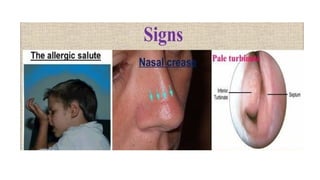
● transverse nasal crease—a black line across the middle of dorsum of nose
due to constant upward rubbing of nose simulating a salute (allergic salute),
● pale and oedematous nasal mucosa which may appear bluish.
● Turbinates are swollen.
● Thin, watery or mucoid discharge is usually present.
2• Ocular signs include
● oedema of lids,
● congestion and cobble-stone appearance of the conjunctiva,
● dark circles under the eyes (allergic shiners).
3• Otologic signs include retracted tympanic membrane or serous otitis media as
a result of eustachian tube blockage
● Allergic shiners
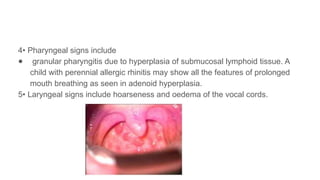
4• Pharyngeal signs include
● granular pharyngitis due to hyperplasia of submucosal lymphoid tissue. A
child with perennial allergic rhinitis may show all the features of prolonged
mouth breathing as seen in adenoid hyperplasia.
5• Laryngeal signs include hoarseness and oedema of the vocal cords.
Investigations
● 1. Total and differential count. Peripheral eosinophilia may be seen but this is
an inconsistent finding.
● 2. Nasal smear. It shows large number of eosinophils in allergic rhinitis. Nasal
smear should be taken at the time of clinically active disease or after nasal
chal lenge test. Nasal eosinophilia is also seen in certain nonallergic rhinitis,
e.g. NARES (nonallergic rhinitis with eosinophilia syndrome)
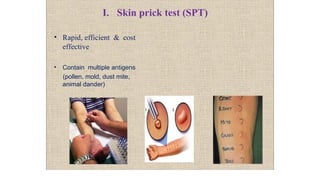
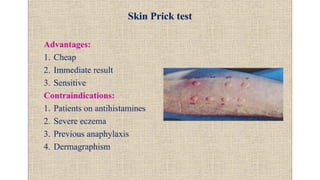
● Specific IgE measurements- It is an in vitro test to find the specific allergen.
There is a good correlation between the skin tests and specific IgE measure
ments. However both false positive and false nega tive results can occur. It is
therefore recommended to correlate the two tests with clinical symptoms.
4. Radioallergosorbent test (RAST). It is an in vitro test and measures specific
IgE antibody concentration in the patient’s serum.
5. Nasal provocation test. A crude method is to challenge the nasal mucosa with
a small amount of aller gen placed at the end of a toothpick and asking the
patient to sniff into each nostril and to observe if allergic symptoms are
reproduced. More sophisticated techniques are available now.
COMPLICATIONS
Nasal allergy may cause:
1. Recurrent sinusitis because of obstruction to the sinus ostia.
2. Formation of nasal polypi in about 2%.
3. Serous otitis media.
4. Orthodontic problems and other ill-effects of pro longed mouth breathing
especially in children.
5. Bronchial asthma. Patients of nasal allergy have four times more risk of
developing bronchial asthma. Twenty to thirty per cent of patients with rhinitis
have asthma
Treatment
● Treatment can be divided into:
● 1. Avoidance of allergen.
● 2. Treatment with drugs.
● 3. Immunotherapy.
1.Avoidance of allergen.
● This is most successful if the antigen involved is single. Removal of a pet from
the house, encasing the pillow or mattress with plastic sheet, change of place
of work or sometimes change of job may be required. A particular food article
to which the patient is found allergic can be eliminated from the diet.
Treatment with drugs
● 1. Antihistaminics.
● 2. Sympathomimetic drugs (oral or topical)-Pseudoephedrine and
phenylephrine are often combined with antihistaminics for oral admin istration.
● 3. Corticosteroids. Oral corticosteroids are very effective in controlling the
symptoms of allergic rhinitis but their use should be limited to acute episodes
● 4. Sodium cromoglycate-It stabilizes the mast cells and prevents them from
degranulation despite the forma tion of IgE-antigen complex.
● 5. Anticholinergics-Ipratropium nasal spray
● 6. Leukotriene receptor antagonists-Montelukast
● 7. Anti-IgE. It reduces the IgE level and has an anti inflammatory effect.
Omalizumab is such a drug. It is indicated in children above 12 years who
have moderate to severe asthma. It is not yet approved for allergic rhinitis.
3. immunotherapy.
● Immunotherapy or hyposensitiza tion is used when drug treatment fails to
control symp toms or produces intolerable side effects. Allergen is given in
gradually increasing doses till the maintenance dose is reached.
Immunotherapy suppresses the forma tion of IgE. It also raises the titre of
specific IgG antibody. Immunotherapy has to be given for a year or so before
significant improvement of symptoms can be noticed.
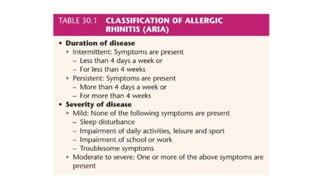
A step-care approach is recommended by ARIA for allergic rhinitis treatment. •
Oral antihistamines or intranasal cromolyn sodium is recommended for mild
intermittent disease.
• For allergic symptoms of moderate severity or for per sistent disease intranasal
corticosteroids can be used as monotherapy.
• For severe symptoms, combination therapy with oral nonsedating
antihistamines and intranasal steroids is used.
• For severe and persistent symptoms in spite of the above treatment a short
course of oral steroids and im munotherapy is recommended.
• If nasal obstruction persists a short course of intranasal decongestant can be
used. Oral decongestant can be combined with antihistamines.
• Avoid allergen and irritants in all forms of disease. Nonallergic rhinitis can
coexist with allergic rhinitis. Nonspecific stimuli produce allergic rhinitis-like symp
toms due to hyper-reactivity of nasal mucosa.
VASOMOTOR RHINITIS (VMR)
● It is nonallergic rhinitis but clinically simulating nasal al lergy with symptoms of
nasal obstruction, rhinorrhoea and sneezing. One or the other of these
symptoms may predominate. The condition usually persists throughout the
year and all the tests of nasal allergy are negative.
● Nasal mucosa has rich blood supply. Its vasculature is similar to the erectile
tissue in having venous sinusoids which are surrounded by fibres of smooth
muscle which act as sphincters and control the filling or emptying of these
sinusoids.
● Sympathetic stimulation causes vasoconstriction and shrinkage of mucosa,
while parasympathetic stimulation causes vasodilation and engorgement.
Overactivity of parasympathetic system also causes excessive secretion from
the nasal glands.
● Autonomic nervous system is under the control of hypothalamus and
therefore emotions play a great role in vasomotor rhinitis.
● Autonomic system is unstable in cases of vasomotor rhinitis.
● Nasal mucosa is also hyper-reactive and responds to several nonspecific
stimuli, e.g. change in temperature, humidity, blasts of air, small amounts of
dust or smoke.
SYMPTOMS
● 1. Paroxysmal sneezing. Bouts of sneezing start just after getting out of the
bed in the morning.
● 2. Excessive rhinorrhoea. This accompanies sneezing or this may be the only
predominant symptom. It is profuse and watery and may even wet several
hand kerchiefs. The nose may drip when the patient leans forward and this
may need to be differentiated from csf rhinorrhoea.
● 3. Nasal obstruction. This alternates from side to side. Usually more marked
at night. It is the dependent side of nose which is often blocked when lying on
one side.
● 4. Postnasal drip.
SIGNS
● Nasal mucosa over the turbinates is generally congested and hypertrophic. In
some, it may be normal.
COMPLICATIONS
Long-standing cases or VMR develop
● nasal polypi,
● hyper trophic rhinitis and
● sinusitis.
Treatment
Medical
1. Avoidance of physical factors which provoke symptoms, e.g. sudden change in
temperature, humidity, blasts of air or dust.
2. Antihistaminic and oral nasal decongestants are helpful in relieving nasal
obstruction, sneezing and rhinorrhea.
3. Topical steroids (e.g. beclomethasone dipropionate, budesonide or
fluticasone), used as spray or aerosol, are useful to control symptoms.
4. Systemic steroids can be given for a short time in very severe cases.
5. Psychological factors should be removed. Tranquillizers may be needed in
some patients
Surgical
● Reliving nasal obstruction
● Vidian neurectomy

allergic rhinitis and vasomotor rhinitis

  • 1.
  • 2.
    Definition: Allergic rhinitisis an inflammatory disorder of the nasal passages, triggered by allergic reactions to airborne allergens. - Also known as: Hay fever *
  • 3.
    - Allergens: - Pollen(trees, grasses, weeds) - Dust mites - Mold - Pet dander - Insect parts - Genetic predisposition - Environmental factors
  • 5.
    Types 1. Seasonal. Symptomsappear in or around a particular season when the pollens of a particular plant, to which the patient is sensitive, are present in the air. 2. Perennial. Symptoms are present throughout the year.
  • 7.
    Symptoms The cardinal symptomsof seasonal nasal allergy include ● paroxysmal sneezing, 10–20 sneezes at a time, ● nasal obstruction, ● watery nasal discharge ● Itching in the nose. Itching may also involve eyes, palate or pharynx. ● Some may get bronchospasm.
  • 8.
    Symptoms of perennialallergy are not so severe as that of the seasonal type. They include ● Frequent colds, ● persistently stuffy nose ● loss of sense of smell due to mucosal oedema ● postnasal drip ● chronic cough and ● hearing impairment due to eustachian tube blockage or fluid in the middle ear.
  • 9.
    Signs 1. Nasal signsinclude ● transverse nasal crease—a black line across the middle of dorsum of nose due to constant upward rubbing of nose simulating a salute (allergic salute), ● pale and oedematous nasal mucosa which may appear bluish. ● Turbinates are swollen. ● Thin, watery or mucoid discharge is usually present.
  • 11.
    2• Ocular signsinclude ● oedema of lids, ● congestion and cobble-stone appearance of the conjunctiva, ● dark circles under the eyes (allergic shiners). 3• Otologic signs include retracted tympanic membrane or serous otitis media as a result of eustachian tube blockage
  • 12.
  • 13.
    4• Pharyngeal signsinclude ● granular pharyngitis due to hyperplasia of submucosal lymphoid tissue. A child with perennial allergic rhinitis may show all the features of prolonged mouth breathing as seen in adenoid hyperplasia. 5• Laryngeal signs include hoarseness and oedema of the vocal cords.
  • 15.
    Investigations ● 1. Totaland differential count. Peripheral eosinophilia may be seen but this is an inconsistent finding. ● 2. Nasal smear. It shows large number of eosinophils in allergic rhinitis. Nasal smear should be taken at the time of clinically active disease or after nasal chal lenge test. Nasal eosinophilia is also seen in certain nonallergic rhinitis, e.g. NARES (nonallergic rhinitis with eosinophilia syndrome)
  • 18.
    ● Specific IgEmeasurements- It is an in vitro test to find the specific allergen. There is a good correlation between the skin tests and specific IgE measure ments. However both false positive and false nega tive results can occur. It is therefore recommended to correlate the two tests with clinical symptoms.
  • 19.
    4. Radioallergosorbent test(RAST). It is an in vitro test and measures specific IgE antibody concentration in the patient’s serum. 5. Nasal provocation test. A crude method is to challenge the nasal mucosa with a small amount of aller gen placed at the end of a toothpick and asking the patient to sniff into each nostril and to observe if allergic symptoms are reproduced. More sophisticated techniques are available now.
  • 20.
    COMPLICATIONS Nasal allergy maycause: 1. Recurrent sinusitis because of obstruction to the sinus ostia. 2. Formation of nasal polypi in about 2%. 3. Serous otitis media. 4. Orthodontic problems and other ill-effects of pro longed mouth breathing especially in children. 5. Bronchial asthma. Patients of nasal allergy have four times more risk of developing bronchial asthma. Twenty to thirty per cent of patients with rhinitis have asthma
  • 21.
    Treatment ● Treatment canbe divided into: ● 1. Avoidance of allergen. ● 2. Treatment with drugs. ● 3. Immunotherapy.
  • 22.
    1.Avoidance of allergen. ●This is most successful if the antigen involved is single. Removal of a pet from the house, encasing the pillow or mattress with plastic sheet, change of place of work or sometimes change of job may be required. A particular food article to which the patient is found allergic can be eliminated from the diet.
  • 23.
    Treatment with drugs ●1. Antihistaminics. ● 2. Sympathomimetic drugs (oral or topical)-Pseudoephedrine and phenylephrine are often combined with antihistaminics for oral admin istration. ● 3. Corticosteroids. Oral corticosteroids are very effective in controlling the symptoms of allergic rhinitis but their use should be limited to acute episodes ● 4. Sodium cromoglycate-It stabilizes the mast cells and prevents them from degranulation despite the forma tion of IgE-antigen complex.
  • 24.
    ● 5. Anticholinergics-Ipratropiumnasal spray ● 6. Leukotriene receptor antagonists-Montelukast ● 7. Anti-IgE. It reduces the IgE level and has an anti inflammatory effect. Omalizumab is such a drug. It is indicated in children above 12 years who have moderate to severe asthma. It is not yet approved for allergic rhinitis.
  • 25.
    3. immunotherapy. ● Immunotherapyor hyposensitiza tion is used when drug treatment fails to control symp toms or produces intolerable side effects. Allergen is given in gradually increasing doses till the maintenance dose is reached. Immunotherapy suppresses the forma tion of IgE. It also raises the titre of specific IgG antibody. Immunotherapy has to be given for a year or so before significant improvement of symptoms can be noticed.
  • 26.
    A step-care approachis recommended by ARIA for allergic rhinitis treatment. • Oral antihistamines or intranasal cromolyn sodium is recommended for mild intermittent disease. • For allergic symptoms of moderate severity or for per sistent disease intranasal corticosteroids can be used as monotherapy. • For severe symptoms, combination therapy with oral nonsedating antihistamines and intranasal steroids is used. • For severe and persistent symptoms in spite of the above treatment a short course of oral steroids and im munotherapy is recommended. • If nasal obstruction persists a short course of intranasal decongestant can be used. Oral decongestant can be combined with antihistamines. • Avoid allergen and irritants in all forms of disease. Nonallergic rhinitis can coexist with allergic rhinitis. Nonspecific stimuli produce allergic rhinitis-like symp toms due to hyper-reactivity of nasal mucosa.
  • 27.
    VASOMOTOR RHINITIS (VMR) ●It is nonallergic rhinitis but clinically simulating nasal al lergy with symptoms of nasal obstruction, rhinorrhoea and sneezing. One or the other of these symptoms may predominate. The condition usually persists throughout the year and all the tests of nasal allergy are negative.
  • 28.
    ● Nasal mucosahas rich blood supply. Its vasculature is similar to the erectile tissue in having venous sinusoids which are surrounded by fibres of smooth muscle which act as sphincters and control the filling or emptying of these sinusoids. ● Sympathetic stimulation causes vasoconstriction and shrinkage of mucosa, while parasympathetic stimulation causes vasodilation and engorgement. Overactivity of parasympathetic system also causes excessive secretion from the nasal glands.
  • 29.
    ● Autonomic nervoussystem is under the control of hypothalamus and therefore emotions play a great role in vasomotor rhinitis. ● Autonomic system is unstable in cases of vasomotor rhinitis. ● Nasal mucosa is also hyper-reactive and responds to several nonspecific stimuli, e.g. change in temperature, humidity, blasts of air, small amounts of dust or smoke.
  • 30.
    SYMPTOMS ● 1. Paroxysmalsneezing. Bouts of sneezing start just after getting out of the bed in the morning. ● 2. Excessive rhinorrhoea. This accompanies sneezing or this may be the only predominant symptom. It is profuse and watery and may even wet several hand kerchiefs. The nose may drip when the patient leans forward and this may need to be differentiated from csf rhinorrhoea. ● 3. Nasal obstruction. This alternates from side to side. Usually more marked at night. It is the dependent side of nose which is often blocked when lying on one side. ● 4. Postnasal drip.
  • 31.
    SIGNS ● Nasal mucosaover the turbinates is generally congested and hypertrophic. In some, it may be normal.
  • 32.
    COMPLICATIONS Long-standing cases orVMR develop ● nasal polypi, ● hyper trophic rhinitis and ● sinusitis.
  • 33.
    Treatment Medical 1. Avoidance ofphysical factors which provoke symptoms, e.g. sudden change in temperature, humidity, blasts of air or dust. 2. Antihistaminic and oral nasal decongestants are helpful in relieving nasal obstruction, sneezing and rhinorrhea. 3. Topical steroids (e.g. beclomethasone dipropionate, budesonide or fluticasone), used as spray or aerosol, are useful to control symptoms. 4. Systemic steroids can be given for a short time in very severe cases. 5. Psychological factors should be removed. Tranquillizers may be needed in some patients
  • 34.
    Surgical ● Reliving nasalobstruction ● Vidian neurectomy