BENIGN PAROXYSMAL
POSITIONAL VERTIGO (BPPV)
Sunil Kumar Daha
Introduction
• Most common cause of positional vertigo
• Women > Men
• D/t presence of otolithic debris from saccule or utricle
affecting free flow of endolymph in semicircular canals
(cupulolithiasis)
• Occurs secondary to free-floating canalith within
posterior semicircular canal
• It may follow head injury but typically is spontaneous
/idiopathic
Causes
• Idiopathic
• Infection (viral neuronitis)
• Head trauma
• Surgical damage to the labyrinth
• Ischemic complication of Giant Cell Arteritis
(GCA)
Clinical Features
• Sudden and distressing onset
• Recurrent episodes of vertigo lasting < 1 min
• Symptoms provoked by specific head movements
• Looking up while standing and sitting
• Lying down or getting up from bed
• Rolling over in bed
• Waxing and waning pattern of vertigo
• Sometimes associated nausea and vomiting
• No neurological symptoms
Pathophysiology
• Otoliths (CaCO3 particles) are normally attached to a membrane
inside the utricle and saccule
• Utricle is connected to the semicircular ducts
• Otoliths may become displaced from the utricle to enter the
posterior semicircular duct since this is the most dependent of
the 3 ducts
• Changing head position relative to gravity causes the free
otoliths to gravitate longitudinally through the canal
• Concurrent flow of endolymph stimulates the hair cells of the
affected semicircular canal, causing vertigo
Variants of BPPV
• Posterior Canal BPPV (most common!!)
• Anterior Canal BPPV
• Horizontal Canal BPPV
• Pure Torsional BPPV
Diagnosis
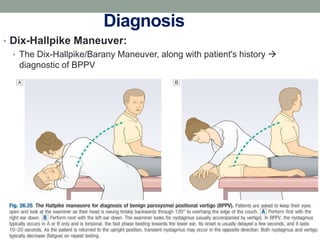
• Dix-Hallpike Maneuver:
• The Dix-Hallpike/Barany Maneuver, along with patient's history 
diagnostic of BPPV
Cont…
• Investigations: generally not needed
• Electronystagmography (ENG): for detecting
preexisting vestibular pathology
• Neuroimaging: If nystagmus doesn’t fit classical
BPPV symptoms
Management
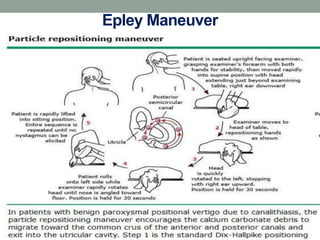
• Particle Repositioning Maneuver:
• Epley Maneuver (choice of T/t)
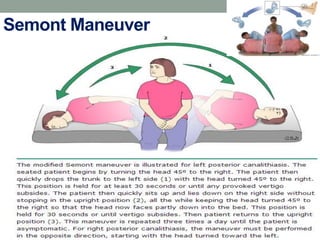
• Semont Maneuver
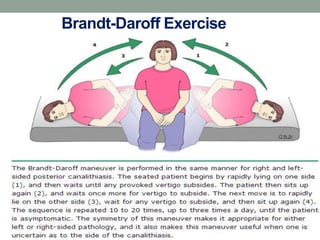
• Brandt-Daroff Exercise (self home treatment)
• Medications:
• Antiemetics
• Antihistaminics
• Anticholinergics
• Surgeries: (better avoided d/t possibility of hearing loss)
• Singular neurectomy
• Posterior Canal Plugging Procedure
• Vestibular Nerve Section
(Epley maneuver)
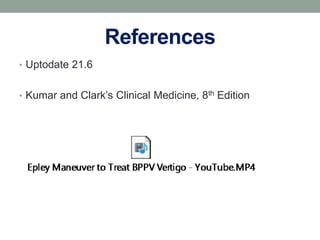
Epley Maneuver
Epley Maneuver
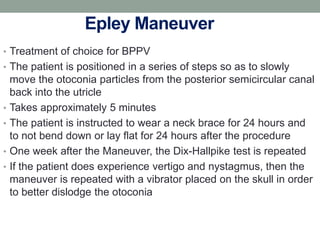
• Treatment of choice for BPPV
• The patient is positioned in a series of steps so as to slowly
move the otoconia particles from the posterior semicircular canal
back into the utricle
• Takes approximately 5 minutes
• The patient is instructed to wear a neck brace for 24 hours and
to not bend down or lay flat for 24 hours after the procedure
• One week after the Maneuver, the Dix-Hallpike test is repeated
• If the patient does experience vertigo and nystagmus, then the
maneuver is repeated with a vibrator placed on the skull in order
to better dislodge the otoconia
Semont Maneuver
Brandt-Daroff Exercise
Surgical
Singular neurectomy
•Old procedure
•Section the nerve that transmits information from the posterior
semicircular canal ampulla toward the brain.
•Can cause hearing loss in 7-17% of patients and fails in 8-12%
Posterior Canal Plugging Procedure
•The canal is gently, firmly packed off with tissue so the debris can
no longer move within the canal and strike against the nerve
endings
•<20% hearing loss
Contd..
Vestibular Nerve Section
•Done if medication fails
•An incision is made behind the ear and balance-hearing nerve is
located
•The balance part of the nerve is cut
•The success rate (no vertigo attacks) is over 90%
•The hearing is usually not affected
References
• Uptodate 21.6
• Kumar and Clark’s Clinical Medicine, 8th Edition
Thank you

Benign Paroxysmal Positional Vertigo (BPPV)

  • 1.
    BENIGN PAROXYSMAL POSITIONAL VERTIGO(BPPV) Sunil Kumar Daha
  • 2.
    Introduction • Most commoncause of positional vertigo • Women > Men • D/t presence of otolithic debris from saccule or utricle affecting free flow of endolymph in semicircular canals (cupulolithiasis) • Occurs secondary to free-floating canalith within posterior semicircular canal • It may follow head injury but typically is spontaneous /idiopathic
  • 3.
    Causes • Idiopathic • Infection(viral neuronitis) • Head trauma • Surgical damage to the labyrinth • Ischemic complication of Giant Cell Arteritis (GCA)
  • 4.
    Clinical Features • Suddenand distressing onset • Recurrent episodes of vertigo lasting < 1 min • Symptoms provoked by specific head movements • Looking up while standing and sitting • Lying down or getting up from bed • Rolling over in bed • Waxing and waning pattern of vertigo • Sometimes associated nausea and vomiting • No neurological symptoms
  • 5.
    Pathophysiology • Otoliths (CaCO3particles) are normally attached to a membrane inside the utricle and saccule • Utricle is connected to the semicircular ducts • Otoliths may become displaced from the utricle to enter the posterior semicircular duct since this is the most dependent of the 3 ducts • Changing head position relative to gravity causes the free otoliths to gravitate longitudinally through the canal • Concurrent flow of endolymph stimulates the hair cells of the affected semicircular canal, causing vertigo
  • 6.
    Variants of BPPV •Posterior Canal BPPV (most common!!) • Anterior Canal BPPV • Horizontal Canal BPPV • Pure Torsional BPPV
  • 7.
    Diagnosis • Dix-Hallpike Maneuver: •The Dix-Hallpike/Barany Maneuver, along with patient's history  diagnostic of BPPV
  • 8.
    Cont… • Investigations: generallynot needed • Electronystagmography (ENG): for detecting preexisting vestibular pathology • Neuroimaging: If nystagmus doesn’t fit classical BPPV symptoms
  • 9.
    Management • Particle RepositioningManeuver: • Epley Maneuver (choice of T/t) • Semont Maneuver • Brandt-Daroff Exercise (self home treatment) • Medications: • Antiemetics • Antihistaminics • Anticholinergics • Surgeries: (better avoided d/t possibility of hearing loss) • Singular neurectomy • Posterior Canal Plugging Procedure • Vestibular Nerve Section
  • 10.
  • 11.
    Epley Maneuver • Treatmentof choice for BPPV • The patient is positioned in a series of steps so as to slowly move the otoconia particles from the posterior semicircular canal back into the utricle • Takes approximately 5 minutes • The patient is instructed to wear a neck brace for 24 hours and to not bend down or lay flat for 24 hours after the procedure • One week after the Maneuver, the Dix-Hallpike test is repeated • If the patient does experience vertigo and nystagmus, then the maneuver is repeated with a vibrator placed on the skull in order to better dislodge the otoconia
  • 12.
  • 13.
  • 14.
    Surgical Singular neurectomy •Old procedure •Sectionthe nerve that transmits information from the posterior semicircular canal ampulla toward the brain. •Can cause hearing loss in 7-17% of patients and fails in 8-12% Posterior Canal Plugging Procedure •The canal is gently, firmly packed off with tissue so the debris can no longer move within the canal and strike against the nerve endings •<20% hearing loss
  • 15.
    Contd.. Vestibular Nerve Section •Doneif medication fails •An incision is made behind the ear and balance-hearing nerve is located •The balance part of the nerve is cut •The success rate (no vertigo attacks) is over 90% •The hearing is usually not affected
  • 16.
    References • Uptodate 21.6 •Kumar and Clark’s Clinical Medicine, 8th Edition
  • 17.