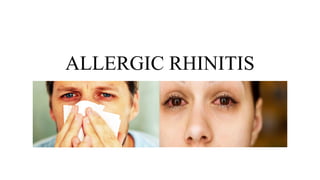
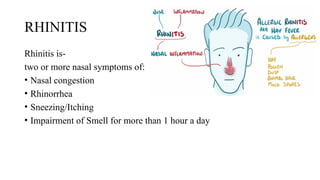
ALLERGIC RHINITIS
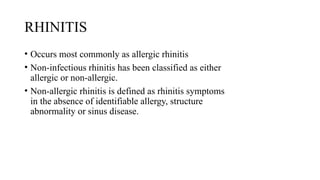
RHINITIS
Rhinitis is-
two or more nasal symptoms of:
• Nasal congestion
• Rhinorrhea
• Sneezing/Itching
• Impairment of Smell for more than 1 hour a day
RHINITIS
• Occurs most commonly as allergic rhinitis
• Non-infectious rhinitis has been classified as either
allergic or non-allergic.
• Non-allergic rhinitis is defined as rhinitis symptoms
in the absence of identifiable allergy, structure
abnormality or sinus disease.
EPIDEMIOLOGY
• Global health problem
• Prevalence :10-20%
• Higher in pediatric age group - 42%
• Affecting every 6th person
• Peak age - 13 to 14.
• Approx. 80% - develop symptoms < 20
INTRODUCTION
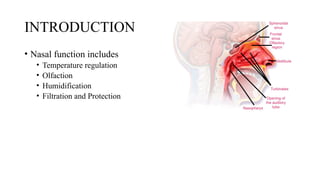
• Nasal function includes
• Temperature regulation
• Olfaction
• Humidification
• Filtration and Protection
INTRODUCTION (Cont.)
• Nasal lining contains secretion of IgA, proteins and enzymes
• Nasal Cilia propel the matter toward the natural ostia at frequency of
10-15 beats per minute
• Mucous move at a rate of 2.5-7.5 ml per minute
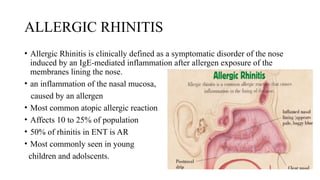
ALLERGIC RHINITIS
• Allergic Rhinitis is clinically defined as a symptomatic disorder of the nose
induced by an IgE-mediated inflammation after allergen exposure of the
membranes lining the nose.
• an inflammation of the nasal mucosa,
caused by an allergen
• Most common atopic allergic reaction
• Affects 10 to 25% of population
• 50% of rhinitis in ENT is AR
• Most commonly seen in young
children and adolscents.
ETIOLOGY
• Classified as
• Precipitating factors
• Pre-disposing factors
PRECIPI ATING FACTORS
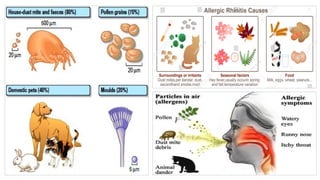
• Aerobiological flora
• Allergens present in the environment
• House dust and dust mites
• Feathers
• Tobacco smoke
• Industrial chemicals
• Animal dander
• Nasal physiology
• Disturbances in normal nasal cycle
PREDISPOSING FACTORS
• Genetic
• Multiple gene interactions are responsible for allergic phenotype
• Chromosomes 5, 6, 11, 12 & 14 control inflammatory process in atopy
• 50% of allergic rhinitis patients have a positive family history of allergic
rhinitis
• Endocrine
• Puberty
• Pregnant states and post partum stages menopausal
PREDISPOSING FACTORS
• Psychological
• Focal sensitivity states
• Infections: fungal infections
• Physical
• Degree of pollution of air
• Humidity and temperature differences
• Temperature changes
• Age & sex
• IgA deficiency
COMMON ALLERGENS
Pollen
• Spring tree pollens(maple)
• Summer: grass pollens
• Autums: weed pollens
Molds
• Penicillium, cladosporium etc.
Insects
• Cockroaches, house flies, fleas, bed
bugs
Animals
• Cats, Dogs, Horse, monkeys, rats,
rabbits etc
Dust mites
• Dermatophagoides
Ingestants
• Nuts, fish, eggs, milk etc
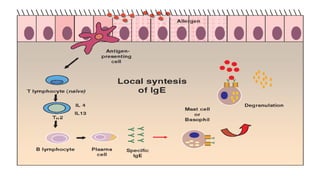
PATHOPHYSIOLOGY
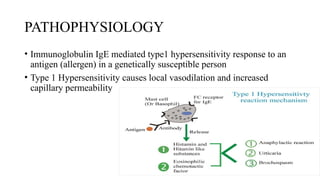
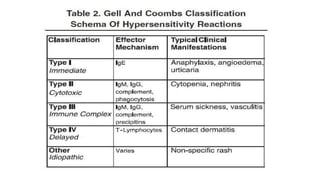
• Immunoglobulin IgE mediated type1 hypersensitivity response to an
antigen (allergen) in a genetically susceptible person
• Type 1 Hypersensitivity causes local vasodilation and increased
capillary permeability
PATHOPHYSIOLOGY (Contd.)
• Sensitization: Development of specific IgE
• Allergens reach Anti-Presenting Cells (APCs)
• APCs promote Th2 polarization
• Th2 promotes production of allergens-specific IgE
• Subsequent response: Development of symptoms
• Nasal symptoms: Early and Late phase response
• Specific and non-specific hyperresponsiveness
• Lower airways symptoms
CLASSIFICATON-FORMER
• Seasonal
• Also known as Hay Fever
• Neither caused by hay or fever
• Summer Cold
• Caused by virus causing URTI
• Rose Fever
• Perennial
• Allergens present throughout the year
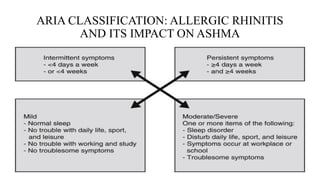
CLASSIFICATION-CURRENT
• Intermittent
• Symptoms present less than 4 days per week and less than 4 weeks per year
• Persistent
• Symptoms present more than 4 days per week and more than 4 weeks per year
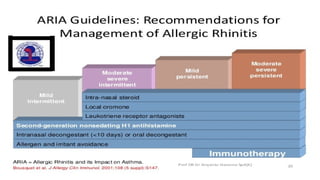
SEVERITY
• Mild
• No interference with daily activity or troublesome symptoms
• Moderate
• Presence of at least one
• Impaired sleep, daily work, activity.
• Troublesome symptoms
ARIA CLASSIFICATION: ALLERGIC RHINITIS
AND ITS IMPACT ON ASHMA
COMPLICATIONS
• Allergic asthma
• Chronic otitis media
• Hearing loss
• Chronic nasal obstruction
• Sinusitis
• Orthodontic malocclusion in children
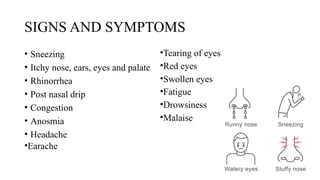
SIGNS AND SYMPTOMS
• Sneezing
• Itchy nose, ears, eyes and palate
• Rhinorrhea
• Post nasal drip
• Congestion
• Anosmia
• Headache
•Earache
•Tearing of eyes
•Red eyes
•Swollen eyes
•Fatigue
•Drowsiness
•Malaise
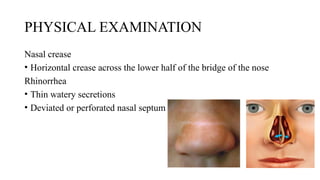
PHYSICAL EXAMINATION
Nasal crease
• Horizontal crease across the lower half of the bridge of the nose
Rhinorrhea
• Thin watery secretions
• Deviated or perforated nasal septum
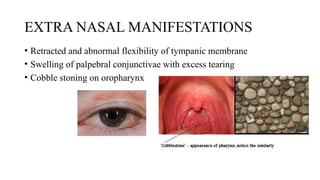
EXTRA NASAL MANIFESTATIONS
• Retracted and abnormal flexibility of tympanic membrane
• Swelling of palpebral conjunctivae with excess tearing
• Cobble stoning on oropharynx
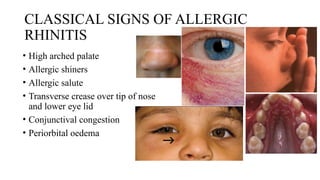
CLASSICAL SIGNS OF ALLERGIC
RHINITIS
• High arched palate
• Allergic shiners
• Allergic salute
• Transverse crease over tip of nose
and lower eye lid
• Conjunctival congestion
• Periorbital oedema
INVESTIGATIONS
• FBC (Full blood count)
• Histamine test
• A nasal smear for eosinophil
• Intranasal provocation test
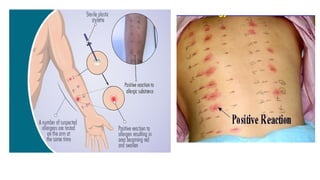
• Skin tests
• Sub-cuticular test
• More accurate with lower incidence of false positive results
• Contraindicated in case of anti histaminic, anti-inflammatory or decongestant
treatment
INVESTIGATIONS (Contd.)
• Intradermal tests
• Be prepared for anaphylaxis
• Skin end point titration test
• Quantitative intradermal test for specific allergen
• Nasal challenge (Nasal Provocation)
• Nasal cytology
• Take a sample of nasal cavity without anaesthesia and send for identification
of cell types in the nasal cavity.
• Increased number of eosinophil suggests allergic disease.
OTHER INVESTIGATIONS
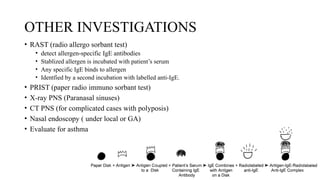
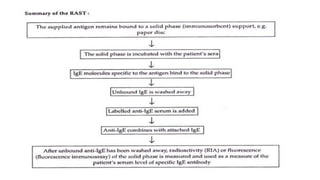
• RAST (radio allergo sorbant test)
• detect allergen-specific IgE antibodies
• Stablized allergen is incubated with patient’s serum
• Any specific IgE binds to allergen
• Identfied by a second incubation with labelled anti-IgE.
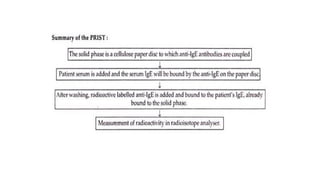
• PRIST (paper radio immuno sorbant test)
• X-ray PNS (Paranasal sinuses)
• CT PNS (for complicated cases with polyposis)
• Nasal endoscopy ( under local or GA)
• Evaluate for asthma
MANAGEMENT
Avoidance
• Outdoor exposure
• Stay indoors as much as possible when pollen counts are at their peak.
• Avoid using window fans that can draw pollens and molds into the house.
• Wear glasses or sunglasses when outdoors to minimize the amount of pollen
getting into your eyes.
• Wear a pollen mask (such as a NIOSH-rated 95 filter mask)
• Try not to rub your eyes; doing so will irritate them and could make your
symptoms worse.
MANAGEMENT
Avoidance
• Indoor exposure
• Reduce exposure to dust mites, especially in the bedroom. Use “mite-proof”
covers for pillows, comforters and duvets, and mattresses and box springs.
Wash your bedding frequently,
• Clean floors with a damp rag or mop, rather than dry-dusting or sweeping.
• Exposure to pets
• Wash your hands immediately after petting any animals; wash your clothes
after visiting friends with pets.
• If you are allergic to a household pet, keep the animal out of your home as
much as possible
MEDICATION
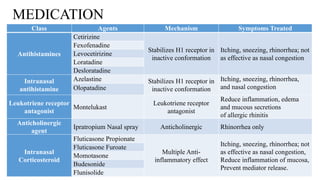
Class Agents Mechanism Symptoms Treated
Antihistamines
Cetirizine
Stabilizes H1 receptor in
inactive conformation
Itching, sneezing, rhinorrhea; not
as effective as nasal congestion
Fexofenadine
Levocetirizine
Loratadine
Desloratadine
Intranasal
antihistamine
Azelastine Stabilizes H1 receptor in
inactive conformation
Itching, sneezing, rhinorrhea,
and nasal congestion
Olopatadine
Leukotriene receptor
antagonist
Montelukast
Leukotriene receptor
antagonist
Reduce inflammation, edema
and mucous secretions
of allergic rhinitis
Anticholinergic
agent
Ipratropium Nasal spray Anticholinergic Rhinorrhea only
Intranasal
Corticosteroid
Fluticasone Propionate
Multiple Anti-
inflammatory effect
Itching, sneezing, rhinorrhea; not
as effective as nasal congestion,
Reduce inflammation of mucosa,
Prevent mediator release.
Fluticasone Furoate
Momotasone
Budesonide
Flunisolide
OTHERS
• Decongestants
• Shrink nasal mucous membrane by vasoconstriction
• Available OTC and in combination with antihistamines, analgesics and anti cholinergics
• Relieve the stuffiness and pressure caused by swollen nasal tissue.
• Eg: Oxymetazoline, Phenylephrine, Pseudoephedrine
• Intranasal cromolyn sodium
• Mast cell stabiliser
• Prevents release of chemical mediators
• Oral mast cell stabilizer
• Prevent the release of histamine and other powerful chemical mediators from mast cells
• Eg: Olopatadine, Rupatadine
• Opthalmic solution cromolyn
IMMUNOTHERAPY
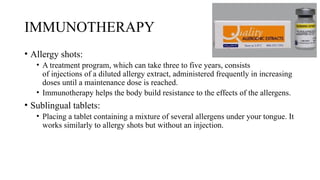
• Allergy shots:
• A treatment program, which can take three to five years, consists
of injections of a diluted allergy extract, administered frequently in increasing
doses until a maintenance dose is reached.
• Immunotherapy helps the body build resistance to the effects of the allergens.
• Sublingual tablets:
• Placing a tablet containing a mixture of several allergens under your tongue. It
works similarly to allergy shots but without an injection.
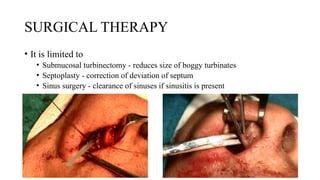
SURGICAL THERAPY
• It is limited to
• Submucosal turbinectomy - reduces size of boggy turbinates
• Septoplasty - correction of deviation of septum
• Sinus surgery - clearance of sinuses if sinusitis is present
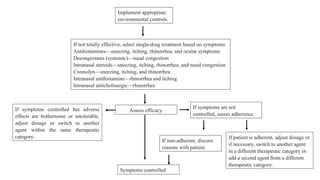
Implement appropriate
environmental controls.
If not totally effective, select single-drug treatment based on symptoms:
Antihistamines—sneezing, itching, rhinorrhea, and ocular symptoms
Decongestants (systemic)—nasal congestion
Intranasal steroids—sneezing, itching, rhinorrhea, and nasal congestion
Cromolyn—sneezing, itching, and rhinorrhea
Intranasal antihistamine—rhinorrhea and itching
Intranasal anticholinergic—rhinorrhea
Assess efficacy.
If symptoms controlled but adverse
effects are bothersome or intolerable,
adjust dosage or switch to another
agent within the same therapeutic
category.
If non-adherent, discuss
reasons with patient.
If patient is adherent, adjust dosage or
if necessary, switch to another agent
in a different therapeutic category or
add a second agent from a different
therapeutic category.
If symptoms are not
controlled, assess adherence.
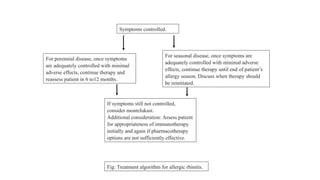
Symptoms controlled.
For perennial disease, once symptoms
are adequately controlled with minimal
adverse effects, continue therapy and
reassess patient in 6 to12 months.
For seasonal disease, once symptoms are
adequately controlled with minimal adverse
effects, continue therapy until end of patient’s
allergy season. Discuss when therapy should
be reinitiated.
If symptoms still not controlled,
consider montelukast.
Additional consideration: Assess patient
for appropriateness of immunotherapy
initially and again if pharmacotherapy
options are not sufficiently effective.
Fig: Treatment algorithm for allergic rhinitis.
TREATMENTS THAT ARE NOT
RECOMMENDED FOR ALLERGIC RHINITIS
• Antibiotics
• Effective for the treatment of bacterial infections, antibiotics do not affect the
course of uncomplicated common colds (a viral infection) and are of no
benefit for noninfectious rhinitis, including allergic rhinitis.
• Nasal surgery
• Surgery is not a treatment for allergic rhinitis, but it may help if patients have
nasal polyps or chronic sinusitis that is not responsive to antibiotics or nasal
steroid sprays.

Powerpoint presentation on ALLERGIC RHINITISs.pptx

  • 1.
  • 2.
    RHINITIS Rhinitis is- two ormore nasal symptoms of: • Nasal congestion • Rhinorrhea • Sneezing/Itching • Impairment of Smell for more than 1 hour a day
  • 3.
    RHINITIS • Occurs mostcommonly as allergic rhinitis • Non-infectious rhinitis has been classified as either allergic or non-allergic. • Non-allergic rhinitis is defined as rhinitis symptoms in the absence of identifiable allergy, structure abnormality or sinus disease.
  • 4.
    EPIDEMIOLOGY • Global healthproblem • Prevalence :10-20% • Higher in pediatric age group - 42% • Affecting every 6th person • Peak age - 13 to 14. • Approx. 80% - develop symptoms < 20
  • 5.
    INTRODUCTION • Nasal functionincludes • Temperature regulation • Olfaction • Humidification • Filtration and Protection
  • 6.
    INTRODUCTION (Cont.) • Nasallining contains secretion of IgA, proteins and enzymes • Nasal Cilia propel the matter toward the natural ostia at frequency of 10-15 beats per minute • Mucous move at a rate of 2.5-7.5 ml per minute
  • 7.
    ALLERGIC RHINITIS • AllergicRhinitis is clinically defined as a symptomatic disorder of the nose induced by an IgE-mediated inflammation after allergen exposure of the membranes lining the nose. • an inflammation of the nasal mucosa, caused by an allergen • Most common atopic allergic reaction • Affects 10 to 25% of population • 50% of rhinitis in ENT is AR • Most commonly seen in young children and adolscents.
  • 8.
    ETIOLOGY • Classified as •Precipitating factors • Pre-disposing factors
  • 9.
    PRECIPI ATING FACTORS •Aerobiological flora • Allergens present in the environment • House dust and dust mites • Feathers • Tobacco smoke • Industrial chemicals • Animal dander • Nasal physiology • Disturbances in normal nasal cycle
  • 10.
    PREDISPOSING FACTORS • Genetic •Multiple gene interactions are responsible for allergic phenotype • Chromosomes 5, 6, 11, 12 & 14 control inflammatory process in atopy • 50% of allergic rhinitis patients have a positive family history of allergic rhinitis • Endocrine • Puberty • Pregnant states and post partum stages menopausal
  • 11.
    PREDISPOSING FACTORS • Psychological •Focal sensitivity states • Infections: fungal infections • Physical • Degree of pollution of air • Humidity and temperature differences • Temperature changes • Age & sex • IgA deficiency
  • 12.
    COMMON ALLERGENS Pollen • Springtree pollens(maple) • Summer: grass pollens • Autums: weed pollens Molds • Penicillium, cladosporium etc. Insects • Cockroaches, house flies, fleas, bed bugs Animals • Cats, Dogs, Horse, monkeys, rats, rabbits etc Dust mites • Dermatophagoides Ingestants • Nuts, fish, eggs, milk etc
  • 14.
    PATHOPHYSIOLOGY • Immunoglobulin IgEmediated type1 hypersensitivity response to an antigen (allergen) in a genetically susceptible person • Type 1 Hypersensitivity causes local vasodilation and increased capillary permeability
  • 16.
    PATHOPHYSIOLOGY (Contd.) • Sensitization:Development of specific IgE • Allergens reach Anti-Presenting Cells (APCs) • APCs promote Th2 polarization • Th2 promotes production of allergens-specific IgE • Subsequent response: Development of symptoms • Nasal symptoms: Early and Late phase response • Specific and non-specific hyperresponsiveness • Lower airways symptoms
  • 18.
    CLASSIFICATON-FORMER • Seasonal • Alsoknown as Hay Fever • Neither caused by hay or fever • Summer Cold • Caused by virus causing URTI • Rose Fever • Perennial • Allergens present throughout the year
  • 19.
    CLASSIFICATION-CURRENT • Intermittent • Symptomspresent less than 4 days per week and less than 4 weeks per year • Persistent • Symptoms present more than 4 days per week and more than 4 weeks per year
  • 20.
    SEVERITY • Mild • Nointerference with daily activity or troublesome symptoms • Moderate • Presence of at least one • Impaired sleep, daily work, activity. • Troublesome symptoms
  • 21.
    ARIA CLASSIFICATION: ALLERGICRHINITIS AND ITS IMPACT ON ASHMA
  • 22.
    COMPLICATIONS • Allergic asthma •Chronic otitis media • Hearing loss • Chronic nasal obstruction • Sinusitis • Orthodontic malocclusion in children
  • 23.
    SIGNS AND SYMPTOMS •Sneezing • Itchy nose, ears, eyes and palate • Rhinorrhea • Post nasal drip • Congestion • Anosmia • Headache •Earache •Tearing of eyes •Red eyes •Swollen eyes •Fatigue •Drowsiness •Malaise
  • 24.
    PHYSICAL EXAMINATION Nasal crease •Horizontal crease across the lower half of the bridge of the nose Rhinorrhea • Thin watery secretions • Deviated or perforated nasal septum
  • 25.
    EXTRA NASAL MANIFESTATIONS •Retracted and abnormal flexibility of tympanic membrane • Swelling of palpebral conjunctivae with excess tearing • Cobble stoning on oropharynx
  • 26.
    CLASSICAL SIGNS OFALLERGIC RHINITIS • High arched palate • Allergic shiners • Allergic salute • Transverse crease over tip of nose and lower eye lid • Conjunctival congestion • Periorbital oedema
  • 27.
    INVESTIGATIONS • FBC (Fullblood count) • Histamine test • A nasal smear for eosinophil • Intranasal provocation test • Skin tests • Sub-cuticular test • More accurate with lower incidence of false positive results • Contraindicated in case of anti histaminic, anti-inflammatory or decongestant treatment
  • 28.
    INVESTIGATIONS (Contd.) • Intradermaltests • Be prepared for anaphylaxis • Skin end point titration test • Quantitative intradermal test for specific allergen • Nasal challenge (Nasal Provocation) • Nasal cytology • Take a sample of nasal cavity without anaesthesia and send for identification of cell types in the nasal cavity. • Increased number of eosinophil suggests allergic disease.
  • 30.
    OTHER INVESTIGATIONS • RAST(radio allergo sorbant test) • detect allergen-specific IgE antibodies • Stablized allergen is incubated with patient’s serum • Any specific IgE binds to allergen • Identfied by a second incubation with labelled anti-IgE. • PRIST (paper radio immuno sorbant test) • X-ray PNS (Paranasal sinuses) • CT PNS (for complicated cases with polyposis) • Nasal endoscopy ( under local or GA) • Evaluate for asthma
  • 33.
    MANAGEMENT Avoidance • Outdoor exposure •Stay indoors as much as possible when pollen counts are at their peak. • Avoid using window fans that can draw pollens and molds into the house. • Wear glasses or sunglasses when outdoors to minimize the amount of pollen getting into your eyes. • Wear a pollen mask (such as a NIOSH-rated 95 filter mask) • Try not to rub your eyes; doing so will irritate them and could make your symptoms worse.
  • 34.
    MANAGEMENT Avoidance • Indoor exposure •Reduce exposure to dust mites, especially in the bedroom. Use “mite-proof” covers for pillows, comforters and duvets, and mattresses and box springs. Wash your bedding frequently, • Clean floors with a damp rag or mop, rather than dry-dusting or sweeping. • Exposure to pets • Wash your hands immediately after petting any animals; wash your clothes after visiting friends with pets. • If you are allergic to a household pet, keep the animal out of your home as much as possible
  • 35.
    MEDICATION Class Agents MechanismSymptoms Treated Antihistamines Cetirizine Stabilizes H1 receptor in inactive conformation Itching, sneezing, rhinorrhea; not as effective as nasal congestion Fexofenadine Levocetirizine Loratadine Desloratadine Intranasal antihistamine Azelastine Stabilizes H1 receptor in inactive conformation Itching, sneezing, rhinorrhea, and nasal congestion Olopatadine Leukotriene receptor antagonist Montelukast Leukotriene receptor antagonist Reduce inflammation, edema and mucous secretions of allergic rhinitis Anticholinergic agent Ipratropium Nasal spray Anticholinergic Rhinorrhea only Intranasal Corticosteroid Fluticasone Propionate Multiple Anti- inflammatory effect Itching, sneezing, rhinorrhea; not as effective as nasal congestion, Reduce inflammation of mucosa, Prevent mediator release. Fluticasone Furoate Momotasone Budesonide Flunisolide
  • 36.
    OTHERS • Decongestants • Shrinknasal mucous membrane by vasoconstriction • Available OTC and in combination with antihistamines, analgesics and anti cholinergics • Relieve the stuffiness and pressure caused by swollen nasal tissue. • Eg: Oxymetazoline, Phenylephrine, Pseudoephedrine • Intranasal cromolyn sodium • Mast cell stabiliser • Prevents release of chemical mediators • Oral mast cell stabilizer • Prevent the release of histamine and other powerful chemical mediators from mast cells • Eg: Olopatadine, Rupatadine • Opthalmic solution cromolyn
  • 37.
    IMMUNOTHERAPY • Allergy shots: •A treatment program, which can take three to five years, consists of injections of a diluted allergy extract, administered frequently in increasing doses until a maintenance dose is reached. • Immunotherapy helps the body build resistance to the effects of the allergens. • Sublingual tablets: • Placing a tablet containing a mixture of several allergens under your tongue. It works similarly to allergy shots but without an injection.
  • 38.
    SURGICAL THERAPY • Itis limited to • Submucosal turbinectomy - reduces size of boggy turbinates • Septoplasty - correction of deviation of septum • Sinus surgery - clearance of sinuses if sinusitis is present
  • 40.
    Implement appropriate environmental controls. Ifnot totally effective, select single-drug treatment based on symptoms: Antihistamines—sneezing, itching, rhinorrhea, and ocular symptoms Decongestants (systemic)—nasal congestion Intranasal steroids—sneezing, itching, rhinorrhea, and nasal congestion Cromolyn—sneezing, itching, and rhinorrhea Intranasal antihistamine—rhinorrhea and itching Intranasal anticholinergic—rhinorrhea Assess efficacy. If symptoms controlled but adverse effects are bothersome or intolerable, adjust dosage or switch to another agent within the same therapeutic category. If non-adherent, discuss reasons with patient. If patient is adherent, adjust dosage or if necessary, switch to another agent in a different therapeutic category or add a second agent from a different therapeutic category. If symptoms are not controlled, assess adherence. Symptoms controlled.
  • 41.
    Symptoms controlled. For perennialdisease, once symptoms are adequately controlled with minimal adverse effects, continue therapy and reassess patient in 6 to12 months. For seasonal disease, once symptoms are adequately controlled with minimal adverse effects, continue therapy until end of patient’s allergy season. Discuss when therapy should be reinitiated. If symptoms still not controlled, consider montelukast. Additional consideration: Assess patient for appropriateness of immunotherapy initially and again if pharmacotherapy options are not sufficiently effective. Fig: Treatment algorithm for allergic rhinitis.
  • 42.
    TREATMENTS THAT ARENOT RECOMMENDED FOR ALLERGIC RHINITIS • Antibiotics • Effective for the treatment of bacterial infections, antibiotics do not affect the course of uncomplicated common colds (a viral infection) and are of no benefit for noninfectious rhinitis, including allergic rhinitis. • Nasal surgery • Surgery is not a treatment for allergic rhinitis, but it may help if patients have nasal polyps or chronic sinusitis that is not responsive to antibiotics or nasal steroid sprays.