
B Y :
P R I M A D H I T Y O , S . K E D
R E Z D Y T O F A N , S . K E D
Allergy Rhinitis
Background
 Allergic rhinitis is characterized by inflammation of
the nasal passages and subsequent sneezing, nasal
congestion, and rhinorrhea.
 The disease course is chronic and relapsing.
Epidemiology
 Incidence and Prevalence:
 Allergic rhinitis affects more than 20% of the population in
the western countries, with an incidence of 10 in 100,000
children and 15 in 100,000 adults.
 In the U.S., 15,000 to 25,000 in 100,000 people are
affected.
 Demographics:
 Allergic rhinitis occurs mostly in people under age 20 but
can affect persons of any age.
 Women are affected more commonly than men.
Seasonal Perrenial
 Pollens, especially from
grasses, trees, and
weeds, and some
outdoor molds ( eg,
Alternaria , Botrytis ,
Fusarium , Mucor ,
and Cladosporium
species)
 Dust mites
 Animal dander and hair; allergens originate
from the skin, urine, and saliva
 Cockroaches
 Molds ( eg , Penicillium , Aspergillus ,
Alternaria , and Cladosporium species) that
grow in damp indoor areas or are blown into
the house.
 Certain foods, such as apples, celery, and
nuts, in some patients who are sensitive to
birch pollen; foods rarely cause chronic
rhinitis, but rhinitis may be part of an acute
anaphylactic reaction to food
 Cigarette smoke
 Nonspecific environmental pollutants
Causes
Risk factors
 Family history of allergic rhinitis or another allergic
disorder
 Coexisting allergies ( eg , asthma in adults or
children , atopic dermatitis )
 Certain occupations, such as baking, which involves
exposure to yeast molds (Saccharomyces species);
agriculture or food processing involving contact with
castor beans, which contain ricin, a very strong
sensitizer to future allergic response; and plastic and
foam work involving exposure to isocyanates
Associated disorders
 Asthma in adults or children
 Atopic dermatitis
 Serous otitis media
 Chronic sinusitis
 Allergic conjunctivitis
Diagnosis
 Symptoms of nasal congestion; sneezing; rhinorrhea;
and itching of the nose, palate, and pharynx lasting more
than 10 days and the observation of a pale, edematous
nasal mucosa are suggestive of allergic rhinitis.
 The presence of itching is characteristic of allergic
rhinitis as opposed to other types of rhinitis.
 Recurrence or chronicity of symptoms and absence of
fever point to allergic rhinitis rather than upper
respiratory tract infection.
 The diagnosis can be confirmed by a positive skin prick
test or radioallergosorbent test result.
Clinical Presentation
 Onset of symptoms typically occurs during childhood or
adolescence.
 Characteristic symptoms include the following:
 Paroxysmal sneezing
 Rhinorrhea
 Nasal congestion
 Decreased sense of smell and taste
 Itching of the nose, palate, pharynx, eyes, and sometimes the ears
 Sore throat caused by postnasal drip
 Symptoms of seasonal allergic rhinitis are much more
pronounced in the spring and fall due to grass and weed
pollens.
 Symptoms that worsen indoors and upon exposure to pets are
indicative of perennial allergic rhinitis.
Clinical Presentation
 Other historical presentations:
 History of atopic dermatitis or food allergies
 Family history of allergic rhinitis or similar symptoms
Clinical Presentation
 Signs:
 Edematous, blanched nasal mucosa
 Clear nasal secretions
 Mouth breathing caused by nasal congestion
 Dark circles under the eyes ('allergic shiners')
 Nasal polyps may be present, although these also can occur
in patients with nonallergic rhinitis or alone with no
apparent underlying cause.
Clinical Presentations
 Other physical examination factors:
 The 'allergic salute' (wiping the nose upward with the palm of
the hand) is characteristic of allergic rhinitis in children and,
in severe cases, can lead to the formation of a transverse nasal
crease
 The nasal allergic response may be associated with inflamed or
edematous conjunctivae with punctuate papules or with
palatal inflammation
 Bronchial wheezing may indicate asthma in adults or children ,
which often accompanies allergic rhinitis
 Eczema may accompany allergic rhinitis
Diagnostic Testing
 Laboratory workup often is unnecessary if the
diagnosis is apparent based on the history and
physical examination findings.
 Skin prick testing often will confirm allergy to a
particular inhalant and/or food
 Intradermal skin testing may be performed to
identify allergens if a skin prick test result is negative
or equivocal and the clinical presentation is
suggestive of allergic rhinitis
Diagnostic Testing
 Nasal smear often will show large numbers of eosinophils
in patients with allergic rhinitis, whereas the presence of
neutrophils suggests infection
 Radioallergosorbent testing usually detects elevated total
and specific serum immunoglobulin (Ig) E levels in
patients with allergic rhinitis; peripheral blood
eosinophil counts are not useful in diagnosis
 Office spirometry is reserved for patients in whom
coexisting small airway disease (eg , asthma in adults or
children ) is suspected
 If chronic sinusitis is suspected, computed tomography
(CT) scan of the sinuses should be obtained
Differential Diagnosis
 Upper Respiratory Tract Infection
 Upper respiratory tract infections in adults or children are self
limited
 infections usually caused by viruses
 Features include clear to purulent rhinorrhea; sneezing;
inflamed, red nasal mucosa; fever; arthralgia; myalgia; and
sore throat
 Symptoms typically last for 5 to 14 days
 The diagnosis usually is apparent from the clinical history and
physical examination findings
Differential Diagnosis
 Nonallergic rhinitis
 Nonallergic rhinitis is triggered by various environmental
factors, such as strong odors, pollution, and other irritants
 The condition usually is perennial
 Features include nasal congestion, headaches, and often clear
rhinorrhea
 Nasal polyps are common
Differential Diagnosis
 Rhinitis medicamentosa:
 Occurs when nonprescription topical decongestants are used
excessively
 Patients have a history of chronic use of nasal decongestants or
cocaine
 Severe nasal congestion is present
 The nasal mucosa usually is very red
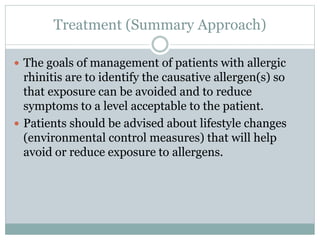
Treatment (Summary Approach)
 The goals of management of patients with allergic
rhinitis are to identify the causative allergen(s) so
that exposure can be avoided and to reduce
symptoms to a level acceptable to the patient.
 Patients should be advised about lifestyle changes
(environmental control measures) that will help
avoid or reduce exposure to allergens.
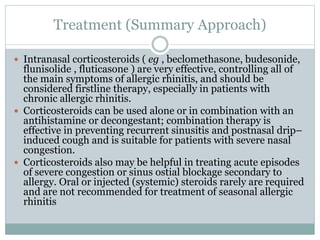
Treatment (Summary Approach)
 Intranasal corticosteroids ( eg , beclomethasone, budesonide,
flunisolide , fluticasone ) are very effective, controlling all of
the main symptoms of allergic rhinitis, and should be
considered firstline therapy, especially in patients with
chronic allergic rhinitis.
 Corticosteroids can be used alone or in combination with an
antihistamine or decongestant; combination therapy is
effective in preventing recurrent sinusitis and postnasal drip–
induced cough and is suitable for patients with severe nasal
congestion.
 Corticosteroids also may be helpful in treating acute episodes
of severe congestion or sinus ostial blockage secondary to
allergy. Oral or injected (systemic) steroids rarely are required
and are not recommended for treatment of seasonal allergic
rhinitis
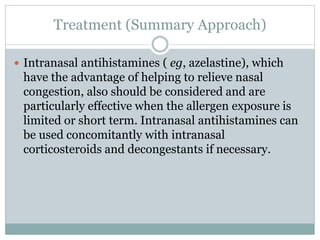
Treatment (Summary Approach)
 Intranasal antihistamines ( eg, azelastine), which
have the advantage of helping to relieve nasal
congestion, also should be considered and are
particularly effective when the allergen exposure is
limited or short term. Intranasal antihistamines can
be used concomitantly with intranasal
corticosteroids and decongestants if necessary.
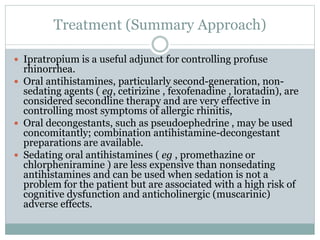
Treatment (Summary Approach)
 Ipratropium is a useful adjunct for controlling profuse
rhinorrhea.
 Oral antihistamines, particularly second-generation, non-
sedating agents ( eg, cetirizine , fexofenadine , loratadin), are
considered secondline therapy and are very effective in
controlling most symptoms of allergic rhinitis,
 Oral decongestants, such as pseudoephedrine , may be used
concomitantly; combination antihistamine-decongestant
preparations are available.
 Sedating oral antihistamines ( eg , promethazine or
chlorpheniramine ) are less expensive than nonsedating
antihistamines and can be used when sedation is not a
problem for the patient but are associated with a high risk of
cognitive dysfunction and anticholinergic (muscarinic)
adverse effects.
Treatment (Summary Approach)
 Montelukast , a leukotriene-receptor antagonist, is
an alternative to oral antihistamines, but
monotherapy usually only results in moderate
improvement in symptoms.
 Intranasal cromolyn sodium is considered thirdline
therapy and is suitable for patients with mild to
moderate allergic rhinitis and children. However,
cromolyn is used primarily for prophylaxis and
should be administered before exposure to a known
allergen.
Treatment (Summary Approach)
 Immunotherapy is reserved for patients with severe,
treatment-refractory allergic rhinitis who experience
symptoms during most of the year.
 Subcutaneous injections or sublingual oral therapy
are used most commonly. A weekly treatment
buildup period of 3 to 4 months is required followed
by continuous monthly maintenance therapy for 3 to
5 years.
 Clinical benefits may be sustained for years after
discontinuation of treatment.
Follow-up
 Monitoring
 Patients who remain symptomatic and require medication
should have regular follow-up visits
 Prognosis
 Allergic rhinitis is a chronic condition that usually is lifelong,
although symptoms can decrease with age
 The prognosis is affected adversely by other medical
conditions, such as asthma in adults or children , and by
exposure to perennial allergens, such as dust mites and molds
Complication
 Epistaxis
 Serous otitis media
 Secondary sinusitis
 Facial malformations in children with longstanding
allergic rhinitis and severe nasal congestion
 Nasal speech
 Eustachian tube dysfunction
 Increased susceptibility to upper respiratory tract
infection in adults and children
 Allergic conjunctivitis
 Increased susceptibility to or exacerbation of asthma
Patient education
 Patients with allergic rhinitis should be strongly
encouraged to quit smoking and to avoid exposure to
allergens to the extent possible
 Patients with seasonal allergic rhinitis should be
advised to keep doors and windows closed and use
air conditioning, with special filters if possible, at
home and in vehicles; patients also may need to alter
outdoor activity depending on the time of year
Thank you

Allergy rhinitis

  • 1.
    B Y : PR I M A D H I T Y O , S . K E D R E Z D Y T O F A N , S . K E D Allergy Rhinitis
  • 2.
    Background  Allergic rhinitisis characterized by inflammation of the nasal passages and subsequent sneezing, nasal congestion, and rhinorrhea.  The disease course is chronic and relapsing.
  • 3.
    Epidemiology  Incidence andPrevalence:  Allergic rhinitis affects more than 20% of the population in the western countries, with an incidence of 10 in 100,000 children and 15 in 100,000 adults.  In the U.S., 15,000 to 25,000 in 100,000 people are affected.  Demographics:  Allergic rhinitis occurs mostly in people under age 20 but can affect persons of any age.  Women are affected more commonly than men.
  • 4.
    Seasonal Perrenial  Pollens,especially from grasses, trees, and weeds, and some outdoor molds ( eg, Alternaria , Botrytis , Fusarium , Mucor , and Cladosporium species)  Dust mites  Animal dander and hair; allergens originate from the skin, urine, and saliva  Cockroaches  Molds ( eg , Penicillium , Aspergillus , Alternaria , and Cladosporium species) that grow in damp indoor areas or are blown into the house.  Certain foods, such as apples, celery, and nuts, in some patients who are sensitive to birch pollen; foods rarely cause chronic rhinitis, but rhinitis may be part of an acute anaphylactic reaction to food  Cigarette smoke  Nonspecific environmental pollutants Causes
  • 5.
    Risk factors  Familyhistory of allergic rhinitis or another allergic disorder  Coexisting allergies ( eg , asthma in adults or children , atopic dermatitis )  Certain occupations, such as baking, which involves exposure to yeast molds (Saccharomyces species); agriculture or food processing involving contact with castor beans, which contain ricin, a very strong sensitizer to future allergic response; and plastic and foam work involving exposure to isocyanates
  • 6.
    Associated disorders  Asthmain adults or children  Atopic dermatitis  Serous otitis media  Chronic sinusitis  Allergic conjunctivitis
  • 7.
    Diagnosis  Symptoms ofnasal congestion; sneezing; rhinorrhea; and itching of the nose, palate, and pharynx lasting more than 10 days and the observation of a pale, edematous nasal mucosa are suggestive of allergic rhinitis.  The presence of itching is characteristic of allergic rhinitis as opposed to other types of rhinitis.  Recurrence or chronicity of symptoms and absence of fever point to allergic rhinitis rather than upper respiratory tract infection.  The diagnosis can be confirmed by a positive skin prick test or radioallergosorbent test result.
  • 8.
    Clinical Presentation  Onsetof symptoms typically occurs during childhood or adolescence.  Characteristic symptoms include the following:  Paroxysmal sneezing  Rhinorrhea  Nasal congestion  Decreased sense of smell and taste  Itching of the nose, palate, pharynx, eyes, and sometimes the ears  Sore throat caused by postnasal drip  Symptoms of seasonal allergic rhinitis are much more pronounced in the spring and fall due to grass and weed pollens.  Symptoms that worsen indoors and upon exposure to pets are indicative of perennial allergic rhinitis.
  • 9.
    Clinical Presentation  Otherhistorical presentations:  History of atopic dermatitis or food allergies  Family history of allergic rhinitis or similar symptoms
  • 10.
    Clinical Presentation  Signs: Edematous, blanched nasal mucosa  Clear nasal secretions  Mouth breathing caused by nasal congestion  Dark circles under the eyes ('allergic shiners')  Nasal polyps may be present, although these also can occur in patients with nonallergic rhinitis or alone with no apparent underlying cause.
  • 11.
    Clinical Presentations  Otherphysical examination factors:  The 'allergic salute' (wiping the nose upward with the palm of the hand) is characteristic of allergic rhinitis in children and, in severe cases, can lead to the formation of a transverse nasal crease  The nasal allergic response may be associated with inflamed or edematous conjunctivae with punctuate papules or with palatal inflammation  Bronchial wheezing may indicate asthma in adults or children , which often accompanies allergic rhinitis  Eczema may accompany allergic rhinitis
  • 12.
    Diagnostic Testing  Laboratoryworkup often is unnecessary if the diagnosis is apparent based on the history and physical examination findings.  Skin prick testing often will confirm allergy to a particular inhalant and/or food  Intradermal skin testing may be performed to identify allergens if a skin prick test result is negative or equivocal and the clinical presentation is suggestive of allergic rhinitis
  • 13.
    Diagnostic Testing  Nasalsmear often will show large numbers of eosinophils in patients with allergic rhinitis, whereas the presence of neutrophils suggests infection  Radioallergosorbent testing usually detects elevated total and specific serum immunoglobulin (Ig) E levels in patients with allergic rhinitis; peripheral blood eosinophil counts are not useful in diagnosis  Office spirometry is reserved for patients in whom coexisting small airway disease (eg , asthma in adults or children ) is suspected  If chronic sinusitis is suspected, computed tomography (CT) scan of the sinuses should be obtained
  • 14.
    Differential Diagnosis  UpperRespiratory Tract Infection  Upper respiratory tract infections in adults or children are self limited  infections usually caused by viruses  Features include clear to purulent rhinorrhea; sneezing; inflamed, red nasal mucosa; fever; arthralgia; myalgia; and sore throat  Symptoms typically last for 5 to 14 days  The diagnosis usually is apparent from the clinical history and physical examination findings
  • 15.
    Differential Diagnosis  Nonallergicrhinitis  Nonallergic rhinitis is triggered by various environmental factors, such as strong odors, pollution, and other irritants  The condition usually is perennial  Features include nasal congestion, headaches, and often clear rhinorrhea  Nasal polyps are common
  • 16.
    Differential Diagnosis  Rhinitismedicamentosa:  Occurs when nonprescription topical decongestants are used excessively  Patients have a history of chronic use of nasal decongestants or cocaine  Severe nasal congestion is present  The nasal mucosa usually is very red
  • 17.
    Treatment (Summary Approach) The goals of management of patients with allergic rhinitis are to identify the causative allergen(s) so that exposure can be avoided and to reduce symptoms to a level acceptable to the patient.  Patients should be advised about lifestyle changes (environmental control measures) that will help avoid or reduce exposure to allergens.
  • 18.
    Treatment (Summary Approach) Intranasal corticosteroids ( eg , beclomethasone, budesonide, flunisolide , fluticasone ) are very effective, controlling all of the main symptoms of allergic rhinitis, and should be considered firstline therapy, especially in patients with chronic allergic rhinitis.  Corticosteroids can be used alone or in combination with an antihistamine or decongestant; combination therapy is effective in preventing recurrent sinusitis and postnasal drip– induced cough and is suitable for patients with severe nasal congestion.  Corticosteroids also may be helpful in treating acute episodes of severe congestion or sinus ostial blockage secondary to allergy. Oral or injected (systemic) steroids rarely are required and are not recommended for treatment of seasonal allergic rhinitis
  • 19.
    Treatment (Summary Approach) Intranasal antihistamines ( eg, azelastine), which have the advantage of helping to relieve nasal congestion, also should be considered and are particularly effective when the allergen exposure is limited or short term. Intranasal antihistamines can be used concomitantly with intranasal corticosteroids and decongestants if necessary.
  • 20.
    Treatment (Summary Approach) Ipratropium is a useful adjunct for controlling profuse rhinorrhea.  Oral antihistamines, particularly second-generation, non- sedating agents ( eg, cetirizine , fexofenadine , loratadin), are considered secondline therapy and are very effective in controlling most symptoms of allergic rhinitis,  Oral decongestants, such as pseudoephedrine , may be used concomitantly; combination antihistamine-decongestant preparations are available.  Sedating oral antihistamines ( eg , promethazine or chlorpheniramine ) are less expensive than nonsedating antihistamines and can be used when sedation is not a problem for the patient but are associated with a high risk of cognitive dysfunction and anticholinergic (muscarinic) adverse effects.
  • 21.
    Treatment (Summary Approach) Montelukast , a leukotriene-receptor antagonist, is an alternative to oral antihistamines, but monotherapy usually only results in moderate improvement in symptoms.  Intranasal cromolyn sodium is considered thirdline therapy and is suitable for patients with mild to moderate allergic rhinitis and children. However, cromolyn is used primarily for prophylaxis and should be administered before exposure to a known allergen.
  • 22.
    Treatment (Summary Approach) Immunotherapy is reserved for patients with severe, treatment-refractory allergic rhinitis who experience symptoms during most of the year.  Subcutaneous injections or sublingual oral therapy are used most commonly. A weekly treatment buildup period of 3 to 4 months is required followed by continuous monthly maintenance therapy for 3 to 5 years.  Clinical benefits may be sustained for years after discontinuation of treatment.
  • 23.
    Follow-up  Monitoring  Patientswho remain symptomatic and require medication should have regular follow-up visits  Prognosis  Allergic rhinitis is a chronic condition that usually is lifelong, although symptoms can decrease with age  The prognosis is affected adversely by other medical conditions, such as asthma in adults or children , and by exposure to perennial allergens, such as dust mites and molds
  • 24.
    Complication  Epistaxis  Serousotitis media  Secondary sinusitis  Facial malformations in children with longstanding allergic rhinitis and severe nasal congestion  Nasal speech  Eustachian tube dysfunction  Increased susceptibility to upper respiratory tract infection in adults and children  Allergic conjunctivitis  Increased susceptibility to or exacerbation of asthma
  • 25.
    Patient education  Patientswith allergic rhinitis should be strongly encouraged to quit smoking and to avoid exposure to allergens to the extent possible  Patients with seasonal allergic rhinitis should be advised to keep doors and windows closed and use air conditioning, with special filters if possible, at home and in vehicles; patients also may need to alter outdoor activity depending on the time of year
  • 26.