1 ENGINEERING PHYSICS
Mr. Gouri Kumar Sahu
Sr. Lecturer in Physics.
1 ENGINEERING PHYSICS
Mr. Gouri Kumar Sahu
Sr. Lecturer in Physics.
ENGINERING PHYSICSENGINERING PHYSICSENGINERING PHYSICSENGINERING PHYSICSENGINERING PHYSICSENGINERING PHYSICSENGINERING PHYSICSENGINERING PHYSICS
Mr. Gouri Kumar Sahu
Senior Lecturer in Physics
C.U. T. M.
2 ENGINEERING PHYSICS
Mr. Gouri Kumar Sahu
Sr. Lecturer in Physics.
2 ENGINEERING PHYSICS
Mr. Gouri Kumar Sahu
Sr. Lecturer in Physics.
SESSION-2
2.1. Electrical Conduction
Electrical conductivity of a material is defined in terms of ease
with which a material transmits an electrical current. Electrical
current (I) is flow of electrons, and driving force for the flow of
electrons is called voltage (V). Ohm’s law relates these
parameters as follows
V α I
V = IR……………………………….……….[1.1]
where R – is the materials resistance to flow of electrons through
it.
V, I, and R respectively have units as volts, amperes, and ohms (Ω).
3 ENGINEERING PHYSICS
Mr. Gouri Kumar Sahu
Sr. Lecturer in Physics.
3 ENGINEERING PHYSICS
Mr. Gouri Kumar Sahu
Sr. Lecturer in Physics.
SESSION-2
2.2.Electrical Resistivity
Electrical resistance of a material is influenced by its
geometric configuration; hence a new parameter
called electrical resistivity (ρ) is defined such as it is
independent of the geometry.
ߩ ൌ
ோ஺
௟
……………………………..……….[1.2]
where A = cross-sectional area perpendicular to the
direction of the current
l – the distance between points between which the voltage
is applied.
Units for ρ are ohm-meters (Ω-m).
4 ENGINEERING PHYSICS
Mr. Gouri Kumar Sahu
Sr. Lecturer in Physics.
4 ENGINEERING PHYSICS
Mr. Gouri Kumar Sahu
Sr. Lecturer in Physics.
SESSION-2
2.3.Electrical Conductivity
Reciprocal of the electrical resistivity, known as electrical
conductivity (σ), is used to express the electrical behavior of a
material, which is indicative of the ease with which a material
allows of flow of electrons.
ߪ ൌ
ଵ
ఘ
ൌ
௟
ோ஺
…………………………..……..[1.3]
units: (Ω-m)-1 or mho/meter.
It depends on the presence of free electrons or conduction electrons, which
move freely in the metal and do not correspond to any atom.
These electrons are known as electron gas.
5 ENGINEERING PHYSICS
Mr. Gouri Kumar Sahu
Sr. Lecturer in Physics.
5 ENGINEERING PHYSICS
Mr. Gouri Kumar Sahu
Sr. Lecturer in Physics.
SESSION-2
2.4. Classification of Conducting Materials
materials can be classified into three categories:
I. Zero resistivity materials
II. Low resistivity materials
III. High resistivity materials
1. Zero resistivity materials:
1. Superconductor like alloys of aluminium, zinc, gallium,
nichrome, niobium, etc.
2. zero resistance below the transition temperature.
3. Perfect diamagnetic.
4. Used for energy saving in power systems, superconducting
magnets, memory storage elements.
6 ENGINEERING PHYSICS
Mr. Gouri Kumar Sahu
Sr. Lecturer in Physics.
6 ENGINEERING PHYSICS
Mr. Gouri Kumar Sahu
Sr. Lecturer in Physics.
SESSION-2
2.4. Classification of Conducting Materials
II. Low resistivity materials:
1. Metals and alloys like silver, aluminium etc.
2. Very high electrical conductivity, in the order of
10଼ Ωିଵ݉ିଵ.
3. Used as resistors. Conductors, electrical contacts,
etc. in electrical devices.
III. High resistivity materials:
1. Material like tungsten, platinum, nichrome, etc.
2. High resistivity and low temperature coefficient of
resistances.
3. Used in the manufacturing of resistors, heating
elements, resistance thermometers, etc.
7 ENGINEERING PHYSICS
Mr. Gouri Kumar Sahu
Sr. Lecturer in Physics.
7 ENGINEERING PHYSICS
Mr. Gouri Kumar Sahu
Sr. Lecturer in Physics.
SESSION-2
2.5.Basic Terminologies
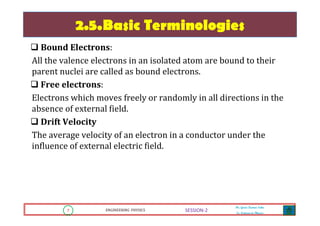
Bound Electrons:
All the valence electrons in an isolated atom are bound to their
parent nuclei are called as bound electrons.
Free electrons:
Electrons which moves freely or randomly in all directions in the
absence of external field.
Drift Velocity
The average velocity of an electron in a conductor under the
influence of external electric field.
8 ENGINEERING PHYSICS
Mr. Gouri Kumar Sahu
Sr. Lecturer in Physics.
8 ENGINEERING PHYSICS
Mr. Gouri Kumar Sahu
Sr. Lecturer in Physics.
SESSION-2
2.5.Basic Terminologies
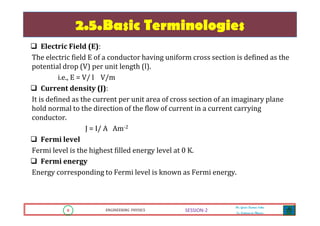
Electric Field (E):
The electric field E of a conductor having uniform cross section is defined as the
potential drop (V) per unit length (l).
i.e., E = V/ l V/m
Current density (J):
It is defined as the current per unit area of cross section of an imaginary plane
hold normal to the direction of the flow of current in a current carrying
conductor.
J = I/ A Am-2
Fermi level
Fermi level is the highest filled energy level at 0 K.
Fermi energy
Energy corresponding to Fermi level is known as Fermi energy.
9 ENGINEERING PHYSICS
Mr. Gouri Kumar Sahu
Sr. Lecturer in Physics.
9 ENGINEERING PHYSICS
Mr. Gouri Kumar Sahu
Sr. Lecturer in Physics.
END OF SESSION -2
THANK YOU

Engineering physics 1(Electrical conductivity)

  • 1.
    1 ENGINEERING PHYSICS Mr.Gouri Kumar Sahu Sr. Lecturer in Physics. 1 ENGINEERING PHYSICS Mr. Gouri Kumar Sahu Sr. Lecturer in Physics. ENGINERING PHYSICSENGINERING PHYSICSENGINERING PHYSICSENGINERING PHYSICSENGINERING PHYSICSENGINERING PHYSICSENGINERING PHYSICSENGINERING PHYSICS Mr. Gouri Kumar Sahu Senior Lecturer in Physics C.U. T. M.
  • 2.
    2 ENGINEERING PHYSICS Mr.Gouri Kumar Sahu Sr. Lecturer in Physics. 2 ENGINEERING PHYSICS Mr. Gouri Kumar Sahu Sr. Lecturer in Physics. SESSION-2 2.1. Electrical Conduction Electrical conductivity of a material is defined in terms of ease with which a material transmits an electrical current. Electrical current (I) is flow of electrons, and driving force for the flow of electrons is called voltage (V). Ohm’s law relates these parameters as follows V α I V = IR……………………………….……….[1.1] where R – is the materials resistance to flow of electrons through it. V, I, and R respectively have units as volts, amperes, and ohms (Ω).
  • 3.
    3 ENGINEERING PHYSICS Mr.Gouri Kumar Sahu Sr. Lecturer in Physics. 3 ENGINEERING PHYSICS Mr. Gouri Kumar Sahu Sr. Lecturer in Physics. SESSION-2 2.2.Electrical Resistivity Electrical resistance of a material is influenced by its geometric configuration; hence a new parameter called electrical resistivity (ρ) is defined such as it is independent of the geometry. ߩ ൌ ோ஺ ௟ ……………………………..……….[1.2] where A = cross-sectional area perpendicular to the direction of the current l – the distance between points between which the voltage is applied. Units for ρ are ohm-meters (Ω-m).
  • 4.
    4 ENGINEERING PHYSICS Mr.Gouri Kumar Sahu Sr. Lecturer in Physics. 4 ENGINEERING PHYSICS Mr. Gouri Kumar Sahu Sr. Lecturer in Physics. SESSION-2 2.3.Electrical Conductivity Reciprocal of the electrical resistivity, known as electrical conductivity (σ), is used to express the electrical behavior of a material, which is indicative of the ease with which a material allows of flow of electrons. ߪ ൌ ଵ ఘ ൌ ௟ ோ஺ …………………………..……..[1.3] units: (Ω-m)-1 or mho/meter. It depends on the presence of free electrons or conduction electrons, which move freely in the metal and do not correspond to any atom. These electrons are known as electron gas.
  • 5.
    5 ENGINEERING PHYSICS Mr.Gouri Kumar Sahu Sr. Lecturer in Physics. 5 ENGINEERING PHYSICS Mr. Gouri Kumar Sahu Sr. Lecturer in Physics. SESSION-2 2.4. Classification of Conducting Materials materials can be classified into three categories: I. Zero resistivity materials II. Low resistivity materials III. High resistivity materials 1. Zero resistivity materials: 1. Superconductor like alloys of aluminium, zinc, gallium, nichrome, niobium, etc. 2. zero resistance below the transition temperature. 3. Perfect diamagnetic. 4. Used for energy saving in power systems, superconducting magnets, memory storage elements.
  • 6.
    6 ENGINEERING PHYSICS Mr.Gouri Kumar Sahu Sr. Lecturer in Physics. 6 ENGINEERING PHYSICS Mr. Gouri Kumar Sahu Sr. Lecturer in Physics. SESSION-2 2.4. Classification of Conducting Materials II. Low resistivity materials: 1. Metals and alloys like silver, aluminium etc. 2. Very high electrical conductivity, in the order of 10଼ Ωିଵ݉ିଵ. 3. Used as resistors. Conductors, electrical contacts, etc. in electrical devices. III. High resistivity materials: 1. Material like tungsten, platinum, nichrome, etc. 2. High resistivity and low temperature coefficient of resistances. 3. Used in the manufacturing of resistors, heating elements, resistance thermometers, etc.
  • 7.
    7 ENGINEERING PHYSICS Mr.Gouri Kumar Sahu Sr. Lecturer in Physics. 7 ENGINEERING PHYSICS Mr. Gouri Kumar Sahu Sr. Lecturer in Physics. SESSION-2 2.5.Basic Terminologies Bound Electrons: All the valence electrons in an isolated atom are bound to their parent nuclei are called as bound electrons. Free electrons: Electrons which moves freely or randomly in all directions in the absence of external field. Drift Velocity The average velocity of an electron in a conductor under the influence of external electric field.
  • 8.
    8 ENGINEERING PHYSICS Mr.Gouri Kumar Sahu Sr. Lecturer in Physics. 8 ENGINEERING PHYSICS Mr. Gouri Kumar Sahu Sr. Lecturer in Physics. SESSION-2 2.5.Basic Terminologies Electric Field (E): The electric field E of a conductor having uniform cross section is defined as the potential drop (V) per unit length (l). i.e., E = V/ l V/m Current density (J): It is defined as the current per unit area of cross section of an imaginary plane hold normal to the direction of the flow of current in a current carrying conductor. J = I/ A Am-2 Fermi level Fermi level is the highest filled energy level at 0 K. Fermi energy Energy corresponding to Fermi level is known as Fermi energy.
  • 9.
    9 ENGINEERING PHYSICS Mr.Gouri Kumar Sahu Sr. Lecturer in Physics. 9 ENGINEERING PHYSICS Mr. Gouri Kumar Sahu Sr. Lecturer in Physics. END OF SESSION -2 THANK YOU