
ELECTRIC CURRENT
By
Duddu Sampurna Rao, M.Sc.,
Lecturer in Physics,
KRK Govt. Degree College,
Addanki, Prakasam Dist.
Topics
• Definition
• Ohms law
• Current Types
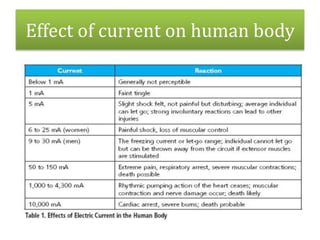
• Effect of current on human body
• Calculation of resistance resistors
• Electric Power
• Daily usage Electric instruments
Definition
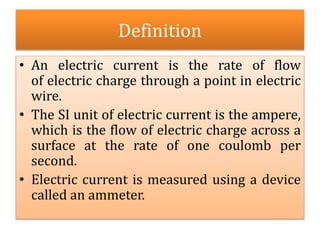
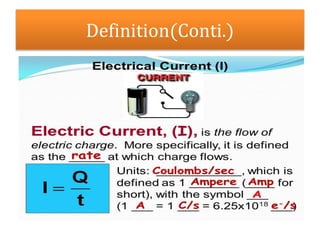
• An electric current is the rate of flow
of electric charge through a point in electric
wire.
• The SI unit of electric current is the ampere,
which is the flow of electric charge across a
surface at the rate of one coulomb per
second.
• Electric current is measured using a device
called an ammeter.
Definition(Conti.)
Ohms law
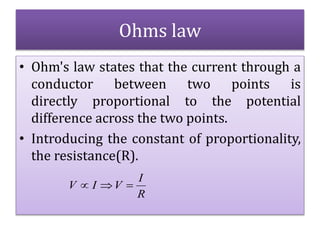
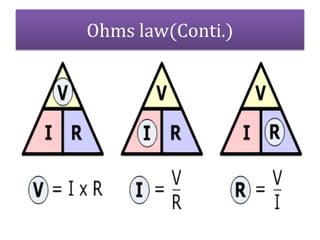
• Ohm's law states that the current through a
conductor between two points is
directly proportional to the potential
difference across the two points.
• Introducing the constant of proportionality,
the resistance(R).
R
I
VIV 
Ohms law(Conti.)
Current Types
• Nowadays two types of Electric currents are
used.
• Alternating current and Direct Current
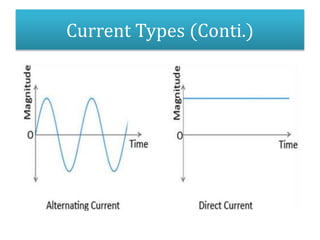
• Def: An electric current that reverses its
direction many times a second at regular
intervals is called Alternating Current.
• AC is the form of electric power most
commonly delivered to businesses and
residences.
Current Types (Conti.)
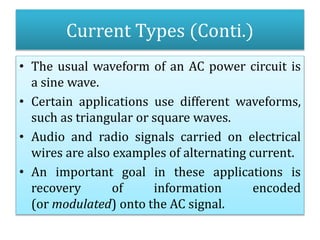
• The usual waveform of an AC power circuit is
a sine wave.
• Certain applications use different waveforms,
such as triangular or square waves.
• Audio and radio signals carried on electrical
wires are also examples of alternating current.
• An important goal in these applications is
recovery of information encoded
(or modulated) onto the AC signal.
Current Types (Conti.)
• In contrast, direct current (DC) is the unidirectional
flow of electric charge, or a system in which the
movement of electric charge is in one direction only.
• Direct current is produced by sources such
as batteries, thermocouples, solar cells,
and commutator-type electric machines of
the dynamo type.
• Direct current may flow in a conductor such as a
wire but can also flows
through semiconductors, insulators, or even through
a vacuum as in electron or ion beams.
• An old name for direct current was galvanic current.
Current Types (Conti.)
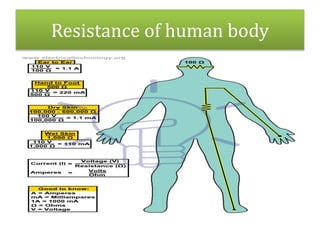
Resistance of human body
Effect of current on human body
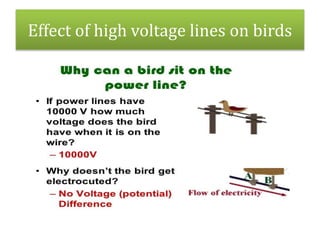
Effect of high voltage lines on birds
Electric Power
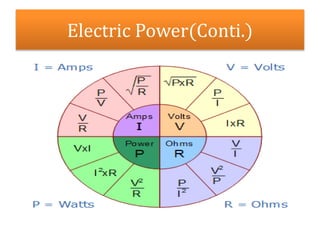
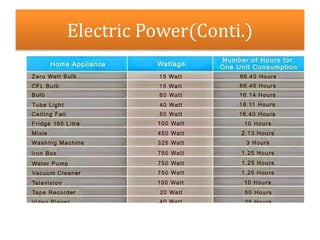
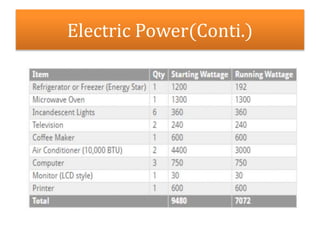
• Electric power is the rate(per unit time) at
which electrical energy is transferred by
an electric circuit.
• The SI unit of power is the watt or one joule
per second.
• Electric power is usually produced
by electric generators, but can also be
supplied by sources such
as electric batteries.
Electric Power(Conti.)
• It is usually supplied to businesses and
homes (as domestic mains electricity) by
the electric power industry through
an electric power grid.
• Electric power can be delivered over long
distances by transmission lines and used for
applications such as motion, light or heat
with high efficiency.
Electric Power(Conti.)
Thank you

Electric current

  • 1.
    ELECTRIC CURRENT By Duddu SampurnaRao, M.Sc., Lecturer in Physics, KRK Govt. Degree College, Addanki, Prakasam Dist.
  • 2.
    Topics • Definition • Ohmslaw • Current Types • Effect of current on human body • Calculation of resistance resistors • Electric Power • Daily usage Electric instruments
  • 3.
    Definition • An electriccurrent is the rate of flow of electric charge through a point in electric wire. • The SI unit of electric current is the ampere, which is the flow of electric charge across a surface at the rate of one coulomb per second. • Electric current is measured using a device called an ammeter.
  • 4.
  • 5.
    Ohms law • Ohm'slaw states that the current through a conductor between two points is directly proportional to the potential difference across the two points. • Introducing the constant of proportionality, the resistance(R). R I VIV 
  • 6.
  • 7.
    Current Types • Nowadaystwo types of Electric currents are used. • Alternating current and Direct Current • Def: An electric current that reverses its direction many times a second at regular intervals is called Alternating Current. • AC is the form of electric power most commonly delivered to businesses and residences.
  • 8.
    Current Types (Conti.) •The usual waveform of an AC power circuit is a sine wave. • Certain applications use different waveforms, such as triangular or square waves. • Audio and radio signals carried on electrical wires are also examples of alternating current. • An important goal in these applications is recovery of information encoded (or modulated) onto the AC signal.
  • 9.
    Current Types (Conti.) •In contrast, direct current (DC) is the unidirectional flow of electric charge, or a system in which the movement of electric charge is in one direction only. • Direct current is produced by sources such as batteries, thermocouples, solar cells, and commutator-type electric machines of the dynamo type. • Direct current may flow in a conductor such as a wire but can also flows through semiconductors, insulators, or even through a vacuum as in electron or ion beams. • An old name for direct current was galvanic current.
  • 10.
  • 11.
  • 12.
    Effect of currenton human body
  • 13.
    Effect of highvoltage lines on birds
  • 14.
    Electric Power • Electricpower is the rate(per unit time) at which electrical energy is transferred by an electric circuit. • The SI unit of power is the watt or one joule per second. • Electric power is usually produced by electric generators, but can also be supplied by sources such as electric batteries.
  • 15.
    Electric Power(Conti.) • Itis usually supplied to businesses and homes (as domestic mains electricity) by the electric power industry through an electric power grid. • Electric power can be delivered over long distances by transmission lines and used for applications such as motion, light or heat with high efficiency.
  • 16.
  • 17.
  • 18.
  • 19.