Introduction to Periodic Motion CP Physics - Sly
Periodic Motion: a comparison Projectile motion  was an object going up and coming down, ONCE! -vs.- Periodic motion  is a repeating motion, that can be described with Newtonian physics and our kinematics equations.
So we will be looking at the following examples: Circular Motion Torque Simple Harmonic Motion (Springs and Pendulums) The only thing is that these situations require us to describe things differently.
The human body cannot sense constant velocity… But it has a great ability to sense small shifts in  acceleration .
I. Circular Motion Remember that acceleration is a change in speed or direction.. So an object spinning in a circle can have constant speed, but since its direction is changing, the velocity is changing and therefore acceleration. In circular motion its called  Centripetal Acceleration . *  Centripeta l: meaning center seeking or towards the center.
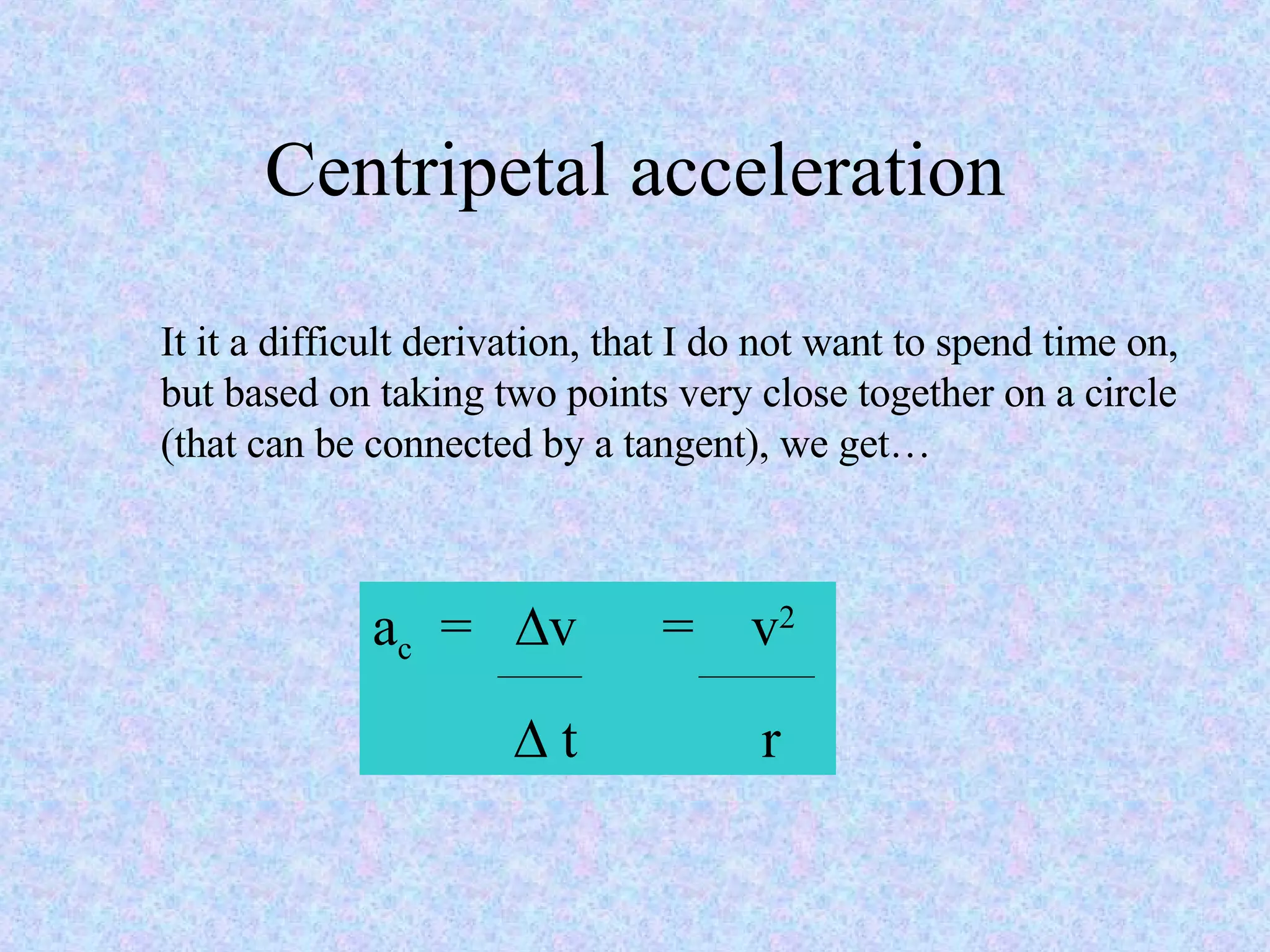
Centripetal acceleration It it a difficult derivation, that I do not want to spend time on, but based on taking two points very close together on a circle (that can be connected by a tangent), we get… a c   =   v  =  v 2      t  r
What is Uniform Circular Motion? Based on the car looping around the track, what do you gather?
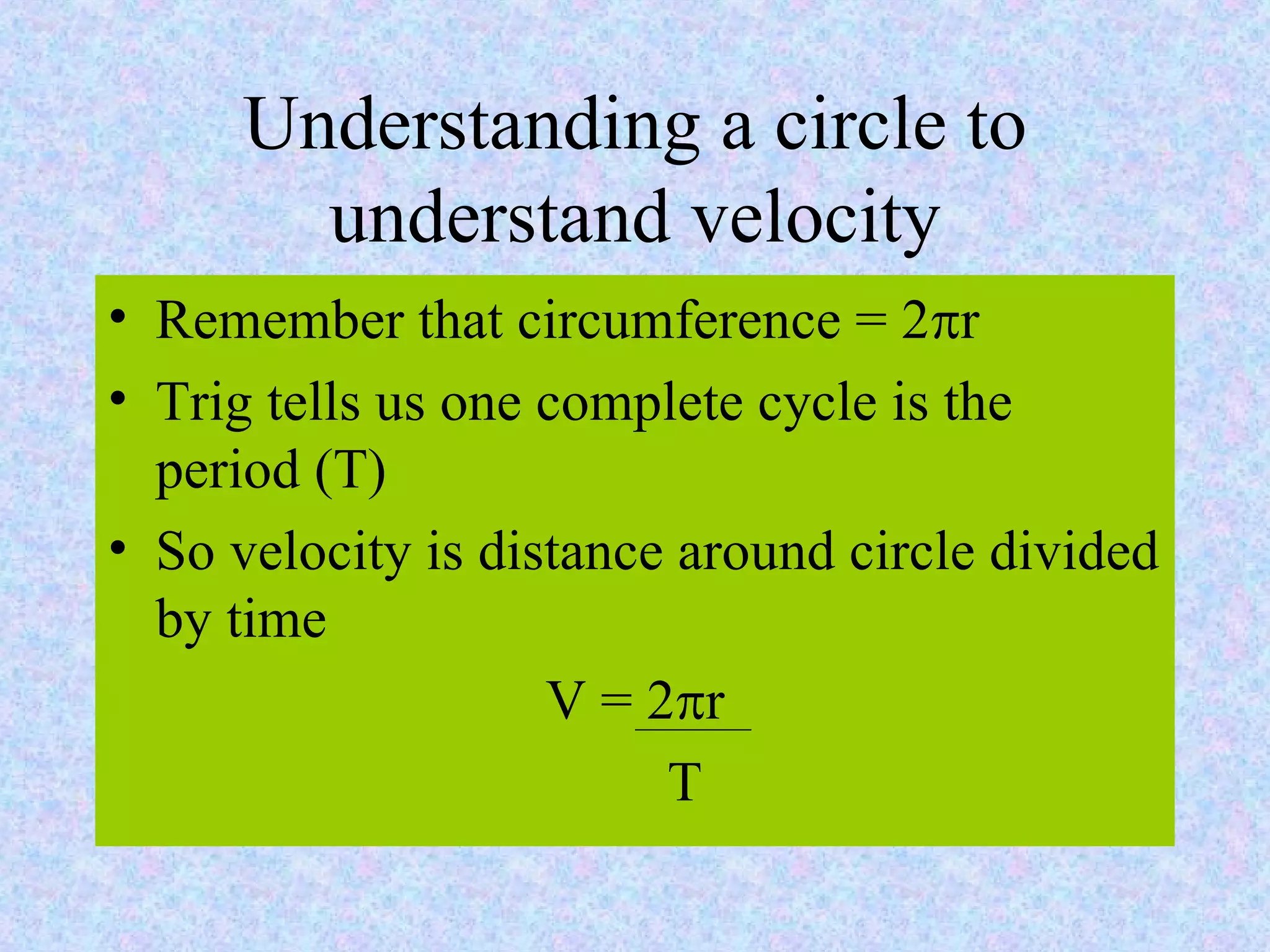
Understanding a circle to understand velocity Remember that circumference = 2  r Trig tells us one complete cycle is the period (T) So velocity is distance around circle divided by time V = 2  r T
Why use this for velocity? This makes it easier to determine the velocity of the object, since distance and time can be measured without interfering in the motion.
Put these two equations together. (derive as a class)
We also have a force Since there is acceleration toward the center, there is also a force towards the center … Centripetal Force F c  = ma c  = mv 2   =  m(4  2 r)   r  T 2
Circular Motion cont. Lets look at this in action…
One last item, fictional forces To compensate, objects in an accelerating reference frame invent fictional forces to explain motions in Newtonian terms. In circular motion, this fictional force is called  centrifugal  force, or in outward direction opposite of centripetal.  WHY? (based on momentum)
So think about riding in a car Consider riding along in a car with your crazy friend, the one who likes to take turns  50 mph.  What forces do you feel in a turn to the left in this scary song? If you say a force to the right then you have identified centrifugal force due to your body wanting to move in a straight line.    NOT A REAL FORCE When you press against the door, the door applies a  centripetal  force (along with friction on the seat) to make you turn.

Periodic Motion P2

  • 1.
    Introduction to PeriodicMotion CP Physics - Sly
  • 2.
    Periodic Motion: acomparison Projectile motion was an object going up and coming down, ONCE! -vs.- Periodic motion is a repeating motion, that can be described with Newtonian physics and our kinematics equations.
  • 3.
    So we willbe looking at the following examples: Circular Motion Torque Simple Harmonic Motion (Springs and Pendulums) The only thing is that these situations require us to describe things differently.
  • 4.
    The human bodycannot sense constant velocity… But it has a great ability to sense small shifts in acceleration .
  • 5.
    I. Circular MotionRemember that acceleration is a change in speed or direction.. So an object spinning in a circle can have constant speed, but since its direction is changing, the velocity is changing and therefore acceleration. In circular motion its called Centripetal Acceleration . * Centripeta l: meaning center seeking or towards the center.
  • 6.
    Centripetal acceleration Itit a difficult derivation, that I do not want to spend time on, but based on taking two points very close together on a circle (that can be connected by a tangent), we get… a c =  v = v 2  t r
  • 7.
    What is UniformCircular Motion? Based on the car looping around the track, what do you gather?
  • 8.
    Understanding a circleto understand velocity Remember that circumference = 2  r Trig tells us one complete cycle is the period (T) So velocity is distance around circle divided by time V = 2  r T
  • 9.
    Why use thisfor velocity? This makes it easier to determine the velocity of the object, since distance and time can be measured without interfering in the motion.
  • 10.
    Put these twoequations together. (derive as a class)
  • 11.
    We also havea force Since there is acceleration toward the center, there is also a force towards the center … Centripetal Force F c = ma c = mv 2 = m(4  2 r) r T 2
  • 12.
    Circular Motion cont.Lets look at this in action…
  • 13.
    One last item,fictional forces To compensate, objects in an accelerating reference frame invent fictional forces to explain motions in Newtonian terms. In circular motion, this fictional force is called centrifugal force, or in outward direction opposite of centripetal. WHY? (based on momentum)
  • 14.
    So think aboutriding in a car Consider riding along in a car with your crazy friend, the one who likes to take turns 50 mph. What forces do you feel in a turn to the left in this scary song? If you say a force to the right then you have identified centrifugal force due to your body wanting to move in a straight line.  NOT A REAL FORCE When you press against the door, the door applies a centripetal force (along with friction on the seat) to make you turn.