Study Material
Engineering Physics
G. K. Sahu
SchoolofEngineering
Centurion
UNIVERSITY
Engineering Physics B.Tech:2012-13
LECTURE NOTE: ENGINEERING PHYSICS, SUBJECT CODE: BSPH1203
[For B.Tech, 1st
Semester CSE, 2nd
Semester ECE, EEE, EE of CENTURION
UNIVERSITY OF TECHNOLOGY AND MANAGEMENT]
Module-1
Session-1
1.1 Introduction: Atomic structure
All matter is formed from basic building blocks called atoms. Atoms are made of
even smaller particles called protons, electrons, and neutrons. Protons and neutrons
live in the nucleus of an atom and are almost identical in mass. However, protons
have positive charges whereas neutrons have no charge. Electrons have a negative
charge and orbit the nucleus in shells or electron orbitals and are much less massive
than the other particles. Since electrons are 1836 times less massive than either
protons or neutrons, most of the mass of an atom is in the nucleus, which is only
1/100,000th the size of an entire atom
1.2 Madelung's Rule:
Engineering Physics B.Tech:2012-13
1.3 Hund's Rule
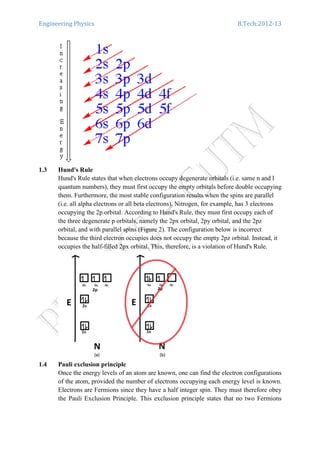
Hund's Rule states that when electrons occupy degenerate orbitals (i.e. same n and l
quantum numbers), they must first occupy the empty orbitals before double occupying
them. Furthermore, the most stable configuration results when the spins are parallel
(i.e. all alpha electrons or all beta electrons). Nitrogen, for example, has 3 electrons
occupying the 2p orbital. According to Hund's Rule, they must first occupy each of
the three degenerate p orbitals, namely the 2px orbital, 2py orbital, and the 2pz
orbital, and with parallel spins (Figure 2). The configuration below is incorrect
because the third electron occupies does not occupy the empty 2pz orbital. Instead, it
occupies the half-filled 2px orbital. This, therefore, is a violation of Hund's Rule.
1.4 Pauli exclusion principle
Once the energy levels of an atom are known, one can find the electron configurations
of the atom, provided the number of electrons occupying each energy level is known.
Electrons are Fermions since they have a half integer spin. They must therefore obey
the Pauli Exclusion Principle. This exclusion principle states that no two Fermions
Engineering Physics B.Tech:2012-13
can occupy the same energy level corresponding to a unique set of quantum numbers
n, l, m or s. The ground state of an atom is therefore obtained by filling each energy
level, starting with the lowest energy, up to the maximum number as allowed by the
Pauli Exclusion Principle.
1.5 Electronic configuration of the elements
The electronic configuration of the elements of the periodic table can be constructed
using the quantum numbers of the hydrogen atom and the Pauli exclusion principle,
starting with the lightest element hydrogen. Hydrogen contains only one proton and
one electron. The electron therefore occupies the lowest energy level of the hydrogen
atom, characterized by the principal quantum number n = 1. The orbital quantum
number, l, equals zero and is referred to as an s orbital (not to be confused with the
quantum number for spin, s).The s orbital can accommodate two electrons with
opposite spin, but only one is occupied. This leads to the shorthand notation of 1s1
for
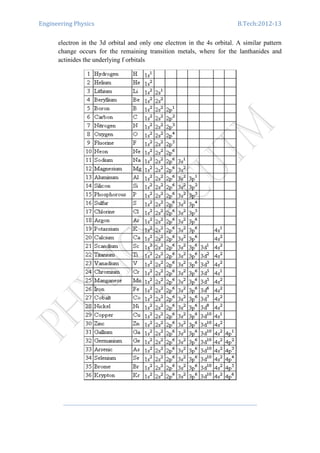
the electronic configuration of hydrogen as listed in Table 1.2.3. This table also lists
the atomic number (which equals the number of electrons), the name and symbol, and
the electronic configuration of the first 36 elements of the periodic table.
Helium is the second element of the periodic table. For this and all other atoms one
still uses the same quantum numbers as for the hydrogen atom. This approach is
justified since all atom cores can be treated as a single charged particle, which yields a
potential very similar to that of a proton. While the electron energies are no longer the
same as for the hydrogen atom, the electron wave functions are very similar and can
be classified in the same way. Since helium contains two electrons it can
accommodate two electrons in the 1s orbital, hence the notation 1s2
. Since the s
orbitals can only accommodate two electrons, this orbital is now completely filled, so
that all other atoms will have more than one filled or partially filled orbital. The two
electrons in the helium atom also fill all available orbitals associated with the first
principal quantum number, yielding a filled outer shell. Atoms with a filled outer shell
are called noble gases, as they are known to be chemically inert.
Lithium contains three electrons and therefore has a completely filled 1s orbital and
one more electron in the next higher 2s orbital. The electronic configuration is
therefore 1s2
2s1
or [He]2s1
, where [He] refers to the electronic configuration of
helium. Beryllium has four electrons, two in the 1s orbital and two in the 2s orbital.
The next six atoms also have a completely filled 1s and 2s orbital as well as the
remaining number of electrons in the 2p orbitals. Neon has six electrons in the 2p
orbitals, thereby completely filling the outer shell of this noble gas.
The next eight elements follow the same pattern leading to argon, the third noble gas.
After that the pattern changes as the underlying 3d orbitals of the transition metals
(scandium through zinc) are filled before the 4p orbitals, leading eventually to the
fourth noble gas, krypton. Exceptions are chromium and zinc, which have one more
Engineering Physics B.Tech:2012-13
electron in the 3d orbital and only one electron in the 4s orbital. A similar pattern
change occurs for the remaining transition metals, where for the lanthanides and
actinides the underlying f orbitals
Engineering Physics B.Tech:2012-13
Session-2
2.1. Electrical Conduction: Electrical conductivity of a material is defined in terms of
ease with which a material transmits an electrical current. Electrical current (I) is
flow of electrons, and driving force for the flow of electrons is called voltage (V).
Ohm’s law relates these parameters as follows
V α I
V = IR……………………………….……….[1.1]
where R – is the materials resistance to flow of electrons through it.
V, I, and R respectively have units as volts, amperes, and ohms ( ).
2.2. Electrical Resistivity: Electrical resistance of a material is influenced by its
geometric configuration; hence a new parameter called electrical resistivity (ρ) is
defined such as it is independent of the geometry.
ߩ ൌ
ோ஺
௟
……………………………..……….[1.2]
where A – cross-sectional area perpendicular to the direction of the current, and l –
the distance between points between which the voltage is applied. Units for ρ are
ohm-meters ( -m).
2.3. Electrical Conductivity: Reciprocal of the electrical resistivity, known as electrical
conductivity (σ), is used to express the electrical behavior of a material, which is
indicative of the ease with which a material allows of flow of electrons.
ߪ ൌ
ଵ
ఘ
ൌ
௟
ோ஺
…………………………..……..[1.3]
Electrical conductivity has the following units: ( -m)-1
or mho/meter. The
conductivity of material depends on the presence of free electrons or conduction
electrons, which move freely in the metal and do not correspond to any atom. These
electrons are known as electron gas.
2.4. Classification of Conducting Materials: Based on electrical conductivity, materials
can be classified into three categories:
i. Zero resistivity materials
ii. Low resistivity materials
iii. High resistivity materials
(i) Zero resistivity materials: Superconductor like alloys of aluminium, zinc,
gallium, nichrome, niobium, etc. are a special class of materials that conduct
electricity almost with zero resistance below the transition temperature. These
materials are perfect diamagnetic. Such materials are used for energy saving in
power systems, superconducting magnets, memory storage elements.
(ii) Low resistivity materials: The metals and alloys like silver, aluminium have
very high electrical conductivity, in the order of 10଼
	Ωିଵ
݉ିଵ
. They are used
as resistors. Conductors, electrical contacts, etc. in electrical devices and also
in electrical power transmission and distribution, winding wires in motors and
transformers.
Engineering Physics B.Tech:2012-13
(iii) High resistivity materials: The material like tungsten, platinum, nichrome, etc.
have high resistivity and low temperature coefficient of resistances. Such
metals and alloys are used in the manufacturing of resistors, heating elements,
resistance thermometers, etc.
2.5. Basic Terminologies
1. Bound Electrons:
All the valence electrons in an isolated atom are bound to their
parent nuclei are called as bound electrons.
2. Free electrons:
Electrons which moves freely or randomly in all directions in the
absence of external field.
3. Drift Velocity
If no electric field is applied on a conductor, the free electrons
move in random directions. They collide with each other and also with the
positive ions. Since the motion is completely random, average velocity in any
direction is zero. If a constant electric field is established inside a conductor,
the electrons experience a force F = -eE due to which they move in the
direction opposite to direction of the field. These electrons undergo frequent
collisions with positive ions. In each such collision, direction of motion of
electrons undergoes random changes. As a result, in addition to the random
motion, the electrons are subjected to a very slow directional motion. This
motion is called drift and the average velocity of this motion is called drift
velocity vd.
4. Electric Field (E):
The electric field E of a conductor having uniform cross
section is defined as the potential drop (V) per unit length (l).
i.e., E = V/ l V/m
5. Current density (J):
It is defined as the current per unit area of cross section of an
imaginary plane hold normal to the direction of the flow of current in a current
carrying conductor.
J = I/ A Am-2
6. Fermi level
Fermi level is the highest filled energy level at 0 K.
7. Fermi energy
Energy corresponding to Fermi level is known as Fermi energy.
[Reference: Material Science by V. Rajendran and A. Marikani, Pages-7.1-7.2]
Engineering Physics B.Tech:2012-13
Session-3
3.1. Electron Theory of metals:
The electron theory of metals explain the following concepts
Structural, electrical and thermal properties of materials.
Elasticity, cohesive force and binding in solids.
Behaviour of conductors, semi conductors, insulators etc.
So far three electron theories have been proposed.
1. Classical Free electron theory:
It is a macroscopic theory.
Proposed by Drude and Loretz in 1900.
It explains the free electrons in lattice
It obeys the laws of classical mechanics.
2. Quantum Free electron theory:
It is a microscopic theory.
Proposed by Sommerfield in 1928.
It explains that the electrons move in a constant potential.
It obeys the Quantum laws.
3. Brillouin Zone theory or Band theory:
Proposed by Bloch in 1928.
It explains that the electrons move in a periodic potential.
It also explains the mechanism of semiconductivity, based on bands
and hence called band theory.
3.2.1. Classical Free electron theory (Drude-Lorentz Theory)
This theory was developed by Drude and Lorentz and hence is also known as
Drude-Lorentz theory. According to this theory, a metal consists of electrons which
are free to move about in the crystal like molecules of a gas in a container. Mutual
repulsion between electrons is ignored and hence potential energy is taken as zero.
Therefore the total energy of the electron is equal to its kinetic energy.
Postulates of Classical free electron theory:
1. All the atoms are composed of atoms. Each atom have central nucleus around
which there are revolving electrons.
2. The electrons are free to move in all possible directions about the whole
volume of metals.
Engineering Physics B.Tech:2012-13
3. In the absence of an electric field the electrons move in random directions
making collisions from time to time with positive ions which are fixed in the lattice or
other free electrons. All the collisions are elastic i.e.; no loss of energy.
4. When an external field is applied the free electrons are slowly drifting towards
the positive potential.
5. Since the electrons are assumed to be a perfect gas they obey classical kinetic
theory of gasses.
6. Classical free electrons in the metal obey Maxwell-Boltzmann statistics.
3.2.2. If no electric field is applied on a conductor, the free electrons move in random
directions. They collide with each other and also with the positive ions. Since the
motion is completely random, average velocity in any direction is zero. If a constant
electric field is established inside a conductor, the electrons experience a force F = -eE
due to which they move in the direction opposite to direction of the field.
Consider a conductor subjected to an electric field E in the x-direction. The force on
the electron due to the electric field = -eE.
From Newton’s law,
െ݁‫ܧ‬௫ ൌ ݉ܽ௫
‫,ݎ݋‬ ܽ௫ ൌ ൬
߲ ൏ ‫ݒ‬௫ ൐
߲‫ݐ‬
൰ ൌ െ
݁‫ܧ‬௫
݉
																													ሾ2.1ሿ
‫	݁ݎ݄݁ݓ‬ ൏ ‫ݒ‬௫ ൐ ݅‫ݕݐ݅ܿ݋݈݁ݒ	ݐ݂݅ݎ݀	݃ܽݎ݁ݒܽ	݄݁ݐ	ݏ‬
Integrating equation ሾ2.1ሿ
൏ ‫ݒ‬௫ ൐	ൌ െ
݁‫ܧ‬௫
݉
‫ݐ‬ ൅ ‫ܥ‬
ܵ݅݊ܿ݁	 ൏ ‫ݒ‬௫ ൐	ൌ 0, ܽ‫ݐ	ݐ‬ ൌ 0	‫ܥ	ݐ݁݃	݁ݓ‬ ൌ ܱ.
ܵ‫,݋‬ ൏ ‫ݒ‬௫ ൐	ൌ െ
݁‫ܧ‬௫
݉
‫																																					ݐ‬ሾ2.2ሿ
ܵ‫,݋‬ ൏ ‫ݒ‬௫ ൐	monotonically proportional with time. So, current density should increase
indefinitely with time but that does not happen. A constant current flows through the
metal. So, a retarding force must act opposite to drift of electron. This retarding force
is provided scattering of electrons by the vibrating atoms (phonon) and the
imperfection in the lattice.
The retarding force is directly proportional to the drift velocity.
So, ቀ
డழ௩ೣவ
డ௧
ቁ
௦௖௔௧௧.
ൌ	െ
ழ௩ೣவ	
ఛ
																																													ሾ2.3ሿ
Engineering Physics B.Tech:2012-13
A
L
d
I
The proportionality constant
ଵ
ఛ
has the unit of sec-1
. So, ߬ is called relaxation time.
In steady state, ቀ
డழ௩ೣவ
డ௧
ቁ
௙௜௘௟ௗ
ൌ െ ቀ
డழ௩ೣவ
డ௧
ቁ
௦௖௔௧௧.
Using eq[2.1] and [2.3], we have
െ
݁‫ܧ‬௫
݉
ൌ
൏ ‫ݒ‬௫ ൐	
߬
‫,ݎ݋‬ ൏ ‫ݒ‬௫ ൐ൌ	െ
݁߬
݉
‫ܧ‬௫																								ሾ2.4ሿ
We know that, Current density ݆௫ ൌ െ݊݁ ൏ ‫ݒ‬௫ ൐																														ሾ2.5ሿ
Where n is the concentration of electrons in the metal.
From eq[2.4] and [2.5],
݆௫ ൌ
݊݁ଶ
߬
݉
‫ܧ‬௫																																			ሾ2.6ሿ
3.2.3 Ohm’s law in terms of E and J
From Ohm’s law ܸ ൌ ‫ܴܫ‬
V=Potential across the conductor,
I= Current through the conductor
R=Resistance
ߪ=conductivity of the conductor
Let L=length
d=width of conductor
A=area of cross section
Now ܸ ൌ ‫ܧ‬௫‫ܮ‬
‫ܫ‬௫ ൌ ‫ܬ‬௫‫ܣ‬
And ܴ ൌ
௅
ఙ஺
So, Ohm’s law can be written as ‫ܧ‬௫‫ܮ‬ ൌ ‫ܬ‬௫‫ܣ‬ ൈ
௅
ఙ஺
Or, ‫ܬ‬௫ ൌ ߪ‫ܧ‬௫																																		ሾ2.7ሿ
Equation [2.7] is the ohm’s law
3.2.4 Electrical Conductivity: Comparing eqs[2.6] and [2.7], we get
࣌ ൌ
௡௘మఛ
௠
																																			ሾ2.8ሿ
The electrical conductivity is directly proportional to the concentration of free
electrons and the relaxation time.
3.2.5 Electrical Resistivity: ࣋ ൌ
૚
࣌
ൌ
࢓
௡௘మఛ
[2.9]
3.2.6 Mobility: It is defined as the average drift velocity per unit applied electric field.
So,
Engineering Physics B.Tech:2012-13
ߤ௘ ൌ
‫ݒ‬
‫ܧ‬
ൌ
݁߬
݉
െ													ሾ2.10ሿ
Hence
ߪ ൌ ݊݁ߤ௘.																	ሾ2.11ሿ
[Reference: Material Science by M. S. Vijaya and G. Rangarajan, Page-203-206]
Session-4
4.1 Interpretation of Relaxation time
From eq[2.3], ቀ
డழ௩ೣவ
డ௧
ቁ
௦௖௔௧௧.
ൌ	െ
ழ௩ೣவ	
ఛ
Let the electric field is switched off at t=0, then the drift velocity gradually falls to
zero, due to scattering by phonons. Integrating above equation
න
߲ ൏ ‫ݒ‬௫ ൐
൏ ‫ݒ‬௫ ൐
ൌ െ න
߲‫ݐ‬
߬
Or, ݈݊ ൏ ‫ݒ‬௫ ൐ൌ െ
௧
ఛ
൅ ‫ܥ‬ [3.1]
At t=0, ൏ ‫ݒ‬௫ ൐ൌ൏ ‫ݒ‬௫ሺ0ሻ ൐, so, from eq[3.1], ‫ܥ‬ ൌ ݈݊ ൏ ‫ݒ‬௫ሺ0ሻ ൐
Putting the value of C, we get
݈݊
൏ ‫ݒ‬௫ ൐
൏ ‫ݒ‬௫ሺ0ሻ ൐
ൌ െ
‫ݐ‬
߬
‫,ݎ݋‬ ൏ ‫ݒ‬௫ ൐ൌ൏ ‫ݒ‬௫ሺ0ሻ ൐ ݁ି
௧
ఛ																																		ሾ3.2ሿ
eq[3.2]shows that, when electric field is switched off, the drift velocity falls
exponentially to zero. The relaxation time is determined by the electron phonon
interaction in the metal. It is of the order of 10-14
sec.
4.2 Temperature Dependence of Electrical Resistivity:
From Kinetic theory, the kinetic energy associated with an electron is
1
2
݉ሺܿ̅ሻଶ
ൌ
3
2
݇஻ܶ
When an electric field is applied, the resulting acceleration ܽ ൌ
௘ா
௠
. If the mean free
path is ߣ, then the time between collision is
ఒ
௖̅
. Hench the drift velocity acquired
before next collision is
‫ݑ‬ ൌ ݈ܽܿܿ.ൈ ‫݁݉݅ݐ‬ ൌ ൬
݁‫ܧ‬
݉
൰ ൬
ߣ
ܿ̅
൰
Thus the average drift velocity is
Engineering Physics B.Tech:2012-13
‫ݑ‬
2
ൌ
݁‫ܧ‬
2݉
ߣ
ܿ̅
If n is the number of electrons per unit volume, then current density is
‫ܬ‬௫ ൌ
݊݁‫ݑ‬
2
ൌ
݊݁ଶ
‫ܧ‬
2݉
ߣ
ܿ̅
Or
ߪ ൌ
‫ܬ‬௫
‫ܧ‬
ൌ
݊݁ଶ
2݉
ߣ
ܿ̅
Or,
ߩ ൌ
2݉
݊ߣ݁ଶ
ൈ ඨ
3݇஻ܶ
݉
ൌ
ඥ12݉݇஻ܶ
݊݁ଶߣ
െ െ െ െ െ െ െ ሾ3.3ሿ
Here it is assumed that ߣ is independent of temperature. Hence ߩ ∝ √ܶ which is
contradictory to the experimental fact that ߩ ∝ ܶ.
4.3 Drawbacks of Classical free electron theory
1) According to this theory, ߩ is proportional to √ܶ. But experimentally it was found
that ߩ is proportional to T.
2) According to this theory, K/ ߪܶ= L, a constant (Wiedmann-Franz law) for all
temperatures. But this is not true at low temperatures.
3) The theoretically predicted value of specific heat of a metal does not agree with the
experimentally obtained value.
4) This theory fails to explain ferromagnetism, superconductivity, photoelectric effect,
Compton effect and blackbody radiation.
[Reference: Material Science by M. S. Vijaya and G. Rangarajan, Page-206-208]
Session-5
5.1 Thermal conductivity: The thermal conductivity is defined as the ratio of the
amount of heat energy conducted per unit area of cross section per second to the
temperature gradient.
Therefore, the thermal conductivity
‫ܭ‬ ൌ െ
ܳ
݀ܶ
݀‫ݔ‬ൗ
ሾ4.1ሿ
Where K is the coefficient of thermal conductivity, Q the amount of heat energy
conducted per unit area of cross section in one second and ݀ܶ
݀‫ݔ‬ൗ the temperature
gradient. The negative sign shows that heat flows from the hot end to cold end.
The thermal conductivity of a material, in general, is due to the presence of lattice
vibrations and electrons. Hence, the thermal conduction can be written as
‫ܭ‬௧௢௧௔௟ ൌ ‫ܭ‬௘௟௘௖௧௥௢௡ ൅ ‫ܭ‬௣௛௢௡௢௡௦
‫݁ݎ݄݁ݓ‬ ‫ݏ݊݋݊݋݄݌‬ ܽ‫݁ݎ‬ ‫݄݁ݐ‬ ݁݊݁‫ݕ݃ݎ‬ ܿܽ‫ݏݎ݁݅ݎݎ‬ ݂‫ݎ݋‬ ݈ܽ‫݁ܿ݅ݐݐ‬ ‫ݏ݊݋݅ݐܽݎܾ݅ݒ‬
Engineering Physics B.Tech:2012-13
In metals, free electron concentration is very high. So, thermal conductivity of metal
is far greater than that for insulator.
5.2 Derivation of expression for thermal conductivity:
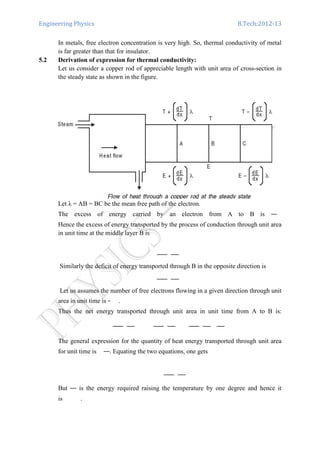
Let us consider a copper rod of appreciable length with unit area of cross-section in
the steady state as shown in the figure.
Let λ = AB = BC be the mean free path of the electron.
The excess of energy carried by an electron from A to B is
Hence the excess of energy transported by the process of conduction through unit area
in unit time at the middle layer B is
Similarly the deficit of energy transported through B in the opposite direction is
Let us assumes the number of free electrons flowing in a given direction through unit
area in unit time is .
Thus the net energy transported through unit area in unit time from A to B is:
The general expression for the quantity of heat energy transported through unit area
for unit time is . Equating the two equations, one gets
But is the energy required raising the temperature by one degree and hence it
is .
Engineering Physics B.Tech:2012-13
Now
݇ ൌ
݊ܿ̅ߣ
3
ሺ‫ܥ‬௩ሻ௘௟ ൌ
݊ߣ
3
ሺ‫ܥ‬௩ሻ௘௟ඨ
3݇஻ܶ
݉
But ሺ‫ܥ‬௩ሻ௘௟ ൌ
ଷ
ଶ
݇஻ with n=1 electron
Thus,
݇ ൌ
݊ߣ
3
൬
3
2
݇஻൰ ඨ
3݇஻ܶ
݉
ൌ
݊ߣ݇஻
2
ඨ
3݇஻ܶ
݉
ሾ4.2ሿ
5.3 Wiedmann-Franz law:
This law states that when the temperature is not too law, the ratio of the thermal
conductivity to the electrical conductivity of a metal is directly proportional to the
absolute temperature, i.e.,
௄
ఙ
∝ ܶ
Or,
‫ܭ‬
ߪܶ
ൌ ܿ‫ݐ݊ܽݐݏ݊݋‬ ൌ ‫ܮ‬ ሾ4.3ሿ
Where L is a constant known as Lorentz number.
From the expression for the thermal conductivity and electrical conductivity, the ratio
can be written as,
‫ܭ‬
ߪ
ൌ
݊ߣ݇஻
2
ට3݇஻ܶ
݉
ൈ
ඥ12݉݇஻ܶ
݊݁ଶߣ
ൌ 3 ൬
݇஻
݁
൰
ଶ
ܶ ሾ4.4ሿ
Or,
௄
ఙ்
ൌ 3 ቀ
௞ಳ
௘
ቁ
ଶ
which is the Lorentz number.
[Reference: Material Science by V. Rajendran and A. Marikani, Pages-7.5-7.8]
Session-6
6.1 Quantum free electron theory
Classical free electron theory could not explain many physical properties. In 1928,
Sommerfeld developed a new theory applying quantum mechanical concepts and
Fermi-Dirac statistics to the free electrons in the metal. This theory is called quantum
free electron theory.
Classical free electron theory permits all electrons to gain energy. But quantum free
electron theory permits only a fraction of electrons to gain energy. In order to
determine the actual number of electrons in a given energy range (dE), it is necessary
to know the number of states (dNs) which have energy in that range. The number of
states per unit energy range is called the density of states g(E).
Therefore, g(E) = dNs/dE
Engineering Physics B.Tech:2012-13
According to Fermi-Dirac statistics, the probability that a particular energy state with
energy E is occupied by an electron is given by,
where is the energy in the Fermi level. Fermi level is the highest filled energy
level at 0 K. Energy corresponding to Fermi level is known as Fermi energy. Now the
actual number of electrons present in the energy range dE,
dN = f(E) g(E)dE
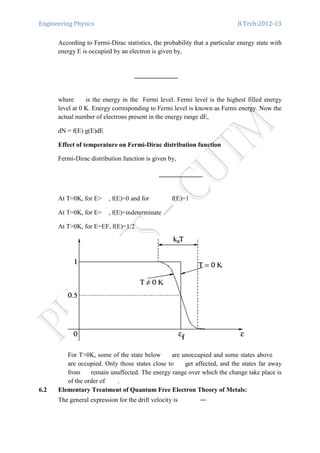
Effect of temperature on Fermi-Dirac distribution function
Fermi-Dirac distribution function is given by,
At T=0K, for E> , f(E)=0 and for f(E)=1
At T=0K, for E= , f(E)=indeterminate
At T>0K, for E=EF, f(E)=1/2
For T>0K, some of the state below are unoccupied and some states above
are occupied. Only those states close to get affected, and the states far away
from remain unaffected. The energy range over which the change take place is
of the order of .
6.2 Elementary Treatment of Quantum Free Electron Theory of Metals:
The general expression for the drift velocity is
Engineering Physics B.Tech:2012-13
And conductivity ࣌ ൌ
௡௘మఛ
௠
where ߬ is the average time elapsed after collision.
The real picture of electrical conduction in metal is quite different from the classical
one, in which it was assumed that the current carried equally by all electrons, each
moving with an average drift velocity	‫ݒ‬ௗ. But quantum mechanical treatment tells us
that the current is in fact, carried out by very few electrons only, all moving at high
velocity (‫ݒ‬ி).
If λ is the mean free paths and ‫ݒ‬ி is the speed of free electrons whose kinetic energy
is equal to Fermi energy since only electrons near Fermi level contributes to the
conductivity. The average time τ between collisions is given by ߬ ൌ
ఒ
௏ಷ
Thus the electric conductivity
࣌ ൌ
௡௘మఒ
௠௏ಷ
																			ሾ5.2ሿ
The only quantity which depends on temperature is the mean free path. Since this free
path is inversely proportional to temperature at high temperature. It follows that,
ߪ ∝
ଵ
்
	‫ߩ	ݎ݋‬ ∝ ܶ, in agreement with experimental conclusion.
it is obvious at a given temperature the only factor which varies from one metal to the
other is densities of free electron. One must also note that the energy kT (where T is
of the order of 300 k) can activate only the free electrons near the Fermi level to move
to unoccupied states and contribute to specific heat. We may therefore require an
energy EF called (very high compared with kT = 0.025 eV at 300 k) Fermi energy to
make all the electrons to move to the unoccupied states corresponding to a
temperature TF called Fermi temperature. The unique relation connecting the various
parameters in quantum theory of free electron is
‫ܧ‬ி ൌ
1
2
ܸ݉ி
ଶ
ൌ ݇஻ܶி
[Reference: Material Science by M. S. Vijaya and G. Rangarajan, Page-212-226]
Session-7
7.1 Band theory of solids
The atoms in the solid are very closely packed. The nucleus of an atom is so heavy
that it considered being at rest and hence the characteristic of an atom are decided by
the electrons. The electrons in an isolated atom have different and discrete amounts of
energy according to their occupations in different shells and sub shells. These energy
values are represented by sharp lines in an energy level diagram.
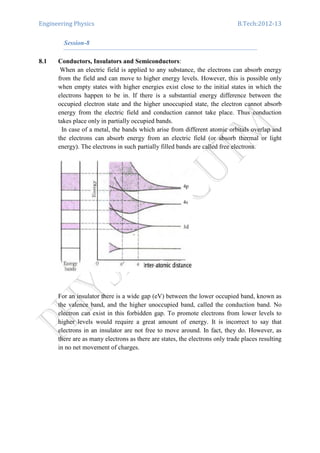
During the formation of a solid, energy levels of outer shell electrons got split up. As
a result, closely packed energy levels are produced. The collection of such a large
number of energy levels is called energy band. The electrons in the outermost shell
are called valence electrons. The band formed by a series of energy levels containing
the valence electrons is known as valence band. The next higher permitted band in a
Engineering Physics B.Tech:2012-13
solid is the conduction band. The electrons occupying this band are known as
conduction electrons.
Conduction band valence band are separated by a gap known as forbidden energy gap.
No electrons can occupy energy levels in this band. When an electrons in the valence
band absorbs enough energy, it jumps across the forbidden energy gap and enters the
conduction band, creating a positively charged hole in the valence band. the hole is
basically the deficiency of an electron.
7.2 Energy Band Diagram
Electrical properties of materials are best understood in terms of their electronic
structure. We know that the energy levels of isolated atoms are discrete. When atoms
are brought together to form a solid, these energy levels spread out into bands of
allowed energies. The effect is qualitatively understood as follows by considering
what happens when a collection of atoms, which are initially far apart are brought
closer.
When the spacing between adjacent atoms is large, each atom has sharply defined
energy levels which are denoted by etc. As the atoms are far apart their orbitals do not
overlap. In particular if each atom is in its ground state, the electrons in each atom
occupy identical quantum states. As the distance starts decreasing, the orbitals
overlap. The electrons of different atoms cannot remain in the same state because of
Pauli Exclusion Principle. Pauli principle states that a particular state can at most
accommodate two electrons of opposite spins. Thus when atoms are brought together,
the levels must split to accommodate electrons in different states. Though they appear
continuous, a band is actually a very large number of closely spaced discrete levels
[Reference: Material Science by V. Rajendran and A. Marikani, Pages-8.22-8.23]
[Reference: Material Science by M. S. Vijaya and G. Rangarajan, Page-226-229]
Engineering Physics B.Tech:2012-13
Session-8
8.1 Conductors, Insulators and Semiconductors:
When an electric field is applied to any substance, the electrons can absorb energy
from the field and can move to higher energy levels. However, this is possible only
when empty states with higher energies exist close to the initial states in which the
electrons happen to be in. If there is a substantial energy difference between the
occupied electron state and the higher unoccupied state, the electron cannot absorb
energy from the electric field and conduction cannot take place. Thus conduction
takes place only in partially occupied bands.
In case of a metal, the bands which arise from different atomic orbitals overlap and
the electrons can absorb energy from an electric field (or absorb thermal or light
energy). The electrons in such partially filled bands are called free electrons.
For an insulator there is a wide gap (eV) between the lower occupied band, known as
the valence band, and the higher unoccupied band, called the conduction band. No
electron can exist in this forbidden gap. To promote electrons from lower levels to
higher levels would require a great amount of energy. It is incorrect to say that
electrons in an insulator are not free to move around. In fact, they do. However, as
there are as many electrons as there are states, the electrons only trade places resulting
in no net movement of charges.
Engineering Physics B.Tech:2012-13
Semiconductors, like insulator have band gaps. However, the gap between the top of
the valence band and the bottom of the conduction band is much narrower than in an
insulator. For comparison, the gap in case of Silicon is 1.1 eV while that for diamond,
which is an insulator, is about 6 eV.
[Reference: Material Science by M. S. Vijaya and G. Rangarajan, Page-230-232]
[Reference: Material Science by V. Rajendran and A. Marikani, Pages-8.23-8.24 &
9.1-9.2]
Session-9
9.1 Semiconductors
Elemental are semiconductors where each atom is of the same type such as Ge, Si.
These atoms are bound together by covalent bonds, so that each atom shares an
electron with its nearest neighbour, forming strong bonds. Compound semiconductors
are made of two or more elements. Common examples are GaAs or InP. These
compound semiconductors belong to the III-V semiconductors so called because first
and second elements can be found in group III and group V of the periodic table
respectively. In compound semiconductors, the difference in electro-negativity leads
to a combination of covalent and ionic bonding. Ternary semiconductors are formed
by the addition of a small quantity of a third element to the mixture, for example Al x
Ga 1-x As. The subscript x refers to the alloy content of the material, what proportion
of the material is added and what proportion is replaced by the alloy material. The
addition of alloys to semiconductors can be extended to include quaternary materials
such as Ga x In (1-x) As y P (1-y) or GaInNAs and even quinternary materials such as
GaInNAsSb. Once again, the subscripts denote the proportion elements that constitute
the mixture of elements. Alloying semiconductors in this way allows the energy gap
and lattice spacing of the crystal to be chosen to suit the application.
Valence band
Very large energy gap
Conduction
band empty
Valence band
Large energy gap
Conduction band
Valence band
Small energy gap
Conduction band
Figure 2
Insulators
Semiconductors
Conductors
Engineering Physics B.Tech:2012-13
9.2 Classification of Semiconductors:
Semiconductors are of two types and are classified on the basis of the concentration of
electrons and holes in the material.
i. Pure or intrinsic semiconductors
ii. Doped or extrinsic semiconductors
9.3 Pure or intrinsic semiconductors:
Intrinsic semiconductors are essentially pure semiconductor material. The
semiconductor material structure should contain no impurity atoms. Elemental and
compound semiconductors can be intrinsic semiconductors. At room temperature, the
thermal energy of the atoms may allow a small number of the electrons to participate
in the conduction process. Unlike metals, where the resistance of the material
decreases with temperature. For semiconductors, as the temperature increases, the
thermal energy of the valence electrons increases, allowing more of them to breach
the energy gap into the conduction band. When an electron gains enough energy to
escape the electrostatic attraction of its parent atom, it leaves behind a vacancy which
may be filled be another electron. The vacancy produced can be thought of as a
second carrier of positive charge. It is known as a hole. As electrons flow through the
semiconductor, holes flow in the opposite direction. If there are n free electrons in an
intrinsic semiconductor, then there must also be n holes. Holes and electrons created
in this way are known as intrinsic charge carriers. The carrier concentration, or charge
density, defines the number of charge carriers per unit volume. This relationship can
be expressed as n=p where n is the number of electrons and p the number of holes per
unit volume. The variation in the energy gap between different semiconductor
materials means that the intrinsic carrier concentration at a given temperature also
varies.
The most common examples of the intrinsic semiconductors are silicon and
germanium. Both these semi conductors are used frequently in manufacturing of
transistors and electronic products manufacturing. The electronic configuration of
both these semiconductors is shown below:
Germanium -1s2
2s2
2p6
3s2
3p6
3d10
4s2
4p2
Silicon: 1s2
2s2
2p6
3s2
3p2
In the electronic configuration of both the semiconductor crystals there are four
valence electrons. These four electrons will form covalent bonds, with the
neighbouring electrons of the germanium atoms. Each covalent bond is formed by
sharing each electron from the each atom. After bond formation, no free electron will
remain in the outermost shell of the germanium semiconductor.
Engineering Physics B.Tech:2012-13
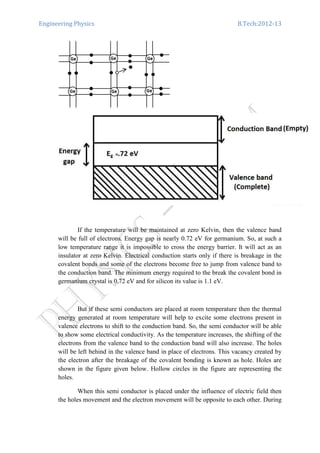
If the temperature will be maintained at zero Kelvin, then the valence band
will be full of electrons. Energy gap is nearly 0.72 eV for germanium. So, at such a
low temperature range it is impossible to cross the energy barrier. It will act as an
insulator at zero Kelvin. Electrical conduction starts only if there is breakage in the
covalent bonds and some of the electrons become free to jump from valence band to
the conduction band. The minimum energy required to the break the covalent bond in
germanium crystal is 0.72 eV and for silicon its value is 1.1 eV.
But if these semi conductors are placed at room temperature then the thermal
energy generated at room temperature will help to excite some electrons present in
valence electrons to shift to the conduction band. So, the semi conductor will be able
to show some electrical conductivity. As the temperature increases, the shifting of the
electrons from the valence band to the conduction band will also increase. The holes
will be left behind in the valence band in place of electrons. This vacancy created by
the electron after the breakage of the covalent bonding is known as hole. Holes are
shown in the figure given below. Hollow circles in the figure are representing the
holes.
When this semi conductor is placed under the influence of electric field then
the holes movement and the electron movement will be opposite to each other. During
Engineering Physics B.Tech:2012-13
this whole process the no of holes and the free electrons in the circuit of the intrinsic
semi conductor will be same.
[Reference: Material Science by V. Rajendran and A. Marikani, Pages-9.2-9.5]
[Reference: Material Science by M. S. Vijaya and G. Rangarajan, Page-263]
Session-10
10.1 Doped or extrinsic semiconductors:
Those semiconductors in which some impurity atoms are embedded are known as
extrinsic semiconductors. The process of adding impurity to the intrinsic
semiconductor is known as doping.
Extrinsic semi conductors are basically of two types:
1. P-type semi conductors
2. N-type semi conductors
10.2 N-type Semi conductors: Let’s take an example of the silicon crystal to understand
the concept of N-type semi conductor. We have studied the electronic configuration
of the silicon atom. It has four electrons in its outermost shell. In N-type semi
conductors, the silicon atoms are replaced with the pentavalent atoms like
phosphorous, bismuth, antimony etc. So, as a result the four of the electrons of the
pentavalent atoms will form the covalent bonds with the silicon atoms and the one
electron will revolve around the nucleus of the impurity atoms with less binding
energy. These electrons are almost free to move. In other words we can say that these
electrons are donated by the impure atoms. So, these are also known as donor atoms.
So, the conduction inside the conductor will take place with the help of the negatively
charged electrons. Electrons are negatively charged. Due to this negative charge these
semiconductors are known as N-type semiconductors.
Each donor atom has denoted an electron from its valence shell. So, as a result due to
loss of the negative charge these atoms will become positively charged. The single
valence electron revolves around the nucleus of the impure atom. The extra valance
electron not needed for the sp3
tetrahedral bonding is only loosely bound to the P
atom in a donor energy level, Ed. The energy of this donor energy level is close to the
lowest energy level of the conduction band (in Si it is 0.4 eV) and so it is easy to
promote an electron from the donor level to the conduction band. These promoted
electrons become charge carriers that contribute to the material's conductivity. Since
they are negative, the result is called an n-type semiconductor.
When the semi conductors are placed at room temperature then the covalent bond
breakage will take place. So, more free electrons will be generated. As a result, same
Engineering Physics B.Tech:2012-13
no of holes generation will take place. But as compared to the free electrons the no of
holes are comparatively less due to the presence of donor electrons.
We can say that major conduction of n-type semi conductors is due to electrons. So,
electrons are known as majority carriers and the holes are known as the minority
carriers.
[Reference: Material Science by M. S. Vijaya and G. Rangarajan, Page-264]
[Reference: Material Science by V. Rajendran and A. Marikani, Pages-9.5-9.6]
Session-11
11.1 P-type semi conductors: In a p-type semi conductor doping is done with trivalent
atoms. Trivalent atoms are those which have three valence electrons in their valence
shell. Some examples of trivalent atoms are Aluminium, boron etc. So, the three
valence electrons of the doped impure atoms will form the covalent bonds between
silicon atoms. But silicon atoms have four electrons in its valence shell. So, one
covalent bond will be improper. So, one more electron is needed for the proper
covalent bonding. This need of one electron is fulfilled from any of the bond between
two silicon atoms. So, the bond between the silicon and indium atom will be
completed. After bond formation the indium will get ionized. As we know that ions
are negatively charged. So, indium will also get negative charge. A hole was created
when the electron come from silicon-silicon bond to complete the bond between
indium and silicon. Now, an electron will move from any one of the covalent bond to
fill the empty hole. This will result in a new holes formation. So, in p-type semi
conductor the holes movement results in the formation of the current. Holes are
positively charged. Hence these conductors are known as p-type semiconductors or
acceptor type semi conductors.
P-type semiconductors have dopants from the IIIA group such as B+3
. These donor
impurity atoms in substitutional solid solution. The lack of an electron needed for sp3
tetrahedral bonding is easily filled by a neighbouring Si atom into an acceptor energy
Engineering Physics B.Tech:2012-13
level, Ea of the dopant atom. The energy of this acceptor level is only slightly above
the valance band and so it is easy to promote an electron from the valance band into it.
For each promotion of an electron into one of these acceptor levels, a hole is left in
the valance band. It is these holes that become the charge carriers and contribute to
the conductivity of the semiconductor. Since these holes are positive, the result is
called a p-type semiconductor.
Note that the temperatures needed to promote the dopant electrons into the conduction
band are lower than the temperatures required to promote the intrinsic electrons into
the conduction band.
When these conductors are placed at room temperature then the covalent bond
breakage will take place. In this type of semi conductors the electrons are very less as
compared to the holes. So, in p-type semi conductors holes are the majority carriers
and electrons are the minority carriers.
[Reference: Material Science by M. S. Vijaya and G. Rangarajan, Page-264-265]
[Reference: Material Science by V. Rajendran and A. Marikani, Pages-9.6]
Session-12
12.1 Hall effect:
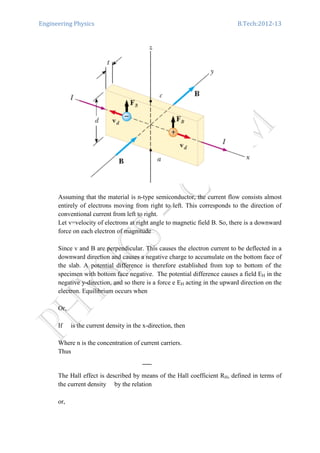
Consider a rectangular slab that carries a current I in the X-direction. A uniform
magnetic field of flux density B is applied along the Z-direction. The current carriers
experience a force (Lorentz force) in the downward direction. This leads to an
accumulation of electrons in the lower face of the slab. This makes the lower face
negative. Similarly the deficiency of electrons makes the upper face positive. As a
result, an electric field is developed along Y-axis. This effect is called Hall effect and
the emf thus developed is called Hall voltage VH. The electric field developed is
called Hall field EH.
Engineering Physics B.Tech:2012-13
Assuming that the material is n-type semiconductor, the current flow consists almost
entirely of electrons moving from right to left. This corresponds to the direction of
conventional current from left to right.
Let v=velocity of electrons at right angle to magnetic field B. So, there is a downward
force on each electron of magnitude
Since v and B are perpendicular. This causes the electron current to be deflected in a
downward direction and causes a negative charge to accumulate on the bottom face of
the slab. A potential difference is therefore established from top to bottom of the
specimen with bottom face negative. The potential difference causes a field EH in the
negative y-direction, and so there is a force e EH acting in the upward direction on the
electron. Equilibrium occurs when
Or,
If is the current density in the x-direction, then
Where n is the concentration of current carriers.
Thus
The Hall effect is described by means of the Hall coefficient RH, defined in terms of
the current density by the relation
or,
Engineering Physics B.Tech:2012-13
ܴு ൌ
‫ܧ‬ு
݆௫‫ܤ‬
																						ሾ12.3ሿ
i.e.,
ܴு ൌ
1
݊݁
																										ሾ12.4ሿ
In this case
ܴு ൌ െ
1
݊݁
																			ሾ12.5ሿ
Negative sign is used because the electric field developed is in the negative y-
direction.
ܴு ൌ െ
‫ܧ‬ு
݆௫‫ܤ‬
ൌ െ
1
݊݁
																			ሾ12.6ሿ
All the three quantities		‫ܧ‬ு, B and ݆௫ cab be measured, and so the Hall coefficient and
carrier density can be found out.
For a p-type specimen, the current is due to holes. In this case
ܴு ൌ
‫ܧ‬ு
݆௫‫ܤ‬
ൌ
1
‫݁݌‬
																													ሾ12.7ሿ
Where p is positive hole density.
12.2 Determination of the Hall coefficient
The Hall coefficient is determined by measuring the Hall voltage that generates the
Hall field. If VH is the Hall Voltage across the sample of width d, then
ܸு ൌ ‫ܧ‬ு݀
Substituting for ‫ܧ‬ு from equation [10.3], we get
ܸு ൌ ‫ܴ݀ܤ‬ு݆௫																												ሾ12.8ሿ
If t is the thickness along the magnetic field of sample, then its cross section will be dt
and the current density ݆௫ ൌ
‫ܫ‬௫
݀‫ݐ‬
ൗ , thus
ܸு ൌ
ܴு‫ܫ‬௫‫݀ܤ‬
݀‫ݐ‬
ൌ
ܴு‫ܫ‬௫‫ܤ‬
‫ݐ‬
Hence,
ܴு ൌ
ܸு‫ݐ‬
‫ܫ‬௫‫ܤ‬
																				ሾ12.9ሿ
The polarity of ܸு will be opposite for n- and p-type semiconductor.
[Reference: Material Science by V. Rajendran and A. Marikani, Pages-10.13-10.17]
[Reference: Material Science by M. S. Vijaya and G. Rangarajan, Page-274-275]
Session-13
13.1 Superconductivity: (DoITPoMS - TLP Library Superconductivity)
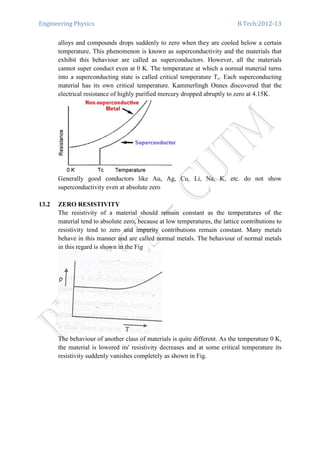
INTRODUCTION: The phenomenon of superconductivity was first discovered by
Kammerlingh Onnes in 1911. He found that electrical resistivity of some metals,
Engineering Physics B.Tech:2012-13
alloys and compounds drops suddenly to zero when they are cooled below a certain
temperature. This phenomenon is known as superconductivity and the materials that
exhibit this behaviour are called as superconductors. However, all the materials
cannot super conduct even at 0 K. The temperature at which a normal material turns
into a superconducting state is called critical temperature Tc. Each superconducting
material has its own critical temperature. Kammerlingh Onnes discovered that the
electrical resistance of highly purified mercury dropped abruptly to zero at 4.15K.
Generally good conductors like Au, Ag, Cu, Li, Na, K, etc. do not show
superconductivity even at absolute zero
13.2 ZERO RESISTIVITY
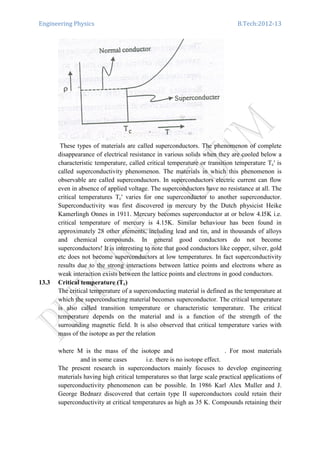
The resistivity of a material should remain constant as the temperatures of the
material tend to absolute zero, because at low temperatures, the lattice contributions to
resistivity tend to zero and impurity contributions remain constant. Many metals
behave in this manner and are called normal metals. The behaviour of normal metals
in this regard is shown in the Fig
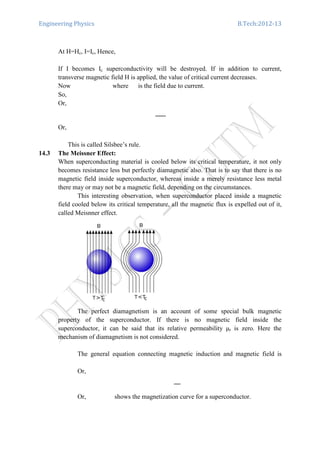
The behaviour of another class of materials is quite different. As the temperature 0 K,
the material is lowered its' resistivity decreases and at some critical temperature its
resistivity suddenly vanishes completely as shown in Fig.
Engineering Physics B.Tech:2012-13
These types of materials are called superconductors. The phenomenon of complete
disappearance of electrical resistance in various solids when they are cooled below a
characteristic temperature, called critical temperature or transition temperature Tc' is
called superconductivity phenomenon. The materials in which this phenomenon is
observable are called superconductors. In superconductors electric current can flow
even in absence of applied voltage. The superconductors have no resistance at all. The
critical temperatures Tc' varies for one superconductor to another superconductor.
Superconductivity was first discovered in mercury by the Dutch physicist Heike
Kamerlingh Onnes in 1911. Mercury becomes superconductor at or below 4.I5K i.e.
critical temperature of mercury is 4.15K. Similar behaviour has been found in
approximately 28 other elements, including lead and tin, and in thousands of alloys
and chemical compounds. In general good conductors do not become
superconductors! It is interesting to note that good conductors like copper, silver, gold
etc does not become superconductors at low temperatures. In fact superconductivity
results due to the strong interactions between lattice points and electrons where as
weak interaction exists between the lattice points and electrons in good conductors.
13.3 Critical temperature (Tc)
The critical temperature of a superconducting material is defined as the temperature at
which the superconducting material becomes superconductor. The critical temperature
is also called transition temperature or characteristic temperature. The critical
temperature depends on the material and is a function of the strength of the
surrounding magnetic field. It is also observed that critical temperature varies with
mass of the isotope as per the relation
where M is the mass of the isotope and . For most materials
and in some cases i.e. there is no isotope effect.
The present research in superconductors mainly focuses to develop engineering
materials having high critical temperatures so that large scale practical applications of
superconductivity phenomenon can be possible. In 1986 Karl Alex Muller and J.
George Bednarz discovered that certain type II superconductors could retain their
superconductivity at critical temperatures as high as 35 K. Compounds retaining their
Engineering Physics B.Tech:2012-13
superconductivity at critical temperatures as high as 134K has been researched out.
Till date the compound Hg0.8Tl0.2Ba2Ca2Cu3O8.33 has the highest world record of
critical temperature 138K.
[Reference: Material Science by V. Rajendran and A. Marikani, Pages-12.1-12.4]
[Reference: Material Science by M. S. Vijaya and G. Rangarajan, Page-322-324]
Session-14
14.1 Magnetic Properties of Superconductors
When the superconducting materials are subjected to a strong magnetic field, it will
result in the destruction of the superconducting property. i.e, they return to the normal
state. The minimum field required to destroy the superconducting property is called
the critical field (Hc). The variation of Hc with temperature is as shown.
The equation used in this connection is
14.2 Critical Currents
The readers should recognize that the magnetic field which destroy the
superconducting property need not be the external electrical field, it can be due to the
current flowing through your superconductor. Hence the maximum current flowing
through the specimen at which this property is destroyed is called critical current.
If a superconducting wire of radius r carries a current I, then as per Ampere’s law,
i.e.,
Engineering Physics B.Tech:2012-13
At H=Hc, I=Ic, Hence,
If I becomes Ic superconductivity will be destroyed. If in addition to current,
transverse magnetic field H is applied, the value of critical current decreases.
Now where is the field due to current.
So,
Or,
Or,
This is called Silsbee’s rule.
14.3 The Meissner Effect:
When superconducting material is cooled below its critical temperature, it not only
becomes resistance less but perfectly diamagnetic also. That is to say that there is no
magnetic field inside superconductor, whereas inside a merely resistance less metal
there may or may not be a magnetic field, depending on the circumstances.
This interesting observation, when superconductor placed inside a magnetic
field cooled below its critical temperature, all the magnetic flux is expelled out of it,
called Meisnner effect.
The perfect diamagnetism is an account of some special bulk magnetic
property of the superconductor. If there is no magnetic field inside the
superconductor, it can be said that its relative permeability µr is zero. Here the
mechanism of diamagnetism is not considered.
The general equation connecting magnetic induction and magnetic field is
Or,
Or, shows the magnetization curve for a superconductor.
Engineering Physics B.Tech:2012-13
The magnetic susceptibility is
߯ெ ൌ
‫ܯ‬
‫ܪ‬
ൌ െ1																																			ሾ12.2ሿ
It must be noted that superconductivity is not only a strong diamagnetism but
also a new type of diamagnetism.
14.4 Isotope effect: It is also observed that critical temperature varies with mass of the
isotope as per the relation
‫ܯ‬ఈ
ܶ௖ ൌ ܿ‫ݐ݊ܽݐݏ݊݋‬
where M is the mass of the isotope and 0.15 ൑ ߙ ൑ 0.50 . For most materials
ߙ ൌ 0.5	and in some cases ߙ ൌ 0	i.e. there is no isotope effect.
Example:
The critical temperature for mercury with isotopic mass 199.5 is 4.18K. Calculate its
critical temperature when its isotopic mass changes to 203.4.
Solution: The data given in the question are M1 = 199.5, M2 = 203.4 and Tc1 = 4.18 K.
The critical temperature in terms of its isotopic mass is given by
ܶ௖ ൌ ‫ܯܣ‬
ିଵ
ଶ
Therefore we have,
ܶ௖ଵ
ܶ௖ଶ
ൌ ൬
‫ܯ‬ଵ
‫ܯ‬ଶ
൰
ି
ଵ
ଶ
ൌ ඨ
‫ܯ‬ଶ
‫ܯ‬ଵ
Or, ܶ௖ଶ ൌ ܶ௖ଵට
ெభ
ெమ
ൌ 4.18 ൈ ට
ଵଽଽ.ହ
ଶ଴ଷ.ସ
ൌ 4.14‫ܭ‬
[Reference: Material Science by M. S. Vijaya and G. Rangarajan, Page-325-328]
[Reference: Material Science by V. Rajendran and A. Marikani, Pages-12.2-12.4]
Session-15
15.1 Types of Superconductors
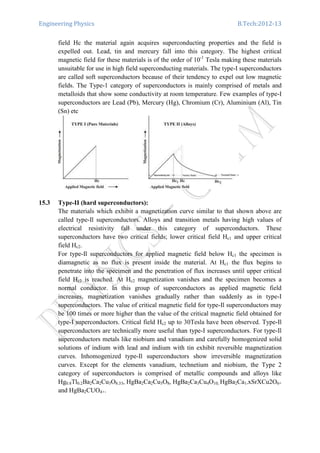
Superconductors are differentiated by there magnetization curves by two types. They
are
a. TYPE I or soft superconductor
b. TYPE II or hard Super conductor
15.2 Type-I (soft superconductors)
The superconductors in which magnetic field is totally excluded from the interior of
the superconductor below a certain critical magnetic field Hc and at H = Hc the
material looses its superconductivity abruptly and the magnetic field penetrates fully,
are termed as type-I or soft superconductors. Type-I superconductors exhibit Meissner
effect of magnetic flux exclusion. The magnetization curve for type-I superconductors
are shown in Fig. The magnetization curve shows that the transition at H = Hc is
reversible and means that if applied magnetic field is reduced below critical magnetic
Engineering Physics B.Tech:2012-13
field Hc the material again acquires superconducting properties and the field is
expelled out. Lead, tin and mercury fall into this category. The highest critical
magnetic field for these materials is of the order of 10-1
Tesla making these materials
unsuitable for use in high field superconducting materials. The type-I superconductors
are called soft superconductors because of their tendency to expel out low magnetic
fields. The Type-1 category of superconductors is mainly comprised of metals and
metalloids that show some conductivity at room temperature. Few examples of type-I
superconductors are Lead (Pb), Mercury (Hg), Chromium (Cr), Aluminium (Al), Tin
(Sn) etc
15.3 Type-II (hard superconductors):
The materials which exhibit a magnetization curve similar to that shown above are
called type-Il superconductors. Alloys and transition metals having high values of
electrical resistivity fall under this category of superconductors. These
superconductors have two critical fields; lower critical field Hc1 and upper critical
field Hc2.
For type-Il superconductors for applied magnetic field below Hc1 the specimen is
diamagnetic as no flux is present inside the material. At Hc1 the flux begins to
penetrate into the specimen and the penetration of flux increases until upper critical
field Hc2 is reached. At Hc2 magnetization vanishes and the specimen becomes a
normal conductor. In this group of superconductors as applied magnetic field
increases, magnetization vanishes gradually rather than suddenly as in type-I
superconductors. The value of critical magnetic field for type-Il superconductors may
be 100 times or more higher than the value of the critical magnetic field obtained for
type-I superconductors. Critical field Hc2 up to 30Tesla have been observed. Type-Il
superconductors are technically more useful than type-I superconductors. For type-Il
superconductors metals like niobium and vanadium and carefully homogenized solid
solutions of indium with lead and indium with tin exhibit reversible magnetization
curves. Inhomogenized type-Il superconductors show irreversible magnetization
curves. Except for the elements vanadium, technetium and niobium, the Type 2
category of superconductors is comprised of metallic compounds and alloys like
Hg0.8Tl0.2Ba2Ca2Cu3O8.33, HgBa2Ca2Cu3O8, HgBa2Ca3Cu4O10, HgBa2Ca1-xSrXCu2O6+
and HgBa2CUO4+.
Engineering Physics B.Tech:2012-13
A distinguishing characteristic of type-I and type-Il superconductors is provided by a
modification of the Meissner effect in type-Il superconductors as shown in fig. This
figure illustrates that superconductivity is only partially destroyed in type-II
superconductors for . The state of the specimen in this region is
called vortex state. The vortex state is really a mixture of normal state and
superconducting state. In general vortex state is unstable for type-I superconductors
where as it is stable for type-Il superconductors. The variation of critical magnetic
field with temperature of a type-Il superconducting material is shown in F ig.(b)
15.4 Some Properties of Superconducting materials:
(i) At room temperature, superconducting materials have greater resistivity than other
elements.
(ii) The transition temperature Tc is different for different isotopes of an element. If
decreases with increasing atomic weight of the isotopes.
(iii) The superconducting property of a superconducting element is not lost by
impurities to it but the critical temperature is lowered.
(iv)There is no change in the crystal structure as revealed by x-ray diffraction studies.
This means that superconductivity may be more concerned with the conduction
electrons than with the atoms themselves.
(v) The thermal expansion and elastic properties do not change in the transition.
(vi) All thermoelectric effects disappear in superconducting state.
(vii) When a sufficiently strong magnetic field is applied to a superconductor below
the critical temperature, its superconducting property is destroyed. At any given
temperature below Tc, there is a critical magnetic field Hc such that the
superconducting property is destroyed by the application of a magnetic field. The
value of Hc decreases as the temperature increases.
[Reference: Material Science by V. Rajendran and A. Marikani, Pages-12.4-12.5]
[Reference: Material Science by M. S. Vijaya and G. Rangarajan, Page-329]
Session-16
Engineering Physics B.Tech:2012-13
16 BCS THEORY OF SUPERCONDUCTIVITY: This theory was developed by
Bardeen, Cooper and Schrieffer in 1957 based on electron- lattice- electron
interaction. The BCS theory explains superconductivity at temperatures close to
absolute zero. According to this theory, as one negatively charged electron passes by
positively charged ions in the lattice of the superconductor, the lattice distorts. This in
turn causes phonons to be emitted which form a trough of positive charges around the
electron. Before the electron passes by and before the lattice springs back to its
normal position, a second electron is drawn into the trough. It is through this process
that two electrons, which should repel one another, link up. The forces exerted by the
phonons, overcome the electrons' natural repulsion. The electron pairs are coherent
with one another as they pass through the conductor in unison. The electrons are
screened by the phonons and are separated by some distance. When one of the
electrons that make up a Cooper pair and passes close to an ion in the crystal lattice,
the attraction between the negative electron and the positive ion cause a vibration to
pass from ion to ion until the other electron of the pair absorbs the vibration. The net
effect is that the electron has emitted a phonon and the other electron has absorbed
the phonon. It is this exchange that keeps the Cooper pairs together. Since an electron
pair has a lower energy than the two normal electrons, there is an energy gap between
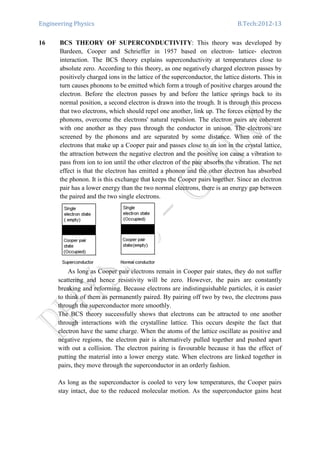
the paired and the two single electrons.
As long as Cooper pair electrons remain in Cooper pair states, they do not suffer
scattering and hence resistivity will be zero. However, the pairs are constantly
breaking and reforming. Because electrons are indistinguishable particles, it is easier
to think of them as permanently paired. By pairing off two by two, the electrons pass
through the superconductor more smoothly.
The BCS theory successfully shows that electrons can be attracted to one another
through interactions with the crystalline lattice. This occurs despite the fact that
electron have the same charge. When the atoms of the lattice oscillate as positive and
negative regions, the electron pair is alternatively pulled together and pushed apart
with out a collision. The electron pairing is favourable because it has the effect of
putting the material into a lower energy state. When electrons are linked together in
pairs, they move through the superconductor in an orderly fashion.
As long as the superconductor is cooled to very low temperatures, the Cooper pairs
stay intact, due to the reduced molecular motion. As the superconductor gains heat
Engineering Physics B.Tech:2012-13
energy the vibrations in the lattice become more violent and break the pairs. As they
break, superconductivity diminishes.
[Reference: Material Science by V. Rajendran and A. Marikani, Pages-12.4-12.5]
Session-17
17 Applications of superconductors:
a. Transportation: Magnetic-levitation is an application where superconductors
perform extremely well, Transport vehicles such as trains can be made to "float"
on strong superconducting magnets, virtually eliminating friction between the
train and its tracks. Not only would conventional electromagnets waste much of
the electrical energy as heat, they would have to be physically much larger than
superconducting magnets. A landmark for the commercial use of MAGLEV
technology occurred in 1990 when it gained the status of a nationally-funded
project in Japan. The Minister of Transport authorized construction of the
Yamanashi Maglev Test Line which opened on April 3, 1997. In December 2003,
the MLX01I test vehicle attained an incredible speed of 361 mph (581 km/hr).
b. Medical:
i. An area where superconductors can perform a life-saving function is in the
field of bio magnetism. Doctors need a non-invasive means of determining
what's going on inside the human body. By impinging a strong
superconductor-derived magnetic field into the body, hydrogen atoms that
exist in the body's water and fat molecules are forced to accept energy
from the magnetic field. They then release this energy at a frequency that
can be detected and displayed graphically by a computer.
ii. The Korean Superconductivity Group has carried bio magnetic technology
a step further with the development of a double-relaxation oscillation
SQUID (Superconducting Quantum. Interference Device) for use in
Magnetoencephalography. SQUID's are capable of sensing a change in a
magnetic field over a billion times weaker than the force that moves the
needle on a compass. With this technology, the body can be probed to
certain depths without the need for the strong magnetic fields associated
with MRl's.
c. Fundamental Research
i. Josephson Effect in superconductivity resulted in an upward revision of
Planck's constant from 6.62559 x 10⁻³⁴
to 6.626196 X 10⁻³⁴
.
ii. Superconductivity has become an essential tool in research work relating
to elementary particle which will ultimately lead to the door of creation of
the universe. High-energy particle research hinges on being able to
accelerate sub-atomic particles to nearly the speed of light. Superconductor
magnets make this possible. CERN, a consortium of several European
nations, is constructing Large Hadron Collider (LHC).
Engineering Physics B.Tech:2012-13
d. Power systems
i. Electric generators made with superconducting wire are far more efficient
than conventional generators wound with copper wire. In fact, their
efficiency is above 99% and their size about half that of conventional
generators. These facts make them very lucrative ventures for power
utilities. General Electric has estimated the potential worldwide market for
superconducting generators in the next decade at around $20-30 billion
dollars. Late in 2002 GE Power Systems received $12.3 million in funding
from the U.S. Department of Energy to move high-temperature
superconducting generator technology toward full commercialization.
ii. Other commercial power projects in the works that employ superconductor
technology include energy storage to enhance power stability which can
provide instantaneous reactive power support.
iii. Recently, power utilities have also begun to use superconductor-based
transformers and "fault limiters". The Swiss-Swedish company ABB was
the first to connect a superconducting transformer to a utility power
network in March of 1997. ABB also recently announced the development
of a 6.4MVA (mega-volt-ampere) fault current limiter, the most powerful
in the world. This new generation of HTS superconducting fault limiters is
being called upon due to their ability to respond in just thousandths of a
second to limit tens of thousands of amperes of current. Intermagnetics
General recently completed tests on its largest (15kv class) power-utility-
size fault limiter at a Southern California Edison (SCE) substation near
Norwalk, California. And, both the US and Japan have plans to replace
underground copper power cables with superconducting cable-in-conduit
cooled with liquid nitrogen. By doing this, more current can be routed
through existing cable tunnels. In one instance 250 pounds of
superconducting wire replaced 18,000 pounds of vintage copper wire,
making it over 7000% more space-efficient.
iv. An idealized application for superconductors is to employ them in the
transmission of commercial power to cities. However, due to the high cost
and impracticality of cooling miles of superconducting wire to cryogenic
temperatures, this has only happened with short test runs. In May of 2001
some 150,000 residents of Copenhagen, Denmark, began receiving their
electricity through HTS (high-temperature superconducting) material.
e. Computers: The National Science Foundation along with NASA and DARPA
and various universities are currently researching “'petaflop" computers. A
petaflop is a thousand-trillion floating point operations per second. Today's
fastest computing operations have only reached "teraflop" speeds, trillions of
operations per second. Currently the fastest is the IBM Blue Gene running at
70.7 teraflops per second (multiple CPU's). The fastest single processor is a
Lenslet optical DSP running at 8 teraflops. It has been conjectured that devices
on the order of 50 nanometers in size along with unconventional switching
Engineering Physics B.Tech:2012-13
mechanisms, such as the Josephson junctions associated with superconductors,
will be necessary to achieve such blistering speeds. These Josephson junctions
are incorporated into field effect transistors which then become part of the
logic circuits within the processors. Recently it was demonstrated at the
Weizmann Institute in Israel that the tiny magnetic fields that penetrate Type-2
superconductors can be used for storing and retrieving digital information. It
however, not a foregone conclusion that computers of the future will be built
around superconducting devices. Competing technologies, such as quantum
(DELTT) transistors, high-density molecule-scale processor, and DNA-base
processing also have the potential to achieve petaflop benchmarks.
f. Electronics: In the electronics industry, ultra-high-performance filters are now
being built. Since superconducting wire has near zero resistance, even at high
frequencies, many more filter stages can be employed to achieve a desired
frequency response. This translates into an ability to pass desired frequencies
and block undesirable frequencies in high-congestion radio frequency
applications such as cellular telephone systems.
g. Military:
i. Superconductors have also found widespread applications in the
military. HTSC SQUIDS are being used by the US NAVY to detect
mines and submarines. And, significantly SMALLER MOTORS are
being built for NAVY ships using superconducting wire and tape. In
mid-July, 2001, American Superconductor unveiled a 5000 horse
power motor made with superconducting wire.
ii. The military is also looking at using superconductive tape as a means
of reducing the length of very low frequency antennas employed on
submarines. Normally, the lower the frequency, the longer an antenna
must be. However, inserting a coil of wire ahead of the antenna will
make it function as if it were much longer. Unfortunately, this loading
coil also increases system losses by adding the resistance in the coil's
wire. Using superconductive materials can significantly reduce losses
in this coil. The Electronic Materials and Devices Research Group at
University of Birmingham (UK) is credited with creating the first
superconducting microwave antenna. Applications engineers suggest
that superconducting carbon nanotubes might be an ideal nano-antenna
for high-gigahertz and terahertz frequencies, once a method of
achieving zero "on tube" contact resistance is perfected.
iii. The most ignominious military Use of Superconductors may come
with the deployment of "E-bombs". These are devices that make use of
strong, superconductor-derived magnetic fields to create a fast, high-
intensity electro-magnetic pulse (EMP) to disable an enemy's
electronic equipment. Such a device saw its first use in wartime in
March 2003 when US Forces attacked an Iraqi broadcast facility.
Engineering Physics B.Tech:2012-13
h. Space Research: Among emerging technologies are a stabilizing momentum
wheel (gyroscope) for earth-orbiting satellites that employs the "flux-pinning"
properties of imperfect superconductors to reduce friction to near zero.
Superconducting x-ray detectors and ultra-fast, superconducting light detectors
are being developed due to their inherent ability to detect extremely weak
amounts of energy; Already Scientists at the European Space Agency (ESA)
have developed what's being called the "S-Cam", an optical camera of
phenomenal sensitivity.
i. Internet: Superconductors may even play a role in Internet communications
soon. Superconductivity can be used to develop a superconducting digital
router for high-speed data communications up to 160 GHz. Since Internet
traffic is increasing exponentially, superconductor technology is being called
upon to meet this super need.
j. Pollution Control: Another impetus to the wider use of superconductors is
political in nature. The reduction of green-house gas (GHG) emissions has
becoming a topical issue due to the Kyoto Protocol which requires the
European Union (EU) to reduce its emissions by 8% from 1990 levels by
2012. Physicists in Finland have calculated that the EU could reduce carbon
dioxide emissions by up to 53 million tons if high-temperature
superconductors were used in power plants.
k. Refrigeration: The future melding of superconductors into our daily lives will
also depend to a great degree on advancements in the field of cryogenic
cooling. New, high-efficiency magnetocaloric-effect compounds such as
gadolinium-silicon-germanium are expected to enter the marketplace soon.
Such materials should make possible compact, refrigeration units to facilitate
additional HTS applications.
[Reference: Material Science by V. Rajendran and A. Marikani, Pages-12.8-12.10]
[Reference: Material Science by M. S. Vijaya and G. Rangarajan, Page-352-353]
Session-18
Assignment-1
Module-II
Session-19
Optical Materials:
19.1. Optical properties
Optical property of a material is defined as its interaction with electro-magnetic
radiation in the visible range.
Engineering Physics B.Tech:2012-13
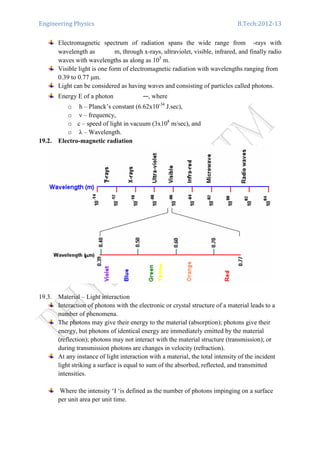
Electromagnetic spectrum of radiation spans the wide range from -rays with
wavelength as m, through x-rays, ultraviolet, visible, infrared, and finally radio
waves with wavelengths as along as 105
m.
Visible light is one form of electromagnetic radiation with wavelengths ranging from
0.39 to 0.77 µm.
Light can be considered as having waves and consisting of particles called photons.
Energy E of a photon , where
o h – Planck’s constant (6.62x10⁻³⁴
J.sec),
o ν – frequency,
o c – speed of light in vacuum (3x10⁸
m/sec), and
o λ – Wavelength.
19.2. Electro-magnetic radiation
19.3. Material – Light interaction
Interaction of photons with the electronic or crystal structure of a material leads to a
number of phenomena.
The photons may give their energy to the material (absorption); photons give their
energy, but photons of identical energy are immediately emitted by the material
(reflection); photons may not interact with the material structure (transmission); or
during transmission photons are changes in velocity (refraction).
At any instance of light interaction with a material, the total intensity of the incident
light striking a surface is equal to sum of the absorbed, reflected, and transmitted
intensities.
Where the intensity ‘I ‘is defined as the number of photons impinging on a surface
per unit area per unit time.
Engineering Physics B.Tech:2012-13
19.4. Optical materials
Materials are classified on the basis of their interaction with visible light into three
categories.
Materials that are capable of transmitting light with relatively little absorption and
reflection are called transparent materials i.e. we can see through them.
Translucent materials are those through which light is transmitted diffusely i.e.
objects are not clearly distinguishable when viewed through.
Those materials that are impervious to the transmission of visible light are termed as
opaque materials. These materials absorb all the energy from the light photons.
19.5. Optical properties – Metals
Metals consist of partially filled high-energy conduction bands.
When photons are directed at metals, their energy is used to excite electrons into
unoccupied states. Thus metals are opaque to the visible light.
Metals are, however, transparent to high end frequencies i.e. x-rays and γ-rays.
Absorption of takes place in very thin outer layer. Thus, metallic films thinner than
0.1 µm can transmit the light.
The absorbed radiation is emitted from the metallic surface in the form of visible light
of the same wavelength as reflected light. The reflectivity of metals is about 0.95,
while the rest of impinged energy is dissipated as heat
The amount of energy absorbed by metals depends on the electronic structure of each
particular metal. For example: with copper and gold there is greater absorption of the
short wavelength colours such as green and blue and a greater reflection of yellow,
orange and red wavelengths.
[Reference: Material Science by V. Rajendran and A. Marikani, Pages-13.1-13.3]
[Reference: Material Science by M. S. Vijaya and G. Rangarajan, Page-461-462]
Session-20
20.1 Optical properties of non-metallic materials
Non-metallic materials consist of various energy band structures. Thus, all four
optical phenomena such as absorption, reflection, transmission and refraction are
important for these materials.
20.2 Refraction
When light photons are transmitted through a material, they cause polarization of the
electrons and in-turn the speed of light is reduced and the beam of light changes
direction.
The relative velocity of light passing through a medium is expressed by the optical
property called the index of refraction (n), and is defined as
݊ ൌ
ܿ
‫ݒ‬
where c – speed of light in vacuum, v – speed of light in the concerned material.
If the angle of incidence from a normal to the surface is θi, and the angle of refraction
is θr, the refractive index of the medium, n, is given by (provided that the incident
Engineering Physics B.Tech:2012-13
light is coming from a phase of low refractive index such as vacuum or air)
speed of light in a material can be related to its electrical and magnetic properties as
Where -electrical permittivity, and µ – magnetic permeability. Thus,
Since most materials are only slightly magnetic i.e. , Thus
Thus, for transparent materials, index of refraction and dielectric constant are related
Refractive indices of some materials
Material Refractive index Material Refractive index
Air 1.00 Epoxy 1.58
Ice 1.309 Polystyrene 1.60
Water 1.33 Spinel, MgAl
2
O
3
1.72
Teflon 1.35 Sapphire, Al
2
O
3
1.76
Silica glass 1.458 Rutile, TiO
2
2.68
Polymethyl
methacrylate
1.49 Diamond 2.417
Silicate glass 1.50 Silicon 3.29
Polyethylene 1.52 Gallium arsenide 3.35
NaCl 1.54 Germanium 4.00
Snell’s law of light refraction: refractive indices for light passing through from one
medium with refractive index n through another of refractive index n’ is related to the
Engineering Physics B.Tech:2012-13
incident angle, θ, and refractive angle, θ’, by
݊
݊ᇱ
ൌ
sin ߠᇱ
sin ߠ
20.3 Reflection
Reflectivity is defined as fraction of light reflected at an interface.
ܴ ൌ
‫ܫ‬ோ
‫ܫ‬ை
Where ‫ܫ‬ை and ‫ܫ‬ோ are the incident and reflected bean intensities respectively.
If the material is in a vacuum or in air then
ܴ ൌ ൬
݊ െ 1
݊ ൅ 1
൰
ଶ
If the material is in some other medium with an index of refraction of ݊௜, then
ܴ ൌ ൬
݊ െ ݊௜
݊ ൅ ݊௜
൰
ଶ
The above equations apply to the reflection from a single surface and assume normal
incidence. The value of R depends upon the angle of incidence.
Materials with a high index of refraction have a higher reflectivity than materials with
a low index. Because the index of refraction varies with the wavelength of the
photons, so does the reflectivity.
In metals, the reflectivity is typically on the order of 0.90-0.95, whereas for glasses it
is close to 0.05. The high reflectivity of metals is one reason that they are opaque.
High reflectivity is desired in many applications including mirrors, coatings on
glasses, etc.
20.4 Absorption
When a light beam in impinged on a material surface, portion of the incident beam
that is not reflected by the material is either absorbed or transmitted through the
material.
Bouguer’s law: The fraction of beam that is absorbed is related to the thickness of the
materials and the manner in which the photons interact with the material’s structure.
‫ܫ‬ ൌ ‫ܫ‬௢݁ିఈ௫
o where I – intensity of the beam coming out of the material,
o ‫ܫ‬௢ – intensity of the incident beam,
o x – path through which the photons move, and
o α – linear absorption coefficient, which is characteristic of a particular
material.
20.5 Absorption mechanisms
Absorption occurs by two mechanisms: Rayleigh scattering and Compton scattering.
Rayleigh scattering: where photon interacts with the electrons orbiting an atom and is
deflected without any change in photon energy. This is significant for high atomic
number atoms and low photon energies. Ex.: Blue colour in the sunlight gets scattered
more than other colours in the visible spectrum and thus making sky look blue.
Engineering Physics B.Tech:2012-13
Tyndall effect is where scattering occurs from particles much larger than the
wavelength of light. Ex.: Clouds look white.
Compton scattering: interacting photon knocks out an electron loosing some of its
energy during the process. This is also significant for high atomic number atoms and
low photon energies.
Photoelectric effect occurs when photon energy is consumed to release an electron
from atom nucleus. This effect arises from the fact that the potential energy barrier for
electrons is finite at the surface of the metal. Ex.: Solar cells.
20.6 Transmission
Fraction of light beam that is not reflected or absorbed is transmitted through the
material.
The process of light transmission is as follows
[Reference: Material Science by V. Rajendran and A. Marikani, Pages-13.3]
[Reference: Material Science by M. S. Vijaya and G. Rangarajan, Page-462, 466, 468]
Session-21
21.1 LASER
The absorption and emission of electromagnetic radiation by materials has been very
ingeniously and skill fully exploited in making a device that amplifies
electromagnetic radiation and generates extremely intense, coherent and mono-
chromatic radiation. This device is called LASER. The term laser is acronym for
Light Amplification by Stimulated Emission of Radiation.
When light radiation of suitable wavelength to match the energy levels in a material is
incident on the material, the electrons absorb the radiation and get excited to higher
energy levels.
Engineering Physics B.Tech:2012-13
Actually, three processes, viz. spontaneous emission, absorption and stimulated
emission occur when an external radiation is incident on a system of energy levels,
described as follows:
21.2 Spontaneous Emission, Absorption and Induced Emission
Consider two energy levels E1 and E2 (Fig. 21.1) where E2 is the energy of the upper
level and E1 is the energy of the lower level. Transitions of atoms between the two
energy levels are possible by the following three processes:
Fig:21.1
i. The atoms in the upper energy level E2 may drop down to the lower level E1,
spontaneously without the need for any external radiation, resulting in
emission of a photon of frequency . This process is called the
spontaneous emission. (Fig. 21.1(a))
ii. When a photon of energy E = is incident on the system, the atom in
the lower energy level may absorb the photon energy and get excited to the
upper energy level. This is called stimulated or induced absorption. (Fig.
21.1(b)).
iii. The incident photon may cause the atom in the upper energy level to drop
down to the lower energy level resulting in an emission of a photon. This is
called stimulated or induced emission (Fig. 21.1 (c)).
21.2.1 Spontaneous Emission
Each energy level has a characteristic life-time, i.e. atoms can reside in a energy
level only for a certain duration which is related (inversely) to the width of the
energy level M through the uncertainty principle. After this interval of time, the atoms
Engineering Physics B.Tech:2012-13
decay down to the lower energy level. The atoms in the ground state have the longest
life-time. In any other level, the atoms are short-lived. While the atom drops down to
a lower level, to conserve energy, a photon of energy equal to the difference between
the energy levels may be emitted. This radiative decay process is called spontaneous
emission, because it occurs without any external stimulation.
If there are a large number of atoms in an upper level, the atoms drop down to the
lower level randomly. The photons thus emitted due to spontaneous emission are in
random phase with respect to each other. This is the process that takes place in
ordinary gas discharge luminescent tubes such as mercury lamp or sodium vapour
lamp.
There may be other decay processes that do not involve emission of radiation. The
decay may occur due to collisions with other particles (in gases) or with phonons (in
solids). Such processes are called non-radiative decay.
21.2.2 Absorption
Absorption, obviously, requires an external stimulation. A photon incident on the
system is absorbed by the atom and the atom gets excited to the upper energy level.
This process can also be called stimulated absorption as it is stimulated by an external
radiation.
21.2.3 Stimulated Emission
An incident photon can also cause de-excitation, i.e. it may cause an atom in the
upper level to drop down to a lower level. This follows from the principle of detailed
balance which is stated as: at equilibrium, the total number of particles leaving a
certain quantum state per unit time is equal to the number arriving in that state per
unit time. According to this principle, if a photon can stimulate an atom from a lower
level to an upper level (absorption), then the photon, with equal probability, should
also be able to stimulate an atom from the upper to the lower level. In the case of
absorption, the photon disappears, in the latter case, an additional photon is emitted.
The additional photon has the same energy as that of the incident photon to conserve
energy and will be in phase with the incident photon to conserve momentum. The
three processes, viz. spontaneous emission, absorption and stimulated emission are
illustrated in Fig. (21.1).
The process, stimulated emission is of interest in lasers. The key to laser action is
the enhancement of the induced emission so that all the photons emanating from the
laser will have the same frequency and will be in phase, i.e. the radiation would be
monochromatic and coherent. The frequency of the emitted radiation is given by
ߥଵଶ ൌ
‫ܧ‬ଶ െ ‫ܧ‬ଵ
݄
where E2 and E1 are the energies of the upper and lower levels respectively. The
energy levels (except the ground state) are not sharp; they have finite characteristic
width. The cause for the finite width of energy levels is described in the next section.
Because of this finite width, the emitted radiation will have a small range of
Engineering Physics B.Tech:2012-13
frequencies. Or in other words the radiation is- not perfectly monochromatic. It will
have a small broadening. This is illustrated in Fig. 22.1.
[Reference: Material Science by M. S. Vijaya and G. Rangarajan, Page-484-486]
Session-22
22.1 Broadening of Emitted Radiation
The emitted radiation from the laser has a finite broadening. One reason for the
broadening is the inherent width of the energy levels. According to Heisenberg's
uncertainty principle, there is an uncertainty ∆‫ܧ‬ in the determination of the energy of
an energy level given by the relation
∆‫ݐ∆	ܧ‬ ൌ ݄ Where ∆‫ݐ‬ is the time of measurement or can be interpreted as the
lifetime of the atom in the energy level E. ∆‫ܧ‬ is the inherent or the natural width of
the energy level. If ∆‫ܧ‬ is small, i.e. if the energy level is sharp then the life time ∆‫ݐ‬ is
large from the uncertainty relation. This means that the energy level in which the
lifetime of the atom is large is very sharp and those energy levels in which the life
time is short are broad. Since in the ground state the atom is most stable, the lifetime
in the ground state energy level is large and so it follows that the ground state energy
level is very sharp. The higher energy levels have a characteristic life time and hence
corresponding characteristic width. The width of the energy level is given by ∆‫ܧ‬ ≅
԰
∆‫ݐ‬ൗ . This inherent width ofthe upper energy levels results in finite broadening of the
emitted light as described in Fig.( 22.1). This broadening is called the natural
broadening.
Some of the other broadening mechanisms are:
• Collisional broadening
• Doppler broadening
22.2 Collisional broadening is due to the collision of the excited atom with the atoms,
molecules or electrons which are in the immediate surrounding of the excited atom.
Due to the collisions the atom may lose energy and decay to the lower energy level.
The atom may come to the lower energy state even earlier than its natural life time.
This causes increase in the uncertainty ∆‫ܧ‬ and hence broadening of the emitted light.
22.3 Doppler broadening is due to the constant motion of the atoms in the laser medium.
This effect is more pronounced in gas lasers. Due to the motion of the atom, while the
atom decays to a lower energy level, there will be shift in the frequency of the emitted
radiation. The shift depends on the velocity. This is the well-known Doppler Effect.
Due to the random motion of the atoms, there will be a small distribution in the
frequency of the emitted radiation about the actual emitted frequency		ߥ௢. This is
called Doppler broadening. The Doppler broadening is normally larger than the
natural broadening.
22.4 Coherence
Laser is a coherent source of radiation. This means that the waves that are
emanating from the laser have the same frequency and they are all in phase with each
Engineering Physics B.Tech:2012-13
other; or in other words, all the photons coming out of the laser have zero phase
difference among them.
As the wave travels, the coherence is not maintained throughout because of the
slight difference in frequency between the various photons. The difference in
frequency arises due to the inherent width of energy.
The question arises how far do the waves travel before they go completely out of
step or go out of phase with each other? Or how close the two beams have to be
laterally so that they can maintain zero phase difference? The answers to these
questions give a measure of the coherence of the laser beam. They are called temporal
coherence and spatial coherence respectively and are described below.
22.4.1 Temporal Coherence
Temporal coherence is also called longitudinal coherence. Consider two waves
emanating from the source. Initially at the first location very close to the source they
are in phase. Then as the waves propagate, the zero or near zero phase difference will
be maintained only up to a certain distance and the phase difference increases as the
distance from the first location increases. This is because of the slight difference in
frequency between the waves. Beyond a certain distance lc from the first location the
two waves go completely out of phase. The length Ic is called the temporal coherence
length or the longitudinal coherence length, This is indicated in Fig. 22.2.
If is the difference in wavelength of the two beams, the temporal coherence is
given by
where is the mean wavelength. The smaller the greater will be the temporal
coherence length. For example, sodium lamp has a temporal coherence of about
fraction of a meter where as lasers have temporal coherence of several hundred
meters. This is because , for sodium lamp whereas for laser
. A highly monochromatic source will have large temporal coherence.
22.4.2 Spatial Coherence
Engineering Physics B.Tech:2012-13
P
Q
s a
b
݈௧
r
Spatial coherence is also called lateral or transverse coherence. This refers to the
lateral distance between two waves coming out of the source. Consider two waves
coming out of the source from the portions P and Q as shown in Fig.
Let the lateral distance between the two portions be s. The two waves will be in
phase as they emanate from the source. As the waves travel away from the source the
lateral distance between the two waves increases as shown. The phase difference will
be maintained up to a certain distance, say r, at which the lateral distance is ݈௧ .
Beyond this they go completely out of phase. The distance ݈௧ is called the spatial
coherence length and it is related to r and s by
݈௧ ൌ
‫ߣݎ‬
‫ݏ‬
Where ߣ is the wavelength of the source.
[Reference: Material Science by M. S. Vijaya and G. Rangarajan, Page-487-489]
Session-23
23.1 Necessary Condition for Laser Action -
23.1.1 Population Inversion
We have seen that an incident photon causes induced absorption and induced
emission. The probability of both absorption and emission are equal. So in the
presence of radiation there will be continuous transitions between the two states, i.e.
continuously the energy (photons) is being absorbed and emitted. The photons that are
emitted due to the transition from upper to the lower level cause further transition
from the lower to the upper level and thus they tend to get continuously absorbed in
the laser medium. The absorption process for an input radiation of intensity ‫ܫ‬௢
travelling in the Z-direction in the medium is described by the equation
‫ܫ‬ ൌ ‫ܫ‬௢݁ሾఙೠ೗ሺேೠିே೗ሻ௭ሿ
																ሾ23.1ሿ
where Nu and NI are the population of the upper and the lower level respectively,
and a is called the stimulated emission cross section and it is a characteristic
parameter which depends on the transition probability between the two states. Under
Engineering Physics B.Tech:2012-13
normal conditions the lower level is more populated than the upper level and the
exponent in Eq. (23. 1) is negative and this describes the absorption process. But if the
value of the exponent in the equation is positive, then ‫ܫ‬ ൐ ‫ܫ‬௢, i.e. the radiation will get
amplified instead of getting attenuated! So amplification will occur if ܰ௨ ൐ ܰ௟ i.e. if
the upper level is more populated than the lower level. Thus population inversion is a
necessary condition for amplification of stimulated radiation.
Population inversion is a necessary condition but not a sufficient condition for
laser action
23.1.2 How to Achieve Population Inversion in a Laser Medium?
Consider a laser system with two energy levels. Initially the lower level is much
more highly populated than the upper level, i.e. ܰ௨ ൏ ܰ௟ so that we can assume that
ܰ ൌ ܰ௨ ൅ ܰ௟ ≅ ܰ௟ where N is the total number of atoms in the two level systems.
Suppose now a radiation of intensity ‫ܫ‬௢ is made to pass through the system, the
energy is absorbed by the system. The intensity of the beam coming out of the system
of length L is given by (replacing ሺܰ௨ െ ܰ௟ሻ ≅ െܰ௟ by -N, and z by L in Eq. (23.1)):
‫ܫ‬ ൌ ‫ܫ‬௢݁ሾିఙೠ೗ே௅ሿ
As lo is increased (i.e. as the input intensity is increased) the energy absorbed in
the medium l increases. The photons absorbed cause transition of atoms from lower
level to the upper level. For very high intensities, there will be large number of
photons, and so it appears that all the atoms in the lower level would get transferred to
the upper level. Thus with very high intensities it appears that population inversion
could be achieved! But this does not really happen because of the following reason:
We can rewrite Eq. (23.1) (putting ܰ௨ ൌ ܰ െ ܰ௟ )as
‫ܫ‬ ൌ ‫ܫ‬௢݁ሾఙೠ೗ሺேିଶே೗ሻ௅ሿ
‫ܫ													,ݎ݋‬ ൌ ‫ܫ‬௢݁ሾఙೠ೗ቀଵିଶ
ே೗
ே
ቁே௅ሿ
																		ሾ23.2ሿ
Initially all the atoms are in the lower level so the ratio
ே೗
ே
ൌ 1 . As the atoms in
the lower level are pumped to the upper level, ܰ௟ decreases, so that the ratio
ே೗
ே
drops
from unity. As it decreases and reaches the value 0.5, I in Eq. (23.2) becomes equal to
‫ܫ‬௢, That is, there can be no more absorption, when the two levels have equal
population! But due to the mechanisms of spontaneous emission and induced
emission there will be a continuous transition from upper level to lower level and this
leads to further absorption. Thus
ே೗
ே
will never decrease to a value less than 0.5. The
conclusion is that population inversion cannot be achieved between two energy levels
by just optical pumping between the same two levels. A minimum of three energy
levels are involved in population inversion and laser action.
[Reference: Material Science by M. S. Vijaya and G. Rangarajan, Page-489-491]
Session-24
24.1 Saturation Intensity and Optical Cavity
Engineering Physics B.Tech:2012-13
Assume that in a laser medium of length L, population inversion is achieved
between two energy levels. The intensity of the beam passing through the medium
along its length is given by Eq. (23.1),
‫ܫ‬ ൌ ‫ܫ‬௢݁ሾఙೠ೗ሺேೠିே೗ሻ௭ሿ
.
The exponent is positive because population inversion is achieved in the medium
(ܰ௨ ൐ ܰ௟). So, as the beam passes through the medium i.e. as z increases, the
intensity of the beam should keep increasing exponentially. The maximum value that
z can take is L, the length of the laser, so the beam coming out of the laser will have
very high amplification. It appears that by increasing the length of the laser one can
get higher amplification. This is true because in a longer laser, more atoms are
available for optical pumping and population inversion. But the intensity will not
grow exponentially up to any length of the laser. At a certain length, the intensity will
reach a saturation value, beyond which it will not grow exponentially. The saturation
intensity is given by
‫ܫ‬௦ ൌ ‫ܫ‬௢݁ሾఙೠ೗ሺேೠିே೗ሻ௅ೞሿ
																			ሾ24.1ሿ
where ‫ܮ‬௦ is the saturation length.
It is not practically possible to make long lasers to get high amplification and so in
practice the effective length of the laser is increased by using mirrors at the two ends
of the laser so that the beam can travel longer distance through the medium by
multiple reflections.
The mirrors at the two ends of the laser serve another purpose. When population
inversion is achieved between the two energy levels, there will be spontaneous
emission due to the atoms falling from the upper to the lower level. Each
spontaneously emitted photon is independent of other such photons, that is, there will
be no phase correlation between the spontaneously emitted photons.
Each of the spontaneously emitted photons initiates laser action between the two
levels, i.e. it causes stimulated emission. These photons in turn cause further
stimulated emission resulting in an avalanche of secondary photons, all in phase with
each other. But there will be no phase correlation between the groups of secondary
photons generated by the different spontaneously emitted photons. These results in a
radiation which will not exhibit high coherence, i.e. the longitudinal and spatial
coherence of such radiation will be very low.
In order to get a highly coherent beam it is necessary to select some photons and
suppress the other photons. This is realized by means of the optical resonant cavity
realized in the laser medium by the presence of pair of parallel mirrors at the two ends
as shown in Fig. 13.10. Only those spontaneous photons which move close to the axis
of the resonant cavity will travel quite long distance within the laser material due to
multiple reflections and they cause an avalanche of photons which are all almost in-
phase. The other photons which move in directions away from the axis (and their
stimulated avalanche of photons) will travel only short length and they die down soon
due to absorption in the material. This is illustrated in Fig. Thus the optical cavity
Engineering Physics B.Tech:2012-13
helps in the selection of photons which are confined to travel close to the axis and
these photons are highly coherent.
Optical resonant cavity and optical modes: The presence of two mirrors at the
ends of a laser makes it act as an optical resonator. These results in the emission of a
selected set of resonant frequencies, within the laser emission width, described as
follows.
For the radiation travelling in the laser medium between the two mirrors the laser
cavity will be resonant to only those radiation which have wavelengths that fit with
integer number of within the cavity (with nodes at the two ends of the cavity). If
L is the length of the cavity
where m takes integral values. Since is in the optical range (400-700 nm) and L
is of the order of few centimetres, it is obvious that m is a very large integer. In terms
of frequency of the radiation the above equation may be written as
where n is the refractive index of the laser medium. From the above equation, it
can be seen that the output radiation from the laser consists of several closely spaced
resonant lines lying within the bandwidth of the radiation as shown in Fig. 13.11.
These lines are equally spaced.
The spacing between any two lines, , may be calculated by putting m = 1 in Eq.
(24.2):
is very small. For example, ruby laser emits radiation of wavelength 694.3 nm
(4.32 x 10¹⁴
Hz). The refractive index of ruby is 1.765. Taking the length of the ruby
crystal as 4 cm, we get,
Engineering Physics B.Tech:2012-13
The number of modes within the bandwidth can be obtained by dividing the
emission line width of the beam by . Normally the line width of the laser beam is in
the range of to Hz for various types of lasers and so it can be verified that
there will be a few to several equally spaced resonant lines in the laser output.
[Reference: Material Science by M. S. Vijaya and G. Rangarajan, Page-491-493]
Session-25
25.1 Sufficient Condition for Laser Action - 3 Level Laser
A minimum of three energy levels are required to cause population inversion
between two levels. The ground state is the most populated and stable state. The life
time of an atom in the ground state may be said to be nearly infinity. Upper energy
levels are normally unstable, in the sense that the atoms in those states have very short
life time. They drop down to lower energy states almost instantaneously. To cause
population inversion what is required is an upper energy level which has a reasonably
long life time. Such a state is called a metastable state. A metastable higher energy
level is an essential requirement for laser action. So, a ground state or a lower energy
state, an upper energy state and an intermediate metastable state are the three essential
states for causing population inversion and hence laser action.
This can be understood by considering a three level system shown in Fig
Fig.
The key to laser action is the presence of a broad energy level (with a short life-
time) above the ground state and a third intermediate sharper metastable level with a
longer life time.
The ground state E1 is highly populated and the excited states are sparsely
populated. To cause population inversion the system is irradiated with an intense
radiation so that atoms from the ground state may be pumped to the upper state E2.
This is called optical pumping. Since this energy level is broad, the incident radiation
may be broad band light with a range of frequencies. The lifetime of the atoms in
level E2 is very short (= 10-7
sec) and so the atoms drop down rapidly to the meta-
stable state E3. The transition from E2 to E3 is a non-radiative transition, i.e. it does
not cause emission of radiation. The energy lost is absorbed by the phonons and the
Engineering Physics B.Tech:2012-13
system gets heated up. Level E3 has a longer life time of about 10-3
sec. So, with
continuous optical pumping a stage will be reached when the level E3 gets much more
highly populated than the ground state E1. Thus population inversion is achieved
between the levels E3 and E1. What is now required is an incident photon of frequency
that matches the difference in energy levels, i.e. photon of frequency given by
ߥଵଷ ൌ
ሺ‫ܧ‬ଷ െ ‫ܧ‬ଵሻ
݄
ൗ
Spontaneous emission from E3 to E1 will generate the required photons. These
photons stimulate or induce transitions between E3 and E1. The photons emitted by the
transition move within the optical cavity and induce further transitions resulting in an
avalanche of photons as described earlier. All the photons travelling along or close to
the axis of the optical cavity will be emitted out as a highly intense, coherent and
monochromatic radiation of frequency ߥଵଷ.
For laser action to take place continuously, the population inversion between the
two levels must be constantly maintained. As the atoms drop down to the lower state
from the meta-stable state, the difference in population would decrease, if the
pumping rate is not sufficient. So it is essential to maintain a proper pumping rate to
maintain a high population constantly in the meta-stable state. This requires a highly
intense input pumping radiation.
25.2 4 Level Laser
Practical lasers are either 3-level or 4- level lasers. In the four level lasers, the
laser action takes place between the meta-stable state and an intermediate state (E4)
above the ground state. The advantage of 4-level laser is that the maintenance of
population inversion between the meta-stable state and the lower energy state is much
easier because the state E4 has short lifetime and the atoms fall to the ground state
quite rapidly from this state. So a modest pumping rate would be sufficient. Practical
lasers are either continuous or pulsed. Some practical laser systems are described in
the following sections.
[Reference: Material Science by M. S. Vijaya and G. Rangarajan, Page-493-495]
Session-26
26.1 Examples of Laser Systems
Energy Levels For practical lasers, systems with suitable energy levels must be
selected. Lasers have been made with gases, liquids and solids. The energy levels
involved in laser action may be atomic energy levels (e.g. He-Ne, Ruby, Nd-YAG
lasers), molecular vibrational energy levels (e.g. CO2, Dye lasers) or energy bands
(e.g. semiconductor diode lasers). This section describes the energy levels and the
notation used for the levels, in different types of lasers.
Engineering Physics B.Tech:2012-13
Atomic energy levels: Let us see how the excited states are evaluated for an
atomic system. In order to understand the notation used for the atomic energy levels
let us consider a simple two electron system, viz. He atom.
Ground state
, , l = 0 for both electrons. L = 0; S = 1/2 – 1/2 = 0; J =0
The term symbol: (singlet ground state)
Excited state (I) I s2 s
Case (i) Anti-parallel spins: l = 0 for both electrons. L = 0;
S= 0; J =0
The term symbol: (singlet excited state).
Case (ii) parallel spins: l = 0 for both electrons. L = 0; S = 1/2
+1/2 = 1, J = 1.
The term symbol: (triplet excited state).
Ground state and a few excited states of He atom (not to scale)
Molecular energy levels: Molecules are formed by strong bonding between two or
more atoms. The electronic energy of molecules depends on the electronic state of the
individual atoms that form the bonds. The separation between the electronic energy
levels is in the optical or ultraviolet range. In addition to the electronic states,
molecules are characterized by their vibrational and rotational energy levels.
The atoms in a molecule vibrate in various normal modes. Assuming the vibration
to be perfectly harmonic, the energy of the vibrating atoms is given by
where , .... are the frequencies of vibration of individual atoms and , , …
take integer values. For a homonuclear diatomic-molecule, where
M = m/2 where m is the mass of the atom. The vibrational energy levels are equally
Engineering Physics B.Tech:2012-13
spaced and the separation is in the range of middle infra-red. In each electronic state
the molecules may exist in one of several vibrational energy states as shown in Fig.
In addition to the vibrational motion, molecules rotate about specific molecular
axes. The rotational energy of the molecules is given by
where J, called the angular momentum quantum number takes integer values (J
should not be confused with the atomic angular momentum quantum number; here we
are talking about molecular angular momentum). The rotational energy levels are not
equally spaced. The separation between the rotational states lies in the far infra-red or
in the microwave range. Figure shows the rotational energy levels which lie closely
between vibrational energy levels. Transitions between the energy levels are possible
governing certain rules known as selection rules. Selection rules for rotational energy
levels is for vibrational energy levels .
[Reference: Material Science by M. S. Vijaya and G. Rangarajan, Page-495-497]
Session-27
27.1 Ruby Laser
Ruby laser is a single crystal of AI2O3 doped with chromium. Cr3+
ions replace
some of the Al3+
ions in the crystal. The Cr3+
ions are responsible for the red colour of
ruby. The laser action takes place in chromium ion energy levels. The schematic
diagram of ruby laser is shown Fig. A single crystal of ruby (Al2O3 + Cr3+
) in the
form of a rod is the laser system. The two ends of the rod are ground perfectly
parallel. A total reflective mirror is placed parallel and closed at one end of the rod
and a partially reflecting mirror is placed at the other end as shown. For optical
pumping, a high intensity xenon flash lamp is used. The xenon lamp is in the form of
Engineering Physics B.Tech:2012-13
a spiral and the ruby rod is placed along the axis of the spiral lamp. The ruby rod is
enclosed in a tube and is cooled by circulating a coolant through the tube.
Ruby laser is a three-level laser system. Cr3+
ions have three energy levels as
shown in Fig.
An intense radiation of wavelength in the range 5500 emitted from the xenon
flash lamp is used for exciting Cr3+
ions from the ground state to the excited state
which has a short life time. The excited ions soon fall to the metastable state and this
transition is a non-radiative transition. This change in energy is absorbed by the
phonons and the crystal gets heated up. Soon population inversion is achieved
between the meta-stable state and the ground state. Spontaneous emission due to
transition from the meta-stable state generates photons of energy 1.79 eV (6943 ).
These photons are reflected back and forth between the mirrors at the ends of the ruby
rod. The photons stimulate transitions from the metastable state to the ground state.
The photons emitted through stimulation will be in phase with the stimulating
photons.
[Reference: Material Science by M. S. Vijaya and G. Rangarajan, Page-497-498]
Session-28
28.1 Applications of Laser
The advent of lasers opened up a wide vista of new techniques of materials study and
materials processing and generated new innovations in high precision measurements.
Lasers find applications in almost all fields of science and technology. The special
Engineering Physics B.Tech:2012-13
characteristics of laser which make it a highly useful tool in many applications are its
extreme directionality, high coherence, extreme monochromaticity and large intensity.
Very commonly used application is in bar-code reading in libraries and super
markets, in CD players and in laser printers. Semiconductor lasers are used in these
applications. There are other engineering applications which need high power laser's.
Lasers in materials processing: In lasers, very large intensity of radiation is
produced in an extremely small region. This capability of concentrating of extremely
high power is what makes laser a useful tool in materials processing. For material
processing high power lasers are used and the laser beam is focussed using lenses.
Laser welding: Carbon dioxide lasers, pulsed ruby lasers and Nd- Y AG lasers are
used for welding. Laser welding is specially suited for precise welding of extremely
thin wires and thin films in microelectronics. Due to the extremely short time
required, finely focussed welding can be done without affecting the other parts of the
elements that are welded. Welding can be done in normally inaccessible areas like
inside an evacuated glass enclosure.
Laser drilling: Pulsed Nd- Yag lasers are used for drilling. Extremely fine holes can
be drilled in fairly thick materials. Holes can be drilled in very hard materials in
which conventional drilling is very difficult. Holes as small as 10ߤ݉ can be made in
the hardest substances such as ruby, diamond etc. The main advantage of laser drilling
is the precise size and location.
Laser cutting: Carbon dioxide laser is normally used for laser cutting. The laser
beam is moved across the material so that a series of partially overlapping holes are
produced. Along with the laser beam, a gas jet of oxygen and an inert gas is also made
to fall on the material. The oxygen helps to promote combustion and the inert gas jet
helps to expel the molten material. Laser cutting of stainless steel, nickel alloys and
other high strength materials find applications in aircraft and automobile industries.
Lasers in surgery: Laser is an extremely useful tool in surgery. In recent years,
lasers are being widely used in surgery in the eyes. They are used for welding the
detached retina. The time involved for welding is very short which is a big advantage.
In cataract surgery, the cataract can be removed by vaporising the tissues using laser.
CO2 lasers are used for surgery. The advantage of laser eye surgery is that no pressure
need be applied on the eyes and as the laser beam is highly focussed, the damage is
negligible. The treatment takes very little time and the patients can be discharged
almost immediately after the operation.
In laser surgery, as the laser cuts, it automatically seals the blood vessels so that
bleeding will be minimal. Lasers are used for treatment of cancer. The laser vaporises
the cancerous tissue without affecting the nearby healthy tissues. Other medical fields,
in which lasers find applications, are dental surgery and dermatology. Nd- YAG,
lasers are used for skin treatment.
Engineering Physics B.Tech:2012-13
Lasers in precision measurement: Laser interferometry techniques are used for
precise measurement of thickness of very thin fibres and thin films. Small
displacements may be measured with an accuracy of . He-Ne lasers or
semiconductor lasers are used in these applications as high power is not required.
Other applications of lasers include holography and laser spectroscopy.
Holography is the technique of capturing three dimensional images of objects. In
conventional photography, what is recorded is only the intensity pattern of the object
and so the photographic image is a two dimensional recording of the object. In
holography, in addition to the intensity, the relative phase of the waves coming from
different parts of the body is also recorded which results in a three dimensional image.
[Reference: Material Science by M. S. Vijaya and G. Rangarajan, Page-504-502]
Session-29
29.1 OPTICAL FIBRES
Optical fibres are waveguides that carry optical radiation. They are thin long flexible
fibres made of silica (glass). If a light source is placed close to one end, the light
radiation is transmitted to the other end of the fibre with little loss, even if the fibre is
bent or coiled!
Optical fibres are used in modem optical communication. The fibre can carry light
signals over long distances without much attenuation and distortion. In optical
communication, the electrical signals are encoded into light signals and the modulated
light signal from the transmitter (semiconductor laser) is transmitted through long
optical fibres and at the other end of the fibre a photodiode converts light signals back
to electrical signals.
29.2 Principle of Optical Fibre
The optical fibre is a thin long glass wire with a composite structure. The central part
called the core is made of high refractive index glass and the surrounding region
called the cladding is made of lower refractive index material. The light beam that
enters the fibre at one end will be confined to travel within the core region because of
total internal reflection at the interface between the two types of glasses. This can be
understood from Fig.
Engineering Physics B.Tech:2012-13
Path of a light beam in optical fibre
When light travels from a higher refractive index medium to a lower refractive index
medium, the beam gets totally internally reflected for incident angles greater than a
certain critical angle which is a characteristic of the two media. The light rays which
enter the fibre at an oblique angle gets totally internally reflected at the core-cladding
interface. The rays undergo multiple reflections as shown in Fig. and arrive at the
other end without much attenuation.
29.3 Structure of Optical Fibre
Optical fibres are made of silica glass. The diameter of the core is in the range of a
few m. The diameter of the outer cladding is of the order of 100 - 125 m. A
protective outer covering is used on top for mechanical protection. The structure of
the fibre is shown in Fig.
The core is made of pure silica. The cladding is silica doped with suitable amounts of
germanium and fluorine to control the refractive index. The outer protective covering
is made of polymer of thickness about 60 m.
There are two types of optical fibres depending on the type of variation of refractive
index from the core to the cladding.
• Step index fibre
• Graded index fibre
In the step index fibre, the refractive index changes abruptly from a high value at the
core to a low value at the cladding. The variation of refractive index in the step index
fibre is shown in Fig. (a).
Engineering Physics B.Tech:2012-13
In this type of fibre, the various light beams entering the fibre at different angles will
traverse different total distances before they arrive at the other end of the fibre as
shown in Fig. (a). So they reach the end at slightly different instances of time. As a
result the modulated light pulse which passes through the fibre will get slightly
distorted when it comes out of the fibre.
In graded index fibre, the distortion is minimized by making the variation of the
refractive index gradual from the axis of the core. The refractive index has a parabolic
variation with its maximum at the fibre axis as shown in Fig. (b). In this type of fibre
the velocity of light is greater near the periphery than at the axis. So those beams
which traverse longer paths in the fibre travel faster in the lower index material and
arrive at the output at the same time as the beam that passes nearer to the axis where
the index is higher. This minimizes the distortion of the signal arriving at the end of
the fibre. The path of the light beam in the graded optical fibre is shown in Fig. (b).
Very thin optical fibres (2 - 8 m diameter) which transmit only one mode are called
mono-mode fibres. Thicker fibres (about 50 m diameter) can transmit several modes
and they are called multi-mode fibres.
[Reference: Material Science by M. S. Vijaya and G. Rangarajan, Page-506-508]
Session-30
30.1 Numerical Aperture of a Step Index Fibre
Engineering Physics B.Tech:2012-13
Numerical aperture (NA) is a measure of the ability of the optical fibre to contain the
light within the core. Only those light beams which strike the cladding at the critical
angle can undergo total internal reflection.
Numerical aperture is defined by:
Where is the refractive index of air ( 1) and is the angle made by the ray with
the axis of the fibre as shown in Fig.
From Snell's law,
and
or,
From above Eqs
For total internal reflection is at least 90°.
So,
i.e.,
Numerical aperture is determined by the difference between the refractive index of the
core and the cladding.
2 is called the acceptance angle of the fibre. Normally for optical fibres, will be
or the order of 11°. This means that only those light beams which make angles less
than 11 ° with the axis of the fibre can undergo total internal reflection and get
transmitted through the fibre.
30.2 Attenuation in Optical Fibres
Engineering Physics B.Tech:2012-13
The light signal, as it travels through the fibre, there is a loss of optical power, which
is called attenuation. Signal attenuation is defined as the ratio of optical input power
(Pi) to the optical output power (Po). Optical input power is the power transmitted into
the fibre from an optical source. Optical output power is the power received at the
fibre end. So, the signal attenuation or absorption coefficient is defined as:
ߙ ൌ
10
‫ܮ‬
logଵ଴
ܲ௜
ܲ௢
Where L is the length of the fibre.
The sources of attenuation are:
• energy absorption by lattice vibrations of the ions of the glass material
• Energy absorption by impurities in the glass. The impurities are mainly
hydroxyl ions which get introduced during fibre production at high
temperature.
• Scattering of light due to local variation in the refractive index. The
unintentional local variations arise due to disordered structure of the glass.
All the above processes are wavelength dependent. By choosing a proper wavelength
of the light signal where the absorption and scattering is minimum due to the above
processes, attenuation may be minimized. The best suited wave lengths for SiO2-
GeO2 glasses are 1310 nm and 1550 nm.
[Reference: Material Science by M. S. Vijaya and G. Rangarajan, Page-508-509]
Session-31
31.1 Pulse dispersion
Dispersion is the spreading out of a light pulse in time as it propagates down the fiber.
Dispersion in optical fiber includes model dispersion, material dispersion and
waveguide dispersion. Each type is discussed in detail below.
Modal Dispersion in Multimode Fibres
Multimode fibres can guide many different light modes since they have much larger
core size. This is shown as the 1st illustration in the picture above. Each mode enters
the fibre at a different angle and thus travels at different paths in the fibre.
Since each mode ray travels a different distance as it propagates, the ray arrives at
different times at the fibber output. So the light pulse spreads out in time which can
cause signal overlapping so seriously that you cannot distinguish them any more.
Model dispersion is not a problem in single mode fibres since there is only one mode
that can travel in the fibre.
Engineering Physics B.Tech:2012-13
Material Dispersion
Material dispersion is the result of the finite line width of the light source and the
dependence of refractive index of the material on wavelength. It is shown as the 2nd
illustration in the first picture.
Material dispersion is a type of chromatic dispersion. Chromatic dispersion is the
pulse spreading that arises because the velocity of light through a fiber depends on its
wavelength.
The following picture shows the refractive index versus wavelength for a typical
fused silica glass.
Waveguide Dispersion
Waveguide dispersion is only important in single mode fibers. It is caused by the fact
that some light travels in the fiber cladding compared to most light travels in the fiber
core. It is shown as the 3rd illustration in the first picture.
Since fiber cladding has lower refractive index than fiber core, light ray that travels in
the cladding travels faster than that in the core. Waveguide dispersion is also a type of
chromatic dispersion. It is a function of fiber core size, V-number, wavelength and
light source linewidth.
Engineering Physics B.Tech:2012-13
While the difference in refractive indices of single mode fiber core and cladding are
minuscule, they can still become a factor over greater distances. It can also combine
with material dispersion to create a nightmare in single mode chromatic dispersion.
Various tweaks in the design of single mode fiber can be used to overcome waveguide
dispersion, and manufacturers are constantly refining their processes to reduce its
effects.
[Reference: Material Science by M. S. Vijaya and G. Rangarajan,]
Session-32
32.1 Optical Fibre Amplifier
When light signals are transmitted through optical fibres over long distances, there
will be attenuation due to absorption in the path. The signal needs to be amplified for
Engineering Physics B.Tech:2012-13
further transmission, for which repeaters are used. Repeaters are systems in which the
light signal is converted back to electrical signal, amplified using conventional
amplifiers and again converted back to light signal for transmission. To circumvent
this laborious process, optical fibre amplifiers have been developed.
32.2 Applications of Optical Fibres
32.2.1 Fibre-optic communication: Optical communication has many advantages over the
conventional electrical transmission. The main advantages are:
• High information density
• Light weight cables
• Freedom from external disturbance (electromagnetic interference)
• Low attenuation
• High speed transmission
In practice, the optical fibres are used in bundles bound together and suitably
positioned in supporting cables. Figure below shows a schematic block diagram of an
optical communication system.
The input analog electrical signal which is the information to be carried is converted
to digital signal in a A/D converter. The digital data is converted into suitable optical
signal in the form of light pulses using the laser source. Normally a semiconductor
infra-red laser is used as the source. The light pulses are transmitted through long
optical fibres.
The signals can be directly transmitted up to about 40 km without much attenuation.
Beyond this distance, amplifiers or repeaters are used to amplify the signals at suitable
distances. At the other end, the light pulses are converted back to electrical signals
using a photo detector. The digital electrical output of the detector is then converted
into an analog signal using D/A converter. Thus signals can be transmitted without
much attenuation and distortion to quite long distances. It may not be long before the
fibre optic communication system almost completely replaces the conventional
electrical transmission systems.
Other uses: Networking, Imaging, Cable TV
Engineering Physics B.Tech:2012-13
[Reference: Material Science by M. S. Vijaya and G. Rangarajan, Page-511]
Session-33
33.1 Medical applications: Optical fibres are used in endoscopes to get the image of the
particular part of the body.
An endoscope consists of a bunch of optical fibres which carries light to the inside of
body and then transfers an image of the minor parts of the body to be viewed on the
screen by the doctor. Endoscopy can be better being done using laser beams because
of the coherence characteristics.
Endoscope can be inserted in the body through the mouth or rectum and moved along
any part of the body, where a particular defect has to be studied by a doctor.
In laser surgery, optical fibres are used to transmit the laser beam to the point of
interest where surgery is to be done.
In dental surgery, the dentist’s drill often incorporates a fiber optic cable that lights up
the insides of patients’ mouths.
33.2 Industrial applications: In laser processing of materials like drilling, welding and
cutting, the high power laser is located at one place and the laser radiation will be
transmitted to different locations in the shop floor through optical fibre cables.
33.3 As sensors: Optical fibers are used in a wide variety of sensing devices, ranging from
thermometers to gyroscopes. The potential in this field is nearly unlimited because
transmitted light is sensitive to many environmental parameters, including pressure,
sound waves, structural strain, heat and motion. The fibers are especially useful where
electrical effects made ordinary sensors useless, less accurate or even hazardous.
[Reference: Engineering Physics-II, Md. Khan]
Session-35
Engineering Physics B.Tech:2012-13
35.1 Scalar Fields
A scalar field is just one where a quantity in “space” is represented by numbers, such
as this temperature map.
Here is another scalar field, height of a mountain.
35.2 Vector field
A vector field is one where a quantity in “space” is represented by both
magnitude and direction, i.e by vectors. The vector field bears a close relationship to
the contours (lines of constant potential energy).
The steeper the gradient, the larger the vectors. The gradient vectors point along the
direction of steepest ascent.
The force vectors (negative of the gradient) point along the direction of steepest
descent, which is also perpendicular to the lines of constant potential energy.
Imagine rain on the mountain. The vectors are also “streamlines.” Water running
down the mountain will follow these streamlines.
Engineering Physics B.Tech:2012-13
35.3 GRADIENT OF A SCALAR FIELD
Suppose we have a scalar function that depends on three space coordinates, x, y and z.
Let's call it T. For example it could be the temperature in the room you're in now.
Since T depends on those three variables we can ask the question: how does T change
when we change one or more of those variables?
And as always, the answer is found by differentiating the function. In this case,
because the function depends on more than one variable, we're talking partial
differentiation.
Now if we differentiate T with respect to x, that tells us the change of T in the x-
direction. That is therefore the i-component of the gradient of T.
You can see that there is going to be three components of the gradient of T, in the i, j
and k directions, which we find by differentiating with respect to x, y and z
respectively. So this quantity "the gradient of T" must be a vector quantity. Indeed it
is a vector field.
This vector field is called "grad T" and written like this:
The gradient of a scalar field is a vector field and whose magnitude is the rate of
change and which points in the direction of the greatest rate of increase of the scalar
field. If the vector is resolved, its components represent the rate of change of the
scalar field with respect to each directional component.
For a three-dimensional scalar field ∅ (x, y, z)
Engineering Physics B.Tech:2012-13
Or, ‫׏‬ሬሬԦ∅ ൌ ሾଓ̂
డ∅
డ௫
൅ ଔ̂
డ∅
డ௬
൅ ݇෠ డ∅
డ௭
ሿ -----------eq[35.1]
Where ‫׏‬ሬሬԦൌ ሾଓ̂
డ
డ௫
൅ ଔ̂
డ
డ௬
൅ ݇෠ డ
డ௭
ሿ ----------
eq[35.2]
The gradient of a scalar field is the derivative of the scalar function in each direction.
Note that the gradient of a scalar field is a vector field. An alternative notation is to
use the del or nabla operator, ‫׏‬f = grad∅ .
35.4 Physical significance of the gradient. At any point the gradient of a function points
in the direction corresponding to that for which the function varies most rapidly. The
magnitude of the gradient vector gives the size of this maximum variation.
In the scalar field consider two level surfaces S1 and S2 very close to each other
characterized by scalar function ∅ and ∅ ൅ ݀∅ respectively. Consider two points
ܲሺ‫,ݔ‬ ‫,ݕ‬ ‫ݖ‬ሻ and ܴሺ‫ݔ‬ ൅ ݀‫,ݔ‬ ‫ݕ‬ ൅ ݀‫,ݕ‬ ‫ݖ‬ ൅ ݀‫ݖ‬ሻ on S1 and S2 with position vectors ‫ݎ‬Ԧ and
‫ݎ‬Ԧ ൅ ݀‫ݎ‬ሬሬሬሬԦ, respectively, with respect to any arbitrary origin O.
Then ܴܲሬሬሬሬሬԦ ൌ ݀‫ݎ‬ሬሬሬሬԦ ൌ ଓ̂݀‫ݔ‬ ൅ ଔ̂݀‫ݕ‬ ൅ ݇෠݀‫ݖ‬ -----------
eq[35.3]
Since ∅ ൌ ∅ሺ‫,ݔ‬ ‫,ݕ‬ ‫ݖ‬ሻ, we have ݀∅ ൌ
డ∅
డ௫
݀‫ݔ‬ ൅
డ∅
డ௬
݀‫ݕ‬ ൅
డ∅
డ௭
݀‫ݖ‬ -----------eq[35.4]
This equation may be written as ݀∅ ൌ ሾଓ̂
డ∅
డ௫
൅ ଔ̂
డ∅
డ௬
൅ ݇෠ డ∅
డ௭
ሿ ∙ ሺ	ଓ̂݀‫ݔ‬ ൅ ଔ̂݀‫ݕ‬ ൅ ݇෠݀‫ݖ‬ሻ
݀∅ ൌ ‫׏‬ሬሬԦ∅ ∙ ݀‫ݎ‬ሬሬሬሬԦ -----------eq[35.5]
ߠ
R
Q
P
ܵଵ
݀݊ሬሬሬሬሬԦ
݀‫ݎ‬ሬሬሬሬԦ
‫ݎ‬Ԧ
∅
∅ ൅ ݀∅
O
ܵଶ
Engineering Physics B.Tech:2012-13
The eq[5] expresses change of scalar field with position in terms of its gradient. If ݀݊
denotes the distance along the normal from the point P to the surface S2, we may write
݀݊ ൌ ܲܳ ൌ ݀‫ߠݏ݋ܿ	ݎ‬ ൌ ݊ො ∙ ݀‫ݎ‬ሬሬሬሬԦ -----------eq[35.6]
Where ݊ො is a unit vector normal to the surface S1 at P.
As the value of function increases by ݀∅	when we move from P to Q along ܲܳሬሬሬሬሬԦ, we
can write
݀∅ ൌ
డ∅
డ௡
݀݊ ൌ
డ∅
డ௡
݊ො ∙ ݀‫ݎ‬ሬሬሬሬԦ -----------eq[35.7]
Combining eq(5) and (7), we have
݀∅ ൌ ‫׏‬ሬሬԦ∅ ∙ ݀‫ݎ‬ሬሬሬሬԦ ൌ
డ∅
డ௡
݊ො ∙ ݀‫ݎ‬ሬሬሬሬԦ -----------eq[35.8]
As ݀‫ݎ‬ሬሬሬሬԦ is arbitrary vector, eq(8) gives
‫׏‬ሬሬԦ∅ ൌ
డ∅
డ௡
݊ො -----------eq[35.9]
Therefore, ݃‫∅	݀ܽݎ‬ ൌ ‫׏‬ሬሬԦ∅ ൌ
డ∅
డ௡
݊ො
Thus ݃‫∅	݀ܽݎ‬ is a vector whose magnitude at any point is equal to the rate of change
of ∅ with distance along the normal to the level surface and whose direction is normal
to the level surface at that point.
As
డ∅
డ௡
݊ො gives the greatest rate of increase of ∅ with respect to space variable, we may
define gradient in general as follow:
The gradient of a scalar function ∅ is a vector whose magnitude at any point is
equal to the maximum rate of change of scalar function ∅ with respect to space
variable and has the direction of that change.
35.5 PROPERTIES OF GRADIENT
If ∅	ܽ݊݀	Ψ are two scalar functions, then
1. ‫׏‬ሬሬԦሺ∅Ψሻ ൌ ሺ‫׏‬ሬሬԦ∅ሻΨ ൅ ∅ሺ‫׏‬ሬሬԦΨሻ
2. ‫׏‬ሬሬԦ ቀ
஍
ஏ
ቁ ൌ
ஏ‫׏‬ሬሬԦ஍ି஍‫׏‬ሬሬԦஏ
ஏమ
Example:
1. Find ‫׏‬ሬሬԦ∅ where ∅ ൌ ܽ‫ݔ‬ଶ
൅ ܾ‫ݕ‬ଶ
൅ ܿ‫.ݖ‬ Given a, b and c are constants.
Solution:
Engineering Physics B.Tech:2012-13
డథ
డ௫
ൌ 2ܽ‫,ݔ‬
డథ
డ௬
ൌ 2ܾ‫,ݕ‬
డథ
డ௭
ൌ ܿ
‫׏‬ሬሬԦ∅ ൌ ଓ̂
߲∅
߲‫ݔ‬
൅ ଔ̂
߲∅
߲‫ݕ‬
൅ ݇෠
߲∅
߲‫ݖ‬
ൌ ଓ̂2ܽ‫ݔ‬ ൅ ଔ̂2ܾ‫ݕ‬ ൅ ݇෠ܿ
2. Show that ‫׏‬ሬሬԦܸሺ‫ݎ‬ሻ ൌ ‫̂ݎ‬
డ௏
డ௥
where ‫̂ݎ‬ is an unit vector along the position vector ‫ݎ‬Ԧ .
Solution:
‫׏‬ሬሬԦܸሺ‫ݎ‬ሻ ൌ ଓ̂
߲ܸ
߲‫ݔ‬
൅ ଔ̂
߲ܸ
߲‫ݕ‬
൅ ݇෠
߲ܸ
߲‫ݖ‬
ൌ ଓ̂
߲ܸ
߲‫ݎ‬
߲‫ݎ‬
߲‫ݔ‬
൅ ଔ̂
߲ܸ
߲‫ݎ‬
߲‫ݎ‬
߲‫ݕ‬
൅ ݇෠
߲ܸ
߲‫ݎ‬
߲‫ݎ‬
߲‫ݖ‬
ൌ
߲ܸ
߲‫ݎ‬
ሺଓ̂
߲‫ݎ‬
߲‫ݔ‬
൅ ଔ̂
߲‫ݎ‬
߲‫ݕ‬
൅ ݇෠
߲‫ݎ‬
߲‫ݖ‬
ሻ
Since ‫ݎ‬Ԧ ൌ ଓ̂‫ݔ‬ ൅ ଔ̂‫ݕ‬ ൅ ݇෠‫,ݖ‬ ‫ݎ‬ ൌ ሺ‫ݔ‬ଶ
൅ ‫ݕ‬ଶ
൅ ‫ݖ‬ଶ
ሻ
ଵ
ଶൗ
So,
డ௥
డ௫
ൌ
ଵ
ଶ
ሺ‫ݔ‬ଶ
൅ ‫ݕ‬ଶ
൅ ‫ݖ‬ଶሻିଵ
ଶൗ ሺ2‫ݔ‬ሻ ൌ
௫
௥
,
Simillarly,
డ௥
డ௬
ൌ
௬
௥
and
డ௥
డ௭
ൌ
௭
௥
.
‫׏‬ሬሬԦܸሺ‫ݎ‬ሻ ൌ
߲ܸ
߲‫ݎ‬
ቀଓ̂
‫ݔ‬
‫ݎ‬
൅ ଔ̂
‫ݕ‬
‫ݎ‬
൅ ݇෠
‫ݖ‬
‫ݎ‬
ቁ ൌ
߲ܸ
߲‫ݎ‬
‫ݎ‬Ԧ
‫ݎ‬
ൌ ‫̂ݎ‬
߲ܸ
߲‫ݎ‬
[Reference: Physics-I by B.B. swain and P. K. Jena, Pages: 211-216]
Session-36
36.1 Divergence of a vector field
The divergence of a vector A is written as ‫׏‬ሬሬԦ ∙ ‫ܣ‬Ԧ or div A and is given by
݀݅‫ݒ‬ ‫ܣ‬Ԧ ൌ ‫׏‬ሬሬԦ ∙ ‫ܣ‬Ԧ ൌ ൬ଓ̂
߲
߲‫ݔ‬
൅ ଔ̂
߲
߲‫ݕ‬
൅ ݇෠
߲
߲‫ݖ‬
൰ ∙ ൫ଓ̂‫ܣ‬௫ ൅ ଔ̂‫ܣ‬௬ ൅ ݇෠‫ܣ‬௭൯
Or, ‫׏‬ሬሬԦ ∙ ‫ܣ‬Ԧ ൌ
డ஺ೣ
డ௫
൅
డ஺೤
డ௬
൅
డ஺೥
డ௭
Where ‫ܣ‬௫, ‫ܣ‬௬ ܽ݊݀ ‫ܣ‬௬ are the scalar components of A. The resultant quantity is a
scalar.
e.g. if A=3x2yzi+x2z2j+z2k then ‫׏‬ሬሬԦ ∙ ‫ܣ‬Ԧ=6xyz+2z
Engineering Physics B.Tech:2012-13
36.2 Physical significance: When the divergence of a vector is positive at a given point
then there is a source of the vector field at that point. A negative divergence implies a
sink for the vector field. We can hence think of the divergence of a vector as telling us
how much of the vector field starts (or terminates) at a given point.
In (a) the vector has a constant magnitude so its divergence is zero. In (b) the x-
component increases along the x-direction. This vector hence has a non-zero, positive
divergence.
Any vector field satisfying the condition , is called solenoidal field.
Properties:
i. where are vector field.
ii. where is a vector field and is a scalar field.
(prove it)
Example:1
Evaluate the divergence of position vector.
Solution:
Position vector
So,
Example: 2
Evaluate where where is a position vector and is a scalar field.
Engineering Physics B.Tech:2012-13
Solution: ‫׏‬ሬሬԦ ∙ ∅ܴሬԦ ൌ ‫׏‬ሬሬԦ∅ ∙ ܴሬԦ ൅ ∅‫׏‬ሬሬԦ ∙ ܴሬԦ
Since ‫׏‬ሬሬԦ ∙ ܴሬԦ ൌ 3 and ‫׏‬ሬሬԦ∅ ൌ ‫̂ݎ‬
డ∅
డ௥
So, ‫׏‬ሬሬԦ ∙ ∅ܴሬԦ ൌ 3∅ ൅	‫̂ݎ‬
డ∅
డ௥
∙ ܴሬԦ ൌ 3∅ ൅ 	ܴ
డ∅
డ௥
36.3 Curl of a vector field
The curl of a vector field A, denoted by curl A or ‫׏‬ x A, is a vector whose magnitude
is the maximum net circulation of A per unit area as the area tends to zero and whose
direction is the normal direction of the area when the area is oriented to make the net
circulation maximum!.
In Cartesian
ܿ‫ܣ	݈ݎݑ‬Ԧ ൌ ‫׏‬ሬሬԦ ൈ ‫ܣ‬Ԧ ൌ ተተ
ଓ̂ ଔ̂
߲
߲‫ݔ‬
߲
߲‫ݕ‬
݇෠
߲
߲‫ݖ‬
‫ܣ‬௫ ‫ܣ‬௬ ‫ܣ‬௭
ተተ
ൌ ଓ̂ ቆ
߲‫ܣ‬௭
߲‫ݕ‬
െ
߲‫ܣ‬௬
߲‫ݖ‬
ቇ ൅ ଔ̂ ൬
߲‫ܣ‬௫
߲‫ݖ‬
െ
߲‫ܣ‬௭
߲‫ݔ‬
൰ ൅ ݇෠ ቆ
߲‫ܣ‬௬
߲‫ݔ‬
െ
߲‫ܣ‬௫
߲‫ݕ‬
ቇ
If ∅is a scalar field and ‫ܣ‬Ԧ and ‫ܤ‬ሬԦ are two vector fields, then
i. ‫׏‬ሬሬԦ ൈ ൫‫ܣ‬Ԧ ൅ ‫ܤ‬ሬԦ൯ ൌ ‫׏‬ሬሬԦ ൈ ൫‫ܣ‬Ԧ൯ ൅ ‫׏‬ሬሬԦ ൈ ൫‫ܤ‬ሬԦ൯
ii. ‫׏‬ሬሬԦ ൈ ൫∅‫ܣ‬Ԧ൯ ൌ ‫׏‬ሬሬԦ∅ ൈ ‫ܣ‬Ԧ ൅ ∅ሺ‫׏‬ሬሬԦ ൈ ‫ܣ‬Ԧሻ
If ‫׏‬ሬሬԦ ൈ ‫ܣ‬Ԧ ൌ 0, ‫ܣ‬Ԧ is called an irrotational field
The physical significance of the curl of a vector field is the amount of "rotation" or
angular momentum of the contents of given region of space.
Example:
Evaluate curl of the position vector.
Solution: The position vector ‫ݎ‬Ԧ ൌ	ଓ̂‫ݔ‬ ൅ ଔ̂‫ݕ‬ ൅ ݇෠‫ݖ‬
ܿ‫ݎ	݈ݎݑ‬Ԧ ൌ ‫׏‬ሬሬԦ ൈ ‫ݎ‬Ԧ ൌ ተ
ଓ̂ ଔ̂
߲
߲‫ݔ‬
߲
߲‫ݕ‬
݇෠
߲
߲‫ݖ‬
‫ݔ‬ ‫ݕ‬ ‫ݖ‬
ተ
ൌ ଓ̂ ൬
߲‫ݖ‬
߲‫ݕ‬
െ
߲‫ݕ‬
߲‫ݖ‬
൰ ൅ ଔ̂ ൬
߲‫ݔ‬
߲‫ݖ‬
െ
߲‫ݖ‬
߲‫ݔ‬
൰ ൅ ݇෠ ൬
߲‫ݕ‬
߲‫ݔ‬
െ
߲‫ݔ‬
߲‫ݕ‬
൰ ൌ 0
Engineering Physics B.Tech:2012-13
Hence position vector is irrotational.
Session-37
37.1 Successive operation of the સሬሬԦ operator
37.1.1 Curl of gradient of a scalar field:
The gradient of a scalar field is ‫׏‬ሬሬԦ∅ ൌ ଓ̂
డ∅
డ௫
൅ ଔ̂
డ∅
డ௬
൅ ݇෠ డ∅
డ௭
So, ‫׏‬ሬሬԦ ൈ ‫׏‬ሬሬԦ∅ ൌ ተተ
ଓ̂ ଔ̂
డ
డ௫
డ
డ௬
݇෠
డ
డ௭
డ∅
డ௫
డ∅
డ௬
డ∅
డ௭
ተተ ൌ ଓ̂ ቀ
డమ∅
డ௬డ௭
െ
డమ∅
డ௭డ௬
ቁ ൅ ଔ̂ ቀ
డమ∅
డ௭డ௫
െ
డమ∅
డ௫డ௭
ቁ ൅ ݇෠ ቀ
డమ∅
డ௫డ௬
െ
డమ∅
డ௬డ௫
ቁ ൌ
0
37.1.2 Divergence of gradient of a scalar field:
‫׏‬ሬሬԦ ∙ ‫׏‬ሬሬԦ∅ ൌ ൬ଓ̂
߲
߲‫ݔ‬
൅ ଔ̂
߲
߲‫ݕ‬
൅ ݇෠
߲
߲‫ݖ‬
൰ ∙ ൬ଓ̂
߲∅
߲‫ݔ‬
൅ ଔ̂
߲∅
߲‫ݕ‬
൅ ݇෠
߲∅
߲‫ݖ‬
൰
ൌ
߲
߲‫ݔ‬
൬
߲∅
߲‫ݔ‬
൰ ൅
߲
߲‫ݕ‬
൬
߲∅
߲‫ݕ‬
൰ ൅
߲
߲‫ݖ‬
൬
߲∅
߲‫ݖ‬
൰
ൌ
߲ଶ
∅
߲‫ݔ‬ଶ
൅
߲ଶ
∅
߲‫ݕ‬ଶ
൅
߲ଶ
∅
߲‫ݖ‬ଶ
ൌ ቆ
߲ଶ
߲‫ݔ‬ଶ
൅
߲ଶ
߲‫ݕ‬ଶ
൅
߲ଶ
߲‫ݖ‬ଶ
ቇ ∅
ൌ ‫׏‬ଶ
∅
Where ‫׏‬ଶ
ൌ ቀ
డమ
డ௫మ ൅
డమ
డ௬మ ൅
డమ
డ௭మቁis called Laplacian operator.
It is a scalar operator which can operate both on scalar and vector.
37.1.3 Divergence of curl of a vector field:
‫׏‬ሬሬԦ ∙ ൫‫׏‬ሬሬԦ ൈ ‫ܣ‬Ԧ൯ ൌ
߲
߲‫ݔ‬
ቆ
߲‫ܣ‬௭
߲‫ݕ‬
െ
߲‫ܣ‬௬
߲‫ݖ‬
ቇ ൅
߲
߲‫ݕ‬
൬
߲‫ܣ‬௫
߲‫ݖ‬
െ
߲‫ܣ‬௭
߲‫ݔ‬
൰ ൅
߲
߲‫ݖ‬
ቆ
߲‫ܣ‬௬
߲‫ݔ‬
െ
߲‫ܣ‬௫
߲‫ݕ‬
ቇ
ൌ
߲ଶ
‫ܣ‬௭
߲‫ݕ߲ݔ‬
െ
߲ଶ
‫ܣ‬௬
߲‫ݖ߲ݔ‬
൅
߲ଶ
‫ܣ‬௫
߲‫ݖ߲ݕ‬
െ
߲ଶ
‫ܣ‬௭
߲‫ݔ߲ݕ‬
൅
߲ଶ
‫ܣ‬௬
߲‫ݔ߲ݖ‬
െ
߲ଶ
‫ܣ‬௫
߲‫ݕ߲ݖ‬
ൌ 0
37.1.4 Curl of curl of a vector field:
‫׏‬ሬሬԦ ൈ ൫‫׏‬ሬሬԦ ൈ ‫ܣ‬Ԧ൯ ൌ ‫׏‬ሬሬԦ൫‫׏‬ሬሬԦ ∙ ‫ܣ‬Ԧ൯ െ ‫׏‬ଶ
‫ܣ‬Ԧ
Engineering Physics B.Tech:2012-13
37.1.5 Divergence of cross product of two vectors:
‫׏‬ሬሬԦ ∙ ൫AሬሬԦ ൈ ‫ܤ‬ሬԦ൯ ൌ ‫ܤ‬ ∙ሬሬሬሬሬԦ ൫‫׏‬ሬሬԦ ൈ ‫ܣ‬Ԧ൯ െ ‫ܣ‬Ԧ ∙ ൫‫׏‬ሬሬԦ ൈ ‫ܤ‬ሬԦ൯
[Reference: Physics-I by B.B. swain and P. K. Jena, Pages: 216-220]
37.2 Line, Surface and Volume integral of vector field
37.2.1 Line integral of vectors: The line integral of a vector field ‫ܣ‬Ԧ, between two points a
and b, along a given path is
‫ܫ‬௅ ൌ න ‫ܣ‬Ԧ
௕
௔
∙ ݈݀ሬሬሬԦ
Where ݈݀ሬሬሬԦ is a vector length element along the given path between a and b. The line
integral of a vector field is a scalar quantity. In terms of the Cartesian components, the
line integral can be written as
‫ܫ‬௅ ൌ න൫ଓ̂‫ܣ‬௫ ൅ ଔ̂‫ܣ‬௬ ൅ ݇෠‫ܣ‬௭൯
௕
௔
∙ ሺ	ଓ̂݀‫ݔ‬ ൅ ଔ̂݀‫ݕ‬ ൅ ݇෠݀‫ݖ‬ሻ
ൌ නሺ‫ܣ‬௫݀‫ݔ‬ ൅ ‫ܣ‬௬݀‫ݕ‬ ൅ ‫ܣ‬௭݀‫ݖ‬ሻ
௕
௔
If the integral is independent of the path of integration and depends only on the initial
and final points, the corresponding vector field is called a conservative field. The line
integral of a conservative field ‫ܣ‬Ԧ along a closed path vanishes, i.e.,
ර AሬሬԦ ∙ ݈݀Ԧ
௖
ൌ 0
37.2.2 Physical Significance of line integral:
If ‫ܨ‬Ԧ is a force and ݈݀ሬሬሬԦ is the small displacement along the path of the particle, the line
integral ‫׬‬ ‫ܨ‬Ԧ௕
௔
∙ ݈݀ሬሬሬԦ represents the work done in moving the particle from point a to
point b along the path in the force field specified by ‫ܨ‬Ԧ.
37.3 Surface integral of Vectors:
The Surface integral of a vector field AሬሬԦ, over a given surface SሬԦ is 	
‫ܫ‬௦ ൌ න ‫ܣ‬Ԧ
௕
௔
∙ ݀ܵሬሬሬሬԦ
where dSሬሬሬሬԦ is a vector area element on the surface. The direction of ݀ܵሬሬሬሬԦ is along the
outward normal to the surface. The surface integration may be open or closed. If ݊ො is
a unit vector normal to the surface at the given point, ݀ܵሬሬሬሬԦ=݊ො݀ܵ. So, the surface integral
can be written as
Engineering Physics B.Tech:2012-13
‫ܫ‬௦ ൌ න ‫ܣ‬Ԧ
௦
∙ ݊ො݀ܵ ൌ න ‫ܣ‬௡݀ܵ
௦
where ‫ܣ‬௡ ൌ ‫ܣ‬௡ ∙ ݊ො is the normal component of the vector at the area element.
The surface integral of a vector field is a scalar quantity.
The surface integral of EሬሬԦ i.e., ‫׬‬ ‫ܧ‬ሬԦ
ௌ
∙ ݀ܵሬሬሬሬԦ represents the total electric flux of the electric
field passing through the surface.
For a closed surface the surface integral is written as ∮ AሬሬԦ ∙ ݀ܵሬሬሬሬԦ
௦
37.4 Volume integral of a vector field:
The volume integral of a vector field AሬሬԦ over a given volume V is ‫ܫ‬௦ ൌ ‫׬‬ ‫ܣ‬Ԧ
௏
ܸ݀ where
dV is the differential volume element. The volume integral of a vector is a vector
field.
[Reference: Physics-I by B.B. swain and P. K. Jena, Pages: 220-222]
Session-38
38.1 Gauss divergence theorem:
The theorem states that the volume integral of divergence of a vector ‫ܣ‬Ԧ over a given
volume V is equal to the surface integral of a vector field over any closed surface
enclosing the volume.
න ‫׏‬ሬሬԦ ∙ ‫ܣ‬Ԧ
௩
	ܸ݀ ൌ ර AሬሬԦ ∙ ݀ܵԦ
௦
Example:
Using Gauss divergence theorem, Show that the volume of a sphere is
ସ
ଷ
ߨܴଷ
, where R
is the radius vector.
Proof: Let ܴሬԦ ൌ	ଓ̂‫ݔ‬ ൅ ଔ̂‫ݕ‬ ൅ ݇෠‫ݖ‬
From Gauss divergence theorem, 	
න ‫׏‬ሬሬԦ ∙ ܴሬԦ
௩
	ܸ݀ ൌ ර RሬሬԦ ∙ ݀ܵԦ
௦
And 	
‫׏‬ሬሬԦ ∙ ܴሬԦ ൌ ൬ଓ̂
߲
߲‫ݔ‬
൅ ଔ̂
߲
߲‫ݕ‬
൅ ݇෠
߲
߲‫ݖ‬
൰ ∙ ൫ଓ̂‫ݔ‬ ൅ ଔ̂‫ݕ‬ ൅ ݇෠‫ݖ‬൯
Engineering Physics B.Tech:2012-13
ൌ
݀‫ݔ‬
݀‫ݔ‬
൅
݀‫ݕ‬
݀‫ݕ‬
൅
݀‫ݖ‬
݀‫ݖ‬
ൌ 1 ൅ 1 ൅ 1 ൌ 3
And RሬሬԦ ∙ ݀ܵԦ ൌ ܴ݀ܵ since radius is perpendicular to surface.
So,
න 3
௩
ܸ݀ ൌ ර ܴ݀ܵ ൌ ܴ න ݀ܵ ൌ ܴ ൈ ܵ ൌ ܴ ൈ 4ߨܴଶ
௦௦
Or,
3ܸ ൌ 4ߨܴଷ
‫,ݎ݋‬ ܸ ൌ
4ߨܴଷ
3
38.2 Stoke’s theorem
According to this theorem, the surface integral of the curl of a vector field ‫ܣ‬Ԧ over a
given area S is equal to the line integral of the vector along the boundary C of the
area.
නሺ‫׏‬ሬሬԦ ൈ ‫ܣ‬Ԧሻ
௦
∙ ݀ܵԦ ൌ ර AሬሬԦ ∙ ݈݀Ԧ
௖
Here the closed curve C encloses the area S. For closed surface, there is no boundary,
so C=0. Hence the surface integral of the curl of a vector over a closed surface
vanishes.
38.3 Green’s theorem
For any scalar field ߶ and a vector field ‫ܣ‬Ԧ, we have, ‫׏‬ሬሬԦ ∙ ሺ߶‫ܣ‬Ԧሻ ൌ ‫׏‬ሬሬԦ߶ ∙ ‫ܣ‬Ԧ ൅ ߶‫׏‬ሬሬԦ ∙ ‫ܣ‬Ԧ
If ‫ܣ‬Ԧ ൌ ‫׏‬ሬሬԦ߰, where ߰ is a scalar field, then
‫׏‬ሬሬԦ ∙ ൫߶‫׏‬ሬሬԦ߰൯ ൌ ‫׏‬ሬሬԦ߶ ∙ ‫׏‬ሬሬԦ߰ ൅ ߶‫׏‬ሬሬԦ ∙ ‫׏‬ሬሬԦ߰ ൌ ‫׏‬ሬሬԦ߶ ∙ ‫׏‬ሬሬԦ߰ ൅ ߶‫׏‬ଶ
߰ ሾ1ሿ
Interchanging ߶ and ߰, in equation [1] we get
‫׏‬ሬሬԦ ∙ ൫߰‫׏‬ሬሬԦ߶൯ ൌ ‫׏‬ሬሬԦ߰ ∙ ‫׏‬ሬሬԦ߶ ൅ ߰‫׏‬ሬሬԦ ∙ ‫׏‬ሬሬԦ߶ ൌ ‫׏‬ሬሬԦ߰ ∙ ‫׏‬ሬሬԦ߶ ൅ ߰‫׏‬ଶ
߶ ሾ2
Subtracting eq[2] from eq[1], we get
‫׏‬ሬሬԦ ∙ ൫߶‫׏‬ሬሬԦ߰ െ ߰‫׏‬ሬሬԦ߶൯ ൌ ߶‫׏‬ଶ
߰ െ ߰‫׏‬ଶ
߶
Taking the volume integral, we get
Engineering Physics B.Tech:2012-13
න ‫׏‬ሬሬԦ ∙ ൫߶‫׏‬ሬሬԦ߰ െ ߰‫׏‬ሬሬԦ߶൯ܸ݀ ൌ නሺ߶‫׏‬ଶ
߰ െ ߰‫׏‬ଶ
߶ሻ
௏௏
ܸ݀																							ሾ3ሿ
Using gauss divergence theorem, LHS of eq[3] can be written as
න ‫׏‬ሬሬԦ ∙ ൫߶‫׏‬ሬሬԦ߰ െ ߰‫׏‬ሬሬԦ߶൯ܸ݀ ൌ ර൫߶‫׏‬ሬሬԦ߰ െ ߰‫׏‬ሬሬԦ߶൯ ∙ ݀ܵԦ
ௌ௏
																										ሾ4ሿ
Where surface S encloses volume V. So, from eq[3], we get
ර൫߶‫׏‬ሬሬԦ߰ െ ߰‫׏‬ሬሬԦ߶൯ ∙ ݀ܵԦ
ௌ
ൌ නሺ߶‫׏‬ଶ
߰ െ ߰‫׏‬ଶ
߶ሻ
௏
ܸ݀																ሾ5ሿ
This is Green’s theorem for two scalar fields.
[Reference: Physics-I by B.B. swain and P. K. Jena, Pages: 222-224]
Session-39
39 Electric field and Gauss' law
39.1 Coulomb's law
The electrostatic force of attraction or repulsion on a point charge q1 due to another
charge q2 separated by a distance r in vacuum is given by Coulomb's law
‫ܨ‬Ԧ ൌ
1
4ߨߝ௢
‫ݍ‬ଵ‫ݍ‬ଶ
‫ݎ‬ଶ
‫̂ݎ‬	
Where ‫̂ݎ‬ is a unit vector from ‫ݍ‬ଶ to ‫ݍ‬ଵ and ߝ௢=electric permittivity of vacuumൌ
8.85 ൈ 10ିଵଶ
‫ܥ‬ଶ
ܰିଵ
݉ଶ
.
The constant
ଵ
ସగఌ೚
ൌ 9.0 ൈ 10ଽ
ܰ݉ଶ
/‫ܥ‬ଶ
In a medium, Coulomb's law is modified to the form
‫ܨ‬Ԧ ൌ
1
4ߨߝ
‫ݍ‬ଵ‫ݍ‬ଶ
‫ݎ‬ଶ
‫̂ݎ‬	
where ߝ is the electric permittivity of the medium. ߝ ൌ ߝ௥ߝ௢
Here, ߝ௥ ൌ
ఌ
ఌ೚
is called the relative permittivity or dielectric constant of the medium. It
is a positive number greater than 1.
39.2 Electric field, electric displacement and electric flux
Engineering Physics B.Tech:2012-13
39.2.1 The electric field E
The electric field E at a point is defined as the limiting value of the net electrostatic
force per unit charge, on a test charge ∆‫ݍ‬ as the charge tends to zero.
‫ܧ‬ሬԦ ൌ lim
∆௤→଴
‫ܨ‬Ԧ
∆‫ݍ‬
The magnitude of the test charge is infinitely small; otherwise the original electric
field would be changed due to the field of the test charge. The electric field is
represented geometrically by electric lines of force which are continuous curves such
that the tangent to the line of force at a point gives the direction of the electric field at
that point. The SI unit of electric field is volt/meter (V/ m) or newton/ coulomb (N/C).
39.2.2 The electric displacement ࡰሬሬԦ
The electric displacement ‫ܦ‬ሬሬԦ at a point is related to the electric field by
‫ܦ‬ሬሬԦ ൌ ߝ‫ܧ‬ሬԦ
where ߝ is the electric permittivity of the medium. In vacuum	‫ܦ‬ሬሬԦ ൌ ߝ௢‫ܧ‬ሬԦ. The SI unit of
electric displacement D is C/m2
.
39.2.3 Electric flux ࣘࡱ
The concept of electric flux was developed by Gauss. The flux of any vector field ‫ܣ‬Ԧ
over a given surface S is the surface integral of the field over the area ߶ ൌ ‫׬‬ ‫ܣ‬Ԧ
௦
∙ ݀ܵሬሬሬሬԦ
The electric flux ߶ா over a surface S is the surface integral of the electric field over
the surface,
߶ா ൌ න ‫ܧ‬ሬԦ
௦
∙ ݀ܵሬሬሬሬԦ
39.3 Gauss' law in electrostatics
The electric flux over a closed surface is related to the net electric charge enclosed by
it. The connection between them was established by Gauss. According to Gauss' law
the total electric flux ߶ா over a closed surface is equal to
ଵ
ఌ೚
times the net charge
enclosed by the surface.
߶ா ൌ න ‫ܧ‬ሬԦ
௦
∙ ݀ܵሬሬሬሬԦ ൌ
‫ݍ‬௡௘௧
ߝ௢
Engineering Physics B.Tech:2012-13
The net charge ‫ݍ‬௡௘௧	is the algebraic sum of the charges enclosed by the surface. The
surface S is usually called the Gaussian surface.
The following points are to be noted.
(i) The charges enclosed by the surface may be point charges or continuously
distributed charges. They may be positive or negative charges.
(ii) The net charge ‫ݍ‬௡௘௧ may be positive, negative or zero. Accordingly, the
net electric flux over the area may be outward, inward or zero.
(iii) The net electric flux over a surface does not depend on the relative
position or state of motion of the charges as long as they are within the
surface.
(iv) The electric flux does not depend on the shape or size of the Gaussian
surface as long as the charges are enclosed by it. This feature is extremely
useful in practical application of Gauss' law. The Gaussian surface can be
chosen to have a suitable geometrical shape over which the flux can be
evaluated in a simple way.
This law can be used to find the magnitude of electric field in situations with
spherical, cylindrical or other known symmetries.
39.3.1 Limitations of Gauss' law
(i) Since the electric flux is a scalar quantity, Gauss' law enables one to find
only the magnitude of the electric field. The direction is to be determined
from other considerations.
(ii) The applicability of the law is limited to situations with simple geometrical
symmetry. In other situations it is very difficult to evaluate the flux over an
area of arbitrary shape.
39.4 Gauss' law in a dielectric medium
In a medium, Gauss' law takes the form,
߶ா ൌ න ‫ܧ‬ሬԦ
௦
∙ ݀ܵሬሬሬሬԦ ൌ
‫ݍ‬௡௘௧
ߝ
where ߝ is the electric permittivity of the medium.
39.5 Gauss' law in terms of displacement
Since ‫ܦ‬ሬሬԦ ൌ ߝ‫ܧ‬ሬԦ in a medium and ‫ܦ‬ሬሬԦ ൌ ߝ௢‫ܧ‬ሬԦin vacuum, we get
න ‫ܦ‬ሬሬԦ
௦
∙ ݀ܵሬሬሬሬԦ ൌ ‫ݍ‬௡௘௧
39.6 Gauss' law in differential form
Engineering Physics B.Tech:2012-13
If the charge is distributed in a region, we can write
‫ݍ‬௡௘௧ ൌ න ߩܸ݀
௏
Where ߩ is the volume charge density (charge per unit volume). From Gauss
divergence theorem, we can write,
ර ‫ܧ‬ሬԦ ∙ ݀ܵԦ
௦
ൌ න ‫׏‬ሬሬԦ ∙ ‫ܧ‬ሬԦ
௩
ܸ݀
So,
න ‫׏‬ሬሬԦ ∙ ‫ܧ‬ሬԦ
௩
ܸ݀ ൌ
1
ߝ௢
න ߩܸ݀
௏
Or,
නሺ‫׏‬ሬሬԦ ∙ ‫ܧ‬ሬԦ
௩
െ
ߩ
ߝ௢
ሻܸ݀ ൌ 0
So, the integrand must vanish.
⇒	‫׏‬ሬሬԦ ∙ ‫ܧ‬ሬԦ ൌ
ఘ
ఌ೚
(Gauss law in vacuum)
This is the differential form of Gauss' law. In terms of electric displacement, the
differential form of Gauss' law is ‫׏‬ሬሬԦ ∙ ‫ܦ‬ሬሬԦ ൌ ߩ
In medium, ‫׏‬ሬሬԦ ∙ ‫ܧ‬ሬԦ ൌ
ఘ
ఌ
where ߝ is the electric permittivity of the medium.
[Reference: Physics-I by B.B. swain and P. K. Jena, Pages: 224-229]
Session-40
40.1 MAGNETIC FLUX DENSITY (B)
When a magnetic material is placed in an external magnetic field, it gets magnetized.
The magnetism thus produced in the material is known as induced magnetism and this
phenomenon is referred to as magnetic induction. The magnetic lines of force inside
such magnetized materials are called magnetic lines of induction.
The number of magnetic lines of induction crossing unit area at right angles to the
flux is called the magnetic flux density B. Its unit is the tesla which is equal to I
Wb/m2
.
Engineering Physics B.Tech:2012-13
40.2 MAGNETIC FIELD STRENGTH (ࡴሬሬሬԦ)
As mentioned earlier, a magnetic material becomes magnetized when placed in a
magnetic field. The actual magnetic field inside the material is the sum of external
field and the field due to its magnetization.
‫ܪ‬ሬሬԦ ൌ
‫ܤ‬ሬԦ
ߤ௢
െ ‫ܯ‬ሬሬԦ
Or,
‫ܤ‬ሬԦ ൌ ߤ௢ሺ‫ܪ‬ሬሬԦ ൅ ‫ܯ‬ሬሬԦሻ
Magnetic field strength at a point in a magnetic field is the magnitude of the force
experienced by a unit pole situated at that point. The SI unit, corresponding to force of
1 Newton, is the A/m. The CGS unit, corresponding to a force of 1 dyne is the
Oersted which is equal to 79.6 A/m.
40.3 Magnetic flux ∅࡮
The magnetic flux over a given area S is the surface integral of magnetic field over
the surface area
∅஻ ൌ න ‫ܤ‬ሬԦ ∙ ݀ܵԦ
ௌ
The S I unit of magnetic flux is weber (Wb). From the above relation, the magnetic
field B is the magnetic flux density (magnetic flux per unit area) with unit Wb / m2
.
40.4 Gauss' law in magnetism
The magnetic lines of force due to a current carrying conductor are closed curves
without any beginning or end (i.e., no source or sink). Similarly, the magnetic poles
always occur in pairs; isolated magnetic poles do not exist. So, within any
macroscopic volume, the net magnetic pole is always zero. From analogy with Gauss'
law in electrostatics, the magnetic flux over a closed surface area enclosing the
volume is always zero.
ර ‫ܤ‬ሬԦ ∙
ௌ
݀ܵԦ ൌ 0								ሾ40.1ሿ	
(Gauss’ law in magnetism)
This is the Gauss' law in magnetism. Using Gauss divergence theorem, the above
surface integral can be converted to a volume integral,
Engineering Physics B.Tech:2012-13
ර ‫ܤ‬ሬԦ ∙ ݀ܵԦ
ௌ
ൌ න ‫׏‬ሬሬԦ ∙ ‫ܤ‬ሬԦ
௏
ܸ݀
Or,
‫׏‬ሬሬԦ ∙ ‫ܤ‬ሬԦ ൌ 0													ሾ40.2ሿ
This is the differential form of Gauss' law in magnetism. This law depicts the non-
existence of isolated magnetic poles. This is like a constraint on the magnetic fields.
All magnetic fields must satisfy Eq.(40.2)
[Reference: Physics-I by B.B. swain and P. K. Jena, Pages: 229-230]
Session-41
41.1 Ampere's circuital law
Ampere's circuital law (formulated by Andre Marie Ampere) relates the distribution
of magnetic field along a closed loop with the net electric current enclosed by the
closed loop. According to this law, the line integral of magnetic field along a closed
loop is equal to ߤ௢ times the net electric current enclosed by the loop.
ර ‫ܤ‬ሬԦ ∙ ݈݀Ԧ ൌ ߤ௢‫ܫ‬௡௘௧																				ሾ41.1ሿ
஼
where C is a closed path enclosing the current, and ‫ܫ‬௡௘௧ is the algebraic sum of the
currents enclosed by the loop C . The closed loop C is called the Amperian loop,
which can be of any shape as long as it encloses the currents. The magnetic field can
be evaluated by choosing a convenient shape of the Amperian loop.
Ampere's circuital law can be expressed in terms of magnetic intensity as follows.
ර ‫ܪ‬ሬሬԦ ∙ ݈݀Ԧ
஼
ൌ ‫ܫ‬௡௘௧																ሾ41.2ሿ
In a medium, Eq.(41.1) and (41.2) are modified by replacing ߤ௢by ߤ.
41.2 Ampere's law in differential form
The electric current I through a surface S can be written as
‫ܫ‬ ൌ න ଔԦ ∙ ݀ܵԦ
ௌ
														ሾ41.3ሿ
Engineering Physics B.Tech:2012-13
where ଔԦ is the current density (current per unit area) vector. If C is a closed curve
along the boundary of the surface S, the LHS of Eq.(41.1) can be converted to a
surface integral, using Stokes' theorem.
ර ‫ܤ‬ሬԦ ∙ ݈݀Ԧ ൌ නሺ‫׏‬ሬሬԦ
ௌ
ൈ ‫ܤ‬ሬԦ
஼
ሻ ∙ ݀ܵԦ								ሾ41.4ሿ
Using Eq.(41.3) and (41.4) , Ampere's circuital law can be written as
න൫‫׏‬ሬሬԦ ൈ ‫ܤ‬ሬԦ൯ ∙ ݀ܵԦ ൌ ߤ௢ න ଔԦ ∙ ݀ܵԦ
ௌௌ
Or,
නൣ൫‫׏‬ሬሬԦ ൈ ‫ܤ‬ሬԦ൯ െ ߤ௢ଔԦ൧ ∙ ݀ܵԦ ൌ 0
ௌ
So, the integrand must vanish, which leads to
‫׏‬ሬሬԦ ൈ ‫ܤ‬ሬԦ ൌ ߤ௢ଔԦ												ሾ41.5ሿ
This is the differential form of Ampere's circuital law.
41.3 Equation of continuity
The electric current density ଔԦ (current per unit area) and the electric charge density ߩ
(charge per unit volume) are related by the equation of continuity, which follows from
the conservation of charge in a given volume.
The electric current through a closed surface S is ‫ܫ‬ ൌ ∮ ଔԦ ∙ ݀ܵԦ
ௌ
Using Gauss divergence theorem, we get
‫ܫ‬ ൌ ර ଔԦ ∙ ݀ܵԦ
ௌ
ൌ න ‫׏‬ሬሬԦ ∙ ଔԦ
௏
ܸ݀
where S is the boundary of the volume V.
The electric current I is the rate of decrease of electric charge, from the volume
through the surface S
‫ܫ‬ ൌ െ
߲‫ݍ‬
߲‫ݐ‬
ൌ െ
߲
߲‫ݐ‬
න ߩܸ݀ ൌ න െ
߲ߩ
߲‫ݐ‬
ܸ݀
So,
Engineering Physics B.Tech:2012-13
න ‫׏‬ሬሬԦ ∙ ଔԦ
௏
ܸ݀ ൌ න െ
߲ߩ
߲‫ݐ‬
ܸ݀
Or,
නሺ‫׏‬ሬሬԦ ∙ ଔԦ
௏
൅
߲ߩ
߲‫ݐ‬
ሻܸ݀ ൌ 0
The vanishing of the integrand gives the equation of continuity,
‫׏‬ሬሬԦ ∙ ଔԦ ൅
߲ߩ
߲‫ݐ‬
ൌ 0													ሾ41.6ሿ
The Gauss' law in electrostatics and magnetostatics, and Ampere's circuital law
describe the steady state behavior of the electric and magnetic fields. However, when
the fields change with time, it is observed that (i) a time varying magnetic field gives
rise to electric field and (ii) a time varying electric field produces a magnetic field.
These are described by Faraday's law of electromagnetic induction and Maxwell's
idea of displacement current, respectively.
[Reference: Physics-I by B.B. swain and P. K. Jena, Pages: 231-233]
Session-42
42.1 Faraday's law of electromagnetic induction
Michael Faraday established experimentally that an e.m.f. is induced in a closed
conducting loop if the magnetic flux linked with the surface enclosed by the loop
changes with time. The magnitude of the induced e.m.f. depends on the rate at which
the flux changes. This is depicted quantitatively in Faraday's law of electromagnetic
induction, according to which the e.m.f ࣟ induced in a conducting loop is equal to the
negative of the rate of change of magnetic flux through the surface enclosed by the
loop.
ࣟ ൌ െ
߲∅஻
߲‫ݐ‬
The induced e.m.f. is the line integral of electric field along the loop
ࣟ ൌ ර ‫ܧ‬ሬԦ ∙ ݈݀Ԧ
஼
If S is the surface enclosed by the loop, the magnetic flux through the surface area S is
Engineering Physics B.Tech:2012-13
∅஻ ൌ න ‫ܤ‬ሬԦ
ௌ
∙ ݀ܵԦ
So, we have
ර ‫ܧ‬ሬԦ ∙ ݈݀Ԧ
஼
ൌ െ
߲
߲‫ݐ‬
න ‫ܤ‬ሬԦ
ௌ
∙ ݀ܵԦ											ሾ42.1ሿ
This is Faraday's law of electromagnetic induction in terms of E and B.
42.2 Differential form of Faraday's law
Using Stoke's theorem, the line integral in the LHS of Eq.(42.1 ) can be converted to a
surface integral,
ර ‫ܧ‬ሬԦ ∙ ݈݀Ԧ
஼
ൌ න൫‫׏‬ሬሬԦ ൈ EሬሬԦ൯ ∙ ݀ܵԦ
ௌ
Using his equation, we get
න൫‫׏‬ሬሬԦ ൈ EሬሬԦ൯ ∙ ݀ܵԦ
ௌ
ൌ െ
߲
߲‫ݐ‬
න ‫ܤ‬ሬԦ
ௌ
∙ ݀ܵԦ
Or,
නሺ‫׏‬ሬሬԦ ൈ EሬሬԦ ൅
߲‫ܤ‬ሬԦ
߲‫ݐ‬
ሻ
ௌ
∙ ݀ܵԦ ൌ 0
The vanishing of the integrand gives,
‫׏‬ሬሬԦ ൈ EሬሬԦ ൅
߲‫ܤ‬ሬԦ
߲‫ݐ‬
ൌ 0											ሾ42.2ሿ
This is the differential form of Faraday's law of electromagnetic induction.
[Reference: Physics-I by B.B. swain and P. K. Jena, Pages: 233-234]
Session-43
43.1 Maxwell's displacement current
The conduction current (in metals) and convection current (in electrolytic solutions
and ionized gases) produce observable magnetic fields which can be evaluated by
using Biot-Savart law or Ampere's circuital law. However, when the electric field in a
Engineering Physics B.Tech:2012-13
region (vacuum or a medium) changes with time, the time varying electric field also
produces a magnetic field. Although this magnetic field is not produced by any
conventional current, it can be imagined to be produced by some quantity analogous
to current. Maxwell associated a current (the displacement current) with the time-
varying electric field.
Consider a parallel plate capacitor being charged by a cell (Fig). During the charging
process, the electric field between the capacitor plates changes with time. It is
observed that a magnetic field exists between the plates, as long as the electric field
changes, even if there is no current between the plates. In order to resolve this
inconsistency, Maxwell introduced the concept of displacement current associated
with the time varying electric field between the capacitor plates.
If q is the electric charge on the capacitor plates and A is the area of each plate, the
electric field in the gap between the plates is
Or,
Where is the displacement current between the plates. The displacement current
exists as long as the electric field changes with time. When the plates of the capacitor
are fully charged, the electric field attains a constant value, = 0 and hence the
displacement current vanishes.
In general, whenever there is a time-varying electric field, a displacement current
exists,
43.2 Modification of Ampere's circuital law
Engineering Physics B.Tech:2012-13
In order to incorporate the effect of time-varying electric fields, the Ampere's circuital
law is to be modified by adding the displacement current ‫ܫ‬ௗ with the conduction
current I.
ර ‫ܤ‬ሬԦ ∙ ݈݀Ԧ ൌ ߤ௢
஼
ሺ‫ܫ‬ ൅ ‫ܫ‬ௗሻ
This modified law is sometimes called the Ampere-Maxwell law.
The corresponding differential form of the above equation is
‫׏‬ሬሬԦ ൈ ‫ܤ‬ሬԦ ൌ ߤ௢ ቆଔԦ ൅ ߝ௢
݀‫ܧ‬ሬԦ
݀‫ݐ‬
ቇ															ሾ43.3ሿ
Here, ߝ௢
ௗாሬԦ
ௗ௧
ൌ ‫ܬ‬Ԧௗ is the displacement current density. Dividing both sides by ߤ௢,
Eq.(43.3) can be written as
‫׏‬ሬሬԦ ൈ
‫ܤ‬ሬԦ
ߤ௢
ൌ ቆଔԦ ൅ ߝ௢
݀‫ܧ‬ሬԦ
݀‫ݐ‬
ቇ
Or 	
‫׏‬ሬሬԦ ൈ ‫ܪ‬ሬሬԦ ൌ ቆଔԦ ൅
݀‫ܦ‬ሬሬԦ
݀‫ݐ‬
ቇ										ሾ43.4ሿ
This is the differential form of Ampere-Maxwell law.
43.3 Distinction between displacement current and conduction current
(i) The conduction current originates from the actual flow of charge carriers
in metals or other conducting medium. On the other hand, the
displacement current is a fictitious current, which can exist in vacuum or
any medium (even in the absence of free charge carriers), if there exists a
time varying electric field there.
(ii) The conduction current obeys Ohm's law and depends on the resistance
and potential difference of the conductor. The displacement current, on the
other hand, depends on the electric permittivity of the medium and the rate
at which the electric field changes with time.
43.4 Relative magnitudes of displacement current and conduction current
Consider an alternating electric field ‫	ܧ‬ ൌ	‫ܧ‬௢	‫.ݐ߱	݊݅ݏ‬ The conduction current density
is ݆	 ൌ 	ߪ‫	ܧ‬ ൌ 	ߪ	‫ܧ‬௢	‫.ݐ߱	݊݅ݏ‬ The displacement current density is ݆ௗ ൌ	
డሺఌ೚ாሻ
డ௧
ൌ
߱ߝ௢‫ܧ‬௢	ܿ‫ݐ߱	ݏ݋‬ , So, there is a phase difference of ߨ
2ൗ between the conduction current
and displacement current. Further, the ratio of their peak values is
௃
௃೏
ൌ
ఙ
ఌ೚ఠ
. This
Engineering Physics B.Tech:2012-13
depends on the frequency with which the electric field alternates. For a copper
conductor in vacuum, the ratio is of the order
ଵ଴భవ
ఠ
. So, for most of the conductors, the
ratio is very large even for reasonably high frequencies. However, if the frequency
exceeds 1020
Hz, the displacement current is dominant. So, the normal conductors
behave as dielectric at extremely high frequencies.
[Reference: Physics-I by B.B. swain and P. K. Jena, Pages: 234-237]
Session-44
44.1 Maxwell's electromagnetic equations
The various laws of electromagnetism were pulled together and were cast into four
equations involving time and space derivatives of electric and magnetic fields. These
equations are known as Maxwell's electromagnetic equations and are given below.
‫׏‬ሬሬԦ ∙ ‫ܦ‬ሬሬԦ ൌ ߩ (Gauss law in electrostatics) [44.1]
‫׏‬ሬሬԦ ∙ ‫ܤ‬ሬԦ ൌ 0 (Non existence of isolated magnetic pole) [44.2]
‫׏‬ሬሬԦ ൈ EሬሬԦ ൅
డ஻ሬԦ
డ௧
ൌ 0 (Faraday's law of e.m. induction) [44.3]
‫׏‬ሬሬԦ ൈ ‫ܪ‬ሬሬԦ െ
డ஽ሬሬԦ
డ௧
ൌ ‫ܬ‬Ԧ	 (Ampere-Maxwell law) [44.4]
The above four are the famous Maxwell's electromagnetic equations in a medium in
the presence of charges and currents. They are the differential forms of (i) Gauss' law
in electrostatics, (ii) Gauss' law in magnetism, (iii) Faraday's law of electromagnetic
induction and (iv) generalized form of Ampere's circuital law respectively.
(i) Eq.(1) and (2) have the same form in vacuum or in a medium. They are
also unaffected by the presence of free charges or currents. They are
usually called the constraint equations for electric and magnetic fields.
(ii) Eq.(1) and (4) depend on the presence or absence of free charges and
currents, and also on the medium.
(iii) The divergence equations given by Eq.(1) and (2) are called the steady
state equations as they do not involve the time dependence of fields.
(iv) The curl equations given by Eq.(3) and (4) are the time varying equations
as they describe the time dependence of the fields.
(v) Eq.(2) and (3) are called the homogeneous Maxwell equations because
their R.H.S. = 0 always. The Eq.(1) and (4) are called the inhomogeneous
Maxwell equation.
44.2 Maxwell's equations in terms of ࡱሬሬԦ and ࡮ሬሬԦ
Engineering Physics B.Tech:2012-13
Since ‫ܦ‬ሬሬԦ 	ൌ 	ߝ‫ܧ‬ሬԦ and ‫ܤ‬ሬԦ ൌ ‫ܪ‬ሬሬԦ
ߤൗ , the Maxwell's equations Eq(1) to (4) can be written
in terms of ‫ܧ‬ሬԦ and ‫ܤ‬ሬԦ as
‫׏‬ሬሬԦ ∙ ‫ܧ‬ሬԦ ൌ
ߩ
ߝ
								ሾ44.5ሿ
‫׏‬ሬሬԦ ∙ ‫ܤ‬ሬԦ ൌ 0								ሾ44.6ሿ	
‫׏‬ሬሬԦ ൈ EሬሬԦ ൅
߲‫ܤ‬ሬԦ
߲‫ݐ‬
ൌ 0								ሾ44.7ሿ	
‫׏‬ሬሬԦ ൈ ‫ܤ‬ሬԦ െ ߝߤ
߲‫ܧ‬ሬԦ
߲‫ݐ‬
ൌ ߤ‫ܬ‬Ԧ							ሾ44.8ሿ
44.3 Maxwell's equations in vacuum
In vacuum, ߝ and ߤ are to be replaced by ߝ௢ and ߤ௢, respectively. In the absence of
charges, ߩ	 ൌ 	0 and in the absence of currents ‫ܬ‬Ԧ ൌ 0.
So, in vacuum in the absence of charges and currents, Maxwell's equations are
‫׏‬ሬሬԦ ∙ ‫ܧ‬ሬԦ ൌ 0															ሾ44.9ሿ
‫׏‬ሬሬԦ ∙ ‫ܤ‬ሬԦ ൌ 0													ሾ44.10ሿ	
‫׏‬ሬሬԦ ൈ EሬሬԦ ൅
߲‫ܤ‬ሬԦ
߲‫ݐ‬
ൌ 0								ሾ44.11ሿ	
‫׏‬ሬሬԦ ൈ ‫ܤ‬ሬԦ െ ߝ௢ߤ௢
߲‫ܧ‬ሬԦ
߲‫ݐ‬
ൌ 0						ሾ44.12ሿ	
44.4 Maxwell's equations in integral form
The Maxwell's equations Eq. (1) to (4) and (5) to (8) are in differential form. They
were obtained from different laws of electromagnetism. The Maxwell's equations can
be expressed in integral form by taking volume and surface integrals of both sides,
and using the integral theorems of vector calculus. The integral forms of Maxwell's
equations in vacuum are:
ර ‫ܧ‬ሬԦ ∙ ݀ܵԦ
௦
ൌ
1
ߝ௢
න ߩܸ݀
௏
ර ‫ܤ‬ሬԦ ∙ ݀ܵԦ
௦
ൌ 0
Engineering Physics B.Tech:2012-13
ර ‫ܧ‬ሬԦ ∙ ݈݀Ԧ
஼
ൌ െ
߲
߲‫ݐ‬
න ‫ܤ‬ሬԦ
ௌ
∙ ݀ܵԦ
ර ‫ܤ‬ሬԦ ∙ ݈݀Ԧ ൌ ߤ௢
஼
න ቆ‫ܬ‬Ԧ൅ ߝ௢
߲‫ܧ‬ሬԦ
߲‫ݐ‬
ቇ
ௌ
∙ ݀ܵԦ
In a medium, ߤ௢ and ߝ௢ are replaced by ߤ and ߝ respectively.
44.5 Physical significance of Maxwell's equations
(i) Maxwell's equations incorporate all the laws of electromagnetism, which were
developed from experimental observations and were expressed in the form of
various empirical laws.
(ii) Maxwell's equations lead to the existence of electromagnetic waves, which has
been amply confirmed by experimental observations. These equations are
consistent with all the observed properties of e.m.waves.
(iii) Maxwell's equations are consistent with the special theory of relativity. (It is
'worth mentioning that many other equations in physics are not consistent with the
requirements of special theory of relativity).
(iv) Maxwell's equations are used to describe the classical e.m. field as well as the
quantum theory of interaction of charged particles with e.m. field.
(v) Maxwell's equations provided a unified description of the electric and magnetic
phenomena which were treated independently.
[Reference: Physics-I by B.B. swain and P. K. Jena, Pages: 237-239]
Session-45
45 ELECTROMAGNETIC WAVES
Maxwell's electromagnetic equations lead to the wave equation for electric and
magnetic fields. The electromagnetic waves, characterized by electric and magnetic
field vectors, are usually classified as gamma rays, X-rays, ultraviolet rays, visible
light, infrared rays, microwaves, radio waves etc. depending on their frequencies.
These waves carry energy and momentum, and travel in vacuum with the same speed.
However, in a medium they travel with different speeds and may undergo dispersion,
absorption etc. They undergo reflection and refraction at boundaries of two media.
45.1 Wave equation for ࡱሬሬԦ and ࡮ሬሬԦ
Maxwell's electromagnetic equations are a set of four coupled first order partial
differential equations relating space and time derivatives of various components of
electric and magnetic fields. They can be decoupled to obtain the wave equations for
Engineering Physics B.Tech:2012-13
electric and magnetic fields. Maxwell's equations in a medium in the presence of
charges and currents are
‫׏‬ሬሬԦ ∙ ‫ܦ‬ሬሬԦ ൌ ߩ
‫׏‬ሬሬԦ ∙ ‫ܤ‬ሬԦ ൌ 0
‫׏‬ሬሬԦ ൈ EሬሬԦ ൅
߲‫ܤ‬ሬԦ
߲‫ݐ‬
ൌ 0
‫׏‬ሬሬԦ ൈ ‫ܪ‬ሬሬԦ െ
߲‫ܦ‬ሬሬԦ
߲‫ݐ‬
ൌ ‫ܬ‬Ԧ	
Where ‫ܧ‬ሬԦ=electric field, ‫ܤ‬ሬԦ=magnetic induction, ‫ܪ‬ሬሬԦ=magnetic field intensity,	‫ܦ‬ሬሬԦ=electric
displacement, ߩ=charge density and ‫ܬ‬Ԧ=current density.
In an isotropic medium, ‫ܦ‬ሬሬԦ ൌ ߝ‫ܧ‬ሬԦ and ‫ܪ‬ሬሬԦ ൌ
஻ሬԦ
ఓ
where ߝ and ߤ are the electric permittivity
and magnetic permeability of the medium, respectively. They may be constant or be
dependent on position and time, ߝ	 ൌ 	ߝ	ሺ‫ݎ‬Ԧ, ‫ݐ‬ሻ and ߤ ൌ ߤሺ‫ݎ‬Ԧ, ‫ݐ‬ሻ . The form of wave
equation in a medium depends on the nature of ߝ and ߤ, and also on the presence or
absence of charges and currents.
45.2Wave equation in free space
In vacuum, ‫ܦ‬ሬሬԦ ൌ ߝ௢‫ܧ‬ሬԦ and ‫ܪ‬ሬሬԦ ൌ
஻ሬԦ
ఓ೚
. So, Maxwell's equations, in absence of charges and
currents ሺߩ	 ൌ 	0, ݆	 ൌ 	0ሻ, in vacuum become
‫׏‬ሬሬԦ ∙ ‫ܧ‬ሬԦ ൌ 0					ሾ45.2.1ሿ
‫׏‬ሬሬԦ ∙ ‫ܤ‬ሬԦ ൌ 0						ሾ45.2.2ሿ
‫׏‬ሬሬԦ ൈ EሬሬԦ ൅
߲‫ܤ‬ሬԦ
߲‫ݐ‬
ൌ 0							ሾ45.2.3ሿ
‫׏‬ሬሬԦ ൈ
‫ܤ‬ሬԦ
ߤ௢
െ ߝ௢
߲‫ܧ‬ሬԦ
߲‫ݐ‬
ൌ 0										ሾ45.2.4ሿ
45.2.1 Wave equation for ࡱሬሬԦ
Taking curl of both sides of Eq (3), we get
‫׏‬ሬሬԦ ൈ ቆ‫׏‬ሬሬԦ ൈ EሬሬԦ ൅
߲‫ܤ‬ሬԦ
߲‫ݐ‬
ቇ ൌ 0
Or,
Engineering Physics B.Tech:2012-13
‫׏‬ሬሬԦ ൈ ‫׏‬ሬሬԦ ൈ ‫ܧ‬ሬԦ ൅
߲
߲‫ݐ‬
൫‫׏‬ሬሬԦ ൈ ‫ܤ‬ሬԦ൯ ൌ 0
since the order of space and time derivatives can be interchanged.
Using the vector relation, ‫׏‬ሬሬԦ ൈ ‫׏‬ሬሬԦ ൈ ‫ܣ‬Ԧ ൌ ‫׏‬ሬሬԦ൫‫׏‬ሬሬԦ ∙ ‫ܣ‬Ԧ൯ െ ‫׏‬ଶ
‫ܣ‬Ԧ and eq(4), we get
‫׏‬ሬሬԦ൫‫׏‬ሬሬԦ ∙ ‫ܧ‬ሬԦ൯ െ ‫׏‬ଶ
‫ܧ‬ሬԦ ൅
߲
߲‫ݐ‬
ቆߝ௢ߤ௢
߲‫ܧ‬ሬԦ
߲‫ݐ‬
ቇ ൌ 0
This equation involves only ‫ܧ‬ሬԦ as ‫ܤ‬ሬԦ has been eliminated. Since ‫׏‬ሬሬԦ ∙ ‫ܧ‬ሬԦ ൌ 0 in free space,
we get
‫׏‬ଶ
‫ܧ‬ሬԦ െ ߝ௢ߤ௢
߲ଶ
‫ܧ‬ሬԦ
߲‫ݐ‬ଶ
ൌ 0										ሾ45.5ሿ
This is the wave equation for ‫ܧ‬ሬԦ. Each component of ‫ܧ‬ሬԦ satisfies the wave equation,
i.e.,
‫׏‬ଶ
‫ܧ‬௫ െ ߝ௢ߤ௢
߲ଶ
‫ܧ‬௫
߲‫ݐ‬ଶ
ൌ 0
‫׏‬ଶ
‫ܧ‬௬ െ ߝ௢ߤ௢
߲ଶ
‫ܧ‬௬
߲‫ݐ‬ଶ
ൌ 0
‫׏‬ଶ
‫ܧ‬௭ െ ߝ௢ߤ௢
߲ଶ
‫ܧ‬௭
߲‫ݐ‬ଶ
ൌ 0
45.2.2 Wave equation for ࡮ሬሬԦ
Similarly the wave equation for ‫ܤ‬ሬԦ can be obtained by taking the curl of both sides of
Eq[4],
‫׏‬ሬሬԦ ൈ ‫׏‬ሬሬԦ ൈ ‫ܤ‬ሬԦ െ ߝ௢ߤ௢‫׏‬ሬሬԦ ൈ
߲‫ܧ‬ሬԦ
߲‫ݐ‬
ൌ 0
Interchanging the order of operation of ‫׏‬ሬሬԦ and
డ
డ௧
we get
‫׏‬ሬሬԦ൫‫׏‬ሬሬԦ ∙ ‫ܤ‬ሬԦ൯ െ ‫׏‬ଶ
‫ܤ‬ሬԦ െ ߝ௢ߤ௢
߲
߲‫ݐ‬
൫‫׏‬ሬሬԦ ൈ ‫ܧ‬ሬԦ൯ ൌ 0
Using eq(x) and (x), we obtain the wave equation
‫׏‬ଶ
‫ܤ‬ሬԦ െ ߝ௢ߤ௢
߲ଶ
‫ܤ‬ሬԦ
߲‫ݐ‬ଶ
ൌ 0								ሾ45.6			ሿ
Engineering Physics B.Tech:2012-13
The wave equations for ‫ܦ‬ሬሬԦ and ‫ܪ‬ሬሬԦ, in vacuum, have the identical form as that for ‫ܧ‬ሬԦ and
‫ܤ‬ሬԦ.
45.3Speed of e.m. wave
We know that the general wave equation satisfied by any wave function ߰ is given by
డమట
డ௫మ
ൌ
ଵ
௩మ
డమట
డ௧మ
, where v is the speed of the wave.
Comparing the wave equations for ‫ܧ‬ሬԦ and ‫ܤ‬ሬԦ with this, we get the speed of
electromagnetic waves in vacuum,
‫ݒ‬ ൌ
1
ඥߝ௢ߤ௢
							ሾ45.7ሿ
Since ߝ௢ ൌ 	8.85 ൈ 10ିଵଶ
‫݉/ܨ‬ and	ߤ௢ ൌ 4ߨ ൈ 10ି଻
‫,݉/ܪ‬ the speed of e.m. waves in
vacuum is ‫ݒ‬ ൌ ܿ ൌ 3 ൈ 10଼
	݉/‫,ݏ‬ which is the speed of light in vacuum. The speed of
e.m. waves in vacuum is independent of frequency.
45.4Wave equation in a charge free non conducting medium.
In a charge free, non-conducting medium ߩ ൌ 	0 and ‫ܬ‬Ԧ	ൌ 0. If the electric
permittivity ߝ and magnetic permeability ߤ of the medium are independent of position
and time, the wave equation for ‫ܧ‬ሬԦ and ‫ܤ‬ሬԦ in the medium can be obtained in the same
way as that for free space. The Eq (45.5) and (45.6) take the form in a medium as
‫׏‬ଶ
‫ܧ‬ሬԦ െ ߝߤ
߲ଶ
‫ܧ‬ሬԦ
߲‫ݐ‬ଶ
ൌ 0							ሾ45.8ሿ
And
‫׏‬ଶ
‫ܤ‬ሬԦ െ ߝߤ
߲ଶ
‫ܤ‬ሬԦ
߲‫ݐ‬ଶ
ൌ 0										ሾ45.9ሿ
Since ߝ ൐ ߝ௢ and ൐ ߤ௢ , the speed of e.m. wave in the medium is
‫ݒ‬ ൌ
1
√ߝߤ
				ሾ45.10ሿ
which is less than c. If ߝ and ߤ are dependent on position and time, the wave equation
becomes more complicated. In a medium, ߝ	and ߤ may, in general, depend on
frequency of the wave. So, the speed of e.m. wave in a medium may be different for
different frequencies. Such a medium is called dispersive medium.
[Reference: Physics-I by B.B. swain and P. K. Jena, Pages: 253-257]
Session-46
Engineering Physics B.Tech:2012-13
46.1 Wave equation in a charge free conducting medium
In a charge free region ߩ ൌ 0. The electric current density, in a conducting medium is
‫ܬ‬Ԧ ൌ ߪ‫ܧ‬ሬԦ, (from Ohm's law) where ߪ is the conductivity of the medium. If ߝ and ߤ are
independent of position and time, the Maxwell's equation Eq (x) to (x) take the form
ߝ‫׏‬ሬሬԦ ∙ ‫ܧ‬ሬԦ ൌ 0							ሾ46.1ሿ
‫׏‬ሬሬԦ ∙ ‫ܤ‬ሬԦ ൌ 0								ሾ46.2ሿ
‫׏‬ሬሬԦ ൈ EሬሬԦ ൅
߲‫ܤ‬ሬԦ
߲‫ݐ‬
ൌ 0									ሾ46.3ሿ
‫׏‬ሬሬԦ ൈ
‫ܤ‬ሬԦ
ߤ
െ ߝ
߲‫ܧ‬ሬԦ
߲‫ݐ‬
ൌ ߪ‫ܧ‬ሬԦ							ሾ46.4ሿ
Taking the curl of both sides of eq(46.3) and interchanging the order of ‫׏‬ሬሬԦ and
డ
డ௧
, we
get,
‫׏‬ሬሬԦ ൈ ‫׏‬ሬሬԦ ൈ EሬሬԦ ൅
߲
߲‫ݐ‬
‫׏‬ሬሬԦ ൈ ‫ܤ‬ሬԦ ൌ 0
Or,
‫׏‬ሬሬԦ൫‫׏‬ሬሬԦ ∙ EሬሬԦ൯ െ ‫׏‬ଶ
EሬሬԦ ൅
߲
߲‫ݐ‬
‫׏‬ሬሬԦ ൈ ‫ܤ‬ሬԦ ൌ 0
Using eq[46.1] and [46.2], in the above, we get
‫׏‬ଶ
EሬሬԦ െ ߝߤ
߲ଶ
‫ܧ‬ሬԦ
߲‫ݐ‬ଶ
ൌ ߤߪ
߲‫ܧ‬ሬԦ
߲‫ݐ‬
									ሾ46.5ሿ
Similarly, taking the curl of both sides of eq[46.4], we get
‫׏‬ሬሬԦ ൈ ‫׏‬ሬሬԦ ൈ ‫ܤ‬ሬԦ െ ߝߤ‫׏‬ሬሬԦ ൈ
߲‫ܧ‬ሬԦ
߲‫ݐ‬
ൌ ߪߤ‫׏‬ሬሬԦ ൈ EሬሬԦ
Or,
‫׏‬ሬሬԦ൫‫׏‬ሬሬԦ ∙ ‫ܤ‬ሬԦ൯ െ ‫׏‬ଶ
‫ܤ‬ሬԦ െ ߝߤ
߲
߲‫ݐ‬
ቆെ
߲‫ܤ‬ሬԦ
߲‫ݐ‬
ቇ ൌ െߪߤ
߲‫ܤ‬ሬԦ
߲‫ݐ‬
Further, ‫׏‬ሬሬԦ ∙ ‫ܤ‬ሬԦ ൌ 0, so we get
‫׏‬ଶ
‫ܤ‬ሬԦ െ ߝߤ
߲ଶ
‫ܤ‬ሬԦ
߲‫ݐ‬ଶ
ൌ ߤߪ
߲‫ܤ‬ሬԦ
߲‫ݐ‬
									ሾ46.6ሿ
Engineering Physics B.Tech:2012-13
Eq. (46.5) and (46.6) are called the telegraph equations. The term ߤߪ
డாሬԦ
డ௧
and ߤߪ
డ஻ሬԦ
డ௧
are
dissipative terms. In a non-conducting medium, ߪ ൌ 0. So Eq[46.5] and [46.6] reduce
to Eq (45.8) and (45.9), respectively.
46.2 Vector potential and scalar potential
From vector calculus we know that any vector field ‫ܨ‬Ԧ satisfies the identity
‫׏‬ሬሬԦ ∙ ൫‫׏‬ሬሬԦ ൈ FሬԦ൯ ൌ 0
If we express ‫׏‬ሬሬԦ ൈ FሬԦ ൌ GሬሬԦ , where GሬሬԦ is another vector field, then ‫׏‬ሬሬԦ ∙ GሬሬԦ ൌ 0 always.
Conversely, if a vector field GሬሬԦ satisfies the relation ‫׏‬ሬሬԦ ∙ GሬሬԦ ൌ 0, then GሬሬԦ can always be
expressed as the curl of another vector field, i.e., ‫ܩ‬Ԧ 	ൌ	‫׏‬ሬሬԦ ൈ FሬԦ.
46.2.1 Magnetic vector potential
We extend the above argument to express the magnetic induction ‫ܤ‬ሬԦ as the curl of
another vector field. From Maxwell's equation we know ‫׏‬ሬሬԦ ∙ ‫ܤ‬ሬԦ ൌ 0 ,So ‫ܤ‬ሬԦ can always
be expressed as the curl of a vector field ‫ܣ‬Ԧ.
‫ܤ‬ሬԦ ൌ ‫׏‬ሬሬԦ ൈ ‫ܣ‬Ԧ
The vector ‫ܣ‬Ԧ is called magnetic vector potential.
The magnetic vector potential ‫ܣ‬Ԧ is a vector field whose curl is the magnetic induction
‫ܤ‬ሬԦ . The SI unit of ‫ܣ‬Ԧ is tesla per metre (T/m) or newton per ampere.
The magnetic vector potential ‫ܣ‬Ԧ is, however, not unique. If a constant vector ‫ܥ‬Ԧ or
gradient of a scalar ‫׏‬ሬሬԦ݂ is added to ‫ܣ‬Ԧ, we still get the same ‫ܤ‬ሬԦ . i.e.,
‫׏‬ሬሬԦ ൈ ൫‫ܣ‬Ԧ ൅ ‫ܥ‬Ԧ൯ ൌ ൫‫׏‬ሬሬԦ ൈ ‫ܣ‬Ԧ൯ ൅ ൫‫׏‬ሬሬԦ ൈ ‫ܥ‬Ԧ൯ ൌ ‫ܤ‬ሬԦ ൅ 0 ൌ ‫ܤ‬ሬԦ
And
‫׏‬ሬሬԦ ൈ ൫‫ܣ‬Ԧ ൅ ‫׏‬ሬሬԦ݂൯ ൌ ൫‫׏‬ሬሬԦ ൈ ‫ܣ‬Ԧ൯ ൅ ൫‫׏‬ሬሬԦ ൈ ‫׏‬ሬሬԦ݂൯ ൌ ‫ܤ‬ሬԦ ൅ 0 ൌ ‫ܤ‬ሬԦ
Thus the three values of vector potential ‫ܣ‬Ԧ, ൫‫ܣ‬Ԧ ൅ ‫ܥ‬Ԧ൯ and ൫‫ܣ‬Ԧ ൅ ‫׏‬ሬሬԦ݂൯ give the same ‫ܤ‬ሬԦ.
So the magnetic vector potential is arbitrary to the extent of addition of a constant
vector or the gradient of a scalar. This arbitrariness allows one to choose a convenient
value of ‫ܣ‬Ԧ for mathematical simplicity.
46.2.2 The scalar potential
The Maxwell equation ‫׏‬ሬሬԦ ൈ EሬሬԦ ൅
డ஻ሬԦ
డ௧
ൌ 0 ,
Engineering Physics B.Tech:2012-13
Using ‫ܤ‬ሬԦ ൌ ‫׏‬ሬሬԦ ൈ ‫ܣ‬Ԧ, we get
‫׏‬ሬሬԦ ൈ ‫ܧ‬ሬԦ ൅
߲ሺ‫׏‬ሬሬԦ ൈ ‫ܣ‬Ԧሻ
߲‫ݐ‬
ൌ 0
⇒	‫׏‬ሬሬԦ ൈ ቆ‫ܧ‬ሬԦ ൅
߲‫ܣ‬Ԧ
߲‫ݐ‬
ቇ ൌ 0
From vector calculus we know that for any scalar f, ‫׏‬ሬሬԦ ൈ ‫׏‬ሬሬԦ݂ ൌ 0, So, in above
equation, ቀ‫ܧ‬ሬԦ ൅
డ஺Ԧ
డ௧
ቁ	can be expressed as the gradient of a scalar.
ቆ‫ܧ‬ሬԦ ൅
߲‫ܣ‬Ԧ
߲‫ݐ‬
ቇ ൌ െ‫׏‬ሬሬԦ∅
Where ∅ is a scalar function called scalar potential.
So,
‫ܧ‬ሬԦ ൌ െ‫׏‬ሬሬԦ∅ െ
߲‫ܣ‬Ԧ
߲‫ݐ‬
For a time independent field,
డ஺Ԧ
డ௧
ൌ 0. So, ‫ܧ‬ሬԦ ൌ െ‫׏‬ሬሬԦ∅. Here ∅ is the electrostatic
potential.
[Reference: Physics-I by B.B. swain and P. K. Jena, Pages: 257-260]
Session-47
47.1 Transverse nature of electromagnetic wave
In a propagating e.m. wave, the electric field ‫ܧ‬ሬԦ and magnetic field ‫ܤ‬ሬԦ are
perpendicular to each other, and both are perpendicular to the direction of propagation
of the wave. Thus ‫ܧ‬ሬԦ, ‫ܤ‬ሬԦ and the propagation vector ݇ሬԦ are mutually orthogonal. This
can be shown as follows :
The plane wave solution of the wave equation for ‫ܧ‬ሬԦ and ‫ܤ‬ሬԦ are
‫ܧ‬ሬԦሺ‫ݎ‬Ԧ, ‫ݐ‬ሻ ൌ ݁̂‫ܧ‬௢݁௜ሺ௞ሬԦ∙௥Ԧିఠ௧ሻ
							ሾ47.1ሿ
‫ܤ‬ሬԦሺ‫ݎ‬Ԧ, ‫ݐ‬ሻ ൌ ܾ෠‫ܤ‬௢݁௜ሺ௞ሬԦ∙௥Ԧିఠ௧ሻ
								ሾ47.2ሿ
Here ݁̂ and ܾ෠ are the unit vectors along ‫ܧ‬ሬԦ and ‫ܤ‬ሬԦ. ‫ܧ‬௢ and ‫ܤ‬௢ are the amplitudes of ‫ܧ‬ሬԦ
and ‫ܤ‬ሬԦ , respectively. The angular frequency is ߱ and the wave propagation vector is
݇ሬԦ. They are related as ߱ ൌ ݇ܿ, where c is the speed of light in vacuum.
Engineering Physics B.Tech:2012-13
47.2.1 Transverse nature of ࡱሬሬԦ
Putting plane wave solution in Maxwell equation ‫׏‬ሬሬԦ ∙ ‫ܧ‬ሬԦ ൌ 0, we get
‫׏‬ሬሬԦ ∙ ቀ݁̂‫ܧ‬௢݁௜൫௞ሬԦ∙௥Ԧିఠ௧൯
ቁ ൌ 0
Here ݁̂ is a unit vector and ‫ܧ‬௢݁௜ሺ௞ሬԦ∙௥Ԧିఠ௧ሻ
is a scalar. So using the relation ‫׏‬ሬሬԦ ∙ ൫‫ܣ‬Ԧܸ൯ ൌ
‫ܣ‬Ԧ ∙ ‫׏‬ሬሬԦܸ ൅ ൫‫׏‬ሬሬԦ ∙ ‫ܣ‬Ԧ൯ܸ where ‫ܣ‬Ԧ is a vector and V is a scalar, we get
݁̂ ∙ ‫׏‬ሬሬԦ ቀ‫ܧ‬௢݁௜൫௞ሬԦ∙௥Ԧିఠ௧൯
ቁ ൅ ൫‫׏‬ሬሬԦ ∙ ݁̂൯ ቀ‫ܧ‬௢݁௜൫௞ሬԦ∙௥Ԧିఠ௧൯
ቁ ൌ 0
Since, ݁̂ is a constant unit vector, ‫׏‬ሬሬԦ ∙ ݁̂ ൌ 0
So, we get ݁̂ ∙ ‫׏‬ሬሬԦ ቀ‫ܧ‬௢݁௜൫௞ሬԦ∙௥Ԧିఠ௧൯
ቁ ൌ 0
Here, ‫׏‬ሬሬԦ is to operate on the position coordinates to give ‫׏‬ሬሬԦ ቀ݁௜൫௞ሬԦ∙௥Ԧ൯
ቁ ൌ ݅݇ሬԦ݁௜൫௞ሬԦ∙௥Ԧ൯
, so
that
݁̂ ∙ ቀ݅݇ሬԦ‫ܧ‬௢݁௜൫௞ሬԦ∙௥Ԧିఠ௧൯
ቁ ൌ 0
Since ‫ܧ‬௢݁௜ሺ௞ሬԦ∙௥Ԧିఠ௧ሻ
് 0,	we should have ݁̂ ∙ ݇ሬԦ ൌ 0	‫,ݎ݋‬ ‫ܧ‬ሬԦ ∙ ݇ሬԦ ൌ 0				ሾ47.3ሿ
Thus the direction of propagation of the wave is perpendicular to the direction of the
electric field.
This shows the transverse nature of electric field.
47.2.2 Transverse nature of ࡮ሬሬԦ
Using the Maxwell’s equation ‫׏‬ሬሬԦ ∙ ‫ܤ‬ሬԦ ൌ 0, we get ܾ෠ ∙ ݇ሬԦ ൌ 0	‫ܤ				,ݎ݋‬ሬԦ ∙ ݇ሬԦ ൌ 0						ሾ47.4ሿ
This shows the transverse nature of the magnetic field. Thus Eq. (47.3) and (47.4)
show the transverse nature of electromagnetic wave.
47.3 Mutual Orthogonality of ࡱሬሬԦ, ࡮ሬሬԦ and ࢑ሬሬԦ
From Maxwell’s equation
‫׏‬ሬሬԦ ൈ EሬሬԦ ൅
߲‫ܤ‬ሬԦ
߲‫ݐ‬
ൌ 0
⇒ ‫׏‬ሬሬԦ ൈ ሺ݁̂‫ܧ‬௢݁௜൫௞ሬԦ∙௥Ԧିఠ௧൯
ሻ ൅
߲
߲‫ݐ‬
ቀܾ෠‫ܤ‬௢݁௜൫௞ሬԦ∙௥Ԧିఠ௧൯
ቁ ൌ 0
But, ‫׏‬ሬሬԦ ൈ ൫‫ܣ‬Ԧܸ൯ ൌ ܸ൫‫׏‬ሬሬԦ ൈ ‫ܣ‬Ԧ൯ ൅ ሺ‫׏‬ሬሬԦܸሻ ൈ ‫ܣ‬Ԧ. Using this identity, we get
Engineering Physics B.Tech:2012-13
‫׏‬ሬሬԦ ൈ ቀ݁̂‫ܧ‬௢݁௜൫௞ሬԦ∙௥Ԧିఠ௧൯
ቁ ൌ ൫‫׏‬ሬሬԦ ൈ ݁̂൯‫ܧ‬௢݁௜൫௞ሬԦ∙௥Ԧିఠ௧൯
൅ ‫ܧ‬௢݁ି௜ఠ௧
ቀ‫׏‬ሬሬԦ݁௜൫௞ሬԦ∙௥Ԧ൯
ቁ ൈ ݁̂
Since ݁̂ is a constant vector, ‫׏‬ሬሬԦ ൈ ݁̂ ൌ 0
Further, ‫׏‬ሬሬԦ ቀ݁௜൫௞ሬԦ∙௥Ԧ൯
ቁ ൌ ݅݇ሬԦ݁௜൫௞ሬԦ∙௥Ԧ൯
So, ‫׏‬ሬሬԦ ൈ ቀ݁̂‫ܧ‬௢݁௜൫௞ሬԦ∙௥Ԧିఠ௧൯
ቁ ൌ ݅ሺ݇ሬԦ ൈ ݁̂ሻ‫ܧ‬௢݁௜൫௞ሬԦ∙௥Ԧିఠ௧൯
Also,
డ
డ௧
ቀܾ෠‫ܤ‬௢݁௜൫௞ሬԦ∙௥Ԧିఠ௧൯
ቁ ൌ െܾ݅߱෠‫ܤ‬௢݁௜൫௞ሬԦ∙௥Ԧିఠ௧൯
This gives ݅൫݇ሬԦ ൈ ݁̂൯‫ܧ‬௢݁௜൫௞ሬԦ∙௥Ԧିఠ௧൯
െ ܾ݅߱෠‫ܤ‬௢݁௜൫௞ሬԦ∙௥Ԧିఠ௧൯
ൌ 0
Since, ‫ܧ‬௢݁௜൫௞ሬԦ∙௥Ԧିఠ௧൯
and ‫ܤ‬௢݁௜൫௞ሬԦ∙௥Ԧିఠ௧൯
are non zero. We get
݇ሬԦ ൈ ݁̂ ൌ
߱‫ܤ‬௢
‫ܧ‬௢
ܾ෠								ሾ47.5ሿ
So, ܾ෠ is perpendicular to both ݇ሬԦ and ݁̂. So, the electric field, magnetic field and the
propagation vector are mutually orthogonal.
47.4 Relative magnitudes of electric and magnetic fields:
Equating the magnitudes of both sides of Eq. (47.5), we get
݇ ൌ
߱‫ܤ‬௢
‫ܧ‬௢
ൌ ܿ݇
‫ܤ‬௢
‫ܧ‬௢
Or,
‫ܧ‬௢
‫ܤ‬௢
ൌ ܿ				ሾ47.6ሿ
Where c is the speed of electromagnetic waves in vacuum=
ଵ
ඥఌ೚ఓ೚
, thus in a
propagating e.m. wave, the electric field is c times larger than the magnetic field.
Since, ‫ܤ‬௢ ൌ ߤ௢‫ܪ‬௢ and ‫ܧ‬௢ ൌ ‫ܤ‬௢ܿ, we have
‫ܧ‬௢
‫ܪ‬௢
ൌ ߤ௢ܿ ൌ
ߤ௢
ඥߝ௢ߤ௢
ൌ ඨ
ߤ௢
ߝ௢
ൌ ܼ௢								ሾ47.7ሿ
The unit of ‫ܧ‬௢ and ‫ܪ‬௢ are V/m and A/m, respectively. So, the unit of
ா೚
ு೚
is V/A=ohm.
Thus, ܼ௢ has the dimension of electrical resistance (or impedance). It is called the
impedance of vacuum and has the value ܼ௢=377 ohm.
47.5 Phase relation between electric and magnetic fields
Engineering Physics B.Tech:2012-13
The electric field and the magnetic field, in the e.m. wave, are in phase. When the
electric field attains the maximum value, the magnetic field also attains the maximum
value. Similarly, they become zero at the same time.
(see 1). However, in a conducting medium, there is a phase .difference between the
electric and magnetic fields.
Since the magnitude and direction of the electric and magnetic fields in e.m. wave are
related, only one of them can be used to describe the e.m. wave. Conventionally, the
electric field is chosen for this purpose, because E is c times larger than B and most of
the instruments used to detect e.m. wave deal with the electric rather than the
magnetic component of the wave. For example, the plane of vibration of the
electromagnetic wave (such as light) is taken as the plane containing the electric field.
[Reference: Physics-I by B.B. swain and P. K. Jena, Pages: 262-266]
48 Electromagnetic energy and Poynting theorem
The electromagnetic waves carry energy and momentum when they propagate. The
conservation of energy in electromagnetic wave phenomena is described by Poynting
theorem.
48.1 Electromagnetic energy density
The electric energy per unit volume is given by
In vacuum, is replaced by
The magnetic energy per unit volume is given by
In vacuum, is replaced by .
Engineering Physics B.Tech:2012-13
The electromagnetic energy density is given by
‫ݑ‬ாெ ൌ
1
2
൫‫ܧ‬ሬԦ ∙ ‫ܦ‬ሬሬԦ ൅ ‫ܤ‬ሬԦ ∙ ‫ܪ‬ሬሬԦ൯ ൌ
1
2
ሺߝ‫ܧ‬ଶ
൅ ߤ‫ܪ‬ଶሻ					ሾ48.3ሿ
The total electromagnetic energy in a region is obtained by taking the volume integral
of the e.m. energy density over the total volume under consideration.
48.2 Poynting vector
The rate of energy transport per unit area in electromagnetic wave is described by a
vector called Poynting vector, named after John Henry Poynting (1852-1914). The
Poynting vector ‫ݏ‬Ԧ for electromagnetic wave is defined in terms of the electric and
magnetic fields by
ܵԦ ൌ ‫ܧ‬ሬԦ ൈ ‫ܪ‬ሬሬԦ ൌ
‫ܧ‬ሬԦ ൈ ‫ܤ‬ሬԦ
ߤ
								ሾ48.4ሿ
The Poynting vector measures the flow of electromagnetic energy per unit time per
unit area normal to the direction of wave propagation. Its S.I. unit is watt / (metre)2
,
The direction of Poynting vector is perpendicular to both the electric and magnetic
fields. It is directed along the direction of propagation of the e.m. wave.
48.3Poynting theorem
From Maxwell's curl equations, we have
‫׏‬ሬሬԦ ൈ EሬሬԦ ൌ െ
߲‫ܤ‬ሬԦ
߲‫ݐ‬
																		ሾ1ሿ
‫׏‬ሬሬԦ ൈ ‫ܪ‬ሬሬԦ ൌ
߲‫ܦ‬ሬሬԦ
߲‫ݐ‬
൅ ‫ܬ‬Ԧ														ሾ2ሿ
Taking the dot product of eq[1] with ‫ܪ‬ሬሬԦ, we get
‫ܪ‬ሬሬԦ ∙ ‫׏‬ሬሬԦ ൈ EሬሬԦ ൌ െ‫ܪ‬ሬሬԦ ∙
߲‫ܤ‬ሬԦ
߲‫ݐ‬
																						ሾ3ሿ
Taking the dot product of eq[2] with ‫ܧ‬ሬԦ, we get
‫ܧ‬ሬԦ ∙ ‫׏‬ሬሬԦ ൈ ‫ܪ‬ሬሬԦ ൌ ‫ܧ‬ሬԦ ∙
߲‫ܦ‬ሬሬԦ
߲‫ݐ‬
൅ ‫ܧ‬ሬԦ ∙ ‫ܬ‬Ԧ															ሾ4ሿ
Subtracting eq[4] from eq[3], we get
‫ܪ‬ሬሬԦ ∙ ‫׏‬ሬሬԦ ൈ EሬሬԦ െ ‫ܧ‬ሬԦ ∙ ‫׏‬ሬሬԦ ൈ ‫ܪ‬ሬሬԦ ൌ െ‫ܪ‬ሬሬԦ ∙
߲‫ܤ‬ሬԦ
߲‫ݐ‬
െ ‫ܧ‬ሬԦ ∙
߲‫ܦ‬ሬሬԦ
߲‫ݐ‬
െ ‫ܧ‬ሬԦ ∙ ‫ܬ‬Ԧ										ሾ5ሿ
Engineering Physics B.Tech:2012-13
We know that, from vector calculus, ‫׏‬ሬሬԦ ∙ ൫‫ܧ‬ሬԦ ൈ ‫ܪ‬ሬሬԦ൯ ൌ ‫ܪ‬ሬሬԦ ∙ ൫‫׏‬ሬሬԦ ൈ ‫ܧ‬ሬԦ൯ െ ‫ܧ‬ሬԦ ∙ ሺ‫׏‬ሬሬԦ ൈ ‫ܪ‬ሬሬԦሻ
So, L.H. S. of eq[5]=	‫׏‬ሬሬԦ ∙ ൫‫ܧ‬ሬԦ ൈ ‫ܪ‬ሬሬԦ൯
Now, the R.H.S is simplified below:
‫ܪ‬ሬሬԦ ∙
߲‫ܤ‬ሬԦ
߲‫ݐ‬
ൌ ‫ܪ‬ሬሬԦ ∙
߲൫ߤ‫ܪ‬ሬሬԦ൯
߲‫ݐ‬
ൌ ߤ‫ܪ‬ሬሬԦ ∙
߲‫ܪ‬ሬሬԦ
߲‫ݐ‬
ൌ
ߤ
2
߲൫‫ܪ‬ሬሬԦ ∙ ‫ܪ‬ሬሬԦ൯
߲‫ݐ‬
ൌ
߲
߲‫ݐ‬
ቆ
ߤ‫ܪ‬ଶ
2
ቇ
Similarly, 	
‫ܧ‬ሬԦ ∙
߲‫ܦ‬ሬሬԦ
߲‫ݐ‬
ൌ ‫ܧ‬ሬԦ ∙
߲൫ߝ‫ܧ‬ሬԦ൯
߲‫ݐ‬
ൌ ߝ‫ܧ‬ሬԦ ∙
߲‫ܧ‬ሬԦ
߲‫ݐ‬
ൌ
ߝ
2
߲൫‫ܧ‬ሬԦ ∙ ‫ܧ‬ሬԦ൯
߲‫ݐ‬
ൌ
߲
߲‫ݐ‬
ቆ
ߝ‫ܧ‬ଶ
2
ቇ
Substituting these in eq[5] gives
‫׏‬ሬሬԦ ∙ ൫‫ܧ‬ሬԦ ൈ ‫ܪ‬ሬሬԦ൯ ൌ െ
߲
߲‫ݐ‬
ቆ
ߝ‫ܧ‬ଶ
2
൅
ߤ‫ܪ‬ଶ
2
ቇ െ ‫ܧ‬ሬԦ ∙ ‫ܬ‬Ԧ
Using the definitions of electromagnetic energy density and Poynting vector, we can
write this equation as
‫׏‬ሬሬԦ ∙ ܵԦ ൌ െ
߲‫ݑ‬ாெ
߲‫ݐ‬
െ ‫ܧ‬ሬԦ ∙ ‫ܬ‬Ԧ												ሾ6ሿ
This is sometimes called the differential form of Poynting theorem.
Taking the volume integral of both the sides over a given volume,
න ‫׏‬ሬሬԦ ∙ ܵԦ
௏
ܸ݀ ൌ െ න
߲‫ݑ‬ாெ
߲‫ݐ‬
ܸ݀
௏
െ න ‫ܧ‬ሬԦ ∙ ‫ܬ‬Ԧ
௏
ܸ݀
Using Gauss divergence theorem, the LHS can be converted to a surface integral over
a closed surface A enclosing the volume V.
So,
ර ܵԦ ∙ ݀‫ܣ‬Ԧ
஺
ൌ െ න
߲‫ݑ‬ாெ
߲‫ݐ‬
ܸ݀
௏
െ න ‫ܧ‬ሬԦ ∙ ‫ܬ‬Ԧ
௏
ܸ݀											ሾ7ሿ
This represents the Poynting theorem.
The LHS is the rate of flow of total e.m. energy through the closed area enclosing the
given volume. The 1st term on the RHS is the rate of change of e.m. energy in the
volume. The 2nd term on the RHS is the rate of work done by the electric field on the
source of current. According to Poynting theorem, the rate of flow of e.m. energy
through the surface of a given closed area is equal to the sum of (i) the rate of
Engineering Physics B.Tech:2012-13
decrease of e.m. energy in the region enclosed by it and (ii) the rate of work done by
the electric field on the source of current present within the enclosed region. Thus
Poynting theorem is a statement of conservation of energy in electromagnetic field.
The Poynting vector plays the role of flux of e.m. field.
In the absence of any source,	ଔԦ ൌ 0. So, Eq. (6) becomes
‫׏‬ሬሬԦ ∙ ܵԦ ൅
߲‫ݑ‬ாெ
߲‫ݐ‬
ൌ 0
This is called the equation of continuity for e.m. wave.
[Reference: Physics-I by B.B. swain and P. K. Jena, Pages: 266-268]
Session-49
49 Poynting vector and intensity of electromagnetic wave
In e.m. waves, the electric field E and magnetic field B are time varying fields. So, the
Poynting vector is also a time varying quantity. Since the electric and magnetic fields
are mutually perpendicular, the magnitude of Poynting vector, from Eq. (48.4), is
ܵ ൌ ‫ܪܧ‬ ൌ
‫ܤܧ‬
ߤ
This equation is in terms of the instantaneous values of the field components and the
Poynting vector. Since the electric and magnetic fields in e.m. wave are in phase, the
ratio of their maximum values is also equal to the ratio of their instantaneous values.
From Eq.(47.7).
‫ܧ‬
‫ܪ‬
ൌ
‫ܧ‬௢
‫ܪ‬௢
ൌ ߤܿ							‫ܵ								,ݎ݋‬ ൌ
‫ܧ‬ଶ
ߤܿ
If ‫ܧ‬ ൌ ‫ܧ‬௢ sin ߱‫,ݐ‬ the time average value of the Poynting vector is the intensity of the
e.m. wave which is equal to the average e.m. energy flowing per unit time across unit
area normal to the direction of flow.
Intensity ‫ܫ‬ ൌ 〈ܵ〉 ൌ ܿߝ‫ܧ‬௥௠௦
ଶ
Or, ‫ܫ‬ ൌ 〈ܵ〉 ൌ ܿ‫ݑ‬ா
[Reference: Physics-I by B.B. swain and P. K. Jena, Pages: 268-269]

Engineering physics

  • 1.
    Study Material Engineering Physics G.K. Sahu SchoolofEngineering Centurion UNIVERSITY
  • 2.
    Engineering Physics B.Tech:2012-13 LECTURENOTE: ENGINEERING PHYSICS, SUBJECT CODE: BSPH1203 [For B.Tech, 1st Semester CSE, 2nd Semester ECE, EEE, EE of CENTURION UNIVERSITY OF TECHNOLOGY AND MANAGEMENT] Module-1 Session-1 1.1 Introduction: Atomic structure All matter is formed from basic building blocks called atoms. Atoms are made of even smaller particles called protons, electrons, and neutrons. Protons and neutrons live in the nucleus of an atom and are almost identical in mass. However, protons have positive charges whereas neutrons have no charge. Electrons have a negative charge and orbit the nucleus in shells or electron orbitals and are much less massive than the other particles. Since electrons are 1836 times less massive than either protons or neutrons, most of the mass of an atom is in the nucleus, which is only 1/100,000th the size of an entire atom 1.2 Madelung's Rule:
  • 3.
    Engineering Physics B.Tech:2012-13 1.3Hund's Rule Hund's Rule states that when electrons occupy degenerate orbitals (i.e. same n and l quantum numbers), they must first occupy the empty orbitals before double occupying them. Furthermore, the most stable configuration results when the spins are parallel (i.e. all alpha electrons or all beta electrons). Nitrogen, for example, has 3 electrons occupying the 2p orbital. According to Hund's Rule, they must first occupy each of the three degenerate p orbitals, namely the 2px orbital, 2py orbital, and the 2pz orbital, and with parallel spins (Figure 2). The configuration below is incorrect because the third electron occupies does not occupy the empty 2pz orbital. Instead, it occupies the half-filled 2px orbital. This, therefore, is a violation of Hund's Rule. 1.4 Pauli exclusion principle Once the energy levels of an atom are known, one can find the electron configurations of the atom, provided the number of electrons occupying each energy level is known. Electrons are Fermions since they have a half integer spin. They must therefore obey the Pauli Exclusion Principle. This exclusion principle states that no two Fermions
  • 4.
    Engineering Physics B.Tech:2012-13 canoccupy the same energy level corresponding to a unique set of quantum numbers n, l, m or s. The ground state of an atom is therefore obtained by filling each energy level, starting with the lowest energy, up to the maximum number as allowed by the Pauli Exclusion Principle. 1.5 Electronic configuration of the elements The electronic configuration of the elements of the periodic table can be constructed using the quantum numbers of the hydrogen atom and the Pauli exclusion principle, starting with the lightest element hydrogen. Hydrogen contains only one proton and one electron. The electron therefore occupies the lowest energy level of the hydrogen atom, characterized by the principal quantum number n = 1. The orbital quantum number, l, equals zero and is referred to as an s orbital (not to be confused with the quantum number for spin, s).The s orbital can accommodate two electrons with opposite spin, but only one is occupied. This leads to the shorthand notation of 1s1 for the electronic configuration of hydrogen as listed in Table 1.2.3. This table also lists the atomic number (which equals the number of electrons), the name and symbol, and the electronic configuration of the first 36 elements of the periodic table. Helium is the second element of the periodic table. For this and all other atoms one still uses the same quantum numbers as for the hydrogen atom. This approach is justified since all atom cores can be treated as a single charged particle, which yields a potential very similar to that of a proton. While the electron energies are no longer the same as for the hydrogen atom, the electron wave functions are very similar and can be classified in the same way. Since helium contains two electrons it can accommodate two electrons in the 1s orbital, hence the notation 1s2 . Since the s orbitals can only accommodate two electrons, this orbital is now completely filled, so that all other atoms will have more than one filled or partially filled orbital. The two electrons in the helium atom also fill all available orbitals associated with the first principal quantum number, yielding a filled outer shell. Atoms with a filled outer shell are called noble gases, as they are known to be chemically inert. Lithium contains three electrons and therefore has a completely filled 1s orbital and one more electron in the next higher 2s orbital. The electronic configuration is therefore 1s2 2s1 or [He]2s1 , where [He] refers to the electronic configuration of helium. Beryllium has four electrons, two in the 1s orbital and two in the 2s orbital. The next six atoms also have a completely filled 1s and 2s orbital as well as the remaining number of electrons in the 2p orbitals. Neon has six electrons in the 2p orbitals, thereby completely filling the outer shell of this noble gas. The next eight elements follow the same pattern leading to argon, the third noble gas. After that the pattern changes as the underlying 3d orbitals of the transition metals (scandium through zinc) are filled before the 4p orbitals, leading eventually to the fourth noble gas, krypton. Exceptions are chromium and zinc, which have one more
  • 5.
    Engineering Physics B.Tech:2012-13 electronin the 3d orbital and only one electron in the 4s orbital. A similar pattern change occurs for the remaining transition metals, where for the lanthanides and actinides the underlying f orbitals
  • 6.
    Engineering Physics B.Tech:2012-13 Session-2 2.1.Electrical Conduction: Electrical conductivity of a material is defined in terms of ease with which a material transmits an electrical current. Electrical current (I) is flow of electrons, and driving force for the flow of electrons is called voltage (V). Ohm’s law relates these parameters as follows V α I V = IR……………………………….……….[1.1] where R – is the materials resistance to flow of electrons through it. V, I, and R respectively have units as volts, amperes, and ohms ( ). 2.2. Electrical Resistivity: Electrical resistance of a material is influenced by its geometric configuration; hence a new parameter called electrical resistivity (ρ) is defined such as it is independent of the geometry. ߩ ൌ ோ஺ ௟ ……………………………..……….[1.2] where A – cross-sectional area perpendicular to the direction of the current, and l – the distance between points between which the voltage is applied. Units for ρ are ohm-meters ( -m). 2.3. Electrical Conductivity: Reciprocal of the electrical resistivity, known as electrical conductivity (σ), is used to express the electrical behavior of a material, which is indicative of the ease with which a material allows of flow of electrons. ߪ ൌ ଵ ఘ ൌ ௟ ோ஺ …………………………..……..[1.3] Electrical conductivity has the following units: ( -m)-1 or mho/meter. The conductivity of material depends on the presence of free electrons or conduction electrons, which move freely in the metal and do not correspond to any atom. These electrons are known as electron gas. 2.4. Classification of Conducting Materials: Based on electrical conductivity, materials can be classified into three categories: i. Zero resistivity materials ii. Low resistivity materials iii. High resistivity materials (i) Zero resistivity materials: Superconductor like alloys of aluminium, zinc, gallium, nichrome, niobium, etc. are a special class of materials that conduct electricity almost with zero resistance below the transition temperature. These materials are perfect diamagnetic. Such materials are used for energy saving in power systems, superconducting magnets, memory storage elements. (ii) Low resistivity materials: The metals and alloys like silver, aluminium have very high electrical conductivity, in the order of 10଼ Ωିଵ ݉ିଵ . They are used as resistors. Conductors, electrical contacts, etc. in electrical devices and also in electrical power transmission and distribution, winding wires in motors and transformers.
  • 7.
    Engineering Physics B.Tech:2012-13 (iii)High resistivity materials: The material like tungsten, platinum, nichrome, etc. have high resistivity and low temperature coefficient of resistances. Such metals and alloys are used in the manufacturing of resistors, heating elements, resistance thermometers, etc. 2.5. Basic Terminologies 1. Bound Electrons: All the valence electrons in an isolated atom are bound to their parent nuclei are called as bound electrons. 2. Free electrons: Electrons which moves freely or randomly in all directions in the absence of external field. 3. Drift Velocity If no electric field is applied on a conductor, the free electrons move in random directions. They collide with each other and also with the positive ions. Since the motion is completely random, average velocity in any direction is zero. If a constant electric field is established inside a conductor, the electrons experience a force F = -eE due to which they move in the direction opposite to direction of the field. These electrons undergo frequent collisions with positive ions. In each such collision, direction of motion of electrons undergoes random changes. As a result, in addition to the random motion, the electrons are subjected to a very slow directional motion. This motion is called drift and the average velocity of this motion is called drift velocity vd. 4. Electric Field (E): The electric field E of a conductor having uniform cross section is defined as the potential drop (V) per unit length (l). i.e., E = V/ l V/m 5. Current density (J): It is defined as the current per unit area of cross section of an imaginary plane hold normal to the direction of the flow of current in a current carrying conductor. J = I/ A Am-2 6. Fermi level Fermi level is the highest filled energy level at 0 K. 7. Fermi energy Energy corresponding to Fermi level is known as Fermi energy. [Reference: Material Science by V. Rajendran and A. Marikani, Pages-7.1-7.2]
  • 8.
    Engineering Physics B.Tech:2012-13 Session-3 3.1.Electron Theory of metals: The electron theory of metals explain the following concepts Structural, electrical and thermal properties of materials. Elasticity, cohesive force and binding in solids. Behaviour of conductors, semi conductors, insulators etc. So far three electron theories have been proposed. 1. Classical Free electron theory: It is a macroscopic theory. Proposed by Drude and Loretz in 1900. It explains the free electrons in lattice It obeys the laws of classical mechanics. 2. Quantum Free electron theory: It is a microscopic theory. Proposed by Sommerfield in 1928. It explains that the electrons move in a constant potential. It obeys the Quantum laws. 3. Brillouin Zone theory or Band theory: Proposed by Bloch in 1928. It explains that the electrons move in a periodic potential. It also explains the mechanism of semiconductivity, based on bands and hence called band theory. 3.2.1. Classical Free electron theory (Drude-Lorentz Theory) This theory was developed by Drude and Lorentz and hence is also known as Drude-Lorentz theory. According to this theory, a metal consists of electrons which are free to move about in the crystal like molecules of a gas in a container. Mutual repulsion between electrons is ignored and hence potential energy is taken as zero. Therefore the total energy of the electron is equal to its kinetic energy. Postulates of Classical free electron theory: 1. All the atoms are composed of atoms. Each atom have central nucleus around which there are revolving electrons. 2. The electrons are free to move in all possible directions about the whole volume of metals.
  • 9.
    Engineering Physics B.Tech:2012-13 3.In the absence of an electric field the electrons move in random directions making collisions from time to time with positive ions which are fixed in the lattice or other free electrons. All the collisions are elastic i.e.; no loss of energy. 4. When an external field is applied the free electrons are slowly drifting towards the positive potential. 5. Since the electrons are assumed to be a perfect gas they obey classical kinetic theory of gasses. 6. Classical free electrons in the metal obey Maxwell-Boltzmann statistics. 3.2.2. If no electric field is applied on a conductor, the free electrons move in random directions. They collide with each other and also with the positive ions. Since the motion is completely random, average velocity in any direction is zero. If a constant electric field is established inside a conductor, the electrons experience a force F = -eE due to which they move in the direction opposite to direction of the field. Consider a conductor subjected to an electric field E in the x-direction. The force on the electron due to the electric field = -eE. From Newton’s law, െ݁‫ܧ‬௫ ൌ ݉ܽ௫ ‫,ݎ݋‬ ܽ௫ ൌ ൬ ߲ ൏ ‫ݒ‬௫ ൐ ߲‫ݐ‬ ൰ ൌ െ ݁‫ܧ‬௫ ݉ ሾ2.1ሿ ‫ ݁ݎ݄݁ݓ‬ ൏ ‫ݒ‬௫ ൐ ݅‫ݕݐ݅ܿ݋݈݁ݒ ݐ݂݅ݎ݀ ݃ܽݎ݁ݒܽ ݄݁ݐ ݏ‬ Integrating equation ሾ2.1ሿ ൏ ‫ݒ‬௫ ൐ ൌ െ ݁‫ܧ‬௫ ݉ ‫ݐ‬ ൅ ‫ܥ‬ ܵ݅݊ܿ݁ ൏ ‫ݒ‬௫ ൐ ൌ 0, ܽ‫ݐ ݐ‬ ൌ 0 ‫ܥ ݐ݁݃ ݁ݓ‬ ൌ ܱ. ܵ‫,݋‬ ൏ ‫ݒ‬௫ ൐ ൌ െ ݁‫ܧ‬௫ ݉ ‫ ݐ‬ሾ2.2ሿ ܵ‫,݋‬ ൏ ‫ݒ‬௫ ൐ monotonically proportional with time. So, current density should increase indefinitely with time but that does not happen. A constant current flows through the metal. So, a retarding force must act opposite to drift of electron. This retarding force is provided scattering of electrons by the vibrating atoms (phonon) and the imperfection in the lattice. The retarding force is directly proportional to the drift velocity. So, ቀ డழ௩ೣவ డ௧ ቁ ௦௖௔௧௧. ൌ െ ழ௩ೣவ ఛ ሾ2.3ሿ
  • 10.
    Engineering Physics B.Tech:2012-13 A L d I Theproportionality constant ଵ ఛ has the unit of sec-1 . So, ߬ is called relaxation time. In steady state, ቀ డழ௩ೣவ డ௧ ቁ ௙௜௘௟ௗ ൌ െ ቀ డழ௩ೣவ డ௧ ቁ ௦௖௔௧௧. Using eq[2.1] and [2.3], we have െ ݁‫ܧ‬௫ ݉ ൌ ൏ ‫ݒ‬௫ ൐ ߬ ‫,ݎ݋‬ ൏ ‫ݒ‬௫ ൐ൌ െ ݁߬ ݉ ‫ܧ‬௫ ሾ2.4ሿ We know that, Current density ݆௫ ൌ െ݊݁ ൏ ‫ݒ‬௫ ൐ ሾ2.5ሿ Where n is the concentration of electrons in the metal. From eq[2.4] and [2.5], ݆௫ ൌ ݊݁ଶ ߬ ݉ ‫ܧ‬௫ ሾ2.6ሿ 3.2.3 Ohm’s law in terms of E and J From Ohm’s law ܸ ൌ ‫ܴܫ‬ V=Potential across the conductor, I= Current through the conductor R=Resistance ߪ=conductivity of the conductor Let L=length d=width of conductor A=area of cross section Now ܸ ൌ ‫ܧ‬௫‫ܮ‬ ‫ܫ‬௫ ൌ ‫ܬ‬௫‫ܣ‬ And ܴ ൌ ௅ ఙ஺ So, Ohm’s law can be written as ‫ܧ‬௫‫ܮ‬ ൌ ‫ܬ‬௫‫ܣ‬ ൈ ௅ ఙ஺ Or, ‫ܬ‬௫ ൌ ߪ‫ܧ‬௫ ሾ2.7ሿ Equation [2.7] is the ohm’s law 3.2.4 Electrical Conductivity: Comparing eqs[2.6] and [2.7], we get ࣌ ൌ ௡௘మఛ ௠ ሾ2.8ሿ The electrical conductivity is directly proportional to the concentration of free electrons and the relaxation time. 3.2.5 Electrical Resistivity: ࣋ ൌ ૚ ࣌ ൌ ࢓ ௡௘మఛ [2.9] 3.2.6 Mobility: It is defined as the average drift velocity per unit applied electric field. So,
  • 11.
    Engineering Physics B.Tech:2012-13 ߤ௘ൌ ‫ݒ‬ ‫ܧ‬ ൌ ݁߬ ݉ െ ሾ2.10ሿ Hence ߪ ൌ ݊݁ߤ௘. ሾ2.11ሿ [Reference: Material Science by M. S. Vijaya and G. Rangarajan, Page-203-206] Session-4 4.1 Interpretation of Relaxation time From eq[2.3], ቀ డழ௩ೣவ డ௧ ቁ ௦௖௔௧௧. ൌ െ ழ௩ೣவ ఛ Let the electric field is switched off at t=0, then the drift velocity gradually falls to zero, due to scattering by phonons. Integrating above equation න ߲ ൏ ‫ݒ‬௫ ൐ ൏ ‫ݒ‬௫ ൐ ൌ െ න ߲‫ݐ‬ ߬ Or, ݈݊ ൏ ‫ݒ‬௫ ൐ൌ െ ௧ ఛ ൅ ‫ܥ‬ [3.1] At t=0, ൏ ‫ݒ‬௫ ൐ൌ൏ ‫ݒ‬௫ሺ0ሻ ൐, so, from eq[3.1], ‫ܥ‬ ൌ ݈݊ ൏ ‫ݒ‬௫ሺ0ሻ ൐ Putting the value of C, we get ݈݊ ൏ ‫ݒ‬௫ ൐ ൏ ‫ݒ‬௫ሺ0ሻ ൐ ൌ െ ‫ݐ‬ ߬ ‫,ݎ݋‬ ൏ ‫ݒ‬௫ ൐ൌ൏ ‫ݒ‬௫ሺ0ሻ ൐ ݁ି ௧ ఛ ሾ3.2ሿ eq[3.2]shows that, when electric field is switched off, the drift velocity falls exponentially to zero. The relaxation time is determined by the electron phonon interaction in the metal. It is of the order of 10-14 sec. 4.2 Temperature Dependence of Electrical Resistivity: From Kinetic theory, the kinetic energy associated with an electron is 1 2 ݉ሺܿ̅ሻଶ ൌ 3 2 ݇஻ܶ When an electric field is applied, the resulting acceleration ܽ ൌ ௘ா ௠ . If the mean free path is ߣ, then the time between collision is ఒ ௖̅ . Hench the drift velocity acquired before next collision is ‫ݑ‬ ൌ ݈ܽܿܿ.ൈ ‫݁݉݅ݐ‬ ൌ ൬ ݁‫ܧ‬ ݉ ൰ ൬ ߣ ܿ̅ ൰ Thus the average drift velocity is
  • 12.
    Engineering Physics B.Tech:2012-13 ‫ݑ‬ 2 ൌ ݁‫ܧ‬ 2݉ ߣ ܿ̅ Ifn is the number of electrons per unit volume, then current density is ‫ܬ‬௫ ൌ ݊݁‫ݑ‬ 2 ൌ ݊݁ଶ ‫ܧ‬ 2݉ ߣ ܿ̅ Or ߪ ൌ ‫ܬ‬௫ ‫ܧ‬ ൌ ݊݁ଶ 2݉ ߣ ܿ̅ Or, ߩ ൌ 2݉ ݊ߣ݁ଶ ൈ ඨ 3݇஻ܶ ݉ ൌ ඥ12݉݇஻ܶ ݊݁ଶߣ െ െ െ െ െ െ െ ሾ3.3ሿ Here it is assumed that ߣ is independent of temperature. Hence ߩ ∝ √ܶ which is contradictory to the experimental fact that ߩ ∝ ܶ. 4.3 Drawbacks of Classical free electron theory 1) According to this theory, ߩ is proportional to √ܶ. But experimentally it was found that ߩ is proportional to T. 2) According to this theory, K/ ߪܶ= L, a constant (Wiedmann-Franz law) for all temperatures. But this is not true at low temperatures. 3) The theoretically predicted value of specific heat of a metal does not agree with the experimentally obtained value. 4) This theory fails to explain ferromagnetism, superconductivity, photoelectric effect, Compton effect and blackbody radiation. [Reference: Material Science by M. S. Vijaya and G. Rangarajan, Page-206-208] Session-5 5.1 Thermal conductivity: The thermal conductivity is defined as the ratio of the amount of heat energy conducted per unit area of cross section per second to the temperature gradient. Therefore, the thermal conductivity ‫ܭ‬ ൌ െ ܳ ݀ܶ ݀‫ݔ‬ൗ ሾ4.1ሿ Where K is the coefficient of thermal conductivity, Q the amount of heat energy conducted per unit area of cross section in one second and ݀ܶ ݀‫ݔ‬ൗ the temperature gradient. The negative sign shows that heat flows from the hot end to cold end. The thermal conductivity of a material, in general, is due to the presence of lattice vibrations and electrons. Hence, the thermal conduction can be written as ‫ܭ‬௧௢௧௔௟ ൌ ‫ܭ‬௘௟௘௖௧௥௢௡ ൅ ‫ܭ‬௣௛௢௡௢௡௦ ‫݁ݎ݄݁ݓ‬ ‫ݏ݊݋݊݋݄݌‬ ܽ‫݁ݎ‬ ‫݄݁ݐ‬ ݁݊݁‫ݕ݃ݎ‬ ܿܽ‫ݏݎ݁݅ݎݎ‬ ݂‫ݎ݋‬ ݈ܽ‫݁ܿ݅ݐݐ‬ ‫ݏ݊݋݅ݐܽݎܾ݅ݒ‬
  • 13.
    Engineering Physics B.Tech:2012-13 Inmetals, free electron concentration is very high. So, thermal conductivity of metal is far greater than that for insulator. 5.2 Derivation of expression for thermal conductivity: Let us consider a copper rod of appreciable length with unit area of cross-section in the steady state as shown in the figure. Let λ = AB = BC be the mean free path of the electron. The excess of energy carried by an electron from A to B is Hence the excess of energy transported by the process of conduction through unit area in unit time at the middle layer B is Similarly the deficit of energy transported through B in the opposite direction is Let us assumes the number of free electrons flowing in a given direction through unit area in unit time is . Thus the net energy transported through unit area in unit time from A to B is: The general expression for the quantity of heat energy transported through unit area for unit time is . Equating the two equations, one gets But is the energy required raising the temperature by one degree and hence it is .
  • 14.
    Engineering Physics B.Tech:2012-13 Now ݇ൌ ݊ܿ̅ߣ 3 ሺ‫ܥ‬௩ሻ௘௟ ൌ ݊ߣ 3 ሺ‫ܥ‬௩ሻ௘௟ඨ 3݇஻ܶ ݉ But ሺ‫ܥ‬௩ሻ௘௟ ൌ ଷ ଶ ݇஻ with n=1 electron Thus, ݇ ൌ ݊ߣ 3 ൬ 3 2 ݇஻൰ ඨ 3݇஻ܶ ݉ ൌ ݊ߣ݇஻ 2 ඨ 3݇஻ܶ ݉ ሾ4.2ሿ 5.3 Wiedmann-Franz law: This law states that when the temperature is not too law, the ratio of the thermal conductivity to the electrical conductivity of a metal is directly proportional to the absolute temperature, i.e., ௄ ఙ ∝ ܶ Or, ‫ܭ‬ ߪܶ ൌ ܿ‫ݐ݊ܽݐݏ݊݋‬ ൌ ‫ܮ‬ ሾ4.3ሿ Where L is a constant known as Lorentz number. From the expression for the thermal conductivity and electrical conductivity, the ratio can be written as, ‫ܭ‬ ߪ ൌ ݊ߣ݇஻ 2 ට3݇஻ܶ ݉ ൈ ඥ12݉݇஻ܶ ݊݁ଶߣ ൌ 3 ൬ ݇஻ ݁ ൰ ଶ ܶ ሾ4.4ሿ Or, ௄ ఙ் ൌ 3 ቀ ௞ಳ ௘ ቁ ଶ which is the Lorentz number. [Reference: Material Science by V. Rajendran and A. Marikani, Pages-7.5-7.8] Session-6 6.1 Quantum free electron theory Classical free electron theory could not explain many physical properties. In 1928, Sommerfeld developed a new theory applying quantum mechanical concepts and Fermi-Dirac statistics to the free electrons in the metal. This theory is called quantum free electron theory. Classical free electron theory permits all electrons to gain energy. But quantum free electron theory permits only a fraction of electrons to gain energy. In order to determine the actual number of electrons in a given energy range (dE), it is necessary to know the number of states (dNs) which have energy in that range. The number of states per unit energy range is called the density of states g(E). Therefore, g(E) = dNs/dE
  • 15.
    Engineering Physics B.Tech:2012-13 Accordingto Fermi-Dirac statistics, the probability that a particular energy state with energy E is occupied by an electron is given by, where is the energy in the Fermi level. Fermi level is the highest filled energy level at 0 K. Energy corresponding to Fermi level is known as Fermi energy. Now the actual number of electrons present in the energy range dE, dN = f(E) g(E)dE Effect of temperature on Fermi-Dirac distribution function Fermi-Dirac distribution function is given by, At T=0K, for E> , f(E)=0 and for f(E)=1 At T=0K, for E= , f(E)=indeterminate At T>0K, for E=EF, f(E)=1/2 For T>0K, some of the state below are unoccupied and some states above are occupied. Only those states close to get affected, and the states far away from remain unaffected. The energy range over which the change take place is of the order of . 6.2 Elementary Treatment of Quantum Free Electron Theory of Metals: The general expression for the drift velocity is
  • 16.
    Engineering Physics B.Tech:2012-13 Andconductivity ࣌ ൌ ௡௘మఛ ௠ where ߬ is the average time elapsed after collision. The real picture of electrical conduction in metal is quite different from the classical one, in which it was assumed that the current carried equally by all electrons, each moving with an average drift velocity ‫ݒ‬ௗ. But quantum mechanical treatment tells us that the current is in fact, carried out by very few electrons only, all moving at high velocity (‫ݒ‬ி). If λ is the mean free paths and ‫ݒ‬ி is the speed of free electrons whose kinetic energy is equal to Fermi energy since only electrons near Fermi level contributes to the conductivity. The average time τ between collisions is given by ߬ ൌ ఒ ௏ಷ Thus the electric conductivity ࣌ ൌ ௡௘మఒ ௠௏ಷ ሾ5.2ሿ The only quantity which depends on temperature is the mean free path. Since this free path is inversely proportional to temperature at high temperature. It follows that, ߪ ∝ ଵ ் ‫ߩ ݎ݋‬ ∝ ܶ, in agreement with experimental conclusion. it is obvious at a given temperature the only factor which varies from one metal to the other is densities of free electron. One must also note that the energy kT (where T is of the order of 300 k) can activate only the free electrons near the Fermi level to move to unoccupied states and contribute to specific heat. We may therefore require an energy EF called (very high compared with kT = 0.025 eV at 300 k) Fermi energy to make all the electrons to move to the unoccupied states corresponding to a temperature TF called Fermi temperature. The unique relation connecting the various parameters in quantum theory of free electron is ‫ܧ‬ி ൌ 1 2 ܸ݉ி ଶ ൌ ݇஻ܶி [Reference: Material Science by M. S. Vijaya and G. Rangarajan, Page-212-226] Session-7 7.1 Band theory of solids The atoms in the solid are very closely packed. The nucleus of an atom is so heavy that it considered being at rest and hence the characteristic of an atom are decided by the electrons. The electrons in an isolated atom have different and discrete amounts of energy according to their occupations in different shells and sub shells. These energy values are represented by sharp lines in an energy level diagram. During the formation of a solid, energy levels of outer shell electrons got split up. As a result, closely packed energy levels are produced. The collection of such a large number of energy levels is called energy band. The electrons in the outermost shell are called valence electrons. The band formed by a series of energy levels containing the valence electrons is known as valence band. The next higher permitted band in a
  • 17.
    Engineering Physics B.Tech:2012-13 solidis the conduction band. The electrons occupying this band are known as conduction electrons. Conduction band valence band are separated by a gap known as forbidden energy gap. No electrons can occupy energy levels in this band. When an electrons in the valence band absorbs enough energy, it jumps across the forbidden energy gap and enters the conduction band, creating a positively charged hole in the valence band. the hole is basically the deficiency of an electron. 7.2 Energy Band Diagram Electrical properties of materials are best understood in terms of their electronic structure. We know that the energy levels of isolated atoms are discrete. When atoms are brought together to form a solid, these energy levels spread out into bands of allowed energies. The effect is qualitatively understood as follows by considering what happens when a collection of atoms, which are initially far apart are brought closer. When the spacing between adjacent atoms is large, each atom has sharply defined energy levels which are denoted by etc. As the atoms are far apart their orbitals do not overlap. In particular if each atom is in its ground state, the electrons in each atom occupy identical quantum states. As the distance starts decreasing, the orbitals overlap. The electrons of different atoms cannot remain in the same state because of Pauli Exclusion Principle. Pauli principle states that a particular state can at most accommodate two electrons of opposite spins. Thus when atoms are brought together, the levels must split to accommodate electrons in different states. Though they appear continuous, a band is actually a very large number of closely spaced discrete levels [Reference: Material Science by V. Rajendran and A. Marikani, Pages-8.22-8.23] [Reference: Material Science by M. S. Vijaya and G. Rangarajan, Page-226-229]
  • 18.
    Engineering Physics B.Tech:2012-13 Session-8 8.1Conductors, Insulators and Semiconductors: When an electric field is applied to any substance, the electrons can absorb energy from the field and can move to higher energy levels. However, this is possible only when empty states with higher energies exist close to the initial states in which the electrons happen to be in. If there is a substantial energy difference between the occupied electron state and the higher unoccupied state, the electron cannot absorb energy from the electric field and conduction cannot take place. Thus conduction takes place only in partially occupied bands. In case of a metal, the bands which arise from different atomic orbitals overlap and the electrons can absorb energy from an electric field (or absorb thermal or light energy). The electrons in such partially filled bands are called free electrons. For an insulator there is a wide gap (eV) between the lower occupied band, known as the valence band, and the higher unoccupied band, called the conduction band. No electron can exist in this forbidden gap. To promote electrons from lower levels to higher levels would require a great amount of energy. It is incorrect to say that electrons in an insulator are not free to move around. In fact, they do. However, as there are as many electrons as there are states, the electrons only trade places resulting in no net movement of charges.
  • 19.
    Engineering Physics B.Tech:2012-13 Semiconductors,like insulator have band gaps. However, the gap between the top of the valence band and the bottom of the conduction band is much narrower than in an insulator. For comparison, the gap in case of Silicon is 1.1 eV while that for diamond, which is an insulator, is about 6 eV. [Reference: Material Science by M. S. Vijaya and G. Rangarajan, Page-230-232] [Reference: Material Science by V. Rajendran and A. Marikani, Pages-8.23-8.24 & 9.1-9.2] Session-9 9.1 Semiconductors Elemental are semiconductors where each atom is of the same type such as Ge, Si. These atoms are bound together by covalent bonds, so that each atom shares an electron with its nearest neighbour, forming strong bonds. Compound semiconductors are made of two or more elements. Common examples are GaAs or InP. These compound semiconductors belong to the III-V semiconductors so called because first and second elements can be found in group III and group V of the periodic table respectively. In compound semiconductors, the difference in electro-negativity leads to a combination of covalent and ionic bonding. Ternary semiconductors are formed by the addition of a small quantity of a third element to the mixture, for example Al x Ga 1-x As. The subscript x refers to the alloy content of the material, what proportion of the material is added and what proportion is replaced by the alloy material. The addition of alloys to semiconductors can be extended to include quaternary materials such as Ga x In (1-x) As y P (1-y) or GaInNAs and even quinternary materials such as GaInNAsSb. Once again, the subscripts denote the proportion elements that constitute the mixture of elements. Alloying semiconductors in this way allows the energy gap and lattice spacing of the crystal to be chosen to suit the application. Valence band Very large energy gap Conduction band empty Valence band Large energy gap Conduction band Valence band Small energy gap Conduction band Figure 2 Insulators Semiconductors Conductors
  • 20.
    Engineering Physics B.Tech:2012-13 9.2Classification of Semiconductors: Semiconductors are of two types and are classified on the basis of the concentration of electrons and holes in the material. i. Pure or intrinsic semiconductors ii. Doped or extrinsic semiconductors 9.3 Pure or intrinsic semiconductors: Intrinsic semiconductors are essentially pure semiconductor material. The semiconductor material structure should contain no impurity atoms. Elemental and compound semiconductors can be intrinsic semiconductors. At room temperature, the thermal energy of the atoms may allow a small number of the electrons to participate in the conduction process. Unlike metals, where the resistance of the material decreases with temperature. For semiconductors, as the temperature increases, the thermal energy of the valence electrons increases, allowing more of them to breach the energy gap into the conduction band. When an electron gains enough energy to escape the electrostatic attraction of its parent atom, it leaves behind a vacancy which may be filled be another electron. The vacancy produced can be thought of as a second carrier of positive charge. It is known as a hole. As electrons flow through the semiconductor, holes flow in the opposite direction. If there are n free electrons in an intrinsic semiconductor, then there must also be n holes. Holes and electrons created in this way are known as intrinsic charge carriers. The carrier concentration, or charge density, defines the number of charge carriers per unit volume. This relationship can be expressed as n=p where n is the number of electrons and p the number of holes per unit volume. The variation in the energy gap between different semiconductor materials means that the intrinsic carrier concentration at a given temperature also varies. The most common examples of the intrinsic semiconductors are silicon and germanium. Both these semi conductors are used frequently in manufacturing of transistors and electronic products manufacturing. The electronic configuration of both these semiconductors is shown below: Germanium -1s2 2s2 2p6 3s2 3p6 3d10 4s2 4p2 Silicon: 1s2 2s2 2p6 3s2 3p2 In the electronic configuration of both the semiconductor crystals there are four valence electrons. These four electrons will form covalent bonds, with the neighbouring electrons of the germanium atoms. Each covalent bond is formed by sharing each electron from the each atom. After bond formation, no free electron will remain in the outermost shell of the germanium semiconductor.
  • 21.
    Engineering Physics B.Tech:2012-13 Ifthe temperature will be maintained at zero Kelvin, then the valence band will be full of electrons. Energy gap is nearly 0.72 eV for germanium. So, at such a low temperature range it is impossible to cross the energy barrier. It will act as an insulator at zero Kelvin. Electrical conduction starts only if there is breakage in the covalent bonds and some of the electrons become free to jump from valence band to the conduction band. The minimum energy required to the break the covalent bond in germanium crystal is 0.72 eV and for silicon its value is 1.1 eV. But if these semi conductors are placed at room temperature then the thermal energy generated at room temperature will help to excite some electrons present in valence electrons to shift to the conduction band. So, the semi conductor will be able to show some electrical conductivity. As the temperature increases, the shifting of the electrons from the valence band to the conduction band will also increase. The holes will be left behind in the valence band in place of electrons. This vacancy created by the electron after the breakage of the covalent bonding is known as hole. Holes are shown in the figure given below. Hollow circles in the figure are representing the holes. When this semi conductor is placed under the influence of electric field then the holes movement and the electron movement will be opposite to each other. During
  • 22.
    Engineering Physics B.Tech:2012-13 thiswhole process the no of holes and the free electrons in the circuit of the intrinsic semi conductor will be same. [Reference: Material Science by V. Rajendran and A. Marikani, Pages-9.2-9.5] [Reference: Material Science by M. S. Vijaya and G. Rangarajan, Page-263] Session-10 10.1 Doped or extrinsic semiconductors: Those semiconductors in which some impurity atoms are embedded are known as extrinsic semiconductors. The process of adding impurity to the intrinsic semiconductor is known as doping. Extrinsic semi conductors are basically of two types: 1. P-type semi conductors 2. N-type semi conductors 10.2 N-type Semi conductors: Let’s take an example of the silicon crystal to understand the concept of N-type semi conductor. We have studied the electronic configuration of the silicon atom. It has four electrons in its outermost shell. In N-type semi conductors, the silicon atoms are replaced with the pentavalent atoms like phosphorous, bismuth, antimony etc. So, as a result the four of the electrons of the pentavalent atoms will form the covalent bonds with the silicon atoms and the one electron will revolve around the nucleus of the impurity atoms with less binding energy. These electrons are almost free to move. In other words we can say that these electrons are donated by the impure atoms. So, these are also known as donor atoms. So, the conduction inside the conductor will take place with the help of the negatively charged electrons. Electrons are negatively charged. Due to this negative charge these semiconductors are known as N-type semiconductors. Each donor atom has denoted an electron from its valence shell. So, as a result due to loss of the negative charge these atoms will become positively charged. The single valence electron revolves around the nucleus of the impure atom. The extra valance electron not needed for the sp3 tetrahedral bonding is only loosely bound to the P atom in a donor energy level, Ed. The energy of this donor energy level is close to the lowest energy level of the conduction band (in Si it is 0.4 eV) and so it is easy to promote an electron from the donor level to the conduction band. These promoted electrons become charge carriers that contribute to the material's conductivity. Since they are negative, the result is called an n-type semiconductor. When the semi conductors are placed at room temperature then the covalent bond breakage will take place. So, more free electrons will be generated. As a result, same
  • 23.
    Engineering Physics B.Tech:2012-13 noof holes generation will take place. But as compared to the free electrons the no of holes are comparatively less due to the presence of donor electrons. We can say that major conduction of n-type semi conductors is due to electrons. So, electrons are known as majority carriers and the holes are known as the minority carriers. [Reference: Material Science by M. S. Vijaya and G. Rangarajan, Page-264] [Reference: Material Science by V. Rajendran and A. Marikani, Pages-9.5-9.6] Session-11 11.1 P-type semi conductors: In a p-type semi conductor doping is done with trivalent atoms. Trivalent atoms are those which have three valence electrons in their valence shell. Some examples of trivalent atoms are Aluminium, boron etc. So, the three valence electrons of the doped impure atoms will form the covalent bonds between silicon atoms. But silicon atoms have four electrons in its valence shell. So, one covalent bond will be improper. So, one more electron is needed for the proper covalent bonding. This need of one electron is fulfilled from any of the bond between two silicon atoms. So, the bond between the silicon and indium atom will be completed. After bond formation the indium will get ionized. As we know that ions are negatively charged. So, indium will also get negative charge. A hole was created when the electron come from silicon-silicon bond to complete the bond between indium and silicon. Now, an electron will move from any one of the covalent bond to fill the empty hole. This will result in a new holes formation. So, in p-type semi conductor the holes movement results in the formation of the current. Holes are positively charged. Hence these conductors are known as p-type semiconductors or acceptor type semi conductors. P-type semiconductors have dopants from the IIIA group such as B+3 . These donor impurity atoms in substitutional solid solution. The lack of an electron needed for sp3 tetrahedral bonding is easily filled by a neighbouring Si atom into an acceptor energy
  • 24.
    Engineering Physics B.Tech:2012-13 level,Ea of the dopant atom. The energy of this acceptor level is only slightly above the valance band and so it is easy to promote an electron from the valance band into it. For each promotion of an electron into one of these acceptor levels, a hole is left in the valance band. It is these holes that become the charge carriers and contribute to the conductivity of the semiconductor. Since these holes are positive, the result is called a p-type semiconductor. Note that the temperatures needed to promote the dopant electrons into the conduction band are lower than the temperatures required to promote the intrinsic electrons into the conduction band. When these conductors are placed at room temperature then the covalent bond breakage will take place. In this type of semi conductors the electrons are very less as compared to the holes. So, in p-type semi conductors holes are the majority carriers and electrons are the minority carriers. [Reference: Material Science by M. S. Vijaya and G. Rangarajan, Page-264-265] [Reference: Material Science by V. Rajendran and A. Marikani, Pages-9.6] Session-12 12.1 Hall effect: Consider a rectangular slab that carries a current I in the X-direction. A uniform magnetic field of flux density B is applied along the Z-direction. The current carriers experience a force (Lorentz force) in the downward direction. This leads to an accumulation of electrons in the lower face of the slab. This makes the lower face negative. Similarly the deficiency of electrons makes the upper face positive. As a result, an electric field is developed along Y-axis. This effect is called Hall effect and the emf thus developed is called Hall voltage VH. The electric field developed is called Hall field EH.
  • 25.
    Engineering Physics B.Tech:2012-13 Assumingthat the material is n-type semiconductor, the current flow consists almost entirely of electrons moving from right to left. This corresponds to the direction of conventional current from left to right. Let v=velocity of electrons at right angle to magnetic field B. So, there is a downward force on each electron of magnitude Since v and B are perpendicular. This causes the electron current to be deflected in a downward direction and causes a negative charge to accumulate on the bottom face of the slab. A potential difference is therefore established from top to bottom of the specimen with bottom face negative. The potential difference causes a field EH in the negative y-direction, and so there is a force e EH acting in the upward direction on the electron. Equilibrium occurs when Or, If is the current density in the x-direction, then Where n is the concentration of current carriers. Thus The Hall effect is described by means of the Hall coefficient RH, defined in terms of the current density by the relation or,
  • 26.
    Engineering Physics B.Tech:2012-13 ܴுൌ ‫ܧ‬ு ݆௫‫ܤ‬ ሾ12.3ሿ i.e., ܴு ൌ 1 ݊݁ ሾ12.4ሿ In this case ܴு ൌ െ 1 ݊݁ ሾ12.5ሿ Negative sign is used because the electric field developed is in the negative y- direction. ܴு ൌ െ ‫ܧ‬ு ݆௫‫ܤ‬ ൌ െ 1 ݊݁ ሾ12.6ሿ All the three quantities ‫ܧ‬ு, B and ݆௫ cab be measured, and so the Hall coefficient and carrier density can be found out. For a p-type specimen, the current is due to holes. In this case ܴு ൌ ‫ܧ‬ு ݆௫‫ܤ‬ ൌ 1 ‫݁݌‬ ሾ12.7ሿ Where p is positive hole density. 12.2 Determination of the Hall coefficient The Hall coefficient is determined by measuring the Hall voltage that generates the Hall field. If VH is the Hall Voltage across the sample of width d, then ܸு ൌ ‫ܧ‬ு݀ Substituting for ‫ܧ‬ு from equation [10.3], we get ܸு ൌ ‫ܴ݀ܤ‬ு݆௫ ሾ12.8ሿ If t is the thickness along the magnetic field of sample, then its cross section will be dt and the current density ݆௫ ൌ ‫ܫ‬௫ ݀‫ݐ‬ ൗ , thus ܸு ൌ ܴு‫ܫ‬௫‫݀ܤ‬ ݀‫ݐ‬ ൌ ܴு‫ܫ‬௫‫ܤ‬ ‫ݐ‬ Hence, ܴு ൌ ܸு‫ݐ‬ ‫ܫ‬௫‫ܤ‬ ሾ12.9ሿ The polarity of ܸு will be opposite for n- and p-type semiconductor. [Reference: Material Science by V. Rajendran and A. Marikani, Pages-10.13-10.17] [Reference: Material Science by M. S. Vijaya and G. Rangarajan, Page-274-275] Session-13 13.1 Superconductivity: (DoITPoMS - TLP Library Superconductivity) INTRODUCTION: The phenomenon of superconductivity was first discovered by Kammerlingh Onnes in 1911. He found that electrical resistivity of some metals,
  • 27.
    Engineering Physics B.Tech:2012-13 alloysand compounds drops suddenly to zero when they are cooled below a certain temperature. This phenomenon is known as superconductivity and the materials that exhibit this behaviour are called as superconductors. However, all the materials cannot super conduct even at 0 K. The temperature at which a normal material turns into a superconducting state is called critical temperature Tc. Each superconducting material has its own critical temperature. Kammerlingh Onnes discovered that the electrical resistance of highly purified mercury dropped abruptly to zero at 4.15K. Generally good conductors like Au, Ag, Cu, Li, Na, K, etc. do not show superconductivity even at absolute zero 13.2 ZERO RESISTIVITY The resistivity of a material should remain constant as the temperatures of the material tend to absolute zero, because at low temperatures, the lattice contributions to resistivity tend to zero and impurity contributions remain constant. Many metals behave in this manner and are called normal metals. The behaviour of normal metals in this regard is shown in the Fig The behaviour of another class of materials is quite different. As the temperature 0 K, the material is lowered its' resistivity decreases and at some critical temperature its resistivity suddenly vanishes completely as shown in Fig.
  • 28.
    Engineering Physics B.Tech:2012-13 Thesetypes of materials are called superconductors. The phenomenon of complete disappearance of electrical resistance in various solids when they are cooled below a characteristic temperature, called critical temperature or transition temperature Tc' is called superconductivity phenomenon. The materials in which this phenomenon is observable are called superconductors. In superconductors electric current can flow even in absence of applied voltage. The superconductors have no resistance at all. The critical temperatures Tc' varies for one superconductor to another superconductor. Superconductivity was first discovered in mercury by the Dutch physicist Heike Kamerlingh Onnes in 1911. Mercury becomes superconductor at or below 4.I5K i.e. critical temperature of mercury is 4.15K. Similar behaviour has been found in approximately 28 other elements, including lead and tin, and in thousands of alloys and chemical compounds. In general good conductors do not become superconductors! It is interesting to note that good conductors like copper, silver, gold etc does not become superconductors at low temperatures. In fact superconductivity results due to the strong interactions between lattice points and electrons where as weak interaction exists between the lattice points and electrons in good conductors. 13.3 Critical temperature (Tc) The critical temperature of a superconducting material is defined as the temperature at which the superconducting material becomes superconductor. The critical temperature is also called transition temperature or characteristic temperature. The critical temperature depends on the material and is a function of the strength of the surrounding magnetic field. It is also observed that critical temperature varies with mass of the isotope as per the relation where M is the mass of the isotope and . For most materials and in some cases i.e. there is no isotope effect. The present research in superconductors mainly focuses to develop engineering materials having high critical temperatures so that large scale practical applications of superconductivity phenomenon can be possible. In 1986 Karl Alex Muller and J. George Bednarz discovered that certain type II superconductors could retain their superconductivity at critical temperatures as high as 35 K. Compounds retaining their
  • 29.
    Engineering Physics B.Tech:2012-13 superconductivityat critical temperatures as high as 134K has been researched out. Till date the compound Hg0.8Tl0.2Ba2Ca2Cu3O8.33 has the highest world record of critical temperature 138K. [Reference: Material Science by V. Rajendran and A. Marikani, Pages-12.1-12.4] [Reference: Material Science by M. S. Vijaya and G. Rangarajan, Page-322-324] Session-14 14.1 Magnetic Properties of Superconductors When the superconducting materials are subjected to a strong magnetic field, it will result in the destruction of the superconducting property. i.e, they return to the normal state. The minimum field required to destroy the superconducting property is called the critical field (Hc). The variation of Hc with temperature is as shown. The equation used in this connection is 14.2 Critical Currents The readers should recognize that the magnetic field which destroy the superconducting property need not be the external electrical field, it can be due to the current flowing through your superconductor. Hence the maximum current flowing through the specimen at which this property is destroyed is called critical current. If a superconducting wire of radius r carries a current I, then as per Ampere’s law, i.e.,
  • 30.
    Engineering Physics B.Tech:2012-13 AtH=Hc, I=Ic, Hence, If I becomes Ic superconductivity will be destroyed. If in addition to current, transverse magnetic field H is applied, the value of critical current decreases. Now where is the field due to current. So, Or, Or, This is called Silsbee’s rule. 14.3 The Meissner Effect: When superconducting material is cooled below its critical temperature, it not only becomes resistance less but perfectly diamagnetic also. That is to say that there is no magnetic field inside superconductor, whereas inside a merely resistance less metal there may or may not be a magnetic field, depending on the circumstances. This interesting observation, when superconductor placed inside a magnetic field cooled below its critical temperature, all the magnetic flux is expelled out of it, called Meisnner effect. The perfect diamagnetism is an account of some special bulk magnetic property of the superconductor. If there is no magnetic field inside the superconductor, it can be said that its relative permeability µr is zero. Here the mechanism of diamagnetism is not considered. The general equation connecting magnetic induction and magnetic field is Or, Or, shows the magnetization curve for a superconductor.
  • 31.
    Engineering Physics B.Tech:2012-13 Themagnetic susceptibility is ߯ெ ൌ ‫ܯ‬ ‫ܪ‬ ൌ െ1 ሾ12.2ሿ It must be noted that superconductivity is not only a strong diamagnetism but also a new type of diamagnetism. 14.4 Isotope effect: It is also observed that critical temperature varies with mass of the isotope as per the relation ‫ܯ‬ఈ ܶ௖ ൌ ܿ‫ݐ݊ܽݐݏ݊݋‬ where M is the mass of the isotope and 0.15 ൑ ߙ ൑ 0.50 . For most materials ߙ ൌ 0.5 and in some cases ߙ ൌ 0 i.e. there is no isotope effect. Example: The critical temperature for mercury with isotopic mass 199.5 is 4.18K. Calculate its critical temperature when its isotopic mass changes to 203.4. Solution: The data given in the question are M1 = 199.5, M2 = 203.4 and Tc1 = 4.18 K. The critical temperature in terms of its isotopic mass is given by ܶ௖ ൌ ‫ܯܣ‬ ିଵ ଶ Therefore we have, ܶ௖ଵ ܶ௖ଶ ൌ ൬ ‫ܯ‬ଵ ‫ܯ‬ଶ ൰ ି ଵ ଶ ൌ ඨ ‫ܯ‬ଶ ‫ܯ‬ଵ Or, ܶ௖ଶ ൌ ܶ௖ଵට ெభ ெమ ൌ 4.18 ൈ ට ଵଽଽ.ହ ଶ଴ଷ.ସ ൌ 4.14‫ܭ‬ [Reference: Material Science by M. S. Vijaya and G. Rangarajan, Page-325-328] [Reference: Material Science by V. Rajendran and A. Marikani, Pages-12.2-12.4] Session-15 15.1 Types of Superconductors Superconductors are differentiated by there magnetization curves by two types. They are a. TYPE I or soft superconductor b. TYPE II or hard Super conductor 15.2 Type-I (soft superconductors) The superconductors in which magnetic field is totally excluded from the interior of the superconductor below a certain critical magnetic field Hc and at H = Hc the material looses its superconductivity abruptly and the magnetic field penetrates fully, are termed as type-I or soft superconductors. Type-I superconductors exhibit Meissner effect of magnetic flux exclusion. The magnetization curve for type-I superconductors are shown in Fig. The magnetization curve shows that the transition at H = Hc is reversible and means that if applied magnetic field is reduced below critical magnetic
  • 32.
    Engineering Physics B.Tech:2012-13 fieldHc the material again acquires superconducting properties and the field is expelled out. Lead, tin and mercury fall into this category. The highest critical magnetic field for these materials is of the order of 10-1 Tesla making these materials unsuitable for use in high field superconducting materials. The type-I superconductors are called soft superconductors because of their tendency to expel out low magnetic fields. The Type-1 category of superconductors is mainly comprised of metals and metalloids that show some conductivity at room temperature. Few examples of type-I superconductors are Lead (Pb), Mercury (Hg), Chromium (Cr), Aluminium (Al), Tin (Sn) etc 15.3 Type-II (hard superconductors): The materials which exhibit a magnetization curve similar to that shown above are called type-Il superconductors. Alloys and transition metals having high values of electrical resistivity fall under this category of superconductors. These superconductors have two critical fields; lower critical field Hc1 and upper critical field Hc2. For type-Il superconductors for applied magnetic field below Hc1 the specimen is diamagnetic as no flux is present inside the material. At Hc1 the flux begins to penetrate into the specimen and the penetration of flux increases until upper critical field Hc2 is reached. At Hc2 magnetization vanishes and the specimen becomes a normal conductor. In this group of superconductors as applied magnetic field increases, magnetization vanishes gradually rather than suddenly as in type-I superconductors. The value of critical magnetic field for type-Il superconductors may be 100 times or more higher than the value of the critical magnetic field obtained for type-I superconductors. Critical field Hc2 up to 30Tesla have been observed. Type-Il superconductors are technically more useful than type-I superconductors. For type-Il superconductors metals like niobium and vanadium and carefully homogenized solid solutions of indium with lead and indium with tin exhibit reversible magnetization curves. Inhomogenized type-Il superconductors show irreversible magnetization curves. Except for the elements vanadium, technetium and niobium, the Type 2 category of superconductors is comprised of metallic compounds and alloys like Hg0.8Tl0.2Ba2Ca2Cu3O8.33, HgBa2Ca2Cu3O8, HgBa2Ca3Cu4O10, HgBa2Ca1-xSrXCu2O6+ and HgBa2CUO4+.
  • 33.
    Engineering Physics B.Tech:2012-13 Adistinguishing characteristic of type-I and type-Il superconductors is provided by a modification of the Meissner effect in type-Il superconductors as shown in fig. This figure illustrates that superconductivity is only partially destroyed in type-II superconductors for . The state of the specimen in this region is called vortex state. The vortex state is really a mixture of normal state and superconducting state. In general vortex state is unstable for type-I superconductors where as it is stable for type-Il superconductors. The variation of critical magnetic field with temperature of a type-Il superconducting material is shown in F ig.(b) 15.4 Some Properties of Superconducting materials: (i) At room temperature, superconducting materials have greater resistivity than other elements. (ii) The transition temperature Tc is different for different isotopes of an element. If decreases with increasing atomic weight of the isotopes. (iii) The superconducting property of a superconducting element is not lost by impurities to it but the critical temperature is lowered. (iv)There is no change in the crystal structure as revealed by x-ray diffraction studies. This means that superconductivity may be more concerned with the conduction electrons than with the atoms themselves. (v) The thermal expansion and elastic properties do not change in the transition. (vi) All thermoelectric effects disappear in superconducting state. (vii) When a sufficiently strong magnetic field is applied to a superconductor below the critical temperature, its superconducting property is destroyed. At any given temperature below Tc, there is a critical magnetic field Hc such that the superconducting property is destroyed by the application of a magnetic field. The value of Hc decreases as the temperature increases. [Reference: Material Science by V. Rajendran and A. Marikani, Pages-12.4-12.5] [Reference: Material Science by M. S. Vijaya and G. Rangarajan, Page-329] Session-16
  • 34.
    Engineering Physics B.Tech:2012-13 16BCS THEORY OF SUPERCONDUCTIVITY: This theory was developed by Bardeen, Cooper and Schrieffer in 1957 based on electron- lattice- electron interaction. The BCS theory explains superconductivity at temperatures close to absolute zero. According to this theory, as one negatively charged electron passes by positively charged ions in the lattice of the superconductor, the lattice distorts. This in turn causes phonons to be emitted which form a trough of positive charges around the electron. Before the electron passes by and before the lattice springs back to its normal position, a second electron is drawn into the trough. It is through this process that two electrons, which should repel one another, link up. The forces exerted by the phonons, overcome the electrons' natural repulsion. The electron pairs are coherent with one another as they pass through the conductor in unison. The electrons are screened by the phonons and are separated by some distance. When one of the electrons that make up a Cooper pair and passes close to an ion in the crystal lattice, the attraction between the negative electron and the positive ion cause a vibration to pass from ion to ion until the other electron of the pair absorbs the vibration. The net effect is that the electron has emitted a phonon and the other electron has absorbed the phonon. It is this exchange that keeps the Cooper pairs together. Since an electron pair has a lower energy than the two normal electrons, there is an energy gap between the paired and the two single electrons. As long as Cooper pair electrons remain in Cooper pair states, they do not suffer scattering and hence resistivity will be zero. However, the pairs are constantly breaking and reforming. Because electrons are indistinguishable particles, it is easier to think of them as permanently paired. By pairing off two by two, the electrons pass through the superconductor more smoothly. The BCS theory successfully shows that electrons can be attracted to one another through interactions with the crystalline lattice. This occurs despite the fact that electron have the same charge. When the atoms of the lattice oscillate as positive and negative regions, the electron pair is alternatively pulled together and pushed apart with out a collision. The electron pairing is favourable because it has the effect of putting the material into a lower energy state. When electrons are linked together in pairs, they move through the superconductor in an orderly fashion. As long as the superconductor is cooled to very low temperatures, the Cooper pairs stay intact, due to the reduced molecular motion. As the superconductor gains heat
  • 35.
    Engineering Physics B.Tech:2012-13 energythe vibrations in the lattice become more violent and break the pairs. As they break, superconductivity diminishes. [Reference: Material Science by V. Rajendran and A. Marikani, Pages-12.4-12.5] Session-17 17 Applications of superconductors: a. Transportation: Magnetic-levitation is an application where superconductors perform extremely well, Transport vehicles such as trains can be made to "float" on strong superconducting magnets, virtually eliminating friction between the train and its tracks. Not only would conventional electromagnets waste much of the electrical energy as heat, they would have to be physically much larger than superconducting magnets. A landmark for the commercial use of MAGLEV technology occurred in 1990 when it gained the status of a nationally-funded project in Japan. The Minister of Transport authorized construction of the Yamanashi Maglev Test Line which opened on April 3, 1997. In December 2003, the MLX01I test vehicle attained an incredible speed of 361 mph (581 km/hr). b. Medical: i. An area where superconductors can perform a life-saving function is in the field of bio magnetism. Doctors need a non-invasive means of determining what's going on inside the human body. By impinging a strong superconductor-derived magnetic field into the body, hydrogen atoms that exist in the body's water and fat molecules are forced to accept energy from the magnetic field. They then release this energy at a frequency that can be detected and displayed graphically by a computer. ii. The Korean Superconductivity Group has carried bio magnetic technology a step further with the development of a double-relaxation oscillation SQUID (Superconducting Quantum. Interference Device) for use in Magnetoencephalography. SQUID's are capable of sensing a change in a magnetic field over a billion times weaker than the force that moves the needle on a compass. With this technology, the body can be probed to certain depths without the need for the strong magnetic fields associated with MRl's. c. Fundamental Research i. Josephson Effect in superconductivity resulted in an upward revision of Planck's constant from 6.62559 x 10⁻³⁴ to 6.626196 X 10⁻³⁴ . ii. Superconductivity has become an essential tool in research work relating to elementary particle which will ultimately lead to the door of creation of the universe. High-energy particle research hinges on being able to accelerate sub-atomic particles to nearly the speed of light. Superconductor magnets make this possible. CERN, a consortium of several European nations, is constructing Large Hadron Collider (LHC).
  • 36.
    Engineering Physics B.Tech:2012-13 d.Power systems i. Electric generators made with superconducting wire are far more efficient than conventional generators wound with copper wire. In fact, their efficiency is above 99% and their size about half that of conventional generators. These facts make them very lucrative ventures for power utilities. General Electric has estimated the potential worldwide market for superconducting generators in the next decade at around $20-30 billion dollars. Late in 2002 GE Power Systems received $12.3 million in funding from the U.S. Department of Energy to move high-temperature superconducting generator technology toward full commercialization. ii. Other commercial power projects in the works that employ superconductor technology include energy storage to enhance power stability which can provide instantaneous reactive power support. iii. Recently, power utilities have also begun to use superconductor-based transformers and "fault limiters". The Swiss-Swedish company ABB was the first to connect a superconducting transformer to a utility power network in March of 1997. ABB also recently announced the development of a 6.4MVA (mega-volt-ampere) fault current limiter, the most powerful in the world. This new generation of HTS superconducting fault limiters is being called upon due to their ability to respond in just thousandths of a second to limit tens of thousands of amperes of current. Intermagnetics General recently completed tests on its largest (15kv class) power-utility- size fault limiter at a Southern California Edison (SCE) substation near Norwalk, California. And, both the US and Japan have plans to replace underground copper power cables with superconducting cable-in-conduit cooled with liquid nitrogen. By doing this, more current can be routed through existing cable tunnels. In one instance 250 pounds of superconducting wire replaced 18,000 pounds of vintage copper wire, making it over 7000% more space-efficient. iv. An idealized application for superconductors is to employ them in the transmission of commercial power to cities. However, due to the high cost and impracticality of cooling miles of superconducting wire to cryogenic temperatures, this has only happened with short test runs. In May of 2001 some 150,000 residents of Copenhagen, Denmark, began receiving their electricity through HTS (high-temperature superconducting) material. e. Computers: The National Science Foundation along with NASA and DARPA and various universities are currently researching “'petaflop" computers. A petaflop is a thousand-trillion floating point operations per second. Today's fastest computing operations have only reached "teraflop" speeds, trillions of operations per second. Currently the fastest is the IBM Blue Gene running at 70.7 teraflops per second (multiple CPU's). The fastest single processor is a Lenslet optical DSP running at 8 teraflops. It has been conjectured that devices on the order of 50 nanometers in size along with unconventional switching
  • 37.
    Engineering Physics B.Tech:2012-13 mechanisms,such as the Josephson junctions associated with superconductors, will be necessary to achieve such blistering speeds. These Josephson junctions are incorporated into field effect transistors which then become part of the logic circuits within the processors. Recently it was demonstrated at the Weizmann Institute in Israel that the tiny magnetic fields that penetrate Type-2 superconductors can be used for storing and retrieving digital information. It however, not a foregone conclusion that computers of the future will be built around superconducting devices. Competing technologies, such as quantum (DELTT) transistors, high-density molecule-scale processor, and DNA-base processing also have the potential to achieve petaflop benchmarks. f. Electronics: In the electronics industry, ultra-high-performance filters are now being built. Since superconducting wire has near zero resistance, even at high frequencies, many more filter stages can be employed to achieve a desired frequency response. This translates into an ability to pass desired frequencies and block undesirable frequencies in high-congestion radio frequency applications such as cellular telephone systems. g. Military: i. Superconductors have also found widespread applications in the military. HTSC SQUIDS are being used by the US NAVY to detect mines and submarines. And, significantly SMALLER MOTORS are being built for NAVY ships using superconducting wire and tape. In mid-July, 2001, American Superconductor unveiled a 5000 horse power motor made with superconducting wire. ii. The military is also looking at using superconductive tape as a means of reducing the length of very low frequency antennas employed on submarines. Normally, the lower the frequency, the longer an antenna must be. However, inserting a coil of wire ahead of the antenna will make it function as if it were much longer. Unfortunately, this loading coil also increases system losses by adding the resistance in the coil's wire. Using superconductive materials can significantly reduce losses in this coil. The Electronic Materials and Devices Research Group at University of Birmingham (UK) is credited with creating the first superconducting microwave antenna. Applications engineers suggest that superconducting carbon nanotubes might be an ideal nano-antenna for high-gigahertz and terahertz frequencies, once a method of achieving zero "on tube" contact resistance is perfected. iii. The most ignominious military Use of Superconductors may come with the deployment of "E-bombs". These are devices that make use of strong, superconductor-derived magnetic fields to create a fast, high- intensity electro-magnetic pulse (EMP) to disable an enemy's electronic equipment. Such a device saw its first use in wartime in March 2003 when US Forces attacked an Iraqi broadcast facility.
  • 38.
    Engineering Physics B.Tech:2012-13 h.Space Research: Among emerging technologies are a stabilizing momentum wheel (gyroscope) for earth-orbiting satellites that employs the "flux-pinning" properties of imperfect superconductors to reduce friction to near zero. Superconducting x-ray detectors and ultra-fast, superconducting light detectors are being developed due to their inherent ability to detect extremely weak amounts of energy; Already Scientists at the European Space Agency (ESA) have developed what's being called the "S-Cam", an optical camera of phenomenal sensitivity. i. Internet: Superconductors may even play a role in Internet communications soon. Superconductivity can be used to develop a superconducting digital router for high-speed data communications up to 160 GHz. Since Internet traffic is increasing exponentially, superconductor technology is being called upon to meet this super need. j. Pollution Control: Another impetus to the wider use of superconductors is political in nature. The reduction of green-house gas (GHG) emissions has becoming a topical issue due to the Kyoto Protocol which requires the European Union (EU) to reduce its emissions by 8% from 1990 levels by 2012. Physicists in Finland have calculated that the EU could reduce carbon dioxide emissions by up to 53 million tons if high-temperature superconductors were used in power plants. k. Refrigeration: The future melding of superconductors into our daily lives will also depend to a great degree on advancements in the field of cryogenic cooling. New, high-efficiency magnetocaloric-effect compounds such as gadolinium-silicon-germanium are expected to enter the marketplace soon. Such materials should make possible compact, refrigeration units to facilitate additional HTS applications. [Reference: Material Science by V. Rajendran and A. Marikani, Pages-12.8-12.10] [Reference: Material Science by M. S. Vijaya and G. Rangarajan, Page-352-353] Session-18 Assignment-1 Module-II Session-19 Optical Materials: 19.1. Optical properties Optical property of a material is defined as its interaction with electro-magnetic radiation in the visible range.
  • 39.
    Engineering Physics B.Tech:2012-13 Electromagneticspectrum of radiation spans the wide range from -rays with wavelength as m, through x-rays, ultraviolet, visible, infrared, and finally radio waves with wavelengths as along as 105 m. Visible light is one form of electromagnetic radiation with wavelengths ranging from 0.39 to 0.77 µm. Light can be considered as having waves and consisting of particles called photons. Energy E of a photon , where o h – Planck’s constant (6.62x10⁻³⁴ J.sec), o ν – frequency, o c – speed of light in vacuum (3x10⁸ m/sec), and o λ – Wavelength. 19.2. Electro-magnetic radiation 19.3. Material – Light interaction Interaction of photons with the electronic or crystal structure of a material leads to a number of phenomena. The photons may give their energy to the material (absorption); photons give their energy, but photons of identical energy are immediately emitted by the material (reflection); photons may not interact with the material structure (transmission); or during transmission photons are changes in velocity (refraction). At any instance of light interaction with a material, the total intensity of the incident light striking a surface is equal to sum of the absorbed, reflected, and transmitted intensities. Where the intensity ‘I ‘is defined as the number of photons impinging on a surface per unit area per unit time.
  • 40.
    Engineering Physics B.Tech:2012-13 19.4.Optical materials Materials are classified on the basis of their interaction with visible light into three categories. Materials that are capable of transmitting light with relatively little absorption and reflection are called transparent materials i.e. we can see through them. Translucent materials are those through which light is transmitted diffusely i.e. objects are not clearly distinguishable when viewed through. Those materials that are impervious to the transmission of visible light are termed as opaque materials. These materials absorb all the energy from the light photons. 19.5. Optical properties – Metals Metals consist of partially filled high-energy conduction bands. When photons are directed at metals, their energy is used to excite electrons into unoccupied states. Thus metals are opaque to the visible light. Metals are, however, transparent to high end frequencies i.e. x-rays and γ-rays. Absorption of takes place in very thin outer layer. Thus, metallic films thinner than 0.1 µm can transmit the light. The absorbed radiation is emitted from the metallic surface in the form of visible light of the same wavelength as reflected light. The reflectivity of metals is about 0.95, while the rest of impinged energy is dissipated as heat The amount of energy absorbed by metals depends on the electronic structure of each particular metal. For example: with copper and gold there is greater absorption of the short wavelength colours such as green and blue and a greater reflection of yellow, orange and red wavelengths. [Reference: Material Science by V. Rajendran and A. Marikani, Pages-13.1-13.3] [Reference: Material Science by M. S. Vijaya and G. Rangarajan, Page-461-462] Session-20 20.1 Optical properties of non-metallic materials Non-metallic materials consist of various energy band structures. Thus, all four optical phenomena such as absorption, reflection, transmission and refraction are important for these materials. 20.2 Refraction When light photons are transmitted through a material, they cause polarization of the electrons and in-turn the speed of light is reduced and the beam of light changes direction. The relative velocity of light passing through a medium is expressed by the optical property called the index of refraction (n), and is defined as ݊ ൌ ܿ ‫ݒ‬ where c – speed of light in vacuum, v – speed of light in the concerned material. If the angle of incidence from a normal to the surface is θi, and the angle of refraction is θr, the refractive index of the medium, n, is given by (provided that the incident
  • 41.
    Engineering Physics B.Tech:2012-13 lightis coming from a phase of low refractive index such as vacuum or air) speed of light in a material can be related to its electrical and magnetic properties as Where -electrical permittivity, and µ – magnetic permeability. Thus, Since most materials are only slightly magnetic i.e. , Thus Thus, for transparent materials, index of refraction and dielectric constant are related Refractive indices of some materials Material Refractive index Material Refractive index Air 1.00 Epoxy 1.58 Ice 1.309 Polystyrene 1.60 Water 1.33 Spinel, MgAl 2 O 3 1.72 Teflon 1.35 Sapphire, Al 2 O 3 1.76 Silica glass 1.458 Rutile, TiO 2 2.68 Polymethyl methacrylate 1.49 Diamond 2.417 Silicate glass 1.50 Silicon 3.29 Polyethylene 1.52 Gallium arsenide 3.35 NaCl 1.54 Germanium 4.00 Snell’s law of light refraction: refractive indices for light passing through from one medium with refractive index n through another of refractive index n’ is related to the
  • 42.
    Engineering Physics B.Tech:2012-13 incidentangle, θ, and refractive angle, θ’, by ݊ ݊ᇱ ൌ sin ߠᇱ sin ߠ 20.3 Reflection Reflectivity is defined as fraction of light reflected at an interface. ܴ ൌ ‫ܫ‬ோ ‫ܫ‬ை Where ‫ܫ‬ை and ‫ܫ‬ோ are the incident and reflected bean intensities respectively. If the material is in a vacuum or in air then ܴ ൌ ൬ ݊ െ 1 ݊ ൅ 1 ൰ ଶ If the material is in some other medium with an index of refraction of ݊௜, then ܴ ൌ ൬ ݊ െ ݊௜ ݊ ൅ ݊௜ ൰ ଶ The above equations apply to the reflection from a single surface and assume normal incidence. The value of R depends upon the angle of incidence. Materials with a high index of refraction have a higher reflectivity than materials with a low index. Because the index of refraction varies with the wavelength of the photons, so does the reflectivity. In metals, the reflectivity is typically on the order of 0.90-0.95, whereas for glasses it is close to 0.05. The high reflectivity of metals is one reason that they are opaque. High reflectivity is desired in many applications including mirrors, coatings on glasses, etc. 20.4 Absorption When a light beam in impinged on a material surface, portion of the incident beam that is not reflected by the material is either absorbed or transmitted through the material. Bouguer’s law: The fraction of beam that is absorbed is related to the thickness of the materials and the manner in which the photons interact with the material’s structure. ‫ܫ‬ ൌ ‫ܫ‬௢݁ିఈ௫ o where I – intensity of the beam coming out of the material, o ‫ܫ‬௢ – intensity of the incident beam, o x – path through which the photons move, and o α – linear absorption coefficient, which is characteristic of a particular material. 20.5 Absorption mechanisms Absorption occurs by two mechanisms: Rayleigh scattering and Compton scattering. Rayleigh scattering: where photon interacts with the electrons orbiting an atom and is deflected without any change in photon energy. This is significant for high atomic number atoms and low photon energies. Ex.: Blue colour in the sunlight gets scattered more than other colours in the visible spectrum and thus making sky look blue.
  • 43.
    Engineering Physics B.Tech:2012-13 Tyndalleffect is where scattering occurs from particles much larger than the wavelength of light. Ex.: Clouds look white. Compton scattering: interacting photon knocks out an electron loosing some of its energy during the process. This is also significant for high atomic number atoms and low photon energies. Photoelectric effect occurs when photon energy is consumed to release an electron from atom nucleus. This effect arises from the fact that the potential energy barrier for electrons is finite at the surface of the metal. Ex.: Solar cells. 20.6 Transmission Fraction of light beam that is not reflected or absorbed is transmitted through the material. The process of light transmission is as follows [Reference: Material Science by V. Rajendran and A. Marikani, Pages-13.3] [Reference: Material Science by M. S. Vijaya and G. Rangarajan, Page-462, 466, 468] Session-21 21.1 LASER The absorption and emission of electromagnetic radiation by materials has been very ingeniously and skill fully exploited in making a device that amplifies electromagnetic radiation and generates extremely intense, coherent and mono- chromatic radiation. This device is called LASER. The term laser is acronym for Light Amplification by Stimulated Emission of Radiation. When light radiation of suitable wavelength to match the energy levels in a material is incident on the material, the electrons absorb the radiation and get excited to higher energy levels.
  • 44.
    Engineering Physics B.Tech:2012-13 Actually,three processes, viz. spontaneous emission, absorption and stimulated emission occur when an external radiation is incident on a system of energy levels, described as follows: 21.2 Spontaneous Emission, Absorption and Induced Emission Consider two energy levels E1 and E2 (Fig. 21.1) where E2 is the energy of the upper level and E1 is the energy of the lower level. Transitions of atoms between the two energy levels are possible by the following three processes: Fig:21.1 i. The atoms in the upper energy level E2 may drop down to the lower level E1, spontaneously without the need for any external radiation, resulting in emission of a photon of frequency . This process is called the spontaneous emission. (Fig. 21.1(a)) ii. When a photon of energy E = is incident on the system, the atom in the lower energy level may absorb the photon energy and get excited to the upper energy level. This is called stimulated or induced absorption. (Fig. 21.1(b)). iii. The incident photon may cause the atom in the upper energy level to drop down to the lower energy level resulting in an emission of a photon. This is called stimulated or induced emission (Fig. 21.1 (c)). 21.2.1 Spontaneous Emission Each energy level has a characteristic life-time, i.e. atoms can reside in a energy level only for a certain duration which is related (inversely) to the width of the energy level M through the uncertainty principle. After this interval of time, the atoms
  • 45.
    Engineering Physics B.Tech:2012-13 decaydown to the lower energy level. The atoms in the ground state have the longest life-time. In any other level, the atoms are short-lived. While the atom drops down to a lower level, to conserve energy, a photon of energy equal to the difference between the energy levels may be emitted. This radiative decay process is called spontaneous emission, because it occurs without any external stimulation. If there are a large number of atoms in an upper level, the atoms drop down to the lower level randomly. The photons thus emitted due to spontaneous emission are in random phase with respect to each other. This is the process that takes place in ordinary gas discharge luminescent tubes such as mercury lamp or sodium vapour lamp. There may be other decay processes that do not involve emission of radiation. The decay may occur due to collisions with other particles (in gases) or with phonons (in solids). Such processes are called non-radiative decay. 21.2.2 Absorption Absorption, obviously, requires an external stimulation. A photon incident on the system is absorbed by the atom and the atom gets excited to the upper energy level. This process can also be called stimulated absorption as it is stimulated by an external radiation. 21.2.3 Stimulated Emission An incident photon can also cause de-excitation, i.e. it may cause an atom in the upper level to drop down to a lower level. This follows from the principle of detailed balance which is stated as: at equilibrium, the total number of particles leaving a certain quantum state per unit time is equal to the number arriving in that state per unit time. According to this principle, if a photon can stimulate an atom from a lower level to an upper level (absorption), then the photon, with equal probability, should also be able to stimulate an atom from the upper to the lower level. In the case of absorption, the photon disappears, in the latter case, an additional photon is emitted. The additional photon has the same energy as that of the incident photon to conserve energy and will be in phase with the incident photon to conserve momentum. The three processes, viz. spontaneous emission, absorption and stimulated emission are illustrated in Fig. (21.1). The process, stimulated emission is of interest in lasers. The key to laser action is the enhancement of the induced emission so that all the photons emanating from the laser will have the same frequency and will be in phase, i.e. the radiation would be monochromatic and coherent. The frequency of the emitted radiation is given by ߥଵଶ ൌ ‫ܧ‬ଶ െ ‫ܧ‬ଵ ݄ where E2 and E1 are the energies of the upper and lower levels respectively. The energy levels (except the ground state) are not sharp; they have finite characteristic width. The cause for the finite width of energy levels is described in the next section. Because of this finite width, the emitted radiation will have a small range of
  • 46.
    Engineering Physics B.Tech:2012-13 frequencies.Or in other words the radiation is- not perfectly monochromatic. It will have a small broadening. This is illustrated in Fig. 22.1. [Reference: Material Science by M. S. Vijaya and G. Rangarajan, Page-484-486] Session-22 22.1 Broadening of Emitted Radiation The emitted radiation from the laser has a finite broadening. One reason for the broadening is the inherent width of the energy levels. According to Heisenberg's uncertainty principle, there is an uncertainty ∆‫ܧ‬ in the determination of the energy of an energy level given by the relation ∆‫ݐ∆ ܧ‬ ൌ ݄ Where ∆‫ݐ‬ is the time of measurement or can be interpreted as the lifetime of the atom in the energy level E. ∆‫ܧ‬ is the inherent or the natural width of the energy level. If ∆‫ܧ‬ is small, i.e. if the energy level is sharp then the life time ∆‫ݐ‬ is large from the uncertainty relation. This means that the energy level in which the lifetime of the atom is large is very sharp and those energy levels in which the life time is short are broad. Since in the ground state the atom is most stable, the lifetime in the ground state energy level is large and so it follows that the ground state energy level is very sharp. The higher energy levels have a characteristic life time and hence corresponding characteristic width. The width of the energy level is given by ∆‫ܧ‬ ≅ ԰ ∆‫ݐ‬ൗ . This inherent width ofthe upper energy levels results in finite broadening of the emitted light as described in Fig.( 22.1). This broadening is called the natural broadening. Some of the other broadening mechanisms are: • Collisional broadening • Doppler broadening 22.2 Collisional broadening is due to the collision of the excited atom with the atoms, molecules or electrons which are in the immediate surrounding of the excited atom. Due to the collisions the atom may lose energy and decay to the lower energy level. The atom may come to the lower energy state even earlier than its natural life time. This causes increase in the uncertainty ∆‫ܧ‬ and hence broadening of the emitted light. 22.3 Doppler broadening is due to the constant motion of the atoms in the laser medium. This effect is more pronounced in gas lasers. Due to the motion of the atom, while the atom decays to a lower energy level, there will be shift in the frequency of the emitted radiation. The shift depends on the velocity. This is the well-known Doppler Effect. Due to the random motion of the atoms, there will be a small distribution in the frequency of the emitted radiation about the actual emitted frequency ߥ௢. This is called Doppler broadening. The Doppler broadening is normally larger than the natural broadening. 22.4 Coherence Laser is a coherent source of radiation. This means that the waves that are emanating from the laser have the same frequency and they are all in phase with each
  • 47.
    Engineering Physics B.Tech:2012-13 other;or in other words, all the photons coming out of the laser have zero phase difference among them. As the wave travels, the coherence is not maintained throughout because of the slight difference in frequency between the various photons. The difference in frequency arises due to the inherent width of energy. The question arises how far do the waves travel before they go completely out of step or go out of phase with each other? Or how close the two beams have to be laterally so that they can maintain zero phase difference? The answers to these questions give a measure of the coherence of the laser beam. They are called temporal coherence and spatial coherence respectively and are described below. 22.4.1 Temporal Coherence Temporal coherence is also called longitudinal coherence. Consider two waves emanating from the source. Initially at the first location very close to the source they are in phase. Then as the waves propagate, the zero or near zero phase difference will be maintained only up to a certain distance and the phase difference increases as the distance from the first location increases. This is because of the slight difference in frequency between the waves. Beyond a certain distance lc from the first location the two waves go completely out of phase. The length Ic is called the temporal coherence length or the longitudinal coherence length, This is indicated in Fig. 22.2. If is the difference in wavelength of the two beams, the temporal coherence is given by where is the mean wavelength. The smaller the greater will be the temporal coherence length. For example, sodium lamp has a temporal coherence of about fraction of a meter where as lasers have temporal coherence of several hundred meters. This is because , for sodium lamp whereas for laser . A highly monochromatic source will have large temporal coherence. 22.4.2 Spatial Coherence
  • 48.
    Engineering Physics B.Tech:2012-13 P Q sa b ݈௧ r Spatial coherence is also called lateral or transverse coherence. This refers to the lateral distance between two waves coming out of the source. Consider two waves coming out of the source from the portions P and Q as shown in Fig. Let the lateral distance between the two portions be s. The two waves will be in phase as they emanate from the source. As the waves travel away from the source the lateral distance between the two waves increases as shown. The phase difference will be maintained up to a certain distance, say r, at which the lateral distance is ݈௧ . Beyond this they go completely out of phase. The distance ݈௧ is called the spatial coherence length and it is related to r and s by ݈௧ ൌ ‫ߣݎ‬ ‫ݏ‬ Where ߣ is the wavelength of the source. [Reference: Material Science by M. S. Vijaya and G. Rangarajan, Page-487-489] Session-23 23.1 Necessary Condition for Laser Action - 23.1.1 Population Inversion We have seen that an incident photon causes induced absorption and induced emission. The probability of both absorption and emission are equal. So in the presence of radiation there will be continuous transitions between the two states, i.e. continuously the energy (photons) is being absorbed and emitted. The photons that are emitted due to the transition from upper to the lower level cause further transition from the lower to the upper level and thus they tend to get continuously absorbed in the laser medium. The absorption process for an input radiation of intensity ‫ܫ‬௢ travelling in the Z-direction in the medium is described by the equation ‫ܫ‬ ൌ ‫ܫ‬௢݁ሾఙೠ೗ሺேೠିே೗ሻ௭ሿ ሾ23.1ሿ where Nu and NI are the population of the upper and the lower level respectively, and a is called the stimulated emission cross section and it is a characteristic parameter which depends on the transition probability between the two states. Under
  • 49.
    Engineering Physics B.Tech:2012-13 normalconditions the lower level is more populated than the upper level and the exponent in Eq. (23. 1) is negative and this describes the absorption process. But if the value of the exponent in the equation is positive, then ‫ܫ‬ ൐ ‫ܫ‬௢, i.e. the radiation will get amplified instead of getting attenuated! So amplification will occur if ܰ௨ ൐ ܰ௟ i.e. if the upper level is more populated than the lower level. Thus population inversion is a necessary condition for amplification of stimulated radiation. Population inversion is a necessary condition but not a sufficient condition for laser action 23.1.2 How to Achieve Population Inversion in a Laser Medium? Consider a laser system with two energy levels. Initially the lower level is much more highly populated than the upper level, i.e. ܰ௨ ൏ ܰ௟ so that we can assume that ܰ ൌ ܰ௨ ൅ ܰ௟ ≅ ܰ௟ where N is the total number of atoms in the two level systems. Suppose now a radiation of intensity ‫ܫ‬௢ is made to pass through the system, the energy is absorbed by the system. The intensity of the beam coming out of the system of length L is given by (replacing ሺܰ௨ െ ܰ௟ሻ ≅ െܰ௟ by -N, and z by L in Eq. (23.1)): ‫ܫ‬ ൌ ‫ܫ‬௢݁ሾିఙೠ೗ே௅ሿ As lo is increased (i.e. as the input intensity is increased) the energy absorbed in the medium l increases. The photons absorbed cause transition of atoms from lower level to the upper level. For very high intensities, there will be large number of photons, and so it appears that all the atoms in the lower level would get transferred to the upper level. Thus with very high intensities it appears that population inversion could be achieved! But this does not really happen because of the following reason: We can rewrite Eq. (23.1) (putting ܰ௨ ൌ ܰ െ ܰ௟ )as ‫ܫ‬ ൌ ‫ܫ‬௢݁ሾఙೠ೗ሺேିଶே೗ሻ௅ሿ ‫ܫ ,ݎ݋‬ ൌ ‫ܫ‬௢݁ሾఙೠ೗ቀଵିଶ ே೗ ே ቁே௅ሿ ሾ23.2ሿ Initially all the atoms are in the lower level so the ratio ே೗ ே ൌ 1 . As the atoms in the lower level are pumped to the upper level, ܰ௟ decreases, so that the ratio ே೗ ே drops from unity. As it decreases and reaches the value 0.5, I in Eq. (23.2) becomes equal to ‫ܫ‬௢, That is, there can be no more absorption, when the two levels have equal population! But due to the mechanisms of spontaneous emission and induced emission there will be a continuous transition from upper level to lower level and this leads to further absorption. Thus ே೗ ே will never decrease to a value less than 0.5. The conclusion is that population inversion cannot be achieved between two energy levels by just optical pumping between the same two levels. A minimum of three energy levels are involved in population inversion and laser action. [Reference: Material Science by M. S. Vijaya and G. Rangarajan, Page-489-491] Session-24 24.1 Saturation Intensity and Optical Cavity
  • 50.
    Engineering Physics B.Tech:2012-13 Assumethat in a laser medium of length L, population inversion is achieved between two energy levels. The intensity of the beam passing through the medium along its length is given by Eq. (23.1), ‫ܫ‬ ൌ ‫ܫ‬௢݁ሾఙೠ೗ሺேೠିே೗ሻ௭ሿ . The exponent is positive because population inversion is achieved in the medium (ܰ௨ ൐ ܰ௟). So, as the beam passes through the medium i.e. as z increases, the intensity of the beam should keep increasing exponentially. The maximum value that z can take is L, the length of the laser, so the beam coming out of the laser will have very high amplification. It appears that by increasing the length of the laser one can get higher amplification. This is true because in a longer laser, more atoms are available for optical pumping and population inversion. But the intensity will not grow exponentially up to any length of the laser. At a certain length, the intensity will reach a saturation value, beyond which it will not grow exponentially. The saturation intensity is given by ‫ܫ‬௦ ൌ ‫ܫ‬௢݁ሾఙೠ೗ሺேೠିே೗ሻ௅ೞሿ ሾ24.1ሿ where ‫ܮ‬௦ is the saturation length. It is not practically possible to make long lasers to get high amplification and so in practice the effective length of the laser is increased by using mirrors at the two ends of the laser so that the beam can travel longer distance through the medium by multiple reflections. The mirrors at the two ends of the laser serve another purpose. When population inversion is achieved between the two energy levels, there will be spontaneous emission due to the atoms falling from the upper to the lower level. Each spontaneously emitted photon is independent of other such photons, that is, there will be no phase correlation between the spontaneously emitted photons. Each of the spontaneously emitted photons initiates laser action between the two levels, i.e. it causes stimulated emission. These photons in turn cause further stimulated emission resulting in an avalanche of secondary photons, all in phase with each other. But there will be no phase correlation between the groups of secondary photons generated by the different spontaneously emitted photons. These results in a radiation which will not exhibit high coherence, i.e. the longitudinal and spatial coherence of such radiation will be very low. In order to get a highly coherent beam it is necessary to select some photons and suppress the other photons. This is realized by means of the optical resonant cavity realized in the laser medium by the presence of pair of parallel mirrors at the two ends as shown in Fig. 13.10. Only those spontaneous photons which move close to the axis of the resonant cavity will travel quite long distance within the laser material due to multiple reflections and they cause an avalanche of photons which are all almost in- phase. The other photons which move in directions away from the axis (and their stimulated avalanche of photons) will travel only short length and they die down soon due to absorption in the material. This is illustrated in Fig. Thus the optical cavity
  • 51.
    Engineering Physics B.Tech:2012-13 helpsin the selection of photons which are confined to travel close to the axis and these photons are highly coherent. Optical resonant cavity and optical modes: The presence of two mirrors at the ends of a laser makes it act as an optical resonator. These results in the emission of a selected set of resonant frequencies, within the laser emission width, described as follows. For the radiation travelling in the laser medium between the two mirrors the laser cavity will be resonant to only those radiation which have wavelengths that fit with integer number of within the cavity (with nodes at the two ends of the cavity). If L is the length of the cavity where m takes integral values. Since is in the optical range (400-700 nm) and L is of the order of few centimetres, it is obvious that m is a very large integer. In terms of frequency of the radiation the above equation may be written as where n is the refractive index of the laser medium. From the above equation, it can be seen that the output radiation from the laser consists of several closely spaced resonant lines lying within the bandwidth of the radiation as shown in Fig. 13.11. These lines are equally spaced. The spacing between any two lines, , may be calculated by putting m = 1 in Eq. (24.2): is very small. For example, ruby laser emits radiation of wavelength 694.3 nm (4.32 x 10¹⁴ Hz). The refractive index of ruby is 1.765. Taking the length of the ruby crystal as 4 cm, we get,
  • 52.
    Engineering Physics B.Tech:2012-13 Thenumber of modes within the bandwidth can be obtained by dividing the emission line width of the beam by . Normally the line width of the laser beam is in the range of to Hz for various types of lasers and so it can be verified that there will be a few to several equally spaced resonant lines in the laser output. [Reference: Material Science by M. S. Vijaya and G. Rangarajan, Page-491-493] Session-25 25.1 Sufficient Condition for Laser Action - 3 Level Laser A minimum of three energy levels are required to cause population inversion between two levels. The ground state is the most populated and stable state. The life time of an atom in the ground state may be said to be nearly infinity. Upper energy levels are normally unstable, in the sense that the atoms in those states have very short life time. They drop down to lower energy states almost instantaneously. To cause population inversion what is required is an upper energy level which has a reasonably long life time. Such a state is called a metastable state. A metastable higher energy level is an essential requirement for laser action. So, a ground state or a lower energy state, an upper energy state and an intermediate metastable state are the three essential states for causing population inversion and hence laser action. This can be understood by considering a three level system shown in Fig Fig. The key to laser action is the presence of a broad energy level (with a short life- time) above the ground state and a third intermediate sharper metastable level with a longer life time. The ground state E1 is highly populated and the excited states are sparsely populated. To cause population inversion the system is irradiated with an intense radiation so that atoms from the ground state may be pumped to the upper state E2. This is called optical pumping. Since this energy level is broad, the incident radiation may be broad band light with a range of frequencies. The lifetime of the atoms in level E2 is very short (= 10-7 sec) and so the atoms drop down rapidly to the meta- stable state E3. The transition from E2 to E3 is a non-radiative transition, i.e. it does not cause emission of radiation. The energy lost is absorbed by the phonons and the
  • 53.
    Engineering Physics B.Tech:2012-13 systemgets heated up. Level E3 has a longer life time of about 10-3 sec. So, with continuous optical pumping a stage will be reached when the level E3 gets much more highly populated than the ground state E1. Thus population inversion is achieved between the levels E3 and E1. What is now required is an incident photon of frequency that matches the difference in energy levels, i.e. photon of frequency given by ߥଵଷ ൌ ሺ‫ܧ‬ଷ െ ‫ܧ‬ଵሻ ݄ ൗ Spontaneous emission from E3 to E1 will generate the required photons. These photons stimulate or induce transitions between E3 and E1. The photons emitted by the transition move within the optical cavity and induce further transitions resulting in an avalanche of photons as described earlier. All the photons travelling along or close to the axis of the optical cavity will be emitted out as a highly intense, coherent and monochromatic radiation of frequency ߥଵଷ. For laser action to take place continuously, the population inversion between the two levels must be constantly maintained. As the atoms drop down to the lower state from the meta-stable state, the difference in population would decrease, if the pumping rate is not sufficient. So it is essential to maintain a proper pumping rate to maintain a high population constantly in the meta-stable state. This requires a highly intense input pumping radiation. 25.2 4 Level Laser Practical lasers are either 3-level or 4- level lasers. In the four level lasers, the laser action takes place between the meta-stable state and an intermediate state (E4) above the ground state. The advantage of 4-level laser is that the maintenance of population inversion between the meta-stable state and the lower energy state is much easier because the state E4 has short lifetime and the atoms fall to the ground state quite rapidly from this state. So a modest pumping rate would be sufficient. Practical lasers are either continuous or pulsed. Some practical laser systems are described in the following sections. [Reference: Material Science by M. S. Vijaya and G. Rangarajan, Page-493-495] Session-26 26.1 Examples of Laser Systems Energy Levels For practical lasers, systems with suitable energy levels must be selected. Lasers have been made with gases, liquids and solids. The energy levels involved in laser action may be atomic energy levels (e.g. He-Ne, Ruby, Nd-YAG lasers), molecular vibrational energy levels (e.g. CO2, Dye lasers) or energy bands (e.g. semiconductor diode lasers). This section describes the energy levels and the notation used for the levels, in different types of lasers.
  • 54.
    Engineering Physics B.Tech:2012-13 Atomicenergy levels: Let us see how the excited states are evaluated for an atomic system. In order to understand the notation used for the atomic energy levels let us consider a simple two electron system, viz. He atom. Ground state , , l = 0 for both electrons. L = 0; S = 1/2 – 1/2 = 0; J =0 The term symbol: (singlet ground state) Excited state (I) I s2 s Case (i) Anti-parallel spins: l = 0 for both electrons. L = 0; S= 0; J =0 The term symbol: (singlet excited state). Case (ii) parallel spins: l = 0 for both electrons. L = 0; S = 1/2 +1/2 = 1, J = 1. The term symbol: (triplet excited state). Ground state and a few excited states of He atom (not to scale) Molecular energy levels: Molecules are formed by strong bonding between two or more atoms. The electronic energy of molecules depends on the electronic state of the individual atoms that form the bonds. The separation between the electronic energy levels is in the optical or ultraviolet range. In addition to the electronic states, molecules are characterized by their vibrational and rotational energy levels. The atoms in a molecule vibrate in various normal modes. Assuming the vibration to be perfectly harmonic, the energy of the vibrating atoms is given by where , .... are the frequencies of vibration of individual atoms and , , … take integer values. For a homonuclear diatomic-molecule, where M = m/2 where m is the mass of the atom. The vibrational energy levels are equally
  • 55.
    Engineering Physics B.Tech:2012-13 spacedand the separation is in the range of middle infra-red. In each electronic state the molecules may exist in one of several vibrational energy states as shown in Fig. In addition to the vibrational motion, molecules rotate about specific molecular axes. The rotational energy of the molecules is given by where J, called the angular momentum quantum number takes integer values (J should not be confused with the atomic angular momentum quantum number; here we are talking about molecular angular momentum). The rotational energy levels are not equally spaced. The separation between the rotational states lies in the far infra-red or in the microwave range. Figure shows the rotational energy levels which lie closely between vibrational energy levels. Transitions between the energy levels are possible governing certain rules known as selection rules. Selection rules for rotational energy levels is for vibrational energy levels . [Reference: Material Science by M. S. Vijaya and G. Rangarajan, Page-495-497] Session-27 27.1 Ruby Laser Ruby laser is a single crystal of AI2O3 doped with chromium. Cr3+ ions replace some of the Al3+ ions in the crystal. The Cr3+ ions are responsible for the red colour of ruby. The laser action takes place in chromium ion energy levels. The schematic diagram of ruby laser is shown Fig. A single crystal of ruby (Al2O3 + Cr3+ ) in the form of a rod is the laser system. The two ends of the rod are ground perfectly parallel. A total reflective mirror is placed parallel and closed at one end of the rod and a partially reflecting mirror is placed at the other end as shown. For optical pumping, a high intensity xenon flash lamp is used. The xenon lamp is in the form of
  • 56.
    Engineering Physics B.Tech:2012-13 aspiral and the ruby rod is placed along the axis of the spiral lamp. The ruby rod is enclosed in a tube and is cooled by circulating a coolant through the tube. Ruby laser is a three-level laser system. Cr3+ ions have three energy levels as shown in Fig. An intense radiation of wavelength in the range 5500 emitted from the xenon flash lamp is used for exciting Cr3+ ions from the ground state to the excited state which has a short life time. The excited ions soon fall to the metastable state and this transition is a non-radiative transition. This change in energy is absorbed by the phonons and the crystal gets heated up. Soon population inversion is achieved between the meta-stable state and the ground state. Spontaneous emission due to transition from the meta-stable state generates photons of energy 1.79 eV (6943 ). These photons are reflected back and forth between the mirrors at the ends of the ruby rod. The photons stimulate transitions from the metastable state to the ground state. The photons emitted through stimulation will be in phase with the stimulating photons. [Reference: Material Science by M. S. Vijaya and G. Rangarajan, Page-497-498] Session-28 28.1 Applications of Laser The advent of lasers opened up a wide vista of new techniques of materials study and materials processing and generated new innovations in high precision measurements. Lasers find applications in almost all fields of science and technology. The special
  • 57.
    Engineering Physics B.Tech:2012-13 characteristicsof laser which make it a highly useful tool in many applications are its extreme directionality, high coherence, extreme monochromaticity and large intensity. Very commonly used application is in bar-code reading in libraries and super markets, in CD players and in laser printers. Semiconductor lasers are used in these applications. There are other engineering applications which need high power laser's. Lasers in materials processing: In lasers, very large intensity of radiation is produced in an extremely small region. This capability of concentrating of extremely high power is what makes laser a useful tool in materials processing. For material processing high power lasers are used and the laser beam is focussed using lenses. Laser welding: Carbon dioxide lasers, pulsed ruby lasers and Nd- Y AG lasers are used for welding. Laser welding is specially suited for precise welding of extremely thin wires and thin films in microelectronics. Due to the extremely short time required, finely focussed welding can be done without affecting the other parts of the elements that are welded. Welding can be done in normally inaccessible areas like inside an evacuated glass enclosure. Laser drilling: Pulsed Nd- Yag lasers are used for drilling. Extremely fine holes can be drilled in fairly thick materials. Holes can be drilled in very hard materials in which conventional drilling is very difficult. Holes as small as 10ߤ݉ can be made in the hardest substances such as ruby, diamond etc. The main advantage of laser drilling is the precise size and location. Laser cutting: Carbon dioxide laser is normally used for laser cutting. The laser beam is moved across the material so that a series of partially overlapping holes are produced. Along with the laser beam, a gas jet of oxygen and an inert gas is also made to fall on the material. The oxygen helps to promote combustion and the inert gas jet helps to expel the molten material. Laser cutting of stainless steel, nickel alloys and other high strength materials find applications in aircraft and automobile industries. Lasers in surgery: Laser is an extremely useful tool in surgery. In recent years, lasers are being widely used in surgery in the eyes. They are used for welding the detached retina. The time involved for welding is very short which is a big advantage. In cataract surgery, the cataract can be removed by vaporising the tissues using laser. CO2 lasers are used for surgery. The advantage of laser eye surgery is that no pressure need be applied on the eyes and as the laser beam is highly focussed, the damage is negligible. The treatment takes very little time and the patients can be discharged almost immediately after the operation. In laser surgery, as the laser cuts, it automatically seals the blood vessels so that bleeding will be minimal. Lasers are used for treatment of cancer. The laser vaporises the cancerous tissue without affecting the nearby healthy tissues. Other medical fields, in which lasers find applications, are dental surgery and dermatology. Nd- YAG, lasers are used for skin treatment.
  • 58.
    Engineering Physics B.Tech:2012-13 Lasersin precision measurement: Laser interferometry techniques are used for precise measurement of thickness of very thin fibres and thin films. Small displacements may be measured with an accuracy of . He-Ne lasers or semiconductor lasers are used in these applications as high power is not required. Other applications of lasers include holography and laser spectroscopy. Holography is the technique of capturing three dimensional images of objects. In conventional photography, what is recorded is only the intensity pattern of the object and so the photographic image is a two dimensional recording of the object. In holography, in addition to the intensity, the relative phase of the waves coming from different parts of the body is also recorded which results in a three dimensional image. [Reference: Material Science by M. S. Vijaya and G. Rangarajan, Page-504-502] Session-29 29.1 OPTICAL FIBRES Optical fibres are waveguides that carry optical radiation. They are thin long flexible fibres made of silica (glass). If a light source is placed close to one end, the light radiation is transmitted to the other end of the fibre with little loss, even if the fibre is bent or coiled! Optical fibres are used in modem optical communication. The fibre can carry light signals over long distances without much attenuation and distortion. In optical communication, the electrical signals are encoded into light signals and the modulated light signal from the transmitter (semiconductor laser) is transmitted through long optical fibres and at the other end of the fibre a photodiode converts light signals back to electrical signals. 29.2 Principle of Optical Fibre The optical fibre is a thin long glass wire with a composite structure. The central part called the core is made of high refractive index glass and the surrounding region called the cladding is made of lower refractive index material. The light beam that enters the fibre at one end will be confined to travel within the core region because of total internal reflection at the interface between the two types of glasses. This can be understood from Fig.
  • 59.
    Engineering Physics B.Tech:2012-13 Pathof a light beam in optical fibre When light travels from a higher refractive index medium to a lower refractive index medium, the beam gets totally internally reflected for incident angles greater than a certain critical angle which is a characteristic of the two media. The light rays which enter the fibre at an oblique angle gets totally internally reflected at the core-cladding interface. The rays undergo multiple reflections as shown in Fig. and arrive at the other end without much attenuation. 29.3 Structure of Optical Fibre Optical fibres are made of silica glass. The diameter of the core is in the range of a few m. The diameter of the outer cladding is of the order of 100 - 125 m. A protective outer covering is used on top for mechanical protection. The structure of the fibre is shown in Fig. The core is made of pure silica. The cladding is silica doped with suitable amounts of germanium and fluorine to control the refractive index. The outer protective covering is made of polymer of thickness about 60 m. There are two types of optical fibres depending on the type of variation of refractive index from the core to the cladding. • Step index fibre • Graded index fibre In the step index fibre, the refractive index changes abruptly from a high value at the core to a low value at the cladding. The variation of refractive index in the step index fibre is shown in Fig. (a).
  • 60.
    Engineering Physics B.Tech:2012-13 Inthis type of fibre, the various light beams entering the fibre at different angles will traverse different total distances before they arrive at the other end of the fibre as shown in Fig. (a). So they reach the end at slightly different instances of time. As a result the modulated light pulse which passes through the fibre will get slightly distorted when it comes out of the fibre. In graded index fibre, the distortion is minimized by making the variation of the refractive index gradual from the axis of the core. The refractive index has a parabolic variation with its maximum at the fibre axis as shown in Fig. (b). In this type of fibre the velocity of light is greater near the periphery than at the axis. So those beams which traverse longer paths in the fibre travel faster in the lower index material and arrive at the output at the same time as the beam that passes nearer to the axis where the index is higher. This minimizes the distortion of the signal arriving at the end of the fibre. The path of the light beam in the graded optical fibre is shown in Fig. (b). Very thin optical fibres (2 - 8 m diameter) which transmit only one mode are called mono-mode fibres. Thicker fibres (about 50 m diameter) can transmit several modes and they are called multi-mode fibres. [Reference: Material Science by M. S. Vijaya and G. Rangarajan, Page-506-508] Session-30 30.1 Numerical Aperture of a Step Index Fibre
  • 61.
    Engineering Physics B.Tech:2012-13 Numericalaperture (NA) is a measure of the ability of the optical fibre to contain the light within the core. Only those light beams which strike the cladding at the critical angle can undergo total internal reflection. Numerical aperture is defined by: Where is the refractive index of air ( 1) and is the angle made by the ray with the axis of the fibre as shown in Fig. From Snell's law, and or, From above Eqs For total internal reflection is at least 90°. So, i.e., Numerical aperture is determined by the difference between the refractive index of the core and the cladding. 2 is called the acceptance angle of the fibre. Normally for optical fibres, will be or the order of 11°. This means that only those light beams which make angles less than 11 ° with the axis of the fibre can undergo total internal reflection and get transmitted through the fibre. 30.2 Attenuation in Optical Fibres
  • 62.
    Engineering Physics B.Tech:2012-13 Thelight signal, as it travels through the fibre, there is a loss of optical power, which is called attenuation. Signal attenuation is defined as the ratio of optical input power (Pi) to the optical output power (Po). Optical input power is the power transmitted into the fibre from an optical source. Optical output power is the power received at the fibre end. So, the signal attenuation or absorption coefficient is defined as: ߙ ൌ 10 ‫ܮ‬ logଵ଴ ܲ௜ ܲ௢ Where L is the length of the fibre. The sources of attenuation are: • energy absorption by lattice vibrations of the ions of the glass material • Energy absorption by impurities in the glass. The impurities are mainly hydroxyl ions which get introduced during fibre production at high temperature. • Scattering of light due to local variation in the refractive index. The unintentional local variations arise due to disordered structure of the glass. All the above processes are wavelength dependent. By choosing a proper wavelength of the light signal where the absorption and scattering is minimum due to the above processes, attenuation may be minimized. The best suited wave lengths for SiO2- GeO2 glasses are 1310 nm and 1550 nm. [Reference: Material Science by M. S. Vijaya and G. Rangarajan, Page-508-509] Session-31 31.1 Pulse dispersion Dispersion is the spreading out of a light pulse in time as it propagates down the fiber. Dispersion in optical fiber includes model dispersion, material dispersion and waveguide dispersion. Each type is discussed in detail below. Modal Dispersion in Multimode Fibres Multimode fibres can guide many different light modes since they have much larger core size. This is shown as the 1st illustration in the picture above. Each mode enters the fibre at a different angle and thus travels at different paths in the fibre. Since each mode ray travels a different distance as it propagates, the ray arrives at different times at the fibber output. So the light pulse spreads out in time which can cause signal overlapping so seriously that you cannot distinguish them any more. Model dispersion is not a problem in single mode fibres since there is only one mode that can travel in the fibre.
  • 63.
    Engineering Physics B.Tech:2012-13 MaterialDispersion Material dispersion is the result of the finite line width of the light source and the dependence of refractive index of the material on wavelength. It is shown as the 2nd illustration in the first picture. Material dispersion is a type of chromatic dispersion. Chromatic dispersion is the pulse spreading that arises because the velocity of light through a fiber depends on its wavelength. The following picture shows the refractive index versus wavelength for a typical fused silica glass. Waveguide Dispersion Waveguide dispersion is only important in single mode fibers. It is caused by the fact that some light travels in the fiber cladding compared to most light travels in the fiber core. It is shown as the 3rd illustration in the first picture. Since fiber cladding has lower refractive index than fiber core, light ray that travels in the cladding travels faster than that in the core. Waveguide dispersion is also a type of chromatic dispersion. It is a function of fiber core size, V-number, wavelength and light source linewidth.
  • 64.
    Engineering Physics B.Tech:2012-13 Whilethe difference in refractive indices of single mode fiber core and cladding are minuscule, they can still become a factor over greater distances. It can also combine with material dispersion to create a nightmare in single mode chromatic dispersion. Various tweaks in the design of single mode fiber can be used to overcome waveguide dispersion, and manufacturers are constantly refining their processes to reduce its effects. [Reference: Material Science by M. S. Vijaya and G. Rangarajan,] Session-32 32.1 Optical Fibre Amplifier When light signals are transmitted through optical fibres over long distances, there will be attenuation due to absorption in the path. The signal needs to be amplified for
  • 65.
    Engineering Physics B.Tech:2012-13 furthertransmission, for which repeaters are used. Repeaters are systems in which the light signal is converted back to electrical signal, amplified using conventional amplifiers and again converted back to light signal for transmission. To circumvent this laborious process, optical fibre amplifiers have been developed. 32.2 Applications of Optical Fibres 32.2.1 Fibre-optic communication: Optical communication has many advantages over the conventional electrical transmission. The main advantages are: • High information density • Light weight cables • Freedom from external disturbance (electromagnetic interference) • Low attenuation • High speed transmission In practice, the optical fibres are used in bundles bound together and suitably positioned in supporting cables. Figure below shows a schematic block diagram of an optical communication system. The input analog electrical signal which is the information to be carried is converted to digital signal in a A/D converter. The digital data is converted into suitable optical signal in the form of light pulses using the laser source. Normally a semiconductor infra-red laser is used as the source. The light pulses are transmitted through long optical fibres. The signals can be directly transmitted up to about 40 km without much attenuation. Beyond this distance, amplifiers or repeaters are used to amplify the signals at suitable distances. At the other end, the light pulses are converted back to electrical signals using a photo detector. The digital electrical output of the detector is then converted into an analog signal using D/A converter. Thus signals can be transmitted without much attenuation and distortion to quite long distances. It may not be long before the fibre optic communication system almost completely replaces the conventional electrical transmission systems. Other uses: Networking, Imaging, Cable TV
  • 66.
    Engineering Physics B.Tech:2012-13 [Reference:Material Science by M. S. Vijaya and G. Rangarajan, Page-511] Session-33 33.1 Medical applications: Optical fibres are used in endoscopes to get the image of the particular part of the body. An endoscope consists of a bunch of optical fibres which carries light to the inside of body and then transfers an image of the minor parts of the body to be viewed on the screen by the doctor. Endoscopy can be better being done using laser beams because of the coherence characteristics. Endoscope can be inserted in the body through the mouth or rectum and moved along any part of the body, where a particular defect has to be studied by a doctor. In laser surgery, optical fibres are used to transmit the laser beam to the point of interest where surgery is to be done. In dental surgery, the dentist’s drill often incorporates a fiber optic cable that lights up the insides of patients’ mouths. 33.2 Industrial applications: In laser processing of materials like drilling, welding and cutting, the high power laser is located at one place and the laser radiation will be transmitted to different locations in the shop floor through optical fibre cables. 33.3 As sensors: Optical fibers are used in a wide variety of sensing devices, ranging from thermometers to gyroscopes. The potential in this field is nearly unlimited because transmitted light is sensitive to many environmental parameters, including pressure, sound waves, structural strain, heat and motion. The fibers are especially useful where electrical effects made ordinary sensors useless, less accurate or even hazardous. [Reference: Engineering Physics-II, Md. Khan] Session-35
  • 67.
    Engineering Physics B.Tech:2012-13 35.1Scalar Fields A scalar field is just one where a quantity in “space” is represented by numbers, such as this temperature map. Here is another scalar field, height of a mountain. 35.2 Vector field A vector field is one where a quantity in “space” is represented by both magnitude and direction, i.e by vectors. The vector field bears a close relationship to the contours (lines of constant potential energy). The steeper the gradient, the larger the vectors. The gradient vectors point along the direction of steepest ascent. The force vectors (negative of the gradient) point along the direction of steepest descent, which is also perpendicular to the lines of constant potential energy. Imagine rain on the mountain. The vectors are also “streamlines.” Water running down the mountain will follow these streamlines.
  • 68.
    Engineering Physics B.Tech:2012-13 35.3GRADIENT OF A SCALAR FIELD Suppose we have a scalar function that depends on three space coordinates, x, y and z. Let's call it T. For example it could be the temperature in the room you're in now. Since T depends on those three variables we can ask the question: how does T change when we change one or more of those variables? And as always, the answer is found by differentiating the function. In this case, because the function depends on more than one variable, we're talking partial differentiation. Now if we differentiate T with respect to x, that tells us the change of T in the x- direction. That is therefore the i-component of the gradient of T. You can see that there is going to be three components of the gradient of T, in the i, j and k directions, which we find by differentiating with respect to x, y and z respectively. So this quantity "the gradient of T" must be a vector quantity. Indeed it is a vector field. This vector field is called "grad T" and written like this: The gradient of a scalar field is a vector field and whose magnitude is the rate of change and which points in the direction of the greatest rate of increase of the scalar field. If the vector is resolved, its components represent the rate of change of the scalar field with respect to each directional component. For a three-dimensional scalar field ∅ (x, y, z)
  • 69.
    Engineering Physics B.Tech:2012-13 Or,‫׏‬ሬሬԦ∅ ൌ ሾଓ̂ డ∅ డ௫ ൅ ଔ̂ డ∅ డ௬ ൅ ݇෠ డ∅ డ௭ ሿ -----------eq[35.1] Where ‫׏‬ሬሬԦൌ ሾଓ̂ డ డ௫ ൅ ଔ̂ డ డ௬ ൅ ݇෠ డ డ௭ ሿ ---------- eq[35.2] The gradient of a scalar field is the derivative of the scalar function in each direction. Note that the gradient of a scalar field is a vector field. An alternative notation is to use the del or nabla operator, ‫׏‬f = grad∅ . 35.4 Physical significance of the gradient. At any point the gradient of a function points in the direction corresponding to that for which the function varies most rapidly. The magnitude of the gradient vector gives the size of this maximum variation. In the scalar field consider two level surfaces S1 and S2 very close to each other characterized by scalar function ∅ and ∅ ൅ ݀∅ respectively. Consider two points ܲሺ‫,ݔ‬ ‫,ݕ‬ ‫ݖ‬ሻ and ܴሺ‫ݔ‬ ൅ ݀‫,ݔ‬ ‫ݕ‬ ൅ ݀‫,ݕ‬ ‫ݖ‬ ൅ ݀‫ݖ‬ሻ on S1 and S2 with position vectors ‫ݎ‬Ԧ and ‫ݎ‬Ԧ ൅ ݀‫ݎ‬ሬሬሬሬԦ, respectively, with respect to any arbitrary origin O. Then ܴܲሬሬሬሬሬԦ ൌ ݀‫ݎ‬ሬሬሬሬԦ ൌ ଓ̂݀‫ݔ‬ ൅ ଔ̂݀‫ݕ‬ ൅ ݇෠݀‫ݖ‬ ----------- eq[35.3] Since ∅ ൌ ∅ሺ‫,ݔ‬ ‫,ݕ‬ ‫ݖ‬ሻ, we have ݀∅ ൌ డ∅ డ௫ ݀‫ݔ‬ ൅ డ∅ డ௬ ݀‫ݕ‬ ൅ డ∅ డ௭ ݀‫ݖ‬ -----------eq[35.4] This equation may be written as ݀∅ ൌ ሾଓ̂ డ∅ డ௫ ൅ ଔ̂ డ∅ డ௬ ൅ ݇෠ డ∅ డ௭ ሿ ∙ ሺ ଓ̂݀‫ݔ‬ ൅ ଔ̂݀‫ݕ‬ ൅ ݇෠݀‫ݖ‬ሻ ݀∅ ൌ ‫׏‬ሬሬԦ∅ ∙ ݀‫ݎ‬ሬሬሬሬԦ -----------eq[35.5] ߠ R Q P ܵଵ ݀݊ሬሬሬሬሬԦ ݀‫ݎ‬ሬሬሬሬԦ ‫ݎ‬Ԧ ∅ ∅ ൅ ݀∅ O ܵଶ
  • 70.
    Engineering Physics B.Tech:2012-13 Theeq[5] expresses change of scalar field with position in terms of its gradient. If ݀݊ denotes the distance along the normal from the point P to the surface S2, we may write ݀݊ ൌ ܲܳ ൌ ݀‫ߠݏ݋ܿ ݎ‬ ൌ ݊ො ∙ ݀‫ݎ‬ሬሬሬሬԦ -----------eq[35.6] Where ݊ො is a unit vector normal to the surface S1 at P. As the value of function increases by ݀∅ when we move from P to Q along ܲܳሬሬሬሬሬԦ, we can write ݀∅ ൌ డ∅ డ௡ ݀݊ ൌ డ∅ డ௡ ݊ො ∙ ݀‫ݎ‬ሬሬሬሬԦ -----------eq[35.7] Combining eq(5) and (7), we have ݀∅ ൌ ‫׏‬ሬሬԦ∅ ∙ ݀‫ݎ‬ሬሬሬሬԦ ൌ డ∅ డ௡ ݊ො ∙ ݀‫ݎ‬ሬሬሬሬԦ -----------eq[35.8] As ݀‫ݎ‬ሬሬሬሬԦ is arbitrary vector, eq(8) gives ‫׏‬ሬሬԦ∅ ൌ డ∅ డ௡ ݊ො -----------eq[35.9] Therefore, ݃‫∅ ݀ܽݎ‬ ൌ ‫׏‬ሬሬԦ∅ ൌ డ∅ డ௡ ݊ො Thus ݃‫∅ ݀ܽݎ‬ is a vector whose magnitude at any point is equal to the rate of change of ∅ with distance along the normal to the level surface and whose direction is normal to the level surface at that point. As డ∅ డ௡ ݊ො gives the greatest rate of increase of ∅ with respect to space variable, we may define gradient in general as follow: The gradient of a scalar function ∅ is a vector whose magnitude at any point is equal to the maximum rate of change of scalar function ∅ with respect to space variable and has the direction of that change. 35.5 PROPERTIES OF GRADIENT If ∅ ܽ݊݀ Ψ are two scalar functions, then 1. ‫׏‬ሬሬԦሺ∅Ψሻ ൌ ሺ‫׏‬ሬሬԦ∅ሻΨ ൅ ∅ሺ‫׏‬ሬሬԦΨሻ 2. ‫׏‬ሬሬԦ ቀ ஍ ஏ ቁ ൌ ஏ‫׏‬ሬሬԦ஍ି஍‫׏‬ሬሬԦஏ ஏమ Example: 1. Find ‫׏‬ሬሬԦ∅ where ∅ ൌ ܽ‫ݔ‬ଶ ൅ ܾ‫ݕ‬ଶ ൅ ܿ‫.ݖ‬ Given a, b and c are constants. Solution:
  • 71.
    Engineering Physics B.Tech:2012-13 డథ డ௫ ൌ2ܽ‫,ݔ‬ డథ డ௬ ൌ 2ܾ‫,ݕ‬ డథ డ௭ ൌ ܿ ‫׏‬ሬሬԦ∅ ൌ ଓ̂ ߲∅ ߲‫ݔ‬ ൅ ଔ̂ ߲∅ ߲‫ݕ‬ ൅ ݇෠ ߲∅ ߲‫ݖ‬ ൌ ଓ̂2ܽ‫ݔ‬ ൅ ଔ̂2ܾ‫ݕ‬ ൅ ݇෠ܿ 2. Show that ‫׏‬ሬሬԦܸሺ‫ݎ‬ሻ ൌ ‫̂ݎ‬ డ௏ డ௥ where ‫̂ݎ‬ is an unit vector along the position vector ‫ݎ‬Ԧ . Solution: ‫׏‬ሬሬԦܸሺ‫ݎ‬ሻ ൌ ଓ̂ ߲ܸ ߲‫ݔ‬ ൅ ଔ̂ ߲ܸ ߲‫ݕ‬ ൅ ݇෠ ߲ܸ ߲‫ݖ‬ ൌ ଓ̂ ߲ܸ ߲‫ݎ‬ ߲‫ݎ‬ ߲‫ݔ‬ ൅ ଔ̂ ߲ܸ ߲‫ݎ‬ ߲‫ݎ‬ ߲‫ݕ‬ ൅ ݇෠ ߲ܸ ߲‫ݎ‬ ߲‫ݎ‬ ߲‫ݖ‬ ൌ ߲ܸ ߲‫ݎ‬ ሺଓ̂ ߲‫ݎ‬ ߲‫ݔ‬ ൅ ଔ̂ ߲‫ݎ‬ ߲‫ݕ‬ ൅ ݇෠ ߲‫ݎ‬ ߲‫ݖ‬ ሻ Since ‫ݎ‬Ԧ ൌ ଓ̂‫ݔ‬ ൅ ଔ̂‫ݕ‬ ൅ ݇෠‫,ݖ‬ ‫ݎ‬ ൌ ሺ‫ݔ‬ଶ ൅ ‫ݕ‬ଶ ൅ ‫ݖ‬ଶ ሻ ଵ ଶൗ So, డ௥ డ௫ ൌ ଵ ଶ ሺ‫ݔ‬ଶ ൅ ‫ݕ‬ଶ ൅ ‫ݖ‬ଶሻିଵ ଶൗ ሺ2‫ݔ‬ሻ ൌ ௫ ௥ , Simillarly, డ௥ డ௬ ൌ ௬ ௥ and డ௥ డ௭ ൌ ௭ ௥ . ‫׏‬ሬሬԦܸሺ‫ݎ‬ሻ ൌ ߲ܸ ߲‫ݎ‬ ቀଓ̂ ‫ݔ‬ ‫ݎ‬ ൅ ଔ̂ ‫ݕ‬ ‫ݎ‬ ൅ ݇෠ ‫ݖ‬ ‫ݎ‬ ቁ ൌ ߲ܸ ߲‫ݎ‬ ‫ݎ‬Ԧ ‫ݎ‬ ൌ ‫̂ݎ‬ ߲ܸ ߲‫ݎ‬ [Reference: Physics-I by B.B. swain and P. K. Jena, Pages: 211-216] Session-36 36.1 Divergence of a vector field The divergence of a vector A is written as ‫׏‬ሬሬԦ ∙ ‫ܣ‬Ԧ or div A and is given by ݀݅‫ݒ‬ ‫ܣ‬Ԧ ൌ ‫׏‬ሬሬԦ ∙ ‫ܣ‬Ԧ ൌ ൬ଓ̂ ߲ ߲‫ݔ‬ ൅ ଔ̂ ߲ ߲‫ݕ‬ ൅ ݇෠ ߲ ߲‫ݖ‬ ൰ ∙ ൫ଓ̂‫ܣ‬௫ ൅ ଔ̂‫ܣ‬௬ ൅ ݇෠‫ܣ‬௭൯ Or, ‫׏‬ሬሬԦ ∙ ‫ܣ‬Ԧ ൌ డ஺ೣ డ௫ ൅ డ஺೤ డ௬ ൅ డ஺೥ డ௭ Where ‫ܣ‬௫, ‫ܣ‬௬ ܽ݊݀ ‫ܣ‬௬ are the scalar components of A. The resultant quantity is a scalar. e.g. if A=3x2yzi+x2z2j+z2k then ‫׏‬ሬሬԦ ∙ ‫ܣ‬Ԧ=6xyz+2z
  • 72.
    Engineering Physics B.Tech:2012-13 36.2Physical significance: When the divergence of a vector is positive at a given point then there is a source of the vector field at that point. A negative divergence implies a sink for the vector field. We can hence think of the divergence of a vector as telling us how much of the vector field starts (or terminates) at a given point. In (a) the vector has a constant magnitude so its divergence is zero. In (b) the x- component increases along the x-direction. This vector hence has a non-zero, positive divergence. Any vector field satisfying the condition , is called solenoidal field. Properties: i. where are vector field. ii. where is a vector field and is a scalar field. (prove it) Example:1 Evaluate the divergence of position vector. Solution: Position vector So, Example: 2 Evaluate where where is a position vector and is a scalar field.
  • 73.
    Engineering Physics B.Tech:2012-13 Solution:‫׏‬ሬሬԦ ∙ ∅ܴሬԦ ൌ ‫׏‬ሬሬԦ∅ ∙ ܴሬԦ ൅ ∅‫׏‬ሬሬԦ ∙ ܴሬԦ Since ‫׏‬ሬሬԦ ∙ ܴሬԦ ൌ 3 and ‫׏‬ሬሬԦ∅ ൌ ‫̂ݎ‬ డ∅ డ௥ So, ‫׏‬ሬሬԦ ∙ ∅ܴሬԦ ൌ 3∅ ൅ ‫̂ݎ‬ డ∅ డ௥ ∙ ܴሬԦ ൌ 3∅ ൅ ܴ డ∅ డ௥ 36.3 Curl of a vector field The curl of a vector field A, denoted by curl A or ‫׏‬ x A, is a vector whose magnitude is the maximum net circulation of A per unit area as the area tends to zero and whose direction is the normal direction of the area when the area is oriented to make the net circulation maximum!. In Cartesian ܿ‫ܣ ݈ݎݑ‬Ԧ ൌ ‫׏‬ሬሬԦ ൈ ‫ܣ‬Ԧ ൌ ተተ ଓ̂ ଔ̂ ߲ ߲‫ݔ‬ ߲ ߲‫ݕ‬ ݇෠ ߲ ߲‫ݖ‬ ‫ܣ‬௫ ‫ܣ‬௬ ‫ܣ‬௭ ተተ ൌ ଓ̂ ቆ ߲‫ܣ‬௭ ߲‫ݕ‬ െ ߲‫ܣ‬௬ ߲‫ݖ‬ ቇ ൅ ଔ̂ ൬ ߲‫ܣ‬௫ ߲‫ݖ‬ െ ߲‫ܣ‬௭ ߲‫ݔ‬ ൰ ൅ ݇෠ ቆ ߲‫ܣ‬௬ ߲‫ݔ‬ െ ߲‫ܣ‬௫ ߲‫ݕ‬ ቇ If ∅is a scalar field and ‫ܣ‬Ԧ and ‫ܤ‬ሬԦ are two vector fields, then i. ‫׏‬ሬሬԦ ൈ ൫‫ܣ‬Ԧ ൅ ‫ܤ‬ሬԦ൯ ൌ ‫׏‬ሬሬԦ ൈ ൫‫ܣ‬Ԧ൯ ൅ ‫׏‬ሬሬԦ ൈ ൫‫ܤ‬ሬԦ൯ ii. ‫׏‬ሬሬԦ ൈ ൫∅‫ܣ‬Ԧ൯ ൌ ‫׏‬ሬሬԦ∅ ൈ ‫ܣ‬Ԧ ൅ ∅ሺ‫׏‬ሬሬԦ ൈ ‫ܣ‬Ԧሻ If ‫׏‬ሬሬԦ ൈ ‫ܣ‬Ԧ ൌ 0, ‫ܣ‬Ԧ is called an irrotational field The physical significance of the curl of a vector field is the amount of "rotation" or angular momentum of the contents of given region of space. Example: Evaluate curl of the position vector. Solution: The position vector ‫ݎ‬Ԧ ൌ ଓ̂‫ݔ‬ ൅ ଔ̂‫ݕ‬ ൅ ݇෠‫ݖ‬ ܿ‫ݎ ݈ݎݑ‬Ԧ ൌ ‫׏‬ሬሬԦ ൈ ‫ݎ‬Ԧ ൌ ተ ଓ̂ ଔ̂ ߲ ߲‫ݔ‬ ߲ ߲‫ݕ‬ ݇෠ ߲ ߲‫ݖ‬ ‫ݔ‬ ‫ݕ‬ ‫ݖ‬ ተ ൌ ଓ̂ ൬ ߲‫ݖ‬ ߲‫ݕ‬ െ ߲‫ݕ‬ ߲‫ݖ‬ ൰ ൅ ଔ̂ ൬ ߲‫ݔ‬ ߲‫ݖ‬ െ ߲‫ݖ‬ ߲‫ݔ‬ ൰ ൅ ݇෠ ൬ ߲‫ݕ‬ ߲‫ݔ‬ െ ߲‫ݔ‬ ߲‫ݕ‬ ൰ ൌ 0
  • 74.
    Engineering Physics B.Tech:2012-13 Henceposition vector is irrotational. Session-37 37.1 Successive operation of the સሬሬԦ operator 37.1.1 Curl of gradient of a scalar field: The gradient of a scalar field is ‫׏‬ሬሬԦ∅ ൌ ଓ̂ డ∅ డ௫ ൅ ଔ̂ డ∅ డ௬ ൅ ݇෠ డ∅ డ௭ So, ‫׏‬ሬሬԦ ൈ ‫׏‬ሬሬԦ∅ ൌ ተተ ଓ̂ ଔ̂ డ డ௫ డ డ௬ ݇෠ డ డ௭ డ∅ డ௫ డ∅ డ௬ డ∅ డ௭ ተተ ൌ ଓ̂ ቀ డమ∅ డ௬డ௭ െ డమ∅ డ௭డ௬ ቁ ൅ ଔ̂ ቀ డమ∅ డ௭డ௫ െ డమ∅ డ௫డ௭ ቁ ൅ ݇෠ ቀ డమ∅ డ௫డ௬ െ డమ∅ డ௬డ௫ ቁ ൌ 0 37.1.2 Divergence of gradient of a scalar field: ‫׏‬ሬሬԦ ∙ ‫׏‬ሬሬԦ∅ ൌ ൬ଓ̂ ߲ ߲‫ݔ‬ ൅ ଔ̂ ߲ ߲‫ݕ‬ ൅ ݇෠ ߲ ߲‫ݖ‬ ൰ ∙ ൬ଓ̂ ߲∅ ߲‫ݔ‬ ൅ ଔ̂ ߲∅ ߲‫ݕ‬ ൅ ݇෠ ߲∅ ߲‫ݖ‬ ൰ ൌ ߲ ߲‫ݔ‬ ൬ ߲∅ ߲‫ݔ‬ ൰ ൅ ߲ ߲‫ݕ‬ ൬ ߲∅ ߲‫ݕ‬ ൰ ൅ ߲ ߲‫ݖ‬ ൬ ߲∅ ߲‫ݖ‬ ൰ ൌ ߲ଶ ∅ ߲‫ݔ‬ଶ ൅ ߲ଶ ∅ ߲‫ݕ‬ଶ ൅ ߲ଶ ∅ ߲‫ݖ‬ଶ ൌ ቆ ߲ଶ ߲‫ݔ‬ଶ ൅ ߲ଶ ߲‫ݕ‬ଶ ൅ ߲ଶ ߲‫ݖ‬ଶ ቇ ∅ ൌ ‫׏‬ଶ ∅ Where ‫׏‬ଶ ൌ ቀ డమ డ௫మ ൅ డమ డ௬మ ൅ డమ డ௭మቁis called Laplacian operator. It is a scalar operator which can operate both on scalar and vector. 37.1.3 Divergence of curl of a vector field: ‫׏‬ሬሬԦ ∙ ൫‫׏‬ሬሬԦ ൈ ‫ܣ‬Ԧ൯ ൌ ߲ ߲‫ݔ‬ ቆ ߲‫ܣ‬௭ ߲‫ݕ‬ െ ߲‫ܣ‬௬ ߲‫ݖ‬ ቇ ൅ ߲ ߲‫ݕ‬ ൬ ߲‫ܣ‬௫ ߲‫ݖ‬ െ ߲‫ܣ‬௭ ߲‫ݔ‬ ൰ ൅ ߲ ߲‫ݖ‬ ቆ ߲‫ܣ‬௬ ߲‫ݔ‬ െ ߲‫ܣ‬௫ ߲‫ݕ‬ ቇ ൌ ߲ଶ ‫ܣ‬௭ ߲‫ݕ߲ݔ‬ െ ߲ଶ ‫ܣ‬௬ ߲‫ݖ߲ݔ‬ ൅ ߲ଶ ‫ܣ‬௫ ߲‫ݖ߲ݕ‬ െ ߲ଶ ‫ܣ‬௭ ߲‫ݔ߲ݕ‬ ൅ ߲ଶ ‫ܣ‬௬ ߲‫ݔ߲ݖ‬ െ ߲ଶ ‫ܣ‬௫ ߲‫ݕ߲ݖ‬ ൌ 0 37.1.4 Curl of curl of a vector field: ‫׏‬ሬሬԦ ൈ ൫‫׏‬ሬሬԦ ൈ ‫ܣ‬Ԧ൯ ൌ ‫׏‬ሬሬԦ൫‫׏‬ሬሬԦ ∙ ‫ܣ‬Ԧ൯ െ ‫׏‬ଶ ‫ܣ‬Ԧ
  • 75.
    Engineering Physics B.Tech:2012-13 37.1.5Divergence of cross product of two vectors: ‫׏‬ሬሬԦ ∙ ൫AሬሬԦ ൈ ‫ܤ‬ሬԦ൯ ൌ ‫ܤ‬ ∙ሬሬሬሬሬԦ ൫‫׏‬ሬሬԦ ൈ ‫ܣ‬Ԧ൯ െ ‫ܣ‬Ԧ ∙ ൫‫׏‬ሬሬԦ ൈ ‫ܤ‬ሬԦ൯ [Reference: Physics-I by B.B. swain and P. K. Jena, Pages: 216-220] 37.2 Line, Surface and Volume integral of vector field 37.2.1 Line integral of vectors: The line integral of a vector field ‫ܣ‬Ԧ, between two points a and b, along a given path is ‫ܫ‬௅ ൌ න ‫ܣ‬Ԧ ௕ ௔ ∙ ݈݀ሬሬሬԦ Where ݈݀ሬሬሬԦ is a vector length element along the given path between a and b. The line integral of a vector field is a scalar quantity. In terms of the Cartesian components, the line integral can be written as ‫ܫ‬௅ ൌ න൫ଓ̂‫ܣ‬௫ ൅ ଔ̂‫ܣ‬௬ ൅ ݇෠‫ܣ‬௭൯ ௕ ௔ ∙ ሺ ଓ̂݀‫ݔ‬ ൅ ଔ̂݀‫ݕ‬ ൅ ݇෠݀‫ݖ‬ሻ ൌ නሺ‫ܣ‬௫݀‫ݔ‬ ൅ ‫ܣ‬௬݀‫ݕ‬ ൅ ‫ܣ‬௭݀‫ݖ‬ሻ ௕ ௔ If the integral is independent of the path of integration and depends only on the initial and final points, the corresponding vector field is called a conservative field. The line integral of a conservative field ‫ܣ‬Ԧ along a closed path vanishes, i.e., ර AሬሬԦ ∙ ݈݀Ԧ ௖ ൌ 0 37.2.2 Physical Significance of line integral: If ‫ܨ‬Ԧ is a force and ݈݀ሬሬሬԦ is the small displacement along the path of the particle, the line integral ‫׬‬ ‫ܨ‬Ԧ௕ ௔ ∙ ݈݀ሬሬሬԦ represents the work done in moving the particle from point a to point b along the path in the force field specified by ‫ܨ‬Ԧ. 37.3 Surface integral of Vectors: The Surface integral of a vector field AሬሬԦ, over a given surface SሬԦ is ‫ܫ‬௦ ൌ න ‫ܣ‬Ԧ ௕ ௔ ∙ ݀ܵሬሬሬሬԦ where dSሬሬሬሬԦ is a vector area element on the surface. The direction of ݀ܵሬሬሬሬԦ is along the outward normal to the surface. The surface integration may be open or closed. If ݊ො is a unit vector normal to the surface at the given point, ݀ܵሬሬሬሬԦ=݊ො݀ܵ. So, the surface integral can be written as
  • 76.
    Engineering Physics B.Tech:2012-13 ‫ܫ‬௦ൌ න ‫ܣ‬Ԧ ௦ ∙ ݊ො݀ܵ ൌ න ‫ܣ‬௡݀ܵ ௦ where ‫ܣ‬௡ ൌ ‫ܣ‬௡ ∙ ݊ො is the normal component of the vector at the area element. The surface integral of a vector field is a scalar quantity. The surface integral of EሬሬԦ i.e., ‫׬‬ ‫ܧ‬ሬԦ ௌ ∙ ݀ܵሬሬሬሬԦ represents the total electric flux of the electric field passing through the surface. For a closed surface the surface integral is written as ∮ AሬሬԦ ∙ ݀ܵሬሬሬሬԦ ௦ 37.4 Volume integral of a vector field: The volume integral of a vector field AሬሬԦ over a given volume V is ‫ܫ‬௦ ൌ ‫׬‬ ‫ܣ‬Ԧ ௏ ܸ݀ where dV is the differential volume element. The volume integral of a vector is a vector field. [Reference: Physics-I by B.B. swain and P. K. Jena, Pages: 220-222] Session-38 38.1 Gauss divergence theorem: The theorem states that the volume integral of divergence of a vector ‫ܣ‬Ԧ over a given volume V is equal to the surface integral of a vector field over any closed surface enclosing the volume. න ‫׏‬ሬሬԦ ∙ ‫ܣ‬Ԧ ௩ ܸ݀ ൌ ර AሬሬԦ ∙ ݀ܵԦ ௦ Example: Using Gauss divergence theorem, Show that the volume of a sphere is ସ ଷ ߨܴଷ , where R is the radius vector. Proof: Let ܴሬԦ ൌ ଓ̂‫ݔ‬ ൅ ଔ̂‫ݕ‬ ൅ ݇෠‫ݖ‬ From Gauss divergence theorem, න ‫׏‬ሬሬԦ ∙ ܴሬԦ ௩ ܸ݀ ൌ ර RሬሬԦ ∙ ݀ܵԦ ௦ And ‫׏‬ሬሬԦ ∙ ܴሬԦ ൌ ൬ଓ̂ ߲ ߲‫ݔ‬ ൅ ଔ̂ ߲ ߲‫ݕ‬ ൅ ݇෠ ߲ ߲‫ݖ‬ ൰ ∙ ൫ଓ̂‫ݔ‬ ൅ ଔ̂‫ݕ‬ ൅ ݇෠‫ݖ‬൯
  • 77.
    Engineering Physics B.Tech:2012-13 ൌ ݀‫ݔ‬ ݀‫ݔ‬ ൅ ݀‫ݕ‬ ݀‫ݕ‬ ൅ ݀‫ݖ‬ ݀‫ݖ‬ ൌ1 ൅ 1 ൅ 1 ൌ 3 And RሬሬԦ ∙ ݀ܵԦ ൌ ܴ݀ܵ since radius is perpendicular to surface. So, න 3 ௩ ܸ݀ ൌ ර ܴ݀ܵ ൌ ܴ න ݀ܵ ൌ ܴ ൈ ܵ ൌ ܴ ൈ 4ߨܴଶ ௦௦ Or, 3ܸ ൌ 4ߨܴଷ ‫,ݎ݋‬ ܸ ൌ 4ߨܴଷ 3 38.2 Stoke’s theorem According to this theorem, the surface integral of the curl of a vector field ‫ܣ‬Ԧ over a given area S is equal to the line integral of the vector along the boundary C of the area. නሺ‫׏‬ሬሬԦ ൈ ‫ܣ‬Ԧሻ ௦ ∙ ݀ܵԦ ൌ ර AሬሬԦ ∙ ݈݀Ԧ ௖ Here the closed curve C encloses the area S. For closed surface, there is no boundary, so C=0. Hence the surface integral of the curl of a vector over a closed surface vanishes. 38.3 Green’s theorem For any scalar field ߶ and a vector field ‫ܣ‬Ԧ, we have, ‫׏‬ሬሬԦ ∙ ሺ߶‫ܣ‬Ԧሻ ൌ ‫׏‬ሬሬԦ߶ ∙ ‫ܣ‬Ԧ ൅ ߶‫׏‬ሬሬԦ ∙ ‫ܣ‬Ԧ If ‫ܣ‬Ԧ ൌ ‫׏‬ሬሬԦ߰, where ߰ is a scalar field, then ‫׏‬ሬሬԦ ∙ ൫߶‫׏‬ሬሬԦ߰൯ ൌ ‫׏‬ሬሬԦ߶ ∙ ‫׏‬ሬሬԦ߰ ൅ ߶‫׏‬ሬሬԦ ∙ ‫׏‬ሬሬԦ߰ ൌ ‫׏‬ሬሬԦ߶ ∙ ‫׏‬ሬሬԦ߰ ൅ ߶‫׏‬ଶ ߰ ሾ1ሿ Interchanging ߶ and ߰, in equation [1] we get ‫׏‬ሬሬԦ ∙ ൫߰‫׏‬ሬሬԦ߶൯ ൌ ‫׏‬ሬሬԦ߰ ∙ ‫׏‬ሬሬԦ߶ ൅ ߰‫׏‬ሬሬԦ ∙ ‫׏‬ሬሬԦ߶ ൌ ‫׏‬ሬሬԦ߰ ∙ ‫׏‬ሬሬԦ߶ ൅ ߰‫׏‬ଶ ߶ ሾ2 Subtracting eq[2] from eq[1], we get ‫׏‬ሬሬԦ ∙ ൫߶‫׏‬ሬሬԦ߰ െ ߰‫׏‬ሬሬԦ߶൯ ൌ ߶‫׏‬ଶ ߰ െ ߰‫׏‬ଶ ߶ Taking the volume integral, we get
  • 78.
    Engineering Physics B.Tech:2012-13 න‫׏‬ሬሬԦ ∙ ൫߶‫׏‬ሬሬԦ߰ െ ߰‫׏‬ሬሬԦ߶൯ܸ݀ ൌ නሺ߶‫׏‬ଶ ߰ െ ߰‫׏‬ଶ ߶ሻ ௏௏ ܸ݀ ሾ3ሿ Using gauss divergence theorem, LHS of eq[3] can be written as න ‫׏‬ሬሬԦ ∙ ൫߶‫׏‬ሬሬԦ߰ െ ߰‫׏‬ሬሬԦ߶൯ܸ݀ ൌ ර൫߶‫׏‬ሬሬԦ߰ െ ߰‫׏‬ሬሬԦ߶൯ ∙ ݀ܵԦ ௌ௏ ሾ4ሿ Where surface S encloses volume V. So, from eq[3], we get ර൫߶‫׏‬ሬሬԦ߰ െ ߰‫׏‬ሬሬԦ߶൯ ∙ ݀ܵԦ ௌ ൌ නሺ߶‫׏‬ଶ ߰ െ ߰‫׏‬ଶ ߶ሻ ௏ ܸ݀ ሾ5ሿ This is Green’s theorem for two scalar fields. [Reference: Physics-I by B.B. swain and P. K. Jena, Pages: 222-224] Session-39 39 Electric field and Gauss' law 39.1 Coulomb's law The electrostatic force of attraction or repulsion on a point charge q1 due to another charge q2 separated by a distance r in vacuum is given by Coulomb's law ‫ܨ‬Ԧ ൌ 1 4ߨߝ௢ ‫ݍ‬ଵ‫ݍ‬ଶ ‫ݎ‬ଶ ‫̂ݎ‬ Where ‫̂ݎ‬ is a unit vector from ‫ݍ‬ଶ to ‫ݍ‬ଵ and ߝ௢=electric permittivity of vacuumൌ 8.85 ൈ 10ିଵଶ ‫ܥ‬ଶ ܰିଵ ݉ଶ . The constant ଵ ସగఌ೚ ൌ 9.0 ൈ 10ଽ ܰ݉ଶ /‫ܥ‬ଶ In a medium, Coulomb's law is modified to the form ‫ܨ‬Ԧ ൌ 1 4ߨߝ ‫ݍ‬ଵ‫ݍ‬ଶ ‫ݎ‬ଶ ‫̂ݎ‬ where ߝ is the electric permittivity of the medium. ߝ ൌ ߝ௥ߝ௢ Here, ߝ௥ ൌ ఌ ఌ೚ is called the relative permittivity or dielectric constant of the medium. It is a positive number greater than 1. 39.2 Electric field, electric displacement and electric flux
  • 79.
    Engineering Physics B.Tech:2012-13 39.2.1The electric field E The electric field E at a point is defined as the limiting value of the net electrostatic force per unit charge, on a test charge ∆‫ݍ‬ as the charge tends to zero. ‫ܧ‬ሬԦ ൌ lim ∆௤→଴ ‫ܨ‬Ԧ ∆‫ݍ‬ The magnitude of the test charge is infinitely small; otherwise the original electric field would be changed due to the field of the test charge. The electric field is represented geometrically by electric lines of force which are continuous curves such that the tangent to the line of force at a point gives the direction of the electric field at that point. The SI unit of electric field is volt/meter (V/ m) or newton/ coulomb (N/C). 39.2.2 The electric displacement ࡰሬሬԦ The electric displacement ‫ܦ‬ሬሬԦ at a point is related to the electric field by ‫ܦ‬ሬሬԦ ൌ ߝ‫ܧ‬ሬԦ where ߝ is the electric permittivity of the medium. In vacuum ‫ܦ‬ሬሬԦ ൌ ߝ௢‫ܧ‬ሬԦ. The SI unit of electric displacement D is C/m2 . 39.2.3 Electric flux ࣘࡱ The concept of electric flux was developed by Gauss. The flux of any vector field ‫ܣ‬Ԧ over a given surface S is the surface integral of the field over the area ߶ ൌ ‫׬‬ ‫ܣ‬Ԧ ௦ ∙ ݀ܵሬሬሬሬԦ The electric flux ߶ா over a surface S is the surface integral of the electric field over the surface, ߶ா ൌ න ‫ܧ‬ሬԦ ௦ ∙ ݀ܵሬሬሬሬԦ 39.3 Gauss' law in electrostatics The electric flux over a closed surface is related to the net electric charge enclosed by it. The connection between them was established by Gauss. According to Gauss' law the total electric flux ߶ா over a closed surface is equal to ଵ ఌ೚ times the net charge enclosed by the surface. ߶ா ൌ න ‫ܧ‬ሬԦ ௦ ∙ ݀ܵሬሬሬሬԦ ൌ ‫ݍ‬௡௘௧ ߝ௢
  • 80.
    Engineering Physics B.Tech:2012-13 Thenet charge ‫ݍ‬௡௘௧ is the algebraic sum of the charges enclosed by the surface. The surface S is usually called the Gaussian surface. The following points are to be noted. (i) The charges enclosed by the surface may be point charges or continuously distributed charges. They may be positive or negative charges. (ii) The net charge ‫ݍ‬௡௘௧ may be positive, negative or zero. Accordingly, the net electric flux over the area may be outward, inward or zero. (iii) The net electric flux over a surface does not depend on the relative position or state of motion of the charges as long as they are within the surface. (iv) The electric flux does not depend on the shape or size of the Gaussian surface as long as the charges are enclosed by it. This feature is extremely useful in practical application of Gauss' law. The Gaussian surface can be chosen to have a suitable geometrical shape over which the flux can be evaluated in a simple way. This law can be used to find the magnitude of electric field in situations with spherical, cylindrical or other known symmetries. 39.3.1 Limitations of Gauss' law (i) Since the electric flux is a scalar quantity, Gauss' law enables one to find only the magnitude of the electric field. The direction is to be determined from other considerations. (ii) The applicability of the law is limited to situations with simple geometrical symmetry. In other situations it is very difficult to evaluate the flux over an area of arbitrary shape. 39.4 Gauss' law in a dielectric medium In a medium, Gauss' law takes the form, ߶ா ൌ න ‫ܧ‬ሬԦ ௦ ∙ ݀ܵሬሬሬሬԦ ൌ ‫ݍ‬௡௘௧ ߝ where ߝ is the electric permittivity of the medium. 39.5 Gauss' law in terms of displacement Since ‫ܦ‬ሬሬԦ ൌ ߝ‫ܧ‬ሬԦ in a medium and ‫ܦ‬ሬሬԦ ൌ ߝ௢‫ܧ‬ሬԦin vacuum, we get න ‫ܦ‬ሬሬԦ ௦ ∙ ݀ܵሬሬሬሬԦ ൌ ‫ݍ‬௡௘௧ 39.6 Gauss' law in differential form
  • 81.
    Engineering Physics B.Tech:2012-13 Ifthe charge is distributed in a region, we can write ‫ݍ‬௡௘௧ ൌ න ߩܸ݀ ௏ Where ߩ is the volume charge density (charge per unit volume). From Gauss divergence theorem, we can write, ර ‫ܧ‬ሬԦ ∙ ݀ܵԦ ௦ ൌ න ‫׏‬ሬሬԦ ∙ ‫ܧ‬ሬԦ ௩ ܸ݀ So, න ‫׏‬ሬሬԦ ∙ ‫ܧ‬ሬԦ ௩ ܸ݀ ൌ 1 ߝ௢ න ߩܸ݀ ௏ Or, නሺ‫׏‬ሬሬԦ ∙ ‫ܧ‬ሬԦ ௩ െ ߩ ߝ௢ ሻܸ݀ ൌ 0 So, the integrand must vanish. ⇒ ‫׏‬ሬሬԦ ∙ ‫ܧ‬ሬԦ ൌ ఘ ఌ೚ (Gauss law in vacuum) This is the differential form of Gauss' law. In terms of electric displacement, the differential form of Gauss' law is ‫׏‬ሬሬԦ ∙ ‫ܦ‬ሬሬԦ ൌ ߩ In medium, ‫׏‬ሬሬԦ ∙ ‫ܧ‬ሬԦ ൌ ఘ ఌ where ߝ is the electric permittivity of the medium. [Reference: Physics-I by B.B. swain and P. K. Jena, Pages: 224-229] Session-40 40.1 MAGNETIC FLUX DENSITY (B) When a magnetic material is placed in an external magnetic field, it gets magnetized. The magnetism thus produced in the material is known as induced magnetism and this phenomenon is referred to as magnetic induction. The magnetic lines of force inside such magnetized materials are called magnetic lines of induction. The number of magnetic lines of induction crossing unit area at right angles to the flux is called the magnetic flux density B. Its unit is the tesla which is equal to I Wb/m2 .
  • 82.
    Engineering Physics B.Tech:2012-13 40.2MAGNETIC FIELD STRENGTH (ࡴሬሬሬԦ) As mentioned earlier, a magnetic material becomes magnetized when placed in a magnetic field. The actual magnetic field inside the material is the sum of external field and the field due to its magnetization. ‫ܪ‬ሬሬԦ ൌ ‫ܤ‬ሬԦ ߤ௢ െ ‫ܯ‬ሬሬԦ Or, ‫ܤ‬ሬԦ ൌ ߤ௢ሺ‫ܪ‬ሬሬԦ ൅ ‫ܯ‬ሬሬԦሻ Magnetic field strength at a point in a magnetic field is the magnitude of the force experienced by a unit pole situated at that point. The SI unit, corresponding to force of 1 Newton, is the A/m. The CGS unit, corresponding to a force of 1 dyne is the Oersted which is equal to 79.6 A/m. 40.3 Magnetic flux ∅࡮ The magnetic flux over a given area S is the surface integral of magnetic field over the surface area ∅஻ ൌ න ‫ܤ‬ሬԦ ∙ ݀ܵԦ ௌ The S I unit of magnetic flux is weber (Wb). From the above relation, the magnetic field B is the magnetic flux density (magnetic flux per unit area) with unit Wb / m2 . 40.4 Gauss' law in magnetism The magnetic lines of force due to a current carrying conductor are closed curves without any beginning or end (i.e., no source or sink). Similarly, the magnetic poles always occur in pairs; isolated magnetic poles do not exist. So, within any macroscopic volume, the net magnetic pole is always zero. From analogy with Gauss' law in electrostatics, the magnetic flux over a closed surface area enclosing the volume is always zero. ර ‫ܤ‬ሬԦ ∙ ௌ ݀ܵԦ ൌ 0 ሾ40.1ሿ (Gauss’ law in magnetism) This is the Gauss' law in magnetism. Using Gauss divergence theorem, the above surface integral can be converted to a volume integral,
  • 83.
    Engineering Physics B.Tech:2012-13 ර‫ܤ‬ሬԦ ∙ ݀ܵԦ ௌ ൌ න ‫׏‬ሬሬԦ ∙ ‫ܤ‬ሬԦ ௏ ܸ݀ Or, ‫׏‬ሬሬԦ ∙ ‫ܤ‬ሬԦ ൌ 0 ሾ40.2ሿ This is the differential form of Gauss' law in magnetism. This law depicts the non- existence of isolated magnetic poles. This is like a constraint on the magnetic fields. All magnetic fields must satisfy Eq.(40.2) [Reference: Physics-I by B.B. swain and P. K. Jena, Pages: 229-230] Session-41 41.1 Ampere's circuital law Ampere's circuital law (formulated by Andre Marie Ampere) relates the distribution of magnetic field along a closed loop with the net electric current enclosed by the closed loop. According to this law, the line integral of magnetic field along a closed loop is equal to ߤ௢ times the net electric current enclosed by the loop. ර ‫ܤ‬ሬԦ ∙ ݈݀Ԧ ൌ ߤ௢‫ܫ‬௡௘௧ ሾ41.1ሿ ஼ where C is a closed path enclosing the current, and ‫ܫ‬௡௘௧ is the algebraic sum of the currents enclosed by the loop C . The closed loop C is called the Amperian loop, which can be of any shape as long as it encloses the currents. The magnetic field can be evaluated by choosing a convenient shape of the Amperian loop. Ampere's circuital law can be expressed in terms of magnetic intensity as follows. ර ‫ܪ‬ሬሬԦ ∙ ݈݀Ԧ ஼ ൌ ‫ܫ‬௡௘௧ ሾ41.2ሿ In a medium, Eq.(41.1) and (41.2) are modified by replacing ߤ௢by ߤ. 41.2 Ampere's law in differential form The electric current I through a surface S can be written as ‫ܫ‬ ൌ න ଔԦ ∙ ݀ܵԦ ௌ ሾ41.3ሿ
  • 84.
    Engineering Physics B.Tech:2012-13 whereଔԦ is the current density (current per unit area) vector. If C is a closed curve along the boundary of the surface S, the LHS of Eq.(41.1) can be converted to a surface integral, using Stokes' theorem. ර ‫ܤ‬ሬԦ ∙ ݈݀Ԧ ൌ නሺ‫׏‬ሬሬԦ ௌ ൈ ‫ܤ‬ሬԦ ஼ ሻ ∙ ݀ܵԦ ሾ41.4ሿ Using Eq.(41.3) and (41.4) , Ampere's circuital law can be written as න൫‫׏‬ሬሬԦ ൈ ‫ܤ‬ሬԦ൯ ∙ ݀ܵԦ ൌ ߤ௢ න ଔԦ ∙ ݀ܵԦ ௌௌ Or, නൣ൫‫׏‬ሬሬԦ ൈ ‫ܤ‬ሬԦ൯ െ ߤ௢ଔԦ൧ ∙ ݀ܵԦ ൌ 0 ௌ So, the integrand must vanish, which leads to ‫׏‬ሬሬԦ ൈ ‫ܤ‬ሬԦ ൌ ߤ௢ଔԦ ሾ41.5ሿ This is the differential form of Ampere's circuital law. 41.3 Equation of continuity The electric current density ଔԦ (current per unit area) and the electric charge density ߩ (charge per unit volume) are related by the equation of continuity, which follows from the conservation of charge in a given volume. The electric current through a closed surface S is ‫ܫ‬ ൌ ∮ ଔԦ ∙ ݀ܵԦ ௌ Using Gauss divergence theorem, we get ‫ܫ‬ ൌ ර ଔԦ ∙ ݀ܵԦ ௌ ൌ න ‫׏‬ሬሬԦ ∙ ଔԦ ௏ ܸ݀ where S is the boundary of the volume V. The electric current I is the rate of decrease of electric charge, from the volume through the surface S ‫ܫ‬ ൌ െ ߲‫ݍ‬ ߲‫ݐ‬ ൌ െ ߲ ߲‫ݐ‬ න ߩܸ݀ ൌ න െ ߲ߩ ߲‫ݐ‬ ܸ݀ So,
  • 85.
    Engineering Physics B.Tech:2012-13 න‫׏‬ሬሬԦ ∙ ଔԦ ௏ ܸ݀ ൌ න െ ߲ߩ ߲‫ݐ‬ ܸ݀ Or, නሺ‫׏‬ሬሬԦ ∙ ଔԦ ௏ ൅ ߲ߩ ߲‫ݐ‬ ሻܸ݀ ൌ 0 The vanishing of the integrand gives the equation of continuity, ‫׏‬ሬሬԦ ∙ ଔԦ ൅ ߲ߩ ߲‫ݐ‬ ൌ 0 ሾ41.6ሿ The Gauss' law in electrostatics and magnetostatics, and Ampere's circuital law describe the steady state behavior of the electric and magnetic fields. However, when the fields change with time, it is observed that (i) a time varying magnetic field gives rise to electric field and (ii) a time varying electric field produces a magnetic field. These are described by Faraday's law of electromagnetic induction and Maxwell's idea of displacement current, respectively. [Reference: Physics-I by B.B. swain and P. K. Jena, Pages: 231-233] Session-42 42.1 Faraday's law of electromagnetic induction Michael Faraday established experimentally that an e.m.f. is induced in a closed conducting loop if the magnetic flux linked with the surface enclosed by the loop changes with time. The magnitude of the induced e.m.f. depends on the rate at which the flux changes. This is depicted quantitatively in Faraday's law of electromagnetic induction, according to which the e.m.f ࣟ induced in a conducting loop is equal to the negative of the rate of change of magnetic flux through the surface enclosed by the loop. ࣟ ൌ െ ߲∅஻ ߲‫ݐ‬ The induced e.m.f. is the line integral of electric field along the loop ࣟ ൌ ර ‫ܧ‬ሬԦ ∙ ݈݀Ԧ ஼ If S is the surface enclosed by the loop, the magnetic flux through the surface area S is
  • 86.
    Engineering Physics B.Tech:2012-13 ∅஻ൌ න ‫ܤ‬ሬԦ ௌ ∙ ݀ܵԦ So, we have ර ‫ܧ‬ሬԦ ∙ ݈݀Ԧ ஼ ൌ െ ߲ ߲‫ݐ‬ න ‫ܤ‬ሬԦ ௌ ∙ ݀ܵԦ ሾ42.1ሿ This is Faraday's law of electromagnetic induction in terms of E and B. 42.2 Differential form of Faraday's law Using Stoke's theorem, the line integral in the LHS of Eq.(42.1 ) can be converted to a surface integral, ර ‫ܧ‬ሬԦ ∙ ݈݀Ԧ ஼ ൌ න൫‫׏‬ሬሬԦ ൈ EሬሬԦ൯ ∙ ݀ܵԦ ௌ Using his equation, we get න൫‫׏‬ሬሬԦ ൈ EሬሬԦ൯ ∙ ݀ܵԦ ௌ ൌ െ ߲ ߲‫ݐ‬ න ‫ܤ‬ሬԦ ௌ ∙ ݀ܵԦ Or, නሺ‫׏‬ሬሬԦ ൈ EሬሬԦ ൅ ߲‫ܤ‬ሬԦ ߲‫ݐ‬ ሻ ௌ ∙ ݀ܵԦ ൌ 0 The vanishing of the integrand gives, ‫׏‬ሬሬԦ ൈ EሬሬԦ ൅ ߲‫ܤ‬ሬԦ ߲‫ݐ‬ ൌ 0 ሾ42.2ሿ This is the differential form of Faraday's law of electromagnetic induction. [Reference: Physics-I by B.B. swain and P. K. Jena, Pages: 233-234] Session-43 43.1 Maxwell's displacement current The conduction current (in metals) and convection current (in electrolytic solutions and ionized gases) produce observable magnetic fields which can be evaluated by using Biot-Savart law or Ampere's circuital law. However, when the electric field in a
  • 87.
    Engineering Physics B.Tech:2012-13 region(vacuum or a medium) changes with time, the time varying electric field also produces a magnetic field. Although this magnetic field is not produced by any conventional current, it can be imagined to be produced by some quantity analogous to current. Maxwell associated a current (the displacement current) with the time- varying electric field. Consider a parallel plate capacitor being charged by a cell (Fig). During the charging process, the electric field between the capacitor plates changes with time. It is observed that a magnetic field exists between the plates, as long as the electric field changes, even if there is no current between the plates. In order to resolve this inconsistency, Maxwell introduced the concept of displacement current associated with the time varying electric field between the capacitor plates. If q is the electric charge on the capacitor plates and A is the area of each plate, the electric field in the gap between the plates is Or, Where is the displacement current between the plates. The displacement current exists as long as the electric field changes with time. When the plates of the capacitor are fully charged, the electric field attains a constant value, = 0 and hence the displacement current vanishes. In general, whenever there is a time-varying electric field, a displacement current exists, 43.2 Modification of Ampere's circuital law
  • 88.
    Engineering Physics B.Tech:2012-13 Inorder to incorporate the effect of time-varying electric fields, the Ampere's circuital law is to be modified by adding the displacement current ‫ܫ‬ௗ with the conduction current I. ර ‫ܤ‬ሬԦ ∙ ݈݀Ԧ ൌ ߤ௢ ஼ ሺ‫ܫ‬ ൅ ‫ܫ‬ௗሻ This modified law is sometimes called the Ampere-Maxwell law. The corresponding differential form of the above equation is ‫׏‬ሬሬԦ ൈ ‫ܤ‬ሬԦ ൌ ߤ௢ ቆଔԦ ൅ ߝ௢ ݀‫ܧ‬ሬԦ ݀‫ݐ‬ ቇ ሾ43.3ሿ Here, ߝ௢ ௗாሬԦ ௗ௧ ൌ ‫ܬ‬Ԧௗ is the displacement current density. Dividing both sides by ߤ௢, Eq.(43.3) can be written as ‫׏‬ሬሬԦ ൈ ‫ܤ‬ሬԦ ߤ௢ ൌ ቆଔԦ ൅ ߝ௢ ݀‫ܧ‬ሬԦ ݀‫ݐ‬ ቇ Or ‫׏‬ሬሬԦ ൈ ‫ܪ‬ሬሬԦ ൌ ቆଔԦ ൅ ݀‫ܦ‬ሬሬԦ ݀‫ݐ‬ ቇ ሾ43.4ሿ This is the differential form of Ampere-Maxwell law. 43.3 Distinction between displacement current and conduction current (i) The conduction current originates from the actual flow of charge carriers in metals or other conducting medium. On the other hand, the displacement current is a fictitious current, which can exist in vacuum or any medium (even in the absence of free charge carriers), if there exists a time varying electric field there. (ii) The conduction current obeys Ohm's law and depends on the resistance and potential difference of the conductor. The displacement current, on the other hand, depends on the electric permittivity of the medium and the rate at which the electric field changes with time. 43.4 Relative magnitudes of displacement current and conduction current Consider an alternating electric field ‫ ܧ‬ ൌ ‫ܧ‬௢ ‫.ݐ߱ ݊݅ݏ‬ The conduction current density is ݆ ൌ ߪ‫ ܧ‬ ൌ ߪ ‫ܧ‬௢ ‫.ݐ߱ ݊݅ݏ‬ The displacement current density is ݆ௗ ൌ డሺఌ೚ாሻ డ௧ ൌ ߱ߝ௢‫ܧ‬௢ ܿ‫ݐ߱ ݏ݋‬ , So, there is a phase difference of ߨ 2ൗ between the conduction current and displacement current. Further, the ratio of their peak values is ௃ ௃೏ ൌ ఙ ఌ೚ఠ . This
  • 89.
    Engineering Physics B.Tech:2012-13 dependson the frequency with which the electric field alternates. For a copper conductor in vacuum, the ratio is of the order ଵ଴భవ ఠ . So, for most of the conductors, the ratio is very large even for reasonably high frequencies. However, if the frequency exceeds 1020 Hz, the displacement current is dominant. So, the normal conductors behave as dielectric at extremely high frequencies. [Reference: Physics-I by B.B. swain and P. K. Jena, Pages: 234-237] Session-44 44.1 Maxwell's electromagnetic equations The various laws of electromagnetism were pulled together and were cast into four equations involving time and space derivatives of electric and magnetic fields. These equations are known as Maxwell's electromagnetic equations and are given below. ‫׏‬ሬሬԦ ∙ ‫ܦ‬ሬሬԦ ൌ ߩ (Gauss law in electrostatics) [44.1] ‫׏‬ሬሬԦ ∙ ‫ܤ‬ሬԦ ൌ 0 (Non existence of isolated magnetic pole) [44.2] ‫׏‬ሬሬԦ ൈ EሬሬԦ ൅ డ஻ሬԦ డ௧ ൌ 0 (Faraday's law of e.m. induction) [44.3] ‫׏‬ሬሬԦ ൈ ‫ܪ‬ሬሬԦ െ డ஽ሬሬԦ డ௧ ൌ ‫ܬ‬Ԧ (Ampere-Maxwell law) [44.4] The above four are the famous Maxwell's electromagnetic equations in a medium in the presence of charges and currents. They are the differential forms of (i) Gauss' law in electrostatics, (ii) Gauss' law in magnetism, (iii) Faraday's law of electromagnetic induction and (iv) generalized form of Ampere's circuital law respectively. (i) Eq.(1) and (2) have the same form in vacuum or in a medium. They are also unaffected by the presence of free charges or currents. They are usually called the constraint equations for electric and magnetic fields. (ii) Eq.(1) and (4) depend on the presence or absence of free charges and currents, and also on the medium. (iii) The divergence equations given by Eq.(1) and (2) are called the steady state equations as they do not involve the time dependence of fields. (iv) The curl equations given by Eq.(3) and (4) are the time varying equations as they describe the time dependence of the fields. (v) Eq.(2) and (3) are called the homogeneous Maxwell equations because their R.H.S. = 0 always. The Eq.(1) and (4) are called the inhomogeneous Maxwell equation. 44.2 Maxwell's equations in terms of ࡱሬሬԦ and ࡮ሬሬԦ
  • 90.
    Engineering Physics B.Tech:2012-13 Since‫ܦ‬ሬሬԦ ൌ ߝ‫ܧ‬ሬԦ and ‫ܤ‬ሬԦ ൌ ‫ܪ‬ሬሬԦ ߤൗ , the Maxwell's equations Eq(1) to (4) can be written in terms of ‫ܧ‬ሬԦ and ‫ܤ‬ሬԦ as ‫׏‬ሬሬԦ ∙ ‫ܧ‬ሬԦ ൌ ߩ ߝ ሾ44.5ሿ ‫׏‬ሬሬԦ ∙ ‫ܤ‬ሬԦ ൌ 0 ሾ44.6ሿ ‫׏‬ሬሬԦ ൈ EሬሬԦ ൅ ߲‫ܤ‬ሬԦ ߲‫ݐ‬ ൌ 0 ሾ44.7ሿ ‫׏‬ሬሬԦ ൈ ‫ܤ‬ሬԦ െ ߝߤ ߲‫ܧ‬ሬԦ ߲‫ݐ‬ ൌ ߤ‫ܬ‬Ԧ ሾ44.8ሿ 44.3 Maxwell's equations in vacuum In vacuum, ߝ and ߤ are to be replaced by ߝ௢ and ߤ௢, respectively. In the absence of charges, ߩ ൌ 0 and in the absence of currents ‫ܬ‬Ԧ ൌ 0. So, in vacuum in the absence of charges and currents, Maxwell's equations are ‫׏‬ሬሬԦ ∙ ‫ܧ‬ሬԦ ൌ 0 ሾ44.9ሿ ‫׏‬ሬሬԦ ∙ ‫ܤ‬ሬԦ ൌ 0 ሾ44.10ሿ ‫׏‬ሬሬԦ ൈ EሬሬԦ ൅ ߲‫ܤ‬ሬԦ ߲‫ݐ‬ ൌ 0 ሾ44.11ሿ ‫׏‬ሬሬԦ ൈ ‫ܤ‬ሬԦ െ ߝ௢ߤ௢ ߲‫ܧ‬ሬԦ ߲‫ݐ‬ ൌ 0 ሾ44.12ሿ 44.4 Maxwell's equations in integral form The Maxwell's equations Eq. (1) to (4) and (5) to (8) are in differential form. They were obtained from different laws of electromagnetism. The Maxwell's equations can be expressed in integral form by taking volume and surface integrals of both sides, and using the integral theorems of vector calculus. The integral forms of Maxwell's equations in vacuum are: ර ‫ܧ‬ሬԦ ∙ ݀ܵԦ ௦ ൌ 1 ߝ௢ න ߩܸ݀ ௏ ර ‫ܤ‬ሬԦ ∙ ݀ܵԦ ௦ ൌ 0
  • 91.
    Engineering Physics B.Tech:2012-13 ර‫ܧ‬ሬԦ ∙ ݈݀Ԧ ஼ ൌ െ ߲ ߲‫ݐ‬ න ‫ܤ‬ሬԦ ௌ ∙ ݀ܵԦ ර ‫ܤ‬ሬԦ ∙ ݈݀Ԧ ൌ ߤ௢ ஼ න ቆ‫ܬ‬Ԧ൅ ߝ௢ ߲‫ܧ‬ሬԦ ߲‫ݐ‬ ቇ ௌ ∙ ݀ܵԦ In a medium, ߤ௢ and ߝ௢ are replaced by ߤ and ߝ respectively. 44.5 Physical significance of Maxwell's equations (i) Maxwell's equations incorporate all the laws of electromagnetism, which were developed from experimental observations and were expressed in the form of various empirical laws. (ii) Maxwell's equations lead to the existence of electromagnetic waves, which has been amply confirmed by experimental observations. These equations are consistent with all the observed properties of e.m.waves. (iii) Maxwell's equations are consistent with the special theory of relativity. (It is 'worth mentioning that many other equations in physics are not consistent with the requirements of special theory of relativity). (iv) Maxwell's equations are used to describe the classical e.m. field as well as the quantum theory of interaction of charged particles with e.m. field. (v) Maxwell's equations provided a unified description of the electric and magnetic phenomena which were treated independently. [Reference: Physics-I by B.B. swain and P. K. Jena, Pages: 237-239] Session-45 45 ELECTROMAGNETIC WAVES Maxwell's electromagnetic equations lead to the wave equation for electric and magnetic fields. The electromagnetic waves, characterized by electric and magnetic field vectors, are usually classified as gamma rays, X-rays, ultraviolet rays, visible light, infrared rays, microwaves, radio waves etc. depending on their frequencies. These waves carry energy and momentum, and travel in vacuum with the same speed. However, in a medium they travel with different speeds and may undergo dispersion, absorption etc. They undergo reflection and refraction at boundaries of two media. 45.1 Wave equation for ࡱሬሬԦ and ࡮ሬሬԦ Maxwell's electromagnetic equations are a set of four coupled first order partial differential equations relating space and time derivatives of various components of electric and magnetic fields. They can be decoupled to obtain the wave equations for
  • 92.
    Engineering Physics B.Tech:2012-13 electricand magnetic fields. Maxwell's equations in a medium in the presence of charges and currents are ‫׏‬ሬሬԦ ∙ ‫ܦ‬ሬሬԦ ൌ ߩ ‫׏‬ሬሬԦ ∙ ‫ܤ‬ሬԦ ൌ 0 ‫׏‬ሬሬԦ ൈ EሬሬԦ ൅ ߲‫ܤ‬ሬԦ ߲‫ݐ‬ ൌ 0 ‫׏‬ሬሬԦ ൈ ‫ܪ‬ሬሬԦ െ ߲‫ܦ‬ሬሬԦ ߲‫ݐ‬ ൌ ‫ܬ‬Ԧ Where ‫ܧ‬ሬԦ=electric field, ‫ܤ‬ሬԦ=magnetic induction, ‫ܪ‬ሬሬԦ=magnetic field intensity, ‫ܦ‬ሬሬԦ=electric displacement, ߩ=charge density and ‫ܬ‬Ԧ=current density. In an isotropic medium, ‫ܦ‬ሬሬԦ ൌ ߝ‫ܧ‬ሬԦ and ‫ܪ‬ሬሬԦ ൌ ஻ሬԦ ఓ where ߝ and ߤ are the electric permittivity and magnetic permeability of the medium, respectively. They may be constant or be dependent on position and time, ߝ ൌ ߝ ሺ‫ݎ‬Ԧ, ‫ݐ‬ሻ and ߤ ൌ ߤሺ‫ݎ‬Ԧ, ‫ݐ‬ሻ . The form of wave equation in a medium depends on the nature of ߝ and ߤ, and also on the presence or absence of charges and currents. 45.2Wave equation in free space In vacuum, ‫ܦ‬ሬሬԦ ൌ ߝ௢‫ܧ‬ሬԦ and ‫ܪ‬ሬሬԦ ൌ ஻ሬԦ ఓ೚ . So, Maxwell's equations, in absence of charges and currents ሺߩ ൌ 0, ݆ ൌ 0ሻ, in vacuum become ‫׏‬ሬሬԦ ∙ ‫ܧ‬ሬԦ ൌ 0 ሾ45.2.1ሿ ‫׏‬ሬሬԦ ∙ ‫ܤ‬ሬԦ ൌ 0 ሾ45.2.2ሿ ‫׏‬ሬሬԦ ൈ EሬሬԦ ൅ ߲‫ܤ‬ሬԦ ߲‫ݐ‬ ൌ 0 ሾ45.2.3ሿ ‫׏‬ሬሬԦ ൈ ‫ܤ‬ሬԦ ߤ௢ െ ߝ௢ ߲‫ܧ‬ሬԦ ߲‫ݐ‬ ൌ 0 ሾ45.2.4ሿ 45.2.1 Wave equation for ࡱሬሬԦ Taking curl of both sides of Eq (3), we get ‫׏‬ሬሬԦ ൈ ቆ‫׏‬ሬሬԦ ൈ EሬሬԦ ൅ ߲‫ܤ‬ሬԦ ߲‫ݐ‬ ቇ ൌ 0 Or,
  • 93.
    Engineering Physics B.Tech:2012-13 ‫׏‬ሬሬԦൈ ‫׏‬ሬሬԦ ൈ ‫ܧ‬ሬԦ ൅ ߲ ߲‫ݐ‬ ൫‫׏‬ሬሬԦ ൈ ‫ܤ‬ሬԦ൯ ൌ 0 since the order of space and time derivatives can be interchanged. Using the vector relation, ‫׏‬ሬሬԦ ൈ ‫׏‬ሬሬԦ ൈ ‫ܣ‬Ԧ ൌ ‫׏‬ሬሬԦ൫‫׏‬ሬሬԦ ∙ ‫ܣ‬Ԧ൯ െ ‫׏‬ଶ ‫ܣ‬Ԧ and eq(4), we get ‫׏‬ሬሬԦ൫‫׏‬ሬሬԦ ∙ ‫ܧ‬ሬԦ൯ െ ‫׏‬ଶ ‫ܧ‬ሬԦ ൅ ߲ ߲‫ݐ‬ ቆߝ௢ߤ௢ ߲‫ܧ‬ሬԦ ߲‫ݐ‬ ቇ ൌ 0 This equation involves only ‫ܧ‬ሬԦ as ‫ܤ‬ሬԦ has been eliminated. Since ‫׏‬ሬሬԦ ∙ ‫ܧ‬ሬԦ ൌ 0 in free space, we get ‫׏‬ଶ ‫ܧ‬ሬԦ െ ߝ௢ߤ௢ ߲ଶ ‫ܧ‬ሬԦ ߲‫ݐ‬ଶ ൌ 0 ሾ45.5ሿ This is the wave equation for ‫ܧ‬ሬԦ. Each component of ‫ܧ‬ሬԦ satisfies the wave equation, i.e., ‫׏‬ଶ ‫ܧ‬௫ െ ߝ௢ߤ௢ ߲ଶ ‫ܧ‬௫ ߲‫ݐ‬ଶ ൌ 0 ‫׏‬ଶ ‫ܧ‬௬ െ ߝ௢ߤ௢ ߲ଶ ‫ܧ‬௬ ߲‫ݐ‬ଶ ൌ 0 ‫׏‬ଶ ‫ܧ‬௭ െ ߝ௢ߤ௢ ߲ଶ ‫ܧ‬௭ ߲‫ݐ‬ଶ ൌ 0 45.2.2 Wave equation for ࡮ሬሬԦ Similarly the wave equation for ‫ܤ‬ሬԦ can be obtained by taking the curl of both sides of Eq[4], ‫׏‬ሬሬԦ ൈ ‫׏‬ሬሬԦ ൈ ‫ܤ‬ሬԦ െ ߝ௢ߤ௢‫׏‬ሬሬԦ ൈ ߲‫ܧ‬ሬԦ ߲‫ݐ‬ ൌ 0 Interchanging the order of operation of ‫׏‬ሬሬԦ and డ డ௧ we get ‫׏‬ሬሬԦ൫‫׏‬ሬሬԦ ∙ ‫ܤ‬ሬԦ൯ െ ‫׏‬ଶ ‫ܤ‬ሬԦ െ ߝ௢ߤ௢ ߲ ߲‫ݐ‬ ൫‫׏‬ሬሬԦ ൈ ‫ܧ‬ሬԦ൯ ൌ 0 Using eq(x) and (x), we obtain the wave equation ‫׏‬ଶ ‫ܤ‬ሬԦ െ ߝ௢ߤ௢ ߲ଶ ‫ܤ‬ሬԦ ߲‫ݐ‬ଶ ൌ 0 ሾ45.6 ሿ
  • 94.
    Engineering Physics B.Tech:2012-13 Thewave equations for ‫ܦ‬ሬሬԦ and ‫ܪ‬ሬሬԦ, in vacuum, have the identical form as that for ‫ܧ‬ሬԦ and ‫ܤ‬ሬԦ. 45.3Speed of e.m. wave We know that the general wave equation satisfied by any wave function ߰ is given by డమట డ௫మ ൌ ଵ ௩మ డమట డ௧మ , where v is the speed of the wave. Comparing the wave equations for ‫ܧ‬ሬԦ and ‫ܤ‬ሬԦ with this, we get the speed of electromagnetic waves in vacuum, ‫ݒ‬ ൌ 1 ඥߝ௢ߤ௢ ሾ45.7ሿ Since ߝ௢ ൌ 8.85 ൈ 10ିଵଶ ‫݉/ܨ‬ and ߤ௢ ൌ 4ߨ ൈ 10ି଻ ‫,݉/ܪ‬ the speed of e.m. waves in vacuum is ‫ݒ‬ ൌ ܿ ൌ 3 ൈ 10଼ ݉/‫,ݏ‬ which is the speed of light in vacuum. The speed of e.m. waves in vacuum is independent of frequency. 45.4Wave equation in a charge free non conducting medium. In a charge free, non-conducting medium ߩ ൌ 0 and ‫ܬ‬Ԧ ൌ 0. If the electric permittivity ߝ and magnetic permeability ߤ of the medium are independent of position and time, the wave equation for ‫ܧ‬ሬԦ and ‫ܤ‬ሬԦ in the medium can be obtained in the same way as that for free space. The Eq (45.5) and (45.6) take the form in a medium as ‫׏‬ଶ ‫ܧ‬ሬԦ െ ߝߤ ߲ଶ ‫ܧ‬ሬԦ ߲‫ݐ‬ଶ ൌ 0 ሾ45.8ሿ And ‫׏‬ଶ ‫ܤ‬ሬԦ െ ߝߤ ߲ଶ ‫ܤ‬ሬԦ ߲‫ݐ‬ଶ ൌ 0 ሾ45.9ሿ Since ߝ ൐ ߝ௢ and ൐ ߤ௢ , the speed of e.m. wave in the medium is ‫ݒ‬ ൌ 1 √ߝߤ ሾ45.10ሿ which is less than c. If ߝ and ߤ are dependent on position and time, the wave equation becomes more complicated. In a medium, ߝ and ߤ may, in general, depend on frequency of the wave. So, the speed of e.m. wave in a medium may be different for different frequencies. Such a medium is called dispersive medium. [Reference: Physics-I by B.B. swain and P. K. Jena, Pages: 253-257] Session-46
  • 95.
    Engineering Physics B.Tech:2012-13 46.1Wave equation in a charge free conducting medium In a charge free region ߩ ൌ 0. The electric current density, in a conducting medium is ‫ܬ‬Ԧ ൌ ߪ‫ܧ‬ሬԦ, (from Ohm's law) where ߪ is the conductivity of the medium. If ߝ and ߤ are independent of position and time, the Maxwell's equation Eq (x) to (x) take the form ߝ‫׏‬ሬሬԦ ∙ ‫ܧ‬ሬԦ ൌ 0 ሾ46.1ሿ ‫׏‬ሬሬԦ ∙ ‫ܤ‬ሬԦ ൌ 0 ሾ46.2ሿ ‫׏‬ሬሬԦ ൈ EሬሬԦ ൅ ߲‫ܤ‬ሬԦ ߲‫ݐ‬ ൌ 0 ሾ46.3ሿ ‫׏‬ሬሬԦ ൈ ‫ܤ‬ሬԦ ߤ െ ߝ ߲‫ܧ‬ሬԦ ߲‫ݐ‬ ൌ ߪ‫ܧ‬ሬԦ ሾ46.4ሿ Taking the curl of both sides of eq(46.3) and interchanging the order of ‫׏‬ሬሬԦ and డ డ௧ , we get, ‫׏‬ሬሬԦ ൈ ‫׏‬ሬሬԦ ൈ EሬሬԦ ൅ ߲ ߲‫ݐ‬ ‫׏‬ሬሬԦ ൈ ‫ܤ‬ሬԦ ൌ 0 Or, ‫׏‬ሬሬԦ൫‫׏‬ሬሬԦ ∙ EሬሬԦ൯ െ ‫׏‬ଶ EሬሬԦ ൅ ߲ ߲‫ݐ‬ ‫׏‬ሬሬԦ ൈ ‫ܤ‬ሬԦ ൌ 0 Using eq[46.1] and [46.2], in the above, we get ‫׏‬ଶ EሬሬԦ െ ߝߤ ߲ଶ ‫ܧ‬ሬԦ ߲‫ݐ‬ଶ ൌ ߤߪ ߲‫ܧ‬ሬԦ ߲‫ݐ‬ ሾ46.5ሿ Similarly, taking the curl of both sides of eq[46.4], we get ‫׏‬ሬሬԦ ൈ ‫׏‬ሬሬԦ ൈ ‫ܤ‬ሬԦ െ ߝߤ‫׏‬ሬሬԦ ൈ ߲‫ܧ‬ሬԦ ߲‫ݐ‬ ൌ ߪߤ‫׏‬ሬሬԦ ൈ EሬሬԦ Or, ‫׏‬ሬሬԦ൫‫׏‬ሬሬԦ ∙ ‫ܤ‬ሬԦ൯ െ ‫׏‬ଶ ‫ܤ‬ሬԦ െ ߝߤ ߲ ߲‫ݐ‬ ቆെ ߲‫ܤ‬ሬԦ ߲‫ݐ‬ ቇ ൌ െߪߤ ߲‫ܤ‬ሬԦ ߲‫ݐ‬ Further, ‫׏‬ሬሬԦ ∙ ‫ܤ‬ሬԦ ൌ 0, so we get ‫׏‬ଶ ‫ܤ‬ሬԦ െ ߝߤ ߲ଶ ‫ܤ‬ሬԦ ߲‫ݐ‬ଶ ൌ ߤߪ ߲‫ܤ‬ሬԦ ߲‫ݐ‬ ሾ46.6ሿ
  • 96.
    Engineering Physics B.Tech:2012-13 Eq.(46.5) and (46.6) are called the telegraph equations. The term ߤߪ డாሬԦ డ௧ and ߤߪ డ஻ሬԦ డ௧ are dissipative terms. In a non-conducting medium, ߪ ൌ 0. So Eq[46.5] and [46.6] reduce to Eq (45.8) and (45.9), respectively. 46.2 Vector potential and scalar potential From vector calculus we know that any vector field ‫ܨ‬Ԧ satisfies the identity ‫׏‬ሬሬԦ ∙ ൫‫׏‬ሬሬԦ ൈ FሬԦ൯ ൌ 0 If we express ‫׏‬ሬሬԦ ൈ FሬԦ ൌ GሬሬԦ , where GሬሬԦ is another vector field, then ‫׏‬ሬሬԦ ∙ GሬሬԦ ൌ 0 always. Conversely, if a vector field GሬሬԦ satisfies the relation ‫׏‬ሬሬԦ ∙ GሬሬԦ ൌ 0, then GሬሬԦ can always be expressed as the curl of another vector field, i.e., ‫ܩ‬Ԧ ൌ ‫׏‬ሬሬԦ ൈ FሬԦ. 46.2.1 Magnetic vector potential We extend the above argument to express the magnetic induction ‫ܤ‬ሬԦ as the curl of another vector field. From Maxwell's equation we know ‫׏‬ሬሬԦ ∙ ‫ܤ‬ሬԦ ൌ 0 ,So ‫ܤ‬ሬԦ can always be expressed as the curl of a vector field ‫ܣ‬Ԧ. ‫ܤ‬ሬԦ ൌ ‫׏‬ሬሬԦ ൈ ‫ܣ‬Ԧ The vector ‫ܣ‬Ԧ is called magnetic vector potential. The magnetic vector potential ‫ܣ‬Ԧ is a vector field whose curl is the magnetic induction ‫ܤ‬ሬԦ . The SI unit of ‫ܣ‬Ԧ is tesla per metre (T/m) or newton per ampere. The magnetic vector potential ‫ܣ‬Ԧ is, however, not unique. If a constant vector ‫ܥ‬Ԧ or gradient of a scalar ‫׏‬ሬሬԦ݂ is added to ‫ܣ‬Ԧ, we still get the same ‫ܤ‬ሬԦ . i.e., ‫׏‬ሬሬԦ ൈ ൫‫ܣ‬Ԧ ൅ ‫ܥ‬Ԧ൯ ൌ ൫‫׏‬ሬሬԦ ൈ ‫ܣ‬Ԧ൯ ൅ ൫‫׏‬ሬሬԦ ൈ ‫ܥ‬Ԧ൯ ൌ ‫ܤ‬ሬԦ ൅ 0 ൌ ‫ܤ‬ሬԦ And ‫׏‬ሬሬԦ ൈ ൫‫ܣ‬Ԧ ൅ ‫׏‬ሬሬԦ݂൯ ൌ ൫‫׏‬ሬሬԦ ൈ ‫ܣ‬Ԧ൯ ൅ ൫‫׏‬ሬሬԦ ൈ ‫׏‬ሬሬԦ݂൯ ൌ ‫ܤ‬ሬԦ ൅ 0 ൌ ‫ܤ‬ሬԦ Thus the three values of vector potential ‫ܣ‬Ԧ, ൫‫ܣ‬Ԧ ൅ ‫ܥ‬Ԧ൯ and ൫‫ܣ‬Ԧ ൅ ‫׏‬ሬሬԦ݂൯ give the same ‫ܤ‬ሬԦ. So the magnetic vector potential is arbitrary to the extent of addition of a constant vector or the gradient of a scalar. This arbitrariness allows one to choose a convenient value of ‫ܣ‬Ԧ for mathematical simplicity. 46.2.2 The scalar potential The Maxwell equation ‫׏‬ሬሬԦ ൈ EሬሬԦ ൅ డ஻ሬԦ డ௧ ൌ 0 ,
  • 97.
    Engineering Physics B.Tech:2012-13 Using‫ܤ‬ሬԦ ൌ ‫׏‬ሬሬԦ ൈ ‫ܣ‬Ԧ, we get ‫׏‬ሬሬԦ ൈ ‫ܧ‬ሬԦ ൅ ߲ሺ‫׏‬ሬሬԦ ൈ ‫ܣ‬Ԧሻ ߲‫ݐ‬ ൌ 0 ⇒ ‫׏‬ሬሬԦ ൈ ቆ‫ܧ‬ሬԦ ൅ ߲‫ܣ‬Ԧ ߲‫ݐ‬ ቇ ൌ 0 From vector calculus we know that for any scalar f, ‫׏‬ሬሬԦ ൈ ‫׏‬ሬሬԦ݂ ൌ 0, So, in above equation, ቀ‫ܧ‬ሬԦ ൅ డ஺Ԧ డ௧ ቁ can be expressed as the gradient of a scalar. ቆ‫ܧ‬ሬԦ ൅ ߲‫ܣ‬Ԧ ߲‫ݐ‬ ቇ ൌ െ‫׏‬ሬሬԦ∅ Where ∅ is a scalar function called scalar potential. So, ‫ܧ‬ሬԦ ൌ െ‫׏‬ሬሬԦ∅ െ ߲‫ܣ‬Ԧ ߲‫ݐ‬ For a time independent field, డ஺Ԧ డ௧ ൌ 0. So, ‫ܧ‬ሬԦ ൌ െ‫׏‬ሬሬԦ∅. Here ∅ is the electrostatic potential. [Reference: Physics-I by B.B. swain and P. K. Jena, Pages: 257-260] Session-47 47.1 Transverse nature of electromagnetic wave In a propagating e.m. wave, the electric field ‫ܧ‬ሬԦ and magnetic field ‫ܤ‬ሬԦ are perpendicular to each other, and both are perpendicular to the direction of propagation of the wave. Thus ‫ܧ‬ሬԦ, ‫ܤ‬ሬԦ and the propagation vector ݇ሬԦ are mutually orthogonal. This can be shown as follows : The plane wave solution of the wave equation for ‫ܧ‬ሬԦ and ‫ܤ‬ሬԦ are ‫ܧ‬ሬԦሺ‫ݎ‬Ԧ, ‫ݐ‬ሻ ൌ ݁̂‫ܧ‬௢݁௜ሺ௞ሬԦ∙௥Ԧିఠ௧ሻ ሾ47.1ሿ ‫ܤ‬ሬԦሺ‫ݎ‬Ԧ, ‫ݐ‬ሻ ൌ ܾ෠‫ܤ‬௢݁௜ሺ௞ሬԦ∙௥Ԧିఠ௧ሻ ሾ47.2ሿ Here ݁̂ and ܾ෠ are the unit vectors along ‫ܧ‬ሬԦ and ‫ܤ‬ሬԦ. ‫ܧ‬௢ and ‫ܤ‬௢ are the amplitudes of ‫ܧ‬ሬԦ and ‫ܤ‬ሬԦ , respectively. The angular frequency is ߱ and the wave propagation vector is ݇ሬԦ. They are related as ߱ ൌ ݇ܿ, where c is the speed of light in vacuum.
  • 98.
    Engineering Physics B.Tech:2012-13 47.2.1Transverse nature of ࡱሬሬԦ Putting plane wave solution in Maxwell equation ‫׏‬ሬሬԦ ∙ ‫ܧ‬ሬԦ ൌ 0, we get ‫׏‬ሬሬԦ ∙ ቀ݁̂‫ܧ‬௢݁௜൫௞ሬԦ∙௥Ԧିఠ௧൯ ቁ ൌ 0 Here ݁̂ is a unit vector and ‫ܧ‬௢݁௜ሺ௞ሬԦ∙௥Ԧିఠ௧ሻ is a scalar. So using the relation ‫׏‬ሬሬԦ ∙ ൫‫ܣ‬Ԧܸ൯ ൌ ‫ܣ‬Ԧ ∙ ‫׏‬ሬሬԦܸ ൅ ൫‫׏‬ሬሬԦ ∙ ‫ܣ‬Ԧ൯ܸ where ‫ܣ‬Ԧ is a vector and V is a scalar, we get ݁̂ ∙ ‫׏‬ሬሬԦ ቀ‫ܧ‬௢݁௜൫௞ሬԦ∙௥Ԧିఠ௧൯ ቁ ൅ ൫‫׏‬ሬሬԦ ∙ ݁̂൯ ቀ‫ܧ‬௢݁௜൫௞ሬԦ∙௥Ԧିఠ௧൯ ቁ ൌ 0 Since, ݁̂ is a constant unit vector, ‫׏‬ሬሬԦ ∙ ݁̂ ൌ 0 So, we get ݁̂ ∙ ‫׏‬ሬሬԦ ቀ‫ܧ‬௢݁௜൫௞ሬԦ∙௥Ԧିఠ௧൯ ቁ ൌ 0 Here, ‫׏‬ሬሬԦ is to operate on the position coordinates to give ‫׏‬ሬሬԦ ቀ݁௜൫௞ሬԦ∙௥Ԧ൯ ቁ ൌ ݅݇ሬԦ݁௜൫௞ሬԦ∙௥Ԧ൯ , so that ݁̂ ∙ ቀ݅݇ሬԦ‫ܧ‬௢݁௜൫௞ሬԦ∙௥Ԧିఠ௧൯ ቁ ൌ 0 Since ‫ܧ‬௢݁௜ሺ௞ሬԦ∙௥Ԧିఠ௧ሻ ് 0, we should have ݁̂ ∙ ݇ሬԦ ൌ 0 ‫,ݎ݋‬ ‫ܧ‬ሬԦ ∙ ݇ሬԦ ൌ 0 ሾ47.3ሿ Thus the direction of propagation of the wave is perpendicular to the direction of the electric field. This shows the transverse nature of electric field. 47.2.2 Transverse nature of ࡮ሬሬԦ Using the Maxwell’s equation ‫׏‬ሬሬԦ ∙ ‫ܤ‬ሬԦ ൌ 0, we get ܾ෠ ∙ ݇ሬԦ ൌ 0 ‫ܤ ,ݎ݋‬ሬԦ ∙ ݇ሬԦ ൌ 0 ሾ47.4ሿ This shows the transverse nature of the magnetic field. Thus Eq. (47.3) and (47.4) show the transverse nature of electromagnetic wave. 47.3 Mutual Orthogonality of ࡱሬሬԦ, ࡮ሬሬԦ and ࢑ሬሬԦ From Maxwell’s equation ‫׏‬ሬሬԦ ൈ EሬሬԦ ൅ ߲‫ܤ‬ሬԦ ߲‫ݐ‬ ൌ 0 ⇒ ‫׏‬ሬሬԦ ൈ ሺ݁̂‫ܧ‬௢݁௜൫௞ሬԦ∙௥Ԧିఠ௧൯ ሻ ൅ ߲ ߲‫ݐ‬ ቀܾ෠‫ܤ‬௢݁௜൫௞ሬԦ∙௥Ԧିఠ௧൯ ቁ ൌ 0 But, ‫׏‬ሬሬԦ ൈ ൫‫ܣ‬Ԧܸ൯ ൌ ܸ൫‫׏‬ሬሬԦ ൈ ‫ܣ‬Ԧ൯ ൅ ሺ‫׏‬ሬሬԦܸሻ ൈ ‫ܣ‬Ԧ. Using this identity, we get
  • 99.
    Engineering Physics B.Tech:2012-13 ‫׏‬ሬሬԦൈ ቀ݁̂‫ܧ‬௢݁௜൫௞ሬԦ∙௥Ԧିఠ௧൯ ቁ ൌ ൫‫׏‬ሬሬԦ ൈ ݁̂൯‫ܧ‬௢݁௜൫௞ሬԦ∙௥Ԧିఠ௧൯ ൅ ‫ܧ‬௢݁ି௜ఠ௧ ቀ‫׏‬ሬሬԦ݁௜൫௞ሬԦ∙௥Ԧ൯ ቁ ൈ ݁̂ Since ݁̂ is a constant vector, ‫׏‬ሬሬԦ ൈ ݁̂ ൌ 0 Further, ‫׏‬ሬሬԦ ቀ݁௜൫௞ሬԦ∙௥Ԧ൯ ቁ ൌ ݅݇ሬԦ݁௜൫௞ሬԦ∙௥Ԧ൯ So, ‫׏‬ሬሬԦ ൈ ቀ݁̂‫ܧ‬௢݁௜൫௞ሬԦ∙௥Ԧିఠ௧൯ ቁ ൌ ݅ሺ݇ሬԦ ൈ ݁̂ሻ‫ܧ‬௢݁௜൫௞ሬԦ∙௥Ԧିఠ௧൯ Also, డ డ௧ ቀܾ෠‫ܤ‬௢݁௜൫௞ሬԦ∙௥Ԧିఠ௧൯ ቁ ൌ െܾ݅߱෠‫ܤ‬௢݁௜൫௞ሬԦ∙௥Ԧିఠ௧൯ This gives ݅൫݇ሬԦ ൈ ݁̂൯‫ܧ‬௢݁௜൫௞ሬԦ∙௥Ԧିఠ௧൯ െ ܾ݅߱෠‫ܤ‬௢݁௜൫௞ሬԦ∙௥Ԧିఠ௧൯ ൌ 0 Since, ‫ܧ‬௢݁௜൫௞ሬԦ∙௥Ԧିఠ௧൯ and ‫ܤ‬௢݁௜൫௞ሬԦ∙௥Ԧିఠ௧൯ are non zero. We get ݇ሬԦ ൈ ݁̂ ൌ ߱‫ܤ‬௢ ‫ܧ‬௢ ܾ෠ ሾ47.5ሿ So, ܾ෠ is perpendicular to both ݇ሬԦ and ݁̂. So, the electric field, magnetic field and the propagation vector are mutually orthogonal. 47.4 Relative magnitudes of electric and magnetic fields: Equating the magnitudes of both sides of Eq. (47.5), we get ݇ ൌ ߱‫ܤ‬௢ ‫ܧ‬௢ ൌ ܿ݇ ‫ܤ‬௢ ‫ܧ‬௢ Or, ‫ܧ‬௢ ‫ܤ‬௢ ൌ ܿ ሾ47.6ሿ Where c is the speed of electromagnetic waves in vacuum= ଵ ඥఌ೚ఓ೚ , thus in a propagating e.m. wave, the electric field is c times larger than the magnetic field. Since, ‫ܤ‬௢ ൌ ߤ௢‫ܪ‬௢ and ‫ܧ‬௢ ൌ ‫ܤ‬௢ܿ, we have ‫ܧ‬௢ ‫ܪ‬௢ ൌ ߤ௢ܿ ൌ ߤ௢ ඥߝ௢ߤ௢ ൌ ඨ ߤ௢ ߝ௢ ൌ ܼ௢ ሾ47.7ሿ The unit of ‫ܧ‬௢ and ‫ܪ‬௢ are V/m and A/m, respectively. So, the unit of ா೚ ு೚ is V/A=ohm. Thus, ܼ௢ has the dimension of electrical resistance (or impedance). It is called the impedance of vacuum and has the value ܼ௢=377 ohm. 47.5 Phase relation between electric and magnetic fields
  • 100.
    Engineering Physics B.Tech:2012-13 Theelectric field and the magnetic field, in the e.m. wave, are in phase. When the electric field attains the maximum value, the magnetic field also attains the maximum value. Similarly, they become zero at the same time. (see 1). However, in a conducting medium, there is a phase .difference between the electric and magnetic fields. Since the magnitude and direction of the electric and magnetic fields in e.m. wave are related, only one of them can be used to describe the e.m. wave. Conventionally, the electric field is chosen for this purpose, because E is c times larger than B and most of the instruments used to detect e.m. wave deal with the electric rather than the magnetic component of the wave. For example, the plane of vibration of the electromagnetic wave (such as light) is taken as the plane containing the electric field. [Reference: Physics-I by B.B. swain and P. K. Jena, Pages: 262-266] 48 Electromagnetic energy and Poynting theorem The electromagnetic waves carry energy and momentum when they propagate. The conservation of energy in electromagnetic wave phenomena is described by Poynting theorem. 48.1 Electromagnetic energy density The electric energy per unit volume is given by In vacuum, is replaced by The magnetic energy per unit volume is given by In vacuum, is replaced by .
  • 101.
    Engineering Physics B.Tech:2012-13 Theelectromagnetic energy density is given by ‫ݑ‬ாெ ൌ 1 2 ൫‫ܧ‬ሬԦ ∙ ‫ܦ‬ሬሬԦ ൅ ‫ܤ‬ሬԦ ∙ ‫ܪ‬ሬሬԦ൯ ൌ 1 2 ሺߝ‫ܧ‬ଶ ൅ ߤ‫ܪ‬ଶሻ ሾ48.3ሿ The total electromagnetic energy in a region is obtained by taking the volume integral of the e.m. energy density over the total volume under consideration. 48.2 Poynting vector The rate of energy transport per unit area in electromagnetic wave is described by a vector called Poynting vector, named after John Henry Poynting (1852-1914). The Poynting vector ‫ݏ‬Ԧ for electromagnetic wave is defined in terms of the electric and magnetic fields by ܵԦ ൌ ‫ܧ‬ሬԦ ൈ ‫ܪ‬ሬሬԦ ൌ ‫ܧ‬ሬԦ ൈ ‫ܤ‬ሬԦ ߤ ሾ48.4ሿ The Poynting vector measures the flow of electromagnetic energy per unit time per unit area normal to the direction of wave propagation. Its S.I. unit is watt / (metre)2 , The direction of Poynting vector is perpendicular to both the electric and magnetic fields. It is directed along the direction of propagation of the e.m. wave. 48.3Poynting theorem From Maxwell's curl equations, we have ‫׏‬ሬሬԦ ൈ EሬሬԦ ൌ െ ߲‫ܤ‬ሬԦ ߲‫ݐ‬ ሾ1ሿ ‫׏‬ሬሬԦ ൈ ‫ܪ‬ሬሬԦ ൌ ߲‫ܦ‬ሬሬԦ ߲‫ݐ‬ ൅ ‫ܬ‬Ԧ ሾ2ሿ Taking the dot product of eq[1] with ‫ܪ‬ሬሬԦ, we get ‫ܪ‬ሬሬԦ ∙ ‫׏‬ሬሬԦ ൈ EሬሬԦ ൌ െ‫ܪ‬ሬሬԦ ∙ ߲‫ܤ‬ሬԦ ߲‫ݐ‬ ሾ3ሿ Taking the dot product of eq[2] with ‫ܧ‬ሬԦ, we get ‫ܧ‬ሬԦ ∙ ‫׏‬ሬሬԦ ൈ ‫ܪ‬ሬሬԦ ൌ ‫ܧ‬ሬԦ ∙ ߲‫ܦ‬ሬሬԦ ߲‫ݐ‬ ൅ ‫ܧ‬ሬԦ ∙ ‫ܬ‬Ԧ ሾ4ሿ Subtracting eq[4] from eq[3], we get ‫ܪ‬ሬሬԦ ∙ ‫׏‬ሬሬԦ ൈ EሬሬԦ െ ‫ܧ‬ሬԦ ∙ ‫׏‬ሬሬԦ ൈ ‫ܪ‬ሬሬԦ ൌ െ‫ܪ‬ሬሬԦ ∙ ߲‫ܤ‬ሬԦ ߲‫ݐ‬ െ ‫ܧ‬ሬԦ ∙ ߲‫ܦ‬ሬሬԦ ߲‫ݐ‬ െ ‫ܧ‬ሬԦ ∙ ‫ܬ‬Ԧ ሾ5ሿ
  • 102.
    Engineering Physics B.Tech:2012-13 Weknow that, from vector calculus, ‫׏‬ሬሬԦ ∙ ൫‫ܧ‬ሬԦ ൈ ‫ܪ‬ሬሬԦ൯ ൌ ‫ܪ‬ሬሬԦ ∙ ൫‫׏‬ሬሬԦ ൈ ‫ܧ‬ሬԦ൯ െ ‫ܧ‬ሬԦ ∙ ሺ‫׏‬ሬሬԦ ൈ ‫ܪ‬ሬሬԦሻ So, L.H. S. of eq[5]= ‫׏‬ሬሬԦ ∙ ൫‫ܧ‬ሬԦ ൈ ‫ܪ‬ሬሬԦ൯ Now, the R.H.S is simplified below: ‫ܪ‬ሬሬԦ ∙ ߲‫ܤ‬ሬԦ ߲‫ݐ‬ ൌ ‫ܪ‬ሬሬԦ ∙ ߲൫ߤ‫ܪ‬ሬሬԦ൯ ߲‫ݐ‬ ൌ ߤ‫ܪ‬ሬሬԦ ∙ ߲‫ܪ‬ሬሬԦ ߲‫ݐ‬ ൌ ߤ 2 ߲൫‫ܪ‬ሬሬԦ ∙ ‫ܪ‬ሬሬԦ൯ ߲‫ݐ‬ ൌ ߲ ߲‫ݐ‬ ቆ ߤ‫ܪ‬ଶ 2 ቇ Similarly, ‫ܧ‬ሬԦ ∙ ߲‫ܦ‬ሬሬԦ ߲‫ݐ‬ ൌ ‫ܧ‬ሬԦ ∙ ߲൫ߝ‫ܧ‬ሬԦ൯ ߲‫ݐ‬ ൌ ߝ‫ܧ‬ሬԦ ∙ ߲‫ܧ‬ሬԦ ߲‫ݐ‬ ൌ ߝ 2 ߲൫‫ܧ‬ሬԦ ∙ ‫ܧ‬ሬԦ൯ ߲‫ݐ‬ ൌ ߲ ߲‫ݐ‬ ቆ ߝ‫ܧ‬ଶ 2 ቇ Substituting these in eq[5] gives ‫׏‬ሬሬԦ ∙ ൫‫ܧ‬ሬԦ ൈ ‫ܪ‬ሬሬԦ൯ ൌ െ ߲ ߲‫ݐ‬ ቆ ߝ‫ܧ‬ଶ 2 ൅ ߤ‫ܪ‬ଶ 2 ቇ െ ‫ܧ‬ሬԦ ∙ ‫ܬ‬Ԧ Using the definitions of electromagnetic energy density and Poynting vector, we can write this equation as ‫׏‬ሬሬԦ ∙ ܵԦ ൌ െ ߲‫ݑ‬ாெ ߲‫ݐ‬ െ ‫ܧ‬ሬԦ ∙ ‫ܬ‬Ԧ ሾ6ሿ This is sometimes called the differential form of Poynting theorem. Taking the volume integral of both the sides over a given volume, න ‫׏‬ሬሬԦ ∙ ܵԦ ௏ ܸ݀ ൌ െ න ߲‫ݑ‬ாெ ߲‫ݐ‬ ܸ݀ ௏ െ න ‫ܧ‬ሬԦ ∙ ‫ܬ‬Ԧ ௏ ܸ݀ Using Gauss divergence theorem, the LHS can be converted to a surface integral over a closed surface A enclosing the volume V. So, ර ܵԦ ∙ ݀‫ܣ‬Ԧ ஺ ൌ െ න ߲‫ݑ‬ாெ ߲‫ݐ‬ ܸ݀ ௏ െ න ‫ܧ‬ሬԦ ∙ ‫ܬ‬Ԧ ௏ ܸ݀ ሾ7ሿ This represents the Poynting theorem. The LHS is the rate of flow of total e.m. energy through the closed area enclosing the given volume. The 1st term on the RHS is the rate of change of e.m. energy in the volume. The 2nd term on the RHS is the rate of work done by the electric field on the source of current. According to Poynting theorem, the rate of flow of e.m. energy through the surface of a given closed area is equal to the sum of (i) the rate of
  • 103.
    Engineering Physics B.Tech:2012-13 decreaseof e.m. energy in the region enclosed by it and (ii) the rate of work done by the electric field on the source of current present within the enclosed region. Thus Poynting theorem is a statement of conservation of energy in electromagnetic field. The Poynting vector plays the role of flux of e.m. field. In the absence of any source, ଔԦ ൌ 0. So, Eq. (6) becomes ‫׏‬ሬሬԦ ∙ ܵԦ ൅ ߲‫ݑ‬ாெ ߲‫ݐ‬ ൌ 0 This is called the equation of continuity for e.m. wave. [Reference: Physics-I by B.B. swain and P. K. Jena, Pages: 266-268] Session-49 49 Poynting vector and intensity of electromagnetic wave In e.m. waves, the electric field E and magnetic field B are time varying fields. So, the Poynting vector is also a time varying quantity. Since the electric and magnetic fields are mutually perpendicular, the magnitude of Poynting vector, from Eq. (48.4), is ܵ ൌ ‫ܪܧ‬ ൌ ‫ܤܧ‬ ߤ This equation is in terms of the instantaneous values of the field components and the Poynting vector. Since the electric and magnetic fields in e.m. wave are in phase, the ratio of their maximum values is also equal to the ratio of their instantaneous values. From Eq.(47.7). ‫ܧ‬ ‫ܪ‬ ൌ ‫ܧ‬௢ ‫ܪ‬௢ ൌ ߤܿ ‫ܵ ,ݎ݋‬ ൌ ‫ܧ‬ଶ ߤܿ If ‫ܧ‬ ൌ ‫ܧ‬௢ sin ߱‫,ݐ‬ the time average value of the Poynting vector is the intensity of the e.m. wave which is equal to the average e.m. energy flowing per unit time across unit area normal to the direction of flow. Intensity ‫ܫ‬ ൌ 〈ܵ〉 ൌ ܿߝ‫ܧ‬௥௠௦ ଶ Or, ‫ܫ‬ ൌ 〈ܵ〉 ൌ ܿ‫ݑ‬ா [Reference: Physics-I by B.B. swain and P. K. Jena, Pages: 268-269]