ELECTRIC LINES OF FORCE
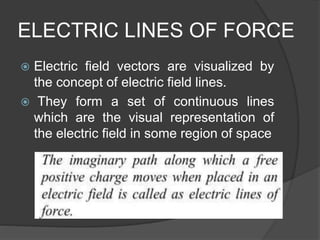
 Electric field vectors are visualized by
the concept of electric field lines.
 They form a set of continuous lines
which are the visual representation of
the electric field in some region of space
PROPERTIES
 The electric field lines start from a
positive charge and end at negative
charges or at infinity.
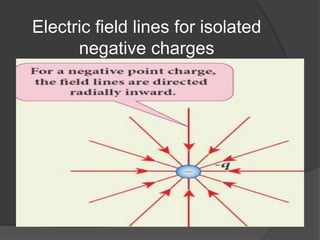
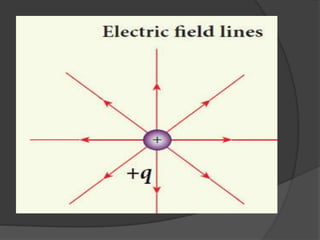
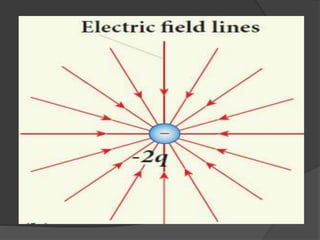
 For a positive point charge the electric
field lines point radially outward and for
a negative point charge, the electric field
lines point radially inward
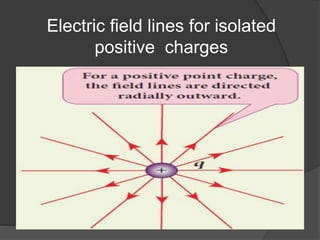
Electric field lines for isolated
positive charges
Electric field lines for isolated
negative charges
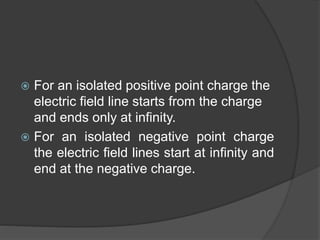
 For an isolated positive point charge the
electric field line starts from the charge
and ends only at infinity.
 For an isolated negative point charge
the electric field lines start at infinity and
end at the negative charge.
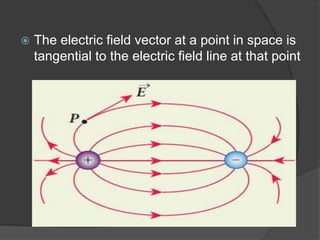
 The electric field vector at a point in space is
tangential to the electric field line at that point
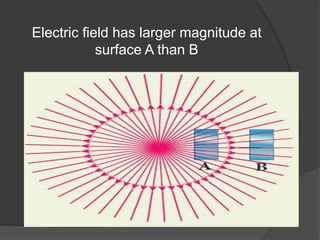
 The electric field lines are denser (more
closer) in a region where the electric field
has larger magnitude and less dense in a
region where the electric field is of smaller
magnitude.
 In other words, the number of lines passing
through a given surface area perpendicular
to the lines is proportional to the magnitude
of the electric field in that region
Electric field has larger magnitude at
surface A than B
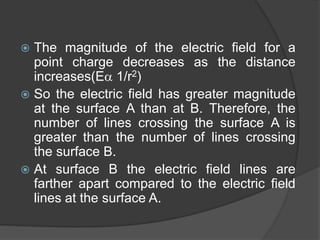
 The magnitude of the electric field for a
point charge decreases as the distance
increases(E 1/r2)
 So the electric field has greater magnitude
at the surface A than at B. Therefore, the
number of lines crossing the surface A is
greater than the number of lines crossing
the surface B.
 At surface B the electric field lines are
farther apart compared to the electric field
lines at the surface A.
 No two electric field lines intersect each
other. If two lines cross at a point, then there
will be two different electric field vectors at
the same point
 If some charge is placed in the
intersection point, then it has to move in
two different directions at the same time,
which is physically impossible.
 Hence, electric field lines do not
intersect.
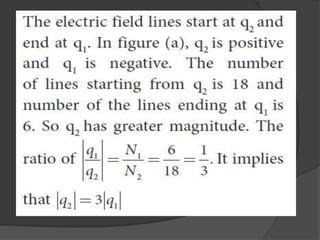
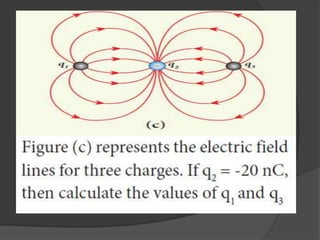
 The number of electric field lines that
emanate from the positive charge or end
at a negative charge is directly
proportional to the magnitude of the
charges
 Note that the number of field lines
emanating from +q is 8 and the number
of field lines ending at -2q is 16.
 Since the magnitude of the second
charge is twice thatof the first charge,
the number of field lines drawn for -2q is
twice in number than that for charge +q.
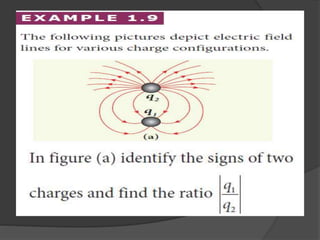
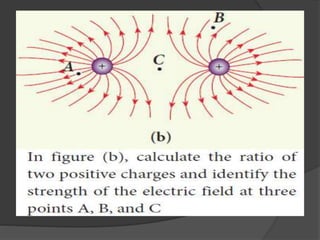
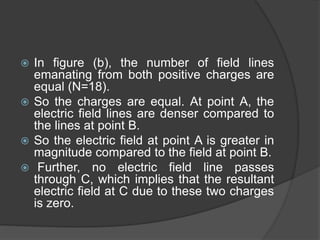
 In figure (b), the number of field lines
emanating from both positive charges are
equal (N=18).
 So the charges are equal. At point A, the
electric field lines are denser compared to
the lines at point B.
 So the electric field at point A is greater in
magnitude compared to the field at point B.
 Further, no electric field line passes
through C, which implies that the resultant
electric field at C due to these two charges
is zero.
ELETRIC FIELD LINES
ELETRIC FIELD LINES

ELETRIC FIELD LINES

  • 2.
    ELECTRIC LINES OFFORCE  Electric field vectors are visualized by the concept of electric field lines.  They form a set of continuous lines which are the visual representation of the electric field in some region of space
  • 3.
    PROPERTIES  The electricfield lines start from a positive charge and end at negative charges or at infinity.  For a positive point charge the electric field lines point radially outward and for a negative point charge, the electric field lines point radially inward
  • 4.
    Electric field linesfor isolated positive charges
  • 5.
    Electric field linesfor isolated negative charges
  • 6.
     For anisolated positive point charge the electric field line starts from the charge and ends only at infinity.  For an isolated negative point charge the electric field lines start at infinity and end at the negative charge.
  • 7.
     The electricfield vector at a point in space is tangential to the electric field line at that point
  • 8.
     The electricfield lines are denser (more closer) in a region where the electric field has larger magnitude and less dense in a region where the electric field is of smaller magnitude.  In other words, the number of lines passing through a given surface area perpendicular to the lines is proportional to the magnitude of the electric field in that region
  • 9.
    Electric field haslarger magnitude at surface A than B
  • 10.
     The magnitudeof the electric field for a point charge decreases as the distance increases(E 1/r2)  So the electric field has greater magnitude at the surface A than at B. Therefore, the number of lines crossing the surface A is greater than the number of lines crossing the surface B.  At surface B the electric field lines are farther apart compared to the electric field lines at the surface A.
  • 11.
     No twoelectric field lines intersect each other. If two lines cross at a point, then there will be two different electric field vectors at the same point
  • 12.
     If somecharge is placed in the intersection point, then it has to move in two different directions at the same time, which is physically impossible.  Hence, electric field lines do not intersect.
  • 13.
     The numberof electric field lines that emanate from the positive charge or end at a negative charge is directly proportional to the magnitude of the charges
  • 16.
     Note thatthe number of field lines emanating from +q is 8 and the number of field lines ending at -2q is 16.  Since the magnitude of the second charge is twice thatof the first charge, the number of field lines drawn for -2q is twice in number than that for charge +q.
  • 20.
     In figure(b), the number of field lines emanating from both positive charges are equal (N=18).  So the charges are equal. At point A, the electric field lines are denser compared to the lines at point B.  So the electric field at point A is greater in magnitude compared to the field at point B.  Further, no electric field line passes through C, which implies that the resultant electric field at C due to these two charges is zero.