ELECTROMAGNETIC THEORY
DR MD KALEEM
12/30/2016 1DR MD KALEEM/ ASSISTANT PROFESSOR
INTRODUCTION
In year 1984 James Clerk Maxwell brought
together and extended four basic laws in
electromagnetism such as , Gauss’s Law in
electrostatics, Gauss’s Law in magnetism,
Ampere's Law and Faraday’s Law.
A complete set of relations giving the
connection between the charges at rest
(Electrostatics) and charges in motion( current
Electricity), electric fields and magnetic fields
(electromagnetism) were divided theoretically
and summarized in four equations by Maxwell,
called Maxwell’s Equations
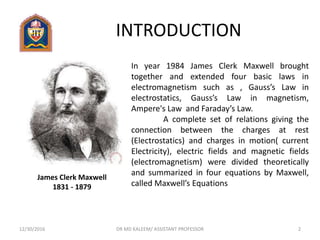
James Clerk Maxwell
1831 - 1879
12/30/2016 2DR MD KALEEM/ ASSISTANT PROFESSOR
Current Density
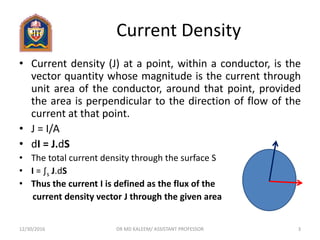
• Current density (J) at a point, within a conductor, is the
vector quantity whose magnitude is the current through
unit area of the conductor, around that point, provided
the area is perpendicular to the direction of flow of the
current at that point.
• J = I/A
• dI = J.dS
• The total current density through the surface S
• I = ∫s J.dS
• Thus the current I is defined as the flux of the
current density vector J through the given area
12/30/2016 3DR MD KALEEM/ ASSISTANT PROFESSOR
Concept of Conduction,
Convection and Radiation
12/30/2016 4DR MD KALEEM/ ASSISTANT PROFESSOR
Conduction Current Density
• Conduction Current Density refers to the amount of
current (charges) flowing on the surface of a
conductor (conduction band) in a time t. This surface
is always parallel to the current flow.
• It obeys Ohm’s Law
12/30/2016 5DR MD KALEEM/ ASSISTANT PROFESSOR
Convection Current Density
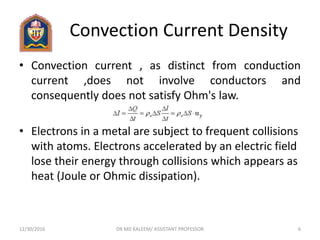
• Convection current , as distinct from conduction
current ,does not involve conductors and
consequently does not satisfy Ohm's law.
• Electrons in a metal are subject to frequent collisions
with atoms. Electrons accelerated by an electric field
lose their energy through collisions which appears as
heat (Joule or Ohmic dissipation).
12/30/2016 6DR MD KALEEM/ ASSISTANT PROFESSOR
• The equation of motion for an electron in the
presence of collisions may be written as
m(dv/dt) = -eE – mνcv
Where ν is the collision frequency. In steady
state, we have
• -eE = mνcv
• Multiplying by –en with n the conduction
electron density, we obtain
12/30/2016 7DR MD KALEEM/ ASSISTANT PROFESSOR
Random and Drift Velocities
• Random Velocity : In absence of electric field
the electrons moves randomly with zero net
velocity. It is about 106 m/s.
• Drift Velocity: In presence of electric field
electrons moves randomly with net motion in
the direction opposite net electric field. It is
about 10-5 – 10-4 m/s
12/30/2016 8DR MD KALEEM/ ASSISTANT PROFESSOR
Introduction of EM Field
• When an event in one place has an effect on
something at a different location, we talk
about the events as being connected by a
“field”.
• A field is a spatial distribution of a quantity; in
general, it can be either scalar or vector in
nature.
12/30/2016 DR MD KALEEM/ ASSISTANT PROFESSOR 9
Fundamental Vector Field Quantities
In Electromagnetics
Electric field intensity (E)
 SI unit = volts per meter (V/m = kg m/A/s3)
Electric flux density (electric displacement) (D)
 SI unit = coulombs per square meter (C/m2 = A s /m2)
Magnetic field intensity (H)
 SI unit = amps per meter (A/m)
Magnetic flux density (B)
 SI units = teslas = webers per square meter (T = Wb/ m2 = kg/A/s3)
12/30/2016 DR MD KALEEM/ ASSISTANT PROFESSOR 10
Gauss’s Law of Electrostatics
• Gauss' Law is the first of Maxwell's
Equations which dictates how the Electric
Field behaves around electric charges.
• Gauss' Law states that electric charge acts as
sources or sinks for Electric Fields.
• Gauss' Law can be written in terms of
the Electric Flux Density and the Electric
Charge Density as
12/30/2016 DR MD KALEEM/ ASSISTANT PROFESSOR 11
Implication of Gauss’ Law
• D and E field lines diverge away from positive
charges
• D and E field lines diverge towards negative
charges
• D and E field lines start and stop on Electric
Charges
• Opposite charges attract and negative charges
repel
• The divergence of the D field over any region
(volume) of space is exactly equal to the net
amount of charge in that region.
12/30/2016 DR MD KALEEM/ ASSISTANT PROFESSOR 12
Gauss Law for Magnetism
• Gauss' Magnetism law states that the
divergence of the Magnetic Flux Density (B) is
zero.
12/30/2016 DR MD KALEEM/ ASSISTANT PROFESSOR 13
Implication of Gauss Law for
Magnetism
• Magnetic Monopoles Do Not Exist
• The Divergence of the B or H Fields is Always
Zero Through Any Volume
• Away from Magnetic Dipoles, Magnetic Fields
flow in a closed loop. This is true even for
plane waves, which just so happen to have an
infinite radius loop.
12/30/2016 DR MD KALEEM/ ASSISTANT PROFESSOR 14
Faraday’s Law of Electromagnetic
Induction
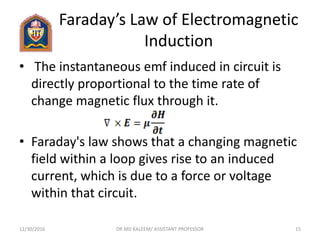
• The instantaneous emf induced in circuit is
directly proportional to the time rate of
change magnetic flux through it.
• Faraday's law shows that a changing magnetic
field within a loop gives rise to an induced
current, which is due to a force or voltage
within that circuit.
12/30/2016 DR MD KALEEM/ ASSISTANT PROFESSOR 15
Implication of Faraday’s Law of
Electromagnetic Induction
• Electric Current gives rise to magnetic fields.
Magnetic Fields around a circuit gives rise to
electric current.
• A Magnetic Field Changing in Time gives rise
to an E-field circulating around it.
• A circulating E-field in time gives rise to a
Magnetic Field Changing in time.
12/30/2016 DR MD KALEEM/ ASSISTANT PROFESSOR 16
Ampere’s Circuital Law
• the curl of the magnetic field is equal to
the Electric Current Density
• A flowing electric current (J) gives rise to a
Magnetic Field that circles the current
• A time-changing Electric Flux Density (D) gives
rise to a Magnetic Field that circles the D field
12/30/2016 DR MD KALEEM/ ASSISTANT PROFESSOR 17
Maxwell’s Modification to
Ampere’s Circuital Law
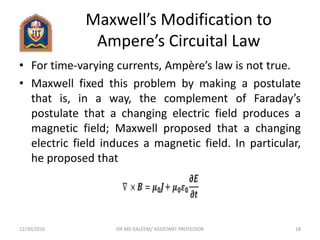
• For time-varying currents, Ampère’s law is not true.
• Maxwell fixed this problem by making a postulate
that is, in a way, the complement of Faraday’s
postulate that a changing electric field produces a
magnetic field; Maxwell proposed that a changing
electric field induces a magnetic field. In particular,
he proposed that
12/30/2016 DR MD KALEEM/ ASSISTANT PROFESSOR 18
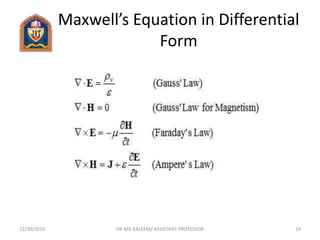
Maxwell’s Equation in Differential
Form
12/30/2016 DR MD KALEEM/ ASSISTANT PROFESSOR 19
Maxwell’s Equation in Integral
Form
12/30/2016 DR MD KALEEM/ ASSISTANT PROFESSOR 20

Electromagnetic Theory

  • 1.
    ELECTROMAGNETIC THEORY DR MDKALEEM 12/30/2016 1DR MD KALEEM/ ASSISTANT PROFESSOR
  • 2.
    INTRODUCTION In year 1984James Clerk Maxwell brought together and extended four basic laws in electromagnetism such as , Gauss’s Law in electrostatics, Gauss’s Law in magnetism, Ampere's Law and Faraday’s Law. A complete set of relations giving the connection between the charges at rest (Electrostatics) and charges in motion( current Electricity), electric fields and magnetic fields (electromagnetism) were divided theoretically and summarized in four equations by Maxwell, called Maxwell’s Equations James Clerk Maxwell 1831 - 1879 12/30/2016 2DR MD KALEEM/ ASSISTANT PROFESSOR
  • 3.
    Current Density • Currentdensity (J) at a point, within a conductor, is the vector quantity whose magnitude is the current through unit area of the conductor, around that point, provided the area is perpendicular to the direction of flow of the current at that point. • J = I/A • dI = J.dS • The total current density through the surface S • I = ∫s J.dS • Thus the current I is defined as the flux of the current density vector J through the given area 12/30/2016 3DR MD KALEEM/ ASSISTANT PROFESSOR
  • 4.
    Concept of Conduction, Convectionand Radiation 12/30/2016 4DR MD KALEEM/ ASSISTANT PROFESSOR
  • 5.
    Conduction Current Density •Conduction Current Density refers to the amount of current (charges) flowing on the surface of a conductor (conduction band) in a time t. This surface is always parallel to the current flow. • It obeys Ohm’s Law 12/30/2016 5DR MD KALEEM/ ASSISTANT PROFESSOR
  • 6.
    Convection Current Density •Convection current , as distinct from conduction current ,does not involve conductors and consequently does not satisfy Ohm's law. • Electrons in a metal are subject to frequent collisions with atoms. Electrons accelerated by an electric field lose their energy through collisions which appears as heat (Joule or Ohmic dissipation). 12/30/2016 6DR MD KALEEM/ ASSISTANT PROFESSOR
  • 7.
    • The equationof motion for an electron in the presence of collisions may be written as m(dv/dt) = -eE – mνcv Where ν is the collision frequency. In steady state, we have • -eE = mνcv • Multiplying by –en with n the conduction electron density, we obtain 12/30/2016 7DR MD KALEEM/ ASSISTANT PROFESSOR
  • 8.
    Random and DriftVelocities • Random Velocity : In absence of electric field the electrons moves randomly with zero net velocity. It is about 106 m/s. • Drift Velocity: In presence of electric field electrons moves randomly with net motion in the direction opposite net electric field. It is about 10-5 – 10-4 m/s 12/30/2016 8DR MD KALEEM/ ASSISTANT PROFESSOR
  • 9.
    Introduction of EMField • When an event in one place has an effect on something at a different location, we talk about the events as being connected by a “field”. • A field is a spatial distribution of a quantity; in general, it can be either scalar or vector in nature. 12/30/2016 DR MD KALEEM/ ASSISTANT PROFESSOR 9
  • 10.
    Fundamental Vector FieldQuantities In Electromagnetics Electric field intensity (E)  SI unit = volts per meter (V/m = kg m/A/s3) Electric flux density (electric displacement) (D)  SI unit = coulombs per square meter (C/m2 = A s /m2) Magnetic field intensity (H)  SI unit = amps per meter (A/m) Magnetic flux density (B)  SI units = teslas = webers per square meter (T = Wb/ m2 = kg/A/s3) 12/30/2016 DR MD KALEEM/ ASSISTANT PROFESSOR 10
  • 11.
    Gauss’s Law ofElectrostatics • Gauss' Law is the first of Maxwell's Equations which dictates how the Electric Field behaves around electric charges. • Gauss' Law states that electric charge acts as sources or sinks for Electric Fields. • Gauss' Law can be written in terms of the Electric Flux Density and the Electric Charge Density as 12/30/2016 DR MD KALEEM/ ASSISTANT PROFESSOR 11
  • 12.
    Implication of Gauss’Law • D and E field lines diverge away from positive charges • D and E field lines diverge towards negative charges • D and E field lines start and stop on Electric Charges • Opposite charges attract and negative charges repel • The divergence of the D field over any region (volume) of space is exactly equal to the net amount of charge in that region. 12/30/2016 DR MD KALEEM/ ASSISTANT PROFESSOR 12
  • 13.
    Gauss Law forMagnetism • Gauss' Magnetism law states that the divergence of the Magnetic Flux Density (B) is zero. 12/30/2016 DR MD KALEEM/ ASSISTANT PROFESSOR 13
  • 14.
    Implication of GaussLaw for Magnetism • Magnetic Monopoles Do Not Exist • The Divergence of the B or H Fields is Always Zero Through Any Volume • Away from Magnetic Dipoles, Magnetic Fields flow in a closed loop. This is true even for plane waves, which just so happen to have an infinite radius loop. 12/30/2016 DR MD KALEEM/ ASSISTANT PROFESSOR 14
  • 15.
    Faraday’s Law ofElectromagnetic Induction • The instantaneous emf induced in circuit is directly proportional to the time rate of change magnetic flux through it. • Faraday's law shows that a changing magnetic field within a loop gives rise to an induced current, which is due to a force or voltage within that circuit. 12/30/2016 DR MD KALEEM/ ASSISTANT PROFESSOR 15
  • 16.
    Implication of Faraday’sLaw of Electromagnetic Induction • Electric Current gives rise to magnetic fields. Magnetic Fields around a circuit gives rise to electric current. • A Magnetic Field Changing in Time gives rise to an E-field circulating around it. • A circulating E-field in time gives rise to a Magnetic Field Changing in time. 12/30/2016 DR MD KALEEM/ ASSISTANT PROFESSOR 16
  • 17.
    Ampere’s Circuital Law •the curl of the magnetic field is equal to the Electric Current Density • A flowing electric current (J) gives rise to a Magnetic Field that circles the current • A time-changing Electric Flux Density (D) gives rise to a Magnetic Field that circles the D field 12/30/2016 DR MD KALEEM/ ASSISTANT PROFESSOR 17
  • 18.
    Maxwell’s Modification to Ampere’sCircuital Law • For time-varying currents, Ampère’s law is not true. • Maxwell fixed this problem by making a postulate that is, in a way, the complement of Faraday’s postulate that a changing electric field produces a magnetic field; Maxwell proposed that a changing electric field induces a magnetic field. In particular, he proposed that 12/30/2016 DR MD KALEEM/ ASSISTANT PROFESSOR 18
  • 19.
    Maxwell’s Equation inDifferential Form 12/30/2016 DR MD KALEEM/ ASSISTANT PROFESSOR 19
  • 20.
    Maxwell’s Equation inIntegral Form 12/30/2016 DR MD KALEEM/ ASSISTANT PROFESSOR 20

Editor's Notes

  • #5 Courtesy: http://mrvillascienceclass.blogspot.in
  • #6 Courtesy: www.edaboard.com