NAME: - AAQIB KHURSHEED 
AND TOWFEEQ UMAR. 
COURSE: - B.E (E&C). 
ENROLL NO:-2556. 
SEMESTER: -7TH. 
LIDAR 
COMPILED BY:
CONTENTS: 
• Introduction. 
• General Description 
• Brief History. 
• Lidar Platforms. 
• Basic Principle and Technique. 
• How Lidar works. 
• Lidar components 
• Application 
• Advantage. 
• Disadvantage. 
• Conclusion.
INTODUCTION:- 
 Lidar is an acronym for light 
detection and ranging. It is an 
optical remote sensing technology 
that can measure the distance to, or 
other properties of a target by 
illuminating the target with light, 
often using pulses from a laser. 
Mobile Lidar at UNG
General description: 
 This is an active remote sensing technique , similar to radar 
but uses laser light pulses instead of radio waves. 
 Most lidar systems operate in near infra–red region of 
electromagnetic spectrum (i.e , 1064 nm). 
 Lidar instruments can rapidly measure the earth’s surface at 
a sampling rate greater than 150khz.The resulting product is 
a densely spaced network of highly accurate georefernced 
elevation points –point cloud. It can be used to generate 3- 
D representation of earth’s surface.
Brief History: 
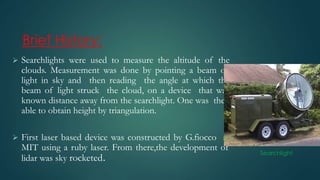
 Searchlights were used to measure the altitude of the 
clouds. Measurement was done by pointing a beam of 
light in sky and then reading the angle at which the 
beam of light struck the cloud, on a device that was 
known distance away from the searchlight. One was then 
able to obtain height by triangulation. 
 First laser based device was constructed by G.fiocco at 
MIT using a ruby laser. From there,the development of 
lidar was sky rocketed. Searchlight
Lidar Platforms:
Basic Principle And Technique:- 
The basic idea is fairly straightforward. 
Laser generates an optical pulse 
Pulse is reflected off an object and returns to 
the system receiver. 
High-speed counter measures the time of flight 
from the start pulse to the return pulse 
Time measurement is converted to a distance 
(the distance to the target and the position of 
the airplane is then used to determine the 
elevation and location).
How Lidar Works: 
I. Directing a laser into 
atmosphere. 
II. Use of telescope. 
III. Digitalization of lidar 
measurement.
LASER SCANNER AND OPTICS 
LIDAR 
COMPONENTS 
LIDAR SENSOR AND 
PHOTODETECTORS. POSITION AND NAVIGATION SYSTEMS.
 LASER: 
Airborne lidar systems 
use 1064nm diode 
pumped YAG lasers 
while bathymetric system 
use 532nm double diode 
pumped YAG lasers. 
Airborne YAG Laser
 Lidar Scanner and Optics: 
The speed at which images can 
be developed is affected by the 
speed at which it can be 
scanned into the system. 
Moreover, optic choice effects 
the angular resolution and range 
that can be detected. 
Leica ALS70-HP
 Lidar Sensors and Photodetectors: 
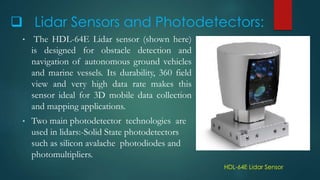
• The HDL-64E Lidar sensor (shown here) 
is designed for obstacle detection and 
navigation of autonomous ground vehicles 
and marine vessels. Its durability, 360 field 
view and very high data rate makes this 
sensor ideal for 3D mobile data collection 
and mapping applications. 
• Two main photodetector technologies are 
used in lidars:-Solid State photodetectors 
such as silicon avalache photodiodes and 
photomultipliers. 
HDL-64E Lidar Sensor
 Position And Navigation System: 
 When a Lidar sensor is 
mounted on a mobile 
platform such as airplanes or 
automobiles ,it is necessary to 
determine the absolute 
position and orientation of 
the sensor to retain useable 
data . For this, we have two 
techniques: 
 GPS 
 IMU
APPLICATIONS: 
1)Agriculture. 
2)Wind Farm Optimization. 
3)Law Enforcement. 
4)Surveying.
Advantages: 
1)Higher Accuracy. 
2)Fast Acquisition and Processing. 
3)Minimum Human Dependence. 
4)Weather/light indepedence.
Disadvantages: 
1)Inability to penetrate very dense canopy leads to elevation model 
errors. 
2)Very large datasets that are difficult to interpret and process. 
3)No International Protocols. 
4) Precise alignment is required.
Date 
Conclusion. 
Lidar has become an established method for collecting very dense 
and elevation data across landscapes, shallow-water areas and 
project sites. Moreover, LIDAR can provide high degree of 
accuracy and more detailed information about the landscape than 
radar technologies .
 IF U LIKE OUER WORK, REMEMBER US IN YOUR PRAYERS

LIDAR

  • 1.
    NAME: - AAQIBKHURSHEED AND TOWFEEQ UMAR. COURSE: - B.E (E&C). ENROLL NO:-2556. SEMESTER: -7TH. LIDAR COMPILED BY:
  • 2.
    CONTENTS: • Introduction. • General Description • Brief History. • Lidar Platforms. • Basic Principle and Technique. • How Lidar works. • Lidar components • Application • Advantage. • Disadvantage. • Conclusion.
  • 3.
    INTODUCTION:-  Lidaris an acronym for light detection and ranging. It is an optical remote sensing technology that can measure the distance to, or other properties of a target by illuminating the target with light, often using pulses from a laser. Mobile Lidar at UNG
  • 4.
    General description: This is an active remote sensing technique , similar to radar but uses laser light pulses instead of radio waves.  Most lidar systems operate in near infra–red region of electromagnetic spectrum (i.e , 1064 nm).  Lidar instruments can rapidly measure the earth’s surface at a sampling rate greater than 150khz.The resulting product is a densely spaced network of highly accurate georefernced elevation points –point cloud. It can be used to generate 3- D representation of earth’s surface.
  • 5.
    Brief History: Searchlights were used to measure the altitude of the clouds. Measurement was done by pointing a beam of light in sky and then reading the angle at which the beam of light struck the cloud, on a device that was known distance away from the searchlight. One was then able to obtain height by triangulation.  First laser based device was constructed by G.fiocco at MIT using a ruby laser. From there,the development of lidar was sky rocketed. Searchlight
  • 6.
  • 7.
    Basic Principle AndTechnique:- The basic idea is fairly straightforward. Laser generates an optical pulse Pulse is reflected off an object and returns to the system receiver. High-speed counter measures the time of flight from the start pulse to the return pulse Time measurement is converted to a distance (the distance to the target and the position of the airplane is then used to determine the elevation and location).
  • 8.
    How Lidar Works: I. Directing a laser into atmosphere. II. Use of telescope. III. Digitalization of lidar measurement.
  • 9.
    LASER SCANNER ANDOPTICS LIDAR COMPONENTS LIDAR SENSOR AND PHOTODETECTORS. POSITION AND NAVIGATION SYSTEMS.
  • 10.
     LASER: Airbornelidar systems use 1064nm diode pumped YAG lasers while bathymetric system use 532nm double diode pumped YAG lasers. Airborne YAG Laser
  • 11.
     Lidar Scannerand Optics: The speed at which images can be developed is affected by the speed at which it can be scanned into the system. Moreover, optic choice effects the angular resolution and range that can be detected. Leica ALS70-HP
  • 12.
     Lidar Sensorsand Photodetectors: • The HDL-64E Lidar sensor (shown here) is designed for obstacle detection and navigation of autonomous ground vehicles and marine vessels. Its durability, 360 field view and very high data rate makes this sensor ideal for 3D mobile data collection and mapping applications. • Two main photodetector technologies are used in lidars:-Solid State photodetectors such as silicon avalache photodiodes and photomultipliers. HDL-64E Lidar Sensor
  • 13.
     Position AndNavigation System:  When a Lidar sensor is mounted on a mobile platform such as airplanes or automobiles ,it is necessary to determine the absolute position and orientation of the sensor to retain useable data . For this, we have two techniques:  GPS  IMU
  • 14.
    APPLICATIONS: 1)Agriculture. 2)WindFarm Optimization. 3)Law Enforcement. 4)Surveying.
  • 15.
    Advantages: 1)Higher Accuracy. 2)Fast Acquisition and Processing. 3)Minimum Human Dependence. 4)Weather/light indepedence.
  • 16.
    Disadvantages: 1)Inability topenetrate very dense canopy leads to elevation model errors. 2)Very large datasets that are difficult to interpret and process. 3)No International Protocols. 4) Precise alignment is required.
  • 17.
    Date Conclusion. Lidarhas become an established method for collecting very dense and elevation data across landscapes, shallow-water areas and project sites. Moreover, LIDAR can provide high degree of accuracy and more detailed information about the landscape than radar technologies .
  • 20.
     IF ULIKE OUER WORK, REMEMBER US IN YOUR PRAYERS