Magnetic Materials
2
Magnetic Materials
• The materials which strongly attract apiece of iron
are known as magnetic materials or magnets.
• The magnetic property of a material arises due to the
magnetic moment or magnetic dipole of materials.
• Materials which are magnetised by the application
of an external magnetic field are known as magnetic
materials.
3
Classification of Magnetic Materials
• Diamagnetic materials-no permanent magnetic
moment
• Paramagnetic, ferromagnetic, antiferromagnetic
and ferromagnetic materials-possess permanent
magnetic moment
4
Diamagnetic Materials
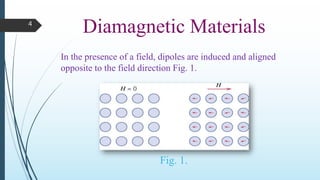
In the presence of a field, dipoles are induced and aligned
opposite to the field direction Fig. 1.
Fig. 1.
5
Properties of Diamagnetic Materials
• They do not have a permanent dipoles moment.
• Magnetic effects are very weak and hence, often masked by
other kind of magnetism.
• The megnetisation becomes zero on removal of the external
field.
• The susceptibility of a diamagnetic material is negative.
• The susceptibility is independent of temperature and external
field.
6
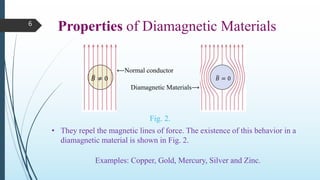
• They repel the magnetic lines of force. The existence of this behavior in a
diamagnetic material is shown in Fig. 2.
𝐵 ≠ 0 𝐵 = 0
⟵Normal conductor
Diamagnetic Materials⟶
Fig. 2.
Properties of Diamagnetic Materials
Examples: Copper, Gold, Mercury, Silver and Zinc.
7
Paramagnetic Materials
The behavior of a paramagnetic material under the
influence of an external field is shown in fig. 3.
Fig. 3.
8
Properties of Paramagnetic Materials
• Paramagnetic material possess a permanent dipole moment.
• The attract the magnetic lines of force.
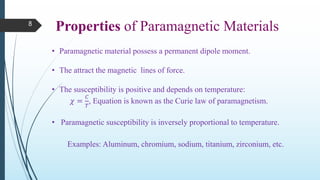
• The susceptibility is positive and depends on temperature:
𝜒 =
𝐶
𝑇
, Equation is known as the Curie law of paramagnetism.
• Paramagnetic susceptibility is inversely proportional to temperature.
Examples: Aluminum, chromium, sodium, titanium, zirconium, etc.
9
Ferromagnetic Materials
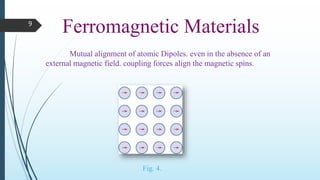
Mutual alignment of atomic Dipoles. even in the absence of an
external magnetic field. coupling forces align the magnetic spins.
Fig. 4.
10
Properties of Ferromagnetic Materials
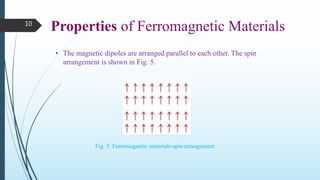
• The magnetic dipoles are arranged parallel to each other. The spin
arrangement is shown in Fig. 5.
Fig. 5. Ferromagnetic materials-spin arrangement
11 Properties of Ferromagnetic Materials
• They have characteristic temperature, namely, ferromagnetic Curie
temperature(𝜃𝑓). Materials below 𝜃𝑓 behave as ferromagnetic materials and obey
hysteretic curve. A material behave as a paramagnetic when it is above 𝜃𝑓.
• They possess permanent dipole moment.
• The susceptibility of a ferromagnetic material is
𝜒 = 𝑐
𝑇−𝜃
, shown as Curie-Weiss law.
Examples: Iron, Cobalt, Nickel.
12
Antiferromagnetic Materials
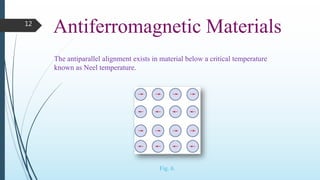
The antiparallel alignment exists in material below a critical temperature
known as Neel temperature.
Fig. 6.
13
Properties of Antiferromagnetic Materials
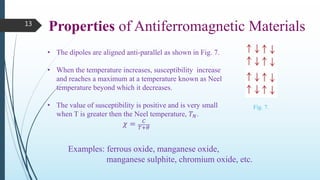
• The dipoles are aligned anti-parallel as shown in Fig. 7.
• When the temperature increases, susceptibility increase
and reaches a maximum at a temperature known as Neel
temperature beyond which it decreases.
• The value of susceptibility is positive and is very small
when T is greater then the Neel temperature, 𝑇 𝑁.
𝜒 = 𝐶
𝑇+𝜃
Fig. 7.
Examples: ferrous oxide, manganese oxide,
manganese sulphite, chromium oxide, etc.
14
Ferrimagnetic Materials
• A special case of antiferromagnetic materials.
• The magnetic dipoles are antiparallel.
• However, their magnitudes are not equal.
• Hence, they produce a large magnetisation even for a
small applied external field.
15
Properties of Ferrimagnetic Materials
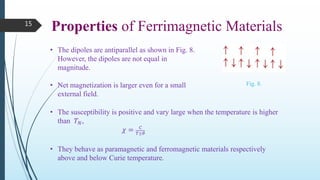
Fig. 8.
• The dipoles are antiparallel as shown in Fig. 8.
However, the dipoles are not equal in
magnitude.
• Net magnetization is larger even for a small
external field.
• The susceptibility is positive and vary large when the temperature is higher
than 𝑇 𝑁,
𝜒 = 𝐶
𝑇±𝜃
• They behave as paramagnetic and ferromagnetic materials respectively
above and below Curie temperature.
16

Magnetic materials

  • 1.
  • 2.
    2 Magnetic Materials • Thematerials which strongly attract apiece of iron are known as magnetic materials or magnets. • The magnetic property of a material arises due to the magnetic moment or magnetic dipole of materials. • Materials which are magnetised by the application of an external magnetic field are known as magnetic materials.
  • 3.
    3 Classification of MagneticMaterials • Diamagnetic materials-no permanent magnetic moment • Paramagnetic, ferromagnetic, antiferromagnetic and ferromagnetic materials-possess permanent magnetic moment
  • 4.
    4 Diamagnetic Materials In thepresence of a field, dipoles are induced and aligned opposite to the field direction Fig. 1. Fig. 1.
  • 5.
    5 Properties of DiamagneticMaterials • They do not have a permanent dipoles moment. • Magnetic effects are very weak and hence, often masked by other kind of magnetism. • The megnetisation becomes zero on removal of the external field. • The susceptibility of a diamagnetic material is negative. • The susceptibility is independent of temperature and external field.
  • 6.
    6 • They repelthe magnetic lines of force. The existence of this behavior in a diamagnetic material is shown in Fig. 2. 𝐵 ≠ 0 𝐵 = 0 ⟵Normal conductor Diamagnetic Materials⟶ Fig. 2. Properties of Diamagnetic Materials Examples: Copper, Gold, Mercury, Silver and Zinc.
  • 7.
    7 Paramagnetic Materials The behaviorof a paramagnetic material under the influence of an external field is shown in fig. 3. Fig. 3.
  • 8.
    8 Properties of ParamagneticMaterials • Paramagnetic material possess a permanent dipole moment. • The attract the magnetic lines of force. • The susceptibility is positive and depends on temperature: 𝜒 = 𝐶 𝑇 , Equation is known as the Curie law of paramagnetism. • Paramagnetic susceptibility is inversely proportional to temperature. Examples: Aluminum, chromium, sodium, titanium, zirconium, etc.
  • 9.
    9 Ferromagnetic Materials Mutual alignmentof atomic Dipoles. even in the absence of an external magnetic field. coupling forces align the magnetic spins. Fig. 4.
  • 10.
    10 Properties of FerromagneticMaterials • The magnetic dipoles are arranged parallel to each other. The spin arrangement is shown in Fig. 5. Fig. 5. Ferromagnetic materials-spin arrangement
  • 11.
    11 Properties ofFerromagnetic Materials • They have characteristic temperature, namely, ferromagnetic Curie temperature(𝜃𝑓). Materials below 𝜃𝑓 behave as ferromagnetic materials and obey hysteretic curve. A material behave as a paramagnetic when it is above 𝜃𝑓. • They possess permanent dipole moment. • The susceptibility of a ferromagnetic material is 𝜒 = 𝑐 𝑇−𝜃 , shown as Curie-Weiss law. Examples: Iron, Cobalt, Nickel.
  • 12.
    12 Antiferromagnetic Materials The antiparallelalignment exists in material below a critical temperature known as Neel temperature. Fig. 6.
  • 13.
    13 Properties of AntiferromagneticMaterials • The dipoles are aligned anti-parallel as shown in Fig. 7. • When the temperature increases, susceptibility increase and reaches a maximum at a temperature known as Neel temperature beyond which it decreases. • The value of susceptibility is positive and is very small when T is greater then the Neel temperature, 𝑇 𝑁. 𝜒 = 𝐶 𝑇+𝜃 Fig. 7. Examples: ferrous oxide, manganese oxide, manganese sulphite, chromium oxide, etc.
  • 14.
    14 Ferrimagnetic Materials • Aspecial case of antiferromagnetic materials. • The magnetic dipoles are antiparallel. • However, their magnitudes are not equal. • Hence, they produce a large magnetisation even for a small applied external field.
  • 15.
    15 Properties of FerrimagneticMaterials Fig. 8. • The dipoles are antiparallel as shown in Fig. 8. However, the dipoles are not equal in magnitude. • Net magnetization is larger even for a small external field. • The susceptibility is positive and vary large when the temperature is higher than 𝑇 𝑁, 𝜒 = 𝐶 𝑇±𝜃 • They behave as paramagnetic and ferromagnetic materials respectively above and below Curie temperature.
  • 16.