Emerging DiseasesEmerging Diseases
in Layer Chickenin Layer Chicken
Emerging DiseaseEmerging Disease
 The World Organisation for Animal Health (OIE) defines anThe World Organisation for Animal Health (OIE) defines an
emerging disease asemerging disease as
““A new infection or infestation resulting from the evolution orA new infection or infestation resulting from the evolution or
change of an existing pathogenic agent, a known infection orchange of an existing pathogenic agent, a known infection or
infestation spreading to a new geographic area or population, or ainfestation spreading to a new geographic area or population, or a
previously un recognised pathogenic agent or disease diagnosed forpreviously un recognised pathogenic agent or disease diagnosed for
the first time and which has a significant impact on animal or publicthe first time and which has a significant impact on animal or public
health.”health.”
A known or endemic disease is considered to be re-emerging if itA known or endemic disease is considered to be re-emerging if it
shifts its geographical setting, expands its host range, orshifts its geographical setting, expands its host range, or
significantly increases its prevalence.significantly increases its prevalence.
IntroductionIntroduction
 The nature and intensification of the poultry industry, multiplication ofThe nature and intensification of the poultry industry, multiplication of
species, movements of birds, trade of vaccine and environmental changesspecies, movements of birds, trade of vaccine and environmental changes
causes emergence of certain diseases in recent yearscauses emergence of certain diseases in recent years
 Both established and emerging poultry diseases, and the pathogens thatBoth established and emerging poultry diseases, and the pathogens that
cause them, are continual threats to the industrycause them, are continual threats to the industry
 Avian influenzaAvian influenza
 Avian metapneumovirusAvian metapneumovirus
 Infectious laryngotracheitisInfectious laryngotracheitis
 Chicken infectious anemiaChicken infectious anemia
 Neoplastic diseasesNeoplastic diseases
 Ornithobacterium rhinotrachiale (ORT)Ornithobacterium rhinotrachiale (ORT)
 Eggshell apex abnormalitiesEggshell apex abnormalities
 Gallibacterium anatis associated peritonitis
ETIOLOGYETIOLOGY
ORTHOMYXOVIRIDAEORTHOMYXOVIRIDAE
Influenza A Influenza B Influenza CInfluenza A Influenza B Influenza C
Infect wide variety of animals Primarily humans occasionally pigsInfect wide variety of animals Primarily humans occasionally pigs
Wild ducks, chickens, turkeys, and seals but not birdsWild ducks, chickens, turkeys, and seals but not birds
Pigs, horses, mink, seals & humansPigs, horses, mink, seals & humans
Influenza AInfluenza A
8 gene segments8 gene segments
10 different proteins10 different proteins
Surface protein Internal proteinsSurface protein Internal proteins
HA, NA & Matrix PB1, PB2, PA, nucleoprotein, matrix 1 protein ,HA, NA & Matrix PB1, PB2, PA, nucleoprotein, matrix 1 protein ,
2 protein Nonstructural protein 1 &22 protein Nonstructural protein 1 &2
HA
PB1
PB2
PA
NP
NA
MA
NS
M2
Hemagglutinin
Neuraminidase
M1
Influenza A Virus
Negative sense RNA
Single stranded
Segmented
18 Hemagglutinin subtypes
11 Neuraminidase Subtypes
Indian scenario of Highly Pathogenic AvianIndian scenario of Highly Pathogenic Avian
InfluenzaInfluenza
 The H5N1-HPAI was first detected in India in February 2006 in severalThe H5N1-HPAI was first detected in India in February 2006 in several
commercial farms in Navapur of Nandurbar district in Maharashtra.commercial farms in Navapur of Nandurbar district in Maharashtra.

 Subsequently, pockets of outbreaks also were reported in backyardSubsequently, pockets of outbreaks also were reported in backyard
poultry in Madhya Pradesh and Gujaratpoultry in Madhya Pradesh and Gujarat
 The outbreak was controlled and India regained disease free status inThe outbreak was controlled and India regained disease free status in
August 2006August 2006
 During the second week of July 2007 HPAI appeared in a smallDuring the second week of July 2007 HPAI appeared in a small
backyard poultry unit in Manipurbackyard poultry unit in Manipur
 The incidence could be successfully contained by precise and timelyThe incidence could be successfully contained by precise and timely
diagnosis by HSADL, IVRI. India again faced more serious HPAIdiagnosis by HSADL, IVRI. India again faced more serious HPAI
outbreak at West Bengal in January 2008outbreak at West Bengal in January 2008
 The disease was rapidly spread mainly in backyard poultry andThe disease was rapidly spread mainly in backyard poultry and
ducks in 15 out of 19 districts within a span of one month andducks in 15 out of 19 districts within a span of one month and
another outbreak was recorded in Tripura in April, 2008 inanother outbreak was recorded in Tripura in April, 2008 in
backyard ducks and geesebackyard ducks and geese
 Though the west Bengal and Tripura outbreaks successfullyThough the west Bengal and Tripura outbreaks successfully
contained and India regained disease free status during firstcontained and India regained disease free status during first
week of November 2008, within two weeks of regaining AIV freeweek of November 2008, within two weeks of regaining AIV free
status, AIV again started to hit in Assam and killed thousandsstatus, AIV again started to hit in Assam and killed thousands
of backyard poultry in last week of November 2008of backyard poultry in last week of November 2008
 Subsequently it was spread to parts of West Bengal andSubsequently it was spread to parts of West Bengal and
Mizoram and Sikkim (DADF-2009) and finally controlledMizoram and Sikkim (DADF-2009) and finally controlled
 India regained its AIV free status on October 2009India regained its AIV free status on October 2009
 Fresh outbreaks of HPAI again sprouted in west Bengal after 15Fresh outbreaks of HPAI again sprouted in west Bengal after 15thth
January 2010 (OIE,2010).January 2010 (OIE,2010).

 New cases were being reported in Bihar, Sikkim, Jharkhand,New cases were being reported in Bihar, Sikkim, Jharkhand,
Odessa, Karnataka and Kerala in the year 2011-14 in domesticOdessa, Karnataka and Kerala in the year 2011-14 in domestic
poultry, crows, turkeys and ducks.poultry, crows, turkeys and ducks.
 As on November 2014;As on November 2014; 98 outbreaks98 outbreaks have been detected in India,have been detected in India,
1, 52, 6431, 52, 643 birds have beenbirds have been succumbed to deathsuccumbed to death andand 64,51,64,51,
985 birds have been destroyed985 birds have been destroyed causing huge economic losses,causing huge economic losses,
reckoned to be in excess of Rs 10,000 crore, to the Indian poultryreckoned to be in excess of Rs 10,000 crore, to the Indian poultry
industryindustry
Avian InfluenzaAvian Influenza
 Low pathogenic avian influenza (LPAI)Low pathogenic avian influenza (LPAI)
 Associated with mild illness in poultryAssociated with mild illness in poultry
 Can evolve into highly pathogenic virusesCan evolve into highly pathogenic viruses
 Associated with poultry outbreaks world wideAssociated with poultry outbreaks world wide
 High pathogenic avian influenza (HPAI)High pathogenic avian influenza (HPAI)
 Causes high mortality in domestic poultryCauses high mortality in domestic poultry
 Subtypes H5 and H7Subtypes H5 and H7
Cleavage of Hemagglutinin Protein
by Host Proteases
• In LPAI viruses, only trypsin-like proteases
found in the enteric and respiratory tracts
can cleave the HA protein-virus replication
and disease is restricted
• In HPAI viruses, the HA protein can be
cleaved by ubiquitous proteases found in
most cells-virus can replicate systemically
Clinical Signs – Depression and HuddlingClinical Signs – Depression and Huddling
Drop in Egg production
Ruffled feathers
Edema of upper eyelidEdema of upper eyelid
Swollen blue,Swollen blue, cyanoticcyanotic combs and wattlescombs and wattles
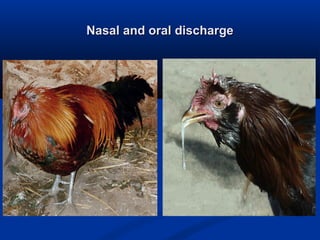
Nasal and oral dischargeNasal and oral discharge
Diarrhoea and DehydrationDiarrhoea and Dehydration
Clinical SignsClinical Signs
Subcutaneous hemorrhage of shanksSubcutaneous hemorrhage of shanks
2006
Clinical Signs –Clinical Signs – Huddling, Sinusitis andHuddling, Sinusitis and
Respiratory signsRespiratory signs
Neurological signs (Nervous signs) Similar toNeurological signs (Nervous signs) Similar to
Newcastle DiseaseNewcastle Disease
Avian Influenza
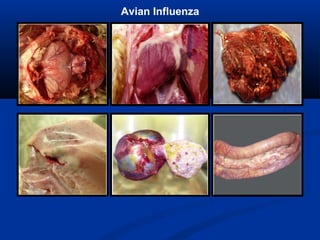
Avian Influenza - Gross lesions
Haemorrhage in muscle cyanotic wattle, comb, and facial edema
Urate deposit in kidneys Haemorrhages in skin and shank Haemorrhages in intestinal
walls
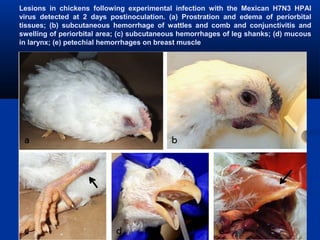
Lesions in chickens following experimental infection with the Mexican H7N3 HPAI
virus detected at 2 days postinoculation. (a) Prostration and edema of periorbital
tissues; (b) subcutaneous hemorrhage of wattles and comb and conjunctivitis and
swelling of periorbital area; (c) subcutaneous hemorrhages of leg shanks; (d) mucous
in larynx; (e) petechial hemorrhages on breast muscle
LPAILPAI
LPAI in respiratory disease complex of commercial - H9N2 subtype.LPAI in respiratory disease complex of commercial - H9N2 subtype.
LPAI outbreaks seasonal - summer but in the recent years throughout theLPAI outbreaks seasonal - summer but in the recent years throughout the
yearyear
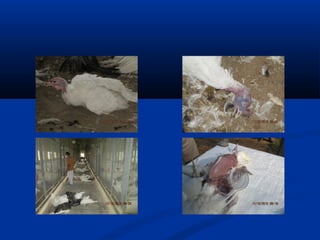
Growers respiratory and nervous signs. Mortality 5 to 25 perGrowers respiratory and nervous signs. Mortality 5 to 25 per
In layer, sudden onset of depression, drop in feed intake and respiratory signsIn layer, sudden onset of depression, drop in feed intake and respiratory signs
are the first indication.are the first indication.
PathologyPathology
Gross lesions mainly in respiratory, genital, urinary and digestive system.Gross lesions mainly in respiratory, genital, urinary and digestive system.
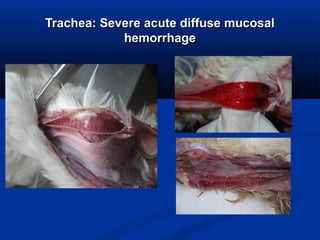
Trachea - mucus exudate, fibrinous flacks, mild to sever congestion evenTrachea - mucus exudate, fibrinous flacks, mild to sever congestion even
haemorrhages.haemorrhages.
Lungs - congestion and edema and few cases consolidation at the insertion of bronchi.Lungs - congestion and edema and few cases consolidation at the insertion of bronchi.
Thoracic and abdominal air sacs -edematous, frothy and contain fibrinous exudates.Thoracic and abdominal air sacs -edematous, frothy and contain fibrinous exudates.
Oviduct - severe transmural edema with clear excessive albumin in lumen and relativelyOviduct - severe transmural edema with clear excessive albumin in lumen and relatively
large quantity of thick, white yellow coloured fluid in the abdominal cavity.large quantity of thick, white yellow coloured fluid in the abdominal cavity.
Peritonitis with low amount of fibrinous exudates over the ovaries.Peritonitis with low amount of fibrinous exudates over the ovaries.
Proventriculus - petechial hemorrhages.Proventriculus - petechial hemorrhages.
Pancreas is enlarged and hardened.Pancreas is enlarged and hardened.
Trachea: Severe acute diffuse mucosalTrachea: Severe acute diffuse mucosal
hemorrhagehemorrhage
LPAI Infected birdLPAI Infected bird
LPAI - PancreasLPAI - Pancreas
Kidneys: Acute diffuse edema and congestion with urate retentionKidneys: Acute diffuse edema and congestion with urate retention
Haemorrhage in proventriculus and sternumHaemorrhage in proventriculus and sternum
Epicardial and Cloacal haemorrhagesEpicardial and Cloacal haemorrhages
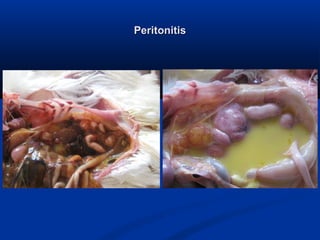
PeritonitisPeritonitis
Avian Meta pneumovirusAvian Meta pneumovirus
Family – ParamyxoviridaeFamily – Paramyxoviridae
Subfamily – PnemovirinaeSubfamily – Pnemovirinae
Genus – MetapneumovirusGenus – Metapneumovirus
Virus – Avian metapneumovirusVirus – Avian metapneumovirus
F protein that promotes cellF protein that promotes cell fusion, dofusion, do
not hemagglutinatenot hemagglutinate
G attachmentG attachment proteins of these virusesproteins of these viruses
do not have neuraminidase activity.do not have neuraminidase activity.
Based on molecular analysis of theBased on molecular analysis of the
genome, aMPV can be classified intogenome, aMPV can be classified into
four subtypes: A, B, C and D.four subtypes: A, B, C and D. India –India –
Subtype ASubtype A
Avian Metapneumo virusAvian Metapneumo virus
 The virus is able to replicate in the respiratory tract, especially theThe virus is able to replicate in the respiratory tract, especially the
upper tissues, resulting in anupper tissues, resulting in an acute respiratory diseaseacute respiratory disease in turkeys andin turkeys and
chickens with significant economic losses, especially if the infection ischickens with significant economic losses, especially if the infection is
associated with secondary pathogens.associated with secondary pathogens.
 In broilers, aMPV is involved, among other agents, in theIn broilers, aMPV is involved, among other agents, in the swollen headswollen head
syndrome (SHS)syndrome (SHS) and is likely to play a role in pathogenesis ofand is likely to play a role in pathogenesis of
testicular diseasetesticular disease..
 Exacerbating factorsExacerbating factors for APV infection are the common ones forfor APV infection are the common ones for
respiratory diseases and include high ammonia and dust levels in therespiratory diseases and include high ammonia and dust levels in the
atmosphere, overcrowding and intercurrent infections.atmosphere, overcrowding and intercurrent infections.
Clinical signs a: Control , b: aMPV subtype-B-inoculated bird showingClinical signs a: Control , b: aMPV subtype-B-inoculated bird showing
swelling of periorbital sinuses and the area around the eye (black arrow)swelling of periorbital sinuses and the area around the eye (black arrow)
and clear nasal exudate (white arrow).and clear nasal exudate (white arrow).
Immunohistochemistry for aMPV antigens, horseradishImmunohistochemistry for aMPV antigens, horseradish
peroxidase method, hematoxylin counterstain.peroxidase method, hematoxylin counterstain.
Nasal cavity Trachea
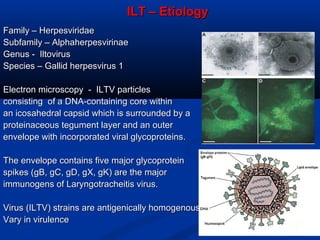
ILT – EtiologyILT – Etiology
Family – HerpesviridaeFamily – Herpesviridae
Subfamily – AlphaherpesvirinaeSubfamily – Alphaherpesvirinae
Genus - IltovirusGenus - Iltovirus
Species – Gallid herpesvirus 1Species – Gallid herpesvirus 1
Electron microscopy - ILTV particlesElectron microscopy - ILTV particles
consisting of a DNA-containing core withinconsisting of a DNA-containing core within
an icosahedral capsid which is surrounded by aan icosahedral capsid which is surrounded by a
proteinaceous tegument layer and an outerproteinaceous tegument layer and an outer
envelope with incorporated viral glycoproteins.envelope with incorporated viral glycoproteins.
The envelope contains five major glycoproteinThe envelope contains five major glycoprotein
spikes (gB, gC, gD, gX, gK) are the majorspikes (gB, gC, gD, gX, gK) are the major
immunogens of Laryngotracheitis virus.immunogens of Laryngotracheitis virus.
Virus (ILTV) strains are antigenically homogenous, however vary inVirus (ILTV) strains are antigenically homogenous, however vary in
Vary in virulenceVary in virulence
Global distribution of ILT as of 2013Global distribution of ILT as of 2013
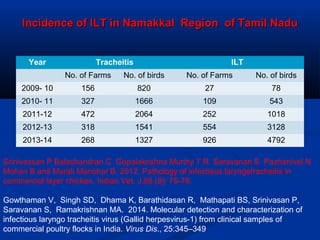
Incidence of ILT in Namakkal Region of Tamil NaduIncidence of ILT in Namakkal Region of Tamil Nadu
Year Tracheitis ILT
No. of Farms No. of birds No. of Farms No. of birds
2009- 10 156 820 27 78
2010- 11 327 1666 109 543
2011-12 472 2064 252 1018
2012-13 318 1541 554 3128
2013-14 268 1327 926 4792
Srinivassan P Balachandran C Gopalakrishna Murthy T R Saravanan S Pazhanivel N
Mohan B and Murali Manohar B. 2012. Pathology of infectious laryngotracheitis in
commercial layer chicken. Indian Vet. J.88 (8): 75-78.
Gowthaman V, Singh SD, Dhama K, Barathidasan R, Mathapati BS, Srinivasan P,
Saravanan S, Ramakrishnan MA. 2014. Molecular detection and characterization of
infectious laryngo tracheitis virus (Gallid herpesvirus-1) from clinical samples of
commercial poultry flocks in India. Virus Dis., 25:345–349
ILT- Clinical signsILT- Clinical signs
 Clinically, the disease may appear in three forms -Peracute , acute, andClinically, the disease may appear in three forms -Peracute , acute, and
chronic or mild.chronic or mild.
 In peracute form, sudden onset and rapid spread. Mortality may be as highIn peracute form, sudden onset and rapid spread. Mortality may be as high
as 70%.as 70%.
 In acute form, the onset of illness is slower and respiratory signs may extendIn acute form, the onset of illness is slower and respiratory signs may extend
over some days before deaths are seen. Mortality may range from 10-30%.over some days before deaths are seen. Mortality may range from 10-30%.
 Chronic or mild ILT may be seen among survivors of the above forms of theChronic or mild ILT may be seen among survivors of the above forms of the
disease, although some outbreaks themselves may be entirely mild. Thedisease, although some outbreaks themselves may be entirely mild. The
mild form is the most commonly seen type and is called “silent, vaccinal, ormild form is the most commonly seen type and is called “silent, vaccinal, or
almond-shape eye” ILT.almond-shape eye” ILT.
 The disease spread very slowly and the path of infection through a cageThe disease spread very slowly and the path of infection through a cage
house may be apparent as a result it persisted for 2 to 6 weeks period inhouse may be apparent as a result it persisted for 2 to 6 weeks period in
each flock.each flock.
 High environmental temperatures (35 C) cause higher mortality from LTVHigh environmental temperatures (35 C) cause higher mortality from LTV
infection, hence during summer the incidence is more compared to otherinfection, hence during summer the incidence is more compared to other
seasons.seasons.
ILT – Peracute Infected birds are lethargic, have swollen eye-lidsILT – Peracute Infected birds are lethargic, have swollen eye-lids
followed by ocular discharge.followed by ocular discharge.
ILT – Peracute Birds exhibit mouth breathing, coughing and emitILT – Peracute Birds exhibit mouth breathing, coughing and emit
respiratory noises.respiratory noises.
Difficult RespirationDifficult Respiration
ILT Peracute - Clots of blood may be coughed up and can beILT Peracute - Clots of blood may be coughed up and can be
found on the floor and walls of the house.found on the floor and walls of the house.
ILT – Acute mucoid nasal discharge, gasping and swollen eyelids.ILT – Acute mucoid nasal discharge, gasping and swollen eyelids.
ILT – Chronic : conjunctivitis, swelling of the infraorbital sinusesILT – Chronic : conjunctivitis, swelling of the infraorbital sinuses
(almond shaped eyes), and nasal discharge.(almond shaped eyes), and nasal discharge.
ILT – Body condition and Liver lesionILT – Body condition and Liver lesion
ILT – Egg boundnessILT – Egg boundness
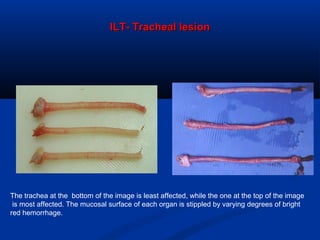
ILT- Tracheal lesionILT- Tracheal lesion
The trachea at the bottom of the image is least affected, while the one at the top of the image
is most affected. The mucosal surface of each organ is stippled by varying degrees of bright
red hemorrhage.
Trachea showing diffuse haemorrhage in the affected birds.Trachea showing diffuse haemorrhage in the affected birds.
ILT – Tracheal lesionsILT – Tracheal lesions
ILT- Tracheal lesionILT- Tracheal lesion
Fibrinous tracheitisFibrinous tracheitis
Air sac and Lung lesionsAir sac and Lung lesions
ILT – Tracheal and Lung lesionsILT – Tracheal and Lung lesions
ILT – Bursal enlargement in growersILT – Bursal enlargement in growers
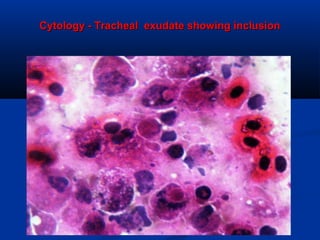
Cytology - Tracheal exudate showing inclusionCytology - Tracheal exudate showing inclusion
ILT - TracheaILT - Trachea
Hyperplasia, lymphcytic infiltration
and oedema
Diffuse lymphocytic aggregation,
degeneration of the epithelium and
haemorrhages
Lumen contain fibrin and debris Necrosis and soughing of epithelium
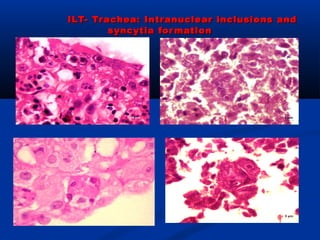
ILT- Trachea: Intranuclear inclusions andILT- Trachea: Intranuclear inclusions and
syncytia formationsyncytia formation
ILT – syncytia with inclusionILT – syncytia with inclusion
Syncytial cell (arrow) with intranuclear inclusion bodies (openSyncytial cell (arrow) with intranuclear inclusion bodies (open
arrows).arrows).
ILT – Inclusion by Phloxine tartrazin stainILT – Inclusion by Phloxine tartrazin stain
ILT- LungILT- Lung
Lung – Mild pulmonary congestion
Lung- Fibrinous bronchopneumonia
Lung – Fibrinous pneumonia with dense cellular
infiltrate of mononuclear cells and heterophils
Indirect immunoperoxidase testIndirect immunoperoxidase test . (b) tracheal lumen: to the left a syncytium. (b) tracheal lumen: to the left a syncytium
without staining, and to the right a syncytium with focal staining); (c) trachealwithout staining, and to the right a syncytium with focal staining); (c) tracheal
lumen: partial staining of syncytium cytoplasm; (d) tracheal lumen: staining oflumen: partial staining of syncytium cytoplasm; (d) tracheal lumen: staining of
nuclei from a disrupted syncytium ; (e) same as (d) but at higher magnification.nuclei from a disrupted syncytium ; (e) same as (d) but at higher magnification.
ILT - ImmunohistochemistryILT - Immunohistochemistry
ILT – Egg inoculationILT – Egg inoculation
CAM showing multinucleated cells and intranuclearCAM showing multinucleated cells and intranuclear
inclusions bodies (arrows).inclusions bodies (arrows).
CAM : Epithelial cells exhibited prominent eosinophilic intranuclear inclusions andCAM : Epithelial cells exhibited prominent eosinophilic intranuclear inclusions and
formation of syncytia typical of ILTV infection. Inset: ILTV inclusion bodies atformation of syncytia typical of ILTV infection. Inset: ILTV inclusion bodies at
higher (40x) magnification demonstrate peripheralization of hromatin.higher (40x) magnification demonstrate peripheralization of hromatin.
Combined infection of ILT and FP: ILT - amphophilic intranuclearCombined infection of ILT and FP: ILT - amphophilic intranuclear
inclusions (thin arrows) and FP - acidophilic haloed intracytoplasmicinclusions (thin arrows) and FP - acidophilic haloed intracytoplasmic
inclusions (white block arrows) are shown.inclusions (white block arrows) are shown.
Amplification of partial glycoprotein- G gene (US4 gene) from theAmplification of partial glycoprotein- G gene (US4 gene) from the
tissue samples yielded expected product size of 589 bptissue samples yielded expected product size of 589 bp
Visualization of the 647-bp PCR product from the Thymidine kinase geneVisualization of the 647-bp PCR product from the Thymidine kinase gene
of ILTV by Agarose gel electrophoresis (1.5%) after staining with ethidiumof ILTV by Agarose gel electrophoresis (1.5%) after staining with ethidium
bromidebromide Lane-1: molecular marker; Lane 2-7 :Lane-1: molecular marker; Lane 2-7 : ILTV Field Isolates Lane 8 :ILTV Field Isolates Lane 8 :
ILT Vaccine (Merile)ILT Vaccine (Merile)
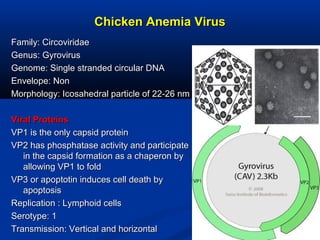
Chicken Anemia VirusChicken Anemia Virus
Family: CircoviridaeFamily: Circoviridae
Genus: GyrovirusGenus: Gyrovirus
Genome: Single stranded circular DNAGenome: Single stranded circular DNA
Envelope: NonEnvelope: Non
Morphology: Icosahedral particle of 22-26 nmMorphology: Icosahedral particle of 22-26 nm
Viral ProteinsViral Proteins
VP1 is the only capsid proteinVP1 is the only capsid protein
VP2 has phosphatase activity and participateVP2 has phosphatase activity and participate
in the capsid formation as a chaperon byin the capsid formation as a chaperon by
allowing VP1 to foldallowing VP1 to fold
VP3 or apoptotin induces cell death byVP3 or apoptotin induces cell death by
apoptosisapoptosis
Replication : Lymphoid cellsReplication : Lymphoid cells
Serotype: 1Serotype: 1
Transmission: Vertical and horizontalTransmission: Vertical and horizontal
Chicken infectious anemiaChicken infectious anemia
 Chicken infectious anemia virus is the causative agent of an immunosuppressiveChicken infectious anemia virus is the causative agent of an immunosuppressive
disease of young chickens.disease of young chickens.
 The clinical symptoms are generally observed at 10 to 14 d of age and includeThe clinical symptoms are generally observed at 10 to 14 d of age and include
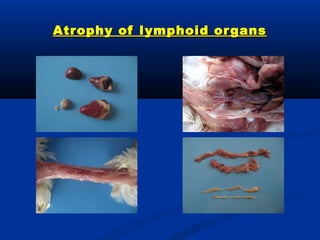
increased mortality, anemia, thymic atrophy, subcutaneous hemorrhages andincreased mortality, anemia, thymic atrophy, subcutaneous hemorrhages and
gangrenous dermatitis.gangrenous dermatitis.
 According to the presenting signs and lesions, the disease has been variouslyAccording to the presenting signs and lesions, the disease has been variously
called anaemia-dermatis syndrome, blue wing disease, infectious anaemia andcalled anaemia-dermatis syndrome, blue wing disease, infectious anaemia and
Haemorrhagic syndromeHaemorrhagic syndrome
 Despite the lack of clinical disease, older birds infected with CIAV have beenDespite the lack of clinical disease, older birds infected with CIAV have been
found to have a decreased immune response as evidenced by poor vaccinefound to have a decreased immune response as evidenced by poor vaccine
response and increased severity of other infectionsresponse and increased severity of other infections
Pale carcass and internal organsPale carcass and internal organs
Gangrenous DermatitisGangrenous Dermatitis
Muscular and visceralMuscular and visceral
haemorrhageshaemorrhages
Pale enlarged liver with focalPale enlarged liver with focal
necrosisnecrosis
Ulceration of proventriculus andUlceration of proventriculus and
gizzard mucosagizzard mucosa
Atrophy of lymphoid organsAtrophy of lymphoid organs
Pale and mottled kidneysPale and mottled kidneys
Pale yellowish bone marrowPale yellowish bone marrow
CAV and concurrent infectionsCAV and concurrent infections
Bone marrowBone marrow
Normal - bone marrow with abundant
cells of the erythrocytic and granulocytic
series (H&E , 400x)
severe bone marrow hypoplasia and
complete aplasia, fully depletion of the
erythrocytic and granulocytic series,
both accompanied by space occupying
adipocytic replacement (H&E , 400x)
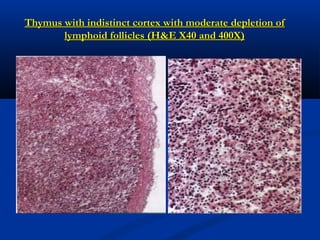
Thymus with indistinct cortex with moderate depletion ofThymus with indistinct cortex with moderate depletion of
lymphoid follicles (H&E X40 and 400X)lymphoid follicles (H&E X40 and 400X)
Histopathology – Bursa and Spleen-Histopathology – Bursa and Spleen-
Lymphoid depletionLymphoid depletion
a. Subcutaneous haemorrhage and oedema with cell swelling of the overlying epidermis in the skin of thea. Subcutaneous haemorrhage and oedema with cell swelling of the overlying epidermis in the skin of the
thigh region.thigh region.
b: Haematopoietic (red) bone marrow with CAV inclusions (arrow) in haemocytoblast.b: Haematopoietic (red) bone marrow with CAV inclusions (arrow) in haemocytoblast.
c: Hypoplastic bone marrow with CAV inclusions (arrows) in haemocytoblast.c: Hypoplastic bone marrow with CAV inclusions (arrows) in haemocytoblast.
Marek’s diseaseMarek’s disease
MDV – enveloped double strandedMDV – enveloped double stranded
DNA virusDNA virus
Originally Gamma herpes virus ButOriginally Gamma herpes virus But
nownow Alpha herpes virusAlpha herpes virus (Genome)(Genome)
Three serotypesThree serotypes
Serotype 1 – Pathogenic or oncogenicSerotype 1 – Pathogenic or oncogenic
virus with attenuated strains –virus with attenuated strains – 44
pathotypespathotypes
Mild (MMDV), Virulent (VMDV), VeryMild (MMDV), Virulent (VMDV), Very
Virulent (VVMDV) and Very VirulentVirulent (VVMDV) and Very Virulent
plus (VV + MDV)plus (VV + MDV)
Serotype 2 – Nonpathogenic strain sSerotype 2 – Nonpathogenic strain s
Serotype 3 – Herpes viruses of turkeySerotype 3 – Herpes viruses of turkey
Marek’s Disease – Current situationMarek’s Disease – Current situation
 Marek's disease virus (MDV) is a highlyMarek's disease virus (MDV) is a highly cell-associatedcell-associated, lymphotropic, lymphotropic
alphaherpesvirus that causes Marek's disease (MD) in chickens. Clinical signsalphaherpesvirus that causes Marek's disease (MD) in chickens. Clinical signs
include immunosuppression, polyneuritis, and T-cell lymphoma formation in theinclude immunosuppression, polyneuritis, and T-cell lymphoma formation in the
visceral and ectoderm-derived tissues.visceral and ectoderm-derived tissues.
 Although MD has been controlled by vaccination for over 30 years, it continues toAlthough MD has been controlled by vaccination for over 30 years, it continues to
be a serious threat to the health and welfare of poultry, and there is growingbe a serious threat to the health and welfare of poultry, and there is growing
evidence thatevidence that intensive use of vaccines is driving the virus to increasingintensive use of vaccines is driving the virus to increasing
virulencevirulence
 TheThe visceral or ‘acute’ formvisceral or ‘acute’ form of MD became the dominant form and causingof MD became the dominant form and causing
higher mortality than the ‘classical’ slower-developing neural form.higher mortality than the ‘classical’ slower-developing neural form.
 Visceral form commonly noticed fromVisceral form commonly noticed from 20 wk to 72 wk20 wk to 72 wk (more common up to 45(more common up to 45
wk)wk)
 Morbidity and mortality in laying hens due to MD ranged fromMorbidity and mortality in laying hens due to MD ranged from 0 to 60%0 to 60% or evenor even
greater, with losses of up to 75 % being common.greater, with losses of up to 75 % being common.
Marek’s Disease – Current situationMarek’s Disease – Current situation
(Sep 2009 to Sep 2013)(Sep 2009 to Sep 2013)
S.No Oncogenic virus Number
of flock
1. MDV 68
2. LLV 14
3. REV 24
4. MDV +REV 03
5. MDV +LLV 24
6. LLV +REV 21
7. MDV+LLV+REV 06
8. Total 160
MDV PathogenesisMDV Pathogenesis
Immunosuppression in Marek’s DiseaseImmunosuppression in Marek’s Disease
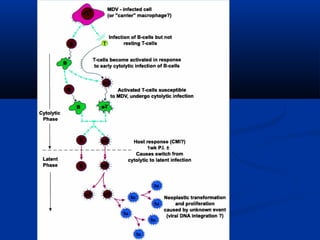
 MDV can induceMDV can induce two phasestwo phases of immunosuppression. Primaryof immunosuppression. Primary
immunosuppression occurs temporarily, immediately after systemic infectionimmunosuppression occurs temporarily, immediately after systemic infection
with MDV, due towith MDV, due to lytic infection of B cellslytic infection of B cells..
 In contrast, the secondary immunosuppression, which is characterized byIn contrast, the secondary immunosuppression, which is characterized by
functional deficiencies of T cellsfunctional deficiencies of T cells, starts about 2 weeks after infection, and, starts about 2 weeks after infection, and
continues for a long period .continues for a long period .
 MDV can induce apoptosis of peripheralMDV can induce apoptosis of peripheral CD4 + T cellsCD4 + T cells and down-regulateand down-regulate
the expression ofthe expression of CD8 + T cellsCD8 + T cells in infected chickens.in infected chickens.
 These immunomodulations may be central to the immunosuppression of TThese immunomodulations may be central to the immunosuppression of T
cells induced by MDV, and it is important for understanding the pathogenesiscells induced by MDV, and it is important for understanding the pathogenesis
of MD to clarify the mechanism of these immunomodulation.of MD to clarify the mechanism of these immunomodulation.
MD- Comb thickening and necrosisMD- Comb thickening and necrosis
MD - EmaciationMD - Emaciation
Visceral form of MDVisceral form of MD
((Liver enlargement with granular appearance)Liver enlargement with granular appearance)
Visceral form of MDVisceral form of MD
(Liver diffusely enlarged)(Liver diffusely enlarged)
Visceral form of MDVisceral form of MD
(( Liver enlargement with focal to multiple nodules )Liver enlargement with focal to multiple nodules )
Visceral form of MDVisceral form of MD
(Liver parenchyma replaced by tumor nodules )(Liver parenchyma replaced by tumor nodules )
Visceral form of MDVisceral form of MD
(Mild Proventriculus thickening)(Mild Proventriculus thickening)
Visceral form of MDVisceral form of MD
( Diffuse Proventriculus thickening)( Diffuse Proventriculus thickening)
Visceral form of MDVisceral form of MD
(Proventriculus mucosa with nodules)(Proventriculus mucosa with nodules)
Visceral form of MD-Visceral form of MD-
(Heart with lymphoma)(Heart with lymphoma)
Visceral form of MDVisceral form of MD
(Pericardium and Heart with lymphoma)(Pericardium and Heart with lymphoma)
Visceral form of MDVisceral form of MD
(Lung with lymphoma)(Lung with lymphoma)
Visceral form of MDVisceral form of MD
(Spleen enlargement and rupture)(Spleen enlargement and rupture)
Visceral form of MDVisceral form of MD
((Spleen enlargement and nodule formation)Spleen enlargement and nodule formation)
Visceral form of MDVisceral form of MD
((Intestine and Mesentery showing lymphoma)Intestine and Mesentery showing lymphoma)
Visceral form of MDVisceral form of MD
(Intestine showing lymphoma)(Intestine showing lymphoma)
Visceral form of MDVisceral form of MD
(Kidney enlargement)(Kidney enlargement)
Visceral form of MDVisceral form of MD
(Ovary atrophy and Ascites)(Ovary atrophy and Ascites)
VisceralVisceral form of MDform of MD
(Ovary with cauliflower like growth)(Ovary with cauliflower like growth)
Visceral form of MDVisceral form of MD
(Ovary with cauliflower like growth)(Ovary with cauliflower like growth)
Visceral form of MDVisceral form of MD
(Ovary with cauliflower like growth and muscle tumor)(Ovary with cauliflower like growth and muscle tumor)
Visceral form of MDVisceral form of MD
(Lesions in visceral organs)(Lesions in visceral organs)
MD in a 14 week old flockMD in a 14 week old flock
Visceral form of MD in Desi birdVisceral form of MD in Desi bird
Gross and histopathologic of
MDV. A. Gross anatomical change,
"a" to "e" were heart, lung, liver,
proventriculus, intestinal tract,
respectively, and tumointestinal
tract and mesentery;
B. "f" to "n" refer to bursa of
fabricius, lung, liver, skeletal
musclers, ovary, spleen, kidney,
proventriculus, cardiac muscle.
Arrows show that pleomorphic
lymphocytes infiltrated and formed
tumors (h, i, m, n), and other
organs were infiltrated by
lymphocytes extensively and their
organizations were completely
destroyed (f, g, j, k, i).
ORTORT
Very small colonies (1-2 mm), non-haemolytic,
greyish white, opaque, convex with butyrous
odour
Gram-negative, highly pleomorphic rod
Species affectedSpecies affected
 Avian species such as chicken, duck, goose, guinea fowl, ostrich,Avian species such as chicken, duck, goose, guinea fowl, ostrich,
pigeon, quail and turkeypigeon, quail and turkey
 Infections caused byInfections caused by Ornithobacterium rhinotrachealeOrnithobacterium rhinotracheale (ORT),(ORT), areare
not promptly recognized. Because either the isolation of ORT isnot promptly recognized. Because either the isolation of ORT is
difficult or investigators are less well-versed with ORT other than thedifficult or investigators are less well-versed with ORT other than the
pathogens likepathogens like Avibacterium paragallinarumAvibacterium paragallinarum etcetc..
Impact of ORTImpact of ORT
 Clinical signs such as depression, gasping, severe dyspnoea mucus
discharge and weakness
 Associated with high economic losses in poultry due to mortality andAssociated with high economic losses in poultry due to mortality and
condemnation rates, a drop in egg production or a decrease of thecondemnation rates, a drop in egg production or a decrease of the
performance resultsperformance results
 The severity of clinical signs, duration of the disease are influenced byThe severity of clinical signs, duration of the disease are influenced by
many environmental factors such as poor management, inadequatemany environmental factors such as poor management, inadequate
ventilation, high stocking density, poor litter conditions, poor hygieneventilation, high stocking density, poor litter conditions, poor hygiene
or concurrent infectionsor concurrent infections
Triggering effect
 Newcastle disease virus and to a lesser extent Infectious Bronchitis
virus showed triggering effects on the ORT infection in chickens
 Not only viruses but also bacteria such as Escherichia coli and
Bordetella avium were able to trigger the ORT infection
ORTORT
HistopathologyHistopathology
TracheaTrachea
 Hypertrophy of gobletHypertrophy of goblet
cells and deciliationcells and deciliation
 Desquamation of epitheliumDesquamation of epithelium
with moderate haemorrhagewith moderate haemorrhage
Egg shell apex abnormality (EAA)
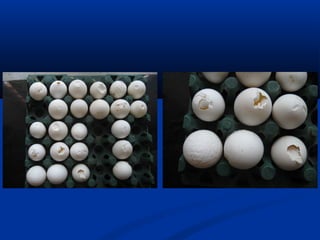
 The EAA are characterized by a roughened shell surface, shell thinning,The EAA are characterized by a roughened shell surface, shell thinning,
increased translucency, cracks and breaks.increased translucency, cracks and breaks.
 The abnormalities were confined to a region up to approximately 2 cm from
the apex of the egg, and in most cases there was a very clear demarcation
zone and increased translucency visible at candling.
 Egg production losses including the loss of eggs due to breakage of soft-
shell eggs, increased number of downgraded eggs and increased labour
costs due to the selection of eggs with EAA and cleaning of the facilities due
to broken eggs were the main contributors to the economic impact of this
eggshell pathology.
 Decrease hatchability in breeder chicken
Identification of EAAIdentification of EAA
 The identification of EAA was based on the outer eggshellThe identification of EAA was based on the outer eggshell
characteristics and egg candling in combination with eggshellcharacteristics and egg candling in combination with eggshell
strength measurement.strength measurement.
 Eggs with EAA are characterized by an altered shell surface, whichEggs with EAA are characterized by an altered shell surface, which
is confined to the top cone of the egg.is confined to the top cone of the egg.
 At candling a clear demarcation zone separates the altered eggshellAt candling a clear demarcation zone separates the altered eggshell
from the normal part and the abnormal eggshell shows increasedfrom the normal part and the abnormal eggshell shows increased
translucency.translucency.
 Egg shell strength is decreased in the affected flocksEgg shell strength is decreased in the affected flocks
Cause of EAACause of EAA
 Mycoplasma synoviae is considered the second most importantMycoplasma synoviae is considered the second most important
mycoplasma affecting chickens.mycoplasma affecting chickens.
 It causes respiratory diseases subclinical respiratory tract infection andIt causes respiratory diseases subclinical respiratory tract infection and
synovitis in chickensynovitis in chicken
 Certain strains of MS alone or in combination with IBV cause theCertain strains of MS alone or in combination with IBV cause the
eggshell apex abnormalitieseggshell apex abnormalities
 M. synoviae may affect the composition and concentration of eggshellM. synoviae may affect the composition and concentration of eggshell
matrix proteins in the uterine fluid, which are needed for the regulation ofmatrix proteins in the uterine fluid, which are needed for the regulation of
the growth of calcite duringthe growth of calcite during eggshell calcification .eggshell calcification .
 M. synoviae may also affect ciliary motility in the oviduct, which couldM. synoviae may also affect ciliary motility in the oviduct, which could
lead changes in the uterine fluid content affecting the deposition oflead changes in the uterine fluid content affecting the deposition of
calcium carbonate crystals.calcium carbonate crystals.
Normal egg shell layersNormal egg shell layers
A: SEM image of an unaffected eggshell showing the inner membranes (A), theA: SEM image of an unaffected eggshell showing the inner membranes (A), the
mammillary knob layer (B) and part of the palisade layer (C).mammillary knob layer (B) and part of the palisade layer (C).
b: SEM image of an abnormal apical eggshell. The mammillary knob layer isb: SEM image of an abnormal apical eggshell. The mammillary knob layer is
absent and only part of the palisade layer is present: inner membranes (A),absent and only part of the palisade layer is present: inner membranes (A),
palisade layer (B), vertical layer (arrow) and cuticule (arrowhead). Note also thepalisade layer (B), vertical layer (arrow) and cuticule (arrowhead). Note also the
increased density of the inner membranes.increased density of the inner membranes.
Shell breaks in the translucent areaShell breaks in the translucent area
Gallibacterium anatis associated peritonitis
 Avian pathogenic Escherichia coli (APEC) has typically been incriminated as
the causative agent of laying hen peritonitis.
 However, evidence suggests that Gallibacterium anatis may also play a role in
the pathogenesis of this disease and their importance is likely to be
underestimated due to overgrowth by other bacterial species and the difficulties
of identification.
 G. anatis is a Gram negative, non-motile, encapsulated, usually β-hemolytic
coccobacillus of the Pasteurellaceae family that forms grayish, round,
semitransparent colonies.
 This bacterium is known to be a member of the normal upper respiratory tract
and lower reproductive tract of chickens but has also been implicated in
peritonitis and salpingitis in commercial laying hens leads to decreased egg
production
 The gross pathological lesions of reproductive disorders due to gallibacterium
infection cannot be distinguished from infections with E. coli.
Gallibacterium anatis associated peritonitis
ConclusionConclusion
 The true prevalence of many emerging diseases are not known. Since we
live in a “global village”, we cannot afford to be complacent about the
tremendous economic, social and public health burden of these diseases.
 The critical steps in addressing any emerging disease are bioexclusion,
surveillance and biocontainment.
 Eradication requires that there is an effective means of detecting,
containing and preventing dissemination of the disease causing agent.
 The success of any eradication program hinges on early detection
through thorough and diligent surveillance and this is possibly where we
are not adequately prepared to handle emerging diseases.
THANK YOU

Emerging diseases in layer chicken

  • 1.
    Emerging DiseasesEmerging Diseases inLayer Chickenin Layer Chicken
  • 2.
    Emerging DiseaseEmerging Disease The World Organisation for Animal Health (OIE) defines anThe World Organisation for Animal Health (OIE) defines an emerging disease asemerging disease as ““A new infection or infestation resulting from the evolution orA new infection or infestation resulting from the evolution or change of an existing pathogenic agent, a known infection orchange of an existing pathogenic agent, a known infection or infestation spreading to a new geographic area or population, or ainfestation spreading to a new geographic area or population, or a previously un recognised pathogenic agent or disease diagnosed forpreviously un recognised pathogenic agent or disease diagnosed for the first time and which has a significant impact on animal or publicthe first time and which has a significant impact on animal or public health.”health.” A known or endemic disease is considered to be re-emerging if itA known or endemic disease is considered to be re-emerging if it shifts its geographical setting, expands its host range, orshifts its geographical setting, expands its host range, or significantly increases its prevalence.significantly increases its prevalence.
  • 3.
    IntroductionIntroduction  The natureand intensification of the poultry industry, multiplication ofThe nature and intensification of the poultry industry, multiplication of species, movements of birds, trade of vaccine and environmental changesspecies, movements of birds, trade of vaccine and environmental changes causes emergence of certain diseases in recent yearscauses emergence of certain diseases in recent years  Both established and emerging poultry diseases, and the pathogens thatBoth established and emerging poultry diseases, and the pathogens that cause them, are continual threats to the industrycause them, are continual threats to the industry  Avian influenzaAvian influenza  Avian metapneumovirusAvian metapneumovirus  Infectious laryngotracheitisInfectious laryngotracheitis  Chicken infectious anemiaChicken infectious anemia  Neoplastic diseasesNeoplastic diseases  Ornithobacterium rhinotrachiale (ORT)Ornithobacterium rhinotrachiale (ORT)  Eggshell apex abnormalitiesEggshell apex abnormalities  Gallibacterium anatis associated peritonitis
  • 4.
    ETIOLOGYETIOLOGY ORTHOMYXOVIRIDAEORTHOMYXOVIRIDAE Influenza A InfluenzaB Influenza CInfluenza A Influenza B Influenza C Infect wide variety of animals Primarily humans occasionally pigsInfect wide variety of animals Primarily humans occasionally pigs Wild ducks, chickens, turkeys, and seals but not birdsWild ducks, chickens, turkeys, and seals but not birds Pigs, horses, mink, seals & humansPigs, horses, mink, seals & humans Influenza AInfluenza A 8 gene segments8 gene segments 10 different proteins10 different proteins Surface protein Internal proteinsSurface protein Internal proteins HA, NA & Matrix PB1, PB2, PA, nucleoprotein, matrix 1 protein ,HA, NA & Matrix PB1, PB2, PA, nucleoprotein, matrix 1 protein , 2 protein Nonstructural protein 1 &22 protein Nonstructural protein 1 &2
  • 5.
    HA PB1 PB2 PA NP NA MA NS M2 Hemagglutinin Neuraminidase M1 Influenza A Virus Negativesense RNA Single stranded Segmented 18 Hemagglutinin subtypes 11 Neuraminidase Subtypes
  • 6.
    Indian scenario ofHighly Pathogenic AvianIndian scenario of Highly Pathogenic Avian InfluenzaInfluenza  The H5N1-HPAI was first detected in India in February 2006 in severalThe H5N1-HPAI was first detected in India in February 2006 in several commercial farms in Navapur of Nandurbar district in Maharashtra.commercial farms in Navapur of Nandurbar district in Maharashtra.   Subsequently, pockets of outbreaks also were reported in backyardSubsequently, pockets of outbreaks also were reported in backyard poultry in Madhya Pradesh and Gujaratpoultry in Madhya Pradesh and Gujarat  The outbreak was controlled and India regained disease free status inThe outbreak was controlled and India regained disease free status in August 2006August 2006  During the second week of July 2007 HPAI appeared in a smallDuring the second week of July 2007 HPAI appeared in a small backyard poultry unit in Manipurbackyard poultry unit in Manipur  The incidence could be successfully contained by precise and timelyThe incidence could be successfully contained by precise and timely diagnosis by HSADL, IVRI. India again faced more serious HPAIdiagnosis by HSADL, IVRI. India again faced more serious HPAI outbreak at West Bengal in January 2008outbreak at West Bengal in January 2008
  • 7.
     The diseasewas rapidly spread mainly in backyard poultry andThe disease was rapidly spread mainly in backyard poultry and ducks in 15 out of 19 districts within a span of one month andducks in 15 out of 19 districts within a span of one month and another outbreak was recorded in Tripura in April, 2008 inanother outbreak was recorded in Tripura in April, 2008 in backyard ducks and geesebackyard ducks and geese  Though the west Bengal and Tripura outbreaks successfullyThough the west Bengal and Tripura outbreaks successfully contained and India regained disease free status during firstcontained and India regained disease free status during first week of November 2008, within two weeks of regaining AIV freeweek of November 2008, within two weeks of regaining AIV free status, AIV again started to hit in Assam and killed thousandsstatus, AIV again started to hit in Assam and killed thousands of backyard poultry in last week of November 2008of backyard poultry in last week of November 2008  Subsequently it was spread to parts of West Bengal andSubsequently it was spread to parts of West Bengal and Mizoram and Sikkim (DADF-2009) and finally controlledMizoram and Sikkim (DADF-2009) and finally controlled  India regained its AIV free status on October 2009India regained its AIV free status on October 2009
  • 8.
     Fresh outbreaksof HPAI again sprouted in west Bengal after 15Fresh outbreaks of HPAI again sprouted in west Bengal after 15thth January 2010 (OIE,2010).January 2010 (OIE,2010).   New cases were being reported in Bihar, Sikkim, Jharkhand,New cases were being reported in Bihar, Sikkim, Jharkhand, Odessa, Karnataka and Kerala in the year 2011-14 in domesticOdessa, Karnataka and Kerala in the year 2011-14 in domestic poultry, crows, turkeys and ducks.poultry, crows, turkeys and ducks.  As on November 2014;As on November 2014; 98 outbreaks98 outbreaks have been detected in India,have been detected in India, 1, 52, 6431, 52, 643 birds have beenbirds have been succumbed to deathsuccumbed to death andand 64,51,64,51, 985 birds have been destroyed985 birds have been destroyed causing huge economic losses,causing huge economic losses, reckoned to be in excess of Rs 10,000 crore, to the Indian poultryreckoned to be in excess of Rs 10,000 crore, to the Indian poultry industryindustry
  • 9.
    Avian InfluenzaAvian Influenza Low pathogenic avian influenza (LPAI)Low pathogenic avian influenza (LPAI)  Associated with mild illness in poultryAssociated with mild illness in poultry  Can evolve into highly pathogenic virusesCan evolve into highly pathogenic viruses  Associated with poultry outbreaks world wideAssociated with poultry outbreaks world wide  High pathogenic avian influenza (HPAI)High pathogenic avian influenza (HPAI)  Causes high mortality in domestic poultryCauses high mortality in domestic poultry  Subtypes H5 and H7Subtypes H5 and H7
  • 10.
    Cleavage of HemagglutininProtein by Host Proteases • In LPAI viruses, only trypsin-like proteases found in the enteric and respiratory tracts can cleave the HA protein-virus replication and disease is restricted • In HPAI viruses, the HA protein can be cleaved by ubiquitous proteases found in most cells-virus can replicate systemically
  • 12.
    Clinical Signs –Depression and HuddlingClinical Signs – Depression and Huddling
  • 13.
    Drop in Eggproduction
  • 14.
  • 15.
    Edema of uppereyelidEdema of upper eyelid
  • 16.
    Swollen blue,Swollen blue,cyanoticcyanotic combs and wattlescombs and wattles
  • 17.
    Nasal and oraldischargeNasal and oral discharge
  • 18.
  • 19.
    Clinical SignsClinical Signs Subcutaneoushemorrhage of shanksSubcutaneous hemorrhage of shanks
  • 20.
    2006 Clinical Signs –ClinicalSigns – Huddling, Sinusitis andHuddling, Sinusitis and Respiratory signsRespiratory signs
  • 21.
    Neurological signs (Nervoussigns) Similar toNeurological signs (Nervous signs) Similar to Newcastle DiseaseNewcastle Disease
  • 23.
  • 24.
    Avian Influenza -Gross lesions Haemorrhage in muscle cyanotic wattle, comb, and facial edema Urate deposit in kidneys Haemorrhages in skin and shank Haemorrhages in intestinal walls
  • 25.
    Lesions in chickensfollowing experimental infection with the Mexican H7N3 HPAI virus detected at 2 days postinoculation. (a) Prostration and edema of periorbital tissues; (b) subcutaneous hemorrhage of wattles and comb and conjunctivitis and swelling of periorbital area; (c) subcutaneous hemorrhages of leg shanks; (d) mucous in larynx; (e) petechial hemorrhages on breast muscle
  • 28.
    LPAILPAI LPAI in respiratorydisease complex of commercial - H9N2 subtype.LPAI in respiratory disease complex of commercial - H9N2 subtype. LPAI outbreaks seasonal - summer but in the recent years throughout theLPAI outbreaks seasonal - summer but in the recent years throughout the yearyear Growers respiratory and nervous signs. Mortality 5 to 25 perGrowers respiratory and nervous signs. Mortality 5 to 25 per In layer, sudden onset of depression, drop in feed intake and respiratory signsIn layer, sudden onset of depression, drop in feed intake and respiratory signs are the first indication.are the first indication.
  • 29.
    PathologyPathology Gross lesions mainlyin respiratory, genital, urinary and digestive system.Gross lesions mainly in respiratory, genital, urinary and digestive system. Trachea - mucus exudate, fibrinous flacks, mild to sever congestion evenTrachea - mucus exudate, fibrinous flacks, mild to sever congestion even haemorrhages.haemorrhages. Lungs - congestion and edema and few cases consolidation at the insertion of bronchi.Lungs - congestion and edema and few cases consolidation at the insertion of bronchi. Thoracic and abdominal air sacs -edematous, frothy and contain fibrinous exudates.Thoracic and abdominal air sacs -edematous, frothy and contain fibrinous exudates. Oviduct - severe transmural edema with clear excessive albumin in lumen and relativelyOviduct - severe transmural edema with clear excessive albumin in lumen and relatively large quantity of thick, white yellow coloured fluid in the abdominal cavity.large quantity of thick, white yellow coloured fluid in the abdominal cavity. Peritonitis with low amount of fibrinous exudates over the ovaries.Peritonitis with low amount of fibrinous exudates over the ovaries. Proventriculus - petechial hemorrhages.Proventriculus - petechial hemorrhages. Pancreas is enlarged and hardened.Pancreas is enlarged and hardened.
  • 30.
    Trachea: Severe acutediffuse mucosalTrachea: Severe acute diffuse mucosal hemorrhagehemorrhage
  • 31.
  • 32.
  • 33.
    Kidneys: Acute diffuseedema and congestion with urate retentionKidneys: Acute diffuse edema and congestion with urate retention
  • 34.
    Haemorrhage in proventriculusand sternumHaemorrhage in proventriculus and sternum
  • 35.
    Epicardial and CloacalhaemorrhagesEpicardial and Cloacal haemorrhages
  • 36.
  • 38.
  • 39.
    Avian Meta pneumovirusAvianMeta pneumovirus Family – ParamyxoviridaeFamily – Paramyxoviridae Subfamily – PnemovirinaeSubfamily – Pnemovirinae Genus – MetapneumovirusGenus – Metapneumovirus Virus – Avian metapneumovirusVirus – Avian metapneumovirus F protein that promotes cellF protein that promotes cell fusion, dofusion, do not hemagglutinatenot hemagglutinate G attachmentG attachment proteins of these virusesproteins of these viruses do not have neuraminidase activity.do not have neuraminidase activity. Based on molecular analysis of theBased on molecular analysis of the genome, aMPV can be classified intogenome, aMPV can be classified into four subtypes: A, B, C and D.four subtypes: A, B, C and D. India –India – Subtype ASubtype A
  • 40.
    Avian Metapneumo virusAvianMetapneumo virus  The virus is able to replicate in the respiratory tract, especially theThe virus is able to replicate in the respiratory tract, especially the upper tissues, resulting in anupper tissues, resulting in an acute respiratory diseaseacute respiratory disease in turkeys andin turkeys and chickens with significant economic losses, especially if the infection ischickens with significant economic losses, especially if the infection is associated with secondary pathogens.associated with secondary pathogens.  In broilers, aMPV is involved, among other agents, in theIn broilers, aMPV is involved, among other agents, in the swollen headswollen head syndrome (SHS)syndrome (SHS) and is likely to play a role in pathogenesis ofand is likely to play a role in pathogenesis of testicular diseasetesticular disease..  Exacerbating factorsExacerbating factors for APV infection are the common ones forfor APV infection are the common ones for respiratory diseases and include high ammonia and dust levels in therespiratory diseases and include high ammonia and dust levels in the atmosphere, overcrowding and intercurrent infections.atmosphere, overcrowding and intercurrent infections.
  • 41.
    Clinical signs a:Control , b: aMPV subtype-B-inoculated bird showingClinical signs a: Control , b: aMPV subtype-B-inoculated bird showing swelling of periorbital sinuses and the area around the eye (black arrow)swelling of periorbital sinuses and the area around the eye (black arrow) and clear nasal exudate (white arrow).and clear nasal exudate (white arrow).
  • 42.
    Immunohistochemistry for aMPVantigens, horseradishImmunohistochemistry for aMPV antigens, horseradish peroxidase method, hematoxylin counterstain.peroxidase method, hematoxylin counterstain. Nasal cavity Trachea
  • 43.
    ILT – EtiologyILT– Etiology Family – HerpesviridaeFamily – Herpesviridae Subfamily – AlphaherpesvirinaeSubfamily – Alphaherpesvirinae Genus - IltovirusGenus - Iltovirus Species – Gallid herpesvirus 1Species – Gallid herpesvirus 1 Electron microscopy - ILTV particlesElectron microscopy - ILTV particles consisting of a DNA-containing core withinconsisting of a DNA-containing core within an icosahedral capsid which is surrounded by aan icosahedral capsid which is surrounded by a proteinaceous tegument layer and an outerproteinaceous tegument layer and an outer envelope with incorporated viral glycoproteins.envelope with incorporated viral glycoproteins. The envelope contains five major glycoproteinThe envelope contains five major glycoprotein spikes (gB, gC, gD, gX, gK) are the majorspikes (gB, gC, gD, gX, gK) are the major immunogens of Laryngotracheitis virus.immunogens of Laryngotracheitis virus. Virus (ILTV) strains are antigenically homogenous, however vary inVirus (ILTV) strains are antigenically homogenous, however vary in Vary in virulenceVary in virulence
  • 44.
    Global distribution ofILT as of 2013Global distribution of ILT as of 2013
  • 45.
    Incidence of ILTin Namakkal Region of Tamil NaduIncidence of ILT in Namakkal Region of Tamil Nadu Year Tracheitis ILT No. of Farms No. of birds No. of Farms No. of birds 2009- 10 156 820 27 78 2010- 11 327 1666 109 543 2011-12 472 2064 252 1018 2012-13 318 1541 554 3128 2013-14 268 1327 926 4792 Srinivassan P Balachandran C Gopalakrishna Murthy T R Saravanan S Pazhanivel N Mohan B and Murali Manohar B. 2012. Pathology of infectious laryngotracheitis in commercial layer chicken. Indian Vet. J.88 (8): 75-78. Gowthaman V, Singh SD, Dhama K, Barathidasan R, Mathapati BS, Srinivasan P, Saravanan S, Ramakrishnan MA. 2014. Molecular detection and characterization of infectious laryngo tracheitis virus (Gallid herpesvirus-1) from clinical samples of commercial poultry flocks in India. Virus Dis., 25:345–349
  • 46.
    ILT- Clinical signsILT-Clinical signs  Clinically, the disease may appear in three forms -Peracute , acute, andClinically, the disease may appear in three forms -Peracute , acute, and chronic or mild.chronic or mild.  In peracute form, sudden onset and rapid spread. Mortality may be as highIn peracute form, sudden onset and rapid spread. Mortality may be as high as 70%.as 70%.  In acute form, the onset of illness is slower and respiratory signs may extendIn acute form, the onset of illness is slower and respiratory signs may extend over some days before deaths are seen. Mortality may range from 10-30%.over some days before deaths are seen. Mortality may range from 10-30%.  Chronic or mild ILT may be seen among survivors of the above forms of theChronic or mild ILT may be seen among survivors of the above forms of the disease, although some outbreaks themselves may be entirely mild. Thedisease, although some outbreaks themselves may be entirely mild. The mild form is the most commonly seen type and is called “silent, vaccinal, ormild form is the most commonly seen type and is called “silent, vaccinal, or almond-shape eye” ILT.almond-shape eye” ILT.  The disease spread very slowly and the path of infection through a cageThe disease spread very slowly and the path of infection through a cage house may be apparent as a result it persisted for 2 to 6 weeks period inhouse may be apparent as a result it persisted for 2 to 6 weeks period in each flock.each flock.  High environmental temperatures (35 C) cause higher mortality from LTVHigh environmental temperatures (35 C) cause higher mortality from LTV infection, hence during summer the incidence is more compared to otherinfection, hence during summer the incidence is more compared to other seasons.seasons.
  • 47.
    ILT – PeracuteInfected birds are lethargic, have swollen eye-lidsILT – Peracute Infected birds are lethargic, have swollen eye-lids followed by ocular discharge.followed by ocular discharge.
  • 48.
    ILT – PeracuteBirds exhibit mouth breathing, coughing and emitILT – Peracute Birds exhibit mouth breathing, coughing and emit respiratory noises.respiratory noises.
  • 49.
  • 50.
    ILT Peracute -Clots of blood may be coughed up and can beILT Peracute - Clots of blood may be coughed up and can be found on the floor and walls of the house.found on the floor and walls of the house.
  • 51.
    ILT – Acutemucoid nasal discharge, gasping and swollen eyelids.ILT – Acute mucoid nasal discharge, gasping and swollen eyelids.
  • 52.
    ILT – Chronic: conjunctivitis, swelling of the infraorbital sinusesILT – Chronic : conjunctivitis, swelling of the infraorbital sinuses (almond shaped eyes), and nasal discharge.(almond shaped eyes), and nasal discharge.
  • 53.
    ILT – Bodycondition and Liver lesionILT – Body condition and Liver lesion
  • 54.
    ILT – EggboundnessILT – Egg boundness
  • 55.
    ILT- Tracheal lesionILT-Tracheal lesion The trachea at the bottom of the image is least affected, while the one at the top of the image is most affected. The mucosal surface of each organ is stippled by varying degrees of bright red hemorrhage.
  • 56.
    Trachea showing diffusehaemorrhage in the affected birds.Trachea showing diffuse haemorrhage in the affected birds.
  • 57.
    ILT – TracheallesionsILT – Tracheal lesions
  • 58.
    ILT- Tracheal lesionILT-Tracheal lesion
  • 59.
  • 60.
    Air sac andLung lesionsAir sac and Lung lesions
  • 61.
    ILT – Trachealand Lung lesionsILT – Tracheal and Lung lesions
  • 62.
    ILT – Bursalenlargement in growersILT – Bursal enlargement in growers
  • 63.
    Cytology - Trachealexudate showing inclusionCytology - Tracheal exudate showing inclusion
  • 64.
    ILT - TracheaILT- Trachea Hyperplasia, lymphcytic infiltration and oedema Diffuse lymphocytic aggregation, degeneration of the epithelium and haemorrhages Lumen contain fibrin and debris Necrosis and soughing of epithelium
  • 65.
    ILT- Trachea: Intranuclearinclusions andILT- Trachea: Intranuclear inclusions and syncytia formationsyncytia formation
  • 66.
    ILT – syncytiawith inclusionILT – syncytia with inclusion
  • 67.
    Syncytial cell (arrow)with intranuclear inclusion bodies (openSyncytial cell (arrow) with intranuclear inclusion bodies (open arrows).arrows).
  • 68.
    ILT – Inclusionby Phloxine tartrazin stainILT – Inclusion by Phloxine tartrazin stain
  • 69.
    ILT- LungILT- Lung Lung– Mild pulmonary congestion Lung- Fibrinous bronchopneumonia Lung – Fibrinous pneumonia with dense cellular infiltrate of mononuclear cells and heterophils
  • 70.
    Indirect immunoperoxidase testIndirectimmunoperoxidase test . (b) tracheal lumen: to the left a syncytium. (b) tracheal lumen: to the left a syncytium without staining, and to the right a syncytium with focal staining); (c) trachealwithout staining, and to the right a syncytium with focal staining); (c) tracheal lumen: partial staining of syncytium cytoplasm; (d) tracheal lumen: staining oflumen: partial staining of syncytium cytoplasm; (d) tracheal lumen: staining of nuclei from a disrupted syncytium ; (e) same as (d) but at higher magnification.nuclei from a disrupted syncytium ; (e) same as (d) but at higher magnification.
  • 71.
    ILT - ImmunohistochemistryILT- Immunohistochemistry
  • 72.
    ILT – EgginoculationILT – Egg inoculation
  • 73.
    CAM showing multinucleatedcells and intranuclearCAM showing multinucleated cells and intranuclear inclusions bodies (arrows).inclusions bodies (arrows).
  • 74.
    CAM : Epithelialcells exhibited prominent eosinophilic intranuclear inclusions andCAM : Epithelial cells exhibited prominent eosinophilic intranuclear inclusions and formation of syncytia typical of ILTV infection. Inset: ILTV inclusion bodies atformation of syncytia typical of ILTV infection. Inset: ILTV inclusion bodies at higher (40x) magnification demonstrate peripheralization of hromatin.higher (40x) magnification demonstrate peripheralization of hromatin.
  • 75.
    Combined infection ofILT and FP: ILT - amphophilic intranuclearCombined infection of ILT and FP: ILT - amphophilic intranuclear inclusions (thin arrows) and FP - acidophilic haloed intracytoplasmicinclusions (thin arrows) and FP - acidophilic haloed intracytoplasmic inclusions (white block arrows) are shown.inclusions (white block arrows) are shown.
  • 76.
    Amplification of partialglycoprotein- G gene (US4 gene) from theAmplification of partial glycoprotein- G gene (US4 gene) from the tissue samples yielded expected product size of 589 bptissue samples yielded expected product size of 589 bp
  • 77.
    Visualization of the647-bp PCR product from the Thymidine kinase geneVisualization of the 647-bp PCR product from the Thymidine kinase gene of ILTV by Agarose gel electrophoresis (1.5%) after staining with ethidiumof ILTV by Agarose gel electrophoresis (1.5%) after staining with ethidium bromidebromide Lane-1: molecular marker; Lane 2-7 :Lane-1: molecular marker; Lane 2-7 : ILTV Field Isolates Lane 8 :ILTV Field Isolates Lane 8 : ILT Vaccine (Merile)ILT Vaccine (Merile)
  • 79.
    Chicken Anemia VirusChickenAnemia Virus Family: CircoviridaeFamily: Circoviridae Genus: GyrovirusGenus: Gyrovirus Genome: Single stranded circular DNAGenome: Single stranded circular DNA Envelope: NonEnvelope: Non Morphology: Icosahedral particle of 22-26 nmMorphology: Icosahedral particle of 22-26 nm Viral ProteinsViral Proteins VP1 is the only capsid proteinVP1 is the only capsid protein VP2 has phosphatase activity and participateVP2 has phosphatase activity and participate in the capsid formation as a chaperon byin the capsid formation as a chaperon by allowing VP1 to foldallowing VP1 to fold VP3 or apoptotin induces cell death byVP3 or apoptotin induces cell death by apoptosisapoptosis Replication : Lymphoid cellsReplication : Lymphoid cells Serotype: 1Serotype: 1 Transmission: Vertical and horizontalTransmission: Vertical and horizontal
  • 80.
    Chicken infectious anemiaChickeninfectious anemia  Chicken infectious anemia virus is the causative agent of an immunosuppressiveChicken infectious anemia virus is the causative agent of an immunosuppressive disease of young chickens.disease of young chickens.  The clinical symptoms are generally observed at 10 to 14 d of age and includeThe clinical symptoms are generally observed at 10 to 14 d of age and include increased mortality, anemia, thymic atrophy, subcutaneous hemorrhages andincreased mortality, anemia, thymic atrophy, subcutaneous hemorrhages and gangrenous dermatitis.gangrenous dermatitis.  According to the presenting signs and lesions, the disease has been variouslyAccording to the presenting signs and lesions, the disease has been variously called anaemia-dermatis syndrome, blue wing disease, infectious anaemia andcalled anaemia-dermatis syndrome, blue wing disease, infectious anaemia and Haemorrhagic syndromeHaemorrhagic syndrome  Despite the lack of clinical disease, older birds infected with CIAV have beenDespite the lack of clinical disease, older birds infected with CIAV have been found to have a decreased immune response as evidenced by poor vaccinefound to have a decreased immune response as evidenced by poor vaccine response and increased severity of other infectionsresponse and increased severity of other infections
  • 82.
    Pale carcass andinternal organsPale carcass and internal organs
  • 83.
  • 84.
    Muscular and visceralMuscularand visceral haemorrhageshaemorrhages
  • 85.
    Pale enlarged liverwith focalPale enlarged liver with focal necrosisnecrosis
  • 86.
    Ulceration of proventriculusandUlceration of proventriculus and gizzard mucosagizzard mucosa
  • 87.
    Atrophy of lymphoidorgansAtrophy of lymphoid organs
  • 88.
    Pale and mottledkidneysPale and mottled kidneys
  • 89.
    Pale yellowish bonemarrowPale yellowish bone marrow
  • 90.
    CAV and concurrentinfectionsCAV and concurrent infections
  • 91.
    Bone marrowBone marrow Normal- bone marrow with abundant cells of the erythrocytic and granulocytic series (H&E , 400x) severe bone marrow hypoplasia and complete aplasia, fully depletion of the erythrocytic and granulocytic series, both accompanied by space occupying adipocytic replacement (H&E , 400x)
  • 92.
    Thymus with indistinctcortex with moderate depletion ofThymus with indistinct cortex with moderate depletion of lymphoid follicles (H&E X40 and 400X)lymphoid follicles (H&E X40 and 400X)
  • 93.
    Histopathology – Bursaand Spleen-Histopathology – Bursa and Spleen- Lymphoid depletionLymphoid depletion
  • 94.
    a. Subcutaneous haemorrhageand oedema with cell swelling of the overlying epidermis in the skin of thea. Subcutaneous haemorrhage and oedema with cell swelling of the overlying epidermis in the skin of the thigh region.thigh region. b: Haematopoietic (red) bone marrow with CAV inclusions (arrow) in haemocytoblast.b: Haematopoietic (red) bone marrow with CAV inclusions (arrow) in haemocytoblast. c: Hypoplastic bone marrow with CAV inclusions (arrows) in haemocytoblast.c: Hypoplastic bone marrow with CAV inclusions (arrows) in haemocytoblast.
  • 95.
    Marek’s diseaseMarek’s disease MDV– enveloped double strandedMDV – enveloped double stranded DNA virusDNA virus Originally Gamma herpes virus ButOriginally Gamma herpes virus But nownow Alpha herpes virusAlpha herpes virus (Genome)(Genome) Three serotypesThree serotypes Serotype 1 – Pathogenic or oncogenicSerotype 1 – Pathogenic or oncogenic virus with attenuated strains –virus with attenuated strains – 44 pathotypespathotypes Mild (MMDV), Virulent (VMDV), VeryMild (MMDV), Virulent (VMDV), Very Virulent (VVMDV) and Very VirulentVirulent (VVMDV) and Very Virulent plus (VV + MDV)plus (VV + MDV) Serotype 2 – Nonpathogenic strain sSerotype 2 – Nonpathogenic strain s Serotype 3 – Herpes viruses of turkeySerotype 3 – Herpes viruses of turkey
  • 96.
    Marek’s Disease –Current situationMarek’s Disease – Current situation  Marek's disease virus (MDV) is a highlyMarek's disease virus (MDV) is a highly cell-associatedcell-associated, lymphotropic, lymphotropic alphaherpesvirus that causes Marek's disease (MD) in chickens. Clinical signsalphaherpesvirus that causes Marek's disease (MD) in chickens. Clinical signs include immunosuppression, polyneuritis, and T-cell lymphoma formation in theinclude immunosuppression, polyneuritis, and T-cell lymphoma formation in the visceral and ectoderm-derived tissues.visceral and ectoderm-derived tissues.  Although MD has been controlled by vaccination for over 30 years, it continues toAlthough MD has been controlled by vaccination for over 30 years, it continues to be a serious threat to the health and welfare of poultry, and there is growingbe a serious threat to the health and welfare of poultry, and there is growing evidence thatevidence that intensive use of vaccines is driving the virus to increasingintensive use of vaccines is driving the virus to increasing virulencevirulence  TheThe visceral or ‘acute’ formvisceral or ‘acute’ form of MD became the dominant form and causingof MD became the dominant form and causing higher mortality than the ‘classical’ slower-developing neural form.higher mortality than the ‘classical’ slower-developing neural form.  Visceral form commonly noticed fromVisceral form commonly noticed from 20 wk to 72 wk20 wk to 72 wk (more common up to 45(more common up to 45 wk)wk)  Morbidity and mortality in laying hens due to MD ranged fromMorbidity and mortality in laying hens due to MD ranged from 0 to 60%0 to 60% or evenor even greater, with losses of up to 75 % being common.greater, with losses of up to 75 % being common.
  • 97.
    Marek’s Disease –Current situationMarek’s Disease – Current situation (Sep 2009 to Sep 2013)(Sep 2009 to Sep 2013) S.No Oncogenic virus Number of flock 1. MDV 68 2. LLV 14 3. REV 24 4. MDV +REV 03 5. MDV +LLV 24 6. LLV +REV 21 7. MDV+LLV+REV 06 8. Total 160
  • 98.
  • 100.
    Immunosuppression in Marek’sDiseaseImmunosuppression in Marek’s Disease  MDV can induceMDV can induce two phasestwo phases of immunosuppression. Primaryof immunosuppression. Primary immunosuppression occurs temporarily, immediately after systemic infectionimmunosuppression occurs temporarily, immediately after systemic infection with MDV, due towith MDV, due to lytic infection of B cellslytic infection of B cells..  In contrast, the secondary immunosuppression, which is characterized byIn contrast, the secondary immunosuppression, which is characterized by functional deficiencies of T cellsfunctional deficiencies of T cells, starts about 2 weeks after infection, and, starts about 2 weeks after infection, and continues for a long period .continues for a long period .  MDV can induce apoptosis of peripheralMDV can induce apoptosis of peripheral CD4 + T cellsCD4 + T cells and down-regulateand down-regulate the expression ofthe expression of CD8 + T cellsCD8 + T cells in infected chickens.in infected chickens.  These immunomodulations may be central to the immunosuppression of TThese immunomodulations may be central to the immunosuppression of T cells induced by MDV, and it is important for understanding the pathogenesiscells induced by MDV, and it is important for understanding the pathogenesis of MD to clarify the mechanism of these immunomodulation.of MD to clarify the mechanism of these immunomodulation.
  • 101.
    MD- Comb thickeningand necrosisMD- Comb thickening and necrosis
  • 102.
    MD - EmaciationMD- Emaciation
  • 103.
    Visceral form ofMDVisceral form of MD ((Liver enlargement with granular appearance)Liver enlargement with granular appearance)
  • 104.
    Visceral form ofMDVisceral form of MD (Liver diffusely enlarged)(Liver diffusely enlarged)
  • 105.
    Visceral form ofMDVisceral form of MD (( Liver enlargement with focal to multiple nodules )Liver enlargement with focal to multiple nodules )
  • 106.
    Visceral form ofMDVisceral form of MD (Liver parenchyma replaced by tumor nodules )(Liver parenchyma replaced by tumor nodules )
  • 107.
    Visceral form ofMDVisceral form of MD (Mild Proventriculus thickening)(Mild Proventriculus thickening)
  • 108.
    Visceral form ofMDVisceral form of MD ( Diffuse Proventriculus thickening)( Diffuse Proventriculus thickening)
  • 109.
    Visceral form ofMDVisceral form of MD (Proventriculus mucosa with nodules)(Proventriculus mucosa with nodules)
  • 110.
    Visceral form ofMD-Visceral form of MD- (Heart with lymphoma)(Heart with lymphoma)
  • 111.
    Visceral form ofMDVisceral form of MD (Pericardium and Heart with lymphoma)(Pericardium and Heart with lymphoma)
  • 112.
    Visceral form ofMDVisceral form of MD (Lung with lymphoma)(Lung with lymphoma)
  • 113.
    Visceral form ofMDVisceral form of MD (Spleen enlargement and rupture)(Spleen enlargement and rupture)
  • 114.
    Visceral form ofMDVisceral form of MD ((Spleen enlargement and nodule formation)Spleen enlargement and nodule formation)
  • 115.
    Visceral form ofMDVisceral form of MD ((Intestine and Mesentery showing lymphoma)Intestine and Mesentery showing lymphoma)
  • 116.
    Visceral form ofMDVisceral form of MD (Intestine showing lymphoma)(Intestine showing lymphoma)
  • 117.
    Visceral form ofMDVisceral form of MD (Kidney enlargement)(Kidney enlargement)
  • 118.
    Visceral form ofMDVisceral form of MD (Ovary atrophy and Ascites)(Ovary atrophy and Ascites)
  • 119.
    VisceralVisceral form ofMDform of MD (Ovary with cauliflower like growth)(Ovary with cauliflower like growth)
  • 120.
    Visceral form ofMDVisceral form of MD (Ovary with cauliflower like growth)(Ovary with cauliflower like growth)
  • 121.
    Visceral form ofMDVisceral form of MD (Ovary with cauliflower like growth and muscle tumor)(Ovary with cauliflower like growth and muscle tumor)
  • 122.
    Visceral form ofMDVisceral form of MD (Lesions in visceral organs)(Lesions in visceral organs)
  • 123.
    MD in a14 week old flockMD in a 14 week old flock
  • 124.
    Visceral form ofMD in Desi birdVisceral form of MD in Desi bird
  • 125.
    Gross and histopathologicof MDV. A. Gross anatomical change, "a" to "e" were heart, lung, liver, proventriculus, intestinal tract, respectively, and tumointestinal tract and mesentery; B. "f" to "n" refer to bursa of fabricius, lung, liver, skeletal musclers, ovary, spleen, kidney, proventriculus, cardiac muscle. Arrows show that pleomorphic lymphocytes infiltrated and formed tumors (h, i, m, n), and other organs were infiltrated by lymphocytes extensively and their organizations were completely destroyed (f, g, j, k, i).
  • 128.
  • 129.
    Very small colonies(1-2 mm), non-haemolytic, greyish white, opaque, convex with butyrous odour Gram-negative, highly pleomorphic rod
  • 130.
    Species affectedSpecies affected Avian species such as chicken, duck, goose, guinea fowl, ostrich,Avian species such as chicken, duck, goose, guinea fowl, ostrich, pigeon, quail and turkeypigeon, quail and turkey  Infections caused byInfections caused by Ornithobacterium rhinotrachealeOrnithobacterium rhinotracheale (ORT),(ORT), areare not promptly recognized. Because either the isolation of ORT isnot promptly recognized. Because either the isolation of ORT is difficult or investigators are less well-versed with ORT other than thedifficult or investigators are less well-versed with ORT other than the pathogens likepathogens like Avibacterium paragallinarumAvibacterium paragallinarum etcetc..
  • 131.
    Impact of ORTImpactof ORT  Clinical signs such as depression, gasping, severe dyspnoea mucus discharge and weakness  Associated with high economic losses in poultry due to mortality andAssociated with high economic losses in poultry due to mortality and condemnation rates, a drop in egg production or a decrease of thecondemnation rates, a drop in egg production or a decrease of the performance resultsperformance results  The severity of clinical signs, duration of the disease are influenced byThe severity of clinical signs, duration of the disease are influenced by many environmental factors such as poor management, inadequatemany environmental factors such as poor management, inadequate ventilation, high stocking density, poor litter conditions, poor hygieneventilation, high stocking density, poor litter conditions, poor hygiene or concurrent infectionsor concurrent infections
  • 132.
    Triggering effect  Newcastledisease virus and to a lesser extent Infectious Bronchitis virus showed triggering effects on the ORT infection in chickens  Not only viruses but also bacteria such as Escherichia coli and Bordetella avium were able to trigger the ORT infection
  • 133.
  • 137.
    HistopathologyHistopathology TracheaTrachea  Hypertrophy ofgobletHypertrophy of goblet cells and deciliationcells and deciliation  Desquamation of epitheliumDesquamation of epithelium with moderate haemorrhagewith moderate haemorrhage
  • 138.
    Egg shell apexabnormality (EAA)  The EAA are characterized by a roughened shell surface, shell thinning,The EAA are characterized by a roughened shell surface, shell thinning, increased translucency, cracks and breaks.increased translucency, cracks and breaks.  The abnormalities were confined to a region up to approximately 2 cm from the apex of the egg, and in most cases there was a very clear demarcation zone and increased translucency visible at candling.  Egg production losses including the loss of eggs due to breakage of soft- shell eggs, increased number of downgraded eggs and increased labour costs due to the selection of eggs with EAA and cleaning of the facilities due to broken eggs were the main contributors to the economic impact of this eggshell pathology.  Decrease hatchability in breeder chicken
  • 139.
    Identification of EAAIdentificationof EAA  The identification of EAA was based on the outer eggshellThe identification of EAA was based on the outer eggshell characteristics and egg candling in combination with eggshellcharacteristics and egg candling in combination with eggshell strength measurement.strength measurement.  Eggs with EAA are characterized by an altered shell surface, whichEggs with EAA are characterized by an altered shell surface, which is confined to the top cone of the egg.is confined to the top cone of the egg.  At candling a clear demarcation zone separates the altered eggshellAt candling a clear demarcation zone separates the altered eggshell from the normal part and the abnormal eggshell shows increasedfrom the normal part and the abnormal eggshell shows increased translucency.translucency.  Egg shell strength is decreased in the affected flocksEgg shell strength is decreased in the affected flocks
  • 140.
    Cause of EAACauseof EAA  Mycoplasma synoviae is considered the second most importantMycoplasma synoviae is considered the second most important mycoplasma affecting chickens.mycoplasma affecting chickens.  It causes respiratory diseases subclinical respiratory tract infection andIt causes respiratory diseases subclinical respiratory tract infection and synovitis in chickensynovitis in chicken  Certain strains of MS alone or in combination with IBV cause theCertain strains of MS alone or in combination with IBV cause the eggshell apex abnormalitieseggshell apex abnormalities  M. synoviae may affect the composition and concentration of eggshellM. synoviae may affect the composition and concentration of eggshell matrix proteins in the uterine fluid, which are needed for the regulation ofmatrix proteins in the uterine fluid, which are needed for the regulation of the growth of calcite duringthe growth of calcite during eggshell calcification .eggshell calcification .  M. synoviae may also affect ciliary motility in the oviduct, which couldM. synoviae may also affect ciliary motility in the oviduct, which could lead changes in the uterine fluid content affecting the deposition oflead changes in the uterine fluid content affecting the deposition of calcium carbonate crystals.calcium carbonate crystals.
  • 141.
    Normal egg shelllayersNormal egg shell layers
  • 142.
    A: SEM imageof an unaffected eggshell showing the inner membranes (A), theA: SEM image of an unaffected eggshell showing the inner membranes (A), the mammillary knob layer (B) and part of the palisade layer (C).mammillary knob layer (B) and part of the palisade layer (C). b: SEM image of an abnormal apical eggshell. The mammillary knob layer isb: SEM image of an abnormal apical eggshell. The mammillary knob layer is absent and only part of the palisade layer is present: inner membranes (A),absent and only part of the palisade layer is present: inner membranes (A), palisade layer (B), vertical layer (arrow) and cuticule (arrowhead). Note also thepalisade layer (B), vertical layer (arrow) and cuticule (arrowhead). Note also the increased density of the inner membranes.increased density of the inner membranes.
  • 144.
    Shell breaks inthe translucent areaShell breaks in the translucent area
  • 148.
    Gallibacterium anatis associatedperitonitis  Avian pathogenic Escherichia coli (APEC) has typically been incriminated as the causative agent of laying hen peritonitis.  However, evidence suggests that Gallibacterium anatis may also play a role in the pathogenesis of this disease and their importance is likely to be underestimated due to overgrowth by other bacterial species and the difficulties of identification.  G. anatis is a Gram negative, non-motile, encapsulated, usually β-hemolytic coccobacillus of the Pasteurellaceae family that forms grayish, round, semitransparent colonies.  This bacterium is known to be a member of the normal upper respiratory tract and lower reproductive tract of chickens but has also been implicated in peritonitis and salpingitis in commercial laying hens leads to decreased egg production  The gross pathological lesions of reproductive disorders due to gallibacterium infection cannot be distinguished from infections with E. coli.
  • 149.
  • 150.
    ConclusionConclusion  The trueprevalence of many emerging diseases are not known. Since we live in a “global village”, we cannot afford to be complacent about the tremendous economic, social and public health burden of these diseases.  The critical steps in addressing any emerging disease are bioexclusion, surveillance and biocontainment.  Eradication requires that there is an effective means of detecting, containing and preventing dissemination of the disease causing agent.  The success of any eradication program hinges on early detection through thorough and diligent surveillance and this is possibly where we are not adequately prepared to handle emerging diseases.
  • 151.