AVIAN INFLUENZA
Disease of Poultry
by-Maria Tayyab Vayani
Class: MSc (final)
Department of Physiology
University of Karachi
Date:30,March,2021
 Introduction of AI
 What is AIV?
 Etiology
 Subtypes of AIV
 AIV Pathogenicity
 Resistance
 Transmission
 Morbidity and Mortality
 Clinical Signs
 Lesions
 Diagnosis
 Treatment
 Control
Table Of Contents
Introduction:
Synonyms
 Bird Flu
 Avian Flu
 Fowl Plague
 Type A Flu or Genus A Flu
 Influenza A Flu
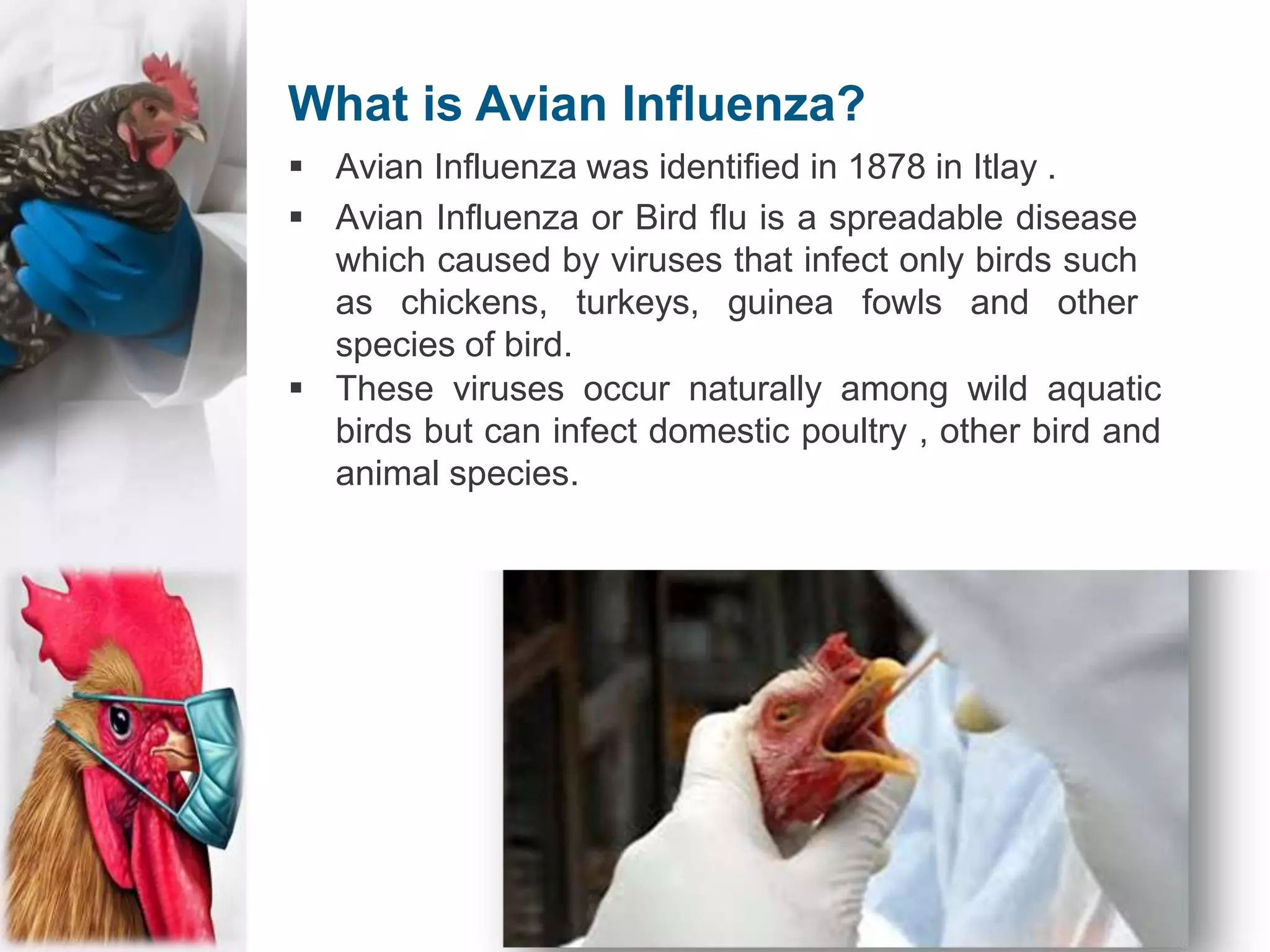
 Avian Influenza was identified in 1878 in Itlay .
 Avian Influenza or Bird flu is a spreadable disease
which caused by viruses that infect only birds such
as chickens, turkeys, guinea fowls and other
species of bird.
What is Avian Influenza?
 These viruses occur naturally among wild aquatic
birds but can infect domestic poultry , other bird and
animal species.
Family: orthomyxoviridae
Genus: Type A Influenza virus
Species: Avian Influenza virus
Etiology:
 It is single stranded neg sense RNA virus.
 Its genome is arranged in 8 segments that encode 10
proteins.
 The outer surface of virus consists of lipid envelope.
 The envelope is covered with glycoproteins HA and NA
which form structures like spikes.
 HA= Haemagglutinin,
 NA= Neuraminidase.
 AI viruses are classified into subtypes on the basis of their
Haemagglutinin (HA or H) , and Neuraminidase (NA or N).
 There are 16 different HA antigens H1 to H16 and 9
different NA antigens N1 to N9.
 15 HA types has been recognized, but a new type H16
was isolated from black-headed gulls in Sweden and
Netherland .
 The three subtypes of AI referred as H5 , H7 and H9 in
which H5 and H7 can produce low and high pathogenic AI
, where as H9 produces only low pathogenic infection.
 Examples : H5N1 , H7N7 , H9N2.
Viral Subtypes:
Viral Subtypes:
In birds (i.e., chickens and turkeys), AI
viruses are classified as being:
1. Highly pathogenic AI HPAI virus.
2. Low pathogenic AI LPAI virus.
AIV Pathogenicity
Biologically, the difference between HPAI and LPAI is that
HPAI is a systemic infection and LPAI remains localized to
the respiratory and intestinal tracts.
 Avian influenza viruses are not stable and sensitive to
detergents .
 They are destroyed by
o oxidizing agents ,
o dilute acid ,
o heat and
o extreme pH .
 Avian influenza virus
can survive for long time
in cold enviroment.
Resistance:
Transmission:
 Water fowls serves as reservoir for AIV and responsible for
introducing the virus into poultry virus which is found in faeces
, respiratory and conjunctival secretions of infected birds.
 It also spreads through contaminated equipments , egg flats,
feed trucks , shared contaminated drinking water etc.
 Incubation period is highly variable and ranges from a few
days in individual birds to 2 weeks in the flock.
 Avian Influenza viruses are highly specie-specific, but on rare
occasions, can crossed the species barrier to infect humans ,
as it is zoonotic.
 Avian influenza viruses usually do not make humans sick
except H5N1virus.
 Most people got sick because of contact with sick poultry
(chickens, ducks, turkeys).
 In 2005, the WHO reports 117 confirmed cases of H5N1 bird
flu in humans.
Mode of Transmission of AIV:
AIV are transmissible to Human
Morbidity and Mortality:
Morbidity and Mortality varies according to species and virus .
Incase of highly pathogenic viruses the morbidity and
mortality reaches upto 100%
Clinical Signs:
The clinical sign varies according to species , age , subtype of
virus and enivroment.
1: Infection with Non pathogenic viruses:
 No clinical signs , with seroconversion.
 Some of these viruses become virulent through genetic
mutation.
2: Infection with low pathogenic viruses:
Severe respiratory disease.
 Ocular and nasal discharge.
 Mortality ranges in layers 3%, in broilers 15%.
 Drop in egg production.
 Swollen infraorbital sinuses in poultry
 Sinusitis is common.
Ocular and nasal discharge
Drop in egg production
Swollen infraorbital sinuses
3: Infection with high pathogenic viruses:
 In per acute cases, sudden death occurs.
 Mortality can be as high as 100%
 In acute cases, death occurs within 24 hours .
 In acute cases - cyanosis and edema of the head , watery
eyes , ruffled feathers , diarrhea.
Cyanosis and edema of the
head
Ruffled feathers
Death chickens in poultry farm
 In peracute cases, lesions may be lacking before death
and congestion of musculature and dehydration.
 In acute cases, there may be
 Edema and haemorrhagic lesions in the shanks, feet,
comb ,
 Discharge of fluid from nares and oral cavity , watery red
eyes,
Lesions:
Lesions:
Lesions of H5 Avian Influenza Virus (AIV) in tested chickens. (A) Cyanosis
of legs and (B) cyanosis of comb and wattles.
Lesions of H5 AIV in tested chickens. (A) Congested muscles (Red arrow) and
hemorrhagic pancreas (blue arrow). (B) Hemorrhages in intestinal tract.
(C) Hemorrhages in coronary fat. (D) Enlarged, congested, and mottled spleen (red
arrow) and hemorrhagic ovarian follicles (blue arrow).
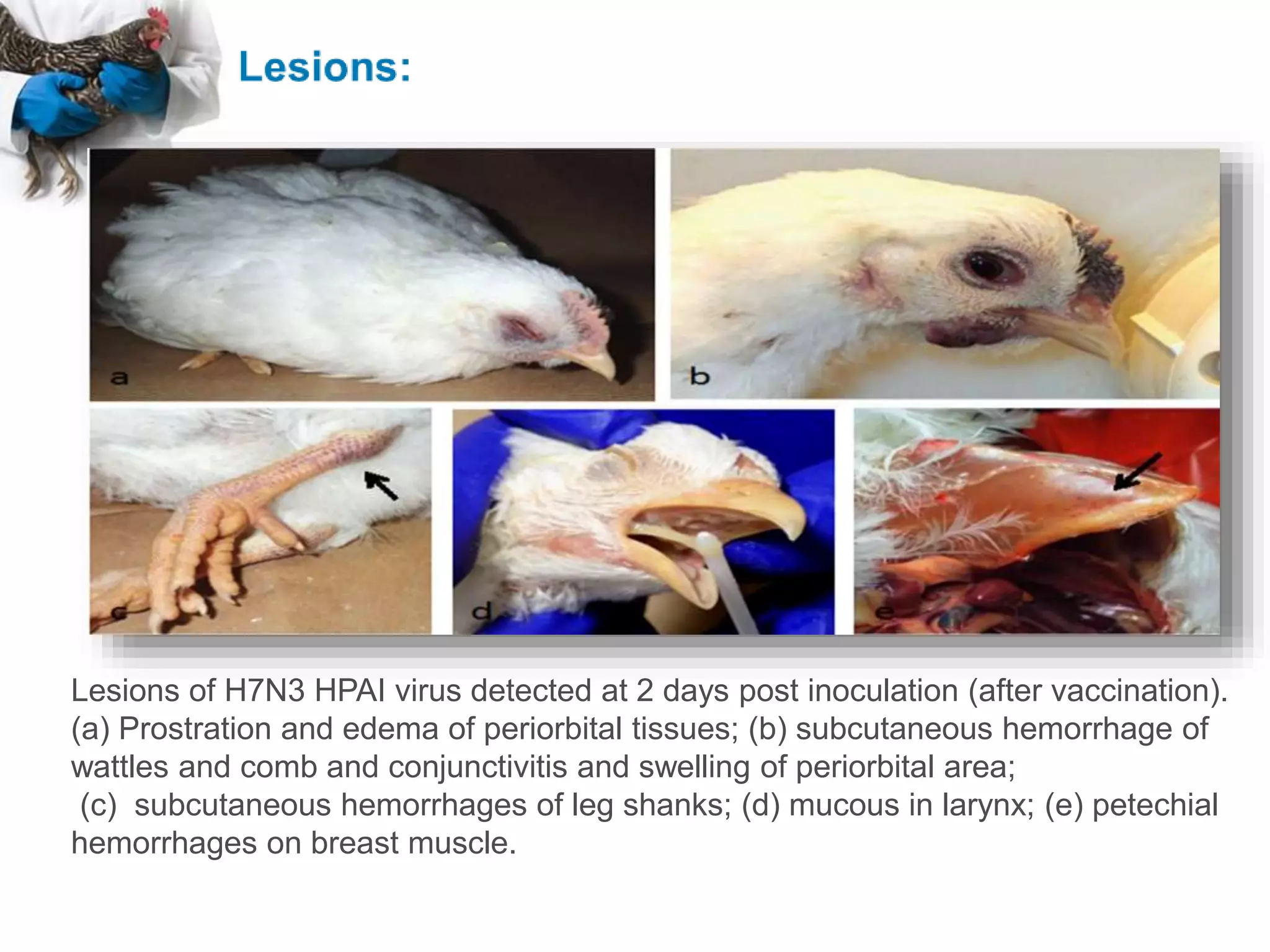
Lesions of H7N3 HPAI virus detected at 2 days post inoculation (after vaccination).
(a) Prostration and edema of periorbital tissues; (b) subcutaneous hemorrhage of
wattles and comb and conjunctivitis and swelling of periorbital area;
(c) subcutaneous hemorrhages of leg shanks; (d) mucous in larynx; (e) petechial
hemorrhages on breast muscle.
The disease can be diagnosed by :
 Symptoms
 Isolation , and
 Identification of organisms by cultivation in embryonated
chicken egg,
 RT-PCR ,
 Serological tests like AGID , HA , ELISA.
Diagnosis:
There is no specific treatment for AIV infections. Amantidine
Hydrochlorideis effective against infection of quails , Turkey
and chicken.
Treatment:
Control:
AIV can be controlled by Inactivated Oil emulsion vaccines
and these vaccines are found effective in chickens and
turkeys.
Prevention:
 Destroying birds carrying or suspected of carrying the virus.
 Disinfecting farm equipment, clothing, and boots.
 Avoid the shipment of live birds within and between countries
that have had bird flu epidemics.
Avian fluenza virus

Avian fluenza virus

  • 1.
    AVIAN INFLUENZA Disease ofPoultry by-Maria Tayyab Vayani Class: MSc (final) Department of Physiology University of Karachi Date:30,March,2021
  • 2.
     Introduction ofAI  What is AIV?  Etiology  Subtypes of AIV  AIV Pathogenicity  Resistance  Transmission  Morbidity and Mortality  Clinical Signs  Lesions  Diagnosis  Treatment  Control Table Of Contents
  • 3.
    Introduction: Synonyms  Bird Flu Avian Flu  Fowl Plague  Type A Flu or Genus A Flu  Influenza A Flu
  • 4.
     Avian Influenzawas identified in 1878 in Itlay .  Avian Influenza or Bird flu is a spreadable disease which caused by viruses that infect only birds such as chickens, turkeys, guinea fowls and other species of bird. What is Avian Influenza?  These viruses occur naturally among wild aquatic birds but can infect domestic poultry , other bird and animal species.
  • 5.
    Family: orthomyxoviridae Genus: TypeA Influenza virus Species: Avian Influenza virus Etiology:  It is single stranded neg sense RNA virus.  Its genome is arranged in 8 segments that encode 10 proteins.  The outer surface of virus consists of lipid envelope.  The envelope is covered with glycoproteins HA and NA which form structures like spikes.  HA= Haemagglutinin,  NA= Neuraminidase.
  • 6.
     AI virusesare classified into subtypes on the basis of their Haemagglutinin (HA or H) , and Neuraminidase (NA or N).  There are 16 different HA antigens H1 to H16 and 9 different NA antigens N1 to N9.  15 HA types has been recognized, but a new type H16 was isolated from black-headed gulls in Sweden and Netherland .  The three subtypes of AI referred as H5 , H7 and H9 in which H5 and H7 can produce low and high pathogenic AI , where as H9 produces only low pathogenic infection.  Examples : H5N1 , H7N7 , H9N2. Viral Subtypes:
  • 7.
  • 8.
    In birds (i.e.,chickens and turkeys), AI viruses are classified as being: 1. Highly pathogenic AI HPAI virus. 2. Low pathogenic AI LPAI virus. AIV Pathogenicity Biologically, the difference between HPAI and LPAI is that HPAI is a systemic infection and LPAI remains localized to the respiratory and intestinal tracts.
  • 10.
     Avian influenzaviruses are not stable and sensitive to detergents .  They are destroyed by o oxidizing agents , o dilute acid , o heat and o extreme pH .  Avian influenza virus can survive for long time in cold enviroment. Resistance:
  • 11.
    Transmission:  Water fowlsserves as reservoir for AIV and responsible for introducing the virus into poultry virus which is found in faeces , respiratory and conjunctival secretions of infected birds.  It also spreads through contaminated equipments , egg flats, feed trucks , shared contaminated drinking water etc.  Incubation period is highly variable and ranges from a few days in individual birds to 2 weeks in the flock.  Avian Influenza viruses are highly specie-specific, but on rare occasions, can crossed the species barrier to infect humans , as it is zoonotic.  Avian influenza viruses usually do not make humans sick except H5N1virus.  Most people got sick because of contact with sick poultry (chickens, ducks, turkeys).  In 2005, the WHO reports 117 confirmed cases of H5N1 bird flu in humans.
  • 12.
  • 13.
  • 14.
    Morbidity and Mortality: Morbidityand Mortality varies according to species and virus . Incase of highly pathogenic viruses the morbidity and mortality reaches upto 100% Clinical Signs: The clinical sign varies according to species , age , subtype of virus and enivroment. 1: Infection with Non pathogenic viruses:  No clinical signs , with seroconversion.  Some of these viruses become virulent through genetic mutation.
  • 15.
    2: Infection withlow pathogenic viruses: Severe respiratory disease.  Ocular and nasal discharge.  Mortality ranges in layers 3%, in broilers 15%.  Drop in egg production.  Swollen infraorbital sinuses in poultry  Sinusitis is common. Ocular and nasal discharge Drop in egg production Swollen infraorbital sinuses
  • 16.
    3: Infection withhigh pathogenic viruses:  In per acute cases, sudden death occurs.  Mortality can be as high as 100%  In acute cases, death occurs within 24 hours .  In acute cases - cyanosis and edema of the head , watery eyes , ruffled feathers , diarrhea. Cyanosis and edema of the head Ruffled feathers Death chickens in poultry farm
  • 17.
     In peracutecases, lesions may be lacking before death and congestion of musculature and dehydration.  In acute cases, there may be  Edema and haemorrhagic lesions in the shanks, feet, comb ,  Discharge of fluid from nares and oral cavity , watery red eyes, Lesions:
  • 18.
    Lesions: Lesions of H5Avian Influenza Virus (AIV) in tested chickens. (A) Cyanosis of legs and (B) cyanosis of comb and wattles. Lesions of H5 AIV in tested chickens. (A) Congested muscles (Red arrow) and hemorrhagic pancreas (blue arrow). (B) Hemorrhages in intestinal tract. (C) Hemorrhages in coronary fat. (D) Enlarged, congested, and mottled spleen (red arrow) and hemorrhagic ovarian follicles (blue arrow).
  • 19.
    Lesions of H7N3HPAI virus detected at 2 days post inoculation (after vaccination). (a) Prostration and edema of periorbital tissues; (b) subcutaneous hemorrhage of wattles and comb and conjunctivitis and swelling of periorbital area; (c) subcutaneous hemorrhages of leg shanks; (d) mucous in larynx; (e) petechial hemorrhages on breast muscle.
  • 20.
    The disease canbe diagnosed by :  Symptoms  Isolation , and  Identification of organisms by cultivation in embryonated chicken egg,  RT-PCR ,  Serological tests like AGID , HA , ELISA. Diagnosis:
  • 21.
    There is nospecific treatment for AIV infections. Amantidine Hydrochlorideis effective against infection of quails , Turkey and chicken. Treatment: Control: AIV can be controlled by Inactivated Oil emulsion vaccines and these vaccines are found effective in chickens and turkeys.
  • 22.
    Prevention:  Destroying birdscarrying or suspected of carrying the virus.  Disinfecting farm equipment, clothing, and boots.  Avoid the shipment of live birds within and between countries that have had bird flu epidemics.