AVIAN INFLUENZA
BY-
CHANDRANI GOSWAMI
SYNONYM
• BIRD FLU
• AVIAN FLU
• FOWL PLAGUE
DEFINATION
• AVIAN INFLUENZA (AI) is a viral
influenza of birds including chickens,
turkeys, guinea fowls, and other avian
species.
• Symptoms vary in severity from
asymptomatic infections to mild
respiratory and reproductive diseases to
an acute , highly fatal systemic diseases.
EPIDEMIOLOGY
 Distributed worldwide and are recovered
frequently from shorebirds and migrating
waterfowl.
 Occasionally recovered from
• Imported pet birds.
• Viruses may be present in village or backyard
flocks
• birds sold through live-poultry markets
EPIDEMIOLOGY (Contd.)
INCIDENCES
• 1st detected in 1997 during a poultry outbreak in
Hong Kong, China.
• Later on again re emerged in China in March
2013.
• In India the first reports of bird flu came from
the village of Navapur in the Nandurbar district
of Maharashtra on 19 February 2006.
• Assam 1st detected the disease on November
27 , 2008, in Rajabazar village, Kamrup district.
TRANSMISSION
 The incubation period is highly
variable and ranges from a few days
in individual birds to 2 wk in the
flock.
ETIOLOGY
• AI viruses are Negative sense, Single
stranded RNA Virus in the family
Orthomyxoviridae, genus Influenza A .
Also called Influenza A virus or Type a
Influenza Virus. Further categorized into
Haemagglutinin (H 1-16) and
Neuraminidase (N1-9) subtypes.
TYPES
• Low pathogenicity avian influenza (LPAI)
by H1-4, H6, H8-16
• Low pathogenicity notifiable avian
influenza (LPNAI) only by H5 and H7
• Highly pathogenicity or highly
pathogenic notifiable avian influenza
(HPNAI) only by mutated forms of H5 and H7
PATHOGENESIS
• Exhibits severe lethargy, fever, weight loss,
transient lymphopenia, and replication in the
upper and lower respiratory tract, as well as
multiple systemic organs, including the brain.
CLINICAL FINDINGS AND LESIONS
•Clinical signs, severity of disease,
and mortality rates vary
depending on AI virus strain
and host species.
CLINICAL FINDINGS AND LESIONS
(Contd.)
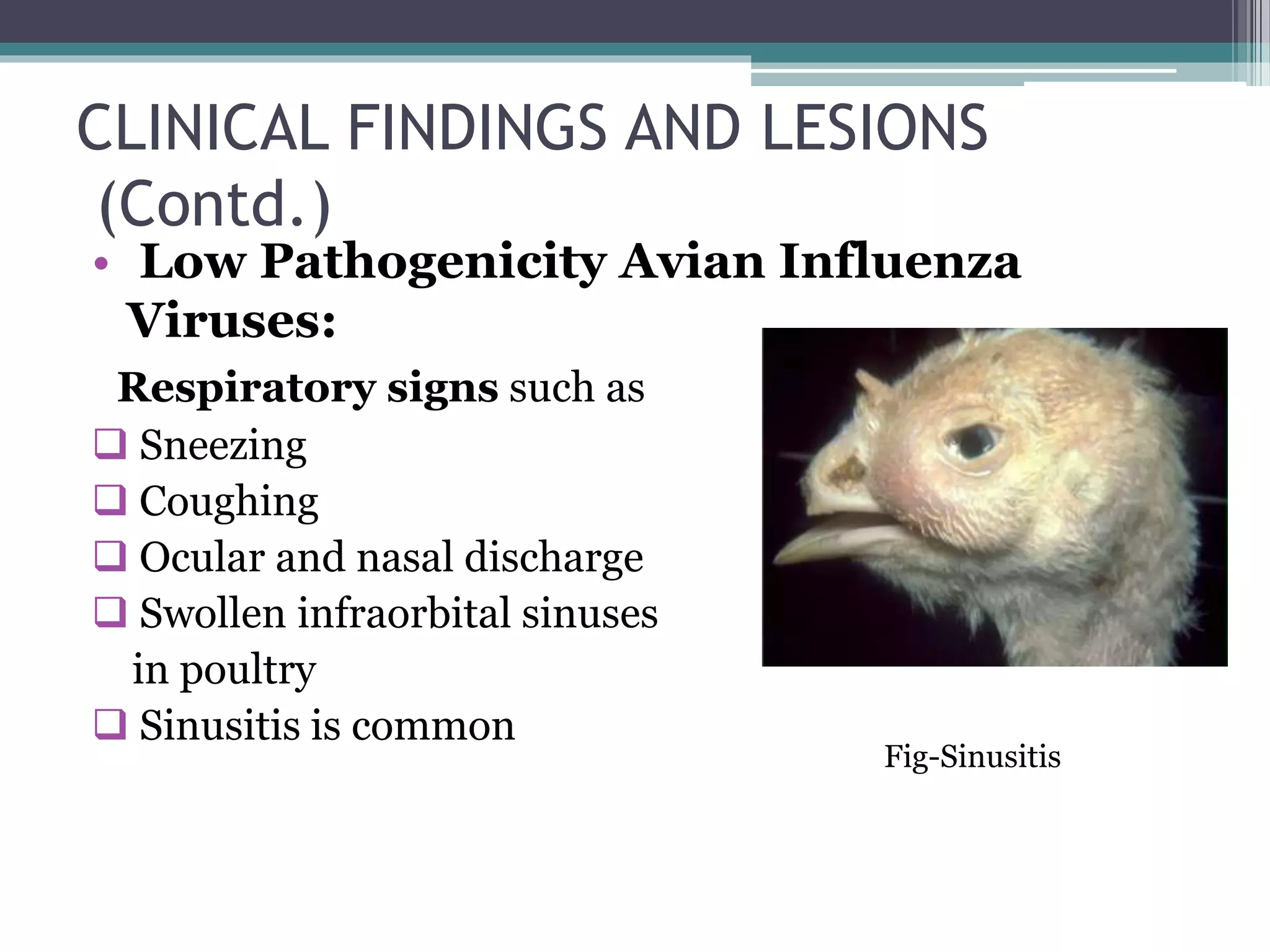
• Low Pathogenicity Avian Influenza
Viruses:
Respiratory signs such as
 Sneezing
 Coughing
 Ocular and nasal discharge
 Swollen infraorbital sinuses
in poultry
 Sinusitis is common
Fig-Sinusitis
CLINICAL FINDINGS AND LESIONS
(Contd.)
Lesions in the respiratory tract includes
congestion and inflammation of the trachea and
lungs.
In layers and breeders,
Decreased egg production or fertility.
Acute renal failure and
Visceral urate deposition (visceral gout)
Morbidity and mortality is usually low
Fig- Inflammation of Trachea
CLINICAL FINDINGS AND LESIONS
(Contd.)
• High Pathogenicity Avian Influenza
Viruses:
severe, systemic disease with high
mortality in chickens, turkeys, and
poultry.
Mortality can be as high as 100%
In peracute cases, clinical signs or gross
lesions may be lacking before death
In acute cases - cyanosis and edema of
the head, comb, wattle, and snood (turkey);
Blood-tinged oral and nasal discharges.
CLINICAL FINDINGS AND LESIONS
(Contd.)
• Edema and haemorrhagic lesions in the shanks,
feet, comb.
Fig-Hemorrhagic skin
visible on the unfeathered
head regions
Fig- Hemorrhagic skin
visible on the
unfeathered regions
CLINICAL FINDINGS AND LESIONS
(Contd.)
In severe cases
Greenish diarrhea is common.
Birds that survive the peracute infection may
develop CNS involvement evident as
• Torticollis
• Opisthotonus
• Incoordination
• Paralysis
• Drooping wings
MICROSCOPIC LESIONS
• Highly variable and may consist of edema,
hemorrhage, and necrosis in parenchymal cells
of multiple visceral organs, skin, and CNS.
• Subcutaneous ecchymotic hemorrhages;
petechial hemorrhages on visceral organs and in
muscles.
CLINAL SIGNS IN HUMAN
DIAGNOSIS
• LP and HP AI viruses can be readily isolated
from oropharyngeal and cloacal swabs. AI
viruses grow well in the allantoic sac of 9- to 11-
day-old embryonating chicken eggs, and they
agglutinate RBCs.
DIAGNOSIS (Contd.)
• rRT- PCR (Real Time Reverse Transcriptase
PCR)is the preferred diagnostic test which gives
result in 3 hours.
TREATMENT AND CONTROL
• There is NO vaccine currently available
in India, although one is under
development.
• Drugs includes amantadine, rimantadine
and neuraminidase inhibitors (e.g.,
oseltamivir, zanamivir)
PREVENTION
• Destroying birds carrying or suspected of
carrying the virus.
PREVENTION
• Disinfecting farm
equipment, clothing, and boots.
PREVENTION
• Limiting, restricting, or banning the shipment
of live birds within and between countries that
have had bird flu epidemics.
Further STEP….
• National Biosecurity
• Farm Biosecurity
• Food Security
• Personal Biosecurity
Fig- Steps toward Personal Biosecurity
CONTROL AND CONTAINMENT
PROGRAMME
Upon positive finding further notification given to Veterinary dept, Health
and family welfare through the secretary.
Further samples are sent to NIHSAD (NATIONAL INSTITUTE OF
HIGH SECURITY ANIMAL DISEASE), Bhopal for confirmation.
If Result found positive, guideline are given to district department and
further symptoms are looked for.
Suspected whole bird taken--PM done– Samples are taken and rRT PCR is
performed at Regional Disease Diagnostic Laboratory
Continued…
Humane killing of birds is done and peoples are asked to willfully
disclose their birds
RRT (RAPID RESPONSE TEAM)
Upto 1km radius 100% is done With the help of
AI zone is made upto 1 km and rest 9 km radius extensive
surveillance is performed
Continued…
Sanitation certificate issued valid for a duration of
2 months
After which disinfection is started with 2% Na
hypochloride and 4% Formalin
Moping procedure initiated
Mandal accompany the team and then and there
compensation are paid.
Continued…
If samples found negative area is declared as Avian
Influenza free.
To be completed within 2 months . 4 combination of
samples are to be collected 15 days apart.
POSP (Post Operative Surveillance Period)
Rest 9km area Surveillance performed
That 1km area is now called Poultry depopulated zone
where no birds are allowed to enter
• Small capacity at a time to installed for 21 days.
• Samples are to be collected at 0th , 15th and 21st
day.
• Upon found negative rest stock to be installed.
RESTOCKING PRECAUTION
Avian influenza

Avian influenza

  • 1.
  • 2.
    SYNONYM • BIRD FLU •AVIAN FLU • FOWL PLAGUE
  • 3.
    DEFINATION • AVIAN INFLUENZA(AI) is a viral influenza of birds including chickens, turkeys, guinea fowls, and other avian species. • Symptoms vary in severity from asymptomatic infections to mild respiratory and reproductive diseases to an acute , highly fatal systemic diseases.
  • 4.
    EPIDEMIOLOGY  Distributed worldwideand are recovered frequently from shorebirds and migrating waterfowl.  Occasionally recovered from • Imported pet birds. • Viruses may be present in village or backyard flocks • birds sold through live-poultry markets
  • 5.
    EPIDEMIOLOGY (Contd.) INCIDENCES • 1stdetected in 1997 during a poultry outbreak in Hong Kong, China. • Later on again re emerged in China in March 2013. • In India the first reports of bird flu came from the village of Navapur in the Nandurbar district of Maharashtra on 19 February 2006. • Assam 1st detected the disease on November 27 , 2008, in Rajabazar village, Kamrup district.
  • 6.
    TRANSMISSION  The incubationperiod is highly variable and ranges from a few days in individual birds to 2 wk in the flock.
  • 8.
    ETIOLOGY • AI virusesare Negative sense, Single stranded RNA Virus in the family Orthomyxoviridae, genus Influenza A . Also called Influenza A virus or Type a Influenza Virus. Further categorized into Haemagglutinin (H 1-16) and Neuraminidase (N1-9) subtypes.
  • 9.
    TYPES • Low pathogenicityavian influenza (LPAI) by H1-4, H6, H8-16 • Low pathogenicity notifiable avian influenza (LPNAI) only by H5 and H7 • Highly pathogenicity or highly pathogenic notifiable avian influenza (HPNAI) only by mutated forms of H5 and H7
  • 10.
    PATHOGENESIS • Exhibits severelethargy, fever, weight loss, transient lymphopenia, and replication in the upper and lower respiratory tract, as well as multiple systemic organs, including the brain.
  • 11.
    CLINICAL FINDINGS ANDLESIONS •Clinical signs, severity of disease, and mortality rates vary depending on AI virus strain and host species.
  • 12.
    CLINICAL FINDINGS ANDLESIONS (Contd.) • Low Pathogenicity Avian Influenza Viruses: Respiratory signs such as  Sneezing  Coughing  Ocular and nasal discharge  Swollen infraorbital sinuses in poultry  Sinusitis is common Fig-Sinusitis
  • 13.
    CLINICAL FINDINGS ANDLESIONS (Contd.) Lesions in the respiratory tract includes congestion and inflammation of the trachea and lungs. In layers and breeders, Decreased egg production or fertility. Acute renal failure and Visceral urate deposition (visceral gout) Morbidity and mortality is usually low Fig- Inflammation of Trachea
  • 14.
    CLINICAL FINDINGS ANDLESIONS (Contd.) • High Pathogenicity Avian Influenza Viruses: severe, systemic disease with high mortality in chickens, turkeys, and poultry. Mortality can be as high as 100% In peracute cases, clinical signs or gross lesions may be lacking before death In acute cases - cyanosis and edema of the head, comb, wattle, and snood (turkey); Blood-tinged oral and nasal discharges.
  • 15.
    CLINICAL FINDINGS ANDLESIONS (Contd.) • Edema and haemorrhagic lesions in the shanks, feet, comb. Fig-Hemorrhagic skin visible on the unfeathered head regions Fig- Hemorrhagic skin visible on the unfeathered regions
  • 16.
    CLINICAL FINDINGS ANDLESIONS (Contd.) In severe cases Greenish diarrhea is common. Birds that survive the peracute infection may develop CNS involvement evident as • Torticollis • Opisthotonus • Incoordination • Paralysis • Drooping wings
  • 17.
    MICROSCOPIC LESIONS • Highlyvariable and may consist of edema, hemorrhage, and necrosis in parenchymal cells of multiple visceral organs, skin, and CNS. • Subcutaneous ecchymotic hemorrhages; petechial hemorrhages on visceral organs and in muscles.
  • 18.
  • 19.
    DIAGNOSIS • LP andHP AI viruses can be readily isolated from oropharyngeal and cloacal swabs. AI viruses grow well in the allantoic sac of 9- to 11- day-old embryonating chicken eggs, and they agglutinate RBCs.
  • 20.
    DIAGNOSIS (Contd.) • rRT-PCR (Real Time Reverse Transcriptase PCR)is the preferred diagnostic test which gives result in 3 hours.
  • 21.
    TREATMENT AND CONTROL •There is NO vaccine currently available in India, although one is under development. • Drugs includes amantadine, rimantadine and neuraminidase inhibitors (e.g., oseltamivir, zanamivir)
  • 22.
    PREVENTION • Destroying birdscarrying or suspected of carrying the virus.
  • 23.
  • 24.
    PREVENTION • Limiting, restricting,or banning the shipment of live birds within and between countries that have had bird flu epidemics.
  • 25.
    Further STEP…. • NationalBiosecurity • Farm Biosecurity • Food Security • Personal Biosecurity
  • 26.
    Fig- Steps towardPersonal Biosecurity
  • 27.
    CONTROL AND CONTAINMENT PROGRAMME Uponpositive finding further notification given to Veterinary dept, Health and family welfare through the secretary. Further samples are sent to NIHSAD (NATIONAL INSTITUTE OF HIGH SECURITY ANIMAL DISEASE), Bhopal for confirmation. If Result found positive, guideline are given to district department and further symptoms are looked for. Suspected whole bird taken--PM done– Samples are taken and rRT PCR is performed at Regional Disease Diagnostic Laboratory
  • 28.
    Continued… Humane killing ofbirds is done and peoples are asked to willfully disclose their birds RRT (RAPID RESPONSE TEAM) Upto 1km radius 100% is done With the help of AI zone is made upto 1 km and rest 9 km radius extensive surveillance is performed
  • 29.
    Continued… Sanitation certificate issuedvalid for a duration of 2 months After which disinfection is started with 2% Na hypochloride and 4% Formalin Moping procedure initiated Mandal accompany the team and then and there compensation are paid.
  • 30.
    Continued… If samples foundnegative area is declared as Avian Influenza free. To be completed within 2 months . 4 combination of samples are to be collected 15 days apart. POSP (Post Operative Surveillance Period) Rest 9km area Surveillance performed That 1km area is now called Poultry depopulated zone where no birds are allowed to enter
  • 31.
    • Small capacityat a time to installed for 21 days. • Samples are to be collected at 0th , 15th and 21st day. • Upon found negative rest stock to be installed. RESTOCKING PRECAUTION