AVIAN INFLUENZA
Dr Namrata Singh
Secretary
Ministry of Land Management Agriculture and Cooperatives
Madhesh Pradesh
 Organism
 History
 Epidemiology
 Transmission
 Disease in Humans
 Disease in Animals
 Prevention and Control
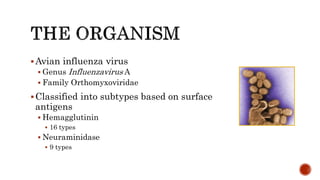
Avian influenza virus
 Genus Influenzavirus A
 Family Orthomyxoviridae
Classified into subtypes based on surface
antigens
 Hemagglutinin
 16 types
 Neuraminidase
 9 types
PATHOGENICITY
High pathogenicity avian influenza (HPAI)
Causes severe disease in poultry
Contains subtypes H5 or H7
Low pathogenicity avian influenza (LPAI)
Causes mild disease in poultry
Contains other H subtypes
 Includes non-HPAI H5 and H7
LPAI H5 or H7 subtypes can
mutate into HPAI
RESERVOIRS
 Waterfowl and shorebirds
Natural reservoirs for influenza A
Carry all known H and N
antigens
 Usually in the LPAI form
Predominant subtypes change
periodically
Center for Food Security and Public Health, Iowa State University, 2013
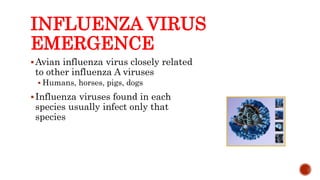
INFLUENZA VIRUS
EMERGENCE
Avian influenza virus closely related
to other influenza A viruses
 Humans, horses, pigs, dogs
Influenza viruses found in each
species usually infect only that
species
Center for Food Security and Public Health, Iowa State University, 2013
ANTIGENIC DRIFT AND
SHIFT
Antigenic drift
 Small changes in influenza virus due to point mutations
accumulated during virus replication
Antigenic shift
 Abrupt change in virus subtype
 Genetic reassortment between subtypes
 Direct transfer of virus
 Re-emergence of virus
Center for Food Security and Public Health, Iowa State University, 2013
INFLUENZA EPIDEMICS
Epidemic requirements
1. New influenza subtype must emerge in species with
little to no immunity
2. Virus must produce disease in that species
3. Sustainable transmission must occur in new species
Note: Asian lineage H5N1 has NOT met third
criteria in humans
Center for Food Security and Public Health, Iowa State University, 2013
HISTORY
HISTORY: U.S.
HPAI eliminated from domesticated poultry in the
U.S.
Viruses could be reintroduced
Imported poultry
Wild birds
Pet birds
Center for Food Security and Public Health, Iowa State University, 2013
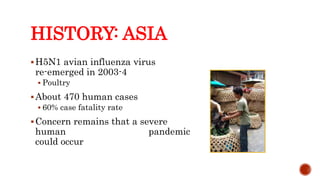
HISTORY: ASIA
H5N1 avian influenza virus
re-emerged in 2003-4
 Poultry
About 470 human cases
 60% case fatality rate
Concern remains that a severe
human pandemic
could occur
Center for Food Security and Public Health, Iowa State University, 2013
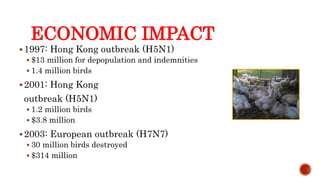
ECONOMIC IMPACT
1997: Hong Kong outbreak (H5N1)
 $13 million for depopulation and indemnities
 1.4 million birds
2001: Hong Kong
outbreak (H5N1)
 1.2 million birds
 $3.8 million
2003: European outbreak (H7N7)
 30 million birds destroyed
 $314 million
Center for Food Security and Public Health, Iowa State University, 2013
EPIDEMIOLOGY
GEOGRAPHIC
DISTRIBUTION
LPAI occurs worldwide
 Wild birds and poultry
HPAI
 Eradicated from domestic poultry
in most developed nations
 Epidemic ongoing in parts of Asia,
the Pacific, Middle East, and Africa
Center for Food Security and Public Health, Iowa State University, 2013
MORBIDITY AND
MORTALITY: HUMANS
Asian lineage H5N1
 High case fatality rate (60%)
 Prevalence unknown
H7, H9 viruses
 Human disease reported
 Resembles human influenza
Antibodies to other H subtypes found in people who work
with birds
Center for Food Security and Public Health, Iowa State University, 2013
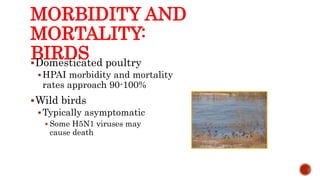
MORBIDITY AND
MORTALITY:
BIRDS
Domesticated poultry
HPAI morbidity and mortality
rates approach 90-100%
Wild birds
Typically asymptomatic
 Some H5N1 viruses may
cause death
Center for Food Security and Public Health, Iowa State University, 2013
MORBIDITY AND
MORTALITY:
MAMMALS
Antibodies found
 Cats and dogs
Fatalities reported
 Captive tigers, leopards
Ferrets, mice
 Severity of disease varies
Pikas (China), pigs
 No evidence of significant illness
Center for Food Security and Public Health, Iowa State University, 2013
TRANSMISSION
TRANSMISSION IN WILD
BIRDS
Influenza virus shed in feces, saliva, nasal secretions
Fecal-oral
 Predominant mode of transmission
Other possible modes
 Fecal-cloacal
 Respiratory
Center for Food Security and Public Health, Iowa State University, 2013
INFLUENZA VIRUS
SURVIVAL
Virus persistence in aquatic environments
 Weeks to months
 Preferred conditions
 Low temperatures, brackish water
 May survive indefinitely when frozen
Virus persistence in feces
 Weeks to months
Center for Food Security and Public Health, Iowa State University, 2013
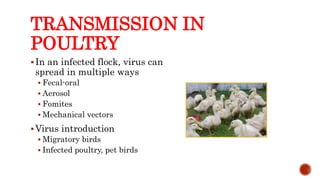
TRANSMISSION IN
POULTRY
In an infected flock, virus can
spread in multiple ways
 Fecal-oral
 Aerosol
 Fomites
 Mechanical vectors
Virus introduction
 Migratory birds
 Infected poultry, pet birds
Center for Food Security and Public Health, Iowa State University, 2013
TRANSMISSION IN
MAMMALS
Close contact with dead or sick birds
Indirect exposure
 Contact with feces
 Swimming in contaminated water
Ingestion
Other routes (experimental)
 Respiratory, oral, intraocular
 Transplacental
Center for Food Security and Public Health, Iowa State University, 2013
HUMAN TRANSMISSION
Previously considered non-pathogenic for humans
1997, Hong Kong
 18 humans infected, 6 died
 H5N1 virus linked to outbreak in live bird market and area farms
2003, the Netherlands
 83 confirmed cases in humans, 1 death
 H7N7 strain
Swine are proposed “mixing vessel”
Center for Food Security and Public Health, Iowa State University, 2013
DISEASE IN
ANIMALS
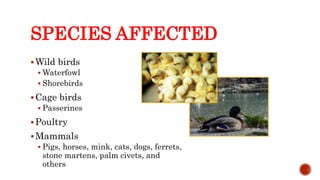
SPECIES AFFECTED
Wild birds
 Waterfowl
 Shorebirds
Cage birds
 Passerines
Poultry
Mammals
 Pigs, horses, mink, cats, dogs, ferrets,
stone martens, palm civets, and
others
Center for Food Security and Public Health, Iowa State University, 2013
INCUBATION IN ANIMALS
Poultry: 1-7 days
Disease control purposes
 21-day incubation period used
 Accounts for virus transmission dynamics
Incubation period for mammals thought to be short
Center for Food Security and Public Health, Iowa State University, 2013
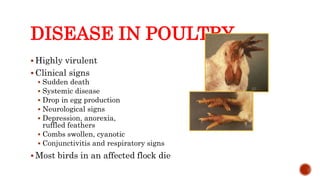
DISEASE IN POULTRY
 Highly virulent
 Clinical signs
 Sudden death
 Systemic disease
 Drop in egg production
 Neurological signs
 Depression, anorexia,
ruffled feathers
 Combs swollen, cyanotic
 Conjunctivitis and respiratory signs
 Most birds in an affected flock die
Center for Food Security and Public Health, Iowa State University, 2013
DISEASE IN WILD BIRDS
Disease often subclinical
 Some strains cause illness
Clinical signs
 Minimal in ducks and geese
 Swans may be found dead
Experimental infections
 Gulls, passerines, psittacines
Center for Food Security and Public Health, Iowa State University, 2013
H5N1 INFECTIONS
IN MAMMALS
Felids
Fatal infections
Respiratory distress
Other mammals
Dogs
Palm civets
 Neurological,
respiratory, CNS, and
liver disease
Center for Food Security and Public Health, Iowa State University, 2013
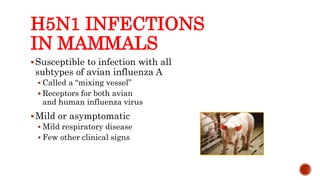
H5N1 INFECTIONS
IN MAMMALS
Susceptible to infection with all
subtypes of avian influenza A
 Called a “mixing vessel”
 Receptors for both avian
and human influenza virus
Mild or asymptomatic
 Mild respiratory disease
 Few other clinical signs
Center for Food Security and Public Health, Iowa State University, 2013
H5N1 INFECTIONS
IN MAMMALS
Experimental infections
 Foxes: asymptomatic
 Ferrets: mild to severe disease
 Mice: clinical signs variable
 Cattle: asymptomatic
Center for Food Security and Public Health, Iowa State University, 2013
OTHER AVIAN INFLUENZA
INFECTIONS IN MAMMALS
Ferrets
 Experimentally infected with both LPAI and HPAI avian influenza
viruses
Seals, pilot whales
 Outbreaks of pneumonia
 Co-infections may have increased severity of clinical signs
Center for Food Security and Public Health, Iowa State University, 2013
COMMUNICABILITY: BIRDS
Avian influenza viruses readily transmitted between birds
Viral shedding
 Begins 1-2 days after infection
 Last up to 36 days (chickens) or 72 days (turkeys)
Birds-to-mammal transmission uncommon
Center for Food Security and Public Health, Iowa State University, 2013
COMMUNICABILITY:
MAMMALS
Cats
 Shed virus by third day post-infection (experimental)
 Naturally infected cats excrete virus sporadically and for < 2
weeks
 Shed from intestinal and respiratory tracts
Horizontal transmission not observed in cats or other
mammals
Center for Food Security and Public Health, Iowa State University, 2013
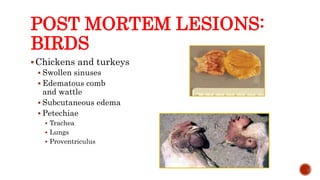
POST MORTEM LESIONS:
BIRDS
Chickens and turkeys
 Swollen sinuses
 Edematous comb
and wattle
 Subcutaneous edema
 Petechiae
 Trachea
 Lungs
 Proventriculus
Center for Food Security and Public Health, Iowa State University, 2013
SAMPLING
Before collecting or sending any samples,
the proper authorities should be
contacted
Samples should only be sent under
secure conditions and to authorized
laboratories to prevent the spread of the
disease
HPAI samples may be zoonotic
POST MORTEM LESIONS:
MAMMALS
Multiple lesions possible
Pulmonary edema, pneumonia
Conjunctivitis
Cerebral, renal and splenic congestion
Multifocal hepatic necrosis
Hemorrhages in the intestinal serosa, lymph nodes,
perirenal tissue and/or diaphragm
Severe hemorrhagic pancreatitis
Center for Food Security and Public Health, Iowa State University, 2013
DIFFERENTIAL DIAGNOSIS
Virulent Newcastle disease
Avian pneumovirus
Infectious laryngotracheitis
Infectious bronchitis
Chlamydia
Mycoplasma
Acute bacterial diseases
 Fowl cholera, E. coli infection
Center for Food Security and Public Health, Iowa State University, 2013
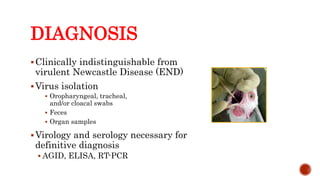
DIAGNOSIS
Clinically indistinguishable from
virulent Newcastle Disease (END)
Virus isolation
 Oropharyngeal, tracheal,
and/or cloacal swabs
 Feces
 Organ samples
Virology and serology necessary for
definitive diagnosis
 AGID, ELISA, RT-PCR
Center for Food Security and Public Health, Iowa State University, 2013
DIAGNOSIS, CONT’D
RT-PCR
 Clinical samples
 Can distinguish different subtypes
Viral antigen detection
 Best for flocks, not individuals
Serology
 AGID
 Hemagglutination inhibition
 ELISA
Center for Food Security and Public Health, Iowa State University, 2013
TREATMENT
No specific treatment
HPAI in poultry usually not
treated
Outbreaks controlled
by eradication
Antivirals (amantadine)
effective in reducing
mortality
 Not approved in food animals
 Results in resistant viruses
Center for Food Security and Public Health, Iowa State University, 2013
DISEASE IN
HUMANS
INCUBATION IN HUMANS
Difficult to determine
 2-17 days possible
Symptoms usually
appear in 2-5 days
Center for Food Security and Public Health, Iowa State University, 2013
World
Health
Organization
Recommends using incubation
period of seven days for field
investigations and monitoring
patient contact
H5N1 INFECTIONS IN
HUMANS
Cause severe disease
 High fever
 Upper respiratory symptoms
 Mucosal bleeding
 Gastrointestinal symptoms
Patients may deteriorate rapidly
Late symptoms
 Organ failure, DIC
Center for Food Security and Public Health, Iowa State University, 2013
COMMUNICABILITY
Rare cases of person-to-person transmission
NO cases of sustained transmission
Fecal shedding and transplacental transmission may
occur
Center for Food Security and Public Health, Iowa State University, 2013
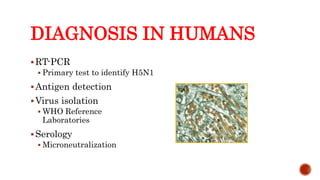
DIAGNOSIS IN HUMANS
RT-PCR
 Primary test to identify H5N1
Antigen detection
Virus isolation
 WHO Reference
Laboratories
Serology
 Microneutralization
Center for Food Security and Public Health, Iowa State University, 2013
TREATMENT IN HUMANS
Antiviral drugs
 Amantadine
 Rimantadine
 Zanamivir
 Oseltamivir
Currently circulating H5N1 viruses may be resistant to
amantadine, rimantadine
Center for Food Security and Public Health, Iowa State University, 2013
PREVENTION
AND CONTROL
RECOMMENDED ACTIONS
Notification of Authorities
 Federal:
Area Veterinarian in Charge (AVIC)
 www.aphis.usda.gov/wcm/connect/aphis_content_library/sa_our_focus/sa_ani
mal_health/sa_contact_us/sa_area_offices/ct_area_offices_avic
 State veterinarian
 www.aphis.usda.gov/traceability/downloads/StateAnimalHealthOfficials.pdf
Quarantine
Center for Food Security and Public Health, Iowa State University, 2013
PREVENTION IN HUMANS
People working with infected poultry
 Follow good hygiene practices
 Wear protective clothing (gloves, masks)
 Consider antiviral prophylaxis
 Be vaccinated against human influenza
 Do not have contact with sick birds if
experiencing symptoms of influenza
Center for Food Security and Public Health, Iowa State University, 2013
PREVENTION IN HUMANS
If Asian lineage H5N1 is present, avoid contact with:
 Domesticated poultry
 Poultry farms
 Live bird markets
Prepare food properly
 Practice good hygiene
 Cook chicken and eggs thoroughly
Center for Food Security and Public Health, Iowa State University, 2013
PREVENTION IN HUMANS
Avoid wild bird contact
Report dead or diseased wildlife
Do not handle or eat sick game
Wear gloves while handling or cleaning wild birds
Wash hands
Cook game thoroughly
Center for Food Security and Public Health, Iowa State University, 2013
PANDEMIC PRECAUTIONS
If a pandemic occurs:
 Avoid crowded conditions and
close contact with other people
 Consider wearing respirators or
other protective equipment
 Follow good hygiene measures
 Practice social distancing
 Quarantine ill individuals
 Vaccination
Center for Food Security and Public Health, Iowa State University, 2013
PREVENTION IN BIRDS
 All-in/all-out flock management
 Prevent contact with wild birds
or their water sources
 Do not allow birds to return to the
farm from live markets
 Practice strict hygiene and biosecurity
measures
Center for Food Security and Public Health, Iowa State University, 2013
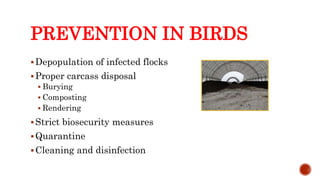
PREVENTION IN BIRDS
Depopulation of infected flocks
Proper carcass disposal
 Burying
 Composting
 Rendering
Strict biosecurity measures
Quarantine
Cleaning and disinfection
Center for Food Security and Public Health, Iowa State University, 2013
PREVENTION IN BIRDS
Vaccination
 Not used routinely in the U.S.
 Usually autogenous
 Requires approval of State veterinarian and USDA (H5, H7
vaccines)
 May not prevent virus shedding
 Differentiating Infected from Vaccinated Animals (DIVA) strategy
used to recognize field viruses in vaccinated flocks
Center for Food Security and Public Health, Iowa State University, 2013
USDA PREVENTION
ACTIVITIES
Import restrictions
 No live birds or bird products from
infected countries
Increasing surveillance of wild birds
National H5 and H7 control
program
Training for disease recognition
Improving diagnostics for
rapid detection
Center for Food Security and Public Health, Iowa State University, 2013
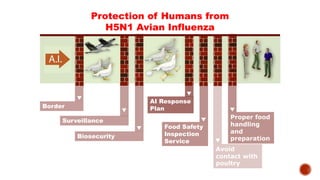
Protection of Humans from
H5N1 Avian Influenza
Surveillance
Avoid
contact with
poultry
Border
AI Response
Plan
Food Safety
Inspection
Service
q
q
q
q
q
Biosecurity
q
Proper food
handling
and
preparation
q
PREVENTION IN MAMMALS
 Do not feed infected poultry or
birds to mammals
 Prevent contact with potentially
infected flocks and wild birds
 Keep cats and dogs indoors
during avian influenza outbreaks
Center for Food Security and Public Health, Iowa State University, 2013
DISINFECTION
Sodium hypochlorite
70% ethanol
Oxidizing agents
Quaternary ammonium compounds
Aldehydes
Phenols
Acids
Povidone-iodine
Center for Food Security and Public Health, Iowa State University, 2013
DISINFECTION, CONT’D
Heat
 56°C (133°F) for a
minimum
of 60 minutes
Ionizing radiation
Low pH (pH 2)
Center for Food Security and Public Health, Iowa State University, 2013
 Center for Food Security and Public Health
 www.cfsph.iastate.edu
 Centers for Disease Control and Prevention (CDC)
 www.cdc.gov
 World Organization for Animal Health (OIE)
 www.oie.int
 World Health Organization (WHO)
 www.who.int
Center for Food Security and Public Health, Iowa State University, 2013
Development of this presentation was made possible
through grants provided to
the Center for Food Security and Public Health at Iowa
State University, College of Veterinary Medicine from
the Centers for Disease Control and Prevention,
the U.S. Department of Agriculture,
the Iowa Homeland Security and
Emergency Management Division, and the
Multi-State Partnership for Security in Agriculture.
Authors: Kerry Leedom Larson, DVM, MPH, PhD, DACVPM; Danelle Bickett-Weddle, DVM, MPH,
DACVPM; Anna Rovid Spickler, DVM, PhD
Reviewers: Glenda Dvorak, DVM, MPH, DACVPM
Center for Food Security and Public Health, Iowa State University, 2013

Bird Flu.pptx

  • 1.
    AVIAN INFLUENZA Dr NamrataSingh Secretary Ministry of Land Management Agriculture and Cooperatives Madhesh Pradesh
  • 2.
     Organism  History Epidemiology  Transmission  Disease in Humans  Disease in Animals  Prevention and Control
  • 4.
    Avian influenza virus Genus Influenzavirus A  Family Orthomyxoviridae Classified into subtypes based on surface antigens  Hemagglutinin  16 types  Neuraminidase  9 types
  • 5.
    PATHOGENICITY High pathogenicity avianinfluenza (HPAI) Causes severe disease in poultry Contains subtypes H5 or H7 Low pathogenicity avian influenza (LPAI) Causes mild disease in poultry Contains other H subtypes  Includes non-HPAI H5 and H7 LPAI H5 or H7 subtypes can mutate into HPAI
  • 6.
    RESERVOIRS  Waterfowl andshorebirds Natural reservoirs for influenza A Carry all known H and N antigens  Usually in the LPAI form Predominant subtypes change periodically Center for Food Security and Public Health, Iowa State University, 2013
  • 7.
    INFLUENZA VIRUS EMERGENCE Avian influenzavirus closely related to other influenza A viruses  Humans, horses, pigs, dogs Influenza viruses found in each species usually infect only that species Center for Food Security and Public Health, Iowa State University, 2013
  • 8.
    ANTIGENIC DRIFT AND SHIFT Antigenicdrift  Small changes in influenza virus due to point mutations accumulated during virus replication Antigenic shift  Abrupt change in virus subtype  Genetic reassortment between subtypes  Direct transfer of virus  Re-emergence of virus Center for Food Security and Public Health, Iowa State University, 2013
  • 9.
    INFLUENZA EPIDEMICS Epidemic requirements 1.New influenza subtype must emerge in species with little to no immunity 2. Virus must produce disease in that species 3. Sustainable transmission must occur in new species Note: Asian lineage H5N1 has NOT met third criteria in humans Center for Food Security and Public Health, Iowa State University, 2013
  • 10.
  • 11.
    HISTORY: U.S. HPAI eliminatedfrom domesticated poultry in the U.S. Viruses could be reintroduced Imported poultry Wild birds Pet birds Center for Food Security and Public Health, Iowa State University, 2013
  • 12.
    HISTORY: ASIA H5N1 avianinfluenza virus re-emerged in 2003-4  Poultry About 470 human cases  60% case fatality rate Concern remains that a severe human pandemic could occur Center for Food Security and Public Health, Iowa State University, 2013
  • 13.
    ECONOMIC IMPACT 1997: HongKong outbreak (H5N1)  $13 million for depopulation and indemnities  1.4 million birds 2001: Hong Kong outbreak (H5N1)  1.2 million birds  $3.8 million 2003: European outbreak (H7N7)  30 million birds destroyed  $314 million Center for Food Security and Public Health, Iowa State University, 2013
  • 14.
  • 15.
    GEOGRAPHIC DISTRIBUTION LPAI occurs worldwide Wild birds and poultry HPAI  Eradicated from domestic poultry in most developed nations  Epidemic ongoing in parts of Asia, the Pacific, Middle East, and Africa Center for Food Security and Public Health, Iowa State University, 2013
  • 16.
    MORBIDITY AND MORTALITY: HUMANS Asianlineage H5N1  High case fatality rate (60%)  Prevalence unknown H7, H9 viruses  Human disease reported  Resembles human influenza Antibodies to other H subtypes found in people who work with birds Center for Food Security and Public Health, Iowa State University, 2013
  • 17.
    MORBIDITY AND MORTALITY: BIRDS Domesticated poultry HPAImorbidity and mortality rates approach 90-100% Wild birds Typically asymptomatic  Some H5N1 viruses may cause death Center for Food Security and Public Health, Iowa State University, 2013
  • 18.
    MORBIDITY AND MORTALITY: MAMMALS Antibodies found Cats and dogs Fatalities reported  Captive tigers, leopards Ferrets, mice  Severity of disease varies Pikas (China), pigs  No evidence of significant illness Center for Food Security and Public Health, Iowa State University, 2013
  • 19.
  • 20.
    TRANSMISSION IN WILD BIRDS Influenzavirus shed in feces, saliva, nasal secretions Fecal-oral  Predominant mode of transmission Other possible modes  Fecal-cloacal  Respiratory Center for Food Security and Public Health, Iowa State University, 2013
  • 21.
    INFLUENZA VIRUS SURVIVAL Virus persistencein aquatic environments  Weeks to months  Preferred conditions  Low temperatures, brackish water  May survive indefinitely when frozen Virus persistence in feces  Weeks to months Center for Food Security and Public Health, Iowa State University, 2013
  • 22.
    TRANSMISSION IN POULTRY In aninfected flock, virus can spread in multiple ways  Fecal-oral  Aerosol  Fomites  Mechanical vectors Virus introduction  Migratory birds  Infected poultry, pet birds Center for Food Security and Public Health, Iowa State University, 2013
  • 23.
    TRANSMISSION IN MAMMALS Close contactwith dead or sick birds Indirect exposure  Contact with feces  Swimming in contaminated water Ingestion Other routes (experimental)  Respiratory, oral, intraocular  Transplacental Center for Food Security and Public Health, Iowa State University, 2013
  • 24.
    HUMAN TRANSMISSION Previously considerednon-pathogenic for humans 1997, Hong Kong  18 humans infected, 6 died  H5N1 virus linked to outbreak in live bird market and area farms 2003, the Netherlands  83 confirmed cases in humans, 1 death  H7N7 strain Swine are proposed “mixing vessel” Center for Food Security and Public Health, Iowa State University, 2013
  • 25.
  • 26.
    SPECIES AFFECTED Wild birds Waterfowl  Shorebirds Cage birds  Passerines Poultry Mammals  Pigs, horses, mink, cats, dogs, ferrets, stone martens, palm civets, and others Center for Food Security and Public Health, Iowa State University, 2013
  • 27.
    INCUBATION IN ANIMALS Poultry:1-7 days Disease control purposes  21-day incubation period used  Accounts for virus transmission dynamics Incubation period for mammals thought to be short Center for Food Security and Public Health, Iowa State University, 2013
  • 28.
    DISEASE IN POULTRY Highly virulent  Clinical signs  Sudden death  Systemic disease  Drop in egg production  Neurological signs  Depression, anorexia, ruffled feathers  Combs swollen, cyanotic  Conjunctivitis and respiratory signs  Most birds in an affected flock die Center for Food Security and Public Health, Iowa State University, 2013
  • 29.
    DISEASE IN WILDBIRDS Disease often subclinical  Some strains cause illness Clinical signs  Minimal in ducks and geese  Swans may be found dead Experimental infections  Gulls, passerines, psittacines Center for Food Security and Public Health, Iowa State University, 2013
  • 30.
    H5N1 INFECTIONS IN MAMMALS Felids Fatalinfections Respiratory distress Other mammals Dogs Palm civets  Neurological, respiratory, CNS, and liver disease Center for Food Security and Public Health, Iowa State University, 2013
  • 31.
    H5N1 INFECTIONS IN MAMMALS Susceptibleto infection with all subtypes of avian influenza A  Called a “mixing vessel”  Receptors for both avian and human influenza virus Mild or asymptomatic  Mild respiratory disease  Few other clinical signs Center for Food Security and Public Health, Iowa State University, 2013
  • 32.
    H5N1 INFECTIONS IN MAMMALS Experimentalinfections  Foxes: asymptomatic  Ferrets: mild to severe disease  Mice: clinical signs variable  Cattle: asymptomatic Center for Food Security and Public Health, Iowa State University, 2013
  • 33.
    OTHER AVIAN INFLUENZA INFECTIONSIN MAMMALS Ferrets  Experimentally infected with both LPAI and HPAI avian influenza viruses Seals, pilot whales  Outbreaks of pneumonia  Co-infections may have increased severity of clinical signs Center for Food Security and Public Health, Iowa State University, 2013
  • 34.
    COMMUNICABILITY: BIRDS Avian influenzaviruses readily transmitted between birds Viral shedding  Begins 1-2 days after infection  Last up to 36 days (chickens) or 72 days (turkeys) Birds-to-mammal transmission uncommon Center for Food Security and Public Health, Iowa State University, 2013
  • 35.
    COMMUNICABILITY: MAMMALS Cats  Shed virusby third day post-infection (experimental)  Naturally infected cats excrete virus sporadically and for < 2 weeks  Shed from intestinal and respiratory tracts Horizontal transmission not observed in cats or other mammals Center for Food Security and Public Health, Iowa State University, 2013
  • 36.
    POST MORTEM LESIONS: BIRDS Chickensand turkeys  Swollen sinuses  Edematous comb and wattle  Subcutaneous edema  Petechiae  Trachea  Lungs  Proventriculus Center for Food Security and Public Health, Iowa State University, 2013
  • 37.
    SAMPLING Before collecting orsending any samples, the proper authorities should be contacted Samples should only be sent under secure conditions and to authorized laboratories to prevent the spread of the disease HPAI samples may be zoonotic
  • 38.
    POST MORTEM LESIONS: MAMMALS Multiplelesions possible Pulmonary edema, pneumonia Conjunctivitis Cerebral, renal and splenic congestion Multifocal hepatic necrosis Hemorrhages in the intestinal serosa, lymph nodes, perirenal tissue and/or diaphragm Severe hemorrhagic pancreatitis Center for Food Security and Public Health, Iowa State University, 2013
  • 39.
    DIFFERENTIAL DIAGNOSIS Virulent Newcastledisease Avian pneumovirus Infectious laryngotracheitis Infectious bronchitis Chlamydia Mycoplasma Acute bacterial diseases  Fowl cholera, E. coli infection Center for Food Security and Public Health, Iowa State University, 2013
  • 40.
    DIAGNOSIS Clinically indistinguishable from virulentNewcastle Disease (END) Virus isolation  Oropharyngeal, tracheal, and/or cloacal swabs  Feces  Organ samples Virology and serology necessary for definitive diagnosis  AGID, ELISA, RT-PCR Center for Food Security and Public Health, Iowa State University, 2013
  • 41.
    DIAGNOSIS, CONT’D RT-PCR  Clinicalsamples  Can distinguish different subtypes Viral antigen detection  Best for flocks, not individuals Serology  AGID  Hemagglutination inhibition  ELISA Center for Food Security and Public Health, Iowa State University, 2013
  • 42.
    TREATMENT No specific treatment HPAIin poultry usually not treated Outbreaks controlled by eradication Antivirals (amantadine) effective in reducing mortality  Not approved in food animals  Results in resistant viruses Center for Food Security and Public Health, Iowa State University, 2013
  • 43.
  • 44.
    INCUBATION IN HUMANS Difficultto determine  2-17 days possible Symptoms usually appear in 2-5 days Center for Food Security and Public Health, Iowa State University, 2013 World Health Organization Recommends using incubation period of seven days for field investigations and monitoring patient contact
  • 45.
    H5N1 INFECTIONS IN HUMANS Causesevere disease  High fever  Upper respiratory symptoms  Mucosal bleeding  Gastrointestinal symptoms Patients may deteriorate rapidly Late symptoms  Organ failure, DIC Center for Food Security and Public Health, Iowa State University, 2013
  • 46.
    COMMUNICABILITY Rare cases ofperson-to-person transmission NO cases of sustained transmission Fecal shedding and transplacental transmission may occur Center for Food Security and Public Health, Iowa State University, 2013
  • 47.
    DIAGNOSIS IN HUMANS RT-PCR Primary test to identify H5N1 Antigen detection Virus isolation  WHO Reference Laboratories Serology  Microneutralization Center for Food Security and Public Health, Iowa State University, 2013
  • 48.
    TREATMENT IN HUMANS Antiviraldrugs  Amantadine  Rimantadine  Zanamivir  Oseltamivir Currently circulating H5N1 viruses may be resistant to amantadine, rimantadine Center for Food Security and Public Health, Iowa State University, 2013
  • 49.
  • 50.
    RECOMMENDED ACTIONS Notification ofAuthorities  Federal: Area Veterinarian in Charge (AVIC)  www.aphis.usda.gov/wcm/connect/aphis_content_library/sa_our_focus/sa_ani mal_health/sa_contact_us/sa_area_offices/ct_area_offices_avic  State veterinarian  www.aphis.usda.gov/traceability/downloads/StateAnimalHealthOfficials.pdf Quarantine Center for Food Security and Public Health, Iowa State University, 2013
  • 51.
    PREVENTION IN HUMANS Peopleworking with infected poultry  Follow good hygiene practices  Wear protective clothing (gloves, masks)  Consider antiviral prophylaxis  Be vaccinated against human influenza  Do not have contact with sick birds if experiencing symptoms of influenza Center for Food Security and Public Health, Iowa State University, 2013
  • 52.
    PREVENTION IN HUMANS IfAsian lineage H5N1 is present, avoid contact with:  Domesticated poultry  Poultry farms  Live bird markets Prepare food properly  Practice good hygiene  Cook chicken and eggs thoroughly Center for Food Security and Public Health, Iowa State University, 2013
  • 53.
    PREVENTION IN HUMANS Avoidwild bird contact Report dead or diseased wildlife Do not handle or eat sick game Wear gloves while handling or cleaning wild birds Wash hands Cook game thoroughly Center for Food Security and Public Health, Iowa State University, 2013
  • 54.
    PANDEMIC PRECAUTIONS If apandemic occurs:  Avoid crowded conditions and close contact with other people  Consider wearing respirators or other protective equipment  Follow good hygiene measures  Practice social distancing  Quarantine ill individuals  Vaccination Center for Food Security and Public Health, Iowa State University, 2013
  • 55.
    PREVENTION IN BIRDS All-in/all-out flock management  Prevent contact with wild birds or their water sources  Do not allow birds to return to the farm from live markets  Practice strict hygiene and biosecurity measures Center for Food Security and Public Health, Iowa State University, 2013
  • 56.
    PREVENTION IN BIRDS Depopulationof infected flocks Proper carcass disposal  Burying  Composting  Rendering Strict biosecurity measures Quarantine Cleaning and disinfection Center for Food Security and Public Health, Iowa State University, 2013
  • 57.
    PREVENTION IN BIRDS Vaccination Not used routinely in the U.S.  Usually autogenous  Requires approval of State veterinarian and USDA (H5, H7 vaccines)  May not prevent virus shedding  Differentiating Infected from Vaccinated Animals (DIVA) strategy used to recognize field viruses in vaccinated flocks Center for Food Security and Public Health, Iowa State University, 2013
  • 58.
    USDA PREVENTION ACTIVITIES Import restrictions No live birds or bird products from infected countries Increasing surveillance of wild birds National H5 and H7 control program Training for disease recognition Improving diagnostics for rapid detection Center for Food Security and Public Health, Iowa State University, 2013
  • 59.
    Center for FoodSecurity and Public Health, Iowa State University, 2013 Protection of Humans from H5N1 Avian Influenza Surveillance Avoid contact with poultry Border AI Response Plan Food Safety Inspection Service q q q q q Biosecurity q Proper food handling and preparation q
  • 60.
    PREVENTION IN MAMMALS Do not feed infected poultry or birds to mammals  Prevent contact with potentially infected flocks and wild birds  Keep cats and dogs indoors during avian influenza outbreaks Center for Food Security and Public Health, Iowa State University, 2013
  • 61.
    DISINFECTION Sodium hypochlorite 70% ethanol Oxidizingagents Quaternary ammonium compounds Aldehydes Phenols Acids Povidone-iodine Center for Food Security and Public Health, Iowa State University, 2013
  • 62.
    DISINFECTION, CONT’D Heat  56°C(133°F) for a minimum of 60 minutes Ionizing radiation Low pH (pH 2) Center for Food Security and Public Health, Iowa State University, 2013
  • 63.
     Center forFood Security and Public Health  www.cfsph.iastate.edu  Centers for Disease Control and Prevention (CDC)  www.cdc.gov  World Organization for Animal Health (OIE)  www.oie.int  World Health Organization (WHO)  www.who.int Center for Food Security and Public Health, Iowa State University, 2013
  • 64.
    Development of thispresentation was made possible through grants provided to the Center for Food Security and Public Health at Iowa State University, College of Veterinary Medicine from the Centers for Disease Control and Prevention, the U.S. Department of Agriculture, the Iowa Homeland Security and Emergency Management Division, and the Multi-State Partnership for Security in Agriculture. Authors: Kerry Leedom Larson, DVM, MPH, PhD, DACVPM; Danelle Bickett-Weddle, DVM, MPH, DACVPM; Anna Rovid Spickler, DVM, PhD Reviewers: Glenda Dvorak, DVM, MPH, DACVPM Center for Food Security and Public Health, Iowa State University, 2013