The study of the effect that charges
in rest have on each other
Objects
become
charged by
gaining or
loosing
electrons
Two types charges:
Positive:
Shortage of
Electrons
Negative:
Excess of
Electrons
Protons and
neutrons
cannot be
transferred!!!
Forces between charges:
Like charges repel
each other
Opposite charges
attract each other
Friction
Electrons are transferred when two
objects are rubbed against each other
Touch
Electrons are transferred when a charged
object touches a neutral object
Induction (polarization)
Charged particles in a neutral object
rearrange when a charged objects is
brought close to it
Causes temporary charge distribution so
neutral object can be attracted
Induction (polarization)
Charge cannot be created or
destroyed, but only transferred from
one object to another.
-2 nC -4 nC
Charge distribute
equally among both
spheres
Calculate new charge on spheres
-2 nC -4 nC
𝑄 𝑓 =
𝑄1 + 𝑄2
2
𝑄 𝑓 =
−2 + (−4)
2
𝑄 𝑓 = −3 𝑛𝐶
-3 nC-3 nC
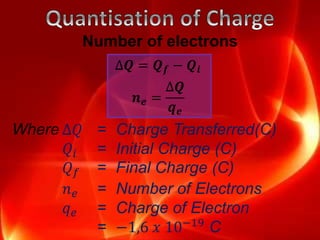
Number of electrons
∆𝑸 = 𝑸 𝒇 − 𝑸𝒊
𝒏 𝒆 =
∆𝑸
𝒒 𝒆
Where ∆𝑄 = Charge Transferred(C)
𝑄𝑖 = Initial Charge (C)
𝑄 𝑓 = Final Charge (C)
𝑛 𝑒 = Number of Electrons
𝑞 𝑒 = Charge of Electron
= −1,6 𝑥 10−19
C
Two identical metal spheres have different
charges. Sphere A has a charge of -5 nC.
Sphere B has a charge of 3 nC.
a) What is the nature of the force between A
and B?
b) If the two spheres touched, what will the
new charge on the spheres be?
c) What is the new nature of the forces
between sphere A and sphere B?
d) In which directions were the electrons
transferred?
e) How many electrons were transferred?
Two identical metal spheres have different
charges. Sphere A has a charge of
–96 X 10-18 C. Sphere B has 60 excess
electrons.
a) What is the charge on sphere B?
b) If the two spheres touched, what will
the new charge on the spheres be?
c) How many electrons were transferred?

Introduction to Electrostatics

  • 2.
    The study ofthe effect that charges in rest have on each other
  • 3.
    Objects become charged by gaining or loosing electrons Twotypes charges: Positive: Shortage of Electrons Negative: Excess of Electrons Protons and neutrons cannot be transferred!!!
  • 4.
    Forces between charges: Likecharges repel each other Opposite charges attract each other
  • 5.
    Friction Electrons are transferredwhen two objects are rubbed against each other
  • 6.
    Touch Electrons are transferredwhen a charged object touches a neutral object
  • 7.
    Induction (polarization) Charged particlesin a neutral object rearrange when a charged objects is brought close to it Causes temporary charge distribution so neutral object can be attracted
  • 8.
  • 9.
    Charge cannot becreated or destroyed, but only transferred from one object to another.
  • 10.
    -2 nC -4nC Charge distribute equally among both spheres
  • 11.
    Calculate new chargeon spheres -2 nC -4 nC 𝑄 𝑓 = 𝑄1 + 𝑄2 2 𝑄 𝑓 = −2 + (−4) 2 𝑄 𝑓 = −3 𝑛𝐶 -3 nC-3 nC
  • 12.
    Number of electrons ∆𝑸= 𝑸 𝒇 − 𝑸𝒊 𝒏 𝒆 = ∆𝑸 𝒒 𝒆 Where ∆𝑄 = Charge Transferred(C) 𝑄𝑖 = Initial Charge (C) 𝑄 𝑓 = Final Charge (C) 𝑛 𝑒 = Number of Electrons 𝑞 𝑒 = Charge of Electron = −1,6 𝑥 10−19 C
  • 13.
    Two identical metalspheres have different charges. Sphere A has a charge of -5 nC. Sphere B has a charge of 3 nC. a) What is the nature of the force between A and B? b) If the two spheres touched, what will the new charge on the spheres be? c) What is the new nature of the forces between sphere A and sphere B? d) In which directions were the electrons transferred? e) How many electrons were transferred?
  • 14.
    Two identical metalspheres have different charges. Sphere A has a charge of –96 X 10-18 C. Sphere B has 60 excess electrons. a) What is the charge on sphere B? b) If the two spheres touched, what will the new charge on the spheres be? c) How many electrons were transferred?