Atoms/ groups of atoms with an electrical
charge
 Positive Ions
 Loses
electrons
 Negative Ions
 Gains
electrons
MEMORIZE the names and charges
of common ions – p 19
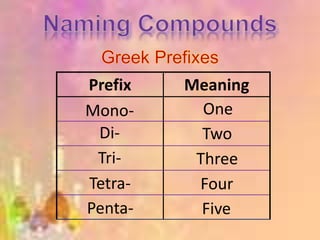
Prefix Meaning
Mono-
Di-
Tri-
Tetra-
Penta-
One
Two
Three
Four
Five
 Metal and Non-metal:
Metal + Non-metal + “-ide”
 Non-metal and Non-metal:
• Name first non-metal, then
second non-metal and add “–ide”
• Use prefixes for ratio’s of
elements
Elements to the left of periodic table
are named FIRST!!!
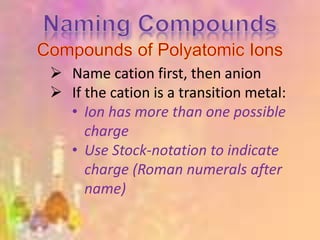
 Name cation first, then anion
 If the cation is a transition metal:
• Ion has more than one possible
charge
• Use Stock-notation to indicate
charge (Roman numerals after
name)
Name the following compounds:
a) CaBr2
b) N2S5
c) V2O5 (V5+)
d) ZnSO4
e) (NH4)3PO4
f) Na3P
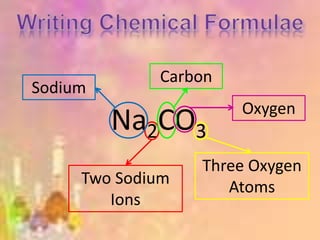
Na2CO3
Two Sodium
Ions
Sodium
Carbon
Oxygen
Three Oxygen
Atoms
 Group I = +1
 Group II = +2
 Group III = +3
 Group IV = + 4
 Group V = -3
 Group VI = -2
 Group VII = -1
 Group VIII = Do Not
form BONDS!!!
 Transitionmetals
• Indicated by Stock-notation
• Know general charges – p19
 Poly-atomic ions
• Know charges – p 19
 Substances combine in such a way that the
compound is neutral
• Sum of charges = 0
 Choose ion with largest charge
• Assume there are only one atom of that
ion in the compound
 Set number of atoms of other ion = x
• Solve for x
 Remove fractions to obtain whole numbers
Write chemical formulae for compounds of the
following substances:
a) Sodium and oxygen
b) Potassium sulphide
c) Iron(II)chloride
d) Magnesium carbonate
e) Calcium Nitrate
f) Aluminium oxide
g) Ammonium sulphate

Chemical nomenclature e

  • 2.
    Atoms/ groups ofatoms with an electrical charge  Positive Ions  Loses electrons  Negative Ions  Gains electrons MEMORIZE the names and charges of common ions – p 19
  • 3.
  • 4.
     Metal andNon-metal: Metal + Non-metal + “-ide”  Non-metal and Non-metal: • Name first non-metal, then second non-metal and add “–ide” • Use prefixes for ratio’s of elements Elements to the left of periodic table are named FIRST!!!
  • 5.
     Name cationfirst, then anion  If the cation is a transition metal: • Ion has more than one possible charge • Use Stock-notation to indicate charge (Roman numerals after name)
  • 6.
    Name the followingcompounds: a) CaBr2 b) N2S5 c) V2O5 (V5+) d) ZnSO4 e) (NH4)3PO4 f) Na3P
  • 7.
  • 8.
     Group I= +1  Group II = +2  Group III = +3  Group IV = + 4  Group V = -3  Group VI = -2  Group VII = -1  Group VIII = Do Not form BONDS!!!
  • 9.
     Transitionmetals • Indicatedby Stock-notation • Know general charges – p19  Poly-atomic ions • Know charges – p 19
  • 10.
     Substances combinein such a way that the compound is neutral • Sum of charges = 0  Choose ion with largest charge • Assume there are only one atom of that ion in the compound  Set number of atoms of other ion = x • Solve for x  Remove fractions to obtain whole numbers
  • 11.
    Write chemical formulaefor compounds of the following substances: a) Sodium and oxygen b) Potassium sulphide c) Iron(II)chloride d) Magnesium carbonate e) Calcium Nitrate f) Aluminium oxide g) Ammonium sulphate