ELECTROSTATICS It is the  branch of Physics which  deals with the study of charges at rest and the forces between static charges.
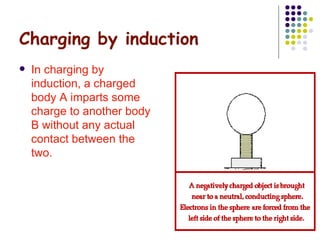
Charging by induction In charging by induction, a charged body A imparts some charge to another body B without any actual contact between the two.
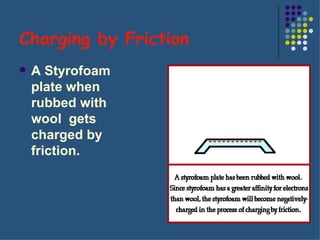
Charging by Friction A Styrofoam plate when  rubbed with wool  gets charged by friction.
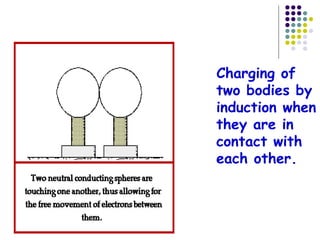
Charging of two bodies by induction when they are in contact with each other.
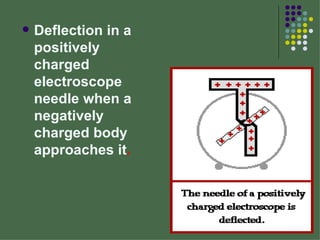
Deflection in a positively charged electroscope needle when a negatively charged body approaches it .
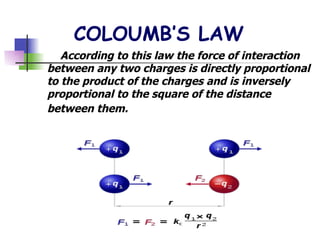
COLOUMB’S LAW According to this law the force of interaction  between any two charges is directly proportional to the product of the charges and is inversely proportional to the square of the distance between them.
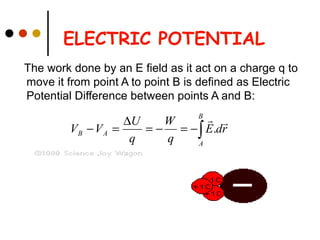
ELECTRIC POTENTIAL   The work done by an E field as it act on a charge q to move it from point A to point B is defined as Electric Potential Difference between points A and B:
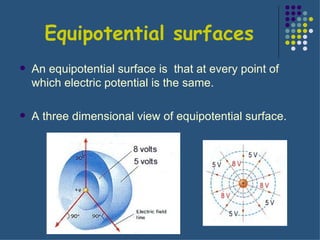
Equipotential surfaces An equipotential surface is  that at every point of which electric potential is the same. A three dimensional view of equipotential surface.
ELECTRIC DIPOLE An electric dipole consists of a pair of equal and opposite point charges separated by a small distance .
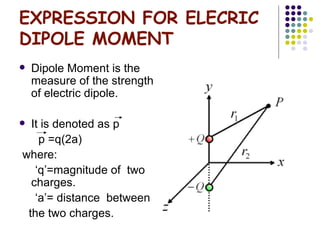
EXPRESSION FOR ELECRIC DIPOLE MOMENT Dipole Moment is the measure of the strength of electric dipole. It is denoted as p p =q(2a) where: ‘ q’=magnitude of  two charges. ‘ a’= distance  between  the two charges.
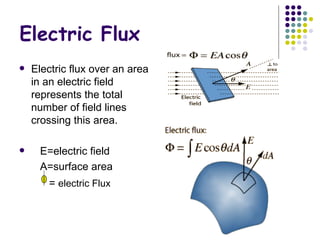
Electric Flux Electric flux over an area in an electric field represents the total number of field lines crossing this area.  E=electric field  A=surface area  =  electric Flux
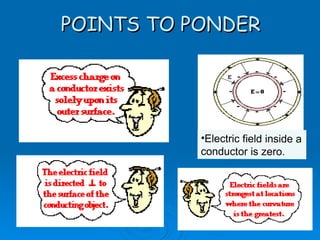
POINTS TO PONDER Electric field inside a conductor is zero.
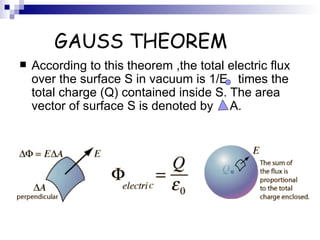
GAUSS THEOREM According to this theorem ,the total electric flux over the surface S in vacuum is 1/E  times the total charge (Q) contained inside S. The area vector of surface S is denoted by  A.
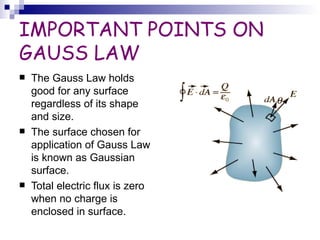
IMPORTANT POINTS ON GAUSS LAW The Gauss Law holds good for any surface regardless of its shape and size. The surface chosen for application of Gauss Law is known as Gaussian surface. Total electric flux is zero when no charge is enclosed in surface.
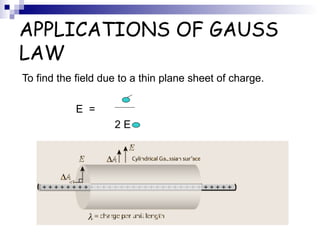
APPLICATIONS OF GAUSS LAW To find the field due to a thin plane sheet of charge. E  =  2 E
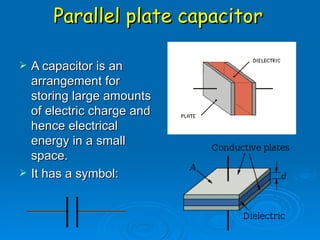
Parallel plate capacitor A capacitor is an arrangement for storing large amounts of electric charge and hence electrical energy in a small space. It has a symbol:
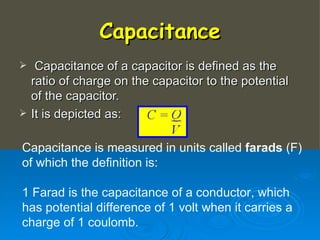
Capacitance Capacitance of a capacitor is defined as the ratio of charge on the capacitor to the potential of the capacitor. It is depicted as: Capacitance is measured in units called  farads  (F) of which the definition is: 1 Farad is the capacitance of a conductor, which has potential difference of 1 volt when it carries a charge of 1 coulomb.    
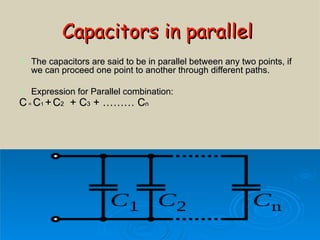
Capacitors in parallel   The capacitors are said to be in parallel between any two points, if we can proceed one point to another through different paths. Expression for Parallel combination: C  =  C 1  +   C 2   + C 3  + ……… C n
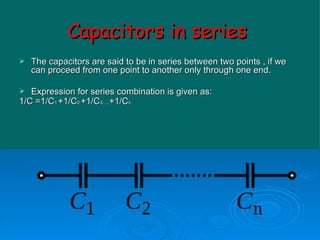
Capacitors in series   The capacitors are said to be in series between two points , if we can proceed from one point to another only through one end. Expression for series combination is given as: 1/C   =1/C 1  +1/C 2  +1/C 3….. +1/C n
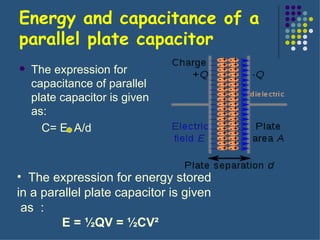
Energy and capacitance of a parallel plate capacitor The expression for capacitance of parallel plate capacitor is given as: C= E  A/d The expression for energy stored  in a parallel plate capacitor is given  as  : E = ½QV = ½CV²    
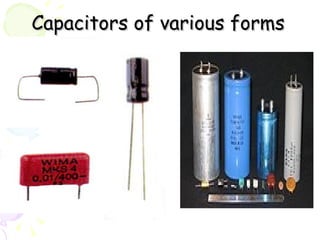
Capacitors of various forms
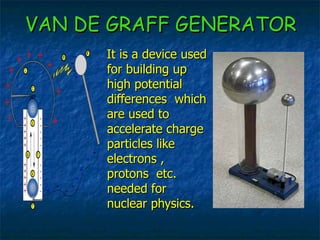
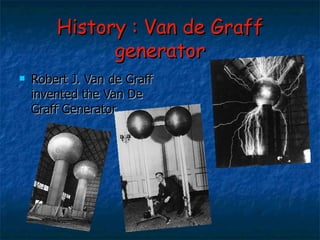
VAN DE GRAFF GENERATOR It is a device used for building up high potential differences  which are used to accelerate charge particles like electrons , protons  etc. needed for nuclear physics.
History : Van de Graff generator Robert J. Van de Graff invented the Van De Graff Generator.
THANKS Efforts by: Ashima Dogra XII – Sci Faith Academy 2008-09