Electrophoresis
• Submitted by
• Saubhagya
• Sri venkateswara college
• University of Delhi
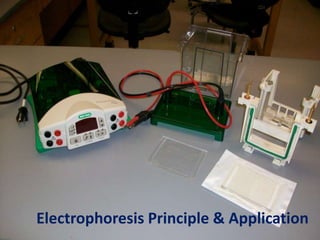
Electrophoresis Principle & Application
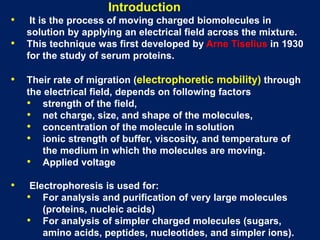
• It is the process of moving charged biomolecules in
solution by applying an electrical field across the mixture.
• This technique was first developed by Arne Tiselius in 1930
for the study of serum proteins.
• Their rate of migration (electrophoretic mobility) through
the electrical field, depends on following factors
• strength of the field,
• net charge, size, and shape of the molecules,
• concentration of the molecule in solution
• ionic strength of buffer, viscosity, and temperature of
the medium in which the molecules are moving.
• Applied voltage
• Electrophoresis is used for:
• For analysis and purification of very large molecules
(proteins, nucleic acids)
• For analysis of simpler charged molecules (sugars,
amino acids, peptides, nucleotides, and simpler ions).
Introduction
• Electrophoresis can be one dimensional (i.e. one plane of
separation) or two dimensional.
• One dimensional electrophoresis is used for most routine
protein and nucleic acid separations. Two dimensional
separation of proteins is used for finger printing , and when
properly constructed can be extremely accurate in resolving
all of the proteins present within a cell (greater than 1,500).
• Most common stabilizing media are polyacrylamide or
agarose gels.
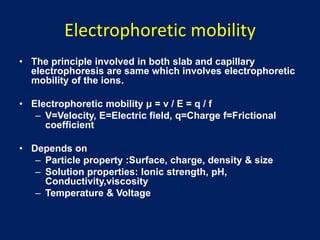
• Molecules can have distinct charges
• Positive or Negative
• Net charge will cause different movement through gel
• Molecules can have different shapes
• Linear
• Globular
• Alpha helix
When charged molecules are placed in an electric field, they
migrate toward either the positive (anode) or negative (cathode)
pole according to their charge.
Basic Principle of Electrophoresis
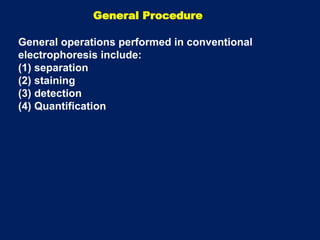
Electrophoretic mobility
• The principle involved in both slab and capillary
electrophoresis are same which involves electrophoretic
mobility of the ions.
• Electrophoretic mobility μ = v / E = q / f
– V=Velocity, E=Electric field, q=Charge f=Frictional
coefficient
• Depends on
– Particle property :Surface, charge, density & size
– Solution properties: Ionic strength, pH,
Conductivity,viscosity
– Temperature & Voltage
General operations performed in conventional
electrophoresis include:
(1) separation
(2) staining
(3) detection
(4) Quantification
General Procedure
The Basic Components
• Support Medium (Powdered of agarose or polyacrylamise
• The electric power supply provides the electricity that carries
the molecules through the gel
• The electrophoresis chamber is where it all takes place.
• Boiling Buffer solution
• Gel stain
• The “gel” in gel electrophoresis is the component that
physically separates the molecules.
• Use the proper gel concentration for sample size
range.
0.5–5% agarose (for DNA & RNA)
3.5–20% polyacrylamide (for Protein)
• Agarose and polyacrylamide gels are across-linked,
spongelike structure
• It is important that the support media is electrically
neutral. Presence of charge group may cause:
-Migration retardation
-The flow of water toward one or the other electrode so
called ‘Electroendosmosis (EEO)’, which decrease
resolution of the separation
Support media
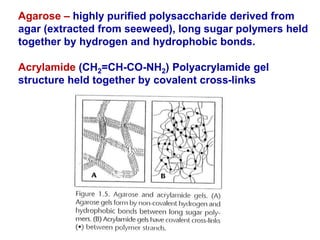
Agarose – highly purified polysaccharide derived from
agar (extracted from seeweed), long sugar polymers held
together by hydrogen and hydrophobic bonds.
Acrylamide (CH2=CH-CO-NH2) Polyacrylamide gel
structure held together by covalent cross-links
Buffer additives modify sample molecules.
• Commonly used buffer
• Tris-acetate-EDTA , Tris Phosphate EDTA & Tris-borate-
EDTA (50mmol/L; pH 7.5-7.8) used most often for DNA.
• 10 mM sodium phosphate or MOPS buffer used for RNA.
• Barbital buffer & Tris-EDTA for protein
• Function of buffer
1. carries the applied current
2. established the pH
3. determine the electric charge on the solute
• High ionic strength of buffer
– produce sharper band
– produce more heat
Buffers
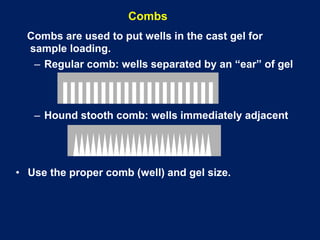
Combs are used to put wells in the cast gel for
sample loading.
– Regular comb: wells separated by an “ear” of gel
– Hound stooth comb: wells immediately adjacent
• Use the proper comb (well) and gel size.
Combs
Applied voltage
• Increase:
-charged molecule migrate faster
-Increases current
- temperature
Temperature
• Better at low temp(40C) : Otherwise density difference 
convection current Disturbed diffusion
• Distortion of Zones: Column gel migrating Center
(warmer) faster than outer (cooler)
• Evaporation: increase in ionic strength of the buffer
• Viscosity: agarose gels becomes softer
Classification
1. Gel electrophoresis
1(a) Electrophoreis of nucleic acids
 Agarose gel electrophoresis of DNA
 Pulsed- field gel electrophoresis
1(b) Electrophoesis of proteins
 Sodium dodecyl sulphate (SDS)- polyacrylamide gel
electrophoresis
– Native (buffer) gels
– Gradient gels
– Isoelectric focusing gel
 Two-dimentional polyacrylamide gel electrophoresis
– Cellulose acetate electrophoresis
– Detection estimation and recovery of proteins in gels
– Protein (western blotting) blotting
2. Capillary electrophoresis
3. Microchip electrophoresis
Electrophoresis
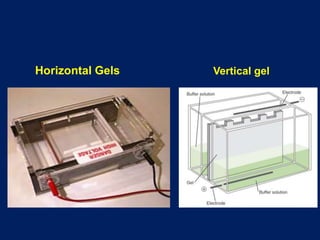
• Horizontal Agarose Gels
• Agarose forms a gel or molecular sieve that
supports the movement of small materials in solution
used for DNA
• Vertical Polyacrylamide Gels
• Made of Polyacrylamide
• Used for Protein molecular size, shape, charge
• IEF electrophoresis
• Western Blot technique
Horizontal Gels Vertical gel
• Gel is a colloid in a solid form (99% is water).
• The separation here is brought about through molecular
sieving technique, based on molecular size of substances.
• During electrophoresis, macromolecules are forced to move
through the pores when the electrical current is applied.
Support media
• Agarose for nucleic acid and polyacrylamide gels for protein
are a cross-linked, sponge like structure.
• It is important that the support media is electrically neutral.
Presence of charge group may cause:
-Migration retardation
-The flow of water toward one or the other electrode so
called ‘Electroendosmosis (EEO)’, which decrease
resolution of the separation
Gel electrophoresis
Agrose gel electrophoresis
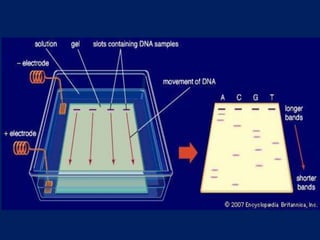
• Agarose gel electrophoresis is a method to separate DNA, or RNA
molecules by size. This is achieved by moving negatively charged
nucleic acid molecules through an agarose matrix with an
electricfield (electrophoresis).
• The pore size is determined by adjusting the concentration of
agarose in a gel (normally in the rank of 0.4-4%
• Shorter molecules move faster and migrate farther than longer
ones .
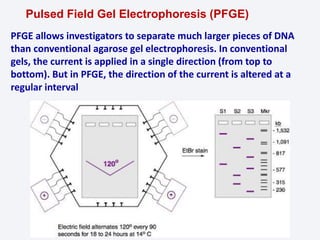
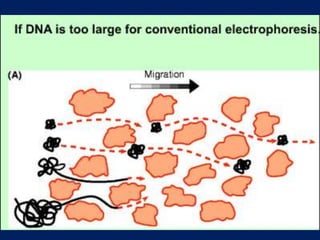
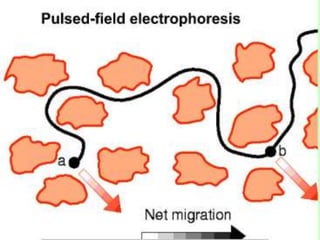
PFGE allows investigators to separate much larger pieces of DNA
than conventional agarose gel electrophoresis. In conventional
gels, the current is applied in a single direction (from top to
bottom). But in PFGE, the direction of the current is altered at a
regular interval
Pulsed Field Gel Electrophoresis (PFGE)
• Detect bands by staining during or after
electrophoresis
• Ethidium bromide: for double-stranded DNA
• SyBr green or SyBr gold: for single- or double-
stranded DNA or for RNA
• Silver stain: more sensitive for single- or double-
stranded DNA or for RNA and proteins
Nucleic acid stain
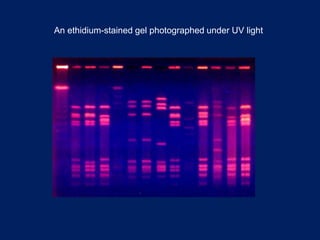
An ethidium-stained gel photographed under UV light
1(a). Electrophoresis of proteins
 Sodiumdodecylsulphate(SDS)-Polyacrylamide Gel Electrophoresis
• Polyacrylamide gel electrophoresis (PAGE), describes a technique widely
used in biochemistry, forensics, genetics, molecular
biology and biotechnology to separate biological macromolecules, usually
proteins or nucleic acids, according to their electrophoretic mobility.
• Mobility is a function of the length, conformation and charge of the
molecule
• As with all forms of gel electrophoresis, molecules may be run in
their native state, preserving the molecules' higher-order structure, or a
chemical denaturant may be added to remove this structure and turn the
molecule into an unstructured linear chain whose mobility depends only
on its length and mass-to-charge ratio.
• For nucleic acids, urea is the most commonly used denaturant. For
proteins, sodium dodecyl sulfate (SDS) also called lauryl sulfate is an
anionic detergent applied to protein sample to linearize proteins and to
impart a negative charge to linearized proteins. This procedure is
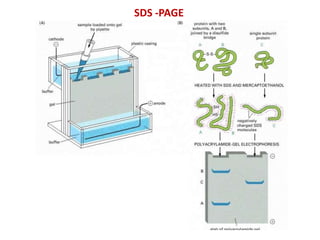
called SDS-PAGE.
• SDS is an anionic detergent that denatures secondary and non–disulfide–
linked tertiary structures, and additionally applies a negative charge to
each protein in proportion to its mass.
• Urea breaks the hydrogen bonds between the base pairs of the nucleic
acid, causing the constituent strands to separate. Heating the samples to
at least 60°C further promotes denaturation.
• In most proteins, the binding of SDS to the polypeptide chain imparts an
even distribution of charge per unit mass, thereby resulting in a
fractionation by approximate size during electrophoresis.
• Proteins that have a greater hydrophobic content, for instance many
membrane proteins, and those that interact with surfactants in their
native environment, are intrinsically harder to treat accurately using this
method, due to the greater variability in the ratio of bound SDS.
• In addition to SDS, proteins may optionally be briefly heated to near
boiling in the presence of a reducing agent, such as dithiothreitol
(DTT) or 2-mercaptoethanol (beta-mercaptoethanol/BME), which further
denatures the proteins by reducing disulfide linkages, thus overcoming
some forms of tertiary protein folding, and breaking up quaternary
protein structure (oligomeric subunits). This is known as reducing SDS-
PAGE.
SDS -PAGE
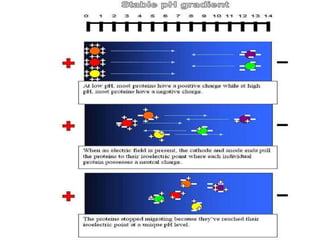
 Electrophoretic method that separates proteins according
to the iso-electric points
 Is ideal for seperation of amphoteric substances
 Each protein has own pI = pH at which the protein has
equal amount of positive and negative charges (the net
charge is zero)
 PI of proteins can be theoretically predicted. Therefore, IEF
can also be used for protein identification.
 Seperation is achieved by applying a potential difference
across a gel that contain a pH gradient
 Mixtures of ampholytes, small amphoteric molecules with
high buffering capacity near their pI, are used to generate
the pH gradient.
 Isoelectric focusing requires solid support such as
polyacrylamide gel
Isoelectric Focusing
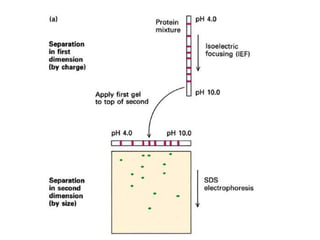
 In the first dimension, proteins are resolved in according to their
isoelectric points (pIs) using immobilized pH gradient electrophoresis
(IPGE), isoelectric focusing (IEF), or non-equilibrium pH gradient
electrophoresis.
 In the second dimension, proteins are separated according to their
approximate molecular weight using sodium dodecyl sulfate poly-
acrylamide-electrophoresis (SDS-PAGE).
 The combination of these two technique to give two-dimension (2-
D)PAGE provides a highly sophisticated analytical method for analysing
protein mixtures.
2D-PAGE
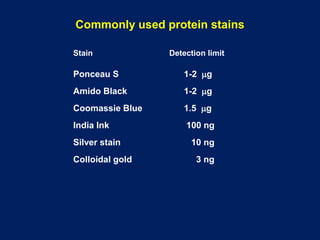
Stain Detection limit
Ponceau S 1-2 mg
Amido Black 1-2 mg
Coomassie Blue 1.5 mg
India Ink 100 ng
Silver stain 10 ng
Colloidal gold 3 ng
Commonly used protein stains
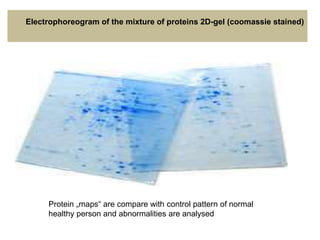
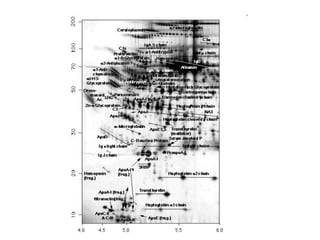
Protein „maps“ are compare with control pattern of normal
healthy person and abnormalities are analysed
Electrophoreogram of the mixture of proteins 2D-gel (coomassie stained)
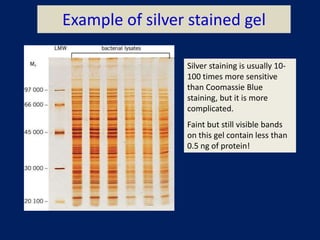
Example of silver stained gel
Silver staining is usually 10-
100 times more sensitive
than Coomassie Blue
staining, but it is more
complicated.
Faint but still visible bands
on this gel contain less than
0.5 ng of protein!
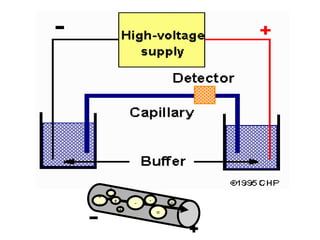
Capillary electrophoresis
Capillary gel electrophoresis is used for separation of biological
molecule including amino acid, peptides, proteins, DNA fragments, and
nucleic acids well as any number of small organic molecules such as
drugs or even metal ions. to separate nucleic acids.
It is classic techniques of electrophoresis are carried out in a small-
bore, fused silica capillary tube, the outer diameter of such tubes
typically varies from 180 to 375 micrometer, the inner diameter from 20
to 180 micrometer, and the total length from 20 cm up to several
meters.
The capillary can also be filled with a gel, which eliminates the
electroosmotic flow. This capillary tube serves as a capillary
electrophoretic chamber that is connected to a detector at its terminal
end and, via buffer reservoirs, to a high-voltage power supply
Separation is accomplished as in conventional gel electrophoresis but
the capillary allows higher resolution, greater sensitivity, and on-line
detection.
One advantage of using capillary is that they reduce problem resulting from
heating effects. Because of small diameter of the tubing there is a larger
surface-to-volume ratio, which give enhanced heat dissipation. Improved
heat dissipation permits the application of voltages in the range of 20 to 30
kV, which enhances separation efficiency and reduces separation time in
some cases to less than 1 minute
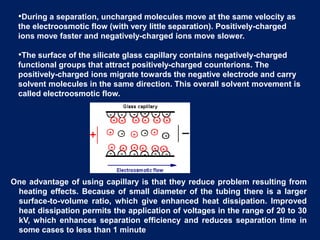
•During a separation, uncharged molecules move at the same velocity as
the electroosmotic flow (with very little separation). Positively-charged
ions move faster and negatively-charged ions move slower.
•The surface of the silicate glass capillary contains negatively-charged
functional groups that attract positively-charged counterions. The
positively-charged ions migrate towards the negative electrode and carry
solvent molecules in the same direction. This overall solvent movement is
called electroosmotic flow.
=
+
+
+
+
+
+
- -
=
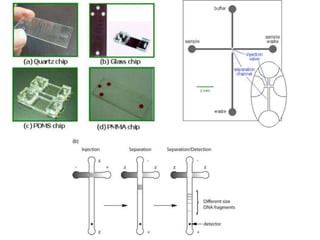
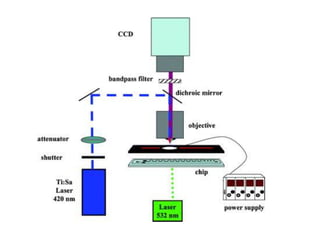
3. Microchip electrophoresis
• Microchip analysis completed in tens of seconds where as capillary
electrophoresis can take 20 min and conventional gel electrophoresis at
least2h.
• Using new detection system, such as laser induced fluorescence,
picomole to attomole (10-8 moles) sensitivity can be achieved, which is at
least two order of magnitude greater than for conventional capillary
electrophoresis.
• The microchip provide an electrophoretic system similar to CE but with
more flexibility.
• Current developments of this technology are based integrating functions
other than just separation in to the chip.
• For example: sample extraction, pre concentration of sample prior to
separation, PCR amplification of DNA sample using infrared mediated
thermo cycling for rapid on-chip amplification and the extraction of
separated molecules using micro chamber –bound solid phases are all
examples of where further functions have been built into a microchip
electrophoresis system.
• An interface has also been developed for microchip electrophoresis-mass
spectrometry where drug have been separated by MCE and then
identified by MS.
Applications
The vast application of electrophoresis include:
• Vaccine analysis such as influenza vaccine, hepatitis vaccine and polio
vaccine.
• Protein and DNA analysis
• To see the map and the differences in the genetic code of species on the
earth.
• Electrophoretic DNA analysis also provides a reliable tool in forensic
investigations.
• Determination of impurities
• Chiral analysis
• Analysis of carbohydrates and other macromolecules.
• Analysis of inorganic anions/metal ions
Protein analysis
• Electrophoresis has advanced our understanding on the structure and
function of proteins. These molecules are needed by our body cells and
may be analyzed, for instance by getting blood and urine samples. Then
through electrophoresis, the amount of protein in your blood or in your
urine is measure d and compare to established normal value lower or
higher than the normal levels usually indicates a disease.
DNA analysis
• Electrophoresis is one way of analyzing DNA, which is the unique code of
every individual. Through electrophoresis, specific DNA sequences can be
analyzed isolated and cloned. The analyzed DNA may be used in forensic
investigation and paternity tests.
• For this well are formed at one end of an agarose gel for the loading of
the DNA sample. The slab is then placed horizontally in to the
electrophoresis buffer chamber. The DNA migrates in bands towards the
positive electrode. The smaller molecule migrate through the matrix more
rapidly than the larger ones, which are restricted. The DNA bands are then
stained gel is then viewed directly under ultraviolet light and
photographed.

electrophoresis

  • 1.
    Electrophoresis • Submitted by •Saubhagya • Sri venkateswara college • University of Delhi
  • 2.
  • 3.
    • It isthe process of moving charged biomolecules in solution by applying an electrical field across the mixture. • This technique was first developed by Arne Tiselius in 1930 for the study of serum proteins. • Their rate of migration (electrophoretic mobility) through the electrical field, depends on following factors • strength of the field, • net charge, size, and shape of the molecules, • concentration of the molecule in solution • ionic strength of buffer, viscosity, and temperature of the medium in which the molecules are moving. • Applied voltage • Electrophoresis is used for: • For analysis and purification of very large molecules (proteins, nucleic acids) • For analysis of simpler charged molecules (sugars, amino acids, peptides, nucleotides, and simpler ions). Introduction
  • 4.
    • Electrophoresis canbe one dimensional (i.e. one plane of separation) or two dimensional. • One dimensional electrophoresis is used for most routine protein and nucleic acid separations. Two dimensional separation of proteins is used for finger printing , and when properly constructed can be extremely accurate in resolving all of the proteins present within a cell (greater than 1,500). • Most common stabilizing media are polyacrylamide or agarose gels.
  • 5.
    • Molecules canhave distinct charges • Positive or Negative • Net charge will cause different movement through gel • Molecules can have different shapes • Linear • Globular • Alpha helix When charged molecules are placed in an electric field, they migrate toward either the positive (anode) or negative (cathode) pole according to their charge. Basic Principle of Electrophoresis
  • 6.
    Electrophoretic mobility • Theprinciple involved in both slab and capillary electrophoresis are same which involves electrophoretic mobility of the ions. • Electrophoretic mobility μ = v / E = q / f – V=Velocity, E=Electric field, q=Charge f=Frictional coefficient • Depends on – Particle property :Surface, charge, density & size – Solution properties: Ionic strength, pH, Conductivity,viscosity – Temperature & Voltage
  • 7.
    General operations performedin conventional electrophoresis include: (1) separation (2) staining (3) detection (4) Quantification General Procedure
  • 8.
    The Basic Components •Support Medium (Powdered of agarose or polyacrylamise • The electric power supply provides the electricity that carries the molecules through the gel • The electrophoresis chamber is where it all takes place. • Boiling Buffer solution • Gel stain
  • 9.
    • The “gel”in gel electrophoresis is the component that physically separates the molecules. • Use the proper gel concentration for sample size range. 0.5–5% agarose (for DNA & RNA) 3.5–20% polyacrylamide (for Protein) • Agarose and polyacrylamide gels are across-linked, spongelike structure • It is important that the support media is electrically neutral. Presence of charge group may cause: -Migration retardation -The flow of water toward one or the other electrode so called ‘Electroendosmosis (EEO)’, which decrease resolution of the separation Support media
  • 10.
    Agarose – highlypurified polysaccharide derived from agar (extracted from seeweed), long sugar polymers held together by hydrogen and hydrophobic bonds. Acrylamide (CH2=CH-CO-NH2) Polyacrylamide gel structure held together by covalent cross-links
  • 11.
    Buffer additives modifysample molecules. • Commonly used buffer • Tris-acetate-EDTA , Tris Phosphate EDTA & Tris-borate- EDTA (50mmol/L; pH 7.5-7.8) used most often for DNA. • 10 mM sodium phosphate or MOPS buffer used for RNA. • Barbital buffer & Tris-EDTA for protein • Function of buffer 1. carries the applied current 2. established the pH 3. determine the electric charge on the solute • High ionic strength of buffer – produce sharper band – produce more heat Buffers
  • 12.
    Combs are usedto put wells in the cast gel for sample loading. – Regular comb: wells separated by an “ear” of gel – Hound stooth comb: wells immediately adjacent • Use the proper comb (well) and gel size. Combs
  • 13.
    Applied voltage • Increase: -chargedmolecule migrate faster -Increases current - temperature Temperature • Better at low temp(40C) : Otherwise density difference  convection current Disturbed diffusion • Distortion of Zones: Column gel migrating Center (warmer) faster than outer (cooler) • Evaporation: increase in ionic strength of the buffer • Viscosity: agarose gels becomes softer
  • 14.
    Classification 1. Gel electrophoresis 1(a)Electrophoreis of nucleic acids  Agarose gel electrophoresis of DNA  Pulsed- field gel electrophoresis 1(b) Electrophoesis of proteins  Sodium dodecyl sulphate (SDS)- polyacrylamide gel electrophoresis – Native (buffer) gels – Gradient gels – Isoelectric focusing gel  Two-dimentional polyacrylamide gel electrophoresis – Cellulose acetate electrophoresis – Detection estimation and recovery of proteins in gels – Protein (western blotting) blotting 2. Capillary electrophoresis 3. Microchip electrophoresis
  • 15.
    Electrophoresis • Horizontal AgaroseGels • Agarose forms a gel or molecular sieve that supports the movement of small materials in solution used for DNA • Vertical Polyacrylamide Gels • Made of Polyacrylamide • Used for Protein molecular size, shape, charge • IEF electrophoresis • Western Blot technique
  • 16.
  • 17.
    • Gel isa colloid in a solid form (99% is water). • The separation here is brought about through molecular sieving technique, based on molecular size of substances. • During electrophoresis, macromolecules are forced to move through the pores when the electrical current is applied. Support media • Agarose for nucleic acid and polyacrylamide gels for protein are a cross-linked, sponge like structure. • It is important that the support media is electrically neutral. Presence of charge group may cause: -Migration retardation -The flow of water toward one or the other electrode so called ‘Electroendosmosis (EEO)’, which decrease resolution of the separation Gel electrophoresis
  • 18.
    Agrose gel electrophoresis •Agarose gel electrophoresis is a method to separate DNA, or RNA molecules by size. This is achieved by moving negatively charged nucleic acid molecules through an agarose matrix with an electricfield (electrophoresis). • The pore size is determined by adjusting the concentration of agarose in a gel (normally in the rank of 0.4-4% • Shorter molecules move faster and migrate farther than longer ones .
  • 20.
    PFGE allows investigatorsto separate much larger pieces of DNA than conventional agarose gel electrophoresis. In conventional gels, the current is applied in a single direction (from top to bottom). But in PFGE, the direction of the current is altered at a regular interval Pulsed Field Gel Electrophoresis (PFGE)
  • 23.
    • Detect bandsby staining during or after electrophoresis • Ethidium bromide: for double-stranded DNA • SyBr green or SyBr gold: for single- or double- stranded DNA or for RNA • Silver stain: more sensitive for single- or double- stranded DNA or for RNA and proteins Nucleic acid stain
  • 24.
    An ethidium-stained gelphotographed under UV light
  • 25.
    1(a). Electrophoresis ofproteins  Sodiumdodecylsulphate(SDS)-Polyacrylamide Gel Electrophoresis • Polyacrylamide gel electrophoresis (PAGE), describes a technique widely used in biochemistry, forensics, genetics, molecular biology and biotechnology to separate biological macromolecules, usually proteins or nucleic acids, according to their electrophoretic mobility. • Mobility is a function of the length, conformation and charge of the molecule • As with all forms of gel electrophoresis, molecules may be run in their native state, preserving the molecules' higher-order structure, or a chemical denaturant may be added to remove this structure and turn the molecule into an unstructured linear chain whose mobility depends only on its length and mass-to-charge ratio. • For nucleic acids, urea is the most commonly used denaturant. For proteins, sodium dodecyl sulfate (SDS) also called lauryl sulfate is an anionic detergent applied to protein sample to linearize proteins and to impart a negative charge to linearized proteins. This procedure is called SDS-PAGE.
  • 26.
    • SDS isan anionic detergent that denatures secondary and non–disulfide– linked tertiary structures, and additionally applies a negative charge to each protein in proportion to its mass. • Urea breaks the hydrogen bonds between the base pairs of the nucleic acid, causing the constituent strands to separate. Heating the samples to at least 60°C further promotes denaturation. • In most proteins, the binding of SDS to the polypeptide chain imparts an even distribution of charge per unit mass, thereby resulting in a fractionation by approximate size during electrophoresis. • Proteins that have a greater hydrophobic content, for instance many membrane proteins, and those that interact with surfactants in their native environment, are intrinsically harder to treat accurately using this method, due to the greater variability in the ratio of bound SDS. • In addition to SDS, proteins may optionally be briefly heated to near boiling in the presence of a reducing agent, such as dithiothreitol (DTT) or 2-mercaptoethanol (beta-mercaptoethanol/BME), which further denatures the proteins by reducing disulfide linkages, thus overcoming some forms of tertiary protein folding, and breaking up quaternary protein structure (oligomeric subunits). This is known as reducing SDS- PAGE.
  • 27.
  • 28.
     Electrophoretic methodthat separates proteins according to the iso-electric points  Is ideal for seperation of amphoteric substances  Each protein has own pI = pH at which the protein has equal amount of positive and negative charges (the net charge is zero)  PI of proteins can be theoretically predicted. Therefore, IEF can also be used for protein identification.  Seperation is achieved by applying a potential difference across a gel that contain a pH gradient  Mixtures of ampholytes, small amphoteric molecules with high buffering capacity near their pI, are used to generate the pH gradient.  Isoelectric focusing requires solid support such as polyacrylamide gel Isoelectric Focusing
  • 30.
     In thefirst dimension, proteins are resolved in according to their isoelectric points (pIs) using immobilized pH gradient electrophoresis (IPGE), isoelectric focusing (IEF), or non-equilibrium pH gradient electrophoresis.  In the second dimension, proteins are separated according to their approximate molecular weight using sodium dodecyl sulfate poly- acrylamide-electrophoresis (SDS-PAGE).  The combination of these two technique to give two-dimension (2- D)PAGE provides a highly sophisticated analytical method for analysing protein mixtures. 2D-PAGE
  • 32.
    Stain Detection limit PonceauS 1-2 mg Amido Black 1-2 mg Coomassie Blue 1.5 mg India Ink 100 ng Silver stain 10 ng Colloidal gold 3 ng Commonly used protein stains
  • 33.
    Protein „maps“ arecompare with control pattern of normal healthy person and abnormalities are analysed Electrophoreogram of the mixture of proteins 2D-gel (coomassie stained)
  • 34.
    Example of silverstained gel Silver staining is usually 10- 100 times more sensitive than Coomassie Blue staining, but it is more complicated. Faint but still visible bands on this gel contain less than 0.5 ng of protein!
  • 36.
    Capillary electrophoresis Capillary gelelectrophoresis is used for separation of biological molecule including amino acid, peptides, proteins, DNA fragments, and nucleic acids well as any number of small organic molecules such as drugs or even metal ions. to separate nucleic acids. It is classic techniques of electrophoresis are carried out in a small- bore, fused silica capillary tube, the outer diameter of such tubes typically varies from 180 to 375 micrometer, the inner diameter from 20 to 180 micrometer, and the total length from 20 cm up to several meters. The capillary can also be filled with a gel, which eliminates the electroosmotic flow. This capillary tube serves as a capillary electrophoretic chamber that is connected to a detector at its terminal end and, via buffer reservoirs, to a high-voltage power supply Separation is accomplished as in conventional gel electrophoresis but the capillary allows higher resolution, greater sensitivity, and on-line detection.
  • 37.
    One advantage ofusing capillary is that they reduce problem resulting from heating effects. Because of small diameter of the tubing there is a larger surface-to-volume ratio, which give enhanced heat dissipation. Improved heat dissipation permits the application of voltages in the range of 20 to 30 kV, which enhances separation efficiency and reduces separation time in some cases to less than 1 minute •During a separation, uncharged molecules move at the same velocity as the electroosmotic flow (with very little separation). Positively-charged ions move faster and negatively-charged ions move slower. •The surface of the silicate glass capillary contains negatively-charged functional groups that attract positively-charged counterions. The positively-charged ions migrate towards the negative electrode and carry solvent molecules in the same direction. This overall solvent movement is called electroosmotic flow.
  • 38.
  • 39.
    3. Microchip electrophoresis •Microchip analysis completed in tens of seconds where as capillary electrophoresis can take 20 min and conventional gel electrophoresis at least2h. • Using new detection system, such as laser induced fluorescence, picomole to attomole (10-8 moles) sensitivity can be achieved, which is at least two order of magnitude greater than for conventional capillary electrophoresis. • The microchip provide an electrophoretic system similar to CE but with more flexibility. • Current developments of this technology are based integrating functions other than just separation in to the chip. • For example: sample extraction, pre concentration of sample prior to separation, PCR amplification of DNA sample using infrared mediated thermo cycling for rapid on-chip amplification and the extraction of separated molecules using micro chamber –bound solid phases are all examples of where further functions have been built into a microchip electrophoresis system. • An interface has also been developed for microchip electrophoresis-mass spectrometry where drug have been separated by MCE and then identified by MS.
  • 42.
    Applications The vast applicationof electrophoresis include: • Vaccine analysis such as influenza vaccine, hepatitis vaccine and polio vaccine. • Protein and DNA analysis • To see the map and the differences in the genetic code of species on the earth. • Electrophoretic DNA analysis also provides a reliable tool in forensic investigations. • Determination of impurities • Chiral analysis • Analysis of carbohydrates and other macromolecules. • Analysis of inorganic anions/metal ions
  • 43.
    Protein analysis • Electrophoresishas advanced our understanding on the structure and function of proteins. These molecules are needed by our body cells and may be analyzed, for instance by getting blood and urine samples. Then through electrophoresis, the amount of protein in your blood or in your urine is measure d and compare to established normal value lower or higher than the normal levels usually indicates a disease. DNA analysis • Electrophoresis is one way of analyzing DNA, which is the unique code of every individual. Through electrophoresis, specific DNA sequences can be analyzed isolated and cloned. The analyzed DNA may be used in forensic investigation and paternity tests. • For this well are formed at one end of an agarose gel for the loading of the DNA sample. The slab is then placed horizontally in to the electrophoresis buffer chamber. The DNA migrates in bands towards the positive electrode. The smaller molecule migrate through the matrix more rapidly than the larger ones, which are restricted. The DNA bands are then stained gel is then viewed directly under ultraviolet light and photographed.