Welcome
To my
presentation
Shahjalal University of Science
&
Technology, Sylhet
Department of Chemistry
Course No. : CHE 300
Course title : Seminar and Oral
A presentation on Electrophoresis
Presented by,
Tanjila Islam
Reg. No. : 2010131019
Semester : 3/2
electrophoresis
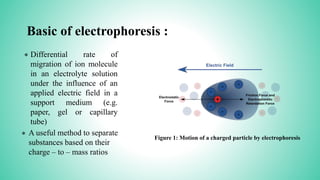
Basic of electrophoresis :
Differential rate of
migration of ion molecule
in an electrolyte solution
under the influence of an
applied electric field in a
support medium (e.g.
paper, gel or capillary
tube)
Figure 1: Motion of a charged particle by electrophoresis
*
* A useful method to separate
substances based on their
charge – to – mass ratios
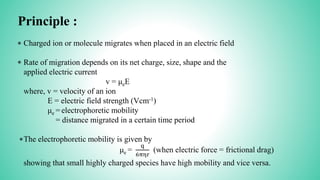
Principle :
* Charged ion or molecule migrates when placed in an electric field
Rate of migration depends on its net charge, size, shape and the
applied electric current
v = μeE
where, v = velocity of an ion
E = electric field strength (Vcm-1)
μe = electrophoretic mobility
= distance migrated in a certain time period
The electrophoretic mobility is given by
μe =
q
6πηr
(when electric force = frictional drag)
showing that small highly charged species have high mobility and vice versa.
*
*
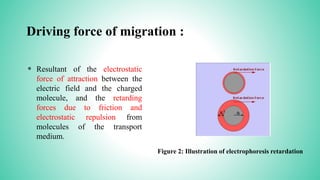
Driving force of migration :
* Resultant of the electrostatic
force of attraction between the
electric field and the charged
molecule, and the retarding
forces due to friction and
electrostatic repulsion from
molecules of the transport
medium.
Figure 2: Illustration of electrophoresis retardation
Supporting media for electrophoresis :
* Paper
- filter paper such as Whatman no.1 and no.3MM
- Used to good effect
* Cellulose acetate
- containing 2 to 3 acetyl groups
- to give sharper bands
- more easily rendered transparent
- low solvent capacity
- enhancing the resolution
Gels
- 3 dimensional semisolid colloids
- resolving power enhanced due to sieve effect operating
- prepared from starch, agar, or polyacrylamide
*
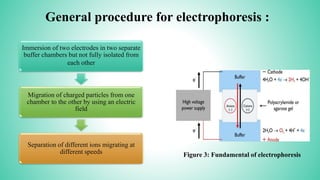
General procedure for electrophoresis :
Immersion of two electrodes in two separate
buffer chambers but not fully isolated from
each other
Migration of charged particles from one
chamber to the other by using an electric
field
Separation of different ions migrating at
different speeds Figure 3: Fundamental of electrophoresis
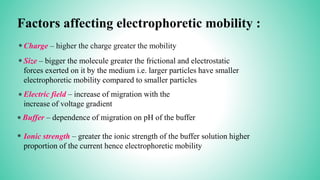
Factors affecting electrophoretic mobility :
*
*
*
Charge – higher the charge greater the mobility
Size – bigger the molecule greater the frictional and electrostatic
forces exerted on it by the medium i.e. larger particles have smaller
electrophoretic mobility compared to smaller particles
Electric field – increase of migration with the
increase of voltage gradient
* Buffer – dependence of migration on pH of the buffer
* Ionic strength – greater the ionic strength of the buffer solution higher
proportion of the current hence electrophoretic mobility
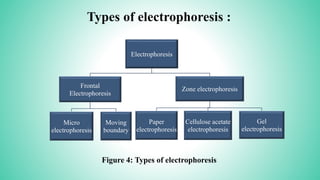
Types of electrophoresis :
Electrophoresis
Frontal
Electrophoresis
Micro
electrophoresis
Moving
boundary
Zone electrophoresis
Paper
electrophoresis
Cellulose acetate
electrophoresis
Gel
electrophoresis
Figure 4: Types of electrophoresis
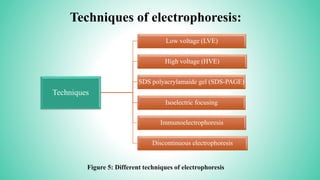
Techniques of electrophoresis:
Techniques
Low voltage (LVE)
High voltage (HVE)
SDS polyacrylamaide gel (SDS-PAGE)
Isoelectric focusing
Immunoelectrophoresis
Discontinuous electrophoresis
Figure 5: Different techniques of electrophoresis
Low voltage electrophoresis :
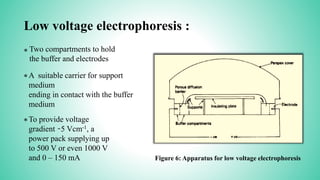
* Two compartments to hold
the buffer and electrodes
Figure 6: Apparatus for low voltage electrophoresis
*A suitable carrier for support
medium
ending in contact with the buffer
medium
*To provide voltage
gradient ̴ 5 Vcm-1, a
power pack supplying up
to 500 V or even 1000 V
and 0 – 150 mA
Application of LVE :
*
*
*
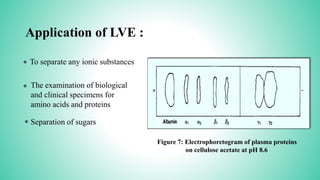
To separate any ionic substances
The examination of biological
and clinical specimens for
amino acids and proteins
Separation of sugars
Figure 7: Electrophoretogram of plasma proteins
on cellulose acetate at pH 8.6
High voltage electrophoresis :
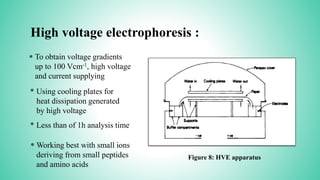
To obtain voltage gradients
up to 100 Vcm-1, high voltage
and current supplying
*
*
*
Using cooling plates for
heat dissipation generated
by high voltage
Less than of 1h analysis time
* Working best with small ions
deriving from small peptides
and amino acids
Figure 8: HVE apparatus
Capillary electrophoresis (CE) :
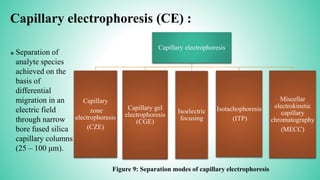
* Separation of
analyte species
achieved on the
basis of
differential
migration in an
electric field
through narrow
bore fused silica
capillary columns
(25 – 100 μm).
Capillary electrophoresis
Capillary
zone
electrophoresis
(CZE)
Capillary gel
electrophoresis
(CGE)
Isoelectric
focusing
Isotachophoresis
(ITP)
Miscellar
electrokinetic
capillary
chromatography
(MECC)
Figure 9: Separation modes of capillary electrophoresis
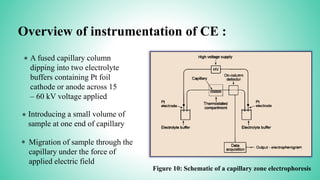
Overview of instrumentation of CE :
* A fused capillary column
dipping into two electrolyte
buffers containing Pt foil
cathode or anode across 15
– 60 kV voltage applied
* Introducing a small volume of
sample at one end of capillary
* Migration of sample through the
capillary under the force of
applied electric field
Figure 10: Schematic of a capillary zone electrophoresis
Advantages of CE :
Power dissipation minimized by high electrical resistance*
* Having voltage gradients up to 100 – 500 Vcm-1 necessary
for rapid separations
*
No Joule–Thompson effect
*
No band broadening
*
Most prominently used because of its faster results and
high resolution separation
*
Large range of detection methods available
Applications of electrophoresis :
*
* DNA analysis
Protein analysis
* Antibiotic analysis
*Vaccine analysis
*
Detection of damaged
genes by gel
electrophoresis
*
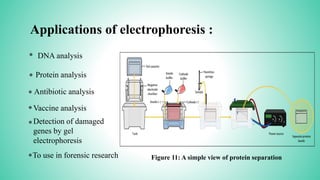
To use in forensic research Figure 11: A simple view of protein separation
Conclusion :
* Although not in principle a chromatographic method,
electrophoresis used in conjunction with paper chromatography
and gel materials, proves an extremely useful method for
separation of charged substances, ranging from small ions to
large charged macromolecules, of biological and biochemical
interest.
* It is widely used yet it has some limitations.
Thank you

Electrophoresis

  • 1.
  • 2.
    Shahjalal University ofScience & Technology, Sylhet Department of Chemistry Course No. : CHE 300 Course title : Seminar and Oral A presentation on Electrophoresis Presented by, Tanjila Islam Reg. No. : 2010131019 Semester : 3/2
  • 3.
  • 4.
    Basic of electrophoresis: Differential rate of migration of ion molecule in an electrolyte solution under the influence of an applied electric field in a support medium (e.g. paper, gel or capillary tube) Figure 1: Motion of a charged particle by electrophoresis * * A useful method to separate substances based on their charge – to – mass ratios
  • 5.
    Principle : * Chargedion or molecule migrates when placed in an electric field Rate of migration depends on its net charge, size, shape and the applied electric current v = μeE where, v = velocity of an ion E = electric field strength (Vcm-1) μe = electrophoretic mobility = distance migrated in a certain time period The electrophoretic mobility is given by μe = q 6πηr (when electric force = frictional drag) showing that small highly charged species have high mobility and vice versa. * *
  • 6.
    Driving force ofmigration : * Resultant of the electrostatic force of attraction between the electric field and the charged molecule, and the retarding forces due to friction and electrostatic repulsion from molecules of the transport medium. Figure 2: Illustration of electrophoresis retardation
  • 7.
    Supporting media forelectrophoresis : * Paper - filter paper such as Whatman no.1 and no.3MM - Used to good effect * Cellulose acetate - containing 2 to 3 acetyl groups - to give sharper bands - more easily rendered transparent - low solvent capacity - enhancing the resolution Gels - 3 dimensional semisolid colloids - resolving power enhanced due to sieve effect operating - prepared from starch, agar, or polyacrylamide *
  • 8.
    General procedure forelectrophoresis : Immersion of two electrodes in two separate buffer chambers but not fully isolated from each other Migration of charged particles from one chamber to the other by using an electric field Separation of different ions migrating at different speeds Figure 3: Fundamental of electrophoresis
  • 9.
    Factors affecting electrophoreticmobility : * * * Charge – higher the charge greater the mobility Size – bigger the molecule greater the frictional and electrostatic forces exerted on it by the medium i.e. larger particles have smaller electrophoretic mobility compared to smaller particles Electric field – increase of migration with the increase of voltage gradient * Buffer – dependence of migration on pH of the buffer * Ionic strength – greater the ionic strength of the buffer solution higher proportion of the current hence electrophoretic mobility
  • 10.
    Types of electrophoresis: Electrophoresis Frontal Electrophoresis Micro electrophoresis Moving boundary Zone electrophoresis Paper electrophoresis Cellulose acetate electrophoresis Gel electrophoresis Figure 4: Types of electrophoresis
  • 11.
    Techniques of electrophoresis: Techniques Lowvoltage (LVE) High voltage (HVE) SDS polyacrylamaide gel (SDS-PAGE) Isoelectric focusing Immunoelectrophoresis Discontinuous electrophoresis Figure 5: Different techniques of electrophoresis
  • 12.
    Low voltage electrophoresis: * Two compartments to hold the buffer and electrodes Figure 6: Apparatus for low voltage electrophoresis *A suitable carrier for support medium ending in contact with the buffer medium *To provide voltage gradient ̴ 5 Vcm-1, a power pack supplying up to 500 V or even 1000 V and 0 – 150 mA
  • 13.
    Application of LVE: * * * To separate any ionic substances The examination of biological and clinical specimens for amino acids and proteins Separation of sugars Figure 7: Electrophoretogram of plasma proteins on cellulose acetate at pH 8.6
  • 14.
    High voltage electrophoresis: To obtain voltage gradients up to 100 Vcm-1, high voltage and current supplying * * * Using cooling plates for heat dissipation generated by high voltage Less than of 1h analysis time * Working best with small ions deriving from small peptides and amino acids Figure 8: HVE apparatus
  • 15.
    Capillary electrophoresis (CE): * Separation of analyte species achieved on the basis of differential migration in an electric field through narrow bore fused silica capillary columns (25 – 100 μm). Capillary electrophoresis Capillary zone electrophoresis (CZE) Capillary gel electrophoresis (CGE) Isoelectric focusing Isotachophoresis (ITP) Miscellar electrokinetic capillary chromatography (MECC) Figure 9: Separation modes of capillary electrophoresis
  • 16.
    Overview of instrumentationof CE : * A fused capillary column dipping into two electrolyte buffers containing Pt foil cathode or anode across 15 – 60 kV voltage applied * Introducing a small volume of sample at one end of capillary * Migration of sample through the capillary under the force of applied electric field Figure 10: Schematic of a capillary zone electrophoresis
  • 17.
    Advantages of CE: Power dissipation minimized by high electrical resistance* * Having voltage gradients up to 100 – 500 Vcm-1 necessary for rapid separations * No Joule–Thompson effect * No band broadening * Most prominently used because of its faster results and high resolution separation * Large range of detection methods available
  • 18.
    Applications of electrophoresis: * * DNA analysis Protein analysis * Antibiotic analysis *Vaccine analysis * Detection of damaged genes by gel electrophoresis * To use in forensic research Figure 11: A simple view of protein separation
  • 19.
    Conclusion : * Althoughnot in principle a chromatographic method, electrophoresis used in conjunction with paper chromatography and gel materials, proves an extremely useful method for separation of charged substances, ranging from small ions to large charged macromolecules, of biological and biochemical interest. * It is widely used yet it has some limitations.
  • 20.