Chapter 9: BJT and FET Frequency Response
Copyright ©2009 by Pearson Education, Inc. 
Upper Saddle River, New Jersey 07458 • All rights reserved. 
Electronic Devices and Circuit Theory, 10/e 
Robert L. Boylestad and Louis Nashelsky 
General Frequency Considerations 
•At frequencies above and below the midrange, capacitance and any inductance will affect the gain of the amplifier. 
•At low frequencies the coupling and bypass capacitors lower the gain. 
•At high frequencies stray capacitances associated with the active device lower the gain. 
•Also, cascading amplifiers limits the gain at high and low frequencies. 
The frequency responseof an amplifier refers to the frequency range in which the amplifier will operate with negligible effects from capacitors and device internal capacitance. This range of frequencies can be called the mid-range. 
2
Copyright ©2009 by Pearson Education, Inc. 
Upper Saddle River, New Jersey 07458 • All rights reserved. 
Electronic Devices and Circuit Theory, 10/e 
Robert L. Boylestad and Louis NashelskyBode Plot 
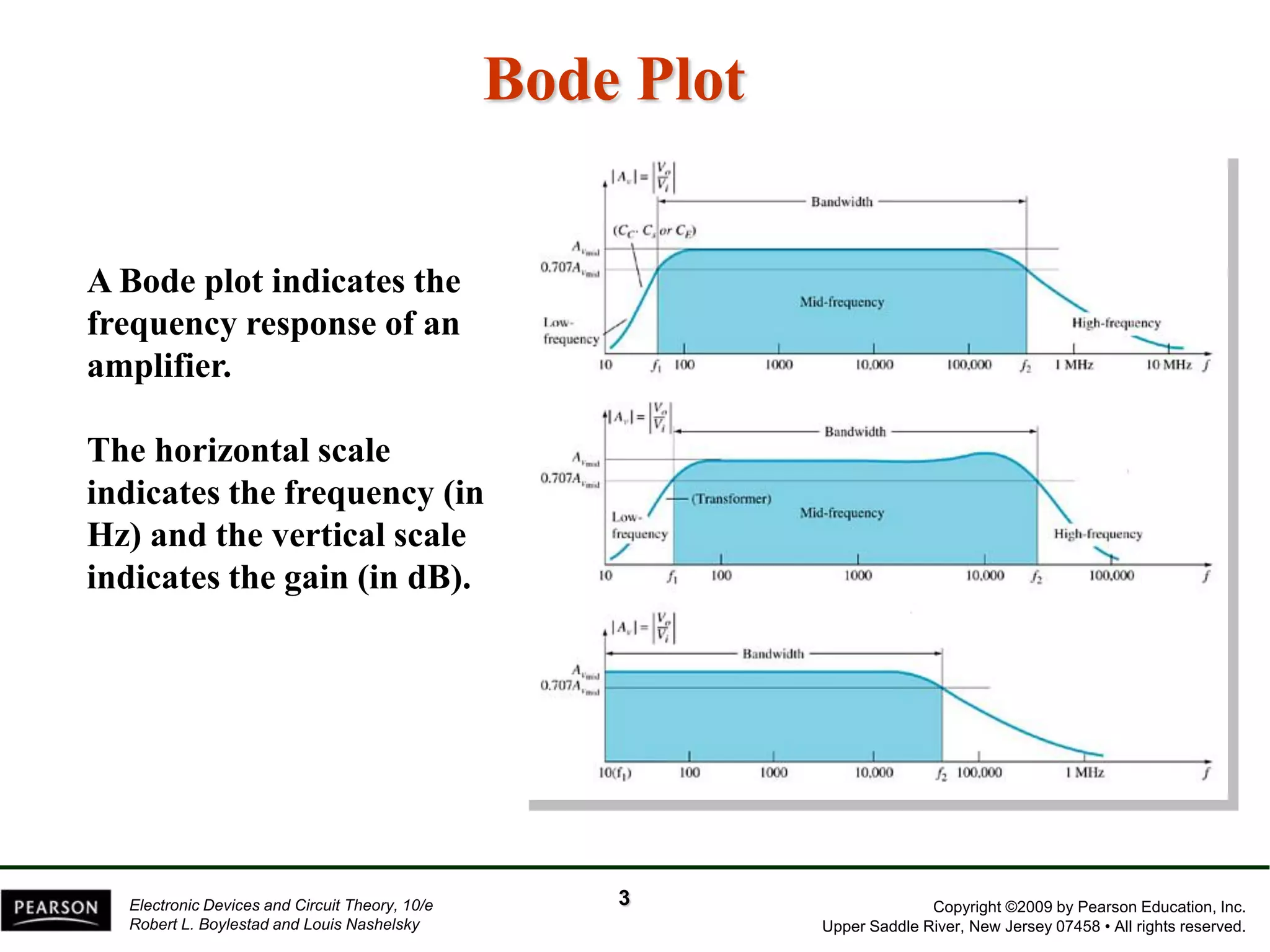
A Bode plot indicates the frequency response of an amplifier. 
The horizontal scale indicates the frequency (in Hz) and the vertical scale indicates the gain (in dB). 
3
Copyright ©2009 by Pearson Education, Inc. 
Upper Saddle River, New Jersey 07458 • All rights reserved. 
Electronic Devices and Circuit Theory, 10/e 
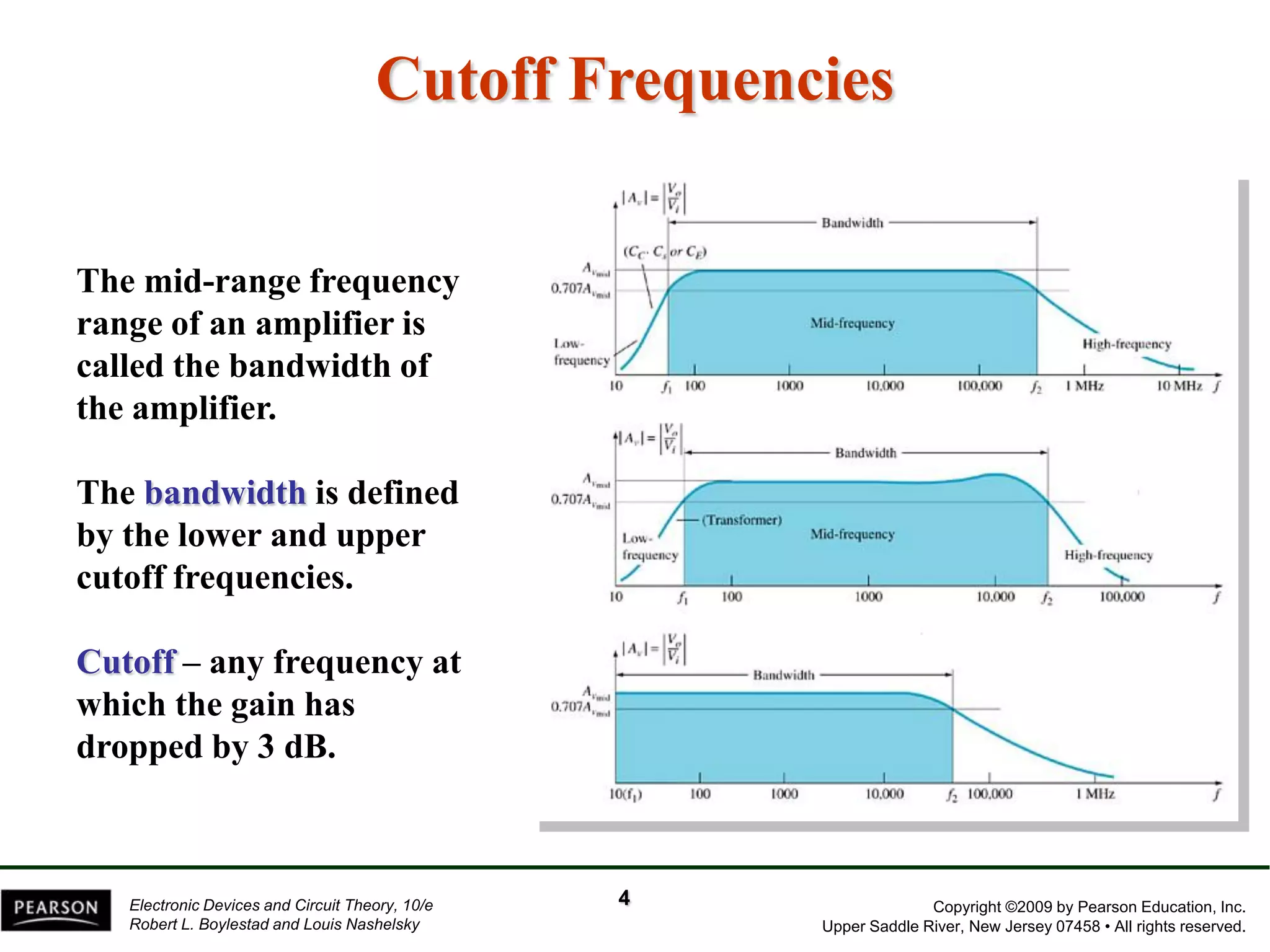
Robert L. Boylestad and Louis NashelskyCutoff FrequenciesThe mid-range frequency range of an amplifier is called the bandwidth of the amplifier. The bandwidthis defined by the lower and upper cutoff frequencies. Cutoff–any frequency at which the gain has dropped by 3 dB. 
4
Copyright ©2009 by Pearson Education, Inc. 
Upper Saddle River, New Jersey 07458 • All rights reserved. 
Electronic Devices and Circuit Theory, 10/e 
Robert L. Boylestad and Louis NashelskyBJT Amplifier Low-Frequency Response 
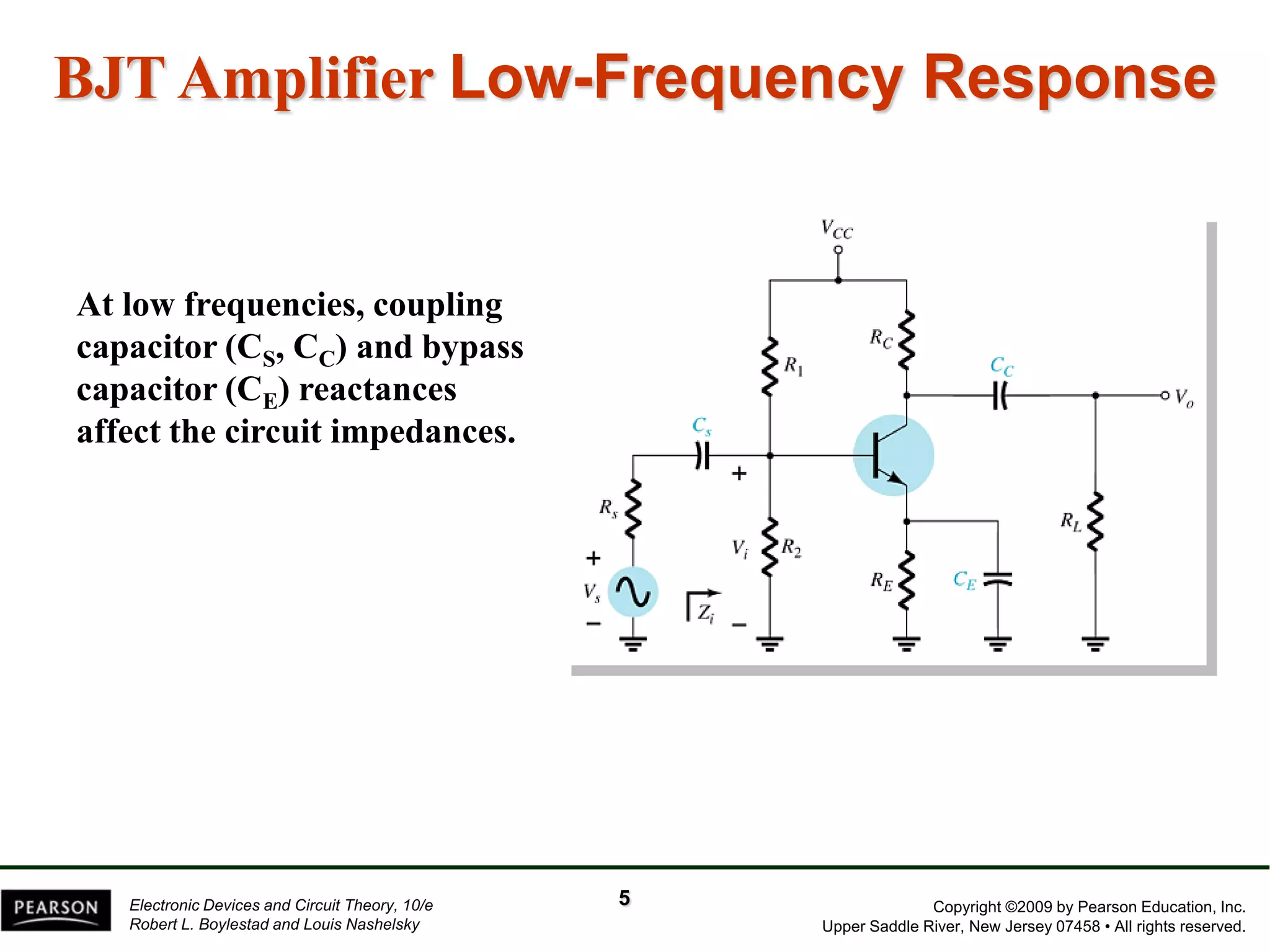
At low frequencies, coupling capacitor (CS, CC) and bypass capacitor (CE) reactances affect the circuit impedances. 
5
Copyright ©2009 by Pearson Education, Inc. 
Upper Saddle River, New Jersey 07458 • All rights reserved. 
Electronic Devices and Circuit Theory, 10/e 
Robert L. Boylestad and Louis Nashelsky 
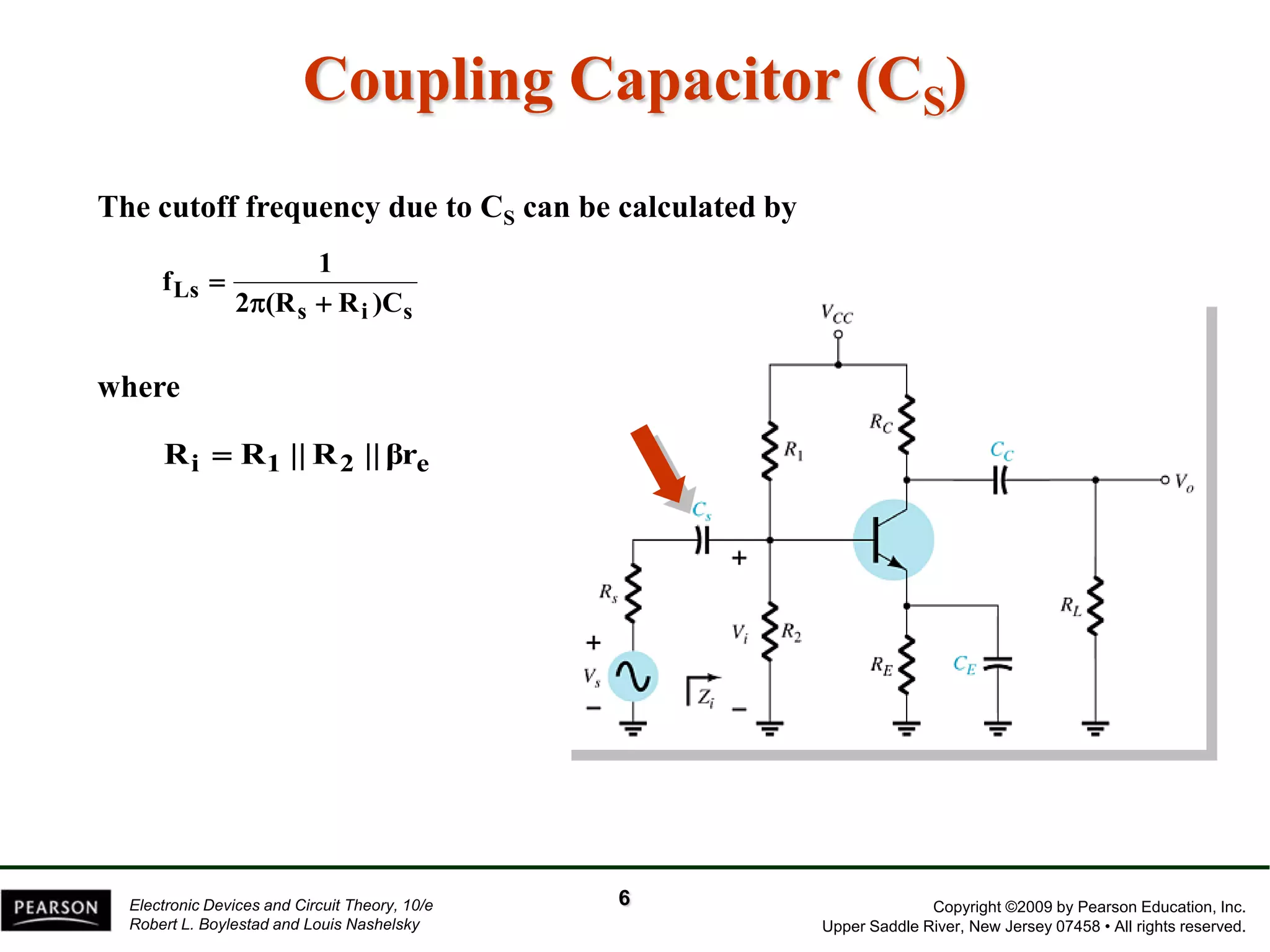
Coupling Capacitor (CS) 
The cutoff frequency due to CS can be calculated by 
s i s 
Ls 
2 (R R )C 
1 
f 
  
 
Ri  R1 ||R2 || βre 
where 
6
Copyright ©2009 by Pearson Education, Inc. 
Upper Saddle River, New Jersey 07458 • All rights reserved. 
Electronic Devices and Circuit Theory, 10/e 
Robert L. Boylestad and Louis Nashelsky 
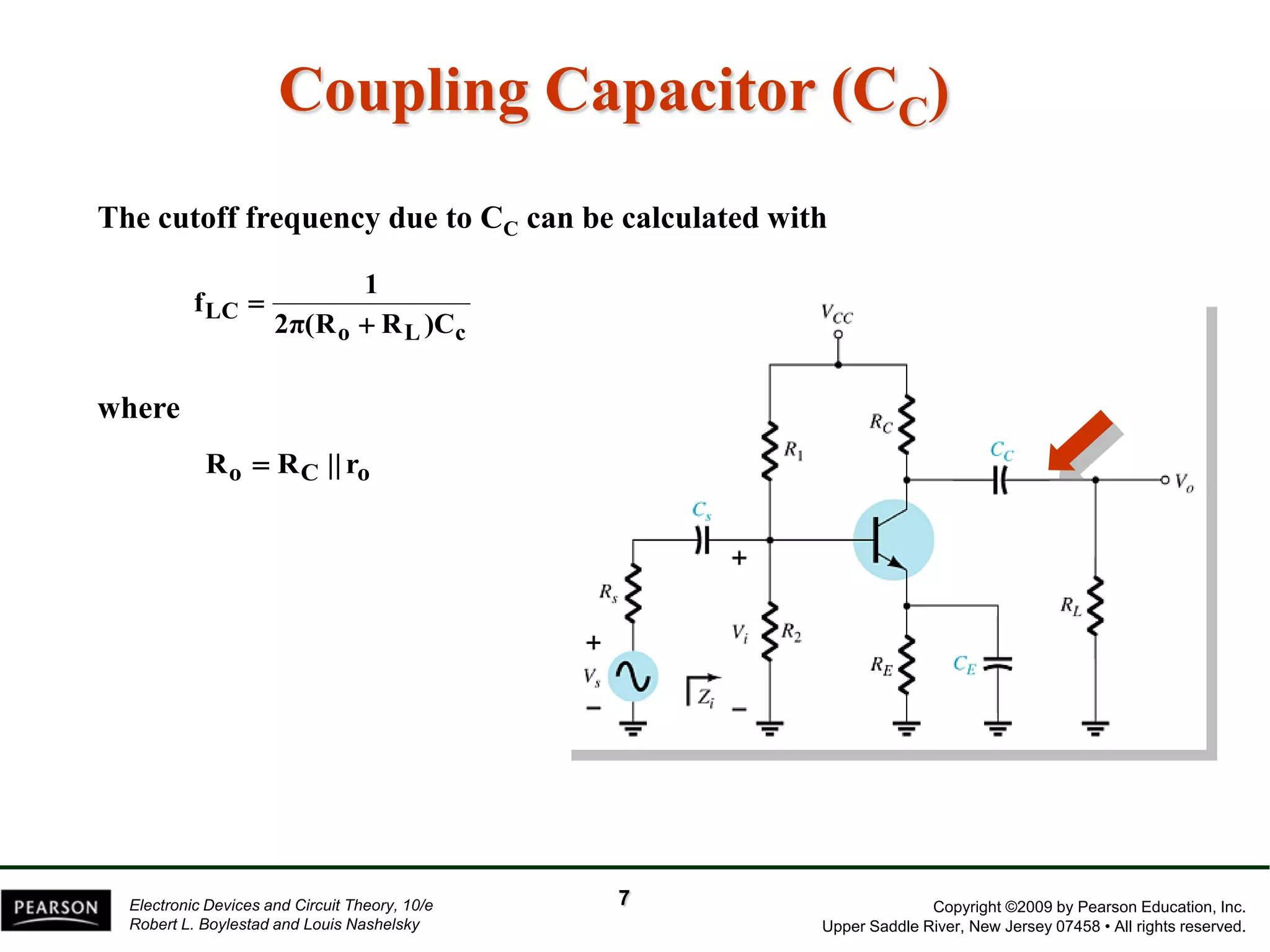
o L c 
LC 
2π(R R )C 
1 
f 
 
 
Ro  RC || ro 
Coupling Capacitor (CC) 
The cutoff frequency due to CC can be calculated with 
where 
7
Copyright ©2009 by Pearson Education, Inc. 
Upper Saddle River, New Jersey 07458 • All rights reserved. 
Electronic Devices and Circuit Theory, 10/e 
Robert L. Boylestad and Louis Nashelsky 
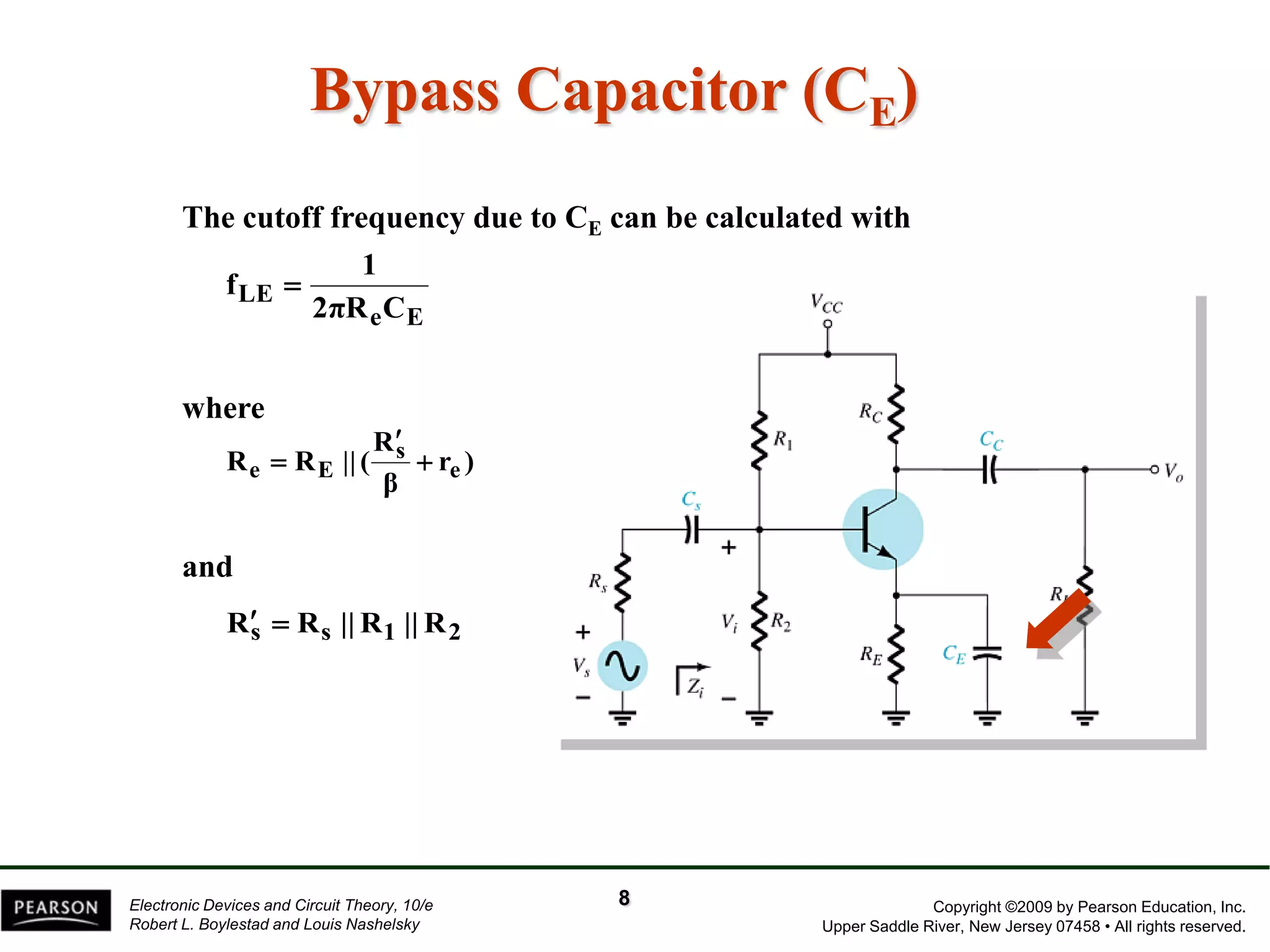
Bypass Capacitor (CE) 
e E 
LE 
2πR C 
1 
f  
r ) 
β 
R 
R R || ( e 
s 
e E  
 
 
Rs  Rs ||R1 ||R2 
The cutoff frequency due to CE can be calculated with 
where 
and 
8
Copyright ©2009 by Pearson Education, Inc. 
Upper Saddle River, New Jersey 07458 • All rights reserved. 
Electronic Devices and Circuit Theory, 10/e 
Robert L. Boylestad and Louis Nashelsky 
BJT Amplifier Low-Frequency Response 
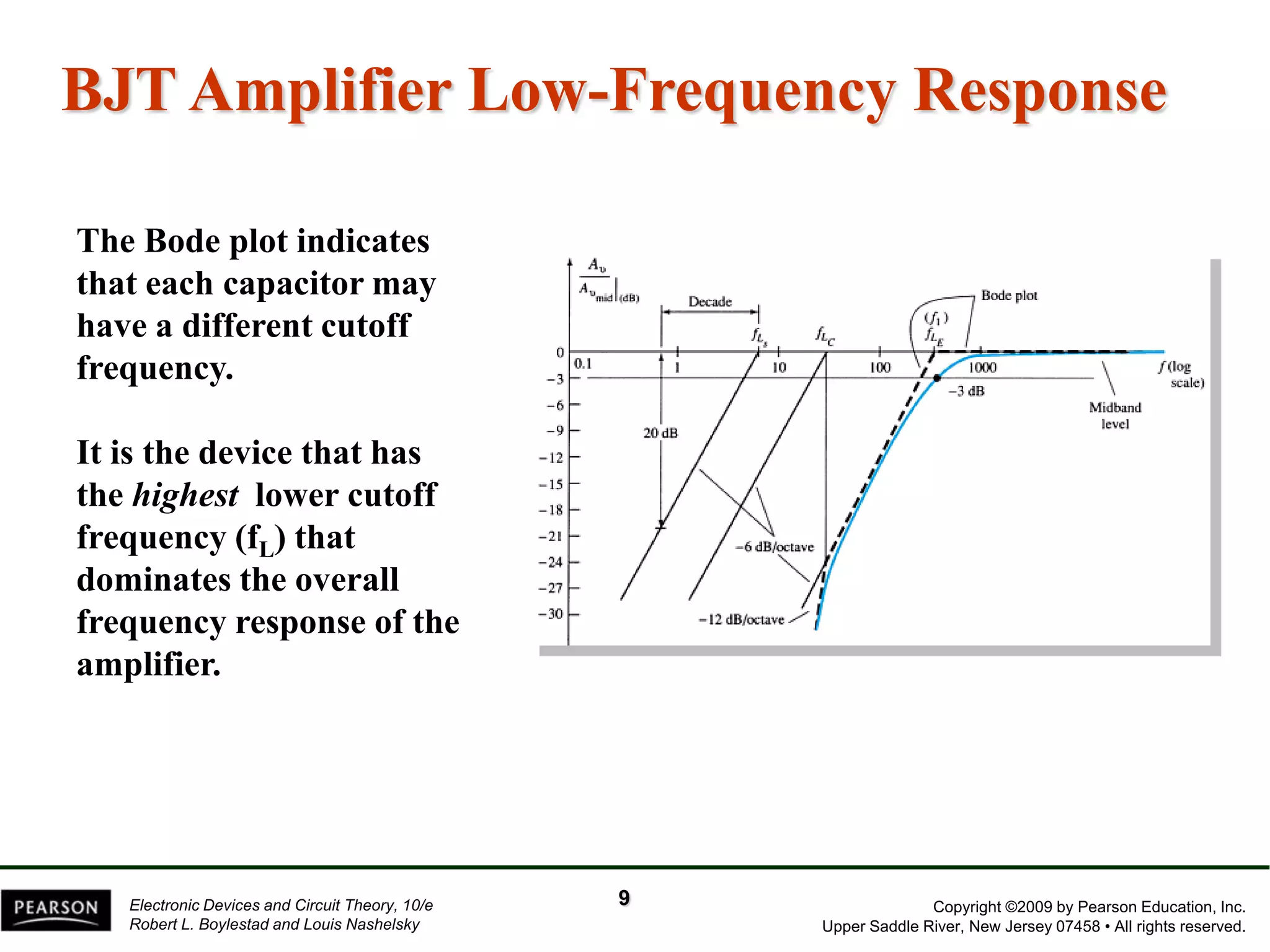
The Bode plot indicates that each capacitor may have a different cutoff frequency. It is the device that has the highestlower cutoff frequency (fL) that dominates the overall frequency response of the amplifier. 
9
Copyright ©2009 by Pearson Education, Inc. 
Upper Saddle River, New Jersey 07458 • All rights reserved. 
Electronic Devices and Circuit Theory, 10/e 
Robert L. Boylestad and Louis Nashelsky 
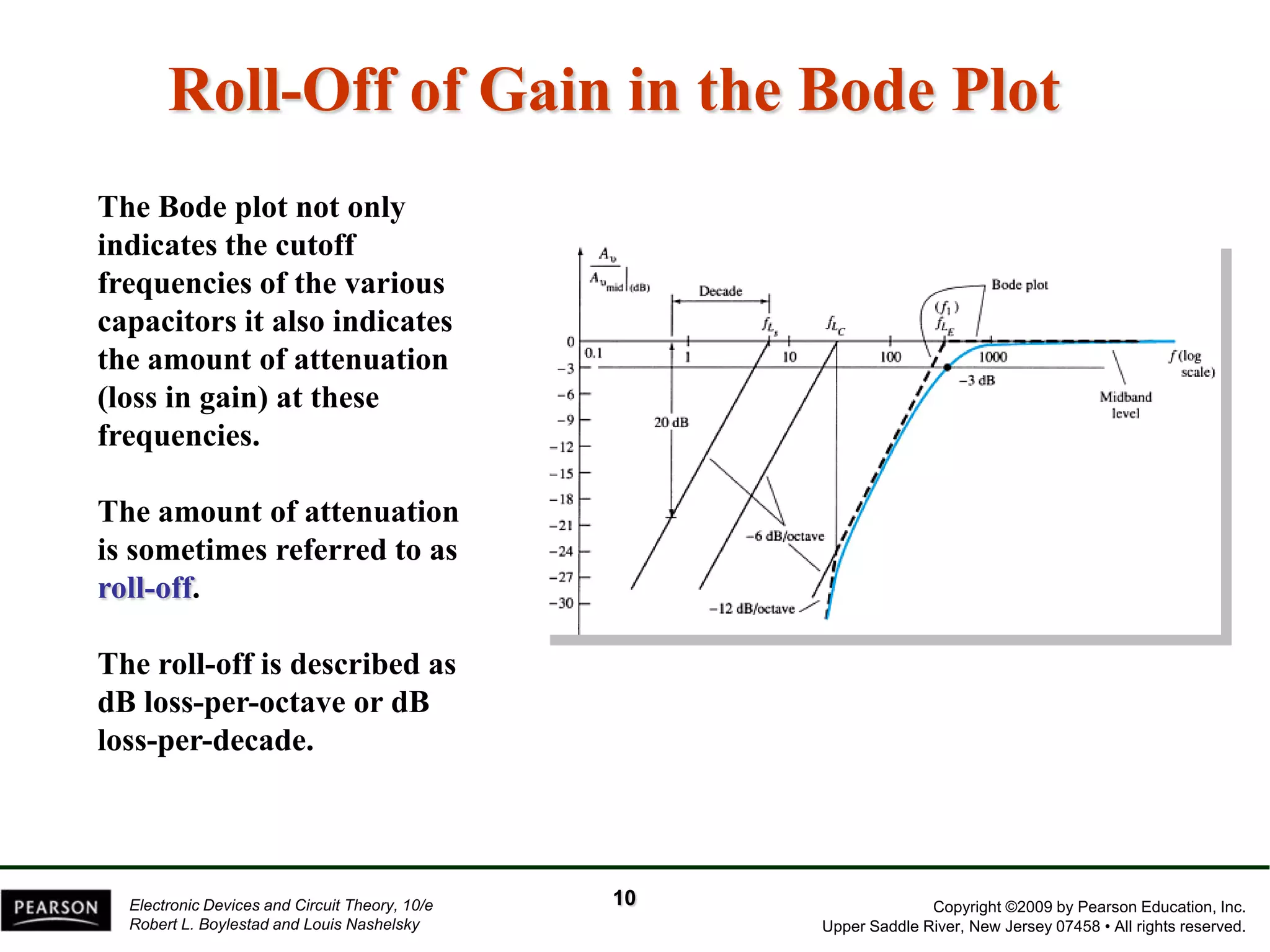
Roll-Off of Gain in the Bode PlotThe Bode plot not only indicates the cutoff frequencies of the various capacitors it also indicates the amount of attenuation (loss in gain) at these frequencies. The amount of attenuation is sometimes referred to as roll-off. The roll-off is described as dB loss-per-octave or dB loss-per-decade. 
10
Copyright ©2009 by Pearson Education, Inc. 
Upper Saddle River, New Jersey 07458 • All rights reserved. 
Electronic Devices and Circuit Theory, 10/e 
Robert L. Boylestad and Louis Nashelsky 
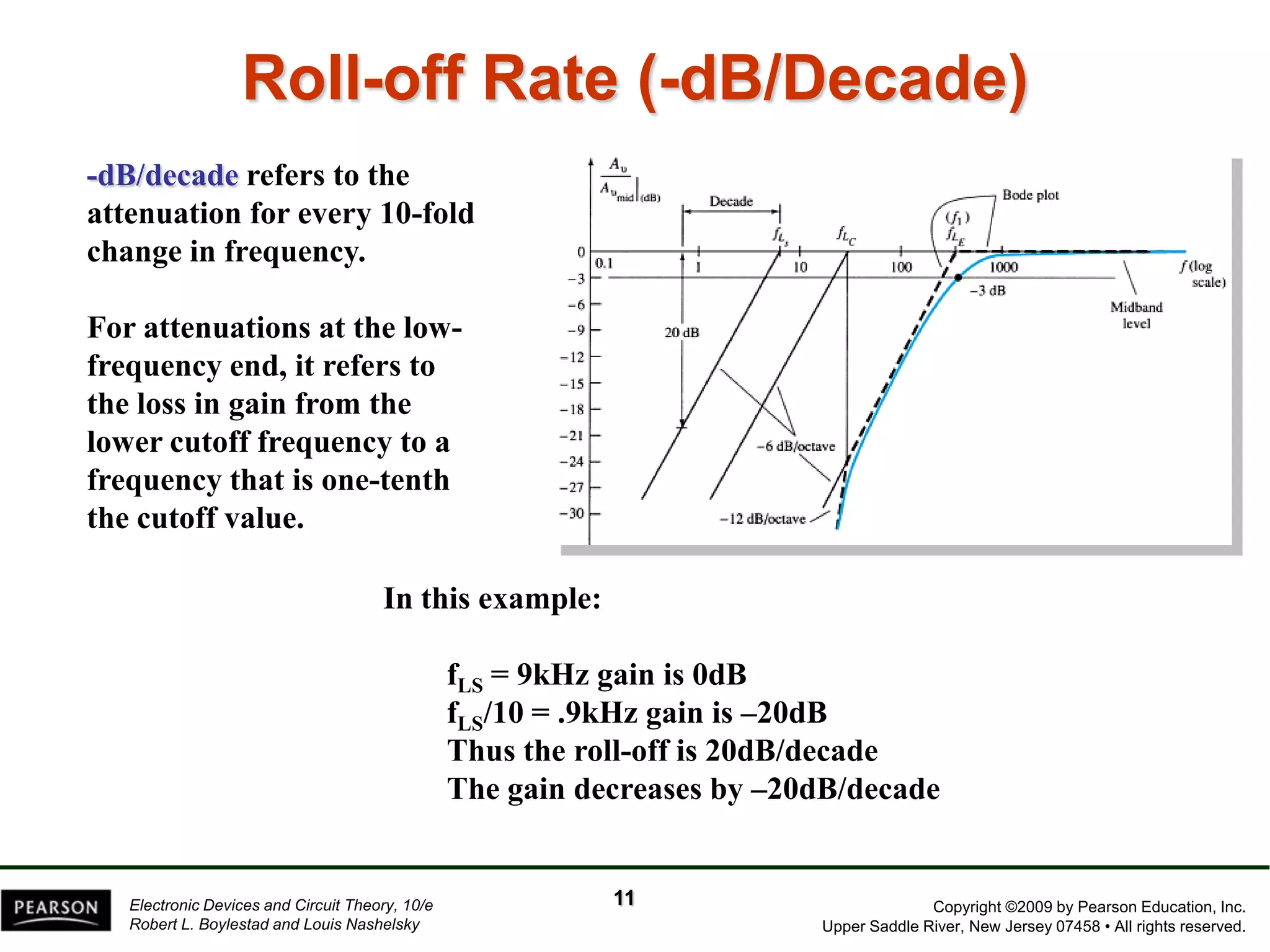
Roll-off Rate (-dB/Decade) -dB/decaderefers to the attenuation for every 10-fold change in frequency. For attenuations at the low- frequency end, it refers to the loss in gain from the lower cutoff frequency to a frequency that is one-tenth the cutoff value. In this example: fLS= 9kHz gain is 0dBfLS/10 = .9kHz gain is –20dBThus the roll-off is 20dB/decadeThe gain decreases by –20dB/decade 
11
Copyright ©2009 by Pearson Education, Inc. 
Upper Saddle River, New Jersey 07458 • All rights reserved. 
Electronic Devices and Circuit Theory, 10/e 
Robert L. Boylestad and Louis NashelskyRoll-Off Rate (–dB/Octave) 
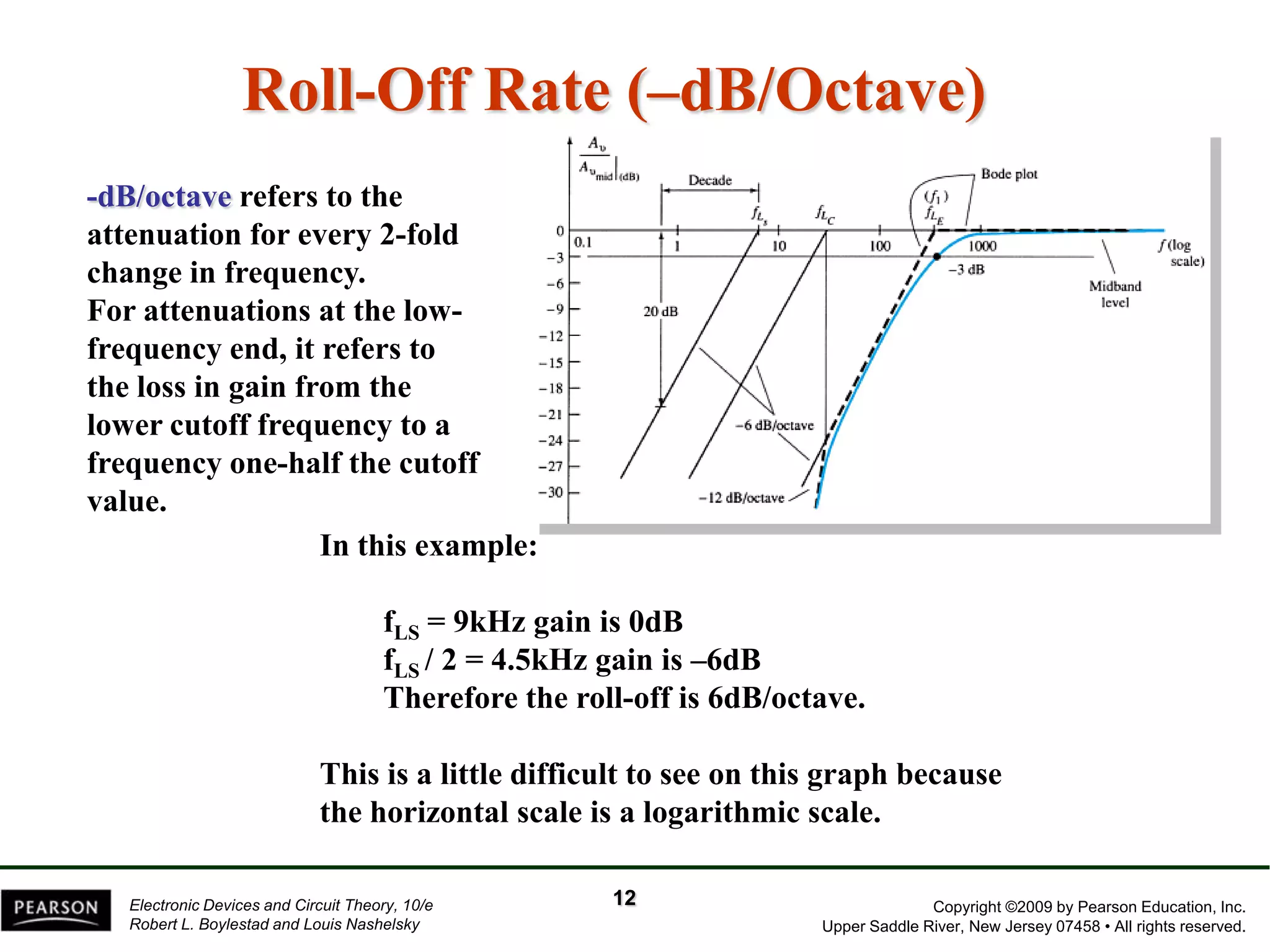
-dB/octaverefers to the attenuation for every 2-fold change in frequency. 
For attenuations at the low- frequency end, it refers to the loss in gain from the lower cutoff frequency to a frequency one-half the cutoff value. 
In this example: 
fLS= 9kHz gain is 0dB 
fLS / 2 = 4.5kHz gain is –6dB 
Therefore the roll-off is 6dB/octave. 
This is a little difficult to see on this graph because the horizontal scale is a logarithmic scale. 
12
Copyright ©2009 by Pearson Education, Inc. 
Upper Saddle River, New Jersey 07458 • All rights reserved. 
Electronic Devices and Circuit Theory, 10/e 
Robert L. Boylestad and Louis NashelskyFET Amplifier Low-Frequency Response 
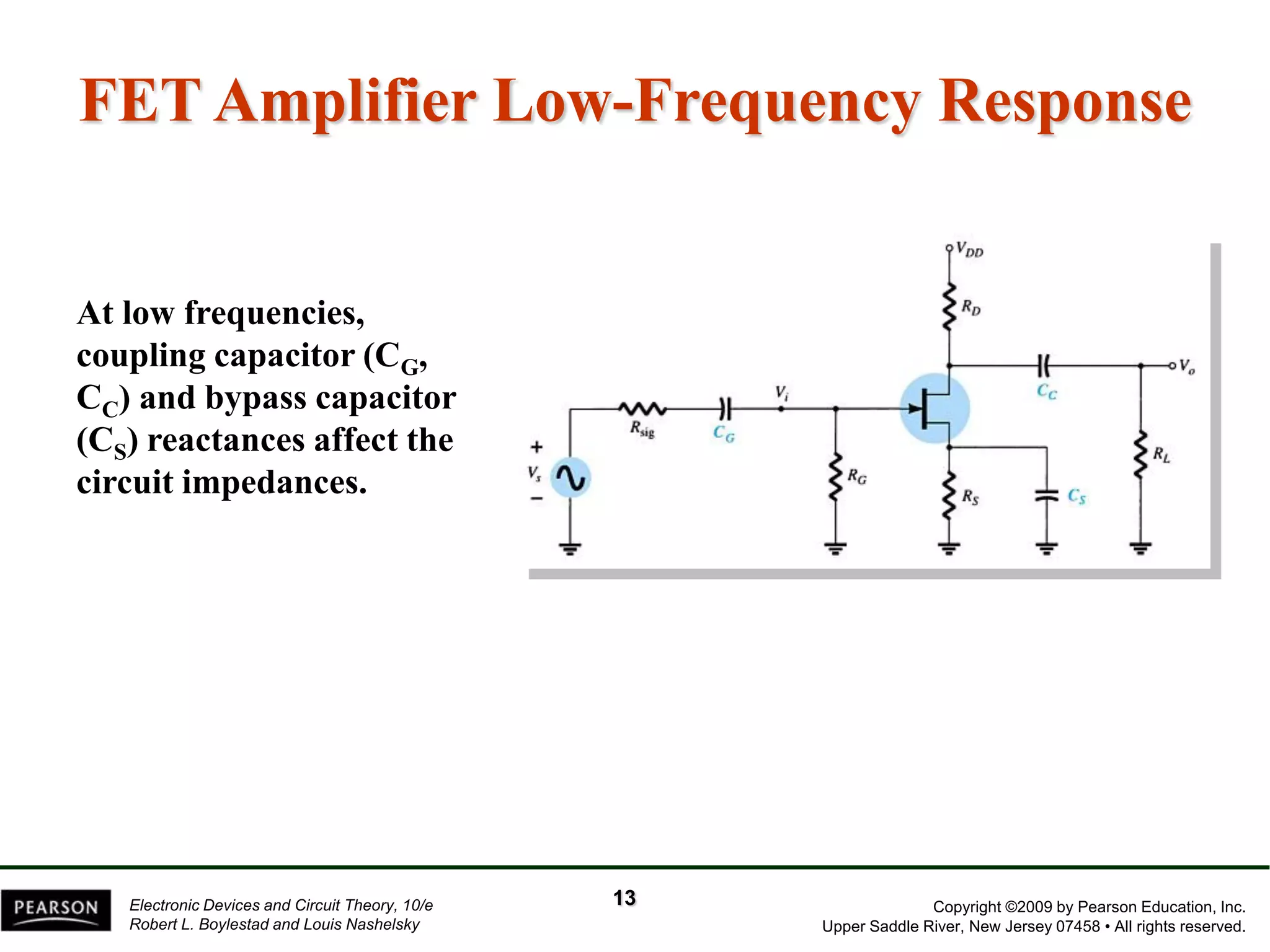
At low frequencies, coupling capacitor (CG, CC) and bypass capacitor (CS) reactances affect the circuit impedances. 
13
Copyright ©2009 by Pearson Education, Inc. 
Upper Saddle River, New Jersey 07458 • All rights reserved. 
Electronic Devices and Circuit Theory, 10/e 
Robert L. Boylestad and Louis Nashelsky 
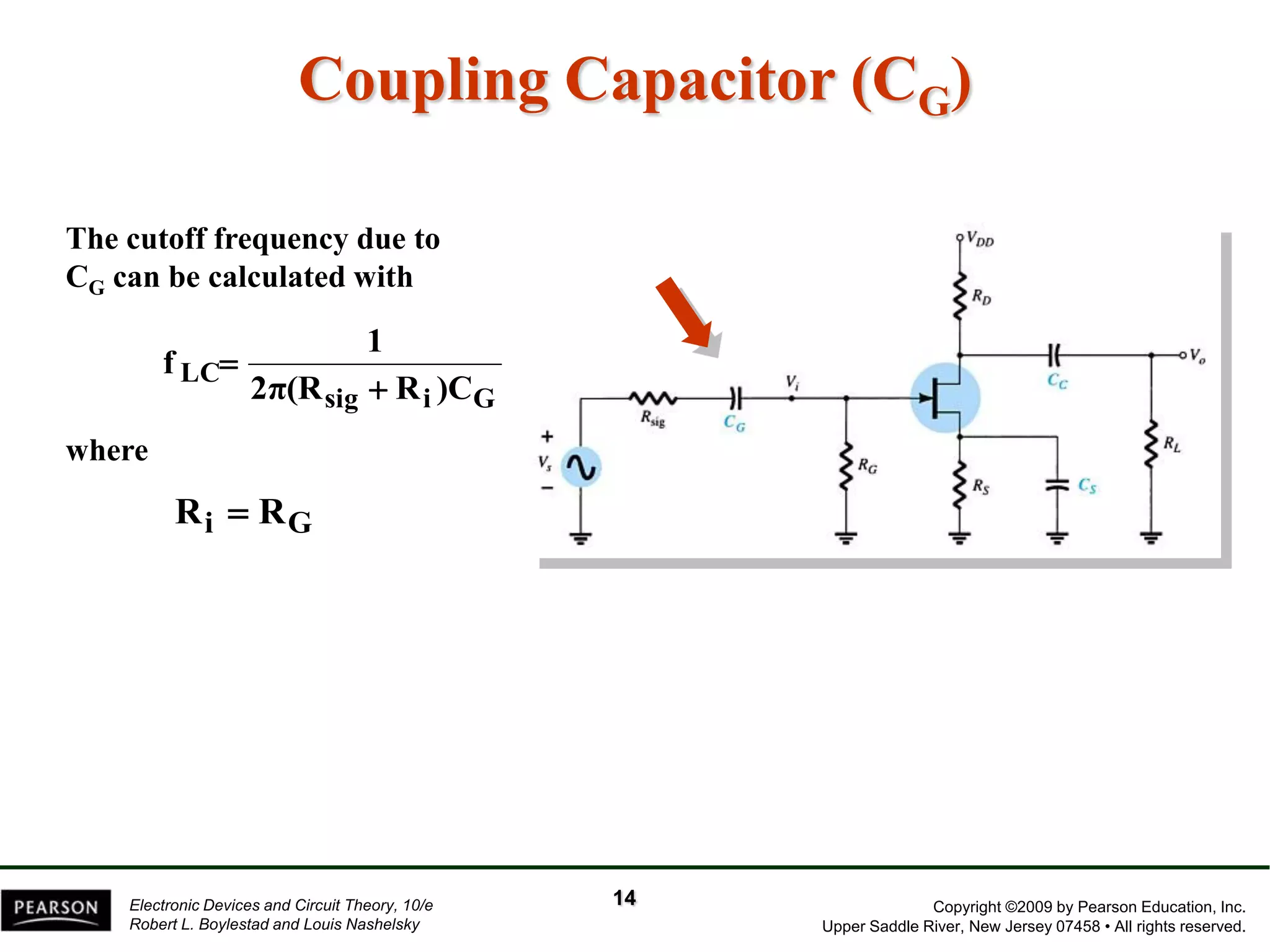
Coupling Capacitor (CG) 
sig i G 
LC 
2π(R R )C 
1 
f 
 
 
Ri  RG 
The cutoff frequency due to 
CG can be calculated with 
where 
14
Copyright ©2009 by Pearson Education, Inc. 
Upper Saddle River, New Jersey 07458 • All rights reserved. 
Electronic Devices and Circuit Theory, 10/e 
Robert L. Boylestad and Louis Nashelsky 
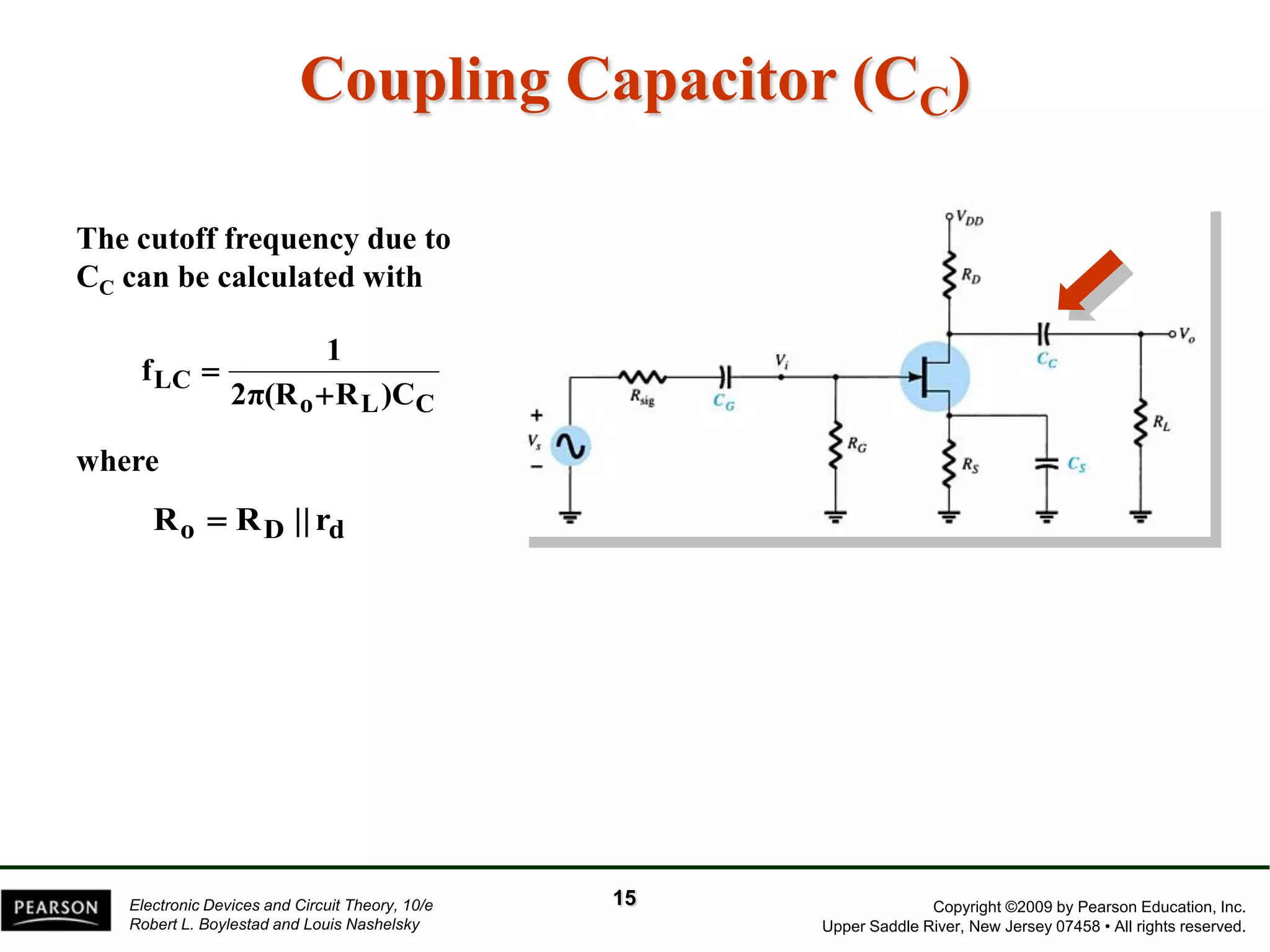
Coupling Capacitor (CC) 
o L C 
LC 
2π(R R )C 
1 
f 
 
 
Ro  RD || rd 
The cutoff frequency due to 
CC can be calculated with 
where 
15
Copyright ©2009 by Pearson Education, Inc. 
Upper Saddle River, New Jersey 07458 • All rights reserved. 
Electronic Devices and Circuit Theory, 10/e 
Robert L. Boylestad and Louis Nashelsky 
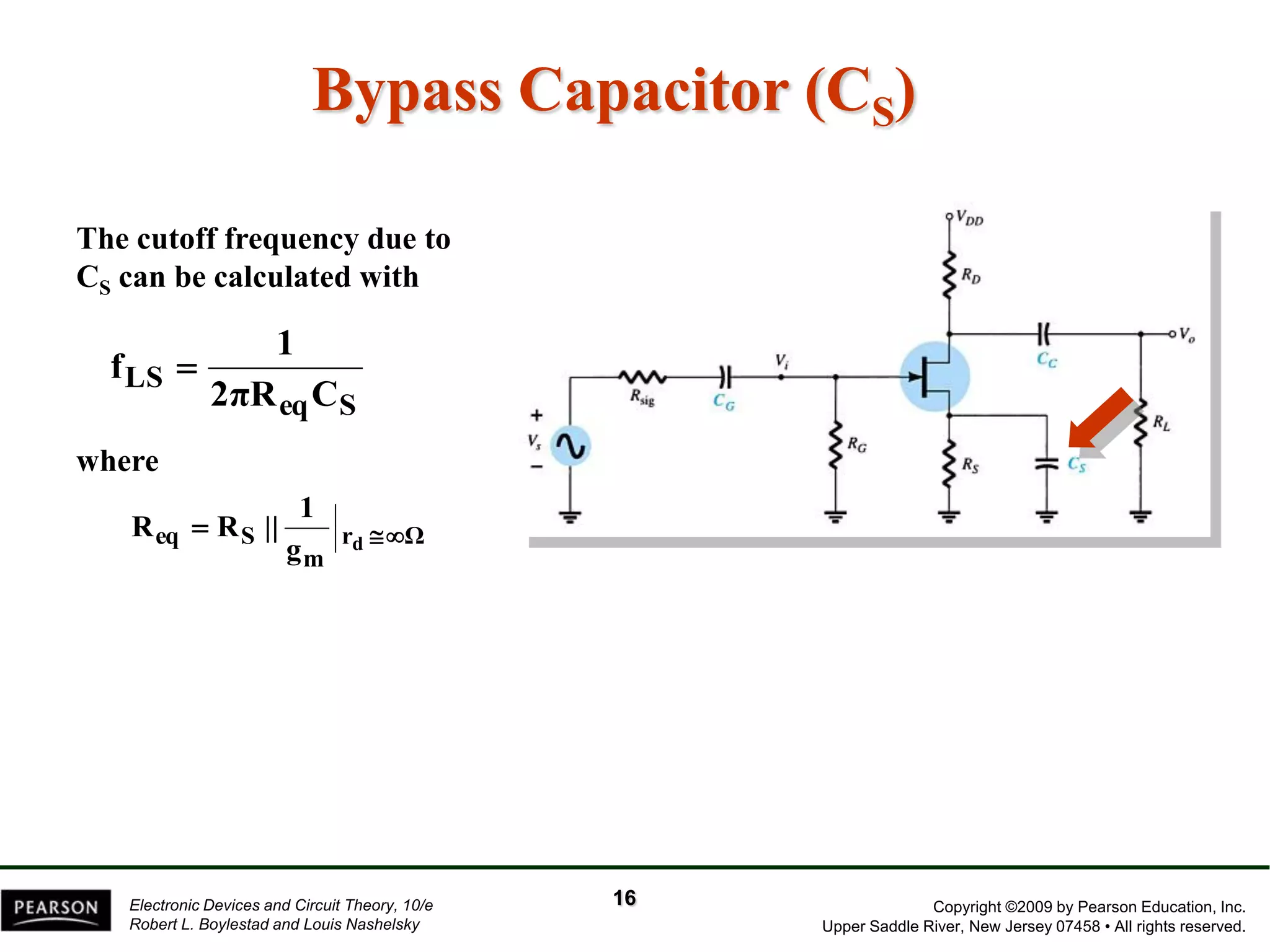
Bypass Capacitor (CS) 
eq S 
LS 
2πR C 
1 
f  
r Ω 
m 
eq S d g 
1 
R  R ||  
The cutoff frequency due to 
CS can be calculated with 
where 
16
Copyright ©2009 by Pearson Education, Inc. 
Upper Saddle River, New Jersey 07458 • All rights reserved. 
Electronic Devices and Circuit Theory, 10/e 
Robert L. Boylestad and Louis Nashelsky 
FET Amplifier Low-Frequency Response 
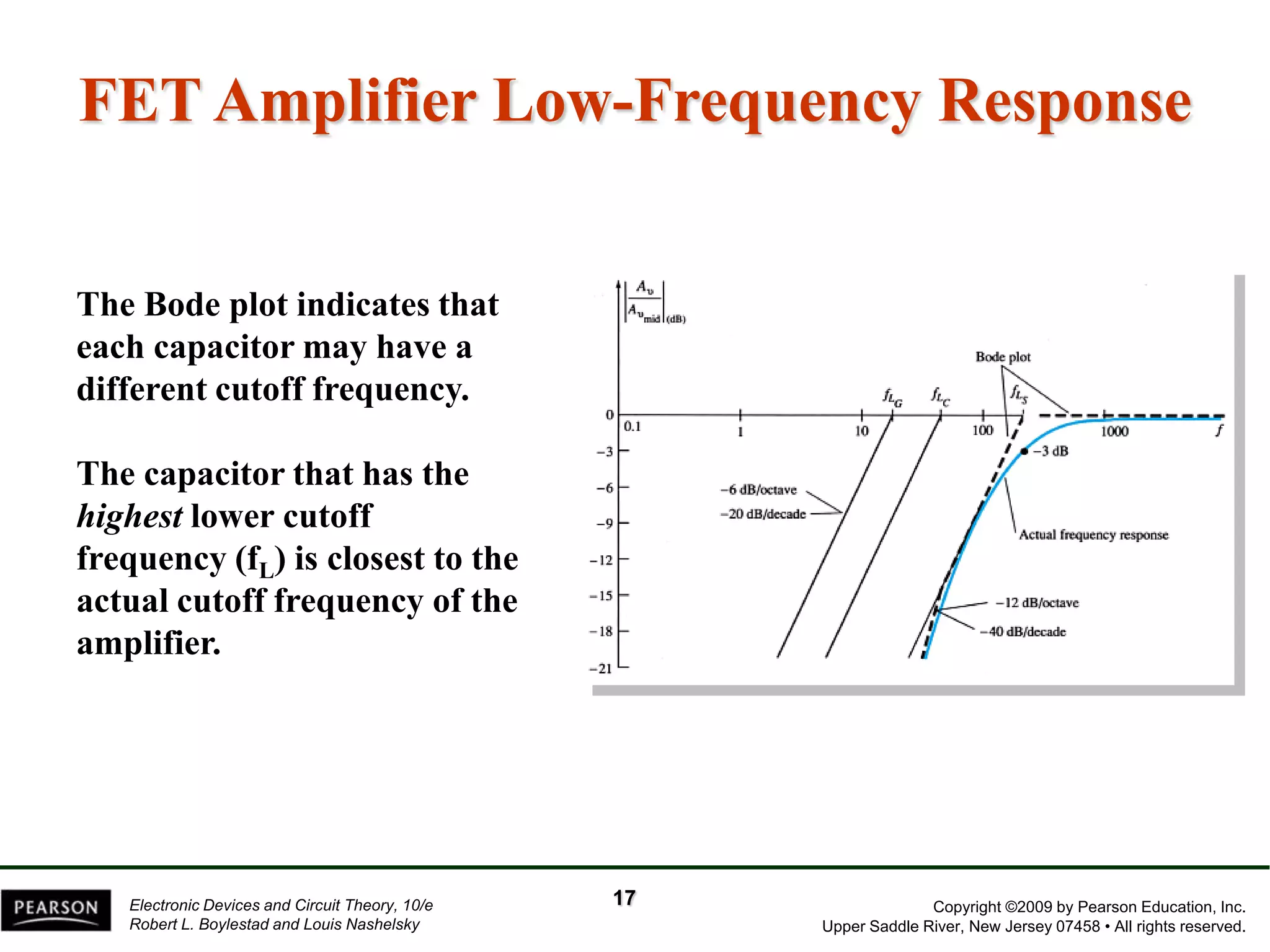
The Bode plot indicates that each capacitor may have a different cutoff frequency. The capacitor that has the highestlower cutoff frequency (fL) is closest to the actual cutoff frequency of the amplifier. 
17
Copyright ©2009 by Pearson Education, Inc. 
Upper Saddle River, New Jersey 07458 • All rights reserved. 
Electronic Devices and Circuit Theory, 10/e 
Robert L. Boylestad and Louis Nashelsky 
Miller Capacitance 
Any p-n junction can develop capacitance. In a BJT amplifier, this capacitance becomes noticeable across: 
•The base-collector junction at high frequencies in common-emitter BJT amplifier configurations 
•The gate-drain junction at high frequencies in common- source FET amplifier configurations. These capacitances are represented as separate input and output capacitances, called the Miller Capacitances. 
18
Copyright ©2009 by Pearson Education, Inc. 
Upper Saddle River, New Jersey 07458 • All rights reserved. 
Electronic Devices and Circuit Theory, 10/e 
Robert L. Boylestad and Louis Nashelsky 
Miller Input Capacitance (CMi) 
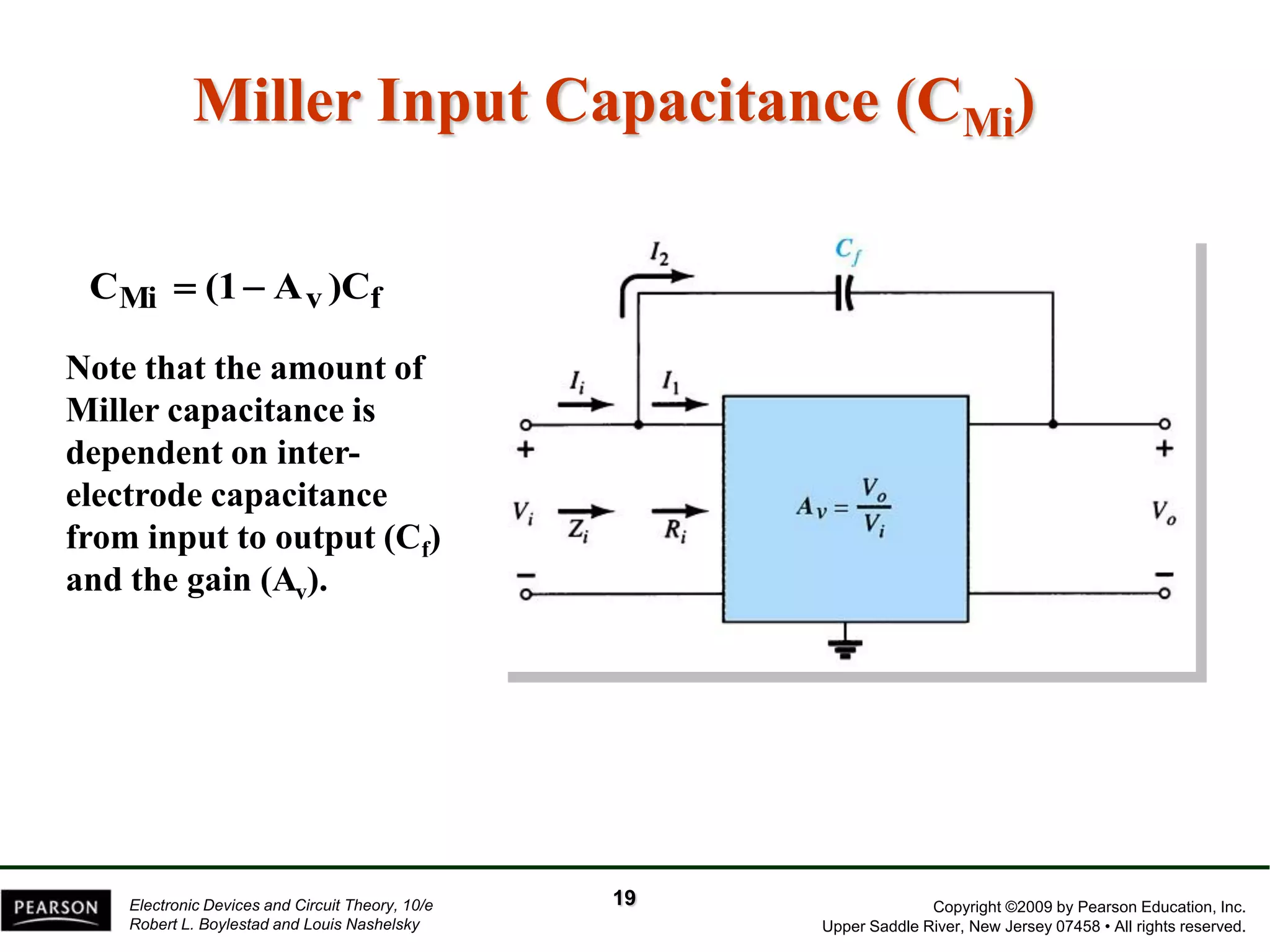
Note that the amount of 
Miller capacitance is 
dependent on inter-electrode 
capacitance 
from input to output (Cf) 
and the gain (Av). 
CMi  (1 Av )Cf 
19
Copyright ©2009 by Pearson Education, Inc. 
Upper Saddle River, New Jersey 07458 • All rights reserved. 
Electronic Devices and Circuit Theory, 10/e 
Robert L. Boylestad and Louis Nashelsky 
Miller Output Capacitance (CMo) 
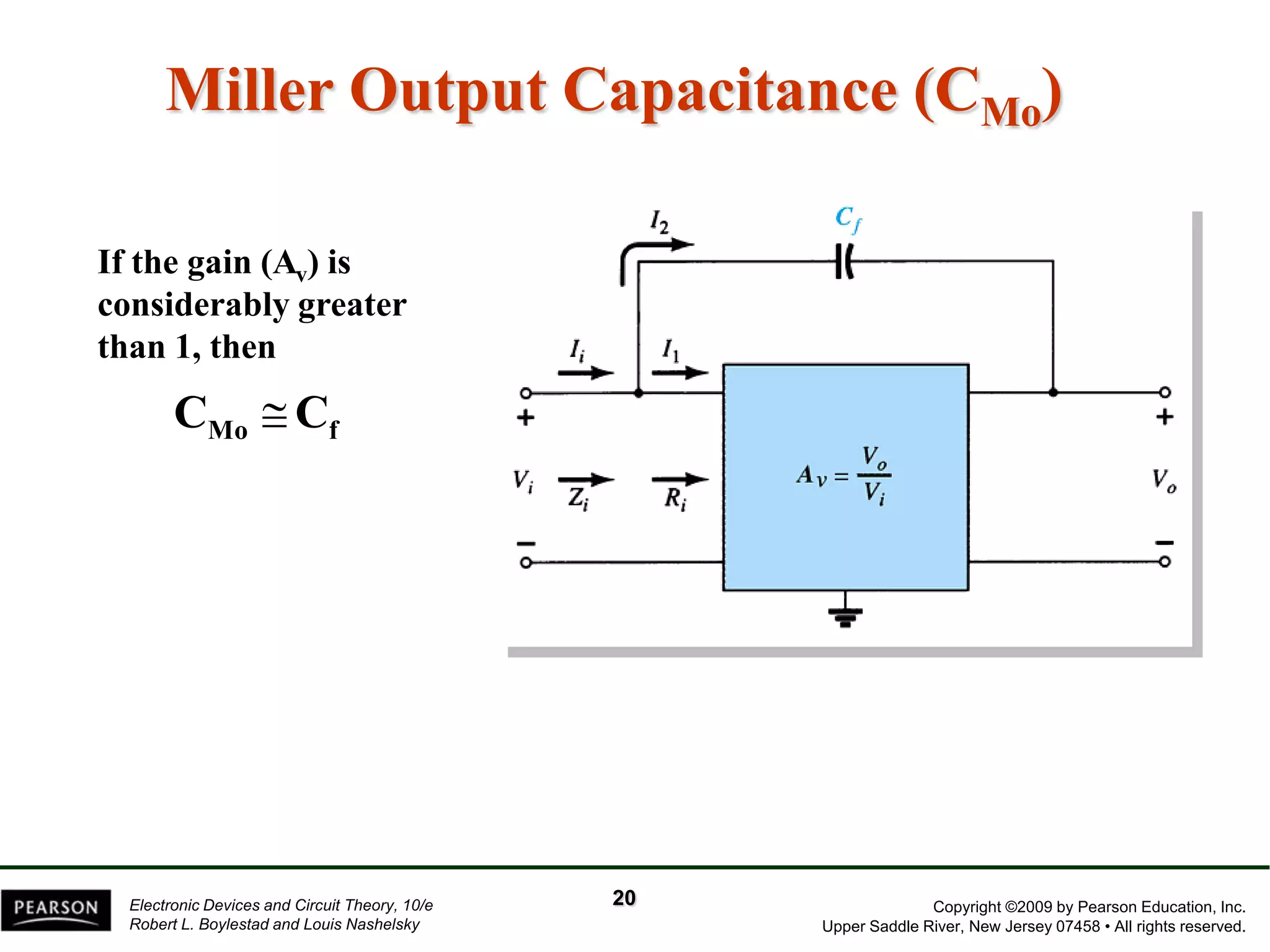
If the gain (Av) is 
considerably greater 
than 1, then 
Mo f C  C 
20
Copyright ©2009 by Pearson Education, Inc. 
Upper Saddle River, New Jersey 07458 • All rights reserved. 
Electronic Devices and Circuit Theory, 10/e 
Robert L. Boylestad and Louis Nashelsky 
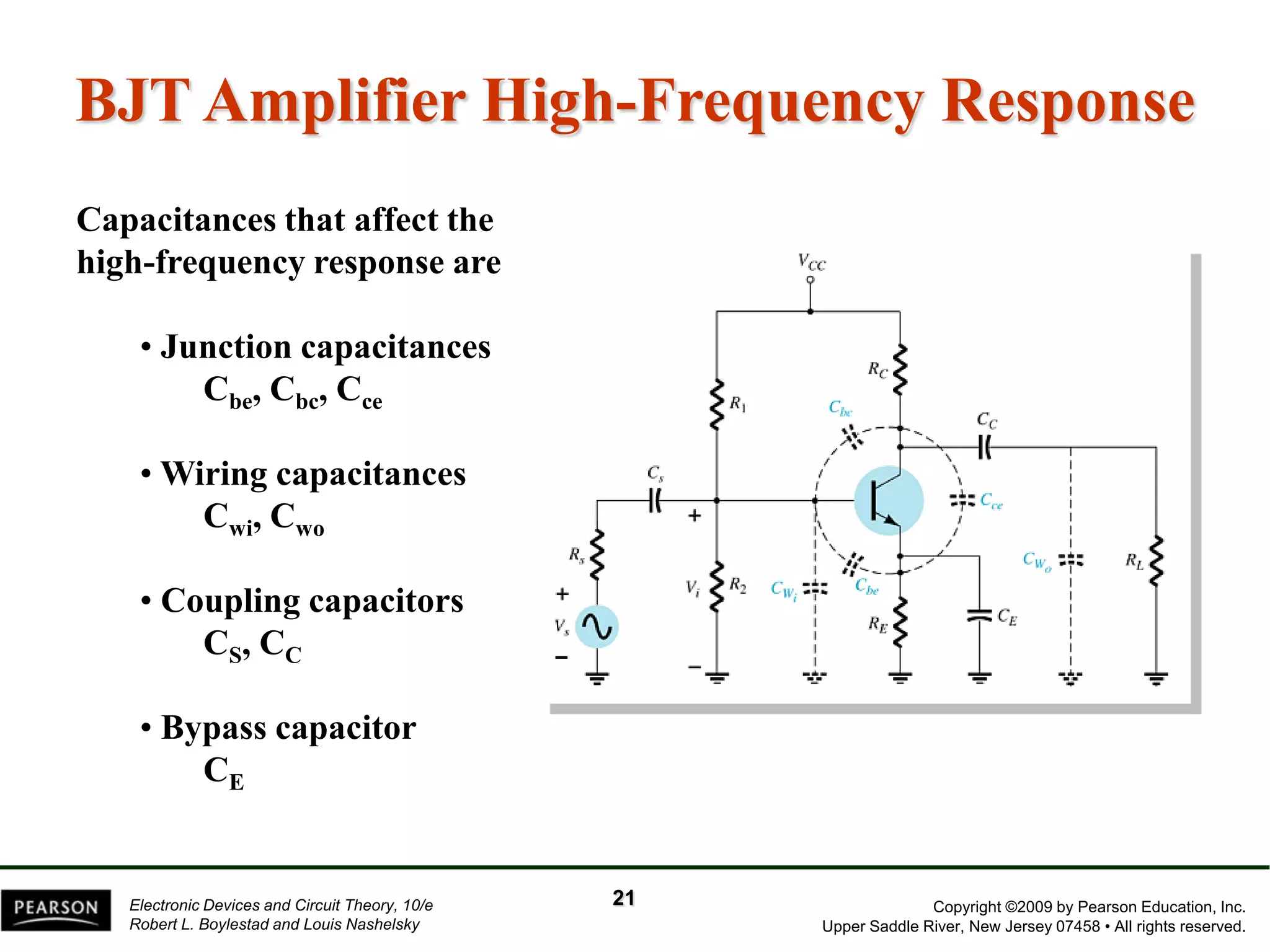
BJT Amplifier High-Frequency Response 
Capacitances that affect the high-frequency response are 
•Junction capacitancesCbe, Cbc, Cce 
•Wiring capacitancesCwi, Cwo 
•Coupling capacitorsCS, CC 
•Bypass capacitorCE 
21
Copyright ©2009 by Pearson Education, Inc. 
Upper Saddle River, New Jersey 07458 • All rights reserved. 
Electronic Devices and Circuit Theory, 10/e 
Robert L. Boylestad and Louis Nashelsky 
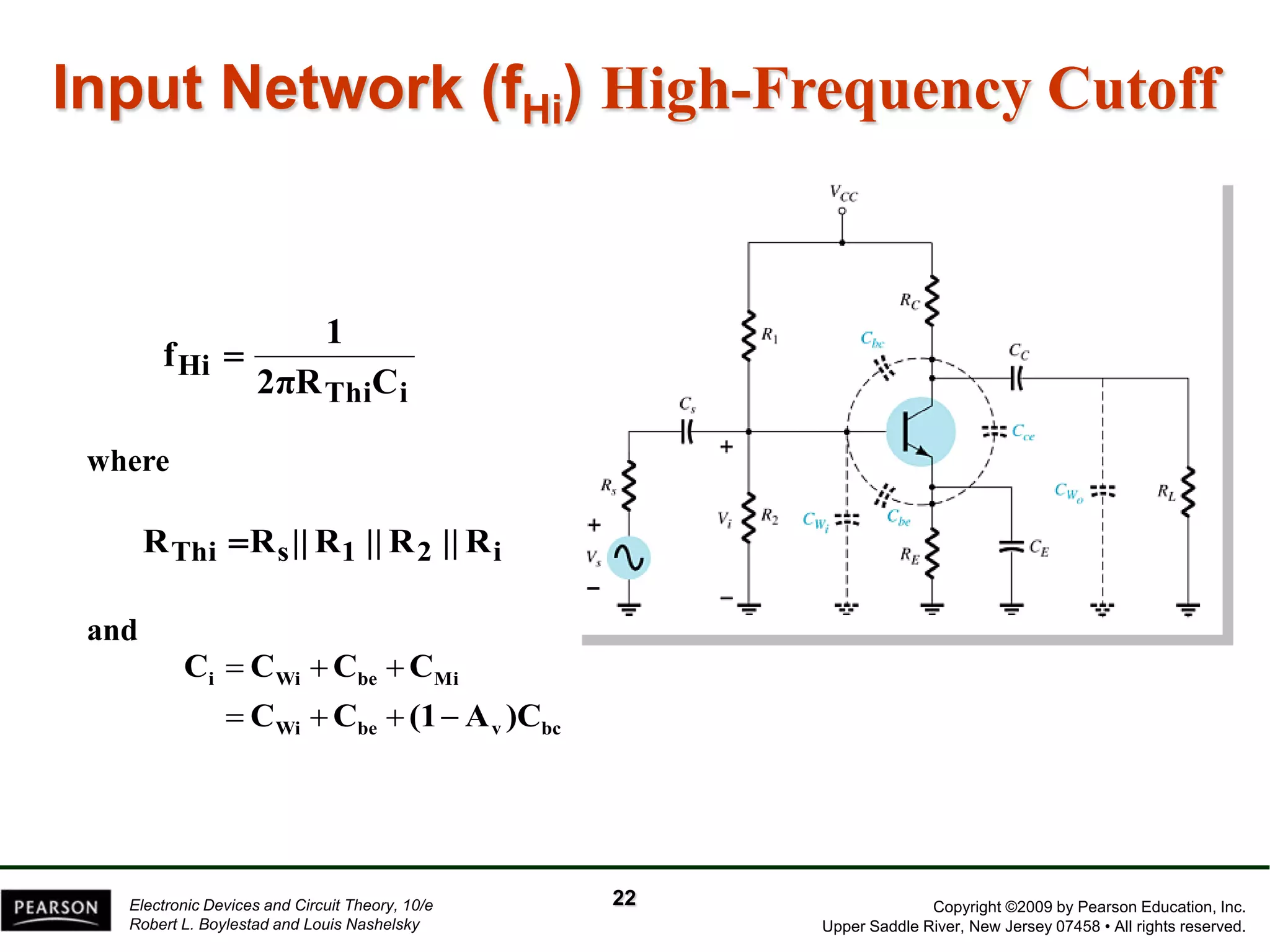
Input Network (fHi) High-Frequency Cutoff 
Thi i 
Hi 
2πR C 
1 
f  
RThi Rs||R1 ||R2 ||Ri 
Wi be v bc 
i Wi be Mi 
C C (1 A )C 
C C C C 
    
   
where 
and 
22
Copyright ©2009 by Pearson Education, Inc. 
Upper Saddle River, New Jersey 07458 • All rights reserved. 
Electronic Devices and Circuit Theory, 10/e 
Robert L. Boylestad and Louis Nashelsky 
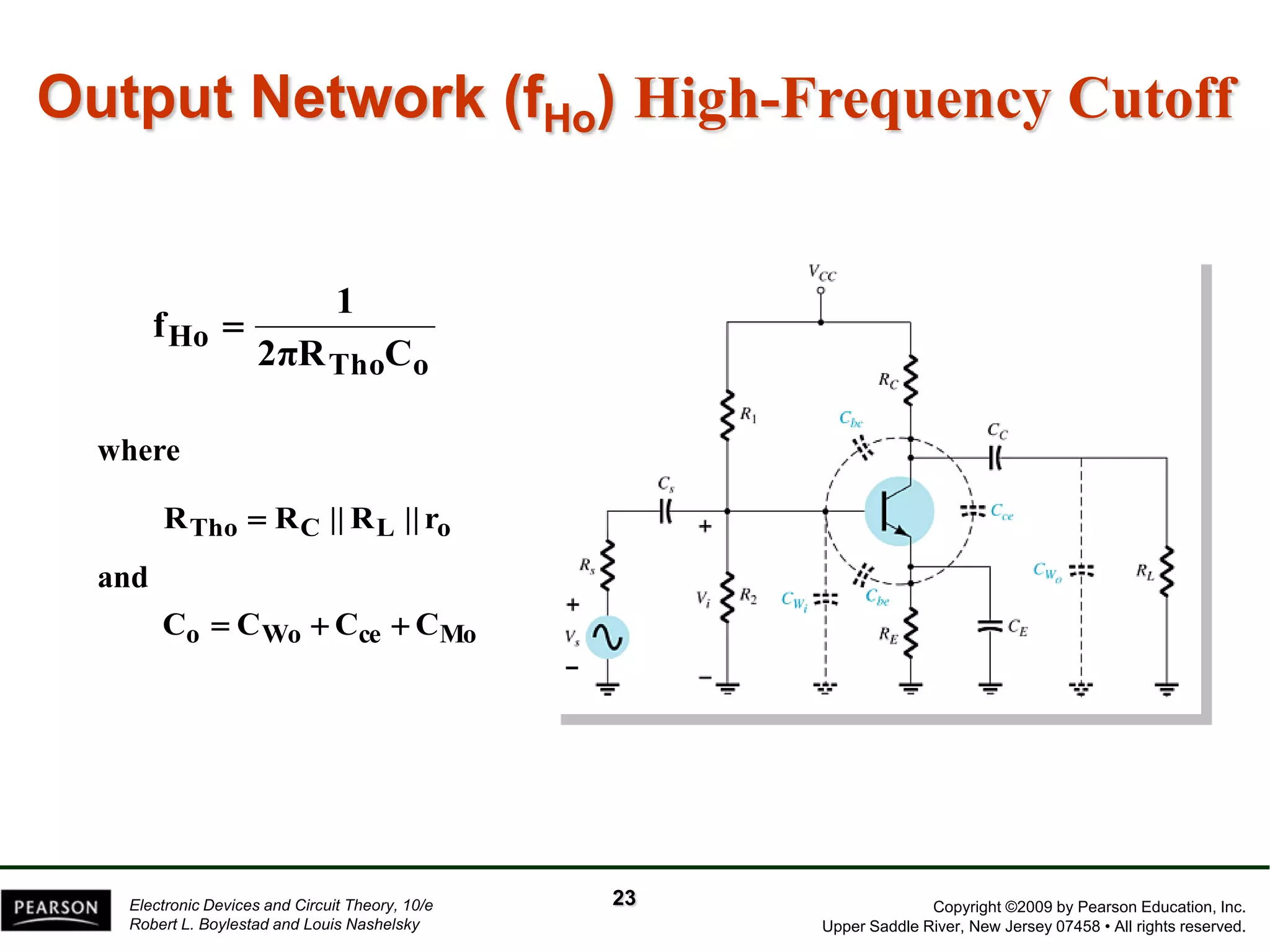
Output Network (fHo) High-Frequency Cutoff 
Co  CWo  Cce  CMo 
RTho  RC ||RL || ro 
Tho o 
Ho 
2πR C 
1 
f  
where 
and 
23
Copyright ©2009 by Pearson Education, Inc. 
Upper Saddle River, New Jersey 07458 • All rights reserved. 
Electronic Devices and Circuit Theory, 10/e 
Robert L. Boylestad and Louis Nashelsky 
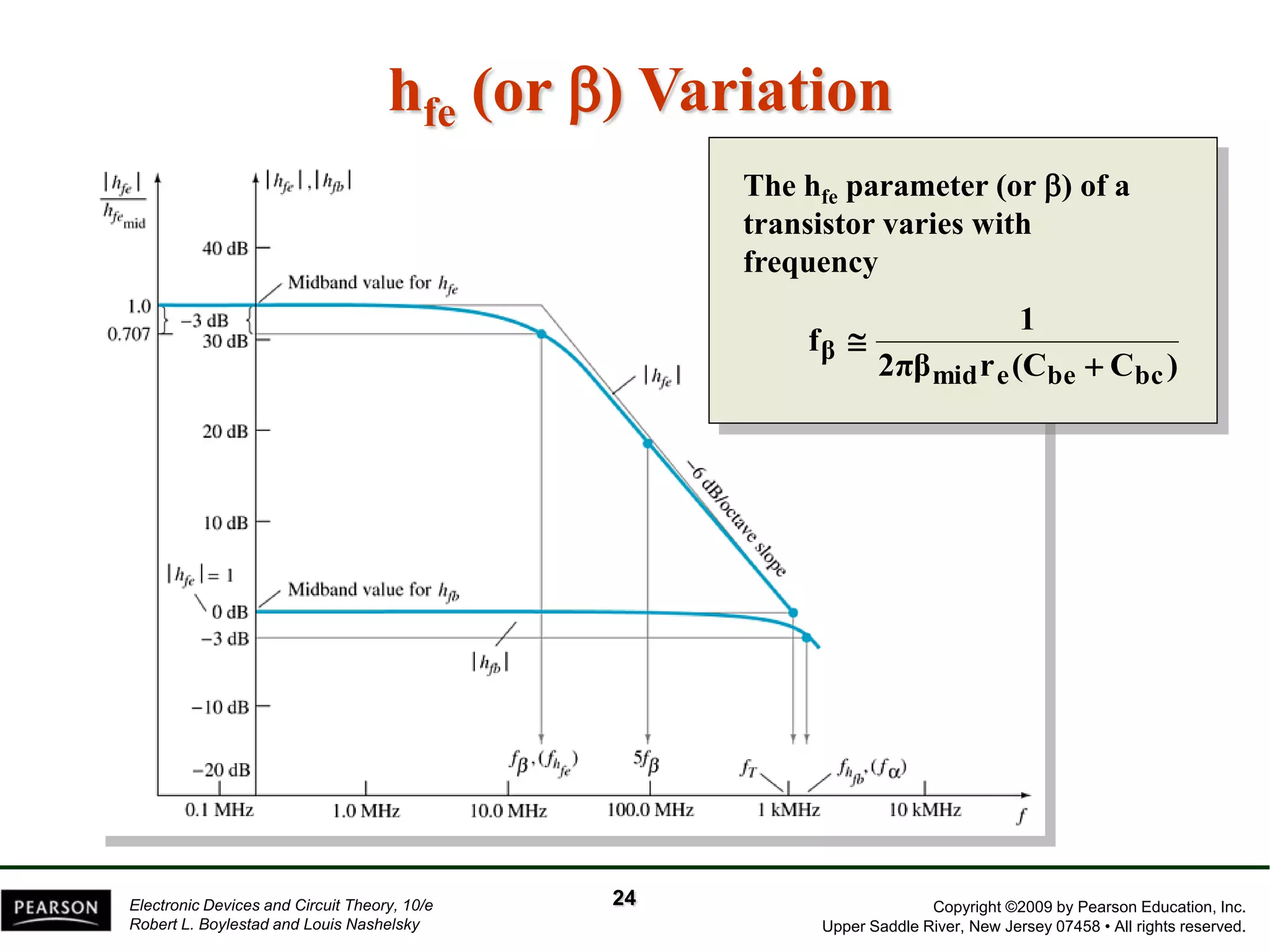
hfe (or ) Variation 
The hfe parameter (or ) of a 
transistor varies with 
frequency 
2πβ r (C C ) 
1 
f 
mid e be bc 
β 
 
 
24
Copyright ©2009 by Pearson Education, Inc. 
Upper Saddle River, New Jersey 07458 • All rights reserved. 
Electronic Devices and Circuit Theory, 10/e 
Robert L. Boylestad and Louis NashelskyBJT Amplifier Frequency Response 
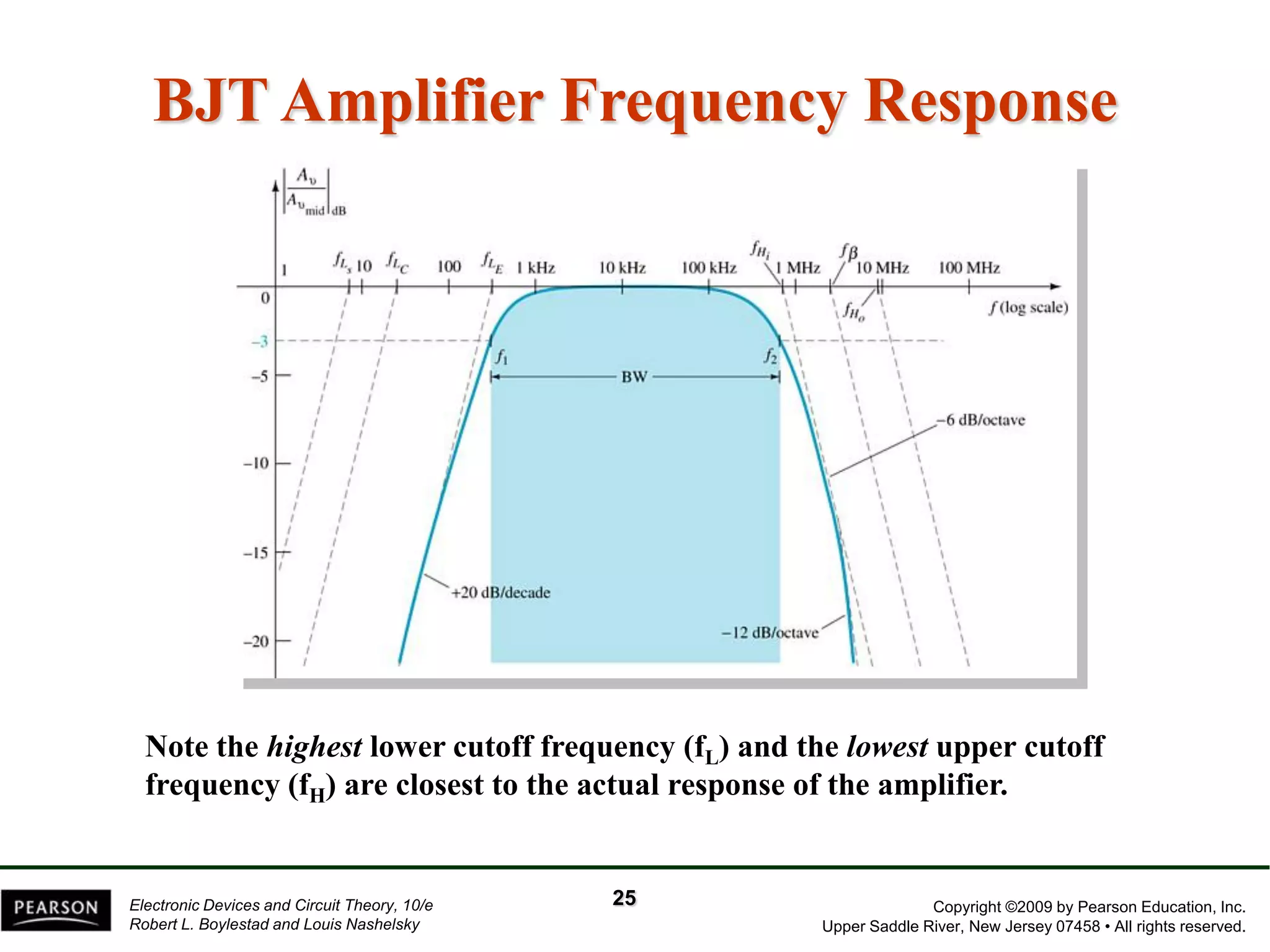
Note the highestlower cutoff frequency (fL) and the lowestupper cutoff frequency (fH) are closest to the actual response of the amplifier. 
25
Copyright ©2009 by Pearson Education, Inc. 
Upper Saddle River, New Jersey 07458 • All rights reserved. 
Electronic Devices and Circuit Theory, 10/e 
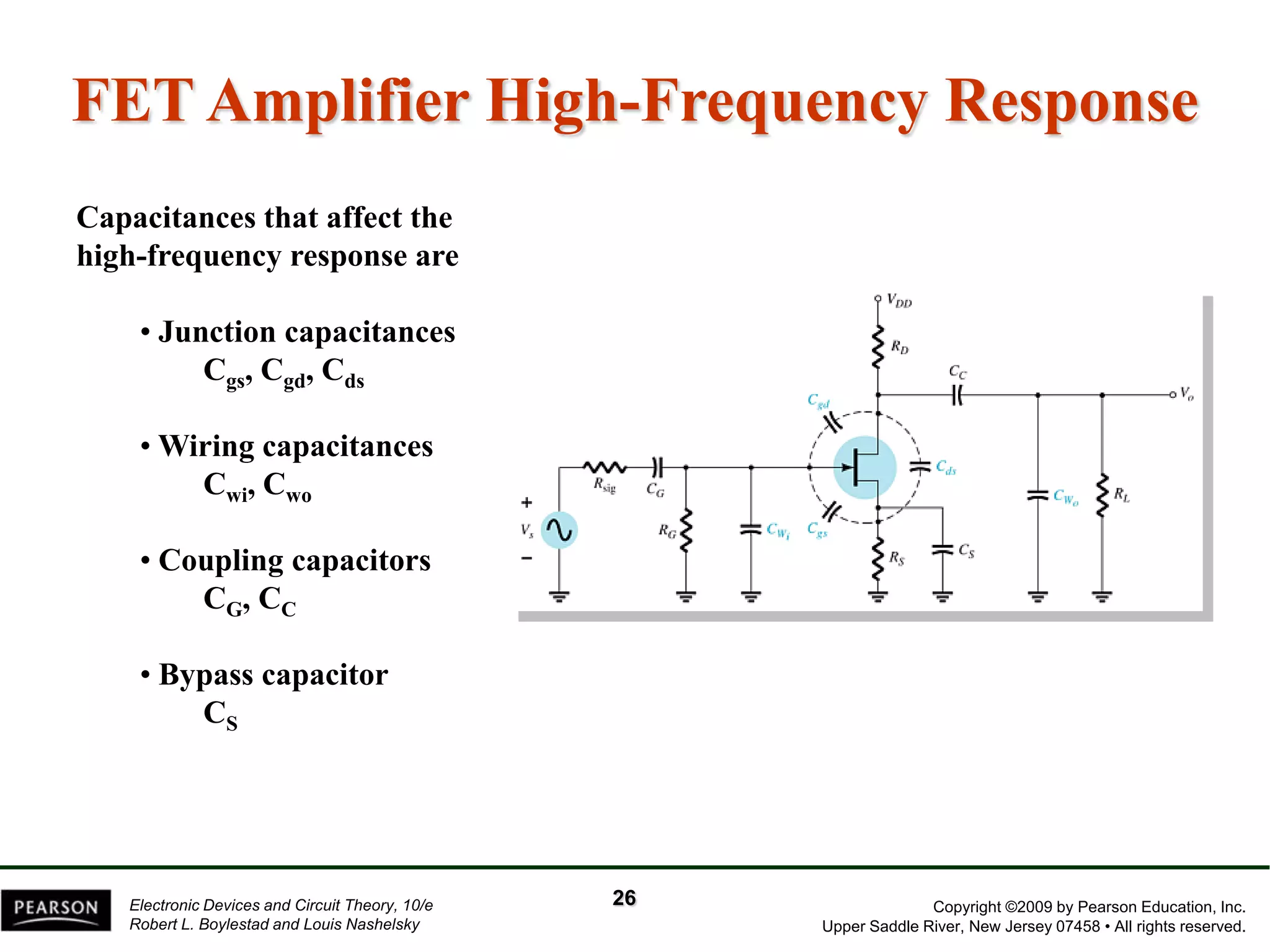
Robert L. Boylestad and Louis NashelskyFET Amplifier High-Frequency ResponseCapacitances that affect the high-frequency response are 
•Junction capacitancesCgs, Cgd, Cds 
•Wiring capacitancesCwi, Cwo 
•Coupling capacitorsCG, CC 
•Bypass capacitorCS 
26
Copyright ©2009 by Pearson Education, Inc. 
Upper Saddle River, New Jersey 07458 • All rights reserved. 
Electronic Devices and Circuit Theory, 10/e 
Robert L. Boylestad and Louis Nashelsky 
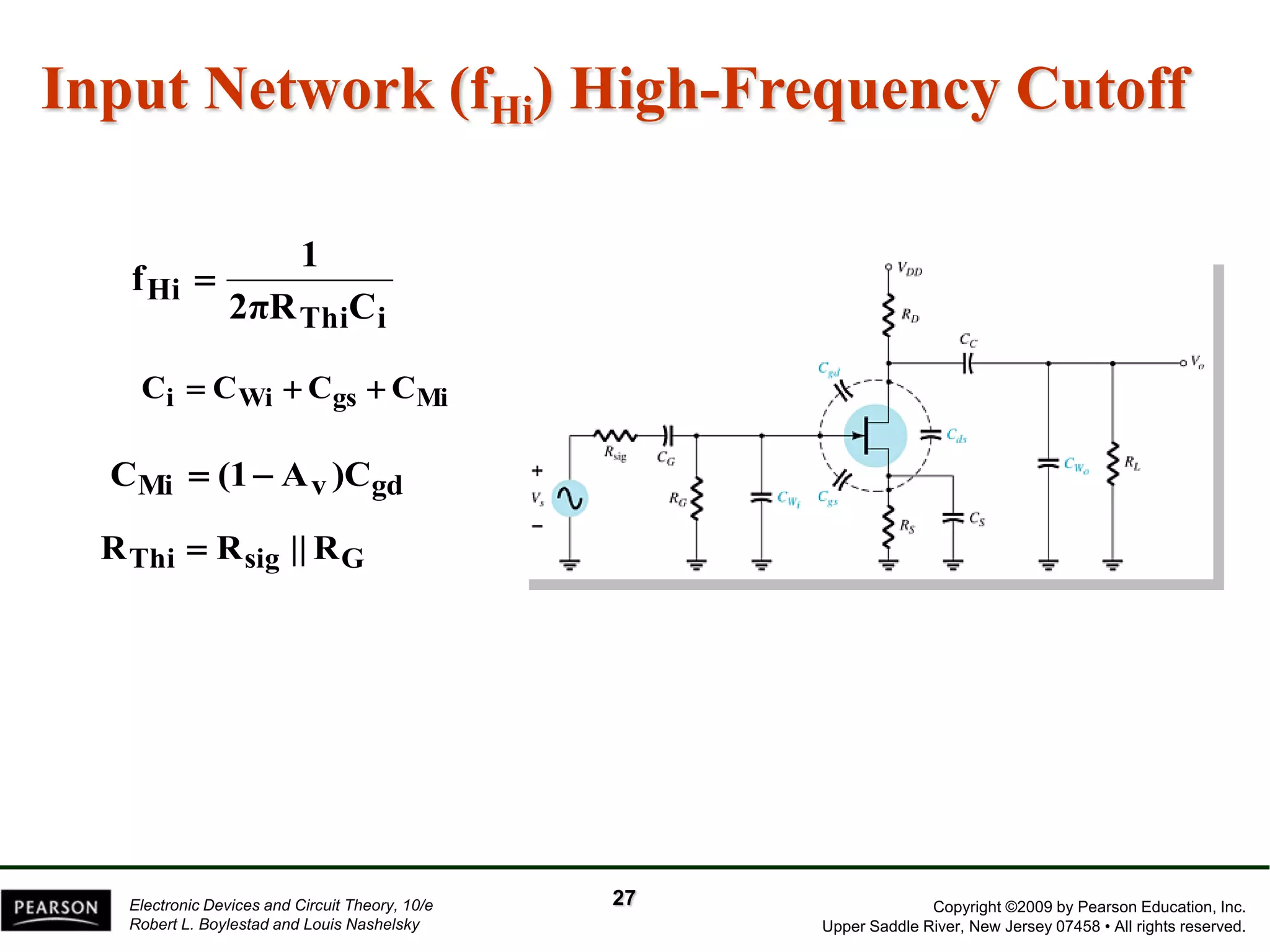
Input Network (fHi) High-Frequency Cutoff 
Thi i 
Hi 
2πR C 
1 
f  
RThi  Rsig ||RG 
Ci  CWi  Cgs  CMi 
CMi  (1 Av )Cgd 
27
Copyright ©2009 by Pearson Education, Inc. 
Upper Saddle River, New Jersey 07458 • All rights reserved. 
Electronic Devices and Circuit Theory, 10/e 
Robert L. Boylestad and Louis Nashelsky 
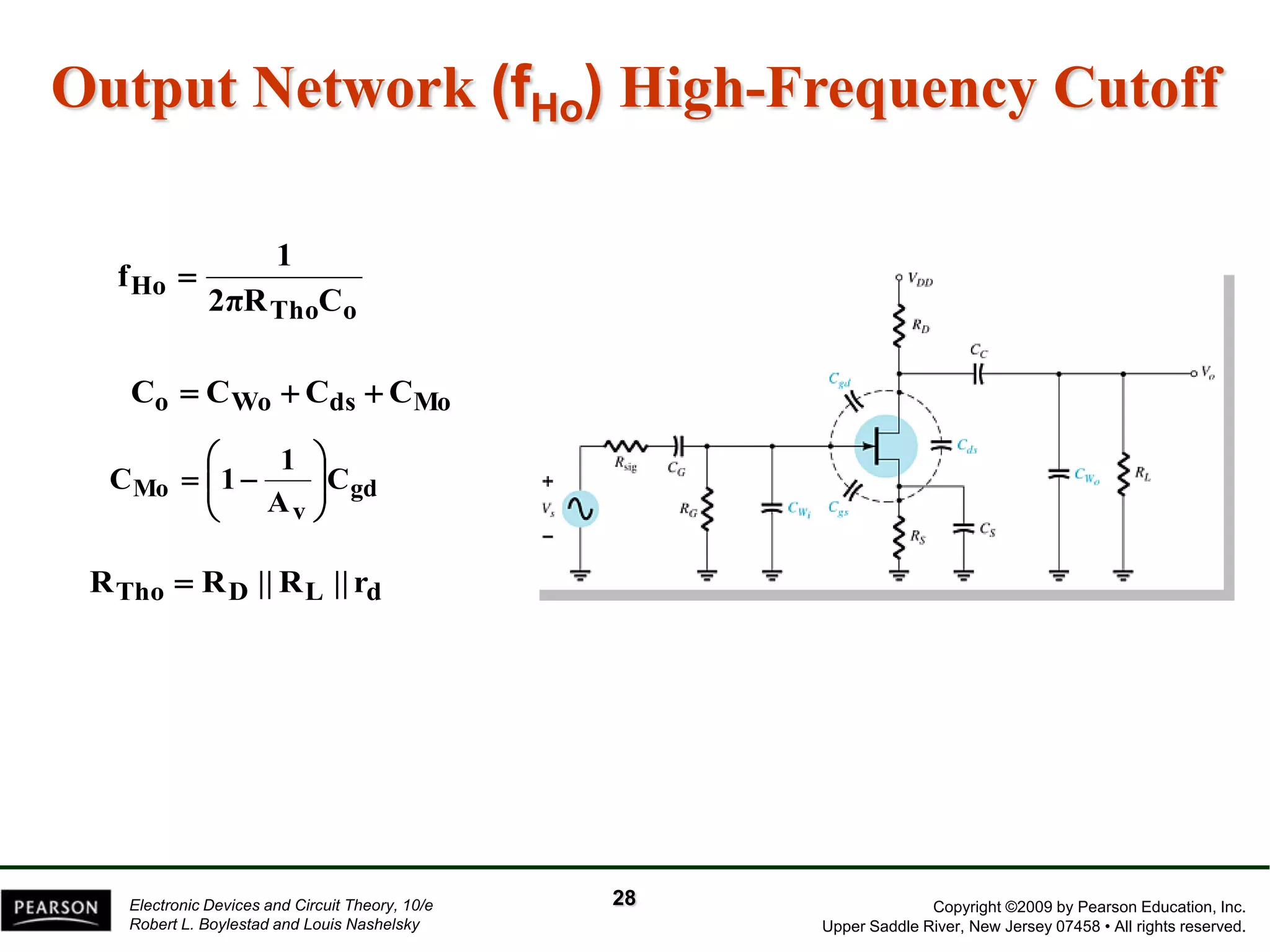
Output Network (fHo) High-Frequency Cutoff 
Tho o 
Ho 
2πR C 
1 
f  
RTho  RD ||RL || rd 
Co  CWo  Cds  CMo 
gd 
v 
Mo C 
A 
1 
1 C   
 
 
  
 
 
  
28
Copyright ©2009 by Pearson Education, Inc. 
Upper Saddle River, New Jersey 07458 • All rights reserved. 
Electronic Devices and Circuit Theory, 10/e 
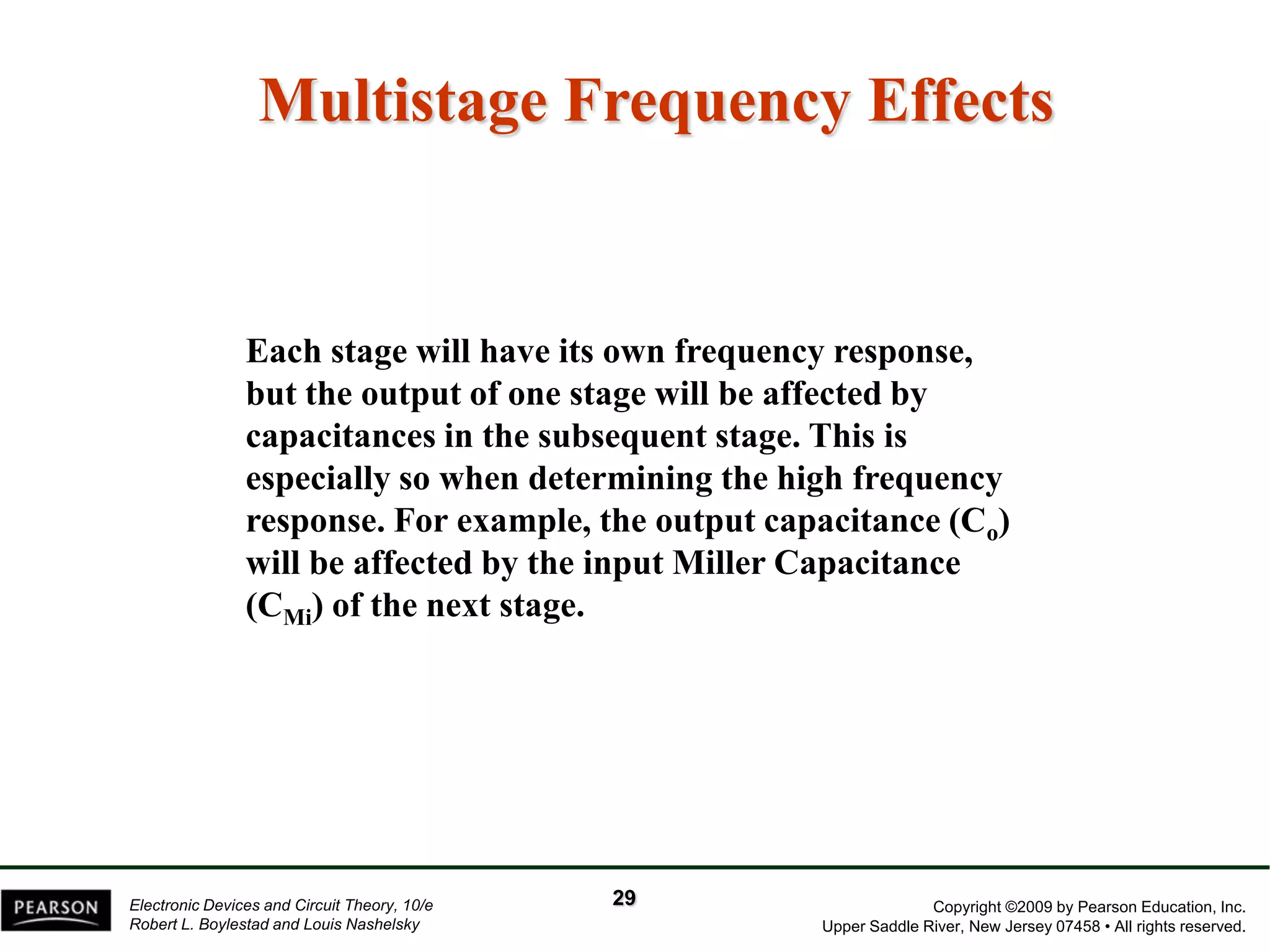
Robert L. Boylestad and Louis NashelskyMultistage Frequency Effects 
Each stage will have its own frequency response, but the output of one stage will be affected by capacitances in the subsequent stage. This is especially so when determining the high frequency response. For example, the output capacitance (Co) will be affected by the input Miller Capacitance (CMi) of the next stage. 
29
Copyright ©2009 by Pearson Education, Inc. 
Upper Saddle River, New Jersey 07458 • All rights reserved. 
Electronic Devices and Circuit Theory, 10/e 
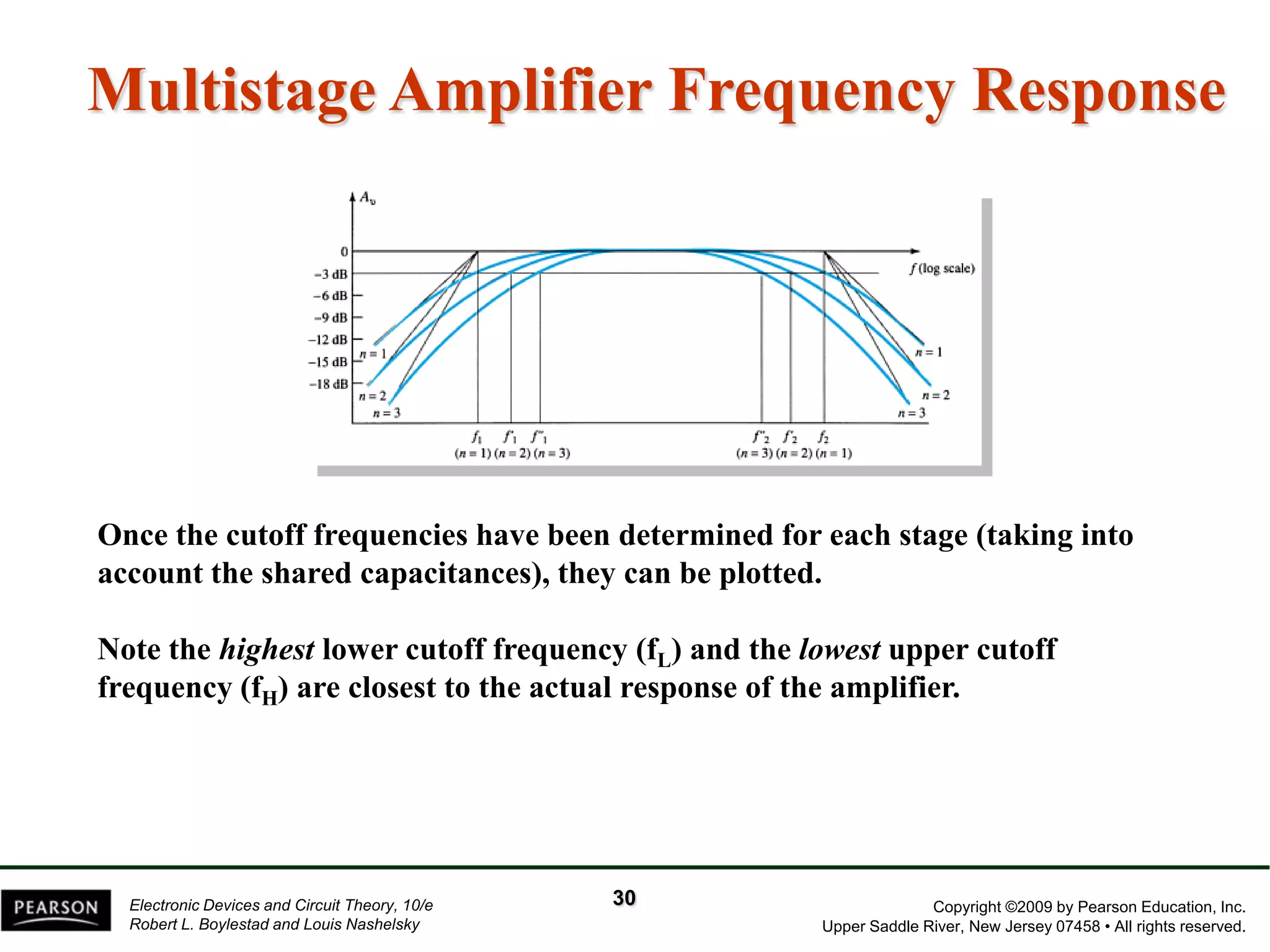
Robert L. Boylestad and Louis NashelskyMultistage Amplifier Frequency Response 
Once the cutoff frequencies have been determined for each stage (taking into account the shared capacitances), they can be plotted. 
Note the highestlower cutoff frequency (fL) and the lowestupper cutoff frequency (fH) are closest to the actual response of the amplifier. 
30
Copyright ©2009 by Pearson Education, Inc. 
Upper Saddle River, New Jersey 07458 • All rights reserved. 
Electronic Devices and Circuit Theory, 10/e 
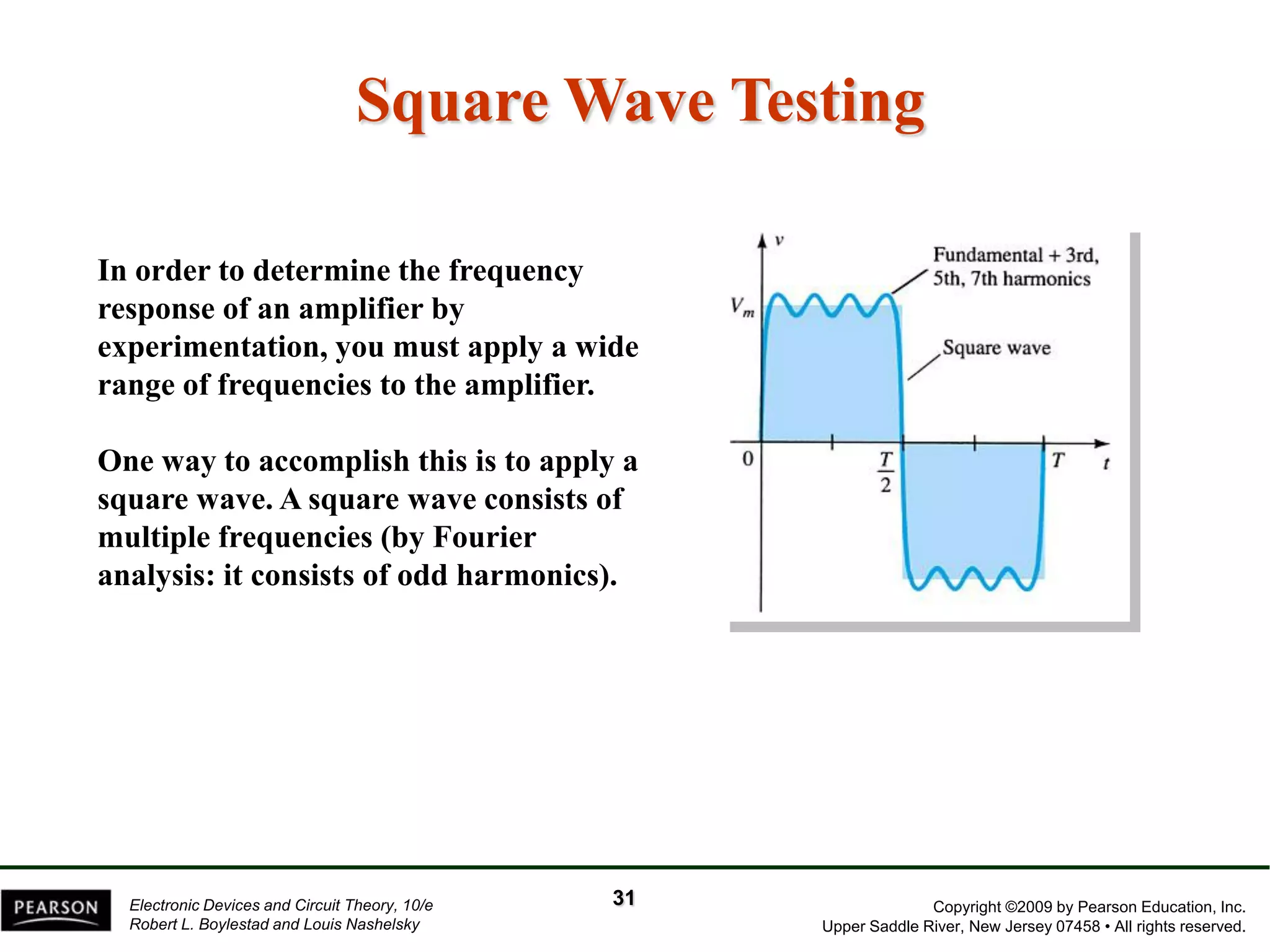
Robert L. Boylestad and Louis NashelskySquare Wave TestingIn order to determine the frequency response of an amplifier by experimentation, you must apply a wide range of frequencies to the amplifier. One way to accomplish this is to apply a square wave. A square wave consists of multiple frequencies (by Fourier analysis: it consists of odd harmonics). 
31
Copyright ©2009 by Pearson Education, Inc. 
Upper Saddle River, New Jersey 07458 • All rights reserved. 
Electronic Devices and Circuit Theory, 10/e 
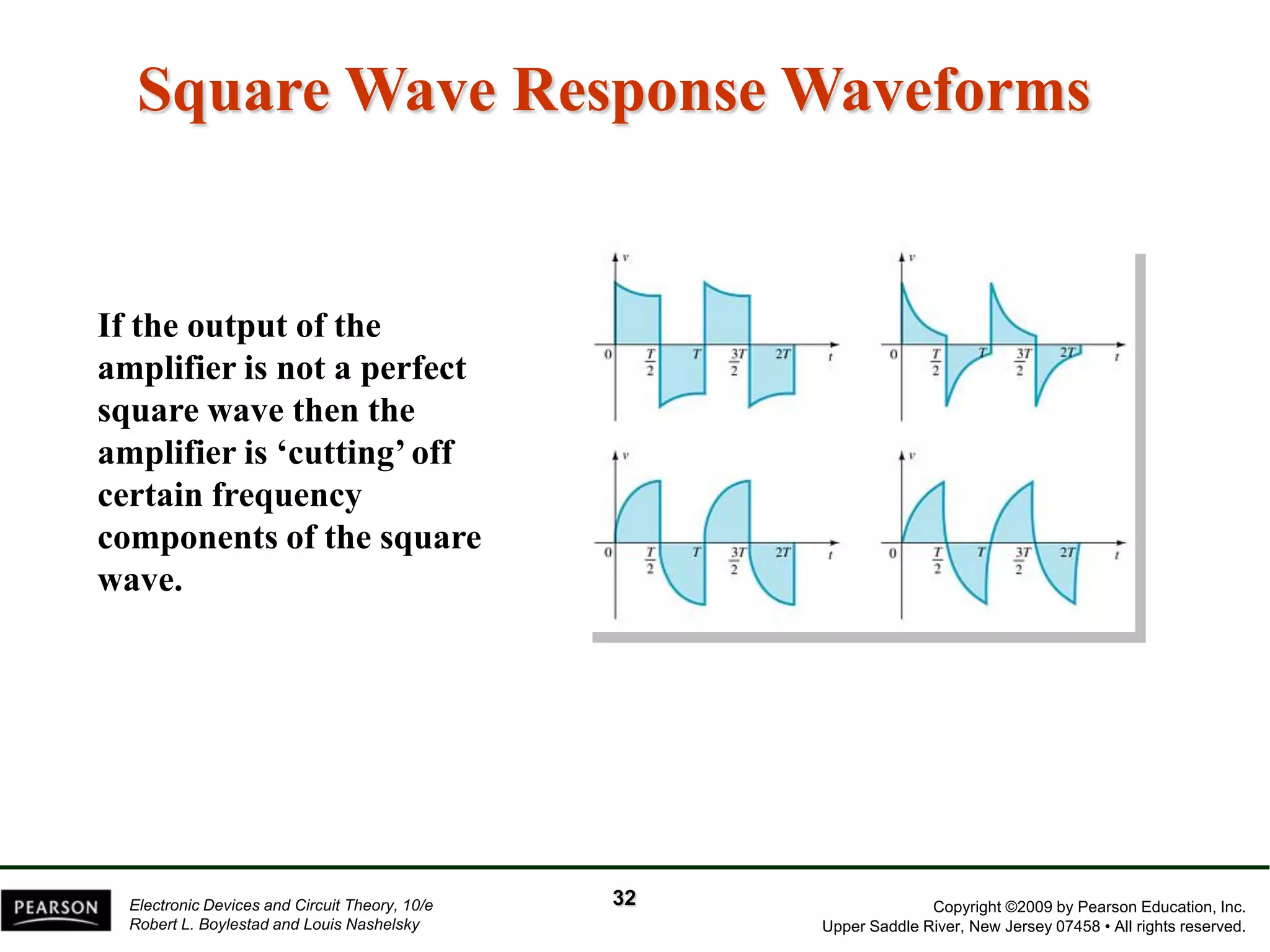
Robert L. Boylestad and Louis NashelskySquare Wave Response Waveforms 
If the output of the amplifier is not a perfect square wave then the amplifier is ‘cutting’ off certain frequency components of the square wave. 
32

Electronic devices-and-circuit-theory-10th-ed-boylestad-chapter-9

  • 1.
    Chapter 9: BJTand FET Frequency Response
  • 2.
    Copyright ©2009 byPearson Education, Inc. Upper Saddle River, New Jersey 07458 • All rights reserved. Electronic Devices and Circuit Theory, 10/e Robert L. Boylestad and Louis Nashelsky General Frequency Considerations •At frequencies above and below the midrange, capacitance and any inductance will affect the gain of the amplifier. •At low frequencies the coupling and bypass capacitors lower the gain. •At high frequencies stray capacitances associated with the active device lower the gain. •Also, cascading amplifiers limits the gain at high and low frequencies. The frequency responseof an amplifier refers to the frequency range in which the amplifier will operate with negligible effects from capacitors and device internal capacitance. This range of frequencies can be called the mid-range. 2
  • 3.
    Copyright ©2009 byPearson Education, Inc. Upper Saddle River, New Jersey 07458 • All rights reserved. Electronic Devices and Circuit Theory, 10/e Robert L. Boylestad and Louis NashelskyBode Plot A Bode plot indicates the frequency response of an amplifier. The horizontal scale indicates the frequency (in Hz) and the vertical scale indicates the gain (in dB). 3
  • 4.
    Copyright ©2009 byPearson Education, Inc. Upper Saddle River, New Jersey 07458 • All rights reserved. Electronic Devices and Circuit Theory, 10/e Robert L. Boylestad and Louis NashelskyCutoff FrequenciesThe mid-range frequency range of an amplifier is called the bandwidth of the amplifier. The bandwidthis defined by the lower and upper cutoff frequencies. Cutoff–any frequency at which the gain has dropped by 3 dB. 4
  • 5.
    Copyright ©2009 byPearson Education, Inc. Upper Saddle River, New Jersey 07458 • All rights reserved. Electronic Devices and Circuit Theory, 10/e Robert L. Boylestad and Louis NashelskyBJT Amplifier Low-Frequency Response At low frequencies, coupling capacitor (CS, CC) and bypass capacitor (CE) reactances affect the circuit impedances. 5
  • 6.
    Copyright ©2009 byPearson Education, Inc. Upper Saddle River, New Jersey 07458 • All rights reserved. Electronic Devices and Circuit Theory, 10/e Robert L. Boylestad and Louis Nashelsky Coupling Capacitor (CS) The cutoff frequency due to CS can be calculated by s i s Ls 2 (R R )C 1 f    Ri  R1 ||R2 || βre where 6
  • 7.
    Copyright ©2009 byPearson Education, Inc. Upper Saddle River, New Jersey 07458 • All rights reserved. Electronic Devices and Circuit Theory, 10/e Robert L. Boylestad and Louis Nashelsky o L c LC 2π(R R )C 1 f   Ro  RC || ro Coupling Capacitor (CC) The cutoff frequency due to CC can be calculated with where 7
  • 8.
    Copyright ©2009 byPearson Education, Inc. Upper Saddle River, New Jersey 07458 • All rights reserved. Electronic Devices and Circuit Theory, 10/e Robert L. Boylestad and Louis Nashelsky Bypass Capacitor (CE) e E LE 2πR C 1 f  r ) β R R R || ( e s e E    Rs  Rs ||R1 ||R2 The cutoff frequency due to CE can be calculated with where and 8
  • 9.
    Copyright ©2009 byPearson Education, Inc. Upper Saddle River, New Jersey 07458 • All rights reserved. Electronic Devices and Circuit Theory, 10/e Robert L. Boylestad and Louis Nashelsky BJT Amplifier Low-Frequency Response The Bode plot indicates that each capacitor may have a different cutoff frequency. It is the device that has the highestlower cutoff frequency (fL) that dominates the overall frequency response of the amplifier. 9
  • 10.
    Copyright ©2009 byPearson Education, Inc. Upper Saddle River, New Jersey 07458 • All rights reserved. Electronic Devices and Circuit Theory, 10/e Robert L. Boylestad and Louis Nashelsky Roll-Off of Gain in the Bode PlotThe Bode plot not only indicates the cutoff frequencies of the various capacitors it also indicates the amount of attenuation (loss in gain) at these frequencies. The amount of attenuation is sometimes referred to as roll-off. The roll-off is described as dB loss-per-octave or dB loss-per-decade. 10
  • 11.
    Copyright ©2009 byPearson Education, Inc. Upper Saddle River, New Jersey 07458 • All rights reserved. Electronic Devices and Circuit Theory, 10/e Robert L. Boylestad and Louis Nashelsky Roll-off Rate (-dB/Decade) -dB/decaderefers to the attenuation for every 10-fold change in frequency. For attenuations at the low- frequency end, it refers to the loss in gain from the lower cutoff frequency to a frequency that is one-tenth the cutoff value. In this example: fLS= 9kHz gain is 0dBfLS/10 = .9kHz gain is –20dBThus the roll-off is 20dB/decadeThe gain decreases by –20dB/decade 11
  • 12.
    Copyright ©2009 byPearson Education, Inc. Upper Saddle River, New Jersey 07458 • All rights reserved. Electronic Devices and Circuit Theory, 10/e Robert L. Boylestad and Louis NashelskyRoll-Off Rate (–dB/Octave) -dB/octaverefers to the attenuation for every 2-fold change in frequency. For attenuations at the low- frequency end, it refers to the loss in gain from the lower cutoff frequency to a frequency one-half the cutoff value. In this example: fLS= 9kHz gain is 0dB fLS / 2 = 4.5kHz gain is –6dB Therefore the roll-off is 6dB/octave. This is a little difficult to see on this graph because the horizontal scale is a logarithmic scale. 12
  • 13.
    Copyright ©2009 byPearson Education, Inc. Upper Saddle River, New Jersey 07458 • All rights reserved. Electronic Devices and Circuit Theory, 10/e Robert L. Boylestad and Louis NashelskyFET Amplifier Low-Frequency Response At low frequencies, coupling capacitor (CG, CC) and bypass capacitor (CS) reactances affect the circuit impedances. 13
  • 14.
    Copyright ©2009 byPearson Education, Inc. Upper Saddle River, New Jersey 07458 • All rights reserved. Electronic Devices and Circuit Theory, 10/e Robert L. Boylestad and Louis Nashelsky Coupling Capacitor (CG) sig i G LC 2π(R R )C 1 f   Ri  RG The cutoff frequency due to CG can be calculated with where 14
  • 15.
    Copyright ©2009 byPearson Education, Inc. Upper Saddle River, New Jersey 07458 • All rights reserved. Electronic Devices and Circuit Theory, 10/e Robert L. Boylestad and Louis Nashelsky Coupling Capacitor (CC) o L C LC 2π(R R )C 1 f   Ro  RD || rd The cutoff frequency due to CC can be calculated with where 15
  • 16.
    Copyright ©2009 byPearson Education, Inc. Upper Saddle River, New Jersey 07458 • All rights reserved. Electronic Devices and Circuit Theory, 10/e Robert L. Boylestad and Louis Nashelsky Bypass Capacitor (CS) eq S LS 2πR C 1 f  r Ω m eq S d g 1 R  R ||  The cutoff frequency due to CS can be calculated with where 16
  • 17.
    Copyright ©2009 byPearson Education, Inc. Upper Saddle River, New Jersey 07458 • All rights reserved. Electronic Devices and Circuit Theory, 10/e Robert L. Boylestad and Louis Nashelsky FET Amplifier Low-Frequency Response The Bode plot indicates that each capacitor may have a different cutoff frequency. The capacitor that has the highestlower cutoff frequency (fL) is closest to the actual cutoff frequency of the amplifier. 17
  • 18.
    Copyright ©2009 byPearson Education, Inc. Upper Saddle River, New Jersey 07458 • All rights reserved. Electronic Devices and Circuit Theory, 10/e Robert L. Boylestad and Louis Nashelsky Miller Capacitance Any p-n junction can develop capacitance. In a BJT amplifier, this capacitance becomes noticeable across: •The base-collector junction at high frequencies in common-emitter BJT amplifier configurations •The gate-drain junction at high frequencies in common- source FET amplifier configurations. These capacitances are represented as separate input and output capacitances, called the Miller Capacitances. 18
  • 19.
    Copyright ©2009 byPearson Education, Inc. Upper Saddle River, New Jersey 07458 • All rights reserved. Electronic Devices and Circuit Theory, 10/e Robert L. Boylestad and Louis Nashelsky Miller Input Capacitance (CMi) Note that the amount of Miller capacitance is dependent on inter-electrode capacitance from input to output (Cf) and the gain (Av). CMi  (1 Av )Cf 19
  • 20.
    Copyright ©2009 byPearson Education, Inc. Upper Saddle River, New Jersey 07458 • All rights reserved. Electronic Devices and Circuit Theory, 10/e Robert L. Boylestad and Louis Nashelsky Miller Output Capacitance (CMo) If the gain (Av) is considerably greater than 1, then Mo f C  C 20
  • 21.
    Copyright ©2009 byPearson Education, Inc. Upper Saddle River, New Jersey 07458 • All rights reserved. Electronic Devices and Circuit Theory, 10/e Robert L. Boylestad and Louis Nashelsky BJT Amplifier High-Frequency Response Capacitances that affect the high-frequency response are •Junction capacitancesCbe, Cbc, Cce •Wiring capacitancesCwi, Cwo •Coupling capacitorsCS, CC •Bypass capacitorCE 21
  • 22.
    Copyright ©2009 byPearson Education, Inc. Upper Saddle River, New Jersey 07458 • All rights reserved. Electronic Devices and Circuit Theory, 10/e Robert L. Boylestad and Louis Nashelsky Input Network (fHi) High-Frequency Cutoff Thi i Hi 2πR C 1 f  RThi Rs||R1 ||R2 ||Ri Wi be v bc i Wi be Mi C C (1 A )C C C C C        where and 22
  • 23.
    Copyright ©2009 byPearson Education, Inc. Upper Saddle River, New Jersey 07458 • All rights reserved. Electronic Devices and Circuit Theory, 10/e Robert L. Boylestad and Louis Nashelsky Output Network (fHo) High-Frequency Cutoff Co  CWo  Cce  CMo RTho  RC ||RL || ro Tho o Ho 2πR C 1 f  where and 23
  • 24.
    Copyright ©2009 byPearson Education, Inc. Upper Saddle River, New Jersey 07458 • All rights reserved. Electronic Devices and Circuit Theory, 10/e Robert L. Boylestad and Louis Nashelsky hfe (or ) Variation The hfe parameter (or ) of a transistor varies with frequency 2πβ r (C C ) 1 f mid e be bc β   24
  • 25.
    Copyright ©2009 byPearson Education, Inc. Upper Saddle River, New Jersey 07458 • All rights reserved. Electronic Devices and Circuit Theory, 10/e Robert L. Boylestad and Louis NashelskyBJT Amplifier Frequency Response Note the highestlower cutoff frequency (fL) and the lowestupper cutoff frequency (fH) are closest to the actual response of the amplifier. 25
  • 26.
    Copyright ©2009 byPearson Education, Inc. Upper Saddle River, New Jersey 07458 • All rights reserved. Electronic Devices and Circuit Theory, 10/e Robert L. Boylestad and Louis NashelskyFET Amplifier High-Frequency ResponseCapacitances that affect the high-frequency response are •Junction capacitancesCgs, Cgd, Cds •Wiring capacitancesCwi, Cwo •Coupling capacitorsCG, CC •Bypass capacitorCS 26
  • 27.
    Copyright ©2009 byPearson Education, Inc. Upper Saddle River, New Jersey 07458 • All rights reserved. Electronic Devices and Circuit Theory, 10/e Robert L. Boylestad and Louis Nashelsky Input Network (fHi) High-Frequency Cutoff Thi i Hi 2πR C 1 f  RThi  Rsig ||RG Ci  CWi  Cgs  CMi CMi  (1 Av )Cgd 27
  • 28.
    Copyright ©2009 byPearson Education, Inc. Upper Saddle River, New Jersey 07458 • All rights reserved. Electronic Devices and Circuit Theory, 10/e Robert L. Boylestad and Louis Nashelsky Output Network (fHo) High-Frequency Cutoff Tho o Ho 2πR C 1 f  RTho  RD ||RL || rd Co  CWo  Cds  CMo gd v Mo C A 1 1 C           28
  • 29.
    Copyright ©2009 byPearson Education, Inc. Upper Saddle River, New Jersey 07458 • All rights reserved. Electronic Devices and Circuit Theory, 10/e Robert L. Boylestad and Louis NashelskyMultistage Frequency Effects Each stage will have its own frequency response, but the output of one stage will be affected by capacitances in the subsequent stage. This is especially so when determining the high frequency response. For example, the output capacitance (Co) will be affected by the input Miller Capacitance (CMi) of the next stage. 29
  • 30.
    Copyright ©2009 byPearson Education, Inc. Upper Saddle River, New Jersey 07458 • All rights reserved. Electronic Devices and Circuit Theory, 10/e Robert L. Boylestad and Louis NashelskyMultistage Amplifier Frequency Response Once the cutoff frequencies have been determined for each stage (taking into account the shared capacitances), they can be plotted. Note the highestlower cutoff frequency (fL) and the lowestupper cutoff frequency (fH) are closest to the actual response of the amplifier. 30
  • 31.
    Copyright ©2009 byPearson Education, Inc. Upper Saddle River, New Jersey 07458 • All rights reserved. Electronic Devices and Circuit Theory, 10/e Robert L. Boylestad and Louis NashelskySquare Wave TestingIn order to determine the frequency response of an amplifier by experimentation, you must apply a wide range of frequencies to the amplifier. One way to accomplish this is to apply a square wave. A square wave consists of multiple frequencies (by Fourier analysis: it consists of odd harmonics). 31
  • 32.
    Copyright ©2009 byPearson Education, Inc. Upper Saddle River, New Jersey 07458 • All rights reserved. Electronic Devices and Circuit Theory, 10/e Robert L. Boylestad and Louis NashelskySquare Wave Response Waveforms If the output of the amplifier is not a perfect square wave then the amplifier is ‘cutting’ off certain frequency components of the square wave. 32