Chapter 16Chapter 16
Semiconductors, Diodes
and Their Applications
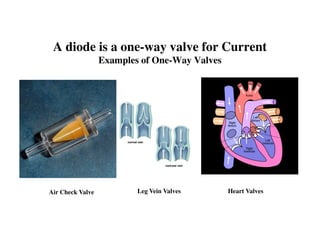
A diode is a one-way valve for Current
Examples of One-Way Valves
Air Check Valve Heart ValvesLeg Vein Valves
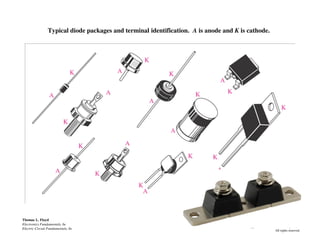
Typical diode packages and terminal identification. A is anode and K is cathode.
Thomas L. Floyd
Electronics Fundamentals, 6e
Electric Circuit Fundamentals, 6e
Copyright ©2004 by Pearson Education, Inc.
Upper Saddle River, New Jersey 07458
All rights reserved.
Introduction to Semiconductor
Materials
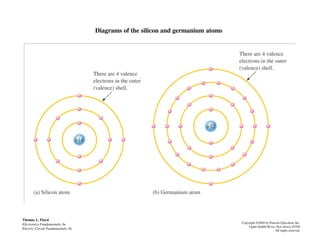
• Two types of semiconductive materials are silicon
and germainium
– both have four valance electrons
• When silicon and germanium atoms combine into
molecules to form a solid material, they arrange
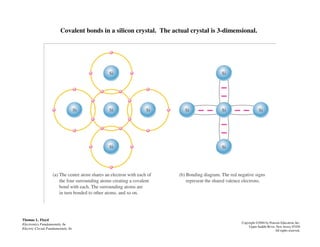
themselves in a fixed pattern called a crystal
– atoms within the crystal structure are held together by
covalent bonds (atoms share valence electrons)
• An intrinsic crystal is one that has no impurities
Introduction to Semiconductor
Materials
• In an intrinsic semiconductor, there are relatively
few free electrons
– pure semiconductive materials are neither good
conductors nor good insulatorsconductors nor good insulators
• Intrinsic semiconductive materials must be
modified by increasing the free electrons and
holes to increase its conductivity and make it
useful for electronic devices
– by adding impurities, n-type and p-type extrinsic
semiconductive material can be produced
Diagrams of the silicon and germanium atoms
Thomas L. Floyd
Electronics Fundamentals, 6e
Electric Circuit Fundamentals, 6e
Copyright ©2004 by Pearson Education, Inc.
Upper Saddle River, New Jersey 07458
All rights reserved.
Covalent bonds in a silicon crystal. The actual crystal is 3-dimensional.
Thomas L. Floyd
Electronics Fundamentals, 6e
Electric Circuit Fundamentals, 6e
Copyright ©2004 by Pearson Education, Inc.
Upper Saddle River, New Jersey 07458
All rights reserved.
Introduction to Modified
Semiconductor Materials
• Doping is the process of adding impurities to
intrinsic semiconductive materials to increase and
control conductivity within the material
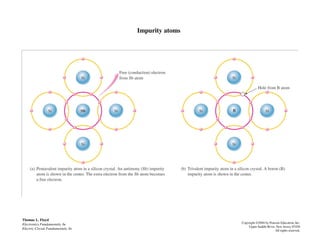
– n-type material is formed by adding pentavalent (5– n-type material is formed by adding pentavalent (5
valence electrons) impurity atoms
• electrons are called majority carriers in n-type material
• holes are called minority carriers in n-type material
– p-type material is formed by adding trivalent (3
valence electrons) impurity atoms
• holes are called majority carriers in p-type material
• electrons are called minority carriers in p-type material
The PN Junction Diode
• A Semiconductor diode consists of an n material
region and a p material region separated by a pn
junction
– the n region has many conduction electrons– the n region has many conduction electrons
– the p region has many holes
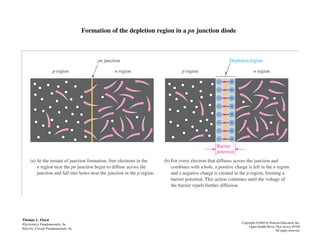
• As a result of recombination, a large number of
positive (in the n region) and negative (in the p
region) ions builds up near the pn junction,
essentially depleting the region of any conduction
electrons or holes - termed the depletion region
Impurity atoms
Thomas L. Floyd
Electronics Fundamentals, 6e
Electric Circuit Fundamentals, 6e
Copyright ©2004 by Pearson Education, Inc.
Upper Saddle River, New Jersey 07458
All rights reserved.
The PN Junction Diode
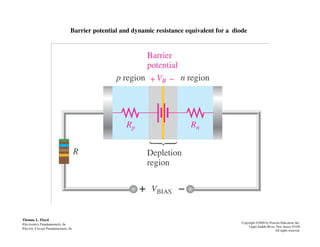
• The barrier potential, VB, is the amount of
voltage required to move electrons through
the electric fieldthe electric field
– At 25°C, it is approximately 0.7 V for silicon
and 0.3 V for germanium
– As the junction temperature increases, the
barrier potential decreases, and vice versa
Formation of the depletion region in a pn junction diode
Thomas L. Floyd
Electronics Fundamentals, 6e
Electric Circuit Fundamentals, 6e
Copyright ©2004 by Pearson Education, Inc.
Upper Saddle River, New Jersey 07458
All rights reserved.
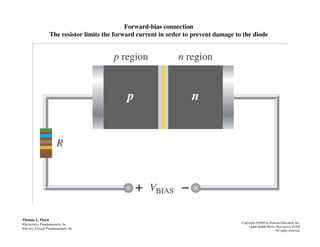
Forward-bias connection
The resistor limits the forward current in order to prevent damage to the diode
Thomas L. Floyd
Electronics Fundamentals, 6e
Electric Circuit Fundamentals, 6e
Copyright ©2004 by Pearson Education, Inc.
Upper Saddle River, New Jersey 07458
All rights reserved.
The PN Junction Diode
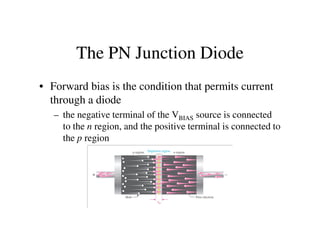
• Forward bias is the condition that permits current
through a diode
– the negative terminal of the VBIAS source is connected
to the n region, and the positive terminal is connected toto the n region, and the positive terminal is connected to
the p region
The PN Junction Diode
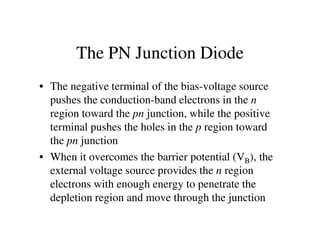
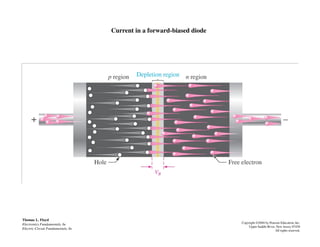
• The negative terminal of the bias-voltage source
pushes the conduction-band electrons in the n
region toward the pn junction, while the positive
terminal pushes the holes in the p region towardterminal pushes the holes in the p region toward
the pn junction
• When it overcomes the barrier potential (VB), the
external voltage source provides the n region
electrons with enough energy to penetrate the
depletion region and move through the junction
Current in a forward-biased diode
Thomas L. Floyd
Electronics Fundamentals, 6e
Electric Circuit Fundamentals, 6e
Copyright ©2004 by Pearson Education, Inc.
Upper Saddle River, New Jersey 07458
All rights reserved.
Barrier potential and dynamic resistance equivalent for a diode
Thomas L. Floyd
Electronics Fundamentals, 6e
Electric Circuit Fundamentals, 6e
Copyright ©2004 by Pearson Education, Inc.
Upper Saddle River, New Jersey 07458
All rights reserved.
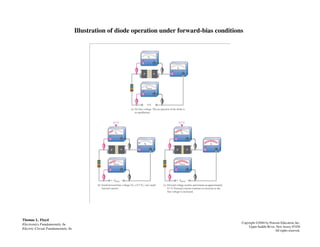
Illustration of diode operation under forward-bias conditions
Thomas L. Floyd
Electronics Fundamentals, 6e
Electric Circuit Fundamentals, 6e
Copyright ©2004 by Pearson Education, Inc.
Upper Saddle River, New Jersey 07458
All rights reserved.
The PN Junction Diode
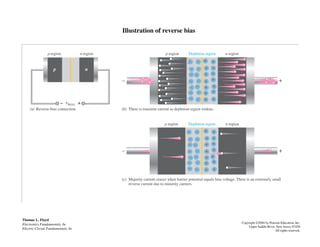
• Reverse bias is the condition that prevents current
through the diode
– the negative terminal of the VBIAS source is connected
to the p region, and the positive terminal is connected toto the p region, and the positive terminal is connected to
the n region
• If the external reverse-bias voltage is increased to
a large enough value, reverse breakdown occurs
– minority conduction-band electrons acquire enough
energy from the external source to accelerate toward the
positive end of the diode, colliding with atoms and
knocking valence electrons into the conduction band
Illustration of reverse bias
Thomas L. Floyd
Electronics Fundamentals, 6e
Electric Circuit Fundamentals, 6e
Copyright ©2004 by Pearson Education, Inc.
Upper Saddle River, New Jersey 07458
All rights reserved.
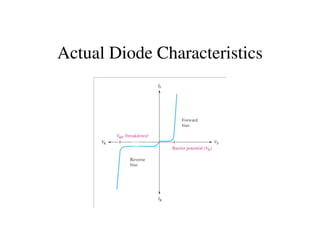
Diode Characteristics
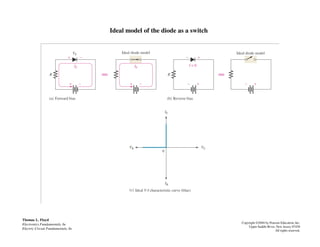
• The simplest way to visualize diode
operation is to think of it as a switch
– When forward-biased, the diode ideally acts as– When forward-biased, the diode ideally acts as
a closed (on) switch
– When reverse-biased, it acts as an open (off)
switch
Ideal model of the diode as a switch
Thomas L. Floyd
Electronics Fundamentals, 6e
Electric Circuit Fundamentals, 6e
Copyright ©2004 by Pearson Education, Inc.
Upper Saddle River, New Jersey 07458
All rights reserved.
Actual Diode Characteristics
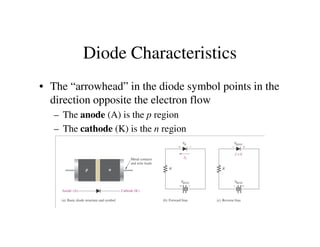
Diode Characteristics
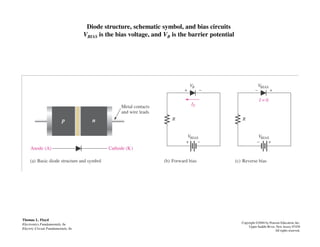
• The “arrowhead” in the diode symbol points in the
direction opposite the electron flow
– The anode (A) is the p region
– The cathode (K) is the n region– The cathode (K) is the n region
Diode structure, schematic symbol, and bias circuits
VBIAS is the bias voltage, and VB is the barrier potential
Thomas L. Floyd
Electronics Fundamentals, 6e
Electric Circuit Fundamentals, 6e
Copyright ©2004 by Pearson Education, Inc.
Upper Saddle River, New Jersey 07458
All rights reserved.
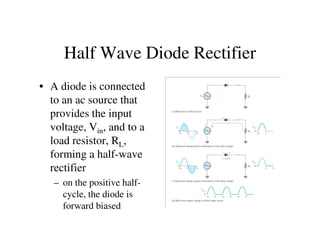
Half Wave Diode Rectifier
• A diode is connected
to an ac source that
provides the input
voltage, V , and to avoltage, Vin, and to a
load resistor, RL,
forming a half-wave
rectifier
– on the positive half-
cycle, the diode is
forward biased
Half Wave Diode Rectifier
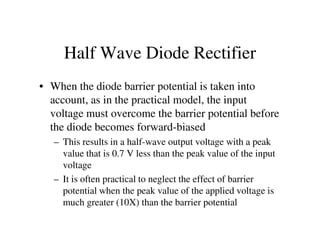
• When the diode barrier potential is taken into
account, as in the practical model, the input
voltage must overcome the barrier potential before
the diode becomes forward-biasedthe diode becomes forward-biased
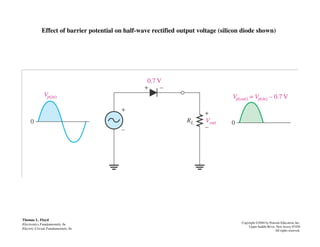
– This results in a half-wave output voltage with a peak
value that is 0.7 V less than the peak value of the input
voltage
– It is often practical to neglect the effect of barrier
potential when the peak value of the applied voltage is
much greater (10X) than the barrier potential
Effect of barrier potential on half-wave rectified output voltage (silicon diode shown)
Thomas L. Floyd
Electronics Fundamentals, 6e
Electric Circuit Fundamentals, 6e
Copyright ©2004 by Pearson Education, Inc.
Upper Saddle River, New Jersey 07458
All rights reserved.
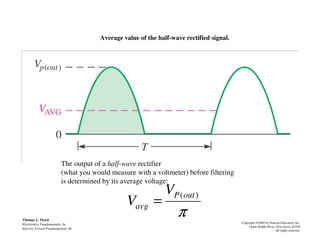
Average value of the half-wave rectified signal.
Thomas L. Floyd
Electronics Fundamentals, 6e
Electric Circuit Fundamentals, 6e
Copyright ©2004 by Pearson Education, Inc.
Upper Saddle River, New Jersey 07458
All rights reserved.
π
)(outP
avg
V
V =
The output of a half-wave rectifier
(what you would measure with a voltmeter) before filtering
is determined by its average voltage:
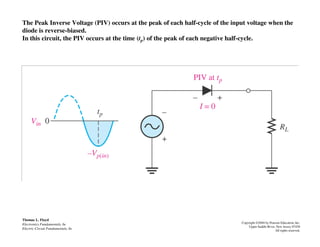
The Peak Inverse Voltage (PIV) occurs at the peak of each half-cycle of the input voltage when the
diode is reverse-biased.
In this circuit, the PIV occurs at the time (tp) of the peak of each negative half-cycle.
Thomas L. Floyd
Electronics Fundamentals, 6e
Electric Circuit Fundamentals, 6e
Copyright ©2004 by Pearson Education, Inc.
Upper Saddle River, New Jersey 07458
All rights reserved.
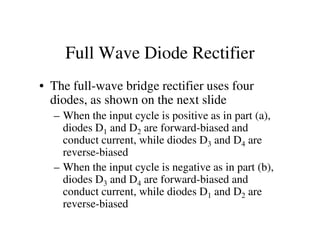
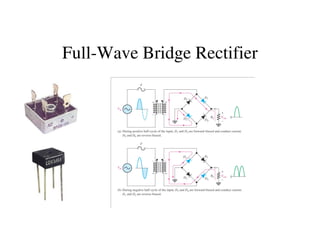
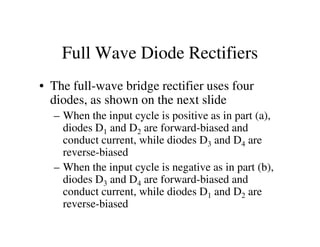
Full Wave Diode Rectifier
• The full-wave bridge rectifier uses four
diodes, as shown on the next slide
– When the input cycle is positive as in part (a),
diodes D and D are forward-biased anddiodes D1 and D2 are forward-biased and
conduct current, while diodes D3 and D4 are
reverse-biased
– When the input cycle is negative as in part (b),
diodes D3 and D4 are forward-biased and
conduct current, while diodes D1 and D2 are
reverse-biased
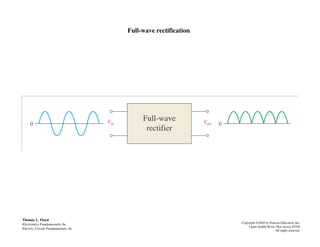
Full-wave rectification
Thomas L. Floyd
Electronics Fundamentals, 6e
Electric Circuit Fundamentals, 6e
Copyright ©2004 by Pearson Education, Inc.
Upper Saddle River, New Jersey 07458
All rights reserved.
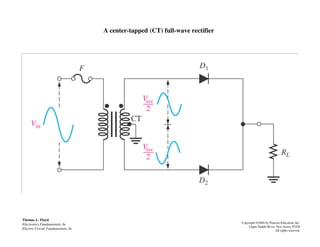
A center-tapped (CT) full-wave rectifier
Thomas L. Floyd
Electronics Fundamentals, 6e
Electric Circuit Fundamentals, 6e
Copyright ©2004 by Pearson Education, Inc.
Upper Saddle River, New Jersey 07458
All rights reserved.
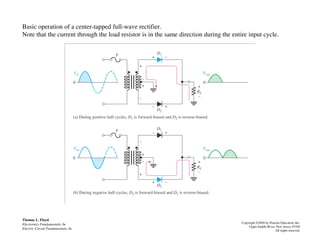
Basic operation of a center-tapped full-wave rectifier.
Note that the current through the load resistor is in the same direction during the entire input cycle.
Thomas L. Floyd
Electronics Fundamentals, 6e
Electric Circuit Fundamentals, 6e
Copyright ©2004 by Pearson Education, Inc.
Upper Saddle River, New Jersey 07458
All rights reserved.
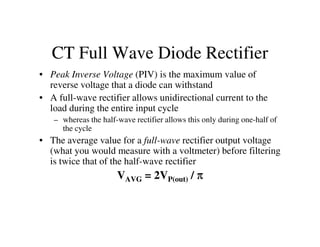
CT Full Wave Diode Rectifier
• Peak Inverse Voltage (PIV) is the maximum value of
reverse voltage that a diode can withstand
• A full-wave rectifier allows unidirectional current to the
load during the entire input cycle
– whereas the half-wave rectifier allows this only during one-half of– whereas the half-wave rectifier allows this only during one-half of
the cycle
• The average value for a full-wave rectifier output voltage
(what you would measure with a voltmeter) before filtering
is twice that of the half-wave rectifier
VAVG = 2VP(out) / ππππ
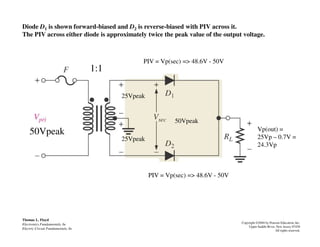
Diode D1 is shown forward-biased and D2 is reverse-biased with PIV across it.
The PIV across either diode is approximately twice the peak value of the output voltage.
1:1
25Vpeak
50Vpeak
PIV = Vp(sec) => 48.6V - 50V
Thomas L. Floyd
Electronics Fundamentals, 6e
Electric Circuit Fundamentals, 6e
Copyright ©2004 by Pearson Education, Inc.
Upper Saddle River, New Jersey 07458
All rights reserved.
50Vpeak
25Vpeak
50Vpeak
PIV = Vp(sec) => 48.6V - 50V
Vp(out) =
25Vp – 0.7V =
24.3Vp
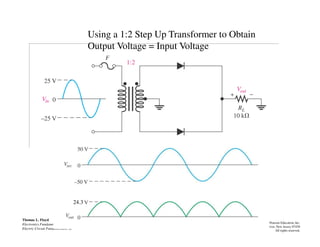
Using a 1:2 Step Up Transformer to Obtain
Output Voltage = Input Voltage
Thomas L. Floyd
Electronics Fundamentals, 6e
Electric Circuit Fundamentals, 6e
Copyright ©2004 by Pearson Education, Inc.
Upper Saddle River, New Jersey 07458
All rights reserved.
24.3
Full Wave Diode Rectifiers
• The full-wave bridge rectifier uses four
diodes, as shown on the next slide
– When the input cycle is positive as in part (a),
diodes D and D are forward-biased anddiodes D1 and D2 are forward-biased and
conduct current, while diodes D3 and D4 are
reverse-biased
– When the input cycle is negative as in part (b),
diodes D3 and D4 are forward-biased and
conduct current, while diodes D1 and D2 are
reverse-biased
Full-Wave Bridge Rectifier
Power Supplies
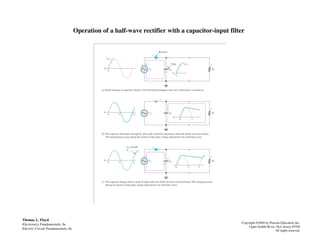
• The dc power supply converts the standard 110 V,
60 Hz ac available at the wall outlets into a
constant dc voltage
– dc voltage is used in most electronic circuits– dc voltage is used in most electronic circuits
• A capacitor is used to filter the output of the
rectifier, charging during each quarter-cycle that
the input voltage exceeds the capacitor voltage,
and discharging through the load when the input
voltage decreases below the capacitor voltage, at
which point the diodes become reverse biased
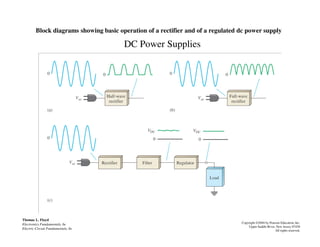
Block diagrams showing basic operation of a rectifier and of a regulated dc power supply
DC Power Supplies
Thomas L. Floyd
Electronics Fundamentals, 6e
Electric Circuit Fundamentals, 6e
Copyright ©2004 by Pearson Education, Inc.
Upper Saddle River, New Jersey 07458
All rights reserved.
Operation of a half-wave rectifier with a capacitor-input filter
Thomas L. Floyd
Electronics Fundamentals, 6e
Electric Circuit Fundamentals, 6e
Copyright ©2004 by Pearson Education, Inc.
Upper Saddle River, New Jersey 07458
All rights reserved.
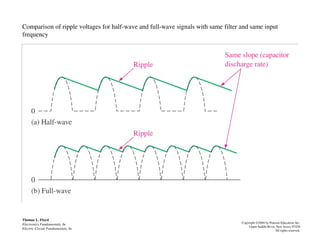
Comparison of ripple voltages for half-wave and full-wave signals with same filter and same input
frequency
Thomas L. Floyd
Electronics Fundamentals, 6e
Electric Circuit Fundamentals, 6e
Copyright ©2004 by Pearson Education, Inc.
Upper Saddle River, New Jersey 07458
All rights reserved.
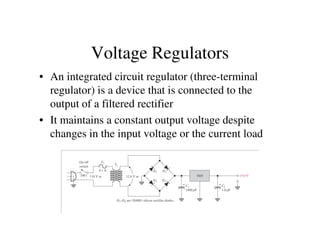
Voltage Regulators
• An integrated circuit regulator (three-terminal
regulator) is a device that is connected to the
output of a filtered rectifier
• It maintains a constant output voltage despite• It maintains a constant output voltage despite
changes in the input voltage or the current load
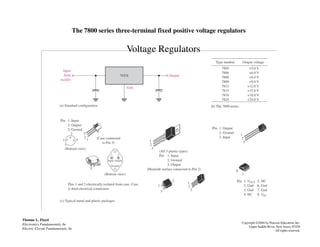
The 7800 series three-terminal fixed positive voltage regulators
Voltage Regulators
Thomas L. Floyd
Electronics Fundamentals, 6e
Electric Circuit Fundamentals, 6e
Copyright ©2004 by Pearson Education, Inc.
Upper Saddle River, New Jersey 07458
All rights reserved.
Zener Diodes
• The zener diode is used to provide an output
reference voltage that is stable despite changes in
input voltage
– Used as a reference in regulated power supplies– Used as a reference in regulated power supplies
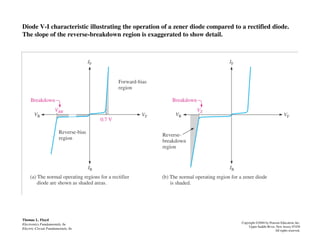
– The zener diode is designed for operation in the reverse
breakdown region, where the voltage remains almost
constant over a wide range of reverse current values
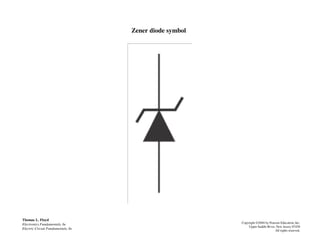
Zener diode symbol
Thomas L. Floyd
Electronics Fundamentals, 6e
Electric Circuit Fundamentals, 6e
Copyright ©2004 by Pearson Education, Inc.
Upper Saddle River, New Jersey 07458
All rights reserved.
Diode V-I characteristic illustrating the operation of a zener diode compared to a rectified diode.
The slope of the reverse-breakdown region is exaggerated to show detail.
Thomas L. Floyd
Electronics Fundamentals, 6e
Electric Circuit Fundamentals, 6e
Copyright ©2004 by Pearson Education, Inc.
Upper Saddle River, New Jersey 07458
All rights reserved.
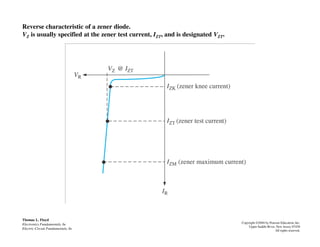
Reverse characteristic of a zener diode.
VZ is usually specified at the zener test current, IZT, and is designated VZT.
Thomas L. Floyd
Electronics Fundamentals, 6e
Electric Circuit Fundamentals, 6e
Copyright ©2004 by Pearson Education, Inc.
Upper Saddle River, New Jersey 07458
All rights reserved.
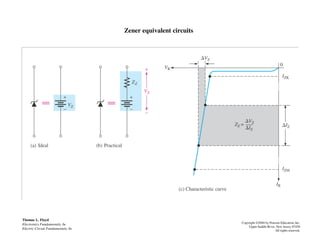
Zener equivalent circuits
Thomas L. Floyd
Electronics Fundamentals, 6e
Electric Circuit Fundamentals, 6e
Copyright ©2004 by Pearson Education, Inc.
Upper Saddle River, New Jersey 07458
All rights reserved.
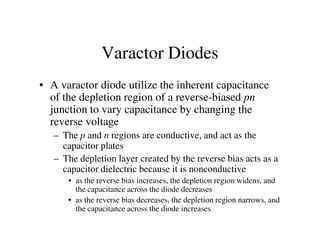
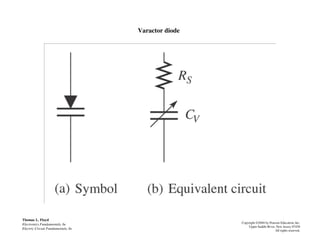
Varactor Diodes
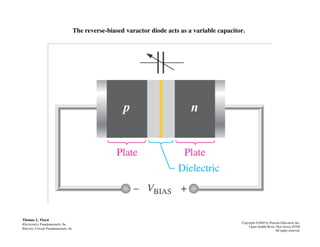
• A varactor diode utilize the inherent capacitance
of the depletion region of a reverse-biased pn
junction to vary capacitance by changing the
reverse voltagereverse voltage
– The p and n regions are conductive, and act as the
capacitor plates
– The depletion layer created by the reverse bias acts as a
capacitor dielectric because it is nonconductive
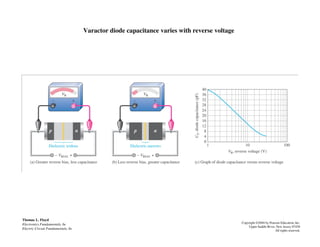
• as the reverse bias increases, the depletion region widens, and
the capacitance across the diode decreases
• as the reverse bias decreases, the depletion region narrows, and
the capacitance across the diode increases
The reverse-biased varactor diode acts as a variable capacitor.
Thomas L. Floyd
Electronics Fundamentals, 6e
Electric Circuit Fundamentals, 6e
Copyright ©2004 by Pearson Education, Inc.
Upper Saddle River, New Jersey 07458
All rights reserved.
Varactor diode capacitance varies with reverse voltage
Thomas L. Floyd
Electronics Fundamentals, 6e
Electric Circuit Fundamentals, 6e
Copyright ©2004 by Pearson Education, Inc.
Upper Saddle River, New Jersey 07458
All rights reserved.
Varactor diode
Thomas L. Floyd
Electronics Fundamentals, 6e
Electric Circuit Fundamentals, 6e
Copyright ©2004 by Pearson Education, Inc.
Upper Saddle River, New Jersey 07458
All rights reserved.
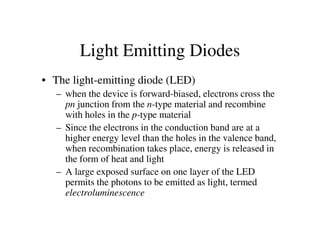
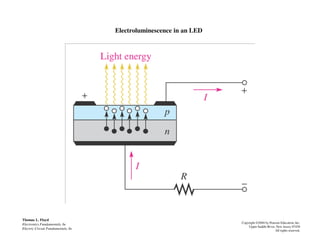
• The light-emitting diode (LED)
– when the device is forward-biased, electrons cross the
pn junction from the n-type material and recombine
with holes in the p-type material
– Since the electrons in the conduction band are at a
Light Emitting Diodes
– Since the electrons in the conduction band are at a
higher energy level than the holes in the valence band,
when recombination takes place, energy is released in
the form of heat and light
– A large exposed surface on one layer of the LED
permits the photons to be emitted as light, termed
electroluminescence
Electroluminescence in an LED
Thomas L. Floyd
Electronics Fundamentals, 6e
Electric Circuit Fundamentals, 6e
Copyright ©2004 by Pearson Education, Inc.
Upper Saddle River, New Jersey 07458
All rights reserved.
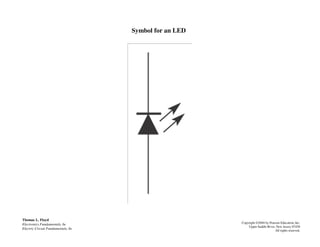
Symbol for an LED
Thomas L. Floyd
Electronics Fundamentals, 6e
Electric Circuit Fundamentals, 6e
Copyright ©2004 by Pearson Education, Inc.
Upper Saddle River, New Jersey 07458
All rights reserved.
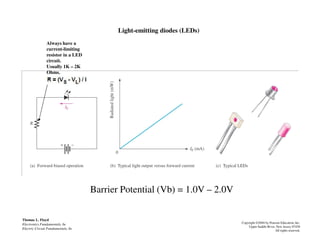
Light-emitting diodes (LEDs)
Always have a
current-limiting
resistor in a LED
circuit.
Usually 1K – 2K
Ohms.
Thomas L. Floyd
Electronics Fundamentals, 6e
Electric Circuit Fundamentals, 6e
Copyright ©2004 by Pearson Education, Inc.
Upper Saddle River, New Jersey 07458
All rights reserved.
Barrier Potential (Vb) = 1.0V – 2.0V
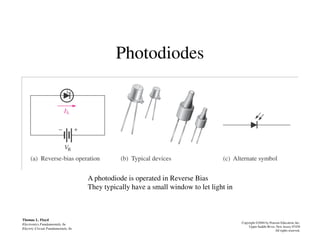
Photodiodes
Thomas L. Floyd
Electronics Fundamentals, 6e
Electric Circuit Fundamentals, 6e
Copyright ©2004 by Pearson Education, Inc.
Upper Saddle River, New Jersey 07458
All rights reserved.
A photodiode is operated in Reverse Bias
They typically have a small window to let light in
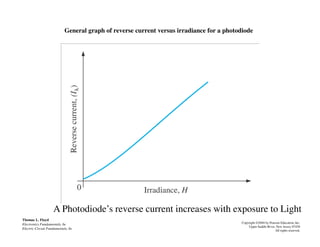
General graph of reverse current versus irradiance for a photodiode
Thomas L. Floyd
Electronics Fundamentals, 6e
Electric Circuit Fundamentals, 6e
Copyright ©2004 by Pearson Education, Inc.
Upper Saddle River, New Jersey 07458
All rights reserved.
A Photodiode’s reverse current increases with exposure to Light
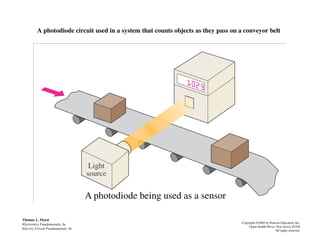
A photodiode circuit used in a system that counts objects as they pass on a conveyor belt
Thomas L. Floyd
Electronics Fundamentals, 6e
Electric Circuit Fundamentals, 6e
Copyright ©2004 by Pearson Education, Inc.
Upper Saddle River, New Jersey 07458
All rights reserved.
A photodiode being used as a sensor
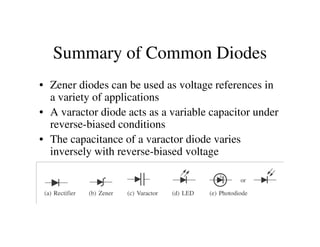
Summary of Common Diodes
• Zener diodes can be used as voltage references in
a variety of applications
• A varactor diode acts as a variable capacitor under
reverse-biased conditionsreverse-biased conditions
• The capacitance of a varactor diode varies
inversely with reverse-biased voltage

Diodes and rectifiers

  • 1.
    Chapter 16Chapter 16 Semiconductors,Diodes and Their Applications
  • 2.
    A diode isa one-way valve for Current Examples of One-Way Valves Air Check Valve Heart ValvesLeg Vein Valves
  • 3.
    Typical diode packagesand terminal identification. A is anode and K is cathode. Thomas L. Floyd Electronics Fundamentals, 6e Electric Circuit Fundamentals, 6e Copyright ©2004 by Pearson Education, Inc. Upper Saddle River, New Jersey 07458 All rights reserved.
  • 4.
    Introduction to Semiconductor Materials •Two types of semiconductive materials are silicon and germainium – both have four valance electrons • When silicon and germanium atoms combine into molecules to form a solid material, they arrange themselves in a fixed pattern called a crystal – atoms within the crystal structure are held together by covalent bonds (atoms share valence electrons) • An intrinsic crystal is one that has no impurities
  • 5.
    Introduction to Semiconductor Materials •In an intrinsic semiconductor, there are relatively few free electrons – pure semiconductive materials are neither good conductors nor good insulatorsconductors nor good insulators • Intrinsic semiconductive materials must be modified by increasing the free electrons and holes to increase its conductivity and make it useful for electronic devices – by adding impurities, n-type and p-type extrinsic semiconductive material can be produced
  • 6.
    Diagrams of thesilicon and germanium atoms Thomas L. Floyd Electronics Fundamentals, 6e Electric Circuit Fundamentals, 6e Copyright ©2004 by Pearson Education, Inc. Upper Saddle River, New Jersey 07458 All rights reserved.
  • 7.
    Covalent bonds ina silicon crystal. The actual crystal is 3-dimensional. Thomas L. Floyd Electronics Fundamentals, 6e Electric Circuit Fundamentals, 6e Copyright ©2004 by Pearson Education, Inc. Upper Saddle River, New Jersey 07458 All rights reserved.
  • 8.
    Introduction to Modified SemiconductorMaterials • Doping is the process of adding impurities to intrinsic semiconductive materials to increase and control conductivity within the material – n-type material is formed by adding pentavalent (5– n-type material is formed by adding pentavalent (5 valence electrons) impurity atoms • electrons are called majority carriers in n-type material • holes are called minority carriers in n-type material – p-type material is formed by adding trivalent (3 valence electrons) impurity atoms • holes are called majority carriers in p-type material • electrons are called minority carriers in p-type material
  • 9.
    The PN JunctionDiode • A Semiconductor diode consists of an n material region and a p material region separated by a pn junction – the n region has many conduction electrons– the n region has many conduction electrons – the p region has many holes • As a result of recombination, a large number of positive (in the n region) and negative (in the p region) ions builds up near the pn junction, essentially depleting the region of any conduction electrons or holes - termed the depletion region
  • 10.
    Impurity atoms Thomas L.Floyd Electronics Fundamentals, 6e Electric Circuit Fundamentals, 6e Copyright ©2004 by Pearson Education, Inc. Upper Saddle River, New Jersey 07458 All rights reserved.
  • 11.
    The PN JunctionDiode • The barrier potential, VB, is the amount of voltage required to move electrons through the electric fieldthe electric field – At 25°C, it is approximately 0.7 V for silicon and 0.3 V for germanium – As the junction temperature increases, the barrier potential decreases, and vice versa
  • 12.
    Formation of thedepletion region in a pn junction diode Thomas L. Floyd Electronics Fundamentals, 6e Electric Circuit Fundamentals, 6e Copyright ©2004 by Pearson Education, Inc. Upper Saddle River, New Jersey 07458 All rights reserved.
  • 13.
    Forward-bias connection The resistorlimits the forward current in order to prevent damage to the diode Thomas L. Floyd Electronics Fundamentals, 6e Electric Circuit Fundamentals, 6e Copyright ©2004 by Pearson Education, Inc. Upper Saddle River, New Jersey 07458 All rights reserved.
  • 14.
    The PN JunctionDiode • Forward bias is the condition that permits current through a diode – the negative terminal of the VBIAS source is connected to the n region, and the positive terminal is connected toto the n region, and the positive terminal is connected to the p region
  • 15.
    The PN JunctionDiode • The negative terminal of the bias-voltage source pushes the conduction-band electrons in the n region toward the pn junction, while the positive terminal pushes the holes in the p region towardterminal pushes the holes in the p region toward the pn junction • When it overcomes the barrier potential (VB), the external voltage source provides the n region electrons with enough energy to penetrate the depletion region and move through the junction
  • 16.
    Current in aforward-biased diode Thomas L. Floyd Electronics Fundamentals, 6e Electric Circuit Fundamentals, 6e Copyright ©2004 by Pearson Education, Inc. Upper Saddle River, New Jersey 07458 All rights reserved.
  • 17.
    Barrier potential anddynamic resistance equivalent for a diode Thomas L. Floyd Electronics Fundamentals, 6e Electric Circuit Fundamentals, 6e Copyright ©2004 by Pearson Education, Inc. Upper Saddle River, New Jersey 07458 All rights reserved.
  • 18.
    Illustration of diodeoperation under forward-bias conditions Thomas L. Floyd Electronics Fundamentals, 6e Electric Circuit Fundamentals, 6e Copyright ©2004 by Pearson Education, Inc. Upper Saddle River, New Jersey 07458 All rights reserved.
  • 19.
    The PN JunctionDiode • Reverse bias is the condition that prevents current through the diode – the negative terminal of the VBIAS source is connected to the p region, and the positive terminal is connected toto the p region, and the positive terminal is connected to the n region • If the external reverse-bias voltage is increased to a large enough value, reverse breakdown occurs – minority conduction-band electrons acquire enough energy from the external source to accelerate toward the positive end of the diode, colliding with atoms and knocking valence electrons into the conduction band
  • 20.
    Illustration of reversebias Thomas L. Floyd Electronics Fundamentals, 6e Electric Circuit Fundamentals, 6e Copyright ©2004 by Pearson Education, Inc. Upper Saddle River, New Jersey 07458 All rights reserved.
  • 21.
    Diode Characteristics • Thesimplest way to visualize diode operation is to think of it as a switch – When forward-biased, the diode ideally acts as– When forward-biased, the diode ideally acts as a closed (on) switch – When reverse-biased, it acts as an open (off) switch
  • 22.
    Ideal model ofthe diode as a switch Thomas L. Floyd Electronics Fundamentals, 6e Electric Circuit Fundamentals, 6e Copyright ©2004 by Pearson Education, Inc. Upper Saddle River, New Jersey 07458 All rights reserved.
  • 23.
  • 24.
    Diode Characteristics • The“arrowhead” in the diode symbol points in the direction opposite the electron flow – The anode (A) is the p region – The cathode (K) is the n region– The cathode (K) is the n region
  • 25.
    Diode structure, schematicsymbol, and bias circuits VBIAS is the bias voltage, and VB is the barrier potential Thomas L. Floyd Electronics Fundamentals, 6e Electric Circuit Fundamentals, 6e Copyright ©2004 by Pearson Education, Inc. Upper Saddle River, New Jersey 07458 All rights reserved.
  • 26.
    Half Wave DiodeRectifier • A diode is connected to an ac source that provides the input voltage, V , and to avoltage, Vin, and to a load resistor, RL, forming a half-wave rectifier – on the positive half- cycle, the diode is forward biased
  • 27.
    Half Wave DiodeRectifier • When the diode barrier potential is taken into account, as in the practical model, the input voltage must overcome the barrier potential before the diode becomes forward-biasedthe diode becomes forward-biased – This results in a half-wave output voltage with a peak value that is 0.7 V less than the peak value of the input voltage – It is often practical to neglect the effect of barrier potential when the peak value of the applied voltage is much greater (10X) than the barrier potential
  • 28.
    Effect of barrierpotential on half-wave rectified output voltage (silicon diode shown) Thomas L. Floyd Electronics Fundamentals, 6e Electric Circuit Fundamentals, 6e Copyright ©2004 by Pearson Education, Inc. Upper Saddle River, New Jersey 07458 All rights reserved.
  • 29.
    Average value ofthe half-wave rectified signal. Thomas L. Floyd Electronics Fundamentals, 6e Electric Circuit Fundamentals, 6e Copyright ©2004 by Pearson Education, Inc. Upper Saddle River, New Jersey 07458 All rights reserved. π )(outP avg V V = The output of a half-wave rectifier (what you would measure with a voltmeter) before filtering is determined by its average voltage:
  • 30.
    The Peak InverseVoltage (PIV) occurs at the peak of each half-cycle of the input voltage when the diode is reverse-biased. In this circuit, the PIV occurs at the time (tp) of the peak of each negative half-cycle. Thomas L. Floyd Electronics Fundamentals, 6e Electric Circuit Fundamentals, 6e Copyright ©2004 by Pearson Education, Inc. Upper Saddle River, New Jersey 07458 All rights reserved.
  • 31.
    Full Wave DiodeRectifier • The full-wave bridge rectifier uses four diodes, as shown on the next slide – When the input cycle is positive as in part (a), diodes D and D are forward-biased anddiodes D1 and D2 are forward-biased and conduct current, while diodes D3 and D4 are reverse-biased – When the input cycle is negative as in part (b), diodes D3 and D4 are forward-biased and conduct current, while diodes D1 and D2 are reverse-biased
  • 32.
    Full-wave rectification Thomas L.Floyd Electronics Fundamentals, 6e Electric Circuit Fundamentals, 6e Copyright ©2004 by Pearson Education, Inc. Upper Saddle River, New Jersey 07458 All rights reserved.
  • 33.
    A center-tapped (CT)full-wave rectifier Thomas L. Floyd Electronics Fundamentals, 6e Electric Circuit Fundamentals, 6e Copyright ©2004 by Pearson Education, Inc. Upper Saddle River, New Jersey 07458 All rights reserved.
  • 34.
    Basic operation ofa center-tapped full-wave rectifier. Note that the current through the load resistor is in the same direction during the entire input cycle. Thomas L. Floyd Electronics Fundamentals, 6e Electric Circuit Fundamentals, 6e Copyright ©2004 by Pearson Education, Inc. Upper Saddle River, New Jersey 07458 All rights reserved.
  • 35.
    CT Full WaveDiode Rectifier • Peak Inverse Voltage (PIV) is the maximum value of reverse voltage that a diode can withstand • A full-wave rectifier allows unidirectional current to the load during the entire input cycle – whereas the half-wave rectifier allows this only during one-half of– whereas the half-wave rectifier allows this only during one-half of the cycle • The average value for a full-wave rectifier output voltage (what you would measure with a voltmeter) before filtering is twice that of the half-wave rectifier VAVG = 2VP(out) / ππππ
  • 36.
    Diode D1 isshown forward-biased and D2 is reverse-biased with PIV across it. The PIV across either diode is approximately twice the peak value of the output voltage. 1:1 25Vpeak 50Vpeak PIV = Vp(sec) => 48.6V - 50V Thomas L. Floyd Electronics Fundamentals, 6e Electric Circuit Fundamentals, 6e Copyright ©2004 by Pearson Education, Inc. Upper Saddle River, New Jersey 07458 All rights reserved. 50Vpeak 25Vpeak 50Vpeak PIV = Vp(sec) => 48.6V - 50V Vp(out) = 25Vp – 0.7V = 24.3Vp
  • 37.
    Using a 1:2Step Up Transformer to Obtain Output Voltage = Input Voltage Thomas L. Floyd Electronics Fundamentals, 6e Electric Circuit Fundamentals, 6e Copyright ©2004 by Pearson Education, Inc. Upper Saddle River, New Jersey 07458 All rights reserved. 24.3
  • 38.
    Full Wave DiodeRectifiers • The full-wave bridge rectifier uses four diodes, as shown on the next slide – When the input cycle is positive as in part (a), diodes D and D are forward-biased anddiodes D1 and D2 are forward-biased and conduct current, while diodes D3 and D4 are reverse-biased – When the input cycle is negative as in part (b), diodes D3 and D4 are forward-biased and conduct current, while diodes D1 and D2 are reverse-biased
  • 39.
  • 40.
    Power Supplies • Thedc power supply converts the standard 110 V, 60 Hz ac available at the wall outlets into a constant dc voltage – dc voltage is used in most electronic circuits– dc voltage is used in most electronic circuits • A capacitor is used to filter the output of the rectifier, charging during each quarter-cycle that the input voltage exceeds the capacitor voltage, and discharging through the load when the input voltage decreases below the capacitor voltage, at which point the diodes become reverse biased
  • 41.
    Block diagrams showingbasic operation of a rectifier and of a regulated dc power supply DC Power Supplies Thomas L. Floyd Electronics Fundamentals, 6e Electric Circuit Fundamentals, 6e Copyright ©2004 by Pearson Education, Inc. Upper Saddle River, New Jersey 07458 All rights reserved.
  • 42.
    Operation of ahalf-wave rectifier with a capacitor-input filter Thomas L. Floyd Electronics Fundamentals, 6e Electric Circuit Fundamentals, 6e Copyright ©2004 by Pearson Education, Inc. Upper Saddle River, New Jersey 07458 All rights reserved.
  • 43.
    Comparison of ripplevoltages for half-wave and full-wave signals with same filter and same input frequency Thomas L. Floyd Electronics Fundamentals, 6e Electric Circuit Fundamentals, 6e Copyright ©2004 by Pearson Education, Inc. Upper Saddle River, New Jersey 07458 All rights reserved.
  • 44.
    Voltage Regulators • Anintegrated circuit regulator (three-terminal regulator) is a device that is connected to the output of a filtered rectifier • It maintains a constant output voltage despite• It maintains a constant output voltage despite changes in the input voltage or the current load
  • 45.
    The 7800 seriesthree-terminal fixed positive voltage regulators Voltage Regulators Thomas L. Floyd Electronics Fundamentals, 6e Electric Circuit Fundamentals, 6e Copyright ©2004 by Pearson Education, Inc. Upper Saddle River, New Jersey 07458 All rights reserved.
  • 46.
    Zener Diodes • Thezener diode is used to provide an output reference voltage that is stable despite changes in input voltage – Used as a reference in regulated power supplies– Used as a reference in regulated power supplies – The zener diode is designed for operation in the reverse breakdown region, where the voltage remains almost constant over a wide range of reverse current values
  • 47.
    Zener diode symbol ThomasL. Floyd Electronics Fundamentals, 6e Electric Circuit Fundamentals, 6e Copyright ©2004 by Pearson Education, Inc. Upper Saddle River, New Jersey 07458 All rights reserved.
  • 48.
    Diode V-I characteristicillustrating the operation of a zener diode compared to a rectified diode. The slope of the reverse-breakdown region is exaggerated to show detail. Thomas L. Floyd Electronics Fundamentals, 6e Electric Circuit Fundamentals, 6e Copyright ©2004 by Pearson Education, Inc. Upper Saddle River, New Jersey 07458 All rights reserved.
  • 49.
    Reverse characteristic ofa zener diode. VZ is usually specified at the zener test current, IZT, and is designated VZT. Thomas L. Floyd Electronics Fundamentals, 6e Electric Circuit Fundamentals, 6e Copyright ©2004 by Pearson Education, Inc. Upper Saddle River, New Jersey 07458 All rights reserved.
  • 50.
    Zener equivalent circuits ThomasL. Floyd Electronics Fundamentals, 6e Electric Circuit Fundamentals, 6e Copyright ©2004 by Pearson Education, Inc. Upper Saddle River, New Jersey 07458 All rights reserved.
  • 51.
    Varactor Diodes • Avaractor diode utilize the inherent capacitance of the depletion region of a reverse-biased pn junction to vary capacitance by changing the reverse voltagereverse voltage – The p and n regions are conductive, and act as the capacitor plates – The depletion layer created by the reverse bias acts as a capacitor dielectric because it is nonconductive • as the reverse bias increases, the depletion region widens, and the capacitance across the diode decreases • as the reverse bias decreases, the depletion region narrows, and the capacitance across the diode increases
  • 52.
    The reverse-biased varactordiode acts as a variable capacitor. Thomas L. Floyd Electronics Fundamentals, 6e Electric Circuit Fundamentals, 6e Copyright ©2004 by Pearson Education, Inc. Upper Saddle River, New Jersey 07458 All rights reserved.
  • 53.
    Varactor diode capacitancevaries with reverse voltage Thomas L. Floyd Electronics Fundamentals, 6e Electric Circuit Fundamentals, 6e Copyright ©2004 by Pearson Education, Inc. Upper Saddle River, New Jersey 07458 All rights reserved.
  • 54.
    Varactor diode Thomas L.Floyd Electronics Fundamentals, 6e Electric Circuit Fundamentals, 6e Copyright ©2004 by Pearson Education, Inc. Upper Saddle River, New Jersey 07458 All rights reserved.
  • 55.
    • The light-emittingdiode (LED) – when the device is forward-biased, electrons cross the pn junction from the n-type material and recombine with holes in the p-type material – Since the electrons in the conduction band are at a Light Emitting Diodes – Since the electrons in the conduction band are at a higher energy level than the holes in the valence band, when recombination takes place, energy is released in the form of heat and light – A large exposed surface on one layer of the LED permits the photons to be emitted as light, termed electroluminescence
  • 56.
    Electroluminescence in anLED Thomas L. Floyd Electronics Fundamentals, 6e Electric Circuit Fundamentals, 6e Copyright ©2004 by Pearson Education, Inc. Upper Saddle River, New Jersey 07458 All rights reserved.
  • 57.
    Symbol for anLED Thomas L. Floyd Electronics Fundamentals, 6e Electric Circuit Fundamentals, 6e Copyright ©2004 by Pearson Education, Inc. Upper Saddle River, New Jersey 07458 All rights reserved.
  • 58.
    Light-emitting diodes (LEDs) Alwayshave a current-limiting resistor in a LED circuit. Usually 1K – 2K Ohms. Thomas L. Floyd Electronics Fundamentals, 6e Electric Circuit Fundamentals, 6e Copyright ©2004 by Pearson Education, Inc. Upper Saddle River, New Jersey 07458 All rights reserved. Barrier Potential (Vb) = 1.0V – 2.0V
  • 59.
    Photodiodes Thomas L. Floyd ElectronicsFundamentals, 6e Electric Circuit Fundamentals, 6e Copyright ©2004 by Pearson Education, Inc. Upper Saddle River, New Jersey 07458 All rights reserved. A photodiode is operated in Reverse Bias They typically have a small window to let light in
  • 60.
    General graph ofreverse current versus irradiance for a photodiode Thomas L. Floyd Electronics Fundamentals, 6e Electric Circuit Fundamentals, 6e Copyright ©2004 by Pearson Education, Inc. Upper Saddle River, New Jersey 07458 All rights reserved. A Photodiode’s reverse current increases with exposure to Light
  • 61.
    A photodiode circuitused in a system that counts objects as they pass on a conveyor belt Thomas L. Floyd Electronics Fundamentals, 6e Electric Circuit Fundamentals, 6e Copyright ©2004 by Pearson Education, Inc. Upper Saddle River, New Jersey 07458 All rights reserved. A photodiode being used as a sensor
  • 62.
    Summary of CommonDiodes • Zener diodes can be used as voltage references in a variety of applications • A varactor diode acts as a variable capacitor under reverse-biased conditionsreverse-biased conditions • The capacitance of a varactor diode varies inversely with reverse-biased voltage