ELECTRICITY DEMAND
    SIDE MANAGEMENT
          AND
    END USE EFFICIENCY


               D. Pawan Kumar
PRESSURE POINTS OF CONTEMPORARY
ELECTRIC UTILITIES:

   Peak demand and energy crisis in many
    utilities due to ever rising demand
    supply gap
   Need for optimization of generation
    and network utilization
   Regulator led energy efficiency
    mandates
   Strong lobbying from environmental
    groups
   Resource constraints and customer
    demands for cheaper rates
   Increased operational flexibility needs
   Competition, thanks to reform process
    and open access
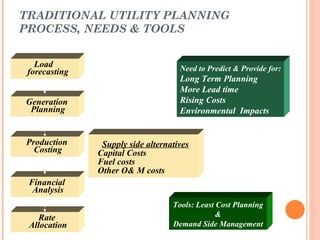
TRADITIONAL UTILITY PLANNING
PROCESS, NEEDS & TOOLS


   Load                              Need to Predict & Provide for:
 forecasting
                                     Long Term Planning
                                     More Lead time
Generation                           Rising Costs
 Planning                            Environmental Impacts


Production      Supply side alternatives
  Costing      Capital Costs
               Fuel costs
               Other O& M costs
 Financial
  Analysis
               Iterate as          Tools: Least Cost Planning
               necessary                        &
   Rate
 Allocation                        Demand Side Management
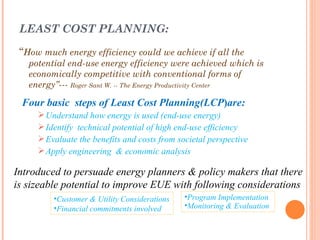
LEAST COST PLANNING:

 “How much energy efficiency could we achieve if all the
   potential end-use energy efficiency were achieved which is
   economically competitive with conventional forms of
   energy”--- Roger Sant W. -- The Energy Productivity Center

 Four basic steps of Least Cost Planning(LCP)are:
      Understand how energy is used (end-use energy)
      Identify technical potential of high end-use efficiency
      Evaluate the benefits and costs from societal perspective
      Apply engineering & economic analysis

Introduced to persuade energy planners & policy makers that there
is sizeable potential to improve EUE with following considerations
         •Customer & Utility Considerations   •Program Implementation
         •Financial commitments involved      •Monitoring & Evaluation
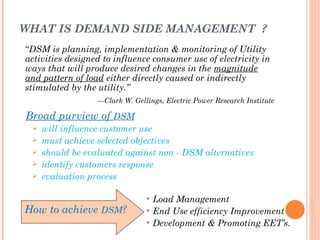
WHAT IS DEMAND SIDE MANAGEMENT ?
“DSM is planning, implementation & monitoring of Utility
activities designed to influence consumer use of electricity in
ways that will produce desired changes in the magnitude
and pattern of load either directly caused or indirectly
stimulated by the utility.”
                  ---Clark W. Gellings, Electric Power Research Institute

Broad purview of DSM
    will influence customer use
    must achieve selected objectives
    should be evaluated against non - DSM alternatives
    identify customers response
    evaluation process

                                 • Load Management
How to achieve DSM?              • End Use efficiency Improvement
                                 • Development & Promoting EET’s.
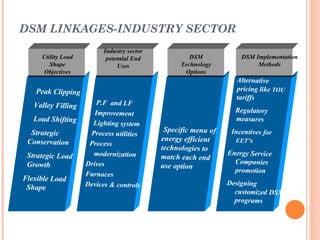
DSM LINKAGES-INDUSTRY SECTOR
                          Industry sector
     Utility Load          potential End             DSM            DSM Implementation
        Shape                  Uses               Technology             Methods
     Objectives                                    Options
                                                                  Alternative
   Peak Clipping                                                  pricing like TOU
                                                                  tariffs
   Valley Filling      P.F and LF
                       Improvement                                Regulatory
   Load Shifting                                                  measures
                      Lighting system
  Strategic          Process utilities       Specific menu of    Incentives for
 Conservation                               energy efficient      EET’s
                     Process
                                            technologies to
 Strategic Load       modernization                             Energy Service
                                            match each end
 Growth             Drives                                        Companies
                                            use option
                                                                  promotion
                    Furnaces
Flexible Load
                    Devices & controls                          Designing
 Shape
                                                                  customized DSM
                                                                  programs
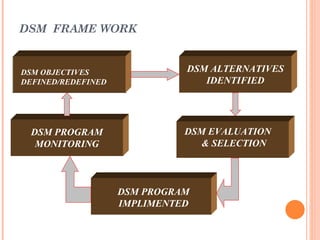
DSM FRAME WORK


DSM OBJECTIVES                DSM ALTERNATIVES
DEFINED/REDEFINED                IDENTIFIED


  DSM PROGRAM                 DSM EVALUATION
   MONITORING                    & SELECTION


                    DSM PROGRAM
                    IMPLIMENTED
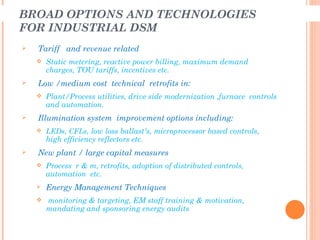
BROAD OPTIONS AND TECHNOLOGIES
FOR INDUSTRIAL DSM
   Tariff and revenue related
       Static metering, reactive power billing, maximum demand
        charges, TOU tariffs, incentives etc.
   Low /medium cost technical retrofits in:
       Plant/Process utilities, drive side modernization ,furnace controls
        and automation.
   Illumination system improvement options including:
       LEDs, CFLs, low loss ballast's, microprocessor based controls,
        high efficiency reflectors etc.
   New plant / large capital measures
       Process r & m, retrofits, adoption of distributed controls,
        automation etc.
       Energy Management Techniques
       monitoring & targeting, EM staff training & motivation,
        mandating and sponsoring energy audits
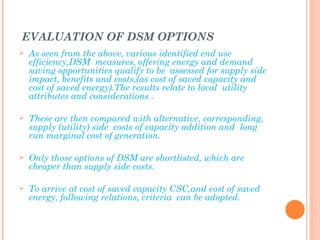
EVALUATION OF DSM OPTIONS
   As seen from the above, various identified end use
    efficiency,DSM measures, offering energy and demand
    saving opportunities qualify to be assessed for supply side
    impact, benefits and costs,(as cost of saved capacity and
    cost of saved energy).The results relate to local utility
    attributes and considerations .

   These are then compared with alternative, corresponding,
    supply (utility) side costs of capacity addition and long
    run marginal cost of generation.

   Only those options of DSM are shortlisted, which are
    cheaper than supply side costs.

   To arrive at cost of saved capacity CSC,and cost of saved
    energy, following relations, criteria can be adopted.
RELATIONS AND CRITERIA…..

»   Capital recovery factor (CRF)
    = d × (1 + d)n / [(1 + d)n - 1]
    where d = utility discount rate & n = measure life
»   Total DSM measure cost
     = initial cost × [ 1 + (1/(1+d/100)m) + (1/(1+d/100)2m+
    …...)
    where d = utility discount rate & m = device life &
      the series includes all terms where exponent is less than
      the measure life
»  Cost of saved capacity (CSC) Rs/kW or Rs/kVA=
                (Total measure cost (Rs))
 ((Saved capacity kVA or kW × PCF) / (1-TDLF) (CUF))
» Cost of saved energy (CSE) Rs/kWh=

               (Total measure cost (Rs) × CRF)
               (Annual Energy Savings (kWh))
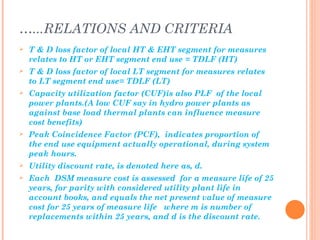
…...RELATIONS AND CRITERIA
   T & D loss factor of local HT & EHT segment for measures
    relates to HT or EHT segment end use = TDLF (HT)
   T & D loss factor of local LT segment for measures relates
    to LT segment end use= TDLF (LT)
   Capacity utilization factor (CUF)is also PLF of the local
    power plants.(A low CUF say in hydro power plants as
    against base load thermal plants can influence measure
    cost benefits)
   Peak Coincidence Factor (PCF), indicates proportion of
    the end use equipment actually operational, during system
    peak hours.
   Utility discount rate, is denoted here as, d.
   Each DSM measure cost is assessed for a measure life of 25
    years, for parity with considered utility plant life in
    account books, and equals the net present value of measure
    cost for 25 years of measure life where m is number of
    replacements within 25 years, and d is the discount rate.
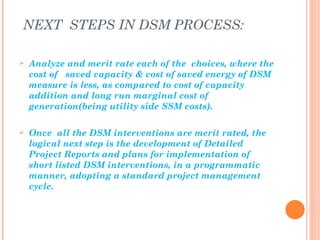
NEXT STEPS IN DSM PROCESS:

   Analyze and merit rate each of the choices, where the
    cost of saved capacity & cost of saved energy of DSM
    measure is less, as compared to cost of capacity
    addition and long run marginal cost of
    generation(being utility side SSM costs).

   Once all the DSM interventions are merit rated, the
    logical next step is the development of Detailed
    Project Reports and plans for implementation of
    short listed DSM interventions, in a programmatic
    manner, adopting a standard project management
    cycle.
ILLUSTRATIVE CASE STUDY OF DSM OPTION EVALUATION…..
(APPLICATION OF LIGHTING VOLTAGE REGULATORS IN
MUNICIPAL WATER PUMP HOUSES)

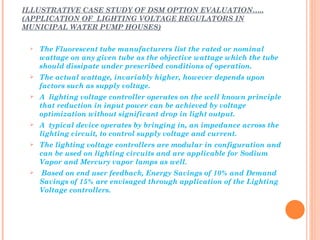
    The Fluorescent tube manufacturers list the rated or nominal
     wattage on any given tube as the objective wattage which the tube
     should dissipate under prescribed conditions of operation.
    The actual wattage, invariably higher, however depends upon
     factors such as supply voltage.
    A lighting voltage controller operates on the well known principle
     that reduction in input power can be achieved by voltage
     optimization without significant drop in light output.
    A typical device operates by bringing in, an impedance across the
     lighting circuit, to control supply voltage and current.
    The lighting voltage controllers are modular in configuration and
     can be used on lighting circuits and are applicable for Sodium
     Vapor and Mercury vapor lamps as well.
    Based on end user feedback, Energy Savings of 10% and Demand
     Savings of 15% are envisaged through application of the Lighting
     Voltage controllers.
….APPLICATION ANALYSIS RESULTS IN A MUNICIPAL
 WATER PUMPING STATION……


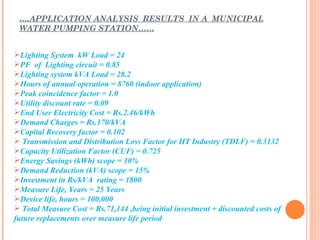
Lighting System kW Load = 24
PF of Lighting circuit = 0.85
Lighting system kVA Load = 28.2
Hours of annual operation = 8760 (indoor application)
Peak coincidence factor = 1.0
Utility discount rate = 0.09
End User Electricity Cost = Rs.2.46/kWh
Demand Charges = Rs.170/kVA
Capital Recovery factor = 0.102
 Transmission and Distribution Loss Factor for HT Industry (TDLF) = 0.3132
Capacity Utilization Factor (CUF) = 0.725
Energy Savings (kWh) scope = 10%
Demand Reduction (kVA) scope = 15%
Investment in Rs/kVA rating = 1800
Measure Life, Years = 25 Years
Device life, hours = 100,000
 Total Measure Cost = Rs.71,144 ,being initial investment + discounted costs of
future replacements over measure life period
…END USER COST BENEFITS…..


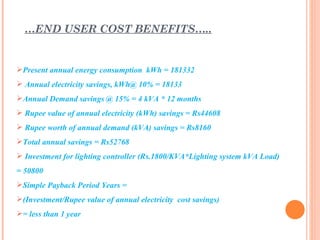
Present annual energy consumption kWh = 181332
 Annual electricity savings, kWh@ 10% = 18133
Annual Demand savings @ 15% = 4 kVA * 12 months
 Rupee value of annual electricity (kWh) savings = Rs44608
 Rupee worth of annual demand (kVA) savings = Rs8160
Total annual savings = Rs52768
 Investment for lighting controller (Rs.1800/KVA*Lighting system kVA Load)
= 50800
Simple Payback Period Years =
(Investment/Rupee value of annual electricity cost savings)
= less than 1 year
…..SUPPLY SIDE COSTS.

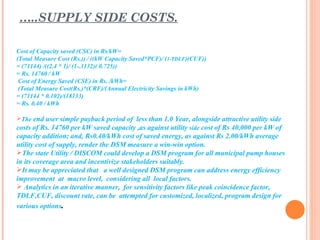
Cost of Capacity saved (CSC) in Rs/kW=
(Total Measure Cost (Rs.)) / ((kW Capacity Saved*PCF)/ (1-TDLF)(CUF))
= (71144) /((2.4 * 1)/ (1-.3132)( 0.725))
= Rs. 14760 / kW
 Cost of Energy Saved (CSE) in Rs. /kWh=
 (Total Measure Cost(Rs.)*(CRF)/(Annual Electricity Savings in kWh)
= (71144 * 0.102)/(18133)
= Rs. 0.40 / kWh

The end user simple payback period of less than 1.0 Year, alongside attractive utility side
costs of Rs. 14760 per kW saved capacity ,as against utility side cost of Rs 40,000 per kW of
capacity addition; and, Rs0.40/kWh cost of saved energy, as against Rs 2.00/kWh average
utility cost of supply, render the DSM measure a win-win option.
The state Utility / DISCOM could develop a DSM program for all municipal pump houses
in its coverage area and incentivize stakeholders suitably.
It may be appreciated that a well designed DSM program can address energy efficiency
improvement at macro level, considering all local factors.
 Analytics in an iterative manner, for sensitivity factors like peak coincidence factor,
TDLF,CUF, discount rate, can be attempted for customized, localized, program design for
various options.
GENERIC DSM MEASURES IN LOAD
MANAGEMENT, PROCESS/PLANT
UTILITIES IN INDUSTRY SECTOR…

   Power factor improvement
                                      Application of VSD’s, cogeneration
                                       etc, for EE
   Conventional ballast's on
    FTL’s replaced by low loss
                                      Replacement of old compressors,
    ballasts                           chillers, by energy efficient
                                       compressors, chillers.
   Adoption of energy efficient
    CFL’s/LEDs ,Magnetic
                                      Distribution system upgrades in
    induction lamps, LPSV, HPSV        water pumping, compressed air,
    lamps…                             chilled water systems for EE
   Adoption of Lighting voltage
                                      Material handling system upgrades
    controllers                        for EE.
   Motor Soft starters/Energy
                                      Adoption of distributed control
    savers adoption                    systems, process automation for EE
   Replacement of old pumps by
                                      Furnace, heater upgrades for EE.
    high efficiency pumps             Replacement of old rewound motors
   Replacement of old fans by         by new high efficiency motors.
    high efficiency fans               motors………
BARRIERS TO DSM…

   Limited Information & Awareness
   Lack of adequate infrastructure
   Perceived risk of implementing new EE technologies
   Absence of codes/standards on EE.
   Lack of reliable and credible service organizations that
    can provide full range of project implementation services
   Limited Availability Of Capital for financing EE Projects
   High costs for consumers to implement EE projects
   Administered energy tariffs which distort economics.
   Absence of any regulatory mandate to review all options
    on DSM & Supply Side Management to develop a least
    cost capacity expansion plan
….BARRIERS TO DSM

   Problems with quality   of power
   Lack of experience in planning, designing &
    implementing DSM programs
   Absence of load research information, databases
    on energy end use segments, reliable data on
    peak coincidence factors etc.
   Lack of resources specifically allocated for EE
   Lack of adequately skilled staff to initiate EE
    measures
   Inadequate participation and attention from
    Govt. and policy makers….
ENABLERS FOR DSM MARKETS – A
WISH LIST:
 Regulators  and utilities start introducing the
  concept of LCP,DSM in the power sector planning
   frame work
 Developing nations initiate programs on EE in
  electricity generation, transmission, distribution
  and industry sectors
 Developing nations initiate design and adoption
  of appropriate energy conservation laws and
  regulations, efficiency standards & labeling,
  rational electricity pricing and incentive schemes
  for EE
 Regulators and utilities initiate regular load
  research and development of customer databases
  on energy use and efficiency improvements for
  analytics and planning.
 Promotion of energy conservation through mass
  media - based awareness campaigns
CONCLUSIONS
   DSM is a viable, win-win cost effective alternative to SSM.
   There is a good case for DISCOMs to develop customized
    DSM programs for end users like industry clusters,
    agricultural pump sector, municipal water pumping, street
    lighting, PSU townships, industrial estates, special
    economic zones, commercial buildings etc., due to diffused
    yet significant bulk nature of these end user entities and
    energy efficiency margins.
   •DISCOMs may also consider developing customized DSM
    programs, involving distribution upgrades, automation,
    kVAh billing, static metering, TOD tariffs etc, to bridge
    demand supply gaps efficiently, without revenue losses.
   Current crunch times at utilities call for load research
    and comprehensive re-visit to various end use segments for
    structured DSM program design and implementation,
    which could be highly cost effective, as against supply side
    capacity augmentation initiatives.
Electricity demand side management and end use efficiency

Electricity demand side management and end use efficiency

  • 1.
    ELECTRICITY DEMAND SIDE MANAGEMENT AND END USE EFFICIENCY D. Pawan Kumar
  • 2.
    PRESSURE POINTS OFCONTEMPORARY ELECTRIC UTILITIES:  Peak demand and energy crisis in many utilities due to ever rising demand supply gap  Need for optimization of generation and network utilization  Regulator led energy efficiency mandates  Strong lobbying from environmental groups  Resource constraints and customer demands for cheaper rates  Increased operational flexibility needs  Competition, thanks to reform process and open access
  • 3.
    TRADITIONAL UTILITY PLANNING PROCESS,NEEDS & TOOLS Load Need to Predict & Provide for: forecasting Long Term Planning More Lead time Generation Rising Costs Planning Environmental Impacts Production Supply side alternatives Costing Capital Costs Fuel costs Other O& M costs Financial Analysis Iterate as Tools: Least Cost Planning necessary & Rate Allocation Demand Side Management
  • 4.
    LEAST COST PLANNING: “How much energy efficiency could we achieve if all the potential end-use energy efficiency were achieved which is economically competitive with conventional forms of energy”--- Roger Sant W. -- The Energy Productivity Center Four basic steps of Least Cost Planning(LCP)are:  Understand how energy is used (end-use energy)  Identify technical potential of high end-use efficiency  Evaluate the benefits and costs from societal perspective  Apply engineering & economic analysis Introduced to persuade energy planners & policy makers that there is sizeable potential to improve EUE with following considerations •Customer & Utility Considerations •Program Implementation •Financial commitments involved •Monitoring & Evaluation
  • 5.
    WHAT IS DEMANDSIDE MANAGEMENT ? “DSM is planning, implementation & monitoring of Utility activities designed to influence consumer use of electricity in ways that will produce desired changes in the magnitude and pattern of load either directly caused or indirectly stimulated by the utility.” ---Clark W. Gellings, Electric Power Research Institute Broad purview of DSM  will influence customer use  must achieve selected objectives  should be evaluated against non - DSM alternatives  identify customers response  evaluation process • Load Management How to achieve DSM? • End Use efficiency Improvement • Development & Promoting EET’s.
  • 6.
    DSM LINKAGES-INDUSTRY SECTOR Industry sector Utility Load potential End DSM DSM Implementation Shape Uses Technology Methods Objectives Options Alternative Peak Clipping pricing like TOU tariffs Valley Filling P.F and LF Improvement Regulatory Load Shifting measures Lighting system Strategic Process utilities Specific menu of Incentives for Conservation energy efficient EET’s Process technologies to Strategic Load modernization Energy Service match each end Growth Drives Companies use option promotion Furnaces Flexible Load Devices & controls Designing Shape customized DSM programs
  • 7.
    DSM FRAME WORK DSMOBJECTIVES DSM ALTERNATIVES DEFINED/REDEFINED IDENTIFIED DSM PROGRAM DSM EVALUATION MONITORING & SELECTION DSM PROGRAM IMPLIMENTED
  • 8.
    BROAD OPTIONS ANDTECHNOLOGIES FOR INDUSTRIAL DSM  Tariff and revenue related  Static metering, reactive power billing, maximum demand charges, TOU tariffs, incentives etc.  Low /medium cost technical retrofits in:  Plant/Process utilities, drive side modernization ,furnace controls and automation.  Illumination system improvement options including:  LEDs, CFLs, low loss ballast's, microprocessor based controls, high efficiency reflectors etc.  New plant / large capital measures  Process r & m, retrofits, adoption of distributed controls, automation etc.  Energy Management Techniques  monitoring & targeting, EM staff training & motivation, mandating and sponsoring energy audits
  • 9.
    EVALUATION OF DSMOPTIONS  As seen from the above, various identified end use efficiency,DSM measures, offering energy and demand saving opportunities qualify to be assessed for supply side impact, benefits and costs,(as cost of saved capacity and cost of saved energy).The results relate to local utility attributes and considerations .  These are then compared with alternative, corresponding, supply (utility) side costs of capacity addition and long run marginal cost of generation.  Only those options of DSM are shortlisted, which are cheaper than supply side costs.  To arrive at cost of saved capacity CSC,and cost of saved energy, following relations, criteria can be adopted.
  • 10.
    RELATIONS AND CRITERIA….. » Capital recovery factor (CRF) = d × (1 + d)n / [(1 + d)n - 1] where d = utility discount rate & n = measure life » Total DSM measure cost = initial cost × [ 1 + (1/(1+d/100)m) + (1/(1+d/100)2m+ …...) where d = utility discount rate & m = device life & the series includes all terms where exponent is less than the measure life » Cost of saved capacity (CSC) Rs/kW or Rs/kVA= (Total measure cost (Rs)) ((Saved capacity kVA or kW × PCF) / (1-TDLF) (CUF)) » Cost of saved energy (CSE) Rs/kWh= (Total measure cost (Rs) × CRF) (Annual Energy Savings (kWh))
  • 11.
    …...RELATIONS AND CRITERIA  T & D loss factor of local HT & EHT segment for measures relates to HT or EHT segment end use = TDLF (HT)  T & D loss factor of local LT segment for measures relates to LT segment end use= TDLF (LT)  Capacity utilization factor (CUF)is also PLF of the local power plants.(A low CUF say in hydro power plants as against base load thermal plants can influence measure cost benefits)  Peak Coincidence Factor (PCF), indicates proportion of the end use equipment actually operational, during system peak hours.  Utility discount rate, is denoted here as, d.  Each DSM measure cost is assessed for a measure life of 25 years, for parity with considered utility plant life in account books, and equals the net present value of measure cost for 25 years of measure life where m is number of replacements within 25 years, and d is the discount rate.
  • 12.
    NEXT STEPS INDSM PROCESS:  Analyze and merit rate each of the choices, where the cost of saved capacity & cost of saved energy of DSM measure is less, as compared to cost of capacity addition and long run marginal cost of generation(being utility side SSM costs).  Once all the DSM interventions are merit rated, the logical next step is the development of Detailed Project Reports and plans for implementation of short listed DSM interventions, in a programmatic manner, adopting a standard project management cycle.
  • 13.
    ILLUSTRATIVE CASE STUDYOF DSM OPTION EVALUATION….. (APPLICATION OF LIGHTING VOLTAGE REGULATORS IN MUNICIPAL WATER PUMP HOUSES)  The Fluorescent tube manufacturers list the rated or nominal wattage on any given tube as the objective wattage which the tube should dissipate under prescribed conditions of operation.  The actual wattage, invariably higher, however depends upon factors such as supply voltage.  A lighting voltage controller operates on the well known principle that reduction in input power can be achieved by voltage optimization without significant drop in light output.  A typical device operates by bringing in, an impedance across the lighting circuit, to control supply voltage and current.  The lighting voltage controllers are modular in configuration and can be used on lighting circuits and are applicable for Sodium Vapor and Mercury vapor lamps as well.  Based on end user feedback, Energy Savings of 10% and Demand Savings of 15% are envisaged through application of the Lighting Voltage controllers.
  • 14.
    ….APPLICATION ANALYSIS RESULTSIN A MUNICIPAL WATER PUMPING STATION…… Lighting System kW Load = 24 PF of Lighting circuit = 0.85 Lighting system kVA Load = 28.2 Hours of annual operation = 8760 (indoor application) Peak coincidence factor = 1.0 Utility discount rate = 0.09 End User Electricity Cost = Rs.2.46/kWh Demand Charges = Rs.170/kVA Capital Recovery factor = 0.102  Transmission and Distribution Loss Factor for HT Industry (TDLF) = 0.3132 Capacity Utilization Factor (CUF) = 0.725 Energy Savings (kWh) scope = 10% Demand Reduction (kVA) scope = 15% Investment in Rs/kVA rating = 1800 Measure Life, Years = 25 Years Device life, hours = 100,000  Total Measure Cost = Rs.71,144 ,being initial investment + discounted costs of future replacements over measure life period
  • 15.
    …END USER COSTBENEFITS….. Present annual energy consumption kWh = 181332  Annual electricity savings, kWh@ 10% = 18133 Annual Demand savings @ 15% = 4 kVA * 12 months  Rupee value of annual electricity (kWh) savings = Rs44608  Rupee worth of annual demand (kVA) savings = Rs8160 Total annual savings = Rs52768  Investment for lighting controller (Rs.1800/KVA*Lighting system kVA Load) = 50800 Simple Payback Period Years = (Investment/Rupee value of annual electricity cost savings) = less than 1 year
  • 16.
    …..SUPPLY SIDE COSTS. Costof Capacity saved (CSC) in Rs/kW= (Total Measure Cost (Rs.)) / ((kW Capacity Saved*PCF)/ (1-TDLF)(CUF)) = (71144) /((2.4 * 1)/ (1-.3132)( 0.725)) = Rs. 14760 / kW Cost of Energy Saved (CSE) in Rs. /kWh= (Total Measure Cost(Rs.)*(CRF)/(Annual Electricity Savings in kWh) = (71144 * 0.102)/(18133) = Rs. 0.40 / kWh The end user simple payback period of less than 1.0 Year, alongside attractive utility side costs of Rs. 14760 per kW saved capacity ,as against utility side cost of Rs 40,000 per kW of capacity addition; and, Rs0.40/kWh cost of saved energy, as against Rs 2.00/kWh average utility cost of supply, render the DSM measure a win-win option. The state Utility / DISCOM could develop a DSM program for all municipal pump houses in its coverage area and incentivize stakeholders suitably. It may be appreciated that a well designed DSM program can address energy efficiency improvement at macro level, considering all local factors.  Analytics in an iterative manner, for sensitivity factors like peak coincidence factor, TDLF,CUF, discount rate, can be attempted for customized, localized, program design for various options.
  • 17.
    GENERIC DSM MEASURESIN LOAD MANAGEMENT, PROCESS/PLANT UTILITIES IN INDUSTRY SECTOR…  Power factor improvement  Application of VSD’s, cogeneration etc, for EE  Conventional ballast's on FTL’s replaced by low loss  Replacement of old compressors, ballasts chillers, by energy efficient compressors, chillers.  Adoption of energy efficient CFL’s/LEDs ,Magnetic  Distribution system upgrades in induction lamps, LPSV, HPSV water pumping, compressed air, lamps… chilled water systems for EE  Adoption of Lighting voltage  Material handling system upgrades controllers for EE.  Motor Soft starters/Energy  Adoption of distributed control savers adoption systems, process automation for EE  Replacement of old pumps by  Furnace, heater upgrades for EE. high efficiency pumps  Replacement of old rewound motors  Replacement of old fans by by new high efficiency motors. high efficiency fans motors………
  • 18.
    BARRIERS TO DSM…  Limited Information & Awareness  Lack of adequate infrastructure  Perceived risk of implementing new EE technologies  Absence of codes/standards on EE.  Lack of reliable and credible service organizations that can provide full range of project implementation services  Limited Availability Of Capital for financing EE Projects  High costs for consumers to implement EE projects  Administered energy tariffs which distort economics.  Absence of any regulatory mandate to review all options on DSM & Supply Side Management to develop a least cost capacity expansion plan
  • 19.
    ….BARRIERS TO DSM  Problems with quality of power  Lack of experience in planning, designing & implementing DSM programs  Absence of load research information, databases on energy end use segments, reliable data on peak coincidence factors etc.  Lack of resources specifically allocated for EE  Lack of adequately skilled staff to initiate EE measures  Inadequate participation and attention from Govt. and policy makers….
  • 20.
    ENABLERS FOR DSMMARKETS – A WISH LIST:  Regulators and utilities start introducing the concept of LCP,DSM in the power sector planning frame work  Developing nations initiate programs on EE in electricity generation, transmission, distribution and industry sectors  Developing nations initiate design and adoption of appropriate energy conservation laws and regulations, efficiency standards & labeling, rational electricity pricing and incentive schemes for EE  Regulators and utilities initiate regular load research and development of customer databases on energy use and efficiency improvements for analytics and planning.  Promotion of energy conservation through mass media - based awareness campaigns
  • 21.
    CONCLUSIONS  DSM is a viable, win-win cost effective alternative to SSM.  There is a good case for DISCOMs to develop customized DSM programs for end users like industry clusters, agricultural pump sector, municipal water pumping, street lighting, PSU townships, industrial estates, special economic zones, commercial buildings etc., due to diffused yet significant bulk nature of these end user entities and energy efficiency margins.  •DISCOMs may also consider developing customized DSM programs, involving distribution upgrades, automation, kVAh billing, static metering, TOD tariffs etc, to bridge demand supply gaps efficiently, without revenue losses.  Current crunch times at utilities call for load research and comprehensive re-visit to various end use segments for structured DSM program design and implementation, which could be highly cost effective, as against supply side capacity augmentation initiatives.