+


                      Renewable Energy
                      for Electricity Generation in
Gilberto M Jannuzzi
                      Latin America: the market,
                      technologies and outlook
+                                                                         2

    Report
     “Renewable Energy for Electricity Generation in Latin
    America: the market, technologies and outlook - 2010”

    Team:
      Gilberto De Martino Jannuzzi University of Campinas – UNICAMP
      and International Energy Initiative – IEI, Brazil
      Odón de Buen Rodríguez Energía, Tecnología y Educación, S.C. –
      ENTE, S.C., Mexico
      João Gorenstein Dedecca International Energy Initiative – IEI,
      Brazil
      Larissa Gonçalves Nogueira International Energy Initiative – IEI,
      Brazil
      Rodolfo Dourado Maia Gomes International Energy Initiative –
      IEI, Brazil
      Judith Navarro Energía, Tecnología y Educación, S.C. – ENTE,
      S.C., Mexico
3
+                                                                           4

    Objective and Characteristics of
    the study
     Objective: provide a picture of the current status and near
     future development of renewable energy technologies in LA
     countries
      Markets up to 2020 (official projections), regulations,
      stakeholders
      Countries: Argentina, Brazil, Central America, Chile, Peru,
      Colombia, Venezuela, and Mexico
      Sources/technologies: SHP (<20 MW), wind, biomass, solar PV,
      geothermal

     Information:
      Survey the existing public available literature, official documents
      and reports
      Personal contacts
+                                             5

    Structure of presentation

     Current picture

     Trends & Drivers

     Policies & Regulation

     Stakeholders

     Most promissing technologies/countries

     Conclusions
+
    Current situation:
    Renewable Electricity (RE)


                                 6
+                                                                                                                  7

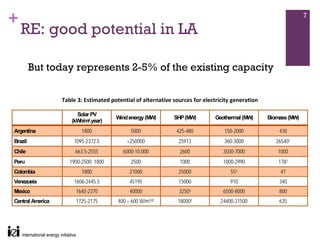
    RE: good potential in LA

         But today represents 2-5% of the existing capacity

                  Table 3: Estimated potential of alternative sources for electricity generation 

                       Solar PV
                                       Wind energy (MW)       SHP (MW)         Geothermal (MW)      Biomass (MW)
                     (kWh/m2.year)
Argentina                 1800                5000             425-480             150-2000             430
Brazil                1095-2372.5           >250000             25913              360-3000            265401
Chile                  663.5-2555         6000-10,000            2600             3500-7000            1000
Peru                 1900-2500; 1800          2500               1000             1000-2990             1782
Colombia                  1800               21000              25000                552                47
Venezuela             1606-2445.5            45195              15000                910                340
Mexico                 1640-2370             40000              32503             6500-8000             800
Central America        1725-2175        400 – 600 W/m2(4)       180003           24400-31500            635
+                                                        8

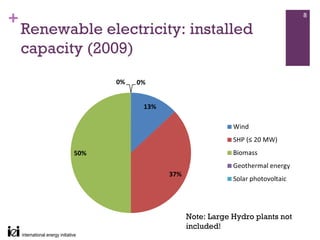
    Renewable electricity: installed
    capacity (2009)


                          Note: Large Hydro plants not
                          included!
+                                                 9

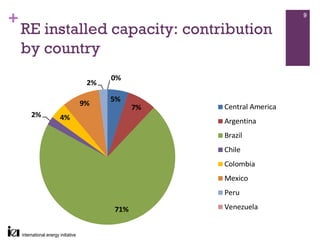
    RE installed capacity: contribution
    by country
                     0%
                2%

                     5%
               9%               Central America
                           7%
     2%   4%                    Argentina
                                Brazil
                                Chile
                                Colombia
                                Mexico
                                Peru

                     71%        Venezuela
+                                                             10

    Summary: RE in Latin America

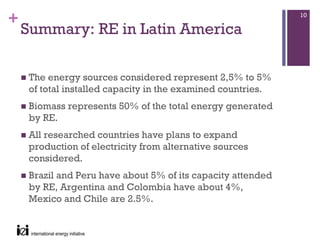
     The energy sources considered represent 2,5% to 5%
     of total installed capacity in the examined countries.
     Biomass represents 50% of the total energy generated
     by RE.
     All researched countries have plans to expand
     production of electricity from alternative sources
     considered.
     Brazil and Peru have about 5% of its capacity attended
     by RE, Argentina and Colombia have about 4%,
     Mexico and Chile are 2.5%.
+
    Drivers for expansion: RE in
    Latin America


                                   11
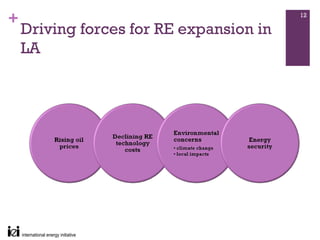
+                                        12

    Driving forces for RE expansion in
    LA
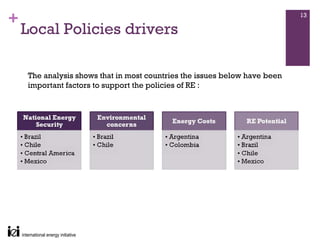
+                                                                           13

    Local Policies drivers

     The analysis shows that in most countries the issues below have been
     important factors to support the policies of RE :
+
    Policies, Stakeholders,
    Funding


                              14
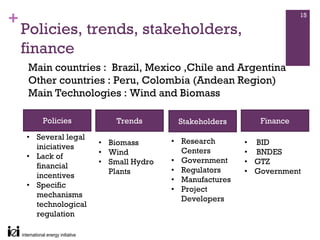
+                                                                   15

    Policies, trends, stakeholders,
    finance
     Main countries : Brazil, Mexico ,Chile and Argentina
     Other countries : Peru, Colombia (Andean Region)
     Main Technologies : Wind and Biomass

        Policies          Trends       Stakeholders       Finance

    • Several legal
                      • Biomass       • Research       • BID
      iniciatives
                      • Wind            Centers        • BNDES
    • Lack of
                      • Small Hydro   • Government     • GTZ
      financial
                        Plants        • Regulators     • Government
      incentives
                                      • Manufactures
    • Specific
                                      • Project
      mechanisms
                                        Developers
      technological
      regulation
+
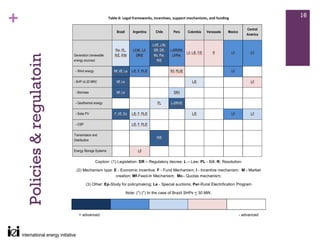
Policies & regulatoin
                        16
+                                                          17

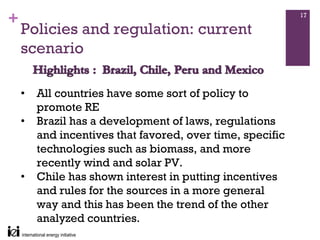
    Policies and regulation: current
    scenario

    •   All countries have some sort of policy to
        promote RE
    •   Brazil has a development of laws, regulations
        and incentives that favored, over time, specific
        technologies such as biomass, and more
        recently wind and solar PV.
    •   Chile has shown interest in putting incentives
        and rules for the sources in a more general
        way and this has been the trend of the other
        analyzed countries.
+                                                      18

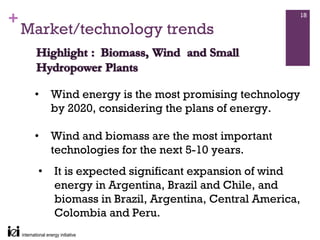
    Market/technology trends


     •    Wind energy is the most promising technology
          by 2020, considering the plans of energy.

     •    Wind and biomass are the most important
          technologies for the next 5-10 years.
      •   It is expected significant expansion of wind
          energy in Argentina, Brazil and Chile, and
          biomass in Brazil, Argentina, Central America,
          Colombia and Peru.
+                                                                             19

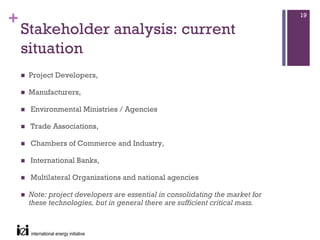
    Stakeholder analysis: current
    situation
     Project Developers,

     Manufacturers,

     Environmental Ministries / Agencies

     Trade Associations,

     Chambers of Commerce and Industry,

     International Banks,

     Multilateral Organizations and national agencies

     Note: project developers are essential in consolidating the market for
     these technologies, but in general there are sufficient critical mass.
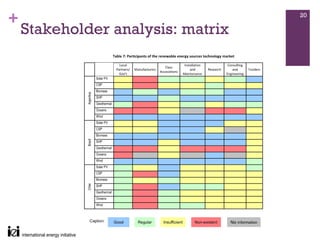
+                                  20

    Stakeholder analysis: matrix
+
    Multicriteria analysis
    Which are the best country+technology ?


                                              21
+                                                                   22

    Criteria selection and analysis

     There are three axes of evaluation or criteria used for this
     analysis: market, regulation and actors.

     Projected installed capacity (High and Low) a quantitative
     criterion.

     Regulation and stakeholders: qualitative and represent,
     respectively, the degree of development and the importance
     of the legal framework and existing players.
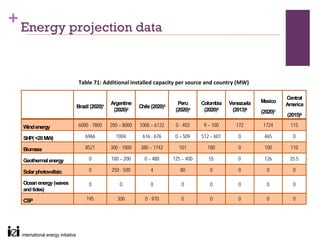
+ Energy projection data


                         Table 71: Additional installed capacity per source and country (MW) 

                                                                                                                    Central
                                         Argentine                      Peru      Colombia    Venezuela   Mexico
                        Brazil (2020)1                Chile (2020)3                                                 America
                                          (2020)2                      (2020)4     (2020)5     (2013)6    (2020)7
                                                                                                                    (2015)8

  Wind energy            6000 - 7800     200 – 8000   1000 – 6122      0 - 403     9 – 100      172        1724      115

  SHP( <20 MW)              6966           1004        616 - 676       0 – 509    512 – 601      0         465        0

  Biomass                   8521         300 - 1000    380 – 1742       101         180          0         100       110

  Geothermal energy           0          100 – 200      0 – 488       125 – 400      55          0         126       25.5

  Solar photovoltaic          0          250 - 500         4             80          0           0          0         0

  Ocean energy (waves         0              0             0             0           0           0          0         0
  and tides)

  CSP                        195            300          0 - 970         0           0           0          0         0
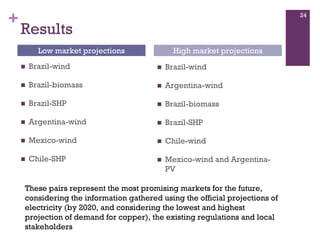
+                                                                            24

    Results
       Low market projections                High market projections
     Brazil-wind                          Brazil-wind

     Brazil-biomass                       Argentina-wind

     Brazil-SHP                           Brazil-biomass

     Argentina-wind                       Brazil-SHP

     Mexico-wind                          Chile-wind

     Chile-SHP                            Mexico-wind and Argentina-
                                          PV

    These pairs represent the most promising markets for the future,
    considering the information gathered using the official projections of
    electricity (by 2020, and considering the lowest and highest
    projection of demand for copper), the existing regulations and local
    stakeholders
+
    Conclusions
    OPORTUNITIES


                   25
+                                                                           26

    Conclusions
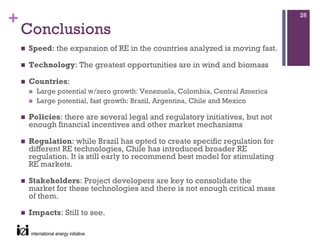
    Speed: the expansion of RE in the countries analyzed is moving fast.

    Technology: The greatest opportunities are in wind and biomass

    Countries:
      Large potential w/zero growth: Venezuela, Colombia, Central America
      Large potential, fast growth: Brazil, Argentina, Chile and Mexico

    Policies: there are several legal and regulatory initiatives, but not
    enough financial incentives and other market mechanisms

    Regulation: while Brazil has opted to create specific regulation for
    different RE technologies, Chile has introduced broader RE
    regulation. It is still early to recommend best model for stimulating
    RE markets.

    Stakeholders: Project developers are key to consolidate the
    market for these technologies and there is not enough critical mass
    of them.

    Impacts: Still to see.
+
    The End
    gilberto@iei-la.org
    jannuzzi@fem.unicamp.br


                              27
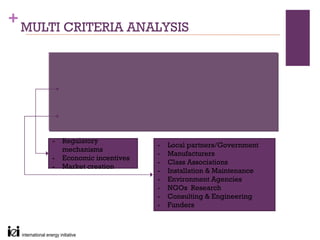
+ MULTI CRITERIA ANALYSIS


      -   Regulatory
                                -   Local partners/Government
          mechanisms
                                -   Manufacturers
      -   Economic incentives
                                -   Class Associations
      -   Market creation
                                -   Installation & Maintenance
                                -   Environment Agencies
                                -   NGOs Research
                                -   Consulting & Engineering
                                -   Funders
+ MULTI CRITERIA ANALYSIS

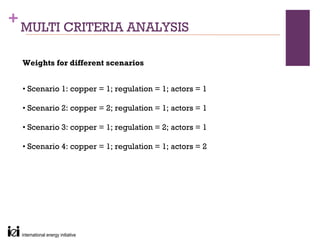
  Weights for different scenarios


  • Scenario 1: copper = 1; regulation = 1; actors = 1

  • Scenario 2: copper = 2; regulation = 1; actors = 1

  • Scenario 3: copper = 1; regulation = 2; actors = 1

  • Scenario 4: copper = 1; regulation = 1; actors = 2
+ MULTI CRITERIA ANALYSIS

    Ranking of evaluated countries-technologies pairs
    scenario 1: lower limit amount of additional copper

Webinar - Renewable Energy for Electricity Generation in Latin America: market, technologies and outlook

  • 1.
    + Renewable Energy for Electricity Generation in Gilberto M Jannuzzi Latin America: the market, technologies and outlook
  • 2.
    + 2 Report “Renewable Energy for Electricity Generation in Latin America: the market, technologies and outlook - 2010” Team: Gilberto De Martino Jannuzzi University of Campinas – UNICAMP and International Energy Initiative – IEI, Brazil Odón de Buen Rodríguez Energía, Tecnología y Educación, S.C. – ENTE, S.C., Mexico João Gorenstein Dedecca International Energy Initiative – IEI, Brazil Larissa Gonçalves Nogueira International Energy Initiative – IEI, Brazil Rodolfo Dourado Maia Gomes International Energy Initiative – IEI, Brazil Judith Navarro Energía, Tecnología y Educación, S.C. – ENTE, S.C., Mexico
  • 3.
  • 4.
    + 4 Objective and Characteristics of the study Objective: provide a picture of the current status and near future development of renewable energy technologies in LA countries Markets up to 2020 (official projections), regulations, stakeholders Countries: Argentina, Brazil, Central America, Chile, Peru, Colombia, Venezuela, and Mexico Sources/technologies: SHP (<20 MW), wind, biomass, solar PV, geothermal Information: Survey the existing public available literature, official documents and reports Personal contacts
  • 5.
    + 5 Structure of presentation Current picture Trends & Drivers Policies & Regulation Stakeholders Most promissing technologies/countries Conclusions
  • 6.
    + Current situation: Renewable Electricity (RE) 6
  • 7.
    + 7 RE: good potential in LA But today represents 2-5% of the existing capacity Table 3: Estimated potential of alternative sources for electricity generation  Solar PV Wind energy (MW) SHP (MW) Geothermal (MW) Biomass (MW) (kWh/m2.year) Argentina 1800 5000 425-480 150-2000 430 Brazil 1095-2372.5 >250000 25913 360-3000 265401 Chile 663.5-2555 6000-10,000 2600 3500-7000 1000 Peru 1900-2500; 1800 2500 1000 1000-2990 1782 Colombia 1800 21000 25000 552 47 Venezuela 1606-2445.5 45195 15000 910 340 Mexico 1640-2370 40000 32503 6500-8000 800 Central America 1725-2175 400 – 600 W/m2(4) 180003 24400-31500 635
  • 8.
    + 8 Renewable electricity: installed capacity (2009) Note: Large Hydro plants not included!
  • 9.
    + 9 RE installed capacity: contribution by country 0% 2% 5% 9% Central America 7% 2% 4% Argentina Brazil Chile Colombia Mexico Peru 71% Venezuela
  • 10.
    + 10 Summary: RE in Latin America The energy sources considered represent 2,5% to 5% of total installed capacity in the examined countries. Biomass represents 50% of the total energy generated by RE. All researched countries have plans to expand production of electricity from alternative sources considered. Brazil and Peru have about 5% of its capacity attended by RE, Argentina and Colombia have about 4%, Mexico and Chile are 2.5%.
  • 11.
    + Drivers for expansion: RE in Latin America 11
  • 12.
    + 12 Driving forces for RE expansion in LA
  • 13.
    + 13 Local Policies drivers The analysis shows that in most countries the issues below have been important factors to support the policies of RE :
  • 14.
    + Policies, Stakeholders, Funding 14
  • 15.
    + 15 Policies, trends, stakeholders, finance Main countries : Brazil, Mexico ,Chile and Argentina Other countries : Peru, Colombia (Andean Region) Main Technologies : Wind and Biomass Policies Trends Stakeholders Finance • Several legal • Biomass • Research • BID iniciatives • Wind Centers • BNDES • Lack of • Small Hydro • Government • GTZ financial Plants • Regulators • Government incentives • Manufactures • Specific • Project mechanisms Developers technological regulation
  • 16.
  • 17.
    + 17 Policies and regulation: current scenario • All countries have some sort of policy to promote RE • Brazil has a development of laws, regulations and incentives that favored, over time, specific technologies such as biomass, and more recently wind and solar PV. • Chile has shown interest in putting incentives and rules for the sources in a more general way and this has been the trend of the other analyzed countries.
  • 18.
    + 18 Market/technology trends • Wind energy is the most promising technology by 2020, considering the plans of energy. • Wind and biomass are the most important technologies for the next 5-10 years. • It is expected significant expansion of wind energy in Argentina, Brazil and Chile, and biomass in Brazil, Argentina, Central America, Colombia and Peru.
  • 19.
    + 19 Stakeholder analysis: current situation Project Developers, Manufacturers, Environmental Ministries / Agencies Trade Associations, Chambers of Commerce and Industry, International Banks, Multilateral Organizations and national agencies Note: project developers are essential in consolidating the market for these technologies, but in general there are sufficient critical mass.
  • 20.
    + 20 Stakeholder analysis: matrix
  • 21.
    + Multicriteria analysis Which are the best country+technology ? 21
  • 22.
    + 22 Criteria selection and analysis There are three axes of evaluation or criteria used for this analysis: market, regulation and actors. Projected installed capacity (High and Low) a quantitative criterion. Regulation and stakeholders: qualitative and represent, respectively, the degree of development and the importance of the legal framework and existing players.
  • 23.
    + Energy projectiondata Table 71: Additional installed capacity per source and country (MW)  Central Argentine Peru Colombia Venezuela Mexico Brazil (2020)1 Chile (2020)3 America (2020)2 (2020)4 (2020)5 (2013)6 (2020)7 (2015)8 Wind energy 6000 - 7800 200 – 8000 1000 – 6122 0 - 403 9 – 100 172 1724 115 SHP( <20 MW) 6966 1004 616 - 676 0 – 509 512 – 601 0 465 0 Biomass 8521 300 - 1000 380 – 1742 101 180 0 100 110 Geothermal energy 0 100 – 200 0 – 488 125 – 400 55 0 126 25.5 Solar photovoltaic 0 250 - 500 4 80 0 0 0 0 Ocean energy (waves 0 0 0 0 0 0 0 0 and tides) CSP 195 300 0 - 970 0 0 0 0 0
  • 24.
    + 24 Results Low market projections High market projections Brazil-wind Brazil-wind Brazil-biomass Argentina-wind Brazil-SHP Brazil-biomass Argentina-wind Brazil-SHP Mexico-wind Chile-wind Chile-SHP Mexico-wind and Argentina- PV These pairs represent the most promising markets for the future, considering the information gathered using the official projections of electricity (by 2020, and considering the lowest and highest projection of demand for copper), the existing regulations and local stakeholders
  • 25.
    + Conclusions OPORTUNITIES 25
  • 26.
    + 26 Conclusions Speed: the expansion of RE in the countries analyzed is moving fast. Technology: The greatest opportunities are in wind and biomass Countries: Large potential w/zero growth: Venezuela, Colombia, Central America Large potential, fast growth: Brazil, Argentina, Chile and Mexico Policies: there are several legal and regulatory initiatives, but not enough financial incentives and other market mechanisms Regulation: while Brazil has opted to create specific regulation for different RE technologies, Chile has introduced broader RE regulation. It is still early to recommend best model for stimulating RE markets. Stakeholders: Project developers are key to consolidate the market for these technologies and there is not enough critical mass of them. Impacts: Still to see.
  • 27.
    + The End gilberto@iei-la.org jannuzzi@fem.unicamp.br 27
  • 28.
    + MULTI CRITERIAANALYSIS - Regulatory - Local partners/Government mechanisms - Manufacturers - Economic incentives - Class Associations - Market creation - Installation & Maintenance - Environment Agencies - NGOs Research - Consulting & Engineering - Funders
  • 29.
    + MULTI CRITERIAANALYSIS Weights for different scenarios • Scenario 1: copper = 1; regulation = 1; actors = 1 • Scenario 2: copper = 2; regulation = 1; actors = 1 • Scenario 3: copper = 1; regulation = 2; actors = 1 • Scenario 4: copper = 1; regulation = 1; actors = 2
  • 30.
    + MULTI CRITERIAANALYSIS Ranking of evaluated countries-technologies pairs scenario 1: lower limit amount of additional copper