

Lean Energy: Industrial Energy Made Lean
            By Richard Stone
           and David Brearley

     Dial in Numbers: 0800 694 8053
     IE Dial in: +44 (0) 207 897 0111
     Conference Code: 4381606605
The background...
► Electricity prices will increase by 60% in the next 4
    years
►   Gas will become more very much more expensive
    after a flattened period
►   Energy supplies are a finite resource
►   Climate change initiatives place tax issues on
    energy usage
►   There is insufficient capacity
►   There are swingeing European „green‟ initiatives
►   Wind generation will become a tariff-setting factor
    once it is a significant factor in the total capacity
►   LNG will become more important as local supplies
    are depleted...
Source MEUC March 2010
Energy – the costliest
unaccountable


 ► “It is in the overhead”
 ► “We have to use power to make things”
 ► “We do turn the lights out”
 ► “The steam / air does not leak”
 ► “We have saved all that we can”
 ► “We have done a kettle audit”
 ► “We cannot work in the dark in a sub-
   zero environment”
 ► “We have installed inverter drives”
The Lean - Energy link

 ► OEE = Availability x Performance x Quality
 ► A low OEE will possibly involve rework –
   especially through Quality problems
 ► One has to make more to make enough
   quality product
 ► That takes more energy.
 ► Lean Energy...

 ► www.wonderware.ie/webinars/
 ► www.wonderware.co.uk/webinars/
Things that are offered, that can be
considered - that can be done...

 ► Accurate 230 VAC (380 V 3 ph) supply** – claims up to
     12% saving – large transformer, high capital cost
 ►   Power factor correction*** – could be as high as 25%
     saving (dependent upon load characteristic) – PFC
     capacitor banks and control gear, high capital cost
 ►   Low energy lighting (first and last mention!)
 ►   Inverter drives – Enhanced Capital Allowance*
 ►   Power displays as part of HMI / SCADA – almost free
 ►   Energy data acquisition, historisation and reporting
     – can be part of an existing Industrial Automation
     scheme – further ROI benefit and value
Electrical engineering
unzipped...


► The Amp meter is where the money is
► The Voltmeter is about supply voltage efficiency (should be very
   close to 230V – or 380V if three phase) – and to tell you that it is
   switched on.
► The Power Factor (COS φ) meter should be close to -0.98 and if it
   isn‟t it will cost you a lot of money!
► These instruments are hidden away on your distribution panel.
TIP – automatically record PF and Voltage – it‟s about Lean!
Sustainable?

 ► Most of the aforementioned capital
   investments are sustainable – but, the
   improvement is one-time, and possibly
   reduces over time.
Sustainability


 ► Savings require measurement
 ► Savings have to be sustainable
 ► Sustainable Saving should not be
   laborious
 ► Sustainability is about automation
 ► Year-on-year energy saving is hard
   – the curve
The case for Lean Energy

 ► Energy „treasure hunts‟ are also
   great ways to reinforce awareness of
   the seven types of waste and make
   explicit links to how the 7 wastes
   contribute to energy losses.
     ▪ “Do try this one at home”
 ► All of the „7 wastes‟ cause energy
   losses but Energy is something
   frequently overlooked and the
   savings are not properly quantified.
The case for Lean Energy

 ► Overproduction, the mother of all wastes
   consumes energy by operating equipment to
   make products we don't need. This leads to
   the other wastes being created, such as
   inventory which needs to be heated,
   cooled, conveyed, illuminated - using
   energy.
 ► Transportation of goods uses more energy.
 ► Waiting itself may not be the greatest
   waste, but surely the light, heat and running
   equipment wastes energy while people wait.
The case for Lean Energy

 ► Defects waste tremendous energy as all of the energy
   to produce it is wasted, the product needs to be made
   again, and many times people spend time correcting,
   reporting and analyzing the defect which uses energy
   in a variety of ways.
 ► Processing waste creates energy losses when the
   equipment size and speed are inappropriate to get the
   job done efficiently.
 ► Motion waste is the most challenging one to link with
   energy waste because we are talking about human
   motion, and excessive human motion can cause unsafe
   work conditions, lower productivity or poor quality which
   has consequences on energy efficiency
Benefits of Energy Management
► Benefits

   ▪ Reduce cost of energy per unit of output
   ▪ Avoid peak demand charges
   ▪ Provide CCL reports
   ▪ Make changes with sustainable results
   ▪ Provide information for an energy continuous
     improvement program
   ▪ Use a standard solution across sites regardless of
     plant automation
   ▪ Provide feedback to departments on energy
     improvements
What is Monitoring & Targeting ?
                 Monitoring and Targeting (M&T)

                 ► Monitoring and targeting (M&T) is a cost-saving energy
                   management technique, designed to detect and diagnose wasteful
                   use of energy, water, and other consumable resources.
GOOD PRACTISE!


                 ► Consumption can be related to measureable driving factors
                   (weather, levels of production output, process parameters…..)
                 ► From understanding the driving-factor you can set a target for each
                   stream of consumption.
                 ► A waste of energy is signaled by an unexpected deviation between
                   monitored and expected consumption (i.e. positive slope on cusum
                   curve)
Targeting with Cusum Charts


         Plot cusum curve
         •horizontal means on target
         •negative slope shows energy reducing
         •Positive slope indicates energy increasing beyond target
What the Enhanced Capital Allowance (ECA)
                 scheme requires (in the UK)*


                  The Analytical Software (i.e. AMT software) should have the following minimum capability:
                  ►   Real-time or scheduled transfer of data into the user‟s AMT database.
                  ►   Store and process interval meter readings to at least a minimum of 30-minute intervals.
                  ►   Present data in both a graphical and tabular format i.e. histograms, line plots, etc.
GOOD PRACTISE!


                  ►   Selectable time bases with periods of 30 minutes, 1 day, 1 week, 4 weeks, 1 calendar
                      month, and 1 year.
                  ►   Ability to select datasets and manipulate them by combining, comparing and calculating
                      in order to analyze, identify and evaluate instances of energy waste.
                  ►   Regression analysis on data streams using two variables in whatever frequency the
                      dataset obtained. Display in graphical form with correlation coefficient.
                  ►   Automatic exception reporting where period consumption is outside a selected variance
                      from a standard or selected data set.

                  AMT = Automatic Monitoring and Targeting
                  http://www.eca.gov.uk/etl
                  http://www.eca.gov.uk/NR/rdonlyres/9AF2858C-CAAD-4640-A085-
                        FCC4FBDDEB59/0/08AMT_ComponentBasedSystems.pdf
What The Carbon Trust say that M&T (Monitoring &
  Targeting) software should do (in the UK)*.


                 ► An emphasis on the assessment of physical performance (as
                   distinct from energy accounting, although they may offer this
                   as well).
GOOD PRACTISE!


                 ► Facilities for setting up calculations of expected consumption,
                   at least using straight-line relationships with single driving
                   factors and preferably other methods as well.
                 ► Generate the overspend league table as defined above, either
                   as a standard built-in report (preferred) or as a user-defined
                   report template.
                 ► Provide scatter, deviation and cusum charts at least, and
                   employ them actively in the target-setting process by enabling
                   selective
                 General website: http://www.carbontrust.co.uk
SEAI

It is recommended to discuss such issues
with Sustainable Energy Authority Ireland.

                            http://www.seai.ie/


                            We have a developing dialogue
                            with SEAI.
Next... Benefits (once quantified) make good ROI
arguments for investments


► The trick is to put a conservative value (cost)
  on each of the 7 wastes that apply to you
► This does not have to be accurate or detailed
► The opportunity will quickly emerge, with a
  value attached to it
► Then you (may) have a budget to work with
Solution(s)
What is required in industry...
                                   Integrated Industrial
BMS                                System
► Energy                           ► Energy per unit
   ▪ But probably for the             ▪ Energy per tonne
      building only                   ▪ Energy per kilo
    ▪ Controls and information        ▪ Energy per metre
      more to do with HVAC            ▪ Energy per nnn
      less to do with industrial   ► By automatic correlation of
      plant                          energy and process data
                                   ► As part of a Lean
                                     manufacturing programme
                                   ► As part of the operational
                                     methodology
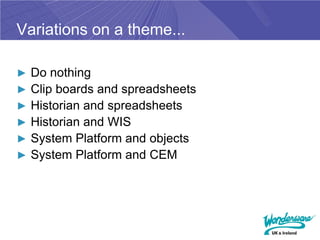
Variations on a theme...

► Do nothing
► Clip boards and spreadsheets
► Historian and spreadsheets
► Historian and WIS
► System Platform and objects
► System Platform and CEM
Problem Statements drove our
User Requirements
►   Management has minimal visibility to usage of energy in the operation
►   Managers do not have the tools to manage energy use to maximize the
    reward and avoid to penalties of supplier contracts
►   Plant utility output is not coordinated to usage in the operation, leading to
    waste
►   Adding an energy management solution to an existing operation is perceived
    as costly and disruptive
►   The data collected for energy usage and demand is not useful for making
    timely operational and economic decisions
►   Data collected for energy usage and demand is not related to operational
    events or business processes
►   Meter technology varies widely and connectivity for automated data collection
    is not standardized
►   Some meters must be read manually and present problems in accuracy and
    timeliness
►   Allocation of energy cost to produced goods and services is not accurate or
    useful in understanding the true cost of goods sold
►   Poor maintenance of equipment and assets causes energy waste
Problem Statements drove our
User Requirements (continued)
►   Operators are not aware of the consequences of decisions that
    create excessive energy usage or demand
►   Self generated energy is difficult to integrate into the operation
►   Data for effective energy management is captured in other plant
    systems not integrated with operations
►   Operations must be prepared to be part of, and take advantage
    of, the Smart Grid programs and mandates
►   The operation incurs unplanned costs when penalized for
    mismanaged energy usage
►   Existing automation and instrumentation cannot economically
    expand to provide tools for energy management
►   Regulatory reporting requirements and corporate reporting for
    KPIs is time consuming and often not accurate
A Unique Approach

► Relate energy usage with production output and process
  variables
► 24 hr Energy Supervision – automation
► Flexible Views of Energy Information
A Unique Approach

► Account for All Energy Types- Points of Energy Usage
► Account for Self Generation of Power
► Built on a world-class, robust real-time automation platform
A Unique Approach

► Fast Deployment
► Flexible and Expansible
A Unique Approach to Energy Management

►Focus on the Economics of Energy Usage
►Active Intelligence
►Flexible Views of Information


                                 27
A Unique Approach to Energy
Management (cont.)
►Fast Deployment
   ▪ Install and configure in days, not weeks or months
   ▪ Instantly connect to existing meters on the network
   ▪ Collect meter readings from un-connected meters using IntelaTrac
   ▪ Deploy inexpensive wireless meters or wireless retrofits to older
     meters
   ▪ Add fixed meters as they are installed and operational
►Fast Results
   ▪ Pre-built reports for instant information
   ▪ Real-time HMI components enable cost “experiments”


                                                       28
The Corporate Energy Module


                    Corporate Energy
                        Module


                    System Platform 3.1
              IAS        Historian        WIS


                DAS-       DAS-       DAS-
                PLC       Modbus     BACnet


2
9
Context Transforms Energy Data to Energy Information

                             Production Worker                            Energy Manager                                  Corporate
                                                                          Controller/Accountant                           Energy Manager

                                  inTouch HMI                                     Web Portal
                             •Real-time view of                              •Run Pre-configured                     Intelligence- EMI for
                             energy usage                                    reports                                      Operations
                             •Configuration of the
                             application


                                                              Energy
    Internal Context                                                                                                Corporate KPI
  •Operational Events from                                  Information                            Energy Metrics
  automation and MES
  •Asset State from
  automation                                               Corporate
  •Order, Batch, SKU                                        Energy
                                                                                                   Energy Usage       ERP/MES
                                                          Management
                         Usage Context                     Application
                                                                                                                      Asset
   External Context                                                                                Work Request     Management
  •Weather- Current,
  Forecast                                                                                                            CMMS
  •Utility Rates
  •Demand Response
  Signals from Grid                                       Energy Usage                             Rich Data
                                                                                                                     Advanced
                                                              Data                                                  Analysis and
                                                                                                                     Simulation

                                              Automatic                        Mobile
                                   •Direct to Meters (also wireless)   •IntelaTrac
                                   •Meters thru PLC/DCS                •Mobile Data Collection
                                   •RTU from remote sites
                                   •Building Management System
    3                              •Utility Interval Readings
    0
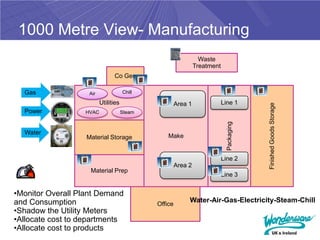
1000 Metre View- Manufacturing
                                                                  Waste
                                                                Treatment
                                Co Gen

  Gas               Air               Chill

                          Utilities                    Area 1               Line 1


                                                                                          Finished Goods Storage
  Power           HVAC                Steam


                                                                              Packaging
  Water
                   Material Storage               Make


                                                                            Line 2
                                                       Area 2
                    Material Prep
                                                                            Line 3


•Monitor Overall Plant Demand
and Consumption                                             Water-Air-Gas-Electricity-Steam-Chill
                                              Office
•Shadow the Utility Meters
•Allocate cost to departments
•Allocate cost to products
Conceptual Overview

                                                            Self Service
                                                            Reports


              People       Systems   Control
                       Notify

                            Act
  Configure                          Events
                          Detect
                                                 Application
                                                  Historian
                          Monitor    CDC*
                                               * Contextualized Data Collection

                          SCADA
Reports


Economic Information

In March, for my Blow Mold Operation,
did I…

• Meet my energy budget?
• Accurately forecast the daily demand?
                                          Needs
• Do better than the last 5 months?
• Have any alarms or warning?             deleting /
                                          amending
                                          or
                                          updating
Special Metals Wiggin


► Special Metals Wiggin, Hereford: is a
   manufacturer of nickel alloys for
   demanding applications. The company
   is a large energy user and insight was
   required to provide detail from which
   savings could be targeted and
   sustained. As part of the company‟s
   lean initiatives energy monitoring and
   targeting was high on the list.
   Following research Special Metals
   Wiggin selected Wonderware Historian
   as the ideal data repository from which
   they could obtain meaningful industrial
   energy data.
Situation and Solution
SITUATION
► Energy (Electricity and Gas) cost was
  radically increasing owing to tariff and to
  small batch sizes
► Attempts with SQL solutions had failed
  (time line correlation)
► Energy per kilo was required
SOLUTION
► Wonderware Historian
► MS Office
► DAQ with low cost PLC
Method


 DAQ (PLC)   DAQ (PLC)


   Meter      Machine
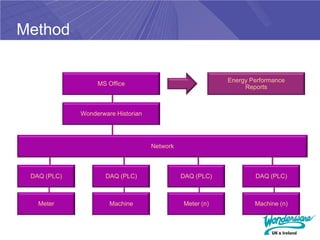
Method

                                                          Energy Performance
                  MS Office
                                                               Reports


             Wonderware Historian


                                    Network


 DAQ (PLC)           DAQ (PLC)                DAQ (PLC)           DAQ (PLC)


   Meter              Machine                 Meter (n)           Machine (n)
Views
A heavy industrial operation
Results
► Energy data is in the same database (historian) as
    production data
►   These can be cross correlated
►   Producing Energy Cost per kilo per batch
►   Operational managers see this information either directly
    or through the company‟s intranet and can act directly
►   Energy display is extrapolated to year-end to produce a
    „consequential‟ view
►   Water consumption is also recorded
►   Environmental data is recorded for Environmental Agency
    reporting (including wind direction)
Reports


          ► Reports are available
            instantaneously – any variance
            resulting in investigation (either
            good or bad)
Method

                                                          Energy Performance
                  MS Office
                                                               Reports


             Wonderware Historian


                                    Network


 DAQ (PLC)           DAQ (PLC)                DAQ (PLC)           DAQ (PLC)


   Meter              Machine                 Meter (n)           Machine (n)
Method
             Wonderware Information                         Interactive Energy Performance
                    Server                                               Reports


                                                                 Energy Performance
                   MS Office
                                                                      Reports


              Wonderware Historian


                                      Network


 DAQ (PLC)            DAQ (PLC)                 DAQ (PLC)                 DAQ (PLC)


   Meter               Machine                  Meter (n)                 Machine (n)
Quotable...
► Mr John Powles, Energy Controller, Special Metals Wiggin, said,
   “Energy cost is directly transferred to other expenditure benefits,”

     ▪ adding, “Wonderware Historian was the key breakthrough in
       making our data available as useful information to us, we
       anticipate that the current programme to integrate this with
       Wonderware Information Server will complete the task and
       provide us all with vastly improved insight into our energy usage
       and production methods taken from an energy view.”


► “The detailed information provides a better basis for discussion of
   tariffs with suppliers and the associated water and other
   environmental data allows us always to have a positive dialogue with
   the Environmental Agency.”
Observations
► The company has ca 200 meters
  connected to the system
► This produces a fine enough energy picture
► The integration with MS Office (Excel and
  PPT) is convenient
► They would be benefit in having interactive
  reports (e.g. drilling down); this is currently
  being evaluated (Wonderware Information
  Server)
► Payback within 9 months (18 months
  planned)
Summary
► Historian with MS Office
     Focussed upon energy usage
► MS Office integration
► Realisation that interactive reporting was
  beneficial
► Delivering measurable, real benefits
► Producing payback on the investment
  within the first year
Summary

► Do all the early stage things
   ▪ Carefully evaluate capital item ROI
► Meter
► Automate
► Report
► Act – Energy hunting
► Sustain
► Continuously Improve

► Talk to Wonderware.
Powering intelligent plant
 decisions in real time.

Lean Energy Webinar

  • 1.
    Lean Energy: IndustrialEnergy Made Lean By Richard Stone and David Brearley Dial in Numbers: 0800 694 8053 IE Dial in: +44 (0) 207 897 0111 Conference Code: 4381606605
  • 2.
    The background... ► Electricityprices will increase by 60% in the next 4 years ► Gas will become more very much more expensive after a flattened period ► Energy supplies are a finite resource ► Climate change initiatives place tax issues on energy usage ► There is insufficient capacity ► There are swingeing European „green‟ initiatives ► Wind generation will become a tariff-setting factor once it is a significant factor in the total capacity ► LNG will become more important as local supplies are depleted... Source MEUC March 2010
  • 3.
    Energy – thecostliest unaccountable ► “It is in the overhead” ► “We have to use power to make things” ► “We do turn the lights out” ► “The steam / air does not leak” ► “We have saved all that we can” ► “We have done a kettle audit” ► “We cannot work in the dark in a sub- zero environment” ► “We have installed inverter drives”
  • 4.
    The Lean -Energy link ► OEE = Availability x Performance x Quality ► A low OEE will possibly involve rework – especially through Quality problems ► One has to make more to make enough quality product ► That takes more energy. ► Lean Energy... ► www.wonderware.ie/webinars/ ► www.wonderware.co.uk/webinars/
  • 5.
    Things that areoffered, that can be considered - that can be done... ► Accurate 230 VAC (380 V 3 ph) supply** – claims up to 12% saving – large transformer, high capital cost ► Power factor correction*** – could be as high as 25% saving (dependent upon load characteristic) – PFC capacitor banks and control gear, high capital cost ► Low energy lighting (first and last mention!) ► Inverter drives – Enhanced Capital Allowance* ► Power displays as part of HMI / SCADA – almost free ► Energy data acquisition, historisation and reporting – can be part of an existing Industrial Automation scheme – further ROI benefit and value
  • 6.
    Electrical engineering unzipped... ► TheAmp meter is where the money is ► The Voltmeter is about supply voltage efficiency (should be very close to 230V – or 380V if three phase) – and to tell you that it is switched on. ► The Power Factor (COS φ) meter should be close to -0.98 and if it isn‟t it will cost you a lot of money! ► These instruments are hidden away on your distribution panel. TIP – automatically record PF and Voltage – it‟s about Lean!
  • 7.
    Sustainable? ► Mostof the aforementioned capital investments are sustainable – but, the improvement is one-time, and possibly reduces over time.
  • 8.
    Sustainability ► Savingsrequire measurement ► Savings have to be sustainable ► Sustainable Saving should not be laborious ► Sustainability is about automation ► Year-on-year energy saving is hard – the curve
  • 9.
    The case forLean Energy ► Energy „treasure hunts‟ are also great ways to reinforce awareness of the seven types of waste and make explicit links to how the 7 wastes contribute to energy losses. ▪ “Do try this one at home” ► All of the „7 wastes‟ cause energy losses but Energy is something frequently overlooked and the savings are not properly quantified.
  • 10.
    The case forLean Energy ► Overproduction, the mother of all wastes consumes energy by operating equipment to make products we don't need. This leads to the other wastes being created, such as inventory which needs to be heated, cooled, conveyed, illuminated - using energy. ► Transportation of goods uses more energy. ► Waiting itself may not be the greatest waste, but surely the light, heat and running equipment wastes energy while people wait.
  • 11.
    The case forLean Energy ► Defects waste tremendous energy as all of the energy to produce it is wasted, the product needs to be made again, and many times people spend time correcting, reporting and analyzing the defect which uses energy in a variety of ways. ► Processing waste creates energy losses when the equipment size and speed are inappropriate to get the job done efficiently. ► Motion waste is the most challenging one to link with energy waste because we are talking about human motion, and excessive human motion can cause unsafe work conditions, lower productivity or poor quality which has consequences on energy efficiency
  • 12.
    Benefits of EnergyManagement ► Benefits ▪ Reduce cost of energy per unit of output ▪ Avoid peak demand charges ▪ Provide CCL reports ▪ Make changes with sustainable results ▪ Provide information for an energy continuous improvement program ▪ Use a standard solution across sites regardless of plant automation ▪ Provide feedback to departments on energy improvements
  • 13.
    What is Monitoring& Targeting ? Monitoring and Targeting (M&T) ► Monitoring and targeting (M&T) is a cost-saving energy management technique, designed to detect and diagnose wasteful use of energy, water, and other consumable resources. GOOD PRACTISE! ► Consumption can be related to measureable driving factors (weather, levels of production output, process parameters…..) ► From understanding the driving-factor you can set a target for each stream of consumption. ► A waste of energy is signaled by an unexpected deviation between monitored and expected consumption (i.e. positive slope on cusum curve)
  • 14.
    Targeting with CusumCharts Plot cusum curve •horizontal means on target •negative slope shows energy reducing •Positive slope indicates energy increasing beyond target
  • 15.
    What the EnhancedCapital Allowance (ECA) scheme requires (in the UK)* The Analytical Software (i.e. AMT software) should have the following minimum capability: ► Real-time or scheduled transfer of data into the user‟s AMT database. ► Store and process interval meter readings to at least a minimum of 30-minute intervals. ► Present data in both a graphical and tabular format i.e. histograms, line plots, etc. GOOD PRACTISE! ► Selectable time bases with periods of 30 minutes, 1 day, 1 week, 4 weeks, 1 calendar month, and 1 year. ► Ability to select datasets and manipulate them by combining, comparing and calculating in order to analyze, identify and evaluate instances of energy waste. ► Regression analysis on data streams using two variables in whatever frequency the dataset obtained. Display in graphical form with correlation coefficient. ► Automatic exception reporting where period consumption is outside a selected variance from a standard or selected data set. AMT = Automatic Monitoring and Targeting http://www.eca.gov.uk/etl http://www.eca.gov.uk/NR/rdonlyres/9AF2858C-CAAD-4640-A085- FCC4FBDDEB59/0/08AMT_ComponentBasedSystems.pdf
  • 16.
    What The CarbonTrust say that M&T (Monitoring & Targeting) software should do (in the UK)*. ► An emphasis on the assessment of physical performance (as distinct from energy accounting, although they may offer this as well). GOOD PRACTISE! ► Facilities for setting up calculations of expected consumption, at least using straight-line relationships with single driving factors and preferably other methods as well. ► Generate the overspend league table as defined above, either as a standard built-in report (preferred) or as a user-defined report template. ► Provide scatter, deviation and cusum charts at least, and employ them actively in the target-setting process by enabling selective General website: http://www.carbontrust.co.uk
  • 17.
    SEAI It is recommendedto discuss such issues with Sustainable Energy Authority Ireland. http://www.seai.ie/ We have a developing dialogue with SEAI.
  • 18.
    Next... Benefits (oncequantified) make good ROI arguments for investments ► The trick is to put a conservative value (cost) on each of the 7 wastes that apply to you ► This does not have to be accurate or detailed ► The opportunity will quickly emerge, with a value attached to it ► Then you (may) have a budget to work with
  • 19.
  • 20.
    What is requiredin industry... Integrated Industrial BMS System ► Energy ► Energy per unit ▪ But probably for the ▪ Energy per tonne building only ▪ Energy per kilo ▪ Controls and information ▪ Energy per metre more to do with HVAC ▪ Energy per nnn less to do with industrial ► By automatic correlation of plant energy and process data ► As part of a Lean manufacturing programme ► As part of the operational methodology
  • 21.
    Variations on atheme... ► Do nothing ► Clip boards and spreadsheets ► Historian and spreadsheets ► Historian and WIS ► System Platform and objects ► System Platform and CEM
  • 22.
    Problem Statements droveour User Requirements ► Management has minimal visibility to usage of energy in the operation ► Managers do not have the tools to manage energy use to maximize the reward and avoid to penalties of supplier contracts ► Plant utility output is not coordinated to usage in the operation, leading to waste ► Adding an energy management solution to an existing operation is perceived as costly and disruptive ► The data collected for energy usage and demand is not useful for making timely operational and economic decisions ► Data collected for energy usage and demand is not related to operational events or business processes ► Meter technology varies widely and connectivity for automated data collection is not standardized ► Some meters must be read manually and present problems in accuracy and timeliness ► Allocation of energy cost to produced goods and services is not accurate or useful in understanding the true cost of goods sold ► Poor maintenance of equipment and assets causes energy waste
  • 23.
    Problem Statements droveour User Requirements (continued) ► Operators are not aware of the consequences of decisions that create excessive energy usage or demand ► Self generated energy is difficult to integrate into the operation ► Data for effective energy management is captured in other plant systems not integrated with operations ► Operations must be prepared to be part of, and take advantage of, the Smart Grid programs and mandates ► The operation incurs unplanned costs when penalized for mismanaged energy usage ► Existing automation and instrumentation cannot economically expand to provide tools for energy management ► Regulatory reporting requirements and corporate reporting for KPIs is time consuming and often not accurate
  • 24.
    A Unique Approach ►Relate energy usage with production output and process variables ► 24 hr Energy Supervision – automation ► Flexible Views of Energy Information
  • 25.
    A Unique Approach ►Account for All Energy Types- Points of Energy Usage ► Account for Self Generation of Power ► Built on a world-class, robust real-time automation platform
  • 26.
    A Unique Approach ►Fast Deployment ► Flexible and Expansible
  • 27.
    A Unique Approachto Energy Management ►Focus on the Economics of Energy Usage ►Active Intelligence ►Flexible Views of Information 27
  • 28.
    A Unique Approachto Energy Management (cont.) ►Fast Deployment ▪ Install and configure in days, not weeks or months ▪ Instantly connect to existing meters on the network ▪ Collect meter readings from un-connected meters using IntelaTrac ▪ Deploy inexpensive wireless meters or wireless retrofits to older meters ▪ Add fixed meters as they are installed and operational ►Fast Results ▪ Pre-built reports for instant information ▪ Real-time HMI components enable cost “experiments” 28
  • 29.
    The Corporate EnergyModule Corporate Energy Module System Platform 3.1 IAS Historian WIS DAS- DAS- DAS- PLC Modbus BACnet 2 9
  • 30.
    Context Transforms EnergyData to Energy Information Production Worker Energy Manager Corporate Controller/Accountant Energy Manager inTouch HMI Web Portal •Real-time view of •Run Pre-configured Intelligence- EMI for energy usage reports Operations •Configuration of the application Energy Internal Context Corporate KPI •Operational Events from Information Energy Metrics automation and MES •Asset State from automation Corporate •Order, Batch, SKU Energy Energy Usage ERP/MES Management Usage Context Application Asset External Context Work Request Management •Weather- Current, Forecast CMMS •Utility Rates •Demand Response Signals from Grid Energy Usage Rich Data Advanced Data Analysis and Simulation Automatic Mobile •Direct to Meters (also wireless) •IntelaTrac •Meters thru PLC/DCS •Mobile Data Collection •RTU from remote sites •Building Management System 3 •Utility Interval Readings 0
  • 31.
    1000 Metre View-Manufacturing Waste Treatment Co Gen Gas Air Chill Utilities Area 1 Line 1 Finished Goods Storage Power HVAC Steam Packaging Water Material Storage Make Line 2 Area 2 Material Prep Line 3 •Monitor Overall Plant Demand and Consumption Water-Air-Gas-Electricity-Steam-Chill Office •Shadow the Utility Meters •Allocate cost to departments •Allocate cost to products
  • 32.
    Conceptual Overview Self Service Reports People Systems Control Notify Act Configure Events Detect Application Historian Monitor CDC* * Contextualized Data Collection SCADA
  • 33.
    Reports Economic Information In March,for my Blow Mold Operation, did I… • Meet my energy budget? • Accurately forecast the daily demand? Needs • Do better than the last 5 months? • Have any alarms or warning? deleting / amending or updating
  • 34.
    Special Metals Wiggin ►Special Metals Wiggin, Hereford: is a manufacturer of nickel alloys for demanding applications. The company is a large energy user and insight was required to provide detail from which savings could be targeted and sustained. As part of the company‟s lean initiatives energy monitoring and targeting was high on the list. Following research Special Metals Wiggin selected Wonderware Historian as the ideal data repository from which they could obtain meaningful industrial energy data.
  • 35.
    Situation and Solution SITUATION ►Energy (Electricity and Gas) cost was radically increasing owing to tariff and to small batch sizes ► Attempts with SQL solutions had failed (time line correlation) ► Energy per kilo was required SOLUTION ► Wonderware Historian ► MS Office ► DAQ with low cost PLC
  • 36.
    Method DAQ (PLC) DAQ (PLC) Meter Machine
  • 37.
    Method Energy Performance MS Office Reports Wonderware Historian Network DAQ (PLC) DAQ (PLC) DAQ (PLC) DAQ (PLC) Meter Machine Meter (n) Machine (n)
  • 38.
  • 39.
    Results ► Energy datais in the same database (historian) as production data ► These can be cross correlated ► Producing Energy Cost per kilo per batch ► Operational managers see this information either directly or through the company‟s intranet and can act directly ► Energy display is extrapolated to year-end to produce a „consequential‟ view ► Water consumption is also recorded ► Environmental data is recorded for Environmental Agency reporting (including wind direction)
  • 40.
    Reports ► Reports are available instantaneously – any variance resulting in investigation (either good or bad)
  • 41.
    Method Energy Performance MS Office Reports Wonderware Historian Network DAQ (PLC) DAQ (PLC) DAQ (PLC) DAQ (PLC) Meter Machine Meter (n) Machine (n)
  • 42.
    Method Wonderware Information Interactive Energy Performance Server Reports Energy Performance MS Office Reports Wonderware Historian Network DAQ (PLC) DAQ (PLC) DAQ (PLC) DAQ (PLC) Meter Machine Meter (n) Machine (n)
  • 43.
    Quotable... ► Mr JohnPowles, Energy Controller, Special Metals Wiggin, said, “Energy cost is directly transferred to other expenditure benefits,” ▪ adding, “Wonderware Historian was the key breakthrough in making our data available as useful information to us, we anticipate that the current programme to integrate this with Wonderware Information Server will complete the task and provide us all with vastly improved insight into our energy usage and production methods taken from an energy view.” ► “The detailed information provides a better basis for discussion of tariffs with suppliers and the associated water and other environmental data allows us always to have a positive dialogue with the Environmental Agency.”
  • 44.
    Observations ► The companyhas ca 200 meters connected to the system ► This produces a fine enough energy picture ► The integration with MS Office (Excel and PPT) is convenient ► They would be benefit in having interactive reports (e.g. drilling down); this is currently being evaluated (Wonderware Information Server) ► Payback within 9 months (18 months planned)
  • 45.
    Summary ► Historian withMS Office Focussed upon energy usage ► MS Office integration ► Realisation that interactive reporting was beneficial ► Delivering measurable, real benefits ► Producing payback on the investment within the first year
  • 46.
    Summary ► Do allthe early stage things ▪ Carefully evaluate capital item ROI ► Meter ► Automate ► Report ► Act – Energy hunting ► Sustain ► Continuously Improve ► Talk to Wonderware.
  • 47.
    Powering intelligent plant decisions in real time.