Demand Side Management
1
PRESENTED BY :
STUTI CHAKRABORTY
IIIT,BHUBANESWAR
WHAT IS DEMAND SIDE MANAGEMENT?
• “Demand Side Management” is the modification of
consumer’s demand of electricity through various
methods such as financial incentives and consumer
education
• DSM refers to “Actions taken on the customer's side of the
meter to change the amount or timing of energy
consumption. Electricity DSM strategies have the goal of
maximizing end-use efficiency to avoid or postpone the
construction of new generating plants."
[USA Department of Energy]
2
3
• Cost reduction of meeting energy demand
• Environmental and social improvement-
-Reduced emissions
• Reliability and network issues—improve
reliability and defer expansion
• Improved markets—demand response
• Improved national energy security
Why Promote DSM?
What Drives DSM?
• Cost reduction and environment:
– Reduce utility costs / customer costs
– Rising fuel prices
– Opposition/financial limitation to building new
plants
– emission/environmental concerns
• Network and market
– Delay or avoid expansion
– Competition
– Demand shifting 4
Need for DSM
• Saving 1 unit of electricity at consumer end
avoids nearly 2.5 times of capacity addition
• 1 MW capacity addition of thermal power
requires Rs 6 crores for installation and another
Rs 3 crores for Transmission and Distribution
5
Need for DSM …..(contd.)
• Increasing energy requirement
• Increasing threat of climate change and other
environmental considerations
• Energy security
• Lack of other supply options
• Huge scope for energy efficiency measures 6
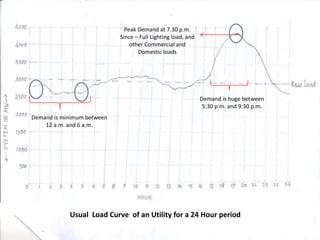
Demand is minimum between
12 a.m. and 6 a.m.
Demand is huge between
5:30 p.m. and 9:30 p.m.
Peak Demand at 7.30 p.m.
Since – Full Lighting load, and
other Commercial and
Domestic loads
7
Usual Load Curve of an Utility for a 24 Hour period
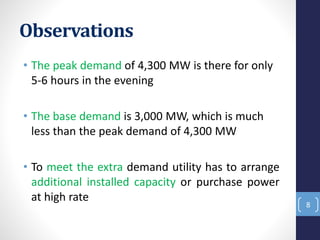
Observations
• The peak demand of 4,300 MW is there for only
5-6 hours in the evening
• The base demand is 3,000 MW, which is much
less than the peak demand of 4,300 MW
• To meet the extra demand utility has to arrange
additional installed capacity or purchase power
at high rate
8
Observations …..(contd.)
• Thus utility will always try to encourage
consumers to:
-Use less energy during Peak hours (Peak
Clipping)
-Shift energy use to off peak hours (Valley
Filling)
9
Therefore consumers too have a very
important role to play for achieving the
objectives of DSM
10
DSM
Utility
Consum
er
HOW TO DO DSM?
• To charge higher prices during Peak Hours
• Improving the efficiency of various end uses by
using energy efficient appliances, better house
keeping and reducing energy leakages.
• This is important for agriculture where energy
efficiency is very low (30-50%)
• Promoting use of Energy Efficient Technologies
11
ROLE OF SMART METER
• Smart meter allows continuous metering and
distance reading of the energy consumption
• In order to give consumers offers that reflect actual
consumption and to have flexible energy demand
• DSI(Demand Side Integration) can be provided by
smart metering
• In addition, load control switches, controllable
thermostats, lighting controls and adjustable
speed drives are required.
• Such equipment receives signals such as alarms or
price signals and controls loads accordingly
12
• Load control switches
• A load control switch is an electronic apparatus
which consists of a communication module and a
relay
• It is wired into the control circuit of an air
conditioning system, a water heater or a piece of
thermal comfort equipment
• The communication module is used to receive
control signals from the DSI program operator
13
• Controllable thermostats
This type of apparatus combines a communication
module with a controllable thermostat, and
replaces conventional thermostats such as those
on air conditioning systems or water heaters
• DSI program operator (or a HAN) can increase or
decrease the temperature set point through the
communication module
• Lighting control
Lighting control equipment is used to manage the
energy used by lighting in a more efficient way.
14
• Adjustable speed drives
ASDs allow electric motors driving pumps,
ventilation units and compressors to function
over a continuous speed range
• The loads of the majority of motorised appliances
change over time and equipment is often
operated at less than full load
• Allows the motors to satisfy the required
functioning conditions and to economise power
and energy use when the system is not
functioning at its maximum load
15
Types of DSM Measures
• Energy reduction programmes—reducing
demand through more efficient processes,
buildings or equipment
• Load management programmes—changing the
load pattern and encouraging less demand at peak
times and peak rates
• Load growth and conservation programmes
16
Energy Reduction Programmes
• Improving performance of boilers, steam
systems, etc.
• Efficient lighting
– CFLs
– Using natural light
• Appliance labelling
• Building regulations
– Efficient and alternative energy use
• Efficient use of electric motors
• Preventative maintenance 17
Energy Reduction Programmes
• Energy management
– Energy purchasing
– Metering and billing
– Performance measurement
– Energy policy development
– Energy surveying and auditing
– Awareness-raising, training and education
– Capital investment management
• Hiring an energy planner
• Housekeeping
– No cost / low cost measures
– Measures requiring some level of investment
• Energy auditing
– Preliminary audit
– Detailed audit
– Financial analysis
18
Load Management Measures
• Load levelling:
– Peak clipping
– Valley filling
– Load shifting
• Load control:
– Loads (e.g. heating, cooling, ventilation, and
lighting) switched on or off, often remotely, by the
utility
• Tariff incentives or penalties:
– Time-of-use & real time pricing
– Power factor penalties 19
Load Growth and Conservation
Programmes
• Growth diverting other energy sources (fuel) to
better (more efficient) electrical sources
• Growth strengthens the utilities capability to
load manage
• Conservation results in a reduction in sales as
well as a change in the pattern of use
20
DSM Programme Challenges
• Developing countries
– Awareness
– Technical capabilities
• Production and safety constraints
• Financing constraints
21
Benefits of Demand Side
Management
•
22
Customer Benefits Utility Benefits Societal Benefits
Satisfy electricity
demands Lower cost of service
Reduce
environmental
degradation
Reduce / stabilize
costs or electricity bill
Improve operating
efficiency,
Flexibility
Conserve resources
Maintain/improve
lifestyle and
productivity
Improve customer
service
Protect global
environment
CONCLUSIONS
• DSM is important for enabling the more efficient use of
base load capacity
• It mitigates electrical system emergencies
• Significant economic, system reliability and
environmental benefits
• Cheap, fast way to solve electricity problems
• Market DSM programmes to show potential customers
their life cycle benefits and often simple techniques for
reducing demand
23
THANK YOU
24

demand side management

  • 1.
    Demand Side Management 1 PRESENTEDBY : STUTI CHAKRABORTY IIIT,BHUBANESWAR
  • 2.
    WHAT IS DEMANDSIDE MANAGEMENT? • “Demand Side Management” is the modification of consumer’s demand of electricity through various methods such as financial incentives and consumer education • DSM refers to “Actions taken on the customer's side of the meter to change the amount or timing of energy consumption. Electricity DSM strategies have the goal of maximizing end-use efficiency to avoid or postpone the construction of new generating plants." [USA Department of Energy] 2
  • 3.
    3 • Cost reductionof meeting energy demand • Environmental and social improvement- -Reduced emissions • Reliability and network issues—improve reliability and defer expansion • Improved markets—demand response • Improved national energy security Why Promote DSM?
  • 4.
    What Drives DSM? •Cost reduction and environment: – Reduce utility costs / customer costs – Rising fuel prices – Opposition/financial limitation to building new plants – emission/environmental concerns • Network and market – Delay or avoid expansion – Competition – Demand shifting 4
  • 5.
    Need for DSM •Saving 1 unit of electricity at consumer end avoids nearly 2.5 times of capacity addition • 1 MW capacity addition of thermal power requires Rs 6 crores for installation and another Rs 3 crores for Transmission and Distribution 5
  • 6.
    Need for DSM…..(contd.) • Increasing energy requirement • Increasing threat of climate change and other environmental considerations • Energy security • Lack of other supply options • Huge scope for energy efficiency measures 6
  • 7.
    Demand is minimumbetween 12 a.m. and 6 a.m. Demand is huge between 5:30 p.m. and 9:30 p.m. Peak Demand at 7.30 p.m. Since – Full Lighting load, and other Commercial and Domestic loads 7 Usual Load Curve of an Utility for a 24 Hour period
  • 8.
    Observations • The peakdemand of 4,300 MW is there for only 5-6 hours in the evening • The base demand is 3,000 MW, which is much less than the peak demand of 4,300 MW • To meet the extra demand utility has to arrange additional installed capacity or purchase power at high rate 8
  • 9.
    Observations …..(contd.) • Thusutility will always try to encourage consumers to: -Use less energy during Peak hours (Peak Clipping) -Shift energy use to off peak hours (Valley Filling) 9
  • 10.
    Therefore consumers toohave a very important role to play for achieving the objectives of DSM 10 DSM Utility Consum er
  • 11.
    HOW TO DODSM? • To charge higher prices during Peak Hours • Improving the efficiency of various end uses by using energy efficient appliances, better house keeping and reducing energy leakages. • This is important for agriculture where energy efficiency is very low (30-50%) • Promoting use of Energy Efficient Technologies 11
  • 12.
    ROLE OF SMARTMETER • Smart meter allows continuous metering and distance reading of the energy consumption • In order to give consumers offers that reflect actual consumption and to have flexible energy demand • DSI(Demand Side Integration) can be provided by smart metering • In addition, load control switches, controllable thermostats, lighting controls and adjustable speed drives are required. • Such equipment receives signals such as alarms or price signals and controls loads accordingly 12
  • 13.
    • Load controlswitches • A load control switch is an electronic apparatus which consists of a communication module and a relay • It is wired into the control circuit of an air conditioning system, a water heater or a piece of thermal comfort equipment • The communication module is used to receive control signals from the DSI program operator 13
  • 14.
    • Controllable thermostats Thistype of apparatus combines a communication module with a controllable thermostat, and replaces conventional thermostats such as those on air conditioning systems or water heaters • DSI program operator (or a HAN) can increase or decrease the temperature set point through the communication module • Lighting control Lighting control equipment is used to manage the energy used by lighting in a more efficient way. 14
  • 15.
    • Adjustable speeddrives ASDs allow electric motors driving pumps, ventilation units and compressors to function over a continuous speed range • The loads of the majority of motorised appliances change over time and equipment is often operated at less than full load • Allows the motors to satisfy the required functioning conditions and to economise power and energy use when the system is not functioning at its maximum load 15
  • 16.
    Types of DSMMeasures • Energy reduction programmes—reducing demand through more efficient processes, buildings or equipment • Load management programmes—changing the load pattern and encouraging less demand at peak times and peak rates • Load growth and conservation programmes 16
  • 17.
    Energy Reduction Programmes •Improving performance of boilers, steam systems, etc. • Efficient lighting – CFLs – Using natural light • Appliance labelling • Building regulations – Efficient and alternative energy use • Efficient use of electric motors • Preventative maintenance 17
  • 18.
    Energy Reduction Programmes •Energy management – Energy purchasing – Metering and billing – Performance measurement – Energy policy development – Energy surveying and auditing – Awareness-raising, training and education – Capital investment management • Hiring an energy planner • Housekeeping – No cost / low cost measures – Measures requiring some level of investment • Energy auditing – Preliminary audit – Detailed audit – Financial analysis 18
  • 19.
    Load Management Measures •Load levelling: – Peak clipping – Valley filling – Load shifting • Load control: – Loads (e.g. heating, cooling, ventilation, and lighting) switched on or off, often remotely, by the utility • Tariff incentives or penalties: – Time-of-use & real time pricing – Power factor penalties 19
  • 20.
    Load Growth andConservation Programmes • Growth diverting other energy sources (fuel) to better (more efficient) electrical sources • Growth strengthens the utilities capability to load manage • Conservation results in a reduction in sales as well as a change in the pattern of use 20
  • 21.
    DSM Programme Challenges •Developing countries – Awareness – Technical capabilities • Production and safety constraints • Financing constraints 21
  • 22.
    Benefits of DemandSide Management • 22 Customer Benefits Utility Benefits Societal Benefits Satisfy electricity demands Lower cost of service Reduce environmental degradation Reduce / stabilize costs or electricity bill Improve operating efficiency, Flexibility Conserve resources Maintain/improve lifestyle and productivity Improve customer service Protect global environment
  • 23.
    CONCLUSIONS • DSM isimportant for enabling the more efficient use of base load capacity • It mitigates electrical system emergencies • Significant economic, system reliability and environmental benefits • Cheap, fast way to solve electricity problems • Market DSM programmes to show potential customers their life cycle benefits and often simple techniques for reducing demand 23
  • 24.