Alwyn A. John
Energy Management Coordinator
                  TST BOCES
Agenda
 Making the case for energy efficiency
 Understanding your district’s energy bills
 Renewable energy and alternative
  technologies
 Understanding funding opportunities
 Identifying low cost/no cost opportunities
  to reduce cost

                                               2
1

Making the case for energy
        efficiency


                             3
Why is Energy Management
           Important?

     “Good Energy Management is Good Business”

The evidence is clear that for both public and private k12
 schools, adopting an energy management strategy is a
 business decision you cannot afford to ignore.


                                                             4
Signs of Energy Waste in
         Commercial Buildings
 A 400% variation in energy use intensity of buildings in the United
  States exists that is not explained by age, technology, hours, size,
  climate.

 Little improvement of overall energy consumption has been seen
  although building components are 30% more efficient since 1980.

 Over-sizing of building fan systems, on average, occurs by 60%.


 Most chillers are oversized by 50–200%.

                     • - EPA


                                                                         5
Signs of Energy Waste in K12
            Buildings
 EPA/Energy Star Statistics:

    The annual energy bill to run America’s primary and secondary
     schools a staggering $6 Billion. $1 out of every $4 spent on energy by
     US schools is wasted. Conservative 25% = $1.5 Billion annually.

    Energy cost total between 1.5% to 3.5% of a typical school district’s
     annual budget. Energy is often second only to staff salaries – more
     than computers and textbooks combined.

    The least efficient schools use three times (3x) more energy than
     the best energy performers

    Top performing ENERGY STAR labeled schools cost forty cents per
     square foot less to operate than the average performers.

                                                                              6
Strong Energy Management
          = Real Savings
 Ford Motor Company has saved over $75 million through effective
  energy management.

 Eastman Kodak saved more than $8.6 million in operating costs in
  2002 from its energy management efforts.

 Fairfax County Public Schools (VA)estimates an annual energy
  savings of $4.5 million (7.19%) from energy efficiency improvements
  on a $62.6 million utilities budget (FY: 2011-12)

 In 2001, the first year of their Energy Management program, Sandy
  Creek CSD (NY) saved $300,000 on a $1.4 Million utility budget (~21%).
  Total of $2.7 Million in savings from 2001 to 2009.


                                                                           7
Pending Crisis
 Due to the recession, demand for energy supply is down,
 resulting in the lowest cost per unit of electricity in the last
 decade. Natural gas is also seeing record lows.
This is a TEMPORARY condition. Over time, usage demand
               will return and cost/unit will rise)

 Utility delivery (NYSEG, etc)companies are starting to shift
 rate structures to put a greater emphasis on peak demand
 usage. Over the next 5 years or so we can expect to see
 increasing peak demand charges and an elimination of the
 differential between day and night rates.
 When usage demand returns, we will be impacted by both
   increased cost/unit and increased peak demand charges

                                                                    8
Accessing Potential Lost Dollars
 By systematically implementing an Energy
 Management Plan, many school districts have been
 able to reduce energy consumption by 30% to 40%.

 The first 10% of reduction in energy use is possible
 with little or no cost.


                                                         9
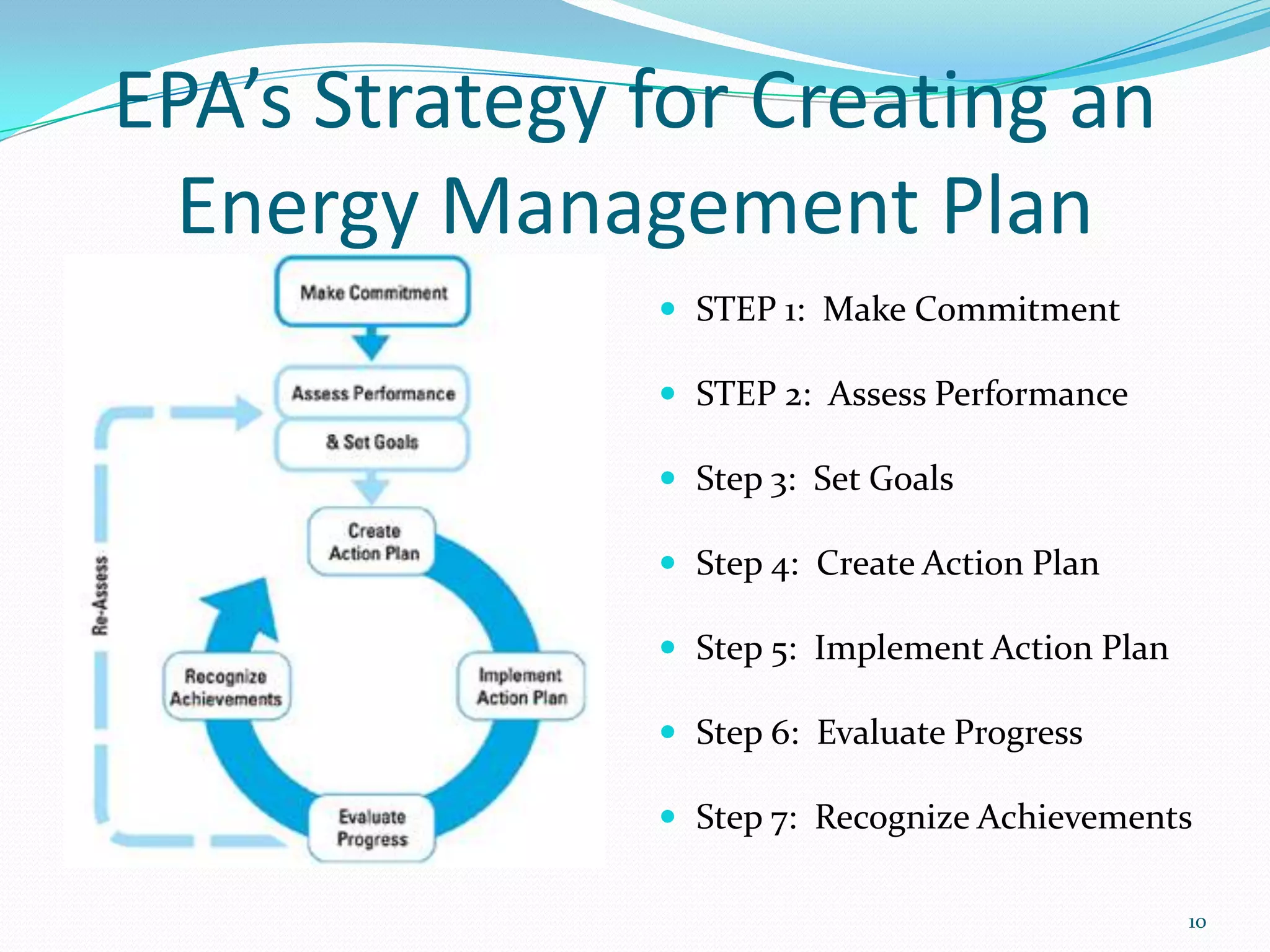
EPA’s Strategy for Creating an
  Energy Management Plan
                STEP 1: Make Commitment

                STEP 2: Assess Performance

                Step 3: Set Goals

                Step 4: Create Action Plan

                Step 5: Implement Action Plan

                Step 6: Evaluate Progress

                Step 7: Recognize Achievements

                                                 10
Key Elements of an Effective
    Energy Management Plan
 District wide energy related mission statement
 Defined heating /cooling set points and setbacks
 Defined access hours for midweek and weekends
 Defined path for requesting exceptions
 Adoption at the highest effective level of the District
 Identify local “Energy Champions”
 Easily measurable specific energy target (at the level of
  utility metering)
 Peer based energy targets – EPA Portfolio manager
  scoring, NYCHIPS,
                                                              11
Resources
 See Auxiliary Docs:
  “EPA_Guidelines_for_Energy_Management “

 www.energystar.gov/index.cfm?c=guidelines.guidelines_index
 www.energystar.gov/index.cfm?c=evaluate_performance.bus_po
  rtfoliomanager
 www.energystar.gov


                                                               12
2

 Understanding your district’s
         energy bills
1. Anatomy of a Utility Bill
2. Using Utility Data


                                   13
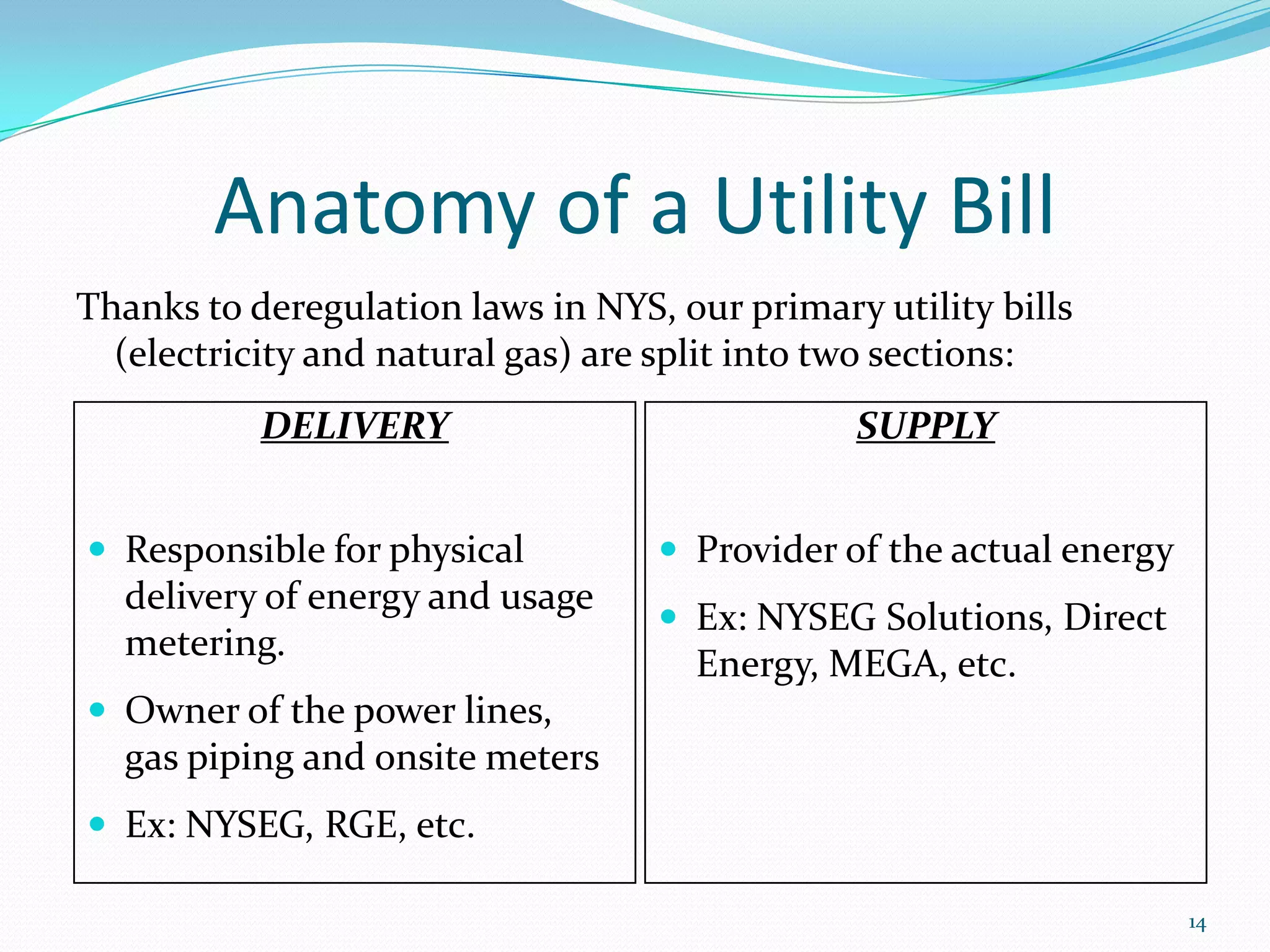
Anatomy of a Utility Bill
Thanks to deregulation laws in NYS, our primary utility bills
  (electricity and natural gas) are split into two sections:
           DELIVERY                            SUPPLY


 Responsible for physical          Provider of the actual energy
  delivery of energy and usage
                                    Ex: NYSEG Solutions, Direct
  metering.
                                     Energy, MEGA, etc.
 Owner of the power lines,
  gas piping and onsite meters
 Ex: NYSEG, RGE, etc.

                                                                     14
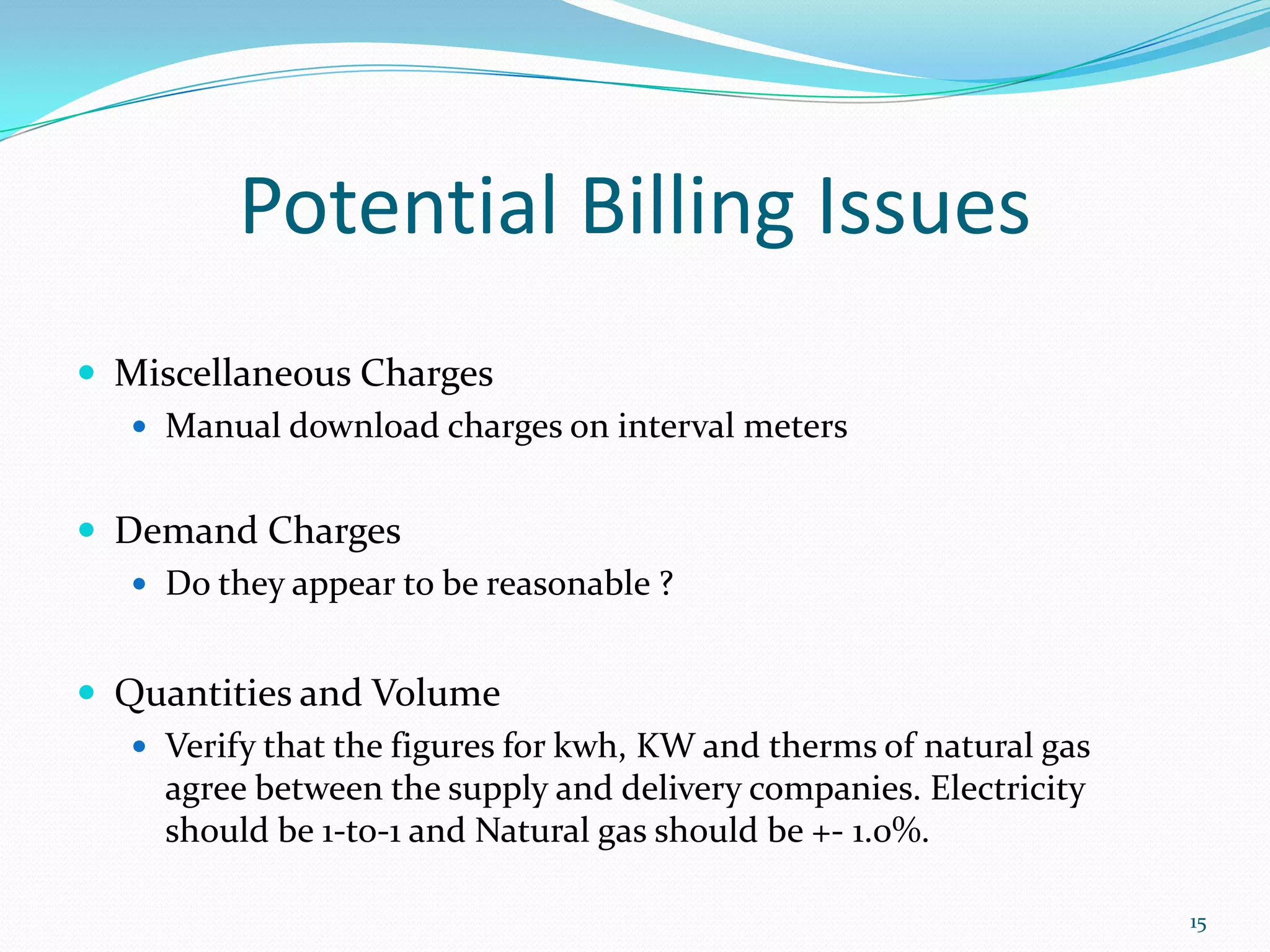
Potential Billing Issues
 Miscellaneous Charges
   Manual download charges on interval meters


 Demand Charges
    Do they appear to be reasonable ?


 Quantities and Volume
    Verify that the figures for kwh, KW and therms of natural gas
     agree between the supply and delivery companies. Electricity
     should be 1-to-1 and Natural gas should be +- 1.0%.

                                                                     15
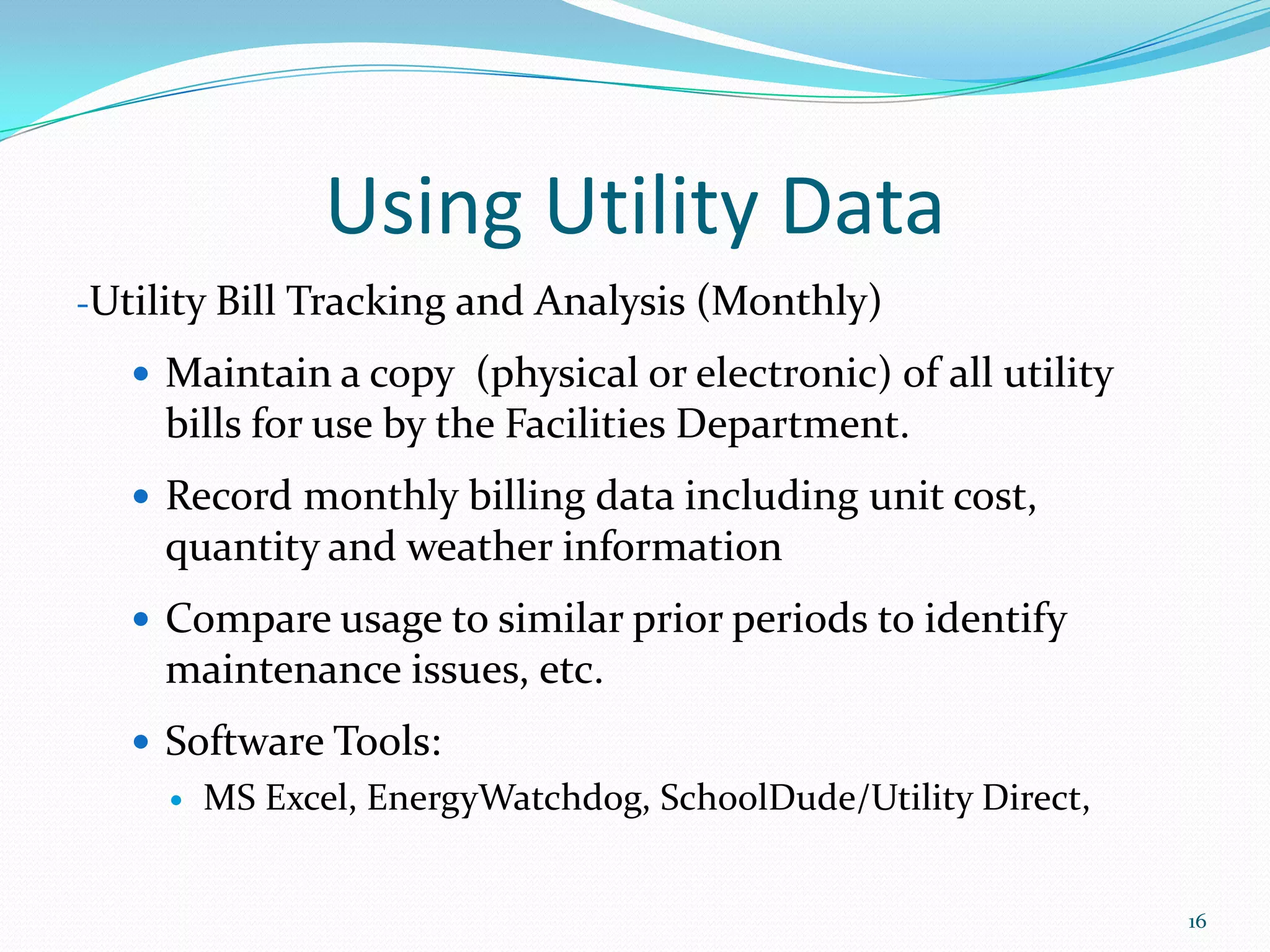
Using Utility Data
-Utility Bill Tracking and Analysis (Monthly)

    Maintain a copy (physical or electronic) of all utility
    bills for use by the Facilities Department.
    Record monthly billing data including unit cost,
    quantity and weather information
    Compare usage to similar prior periods to identify
    maintenance issues, etc.
    Software Tools:
        MS Excel, EnergyWatchdog, SchoolDude/Utility Direct,


                                                                16
Using Utility Data
-Benchmarking (annually)

 Confirm savings   from energy conservation investments
 Compare a building’s normalized performance vs. internal
 and external peers
 Software/Service Examples: NYSERDA’s Benchmarking
 program, EPA Portfolio Manager


                                                             17
3

Renewable energy and
alternative technologies


                           18
Renewable Energy
              Pros and Cons
 Solar and wind make good educational demonstration
 projects

 Often fail to save significant amounts of energy and do
 not provide reasonable pay back periods

 Things to look for:
     Life of equipment/Maintenance schedules vs. payback periods
     Have we fully explored all other energy conservation options
      for our buildings?


                                                                 19
Alternative Technologies
Leading Edge vs. Bleeding Edge
         Leading Edge                     Bleeding Edge
 T8 & T5 lighting                  LED interior lights
 Modulating/Condensing             Heat reflective white roofing
    Boilers                         Waterless urinals
   HVAC control software           Geothermal heating and
   Occupancy controls (lighting     cooling
    & HVAC)                         CoGen
   LED lights (in some
    situations)
   Utility analysis software
   Co Gen
                                                                     20
4

Understanding funding
     opportunities


                        21
NYSERDA
 CFA – Consolidated Funding Application – A single
  application that streamlines access to NYSERDA’s Grant
  program and possibly additional funding from other
  NYS agencies.
 Existing Facilities

 FlexTech

 CHIPS 2.0 – High efficiency school building standard
  for both new and retrofit building projects
 New opportunities in 2012


                                                           22
NYSEG/RGE & National Grid
 NYSEG/RGE
   Existing Facilities - Small Business Energy Efficiency
    Program – Less than 100,000 kwh/month. < 70%
    materials & labor.

 National Grid
   Existing Facilities – Lighting – < 50% materials & labor


 All utility delivery companies offer a Custom Measures
  Program
                                                               23
Energy Performance
               Contracting
 SED allows EPC agreements to go out a maximum of 18
  years.
 5 to 10 year EPC agreements are optimal

 Take advantage of SED $100,000.00 project incentive. C&S
  Companies of Syracuse has an innovative solution called
  “NET ZERO” that combines features of an EPC agreement
  with five $100,000.00 projects. Building aid + energy
  savings + grant money = $0.00 cost to district for over
  $500,000.00 worth of projects.
 Consider a “self-directed” EPC
                                                             24
5

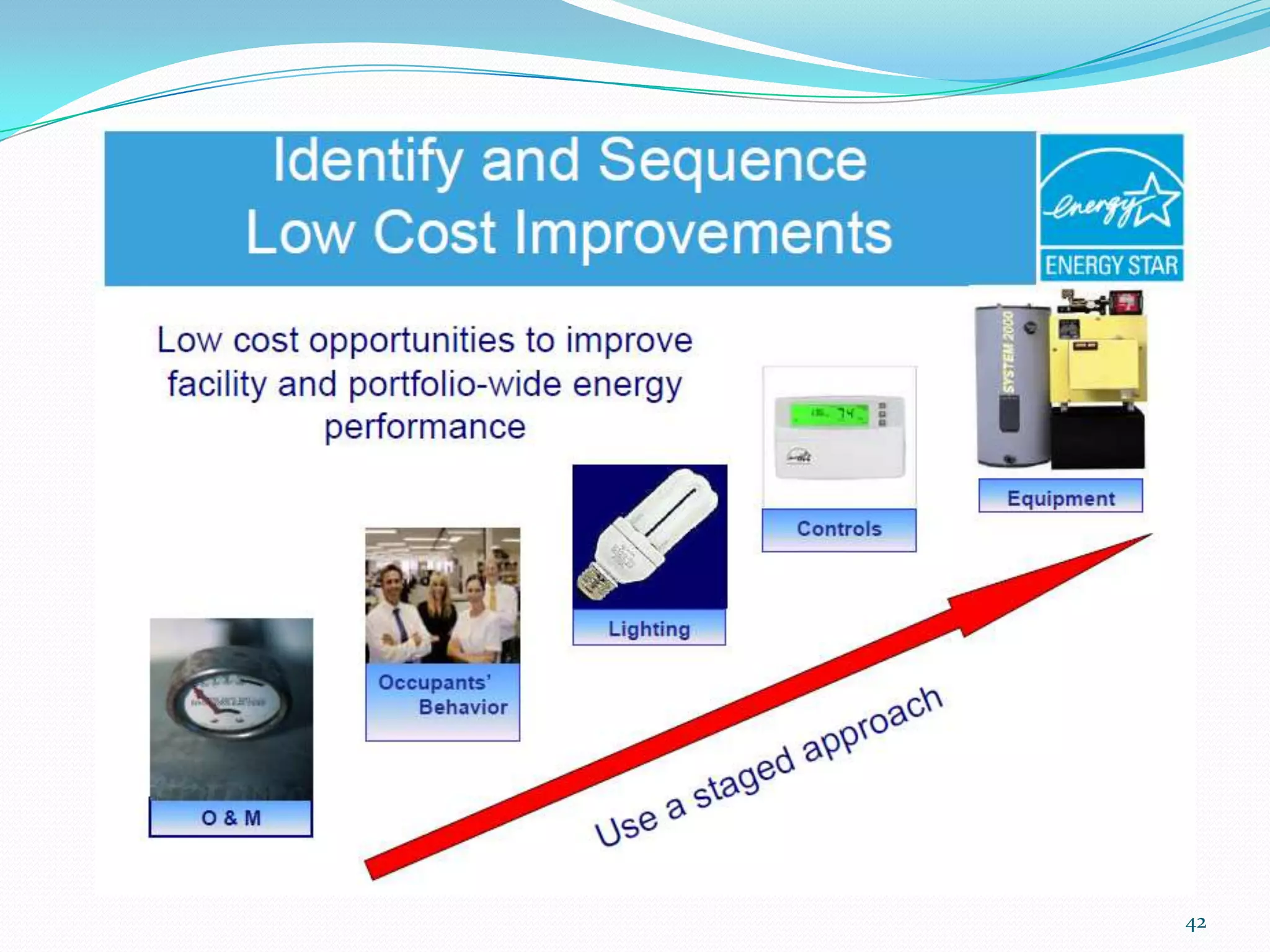
Identifying low cost/no cost
 opportunities to reduce cost


                                25
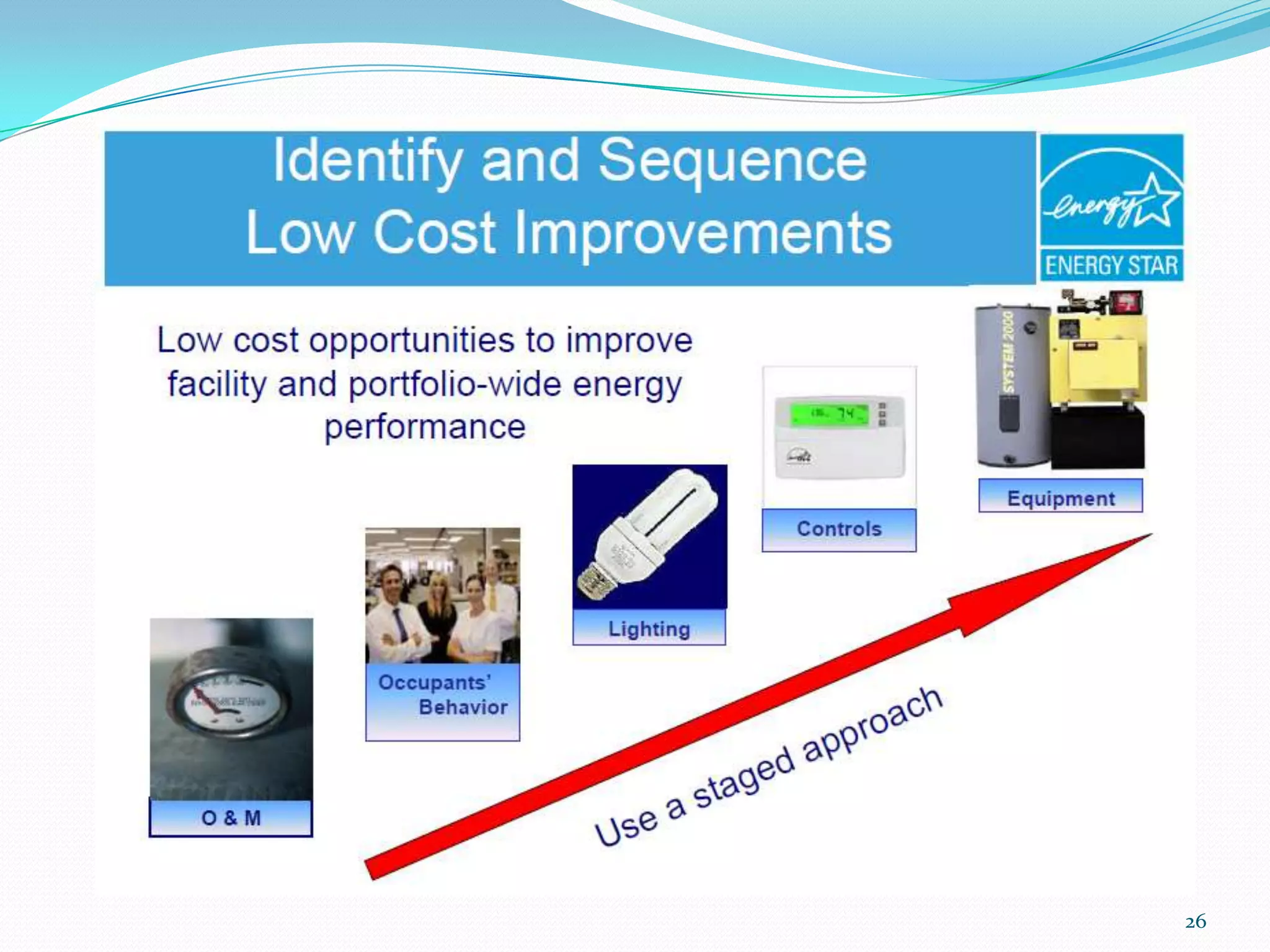
26
Operations & Maintenance
            Functioning as designed


            Calibrate thermostats


            Adjust dampers


            Janitorial services


                                       27
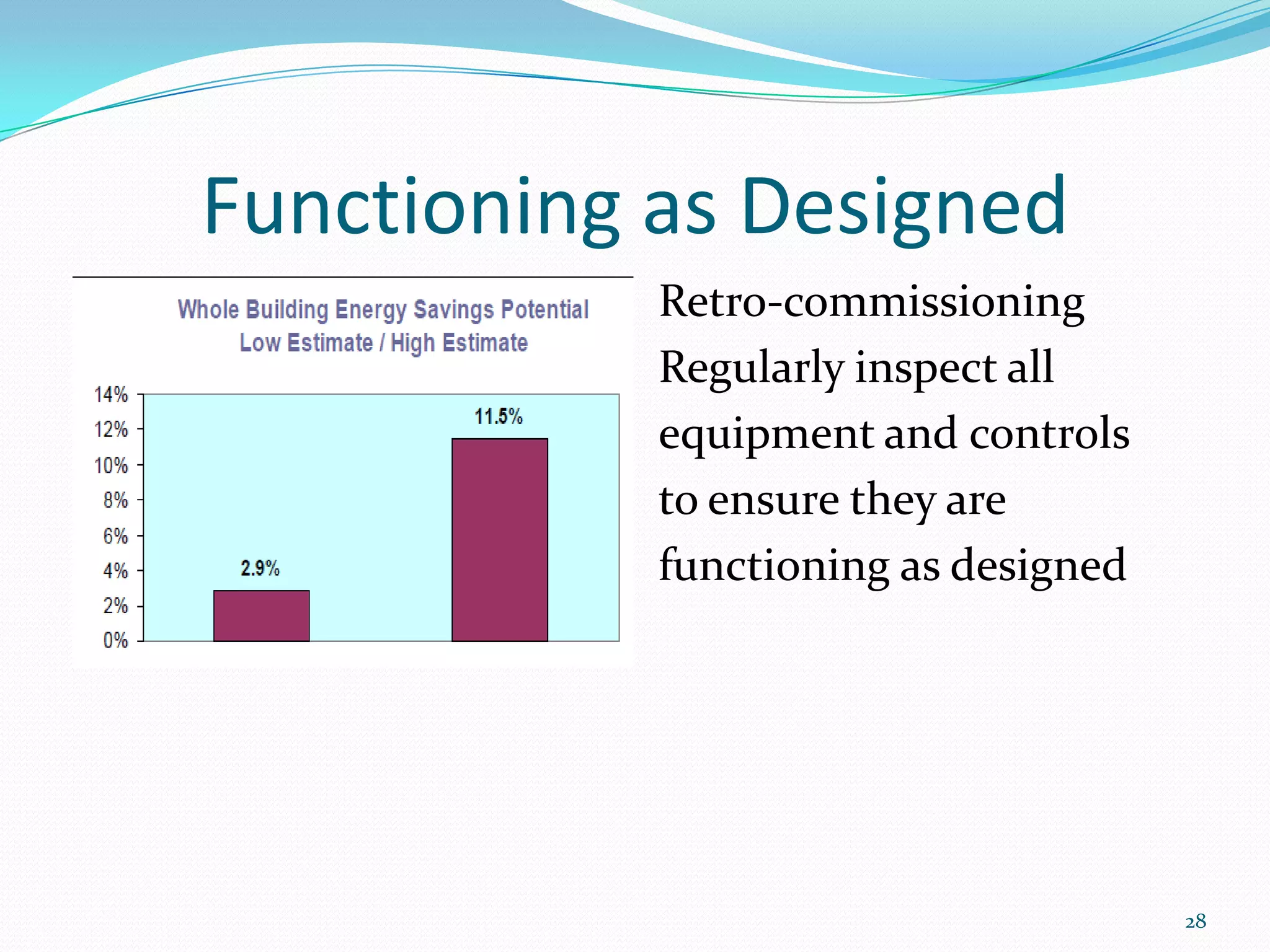
Functioning as Designed
            Retro-commissioning
            Regularly inspect all
            equipment and controls
            to ensure they are
            functioning as designed


                                      28
Functioning as Designed
 Example 1: New school building with regular power quality
  problems. Motors burning out, light fixtures failing early.
  Two years after construction, it was discovered that a power
  conditioner was installed as part of the original construction,
  but was never turned on.
 Example 2: Public school built around 1975 with pneumatic
  controls, with consistently high heating bills and
  increasingly more difficult to control temperature. Detailed
  physical inspection of unit ventilators revealed that in prior
  years as pneumatic controls failed, the outside air dampers
  where hardwired in the open position (either 100% or 75%
  open).
                                                               29
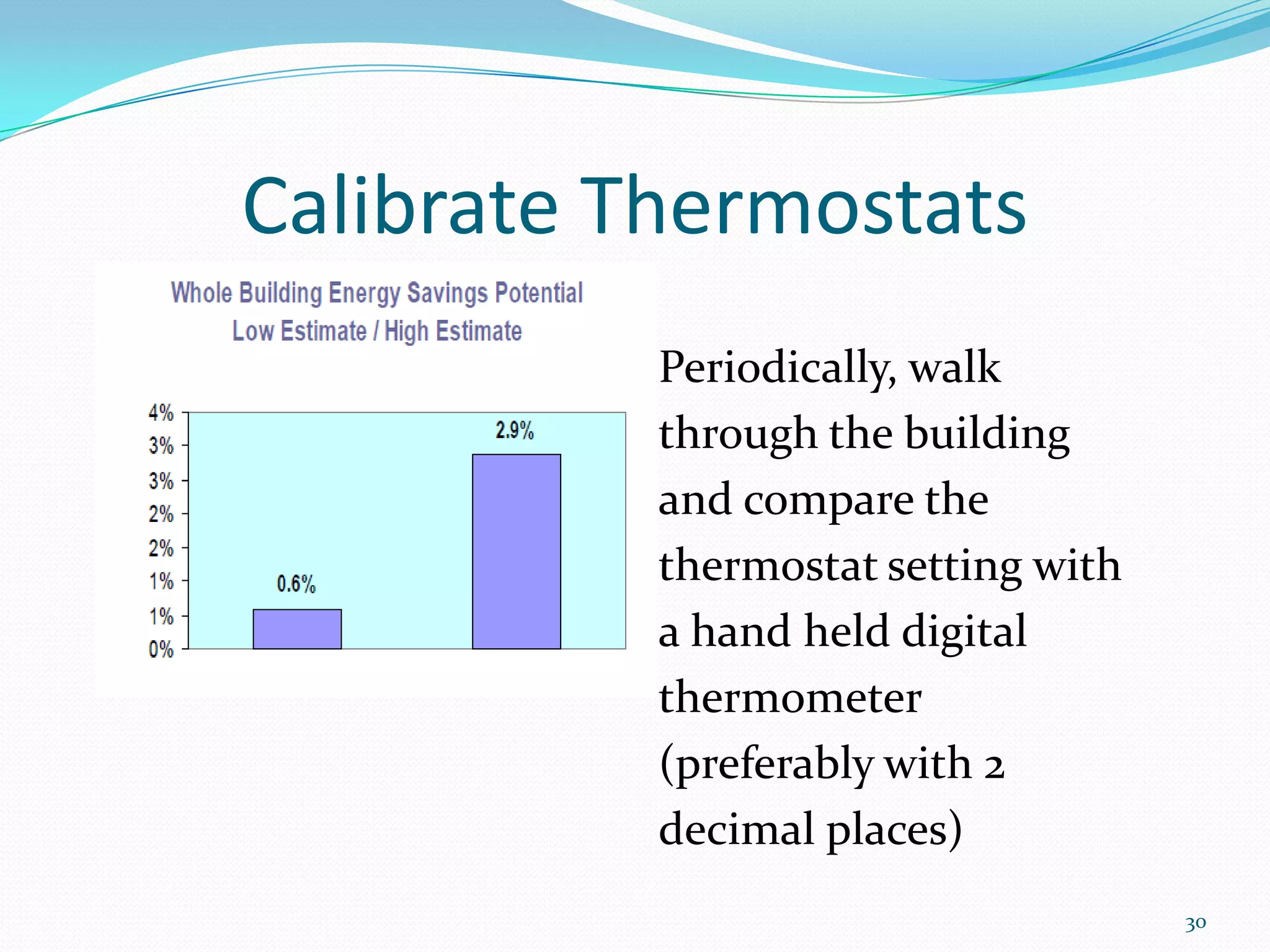
Calibrate Thermostats
           Periodically, walk
           through the building
           and compare the
           thermostat setting with
           a hand held digital
           thermometer
           (preferably with 2
           decimal places)
                                     30
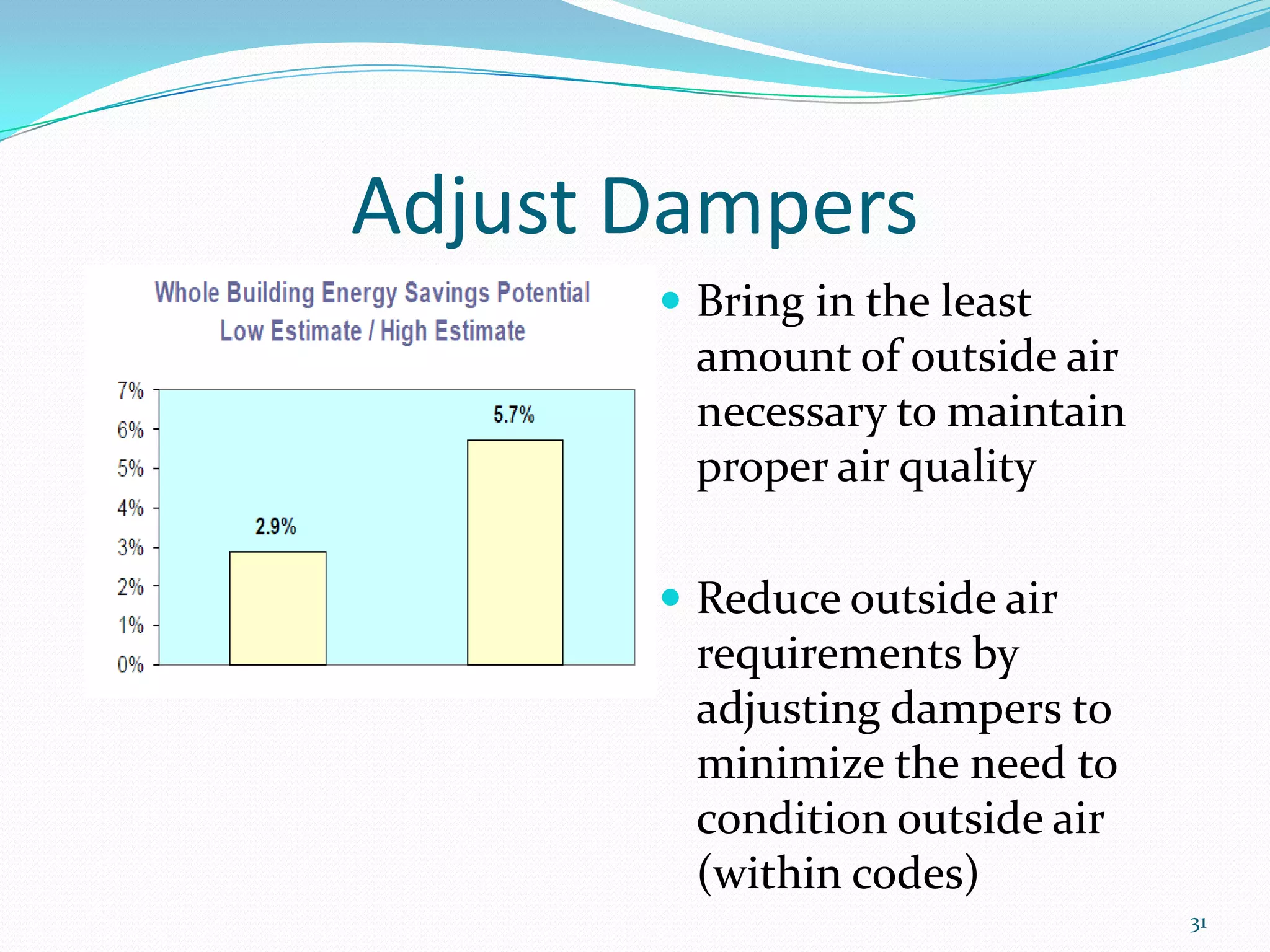
Adjust Dampers
        Bring in the least
         amount of outside air
         necessary to maintain
         proper air quality

        Reduce outside air
         requirements by
         adjusting dampers to
         minimize the need to
         condition outside air
         (within codes)
                                 31
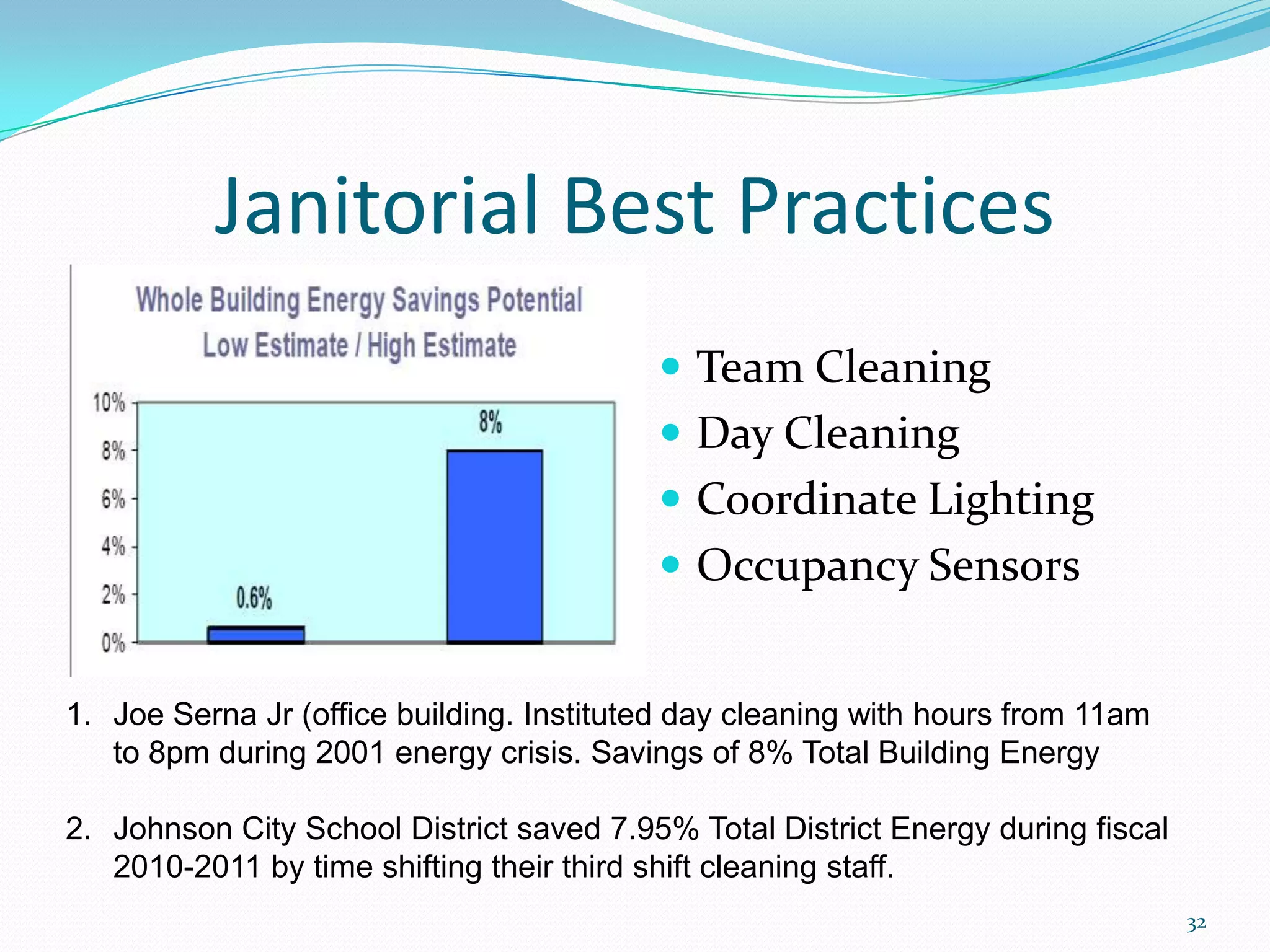
Janitorial Best Practices
                                           Team Cleaning
                                           Day Cleaning
                                           Coordinate Lighting
                                           Occupancy Sensors


1. Joe Serna Jr (office building. Instituted day cleaning with hours from 11am
   to 8pm during 2001 energy crisis. Savings of 8% Total Building Energy
2. Johnson City School District saved 7.95% Total District Energy during fiscal
   2010-2011 by time shifting their third shift cleaning staff.
                                                                                  32
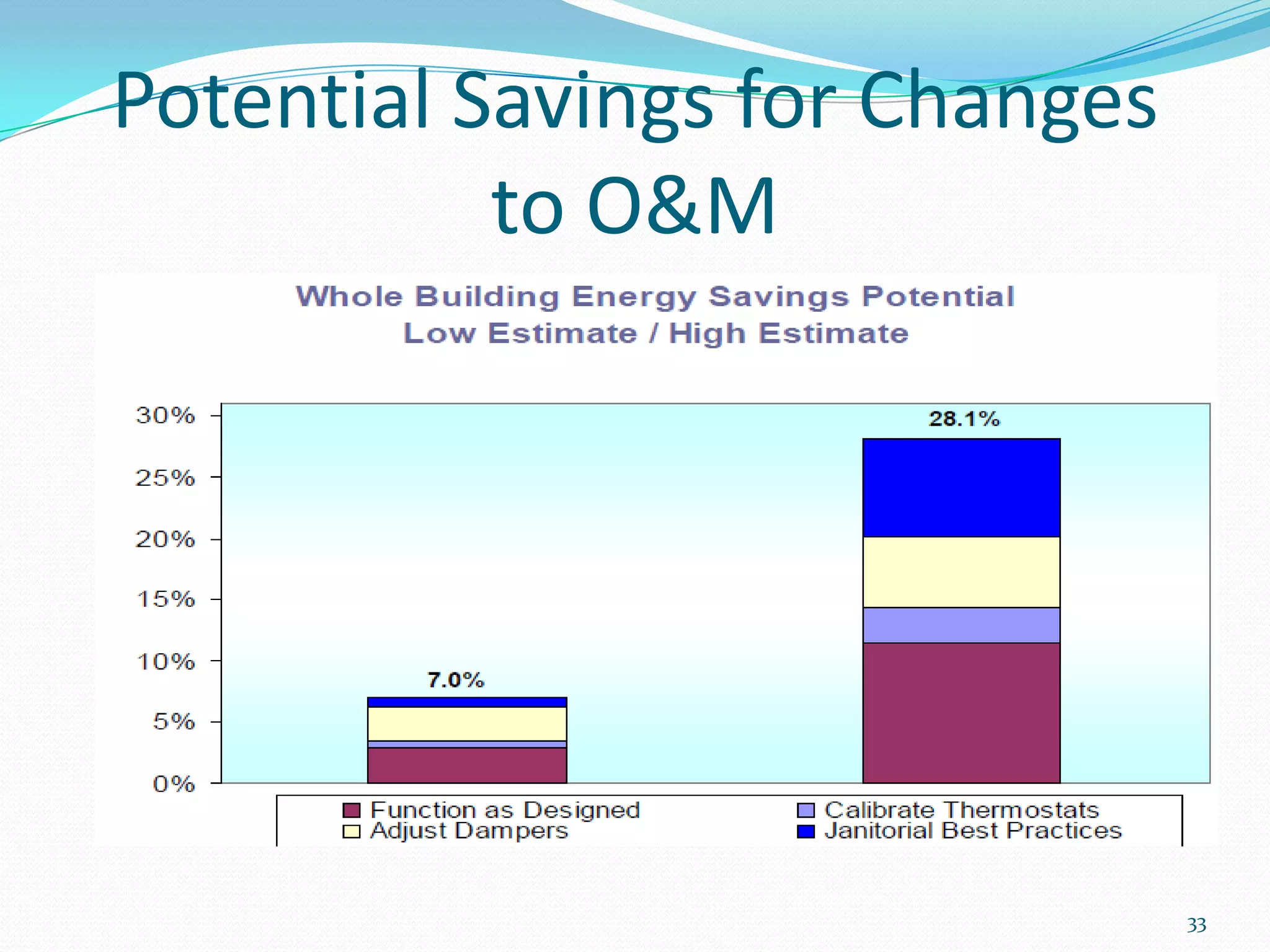
Potential Savings for Changes
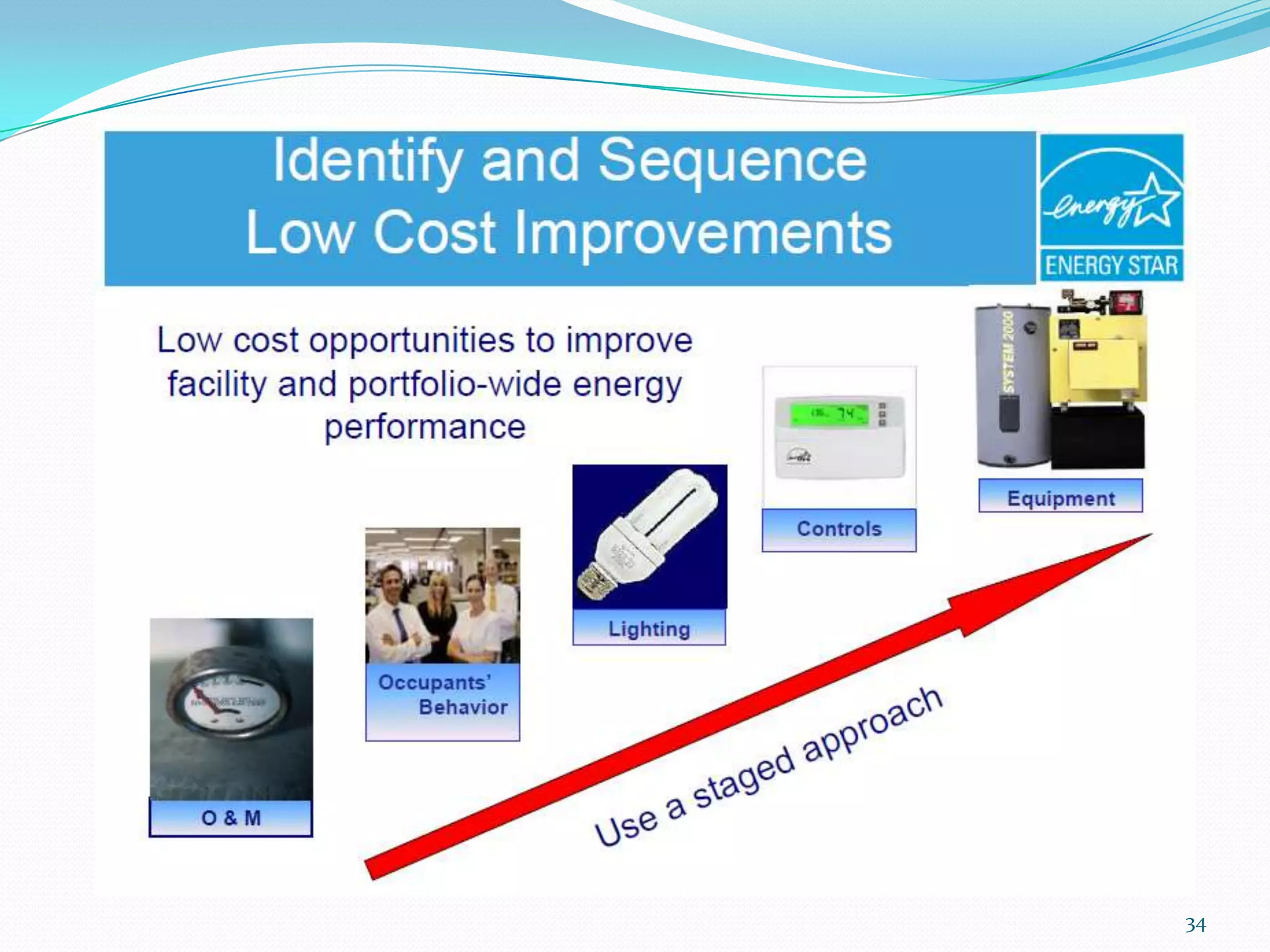
           to O&M


                                33
34
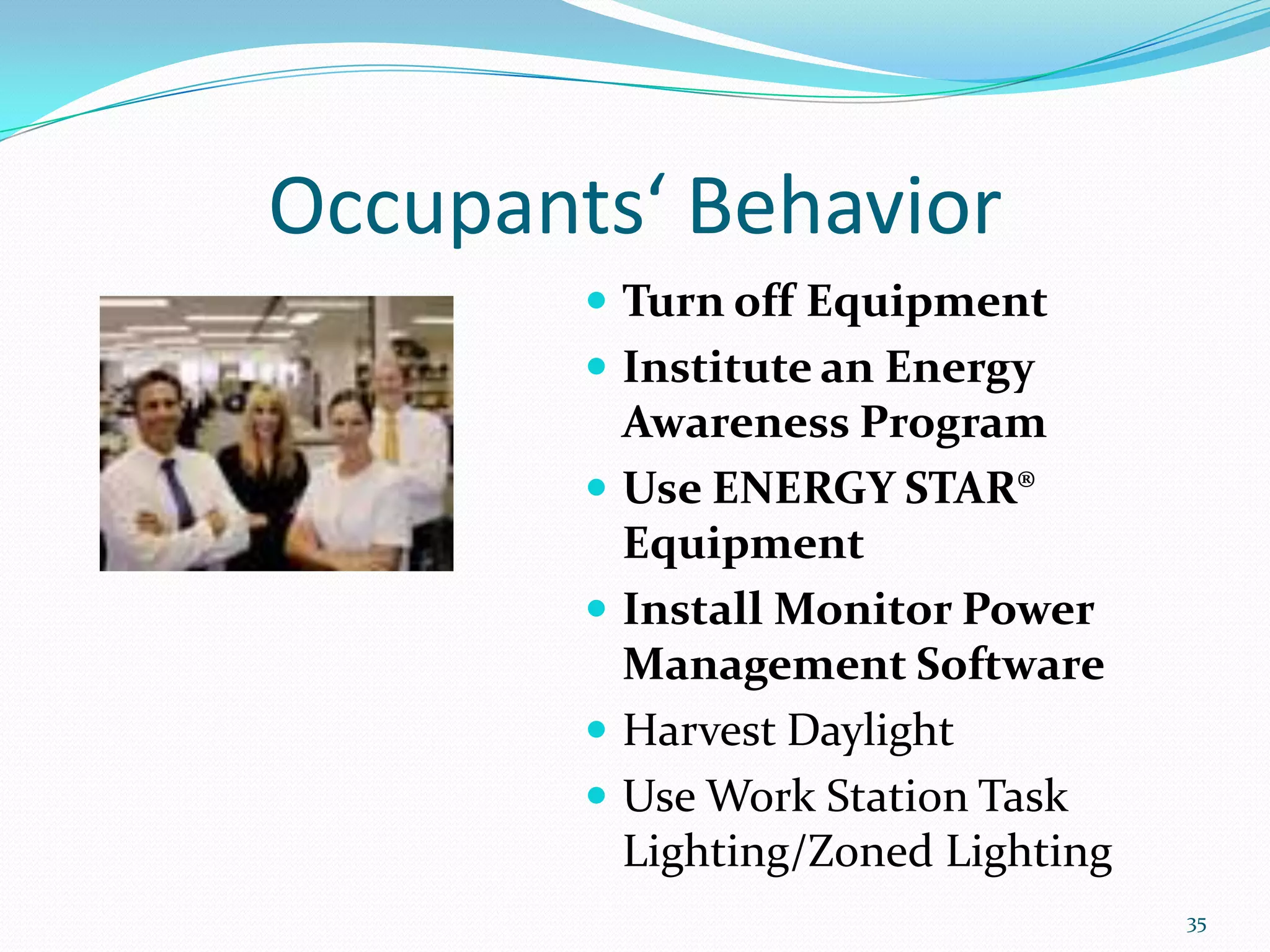
Occupants‘ Behavior
         Turn off Equipment
         Institute an Energy
          Awareness Program
         Use ENERGY STAR®
          Equipment
         Install Monitor Power
          Management Software
         Harvest Daylight
         Use Work Station Task
          Lighting/Zoned Lighting
                                    35
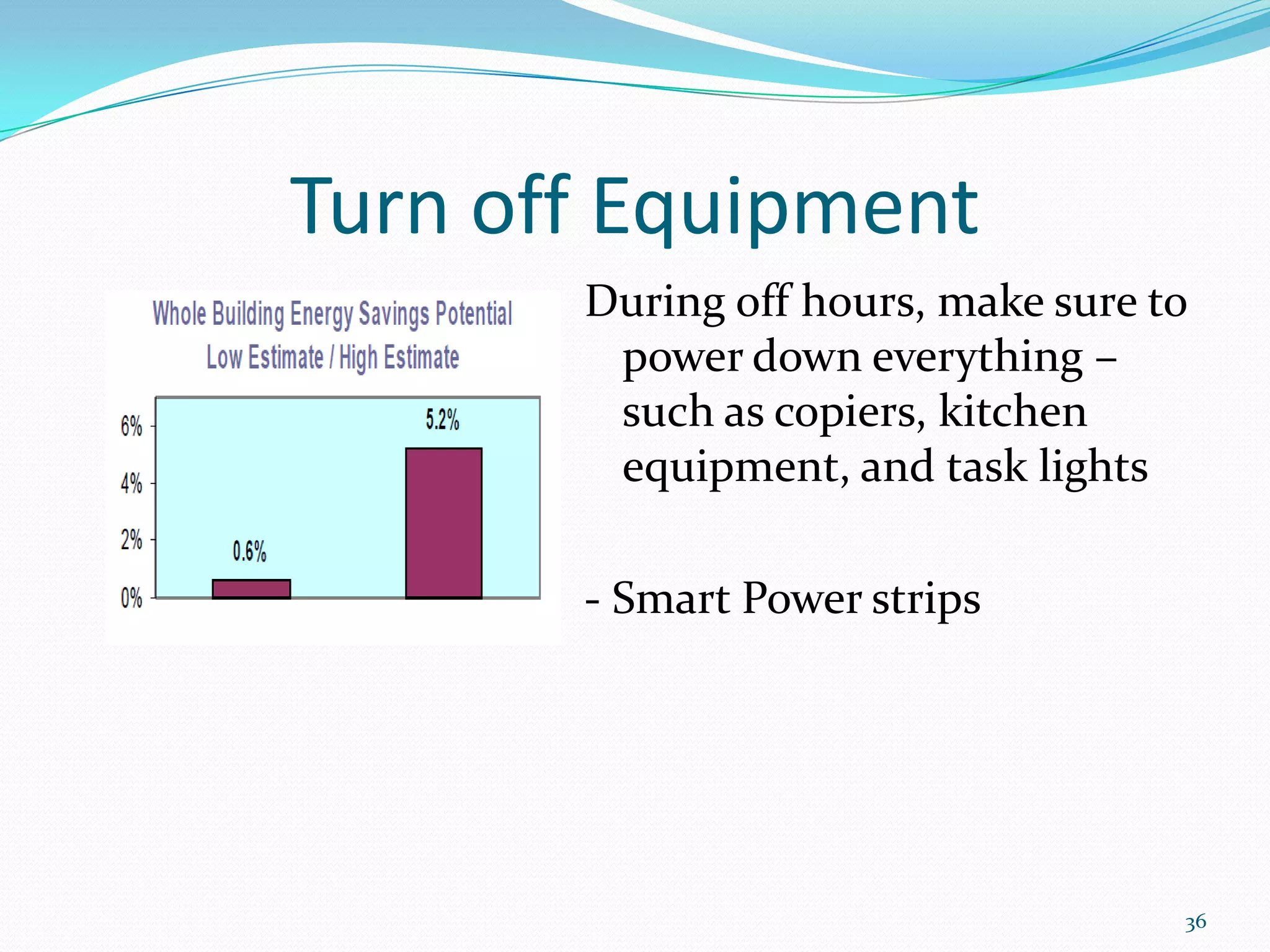
Turn off Equipment
       During off hours, make sure to
        power down everything –
        such as copiers, kitchen
        equipment, and task lights

       - Smart Power strips


                                    36
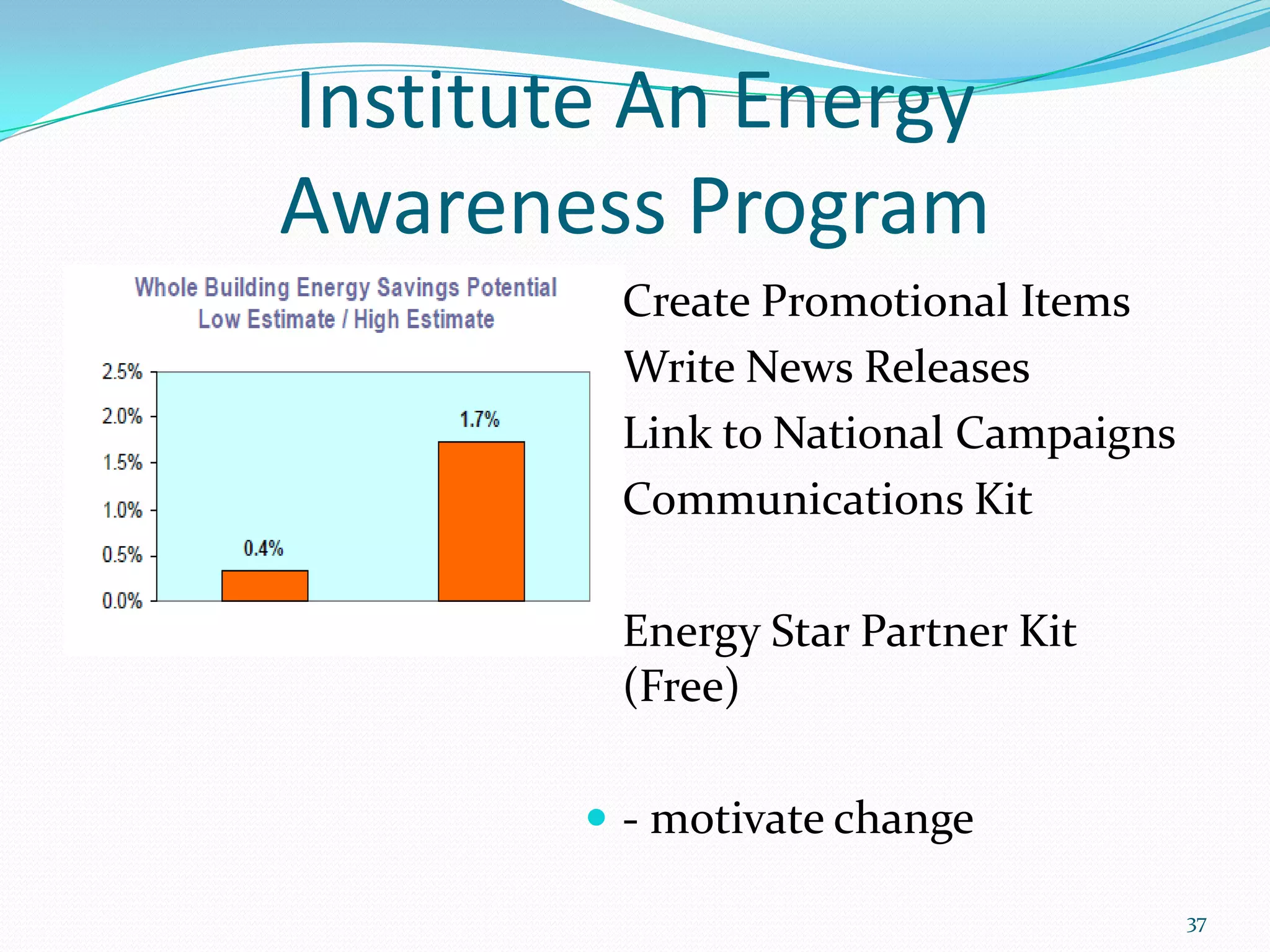
Institute An Energy
Awareness Program
         Create Promotional Items
         Write News Releases
         Link to National Campaigns
         Communications Kit


         Energy Star Partner Kit
         (Free)

         - motivate change

                                       37
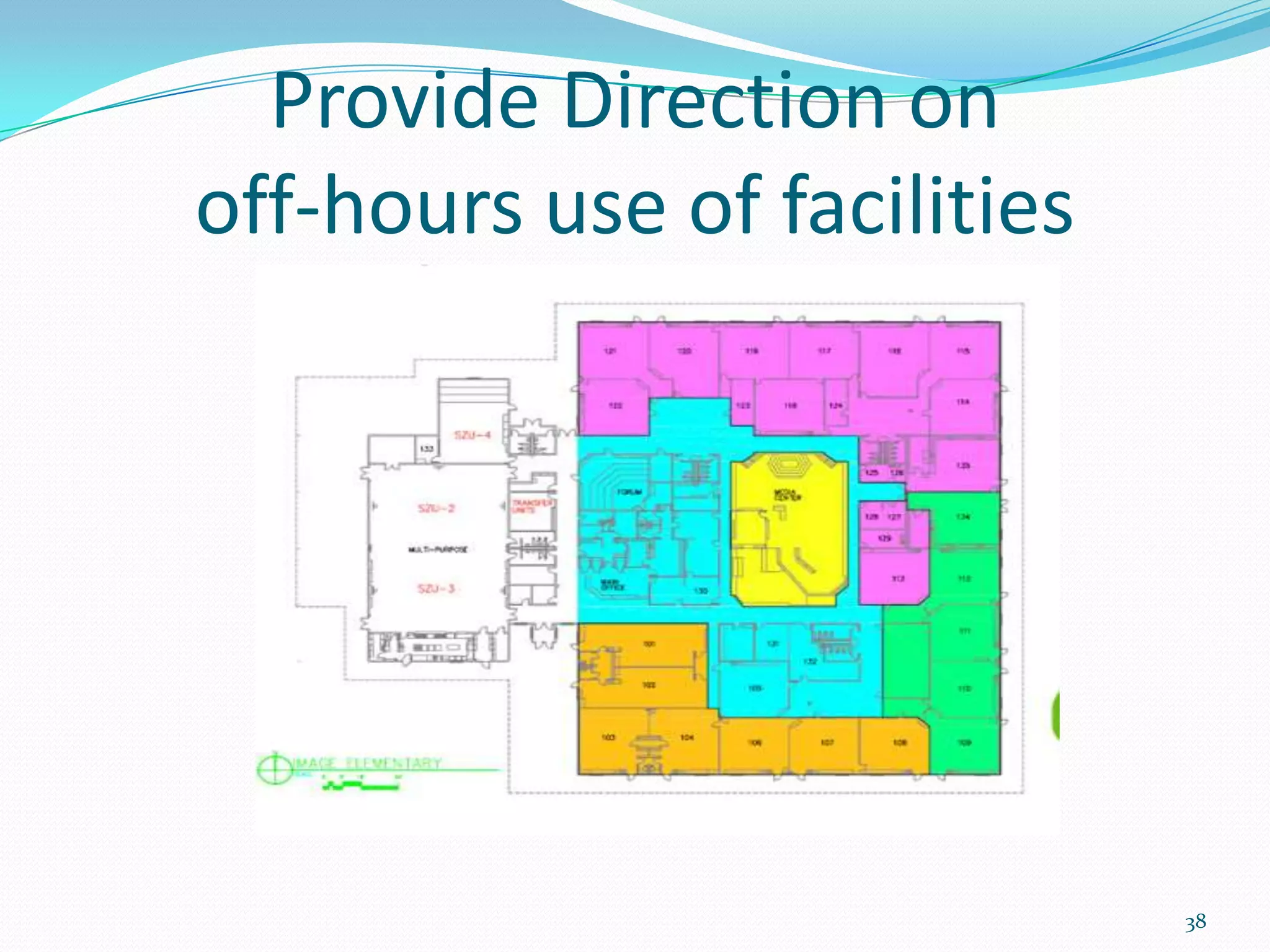
Provide Direction on
off-hours use of facilities


                              38
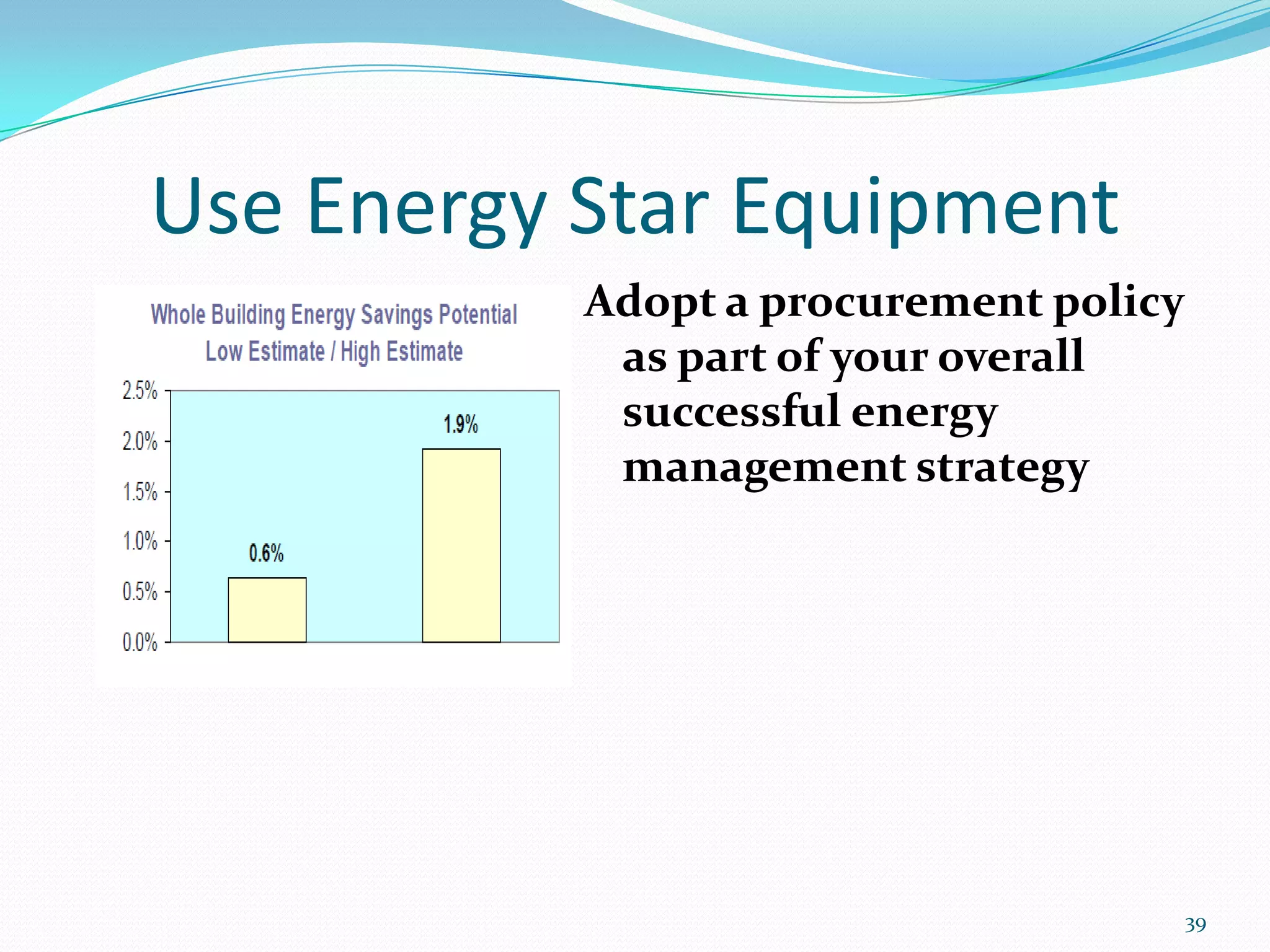
Use Energy Star Equipment
           Adopt a procurement policy
            as part of your overall
            successful energy
            management strategy


                                        39
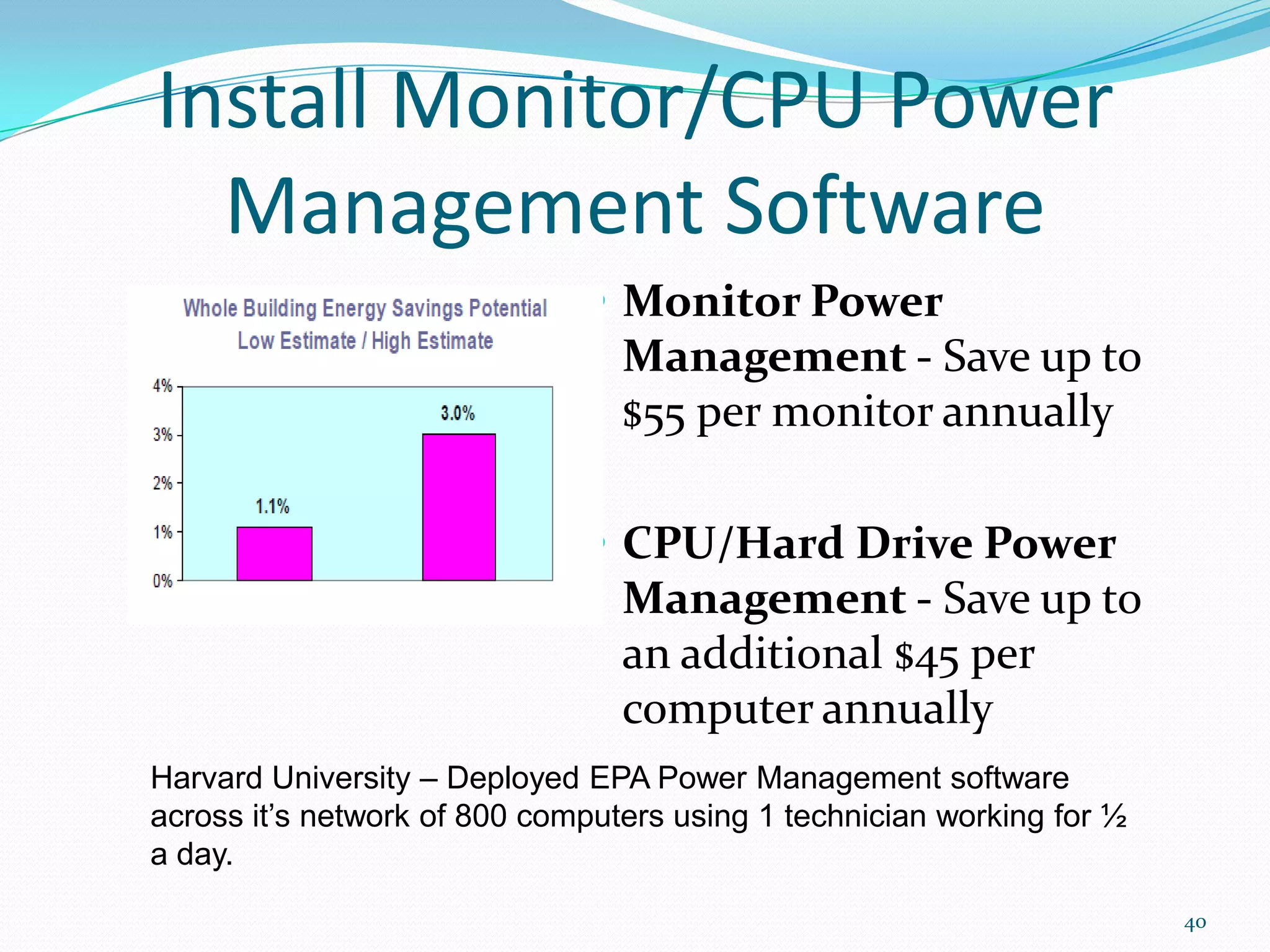
Install Monitor/CPU Power
  Management Software
                               Monitor Power
                                 Management - Save up to
                                 $55 per monitor annually

                               CPU/Hard Drive Power
                                 Management - Save up to
                                 an additional $45 per
                                 computer annually
Harvard University – Deployed EPA Power Management software
across it’s network of 800 computers using 1 technician working for ½
a day.
                                                                        40
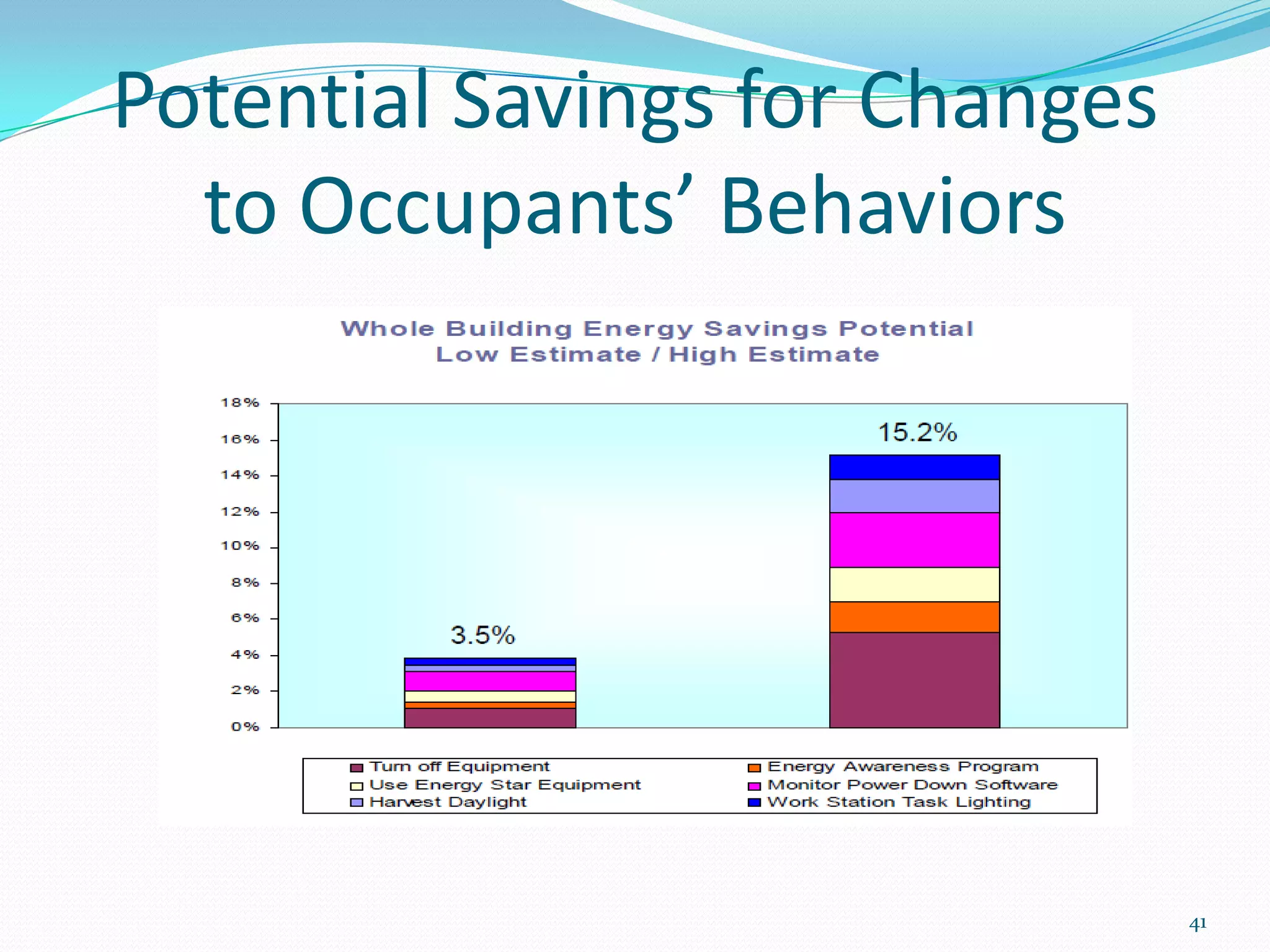
Potential Savings for Changes
  to Occupants’ Behaviors


                                41
42
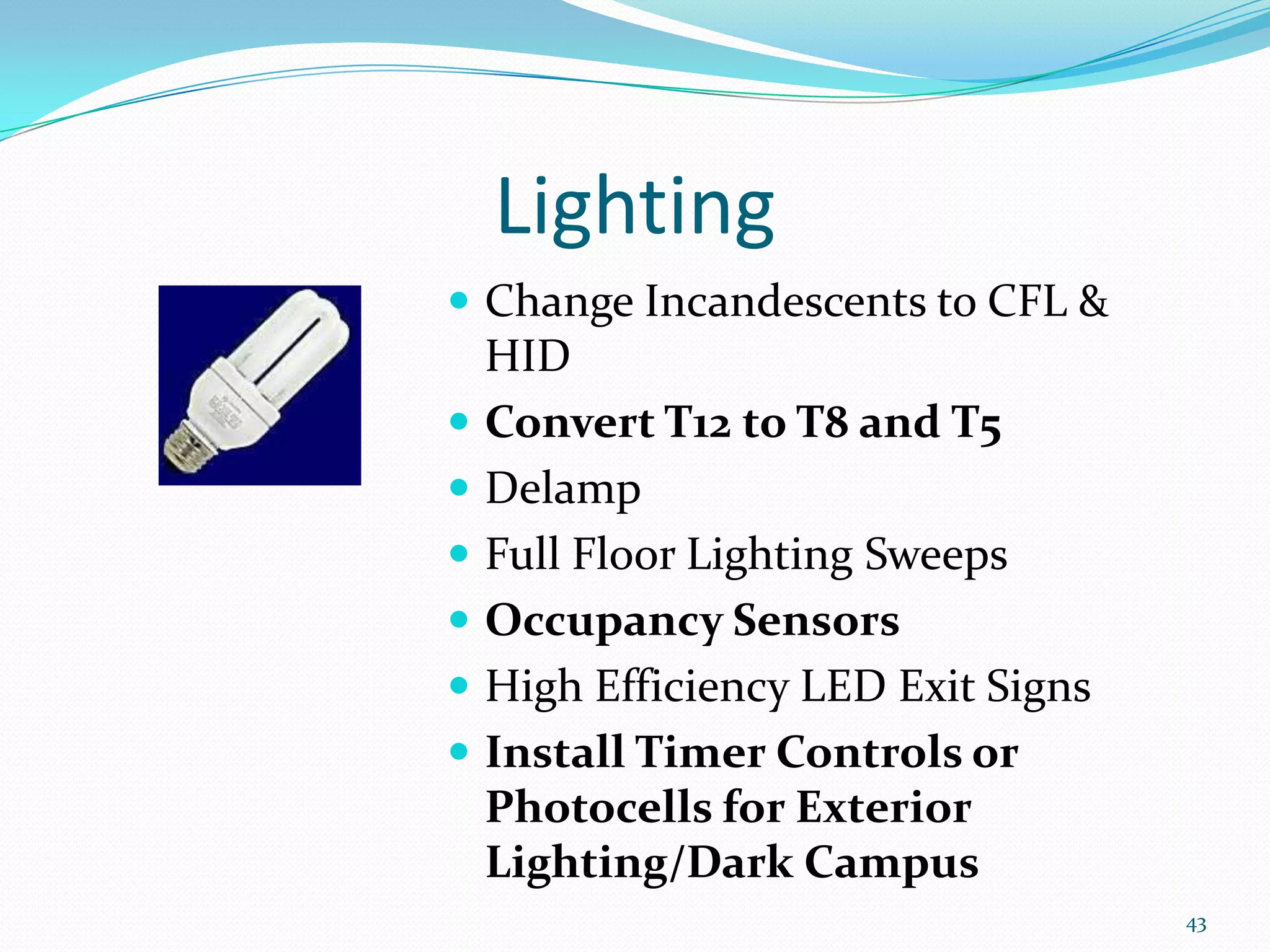
Lighting
 Change Incandescents to CFL &
  HID
 Convert T12 to T8 and T5
 Delamp
 Full Floor Lighting Sweeps
 Occupancy Sensors
 High Efficiency LED Exit Signs
 Install Timer Controls or
  Photocells for Exterior
  Lighting/Dark Campus
                                   43
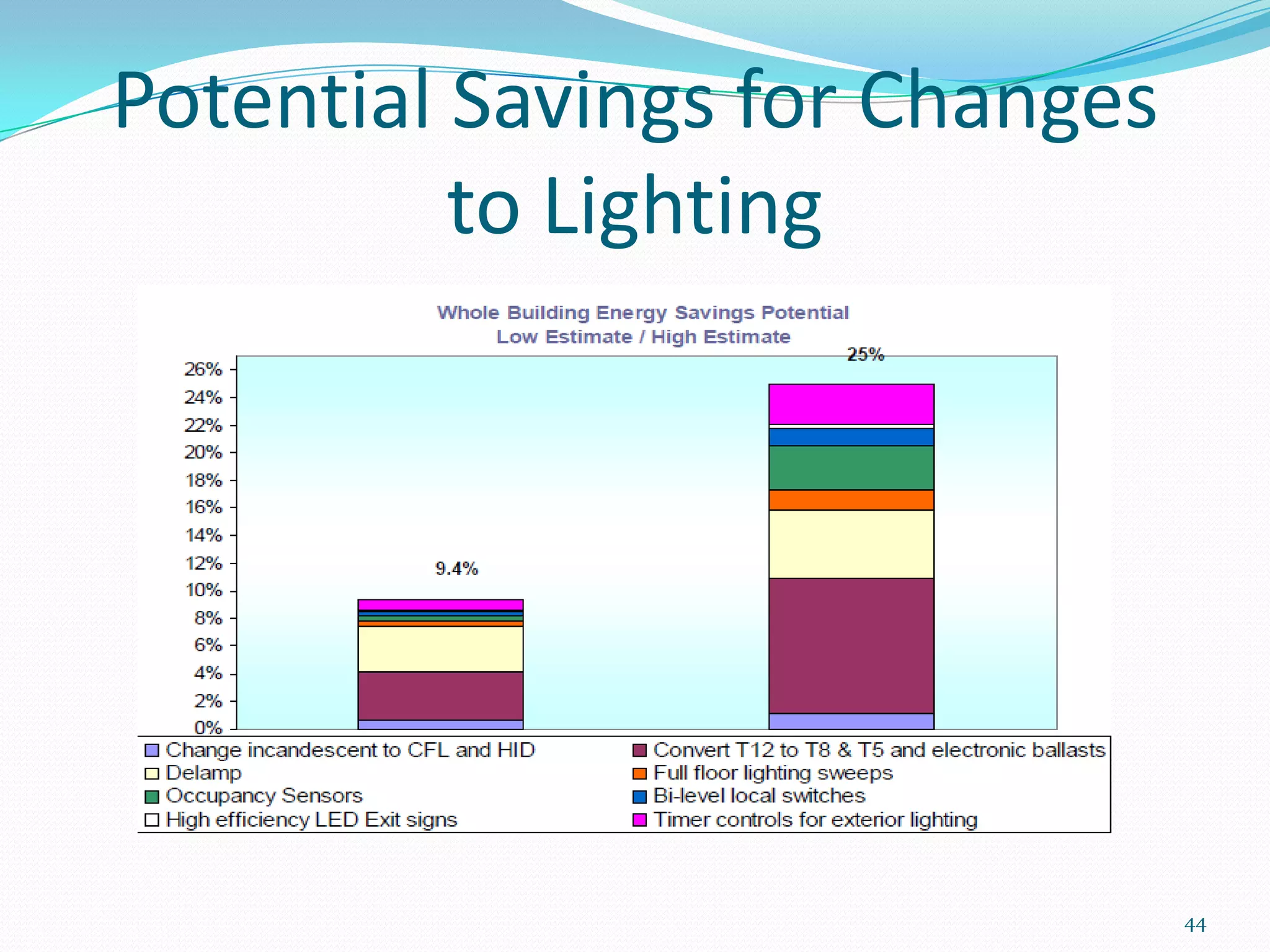
Potential Savings for Changes
          to Lighting


                                44
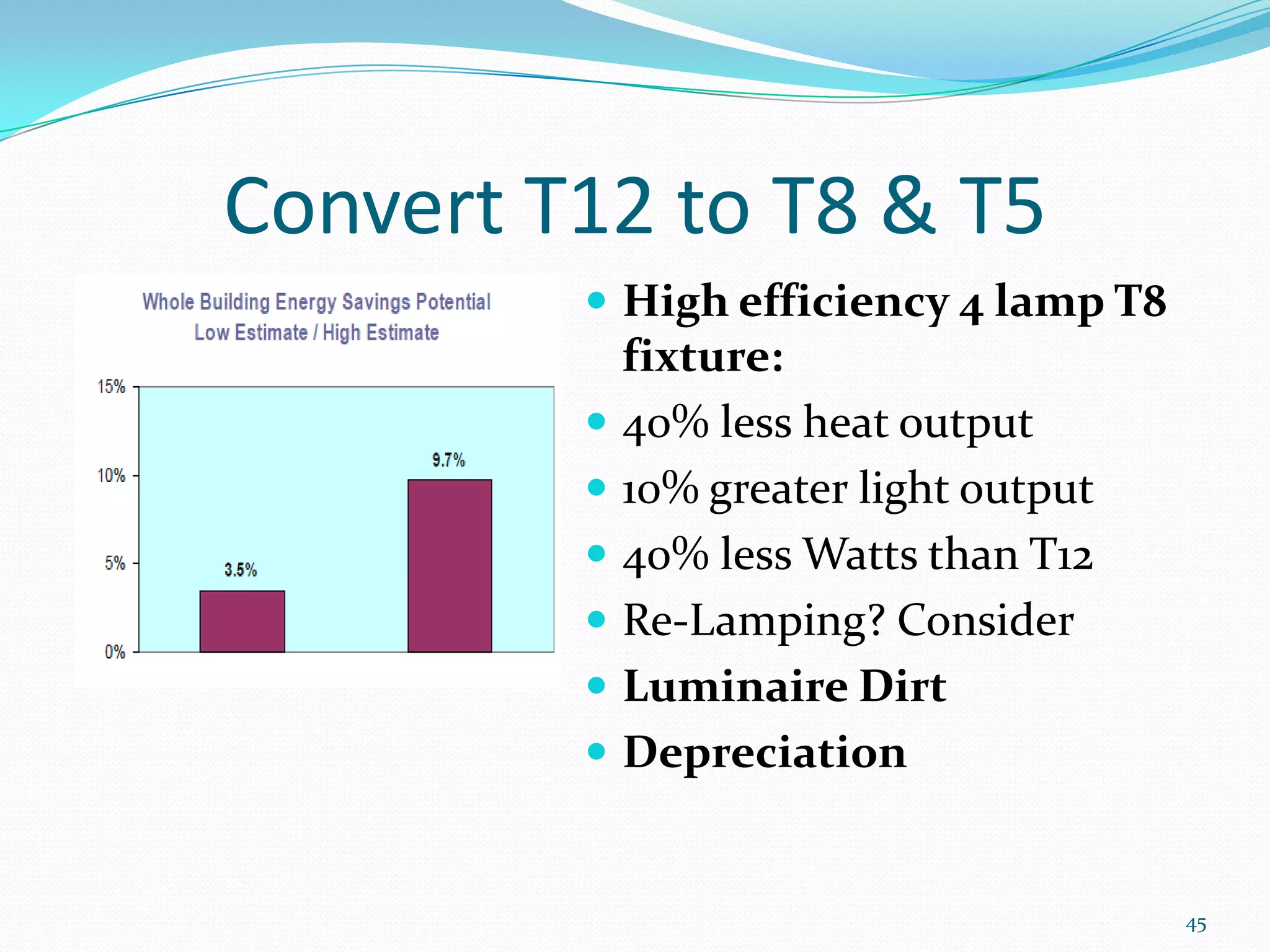
Convert T12 to T8 & T5
          High efficiency 4 lamp T8
           fixture:
          40% less heat output
          10% greater light output
          40% less Watts than T12
          Re-Lamping? Consider
          Luminaire Dirt
          Depreciation


                                       45
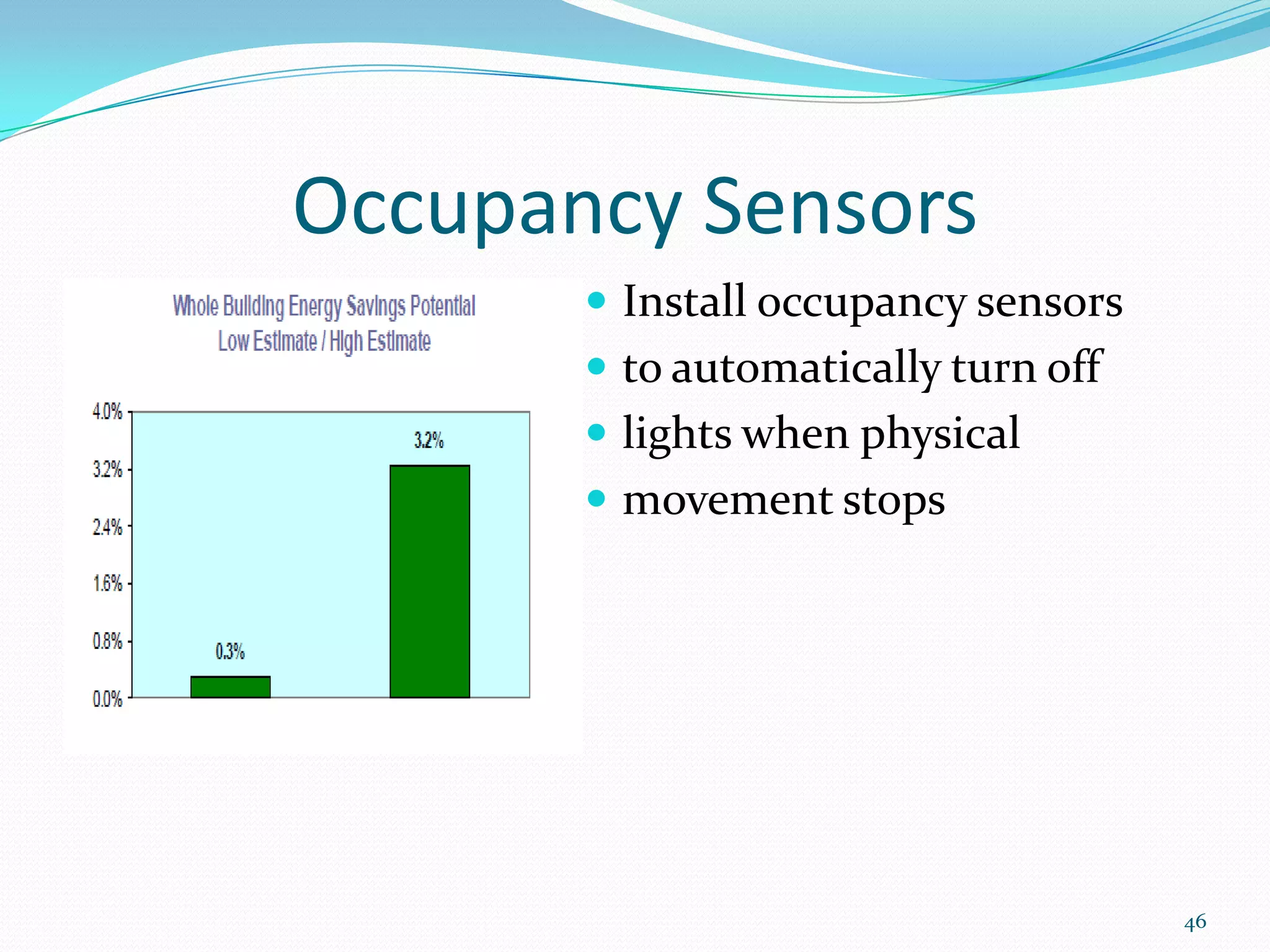
Occupancy Sensors
        Install occupancy sensors
        to automatically turn off
        lights when physical
        movement stops


                                     46
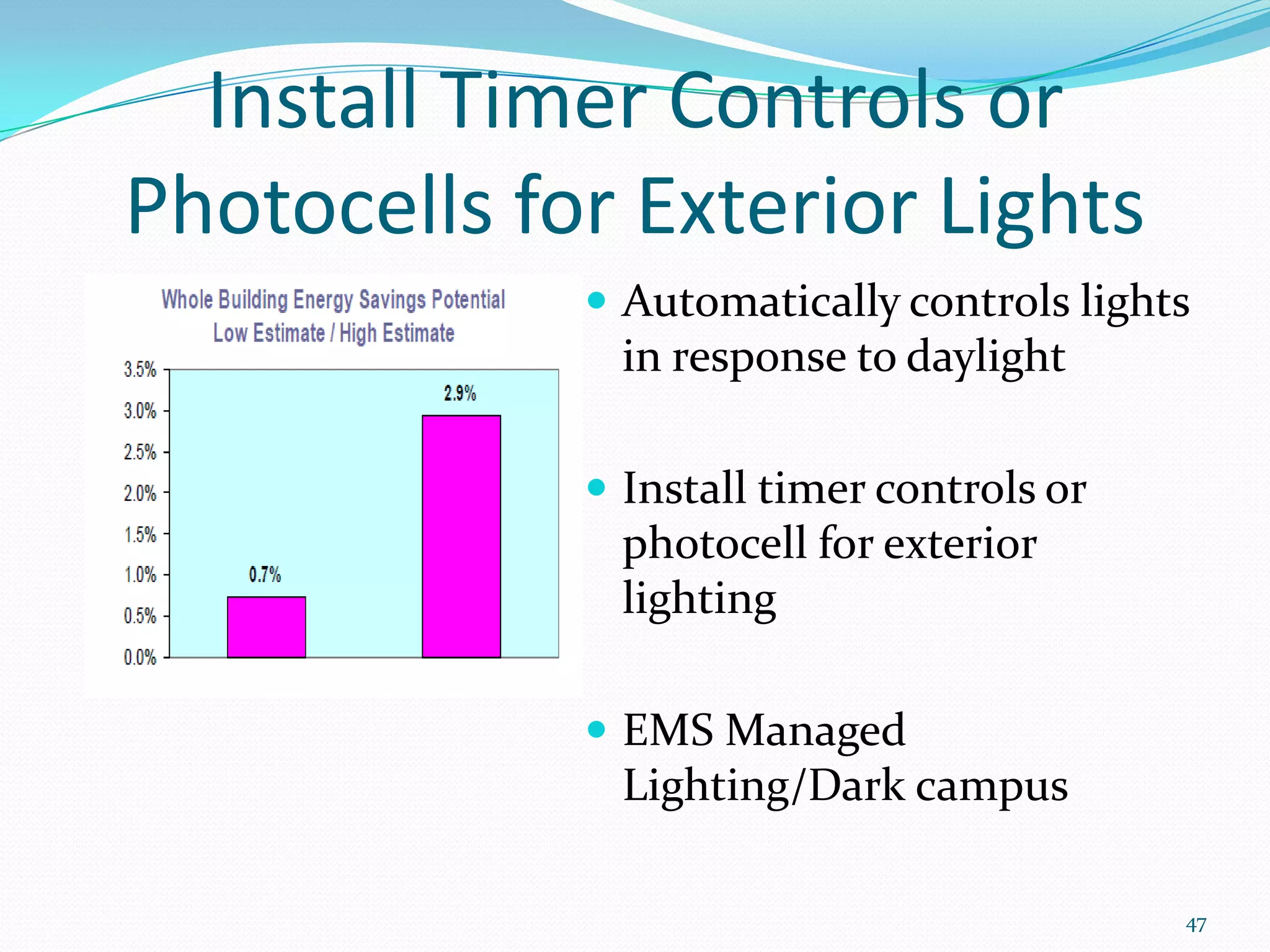
Install Timer Controls or
Photocells for Exterior Lights
              Automatically controls lights
               in response to daylight

              Install timer controls or
               photocell for exterior
               lighting

              EMS Managed
               Lighting/Dark campus

                                           47
48
Controls
 Adjust Temperature
 After Hours Usage
 Adjust Ventilation
 Limit Access to Thermostats
 Seasonal Changes
 Optimize Start Up Time and
  Equipment Sequencing
 Coast Last Hour of Operations


                                  49
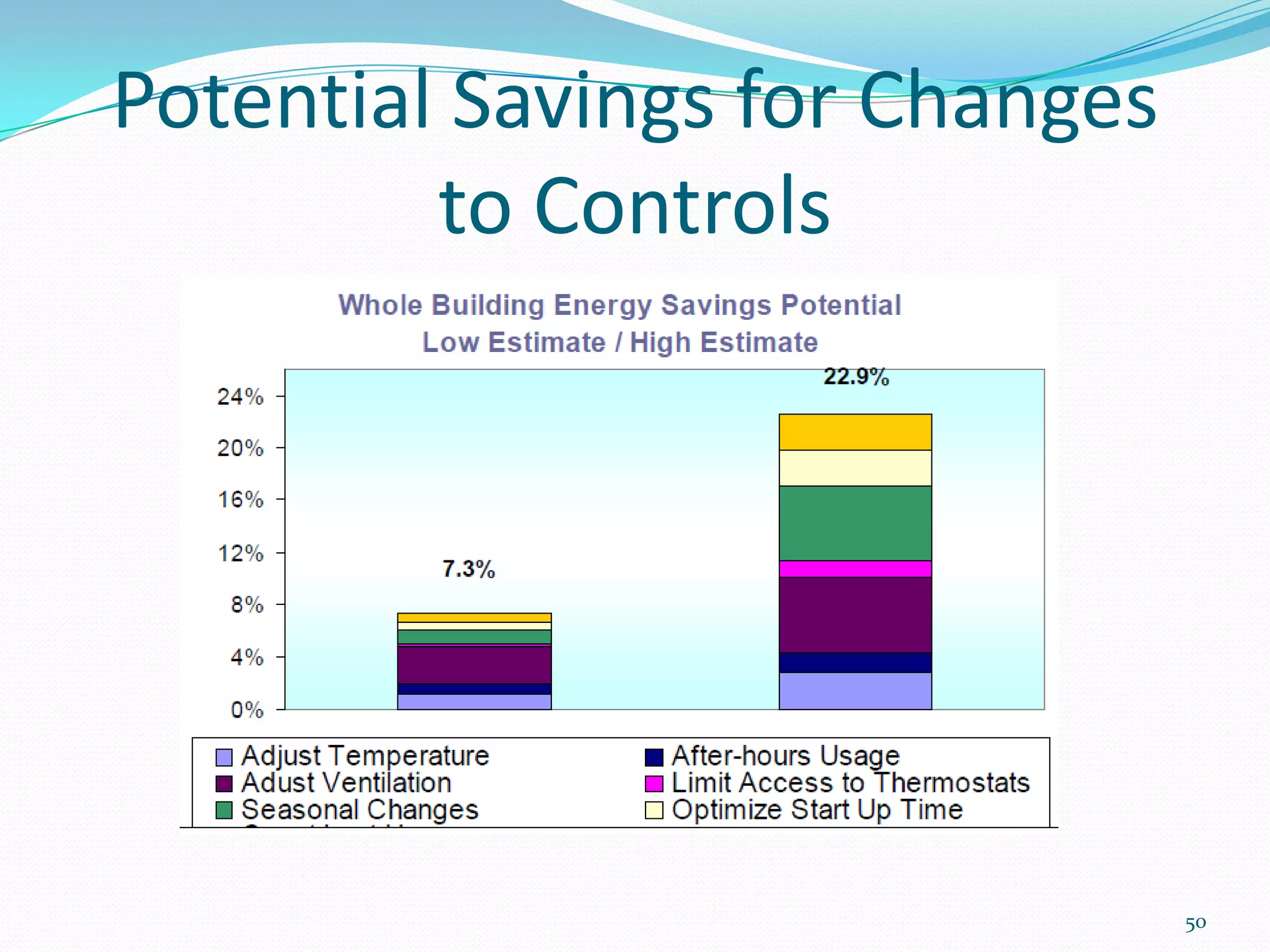
Potential Savings for Changes
         to Controls


                                50
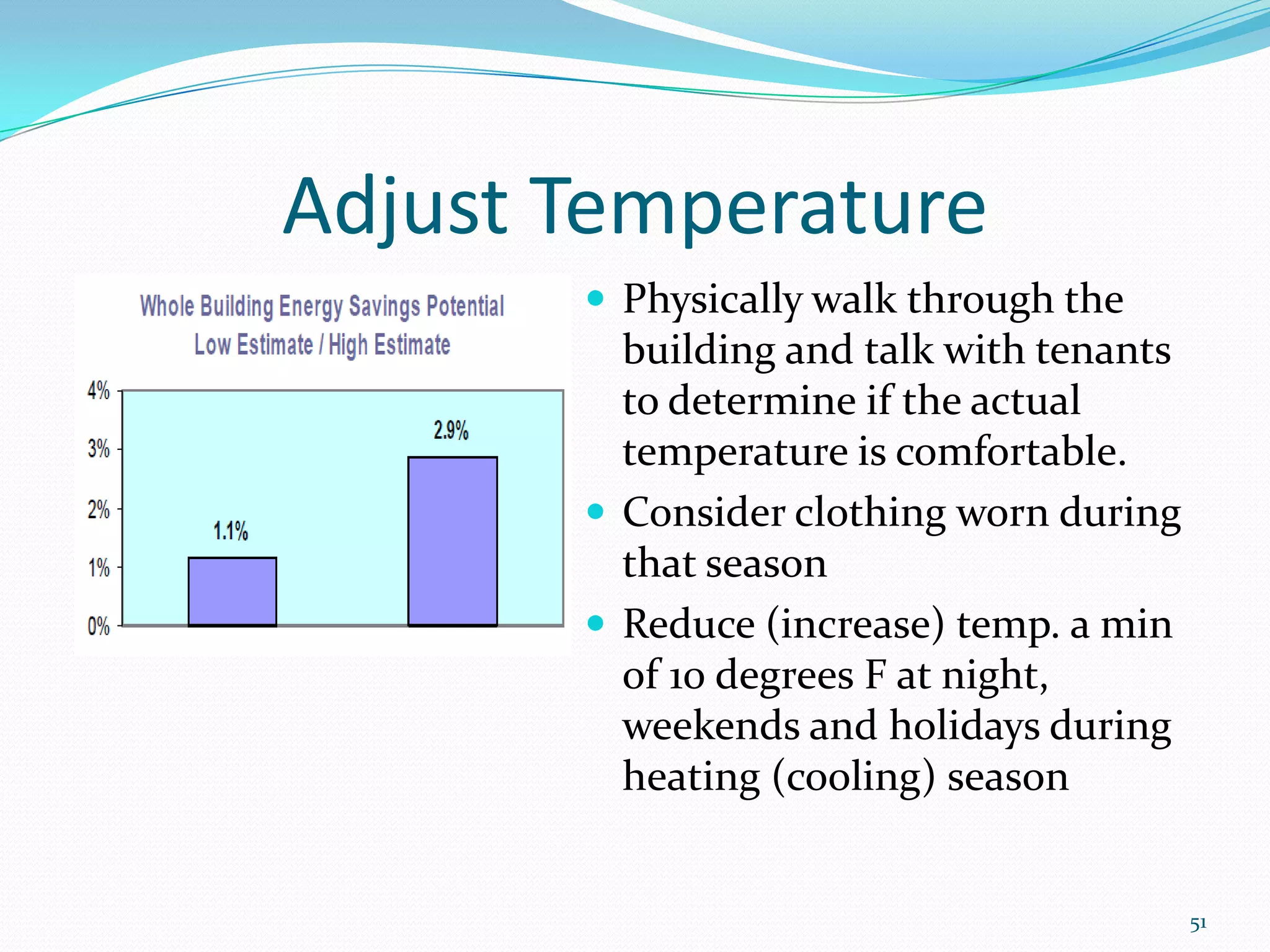
Adjust Temperature
        Physically walk through the
         building and talk with tenants
         to determine if the actual
         temperature is comfortable.
        Consider clothing worn during
         that season
        Reduce (increase) temp. a min
         of 10 degrees F at night,
         weekends and holidays during
         heating (cooling) season


                                          51
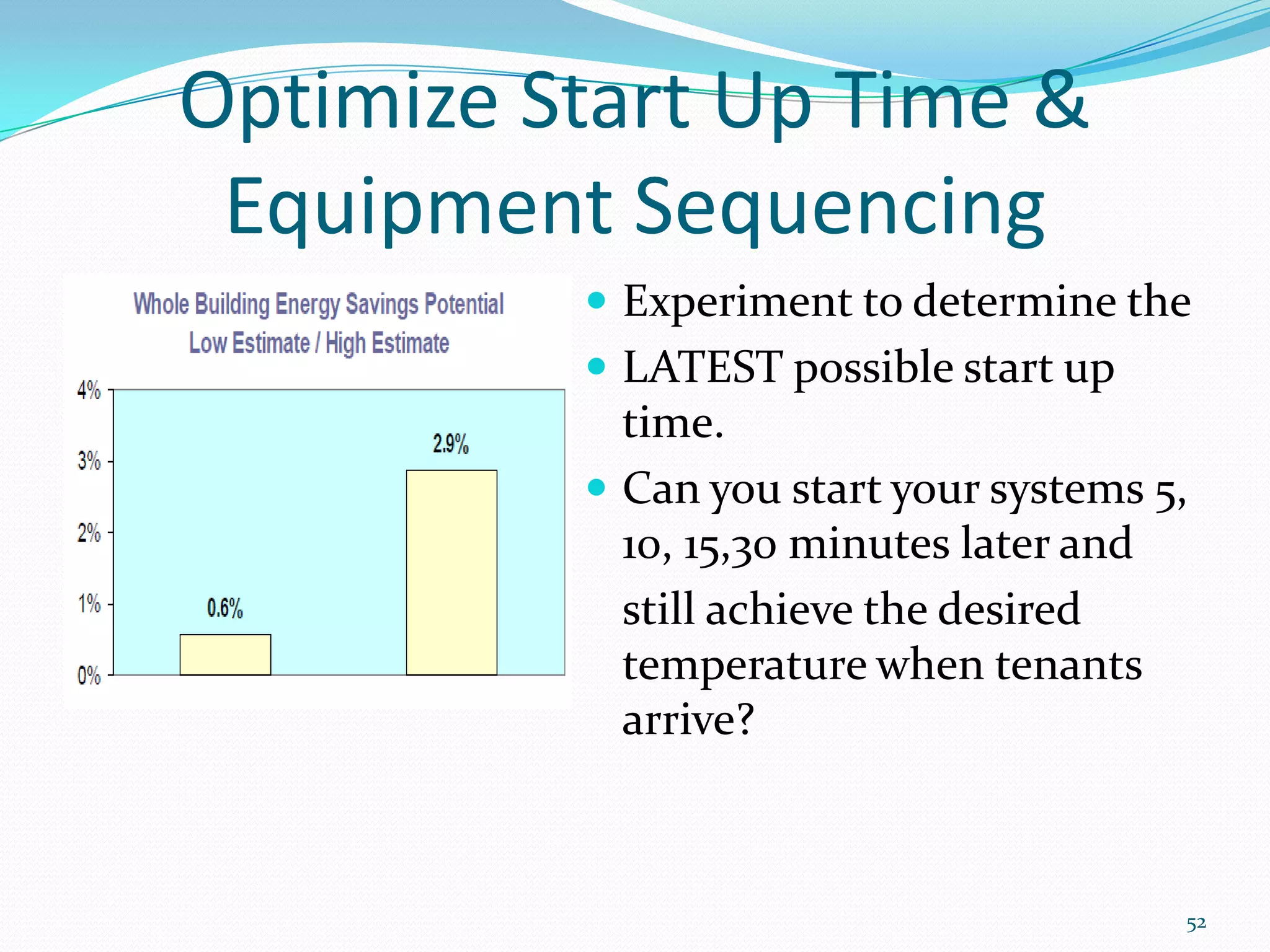
Optimize Start Up Time &
 Equipment Sequencing
           Experiment to determine the
           LATEST possible start up
            time.
           Can you start your systems 5,
            10, 15,30 minutes later and
            still achieve the desired
            temperature when tenants
            arrive?


                                        52
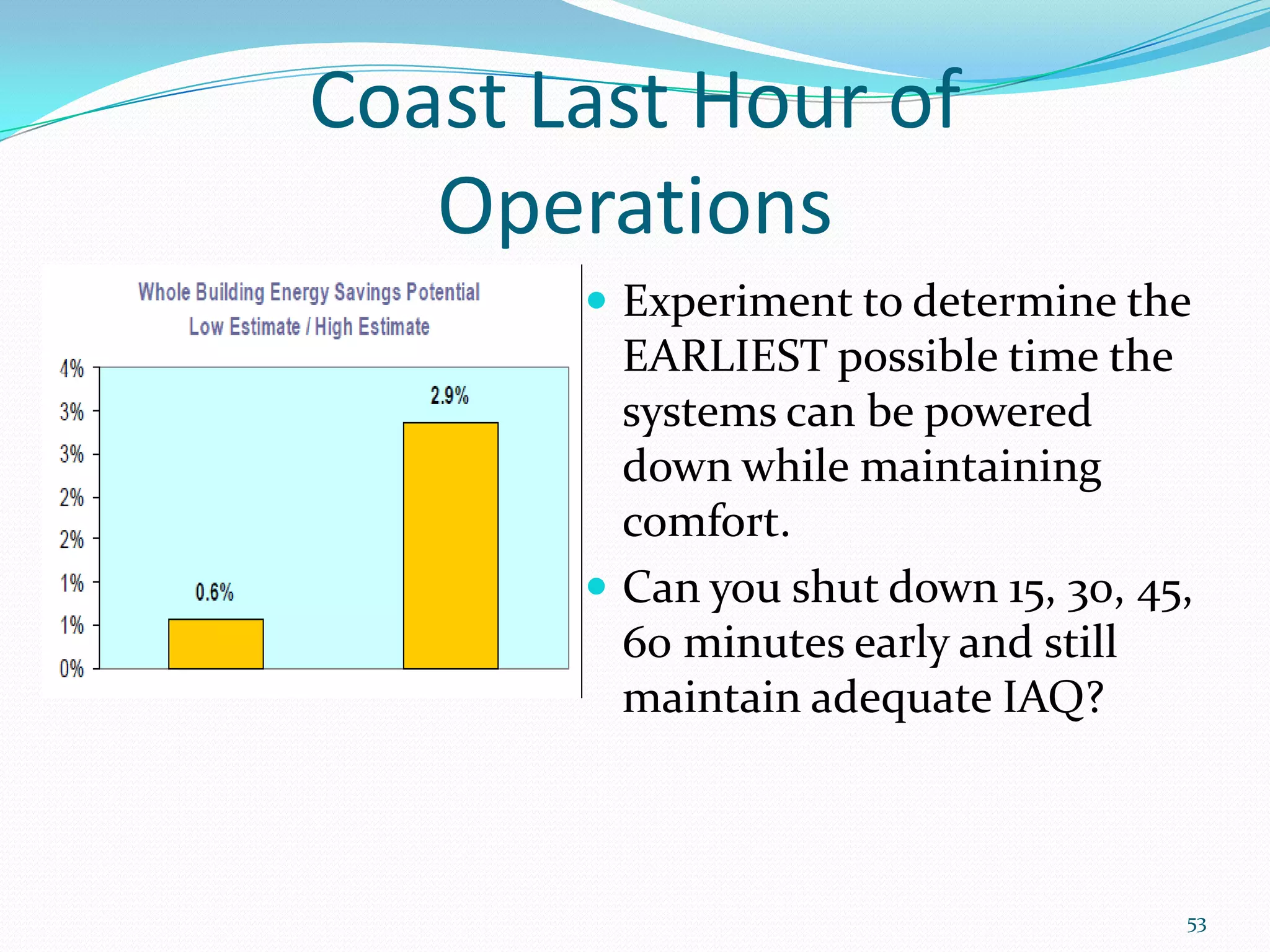
Coast Last Hour of
   Operations
        Experiment to determine the
         EARLIEST possible time the
         systems can be powered
         down while maintaining
         comfort.
        Can you shut down 15, 30, 45,
         60 minutes early and still
         maintain adequate IAQ?


                                     53
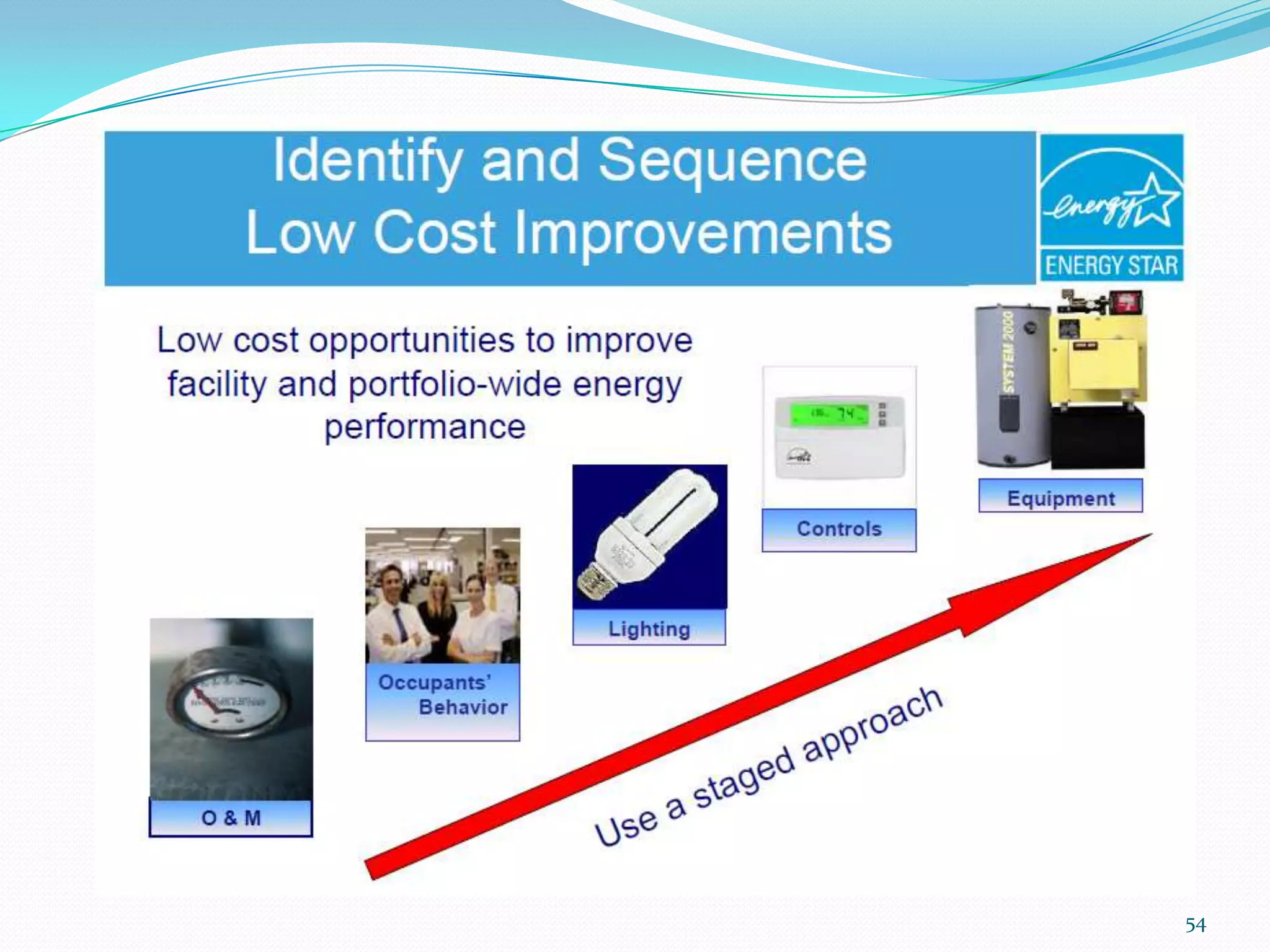
54
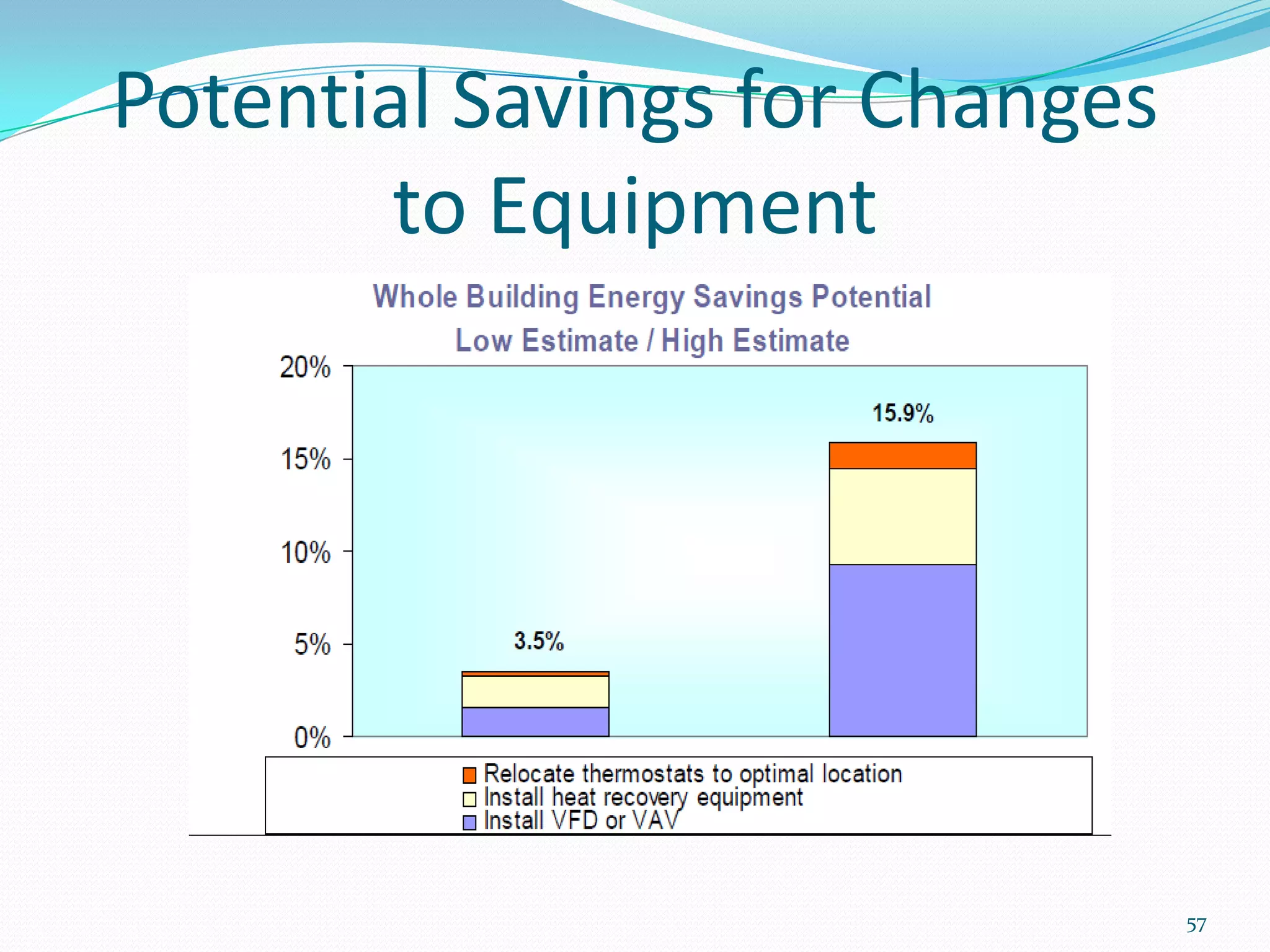
Equipment
 Install VFD & VAV
 Install Heat Recovery Equipment
 Relocate Thermostats to Optimal
 Locations


                                    55
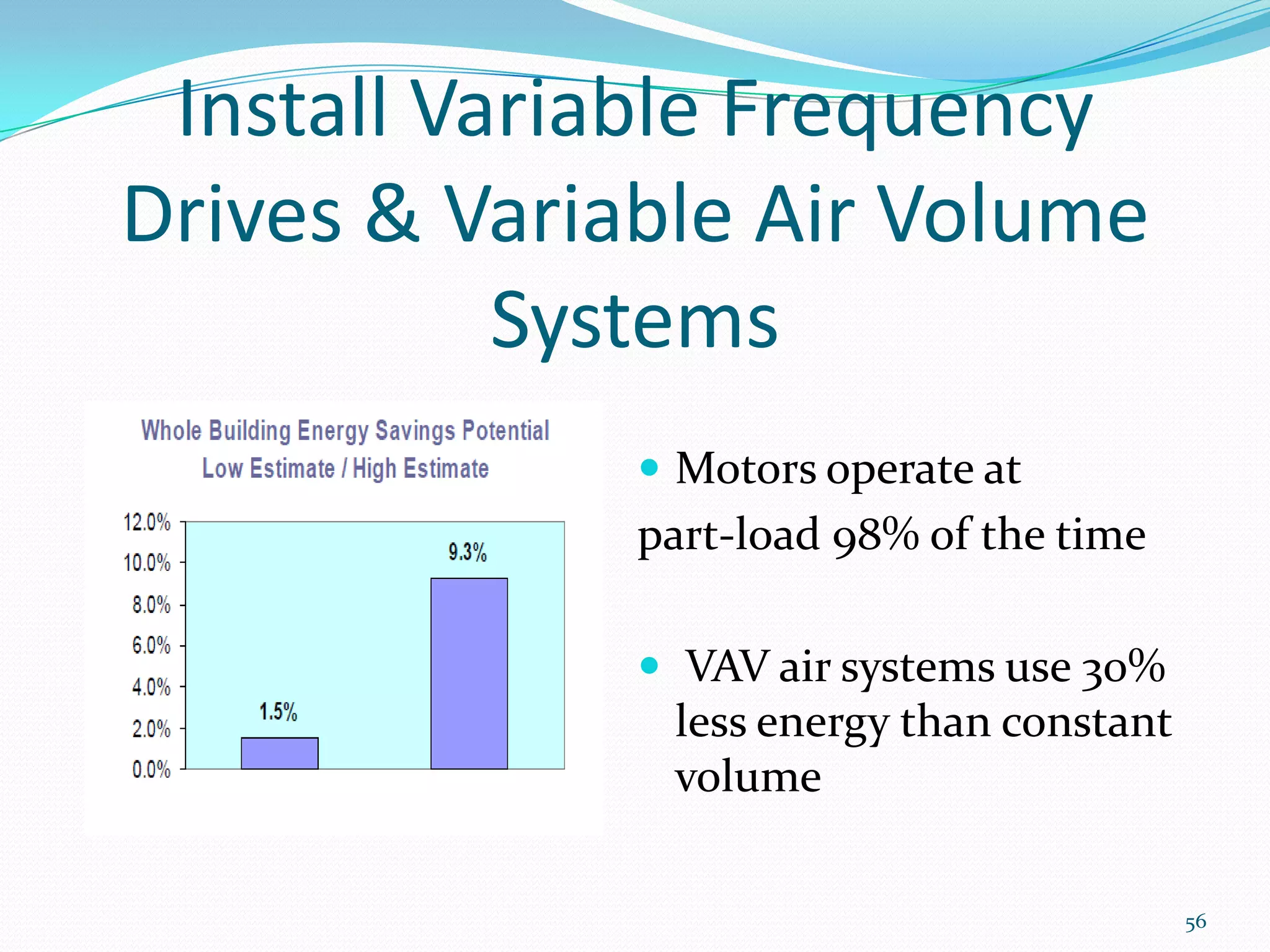
Install Variable Frequency
Drives & Variable Air Volume
           Systems
               Motors operate at
              part-load 98% of the time

               VAV air systems use 30%
               less energy than constant
               volume

                                           56
Potential Savings for Changes
        to Equipment


                                57
New Construction/Retrofit
 Encourage (“demand”) use of integrative design for
  your next building project. Develop the building a
  system.
 Ask for maximum efficiency envelop and optimize
  other components as a system.
 Don’t be dissuaded by potentially high “1st cost” issues.
 Understand long term operating cost for equipment
  selected


                                                              58
Keeping Score
 Energy Star Labeling    Utility Bill Tracking
 LEED                     Software
 CHPS 2.0                EPA Portfolio Manager


                                                   59
Thank You
Email me for full contact information and links to all of
     the programs mentioned in this presentation

                     Alwyn A. John

                 ajohn@tstboces.org
               Cellphone: 607-227-6361


                                                            60

Introduction to School Energy Management

  • 1.
    Alwyn A. John EnergyManagement Coordinator TST BOCES
  • 2.
    Agenda  Making thecase for energy efficiency  Understanding your district’s energy bills  Renewable energy and alternative technologies  Understanding funding opportunities  Identifying low cost/no cost opportunities to reduce cost 2
  • 3.
    1 Making the casefor energy efficiency 3
  • 4.
    Why is EnergyManagement Important? “Good Energy Management is Good Business” The evidence is clear that for both public and private k12 schools, adopting an energy management strategy is a business decision you cannot afford to ignore. 4
  • 5.
    Signs of EnergyWaste in Commercial Buildings  A 400% variation in energy use intensity of buildings in the United States exists that is not explained by age, technology, hours, size, climate.  Little improvement of overall energy consumption has been seen although building components are 30% more efficient since 1980.  Over-sizing of building fan systems, on average, occurs by 60%.  Most chillers are oversized by 50–200%. • - EPA 5
  • 6.
    Signs of EnergyWaste in K12 Buildings  EPA/Energy Star Statistics:  The annual energy bill to run America’s primary and secondary schools a staggering $6 Billion. $1 out of every $4 spent on energy by US schools is wasted. Conservative 25% = $1.5 Billion annually.  Energy cost total between 1.5% to 3.5% of a typical school district’s annual budget. Energy is often second only to staff salaries – more than computers and textbooks combined.  The least efficient schools use three times (3x) more energy than the best energy performers  Top performing ENERGY STAR labeled schools cost forty cents per square foot less to operate than the average performers. 6
  • 7.
    Strong Energy Management = Real Savings  Ford Motor Company has saved over $75 million through effective energy management.  Eastman Kodak saved more than $8.6 million in operating costs in 2002 from its energy management efforts.  Fairfax County Public Schools (VA)estimates an annual energy savings of $4.5 million (7.19%) from energy efficiency improvements on a $62.6 million utilities budget (FY: 2011-12)  In 2001, the first year of their Energy Management program, Sandy Creek CSD (NY) saved $300,000 on a $1.4 Million utility budget (~21%). Total of $2.7 Million in savings from 2001 to 2009. 7
  • 8.
    Pending Crisis  Dueto the recession, demand for energy supply is down, resulting in the lowest cost per unit of electricity in the last decade. Natural gas is also seeing record lows. This is a TEMPORARY condition. Over time, usage demand will return and cost/unit will rise)  Utility delivery (NYSEG, etc)companies are starting to shift rate structures to put a greater emphasis on peak demand usage. Over the next 5 years or so we can expect to see increasing peak demand charges and an elimination of the differential between day and night rates. When usage demand returns, we will be impacted by both increased cost/unit and increased peak demand charges 8
  • 9.
    Accessing Potential LostDollars  By systematically implementing an Energy Management Plan, many school districts have been able to reduce energy consumption by 30% to 40%.  The first 10% of reduction in energy use is possible with little or no cost. 9
  • 10.
    EPA’s Strategy forCreating an Energy Management Plan  STEP 1: Make Commitment  STEP 2: Assess Performance  Step 3: Set Goals  Step 4: Create Action Plan  Step 5: Implement Action Plan  Step 6: Evaluate Progress  Step 7: Recognize Achievements 10
  • 11.
    Key Elements ofan Effective Energy Management Plan  District wide energy related mission statement  Defined heating /cooling set points and setbacks  Defined access hours for midweek and weekends  Defined path for requesting exceptions  Adoption at the highest effective level of the District  Identify local “Energy Champions”  Easily measurable specific energy target (at the level of utility metering)  Peer based energy targets – EPA Portfolio manager scoring, NYCHIPS, 11
  • 12.
    Resources  See AuxiliaryDocs: “EPA_Guidelines_for_Energy_Management “  www.energystar.gov/index.cfm?c=guidelines.guidelines_index  www.energystar.gov/index.cfm?c=evaluate_performance.bus_po rtfoliomanager  www.energystar.gov 12
  • 13.
    2 Understanding yourdistrict’s energy bills 1. Anatomy of a Utility Bill 2. Using Utility Data 13
  • 14.
    Anatomy of aUtility Bill Thanks to deregulation laws in NYS, our primary utility bills (electricity and natural gas) are split into two sections: DELIVERY SUPPLY  Responsible for physical  Provider of the actual energy delivery of energy and usage  Ex: NYSEG Solutions, Direct metering. Energy, MEGA, etc.  Owner of the power lines, gas piping and onsite meters  Ex: NYSEG, RGE, etc. 14
  • 15.
    Potential Billing Issues Miscellaneous Charges  Manual download charges on interval meters  Demand Charges  Do they appear to be reasonable ?  Quantities and Volume  Verify that the figures for kwh, KW and therms of natural gas agree between the supply and delivery companies. Electricity should be 1-to-1 and Natural gas should be +- 1.0%. 15
  • 16.
    Using Utility Data -UtilityBill Tracking and Analysis (Monthly)  Maintain a copy (physical or electronic) of all utility bills for use by the Facilities Department.  Record monthly billing data including unit cost, quantity and weather information  Compare usage to similar prior periods to identify maintenance issues, etc.  Software Tools:  MS Excel, EnergyWatchdog, SchoolDude/Utility Direct, 16
  • 17.
    Using Utility Data -Benchmarking(annually) Confirm savings from energy conservation investments Compare a building’s normalized performance vs. internal and external peers Software/Service Examples: NYSERDA’s Benchmarking program, EPA Portfolio Manager 17
  • 18.
  • 19.
    Renewable Energy Pros and Cons  Solar and wind make good educational demonstration projects  Often fail to save significant amounts of energy and do not provide reasonable pay back periods  Things to look for:  Life of equipment/Maintenance schedules vs. payback periods  Have we fully explored all other energy conservation options for our buildings? 19
  • 20.
    Alternative Technologies Leading Edgevs. Bleeding Edge Leading Edge Bleeding Edge  T8 & T5 lighting  LED interior lights  Modulating/Condensing  Heat reflective white roofing Boilers  Waterless urinals  HVAC control software  Geothermal heating and  Occupancy controls (lighting cooling & HVAC)  CoGen  LED lights (in some situations)  Utility analysis software  Co Gen 20
  • 21.
    4 Understanding funding opportunities 21
  • 22.
    NYSERDA  CFA –Consolidated Funding Application – A single application that streamlines access to NYSERDA’s Grant program and possibly additional funding from other NYS agencies.  Existing Facilities  FlexTech  CHIPS 2.0 – High efficiency school building standard for both new and retrofit building projects  New opportunities in 2012 22
  • 23.
    NYSEG/RGE & NationalGrid  NYSEG/RGE  Existing Facilities - Small Business Energy Efficiency Program – Less than 100,000 kwh/month. < 70% materials & labor.  National Grid  Existing Facilities – Lighting – < 50% materials & labor  All utility delivery companies offer a Custom Measures Program 23
  • 24.
    Energy Performance Contracting  SED allows EPC agreements to go out a maximum of 18 years.  5 to 10 year EPC agreements are optimal  Take advantage of SED $100,000.00 project incentive. C&S Companies of Syracuse has an innovative solution called “NET ZERO” that combines features of an EPC agreement with five $100,000.00 projects. Building aid + energy savings + grant money = $0.00 cost to district for over $500,000.00 worth of projects.  Consider a “self-directed” EPC 24
  • 25.
    5 Identifying low cost/nocost opportunities to reduce cost 25
  • 26.
  • 27.
    Operations & Maintenance  Functioning as designed  Calibrate thermostats  Adjust dampers  Janitorial services 27
  • 28.
    Functioning as Designed Retro-commissioning Regularly inspect all equipment and controls to ensure they are functioning as designed 28
  • 29.
    Functioning as Designed Example 1: New school building with regular power quality problems. Motors burning out, light fixtures failing early. Two years after construction, it was discovered that a power conditioner was installed as part of the original construction, but was never turned on.  Example 2: Public school built around 1975 with pneumatic controls, with consistently high heating bills and increasingly more difficult to control temperature. Detailed physical inspection of unit ventilators revealed that in prior years as pneumatic controls failed, the outside air dampers where hardwired in the open position (either 100% or 75% open). 29
  • 30.
    Calibrate Thermostats Periodically, walk through the building and compare the thermostat setting with a hand held digital thermometer (preferably with 2 decimal places) 30
  • 31.
    Adjust Dampers  Bring in the least amount of outside air necessary to maintain proper air quality  Reduce outside air requirements by adjusting dampers to minimize the need to condition outside air (within codes) 31
  • 32.
    Janitorial Best Practices  Team Cleaning  Day Cleaning  Coordinate Lighting  Occupancy Sensors 1. Joe Serna Jr (office building. Instituted day cleaning with hours from 11am to 8pm during 2001 energy crisis. Savings of 8% Total Building Energy 2. Johnson City School District saved 7.95% Total District Energy during fiscal 2010-2011 by time shifting their third shift cleaning staff. 32
  • 33.
    Potential Savings forChanges to O&M 33
  • 34.
  • 35.
    Occupants‘ Behavior  Turn off Equipment  Institute an Energy Awareness Program  Use ENERGY STAR® Equipment  Install Monitor Power Management Software  Harvest Daylight  Use Work Station Task Lighting/Zoned Lighting 35
  • 36.
    Turn off Equipment During off hours, make sure to power down everything – such as copiers, kitchen equipment, and task lights - Smart Power strips 36
  • 37.
    Institute An Energy AwarenessProgram  Create Promotional Items  Write News Releases  Link to National Campaigns  Communications Kit  Energy Star Partner Kit (Free)  - motivate change 37
  • 38.
    Provide Direction on off-hoursuse of facilities 38
  • 39.
    Use Energy StarEquipment Adopt a procurement policy as part of your overall successful energy management strategy 39
  • 40.
    Install Monitor/CPU Power Management Software  Monitor Power Management - Save up to $55 per monitor annually  CPU/Hard Drive Power Management - Save up to an additional $45 per computer annually Harvard University – Deployed EPA Power Management software across it’s network of 800 computers using 1 technician working for ½ a day. 40
  • 41.
    Potential Savings forChanges to Occupants’ Behaviors 41
  • 42.
  • 43.
    Lighting  Change Incandescentsto CFL & HID  Convert T12 to T8 and T5  Delamp  Full Floor Lighting Sweeps  Occupancy Sensors  High Efficiency LED Exit Signs  Install Timer Controls or Photocells for Exterior Lighting/Dark Campus 43
  • 44.
    Potential Savings forChanges to Lighting 44
  • 45.
    Convert T12 toT8 & T5  High efficiency 4 lamp T8 fixture:  40% less heat output  10% greater light output  40% less Watts than T12  Re-Lamping? Consider  Luminaire Dirt  Depreciation 45
  • 46.
    Occupancy Sensors  Install occupancy sensors  to automatically turn off  lights when physical  movement stops 46
  • 47.
    Install Timer Controlsor Photocells for Exterior Lights  Automatically controls lights in response to daylight  Install timer controls or photocell for exterior lighting  EMS Managed Lighting/Dark campus 47
  • 48.
  • 49.
    Controls  Adjust Temperature After Hours Usage  Adjust Ventilation  Limit Access to Thermostats  Seasonal Changes  Optimize Start Up Time and Equipment Sequencing  Coast Last Hour of Operations 49
  • 50.
    Potential Savings forChanges to Controls 50
  • 51.
    Adjust Temperature  Physically walk through the building and talk with tenants to determine if the actual temperature is comfortable.  Consider clothing worn during that season  Reduce (increase) temp. a min of 10 degrees F at night, weekends and holidays during heating (cooling) season 51
  • 52.
    Optimize Start UpTime & Equipment Sequencing  Experiment to determine the  LATEST possible start up time.  Can you start your systems 5, 10, 15,30 minutes later and still achieve the desired temperature when tenants arrive? 52
  • 53.
    Coast Last Hourof Operations  Experiment to determine the EARLIEST possible time the systems can be powered down while maintaining comfort.  Can you shut down 15, 30, 45, 60 minutes early and still maintain adequate IAQ? 53
  • 54.
  • 55.
    Equipment  Install VFD& VAV  Install Heat Recovery Equipment  Relocate Thermostats to Optimal Locations 55
  • 56.
    Install Variable Frequency Drives& Variable Air Volume Systems  Motors operate at part-load 98% of the time  VAV air systems use 30% less energy than constant volume 56
  • 57.
    Potential Savings forChanges to Equipment 57
  • 58.
    New Construction/Retrofit  Encourage(“demand”) use of integrative design for your next building project. Develop the building a system.  Ask for maximum efficiency envelop and optimize other components as a system.  Don’t be dissuaded by potentially high “1st cost” issues.  Understand long term operating cost for equipment selected 58
  • 59.
    Keeping Score  EnergyStar Labeling  Utility Bill Tracking  LEED Software  CHPS 2.0  EPA Portfolio Manager 59
  • 60.
    Thank You Email mefor full contact information and links to all of the programs mentioned in this presentation Alwyn A. John ajohn@tstboces.org Cellphone: 607-227-6361 60

Editor's Notes

  • #7 As school budgets get tighter, more people are realizing that many of the items on a typical school budget is not optional. Energy cost may be one of the last areas where adjustments can be made without compromising personnel compensation or quality of service.
  • #9 Natural gas wells are being capped. Power generation plants are being mothballed.
  • #29 Example 1: New School building with regular power quality problems. Motors burning out, light fixtures failing early. Two years after construction, it was discovered that the a power conditioner was installed as part of the original construction, but was never turned on.Example 2: Public school built around 1975 with pneumatic controls, with consistently high heating bills and increasingly more difficult to control temperature. Detailed physical inspection of unit ventilators revealed that in prior years as pneumatic controls failed, the outside air dampers where hardwired in the open position (either 100% or 75% open).
  • #31 Ensure thermostat setting equals actual space temperature
  • #32 Reduce outside air requirements by adjusting dampersto minimize the need to condition outside air (within codes)
  • #33 1. Energy Start and SIEU study recommends the use of occupancy sensors to ensure that cleaning staff turns off the lights when they leave an area.2. Joe Serna Jr (office building). Instituted day cleaning with hours from 11am to 8pm during 2001 energy crisis. Savings of 8% Total Building Energy
  • #37 Every year Americans use 4 billion kWh to brew 30 billion pots of coffee.Smart Powerstrips
  • #38 Sponsor PostersPromotionalEvents, Energy TipsSheet, CompanyNewsletters, CompanyAnnouncements, Informational Posters
  • #40 ENERGY STAR labeled computers, copiers, external power adapters,fax machines, laptops, monitors, multifunction devices, printers,scanners, water coolers, and more
  • #41 Harvard University – Deployed EPA Power Management software across it’s network of 800 computers using 1 technician working for ½ a day.
  • #46 1. Light loss factor resultingfrom dirt and dustaccumulated on light fixturesand lamps2. Light loss factor resultingfrom dirt and dustaccumulated on light fixturesand lamps
  • #47 Make sure OC doesnot take the place of good habits. Evergreen Public Schools – Vancouver WA – found that the extra 10minutes on the motion sensor after everyone left their room could be translated into 12,000.00/year. They adjusted their timing to be closer less than the original 20 minutes.
  • #48 Enhanced Options1. EMS Managed Lights2. Dark Campus
  • #52 Enhanced Options1. EMS Managed Lights2. Dark Campus
  • #53 Make sure you understand how optimal start works on your system.
  • #57 “Air handling and distribution is the most prevalent deficiency in buildings.”