Greening Your World…
Vision: Creating a Sustainable Energy Future

    • Areas of Focus
      •   Energy Efficiency
      •   Renewable Energy
      •   Green Building
      •   Climate Change
      •   Transportation


                                               2
2
CCSE Services
    •   Cash Incentives
    •   Educational Workshops
    •   Resource & Tool Lending Libraries
    •   Technical Assistance
    •   Technology Display Center
    •   Distributed Generation Assessment Services
    •   Carbon Impact Assessment and Management
    •   Technical and Policy support for Local
        Governments
                                                     3
3
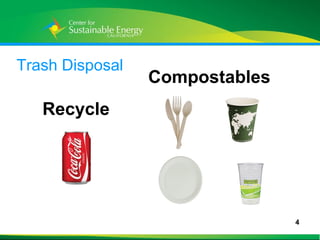
Trash Disposal
                 Compostables
    Recycle


                                4
4
Housekeeping

•   Online Registration is the best way to guarantee a spot
•   Restrooms
•   Phones Off
•   Shhhh. . . Quiet in Hallway
•   Sign-in Sheets & Evaluations


                                                              5
5
CCSE Disclaimer
Workshops are provided as a public service with the
understanding that the California Center for Sustainable Energy
makes no warranties, either expressed or implied, concerning
the accuracy, completeness, reliability, or suitability of the
information.

The California Center for Sustainable Energy does not
endorse any particular product, manufacturer or service
mentioned and does not represent that any goods or services
are fit for any purpose or use.

                                                                  6
6
Power Play Part 2 Overview

• Strategies for Savings:
    • Retro-Commissioning
    • Retrofits
• Plans for Production
    • Solar PV
    • Fuel Cells


                             7
7
Do what makes economic $ense
• Energy Efficiency
    • Lower first costs
    • Quick payback
    • High Net Present Value
• Distributed Generation
    • Producing energy onsite
    • Positive Net Present Value


                                   8
8
The Business Plan
• Conduct Energy Audit
    •   Energy Audits itemize areas of potential savings.
    •   A third party consultant will give you a fresh set of eyes and ideas, and
        can tailor your audit to maximize rebates from IOU programs.
• Apply for IOU Programs
    •   Californian Investor Owned Utilities (IOU) have comprehensive rebate
        programs that will pay for portions of your Energy Efficiency upgrades.
    •   Certain programs subsidize energy audits (TA/TI) and others provide
        cash rebates.
• Research Payment Options
    •   Utilities and investors have varying financing and ownership packages
        available.


                                                                                    9
9
Energy Efficiency
•    More energy to core services
•    Reliable and stable energy supply
•    Onsite generation takes higher load
•    Most cost effective way to meet green goals and
     mandates


                                                       10
10
The Power and Payback of EE
•    Retrofitting old lights & ballasts can save 32W per fixture.
•    At $0.10/kWh, that’s $14 per fixture per year.
•    Installation was estimated at $43/fixture (parts and labor)
•    Could receive a $9.80 rebate through Energy Savings Bid.
•    Simple ROI (without federal tax credit): 42%

     • F40-T12CW with standard magnetic ballast (92W)
     • Conversion to F32-T8 RE70 Electric I.S. ballast (59W)

                                                               11
11
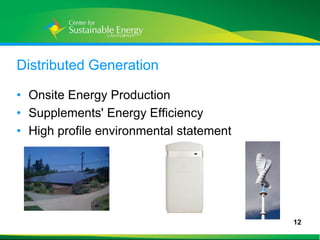
Distributed Generation

• Onsite Energy Production
• Supplements' Energy Efficiency
• High profile environmental statement


                                         12
12
Strategy for Savings:
Retro-Commissioning (RCx)
• Retro-Commissioning is a systematic process for
  improving an existing buildings performance.
• It involves rigorous investigation to identify low
  cost operational improvements to obtain comfort
  and energy savings.
• Works with utility incentive programs and Retrofits


                                                        13
13
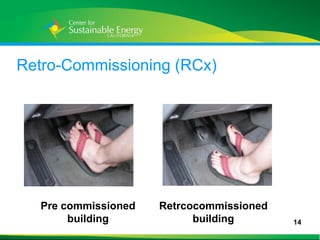
Retro-Commissioning (RCx)


     Pre commissioned   Retrcocommissioned
          building            building       14
14
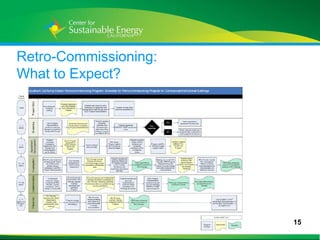
Retro-Commissioning:
What to Expect?


                       15
15
Retro-Commissioning:
What to Expect?
•    Data release/screening inspection
•    Contract to join RCx program
•    A kickoff meeting
•    Investigation and assessment of building (Audit)
•    Savings measures and paybacks are documented
•    Owner installs contractually obligated measures
•    Program pays owner incentives
•    Building is Energy Star benchmarked 12 mo. later
                                                        16
16
Retro-Commissioning Summary
• Costs: $0.13-$0.45/sq ft
• Savings
     • Energy: $0.11-$0.72/sq ft
     • Non-energy: $0.10-$0.45/sq ft
• Data from California Commissioning Guide
     • http://www.cacx.org/resources/documents/CA_Commis
       sioning_Guide_Existing.pdf

                                                      17
17
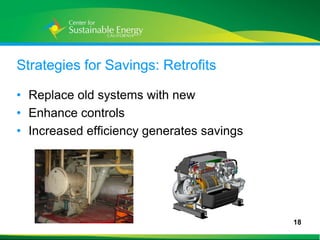
Strategies for Savings: Retrofits

• Replace old systems with new
• Enhance controls
• Increased efficiency generates savings


                                           18
18
Investor Owned Utility Programs
• TA/TI: Technical Assistance with Technology Incentives
  (Demand Response)
• Energy Savings Bid (Large Scale Energy Efficiency)*
• Energy Efficiency Business Incentives (Energy Efficiency)*
• Energy Efficiency Business Rebates (line item change outs)*
• 3rd Party: RCx Retro-Commissioning (SDG&E territory only)
• On Bill Financing (Special Financing for EE upgrades)

• *Participation in these programs requires Energy Star
  Benchmarking

                                                                19
19
Benchmarking Overview

• Compares energy performance of similar
  buildings nationwide
• Scale (1-100) shows % of buildings your building
  outperforms
• Allows access to utility incentives, Energy Star
  label, and possible LEED certification
  requirements

                                                 20
20
Benchmarking: What to Expect?

• Benchmarking Application Supplement
     • Determines eligibility
• Gather Building Data
     • Meter/account numbers
     • Building use
• Data Entry: Online Benchmarking Tool
• Can be Combined with an Audit
                                         21
21
Energy Audit Process: TA/TI
• Contact Contracting Engineer
• Negotiate proposal/obtain utility authorization
• Site Audit: itemizes demand response
  opportunities and documents savings potential.
• Customer Review and approval
• TI request/agreement with utility
• TI Installation, Implementation, Test and Approval


                                                       22
22
Demand Response: Overview
• Utility asks rate payers to use less power.
• Rate payers can agree to shed a certain amount
  when the utility needs help.
     • Example: turn thermostat up for a few hours.
     • Example: turn off some lights in the afternoon.
• Utility will pay to help set up controls.
• Utility provides monthly payments based on how
  much your facility can shed.

                                                         23
23
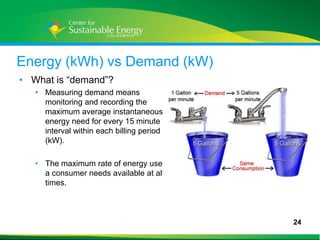
Energy (kWh) vs Demand (kW)
 • What is “demand”?
     • Measuring demand means
       monitoring and recording the
       maximum average instantaneous
       energy need for every 15 minute
       interval within each billing period
       (kW).

     • The maximum rate of energy use
       a consumer needs available at all
       times.


                                             24
24
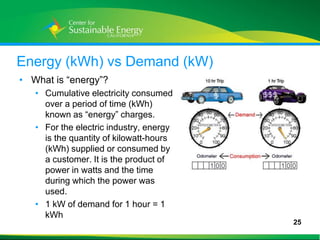
Energy (kWh) vs Demand (kW)
 • What is “energy”?
     • Cumulative electricity consumed
       over a period of time (kWh)
       known as “energy” charges.
     • For the electric industry, energy
       is the quantity of kilowatt-hours
       (kWh) supplied or consumed by
       a customer. It is the product of
       power in watts and the time
       during which the power was
       used.
     • 1 kW of demand for 1 hour = 1
       kWh
                                           25
25
Energy Efficiency: Overview
• Incentives paid based on verified annual energy
  savings from retrofit.
     • Generally requires pre install and post install inspections
• Participation in Energy Efficiency Programs can
  qualify project for special financing.
• Many incentive programs require Energy Star
  Benchmarking.


                                                                     26
26
Energy Audit Process: Retrofit
• Contact Contracting Engineer.
• Negotiate proposal.
• Site Audit: itemizes energy efficiency
  opportunities and documents savings potential.
• Receive report detailing:
     • Retrofit line items.
     • Financial case/paybacks.
     • Investor Owner Utilities (IOU) incentive submissions.
• Utility Pre inspection
• Installation and Savings!
                                                               27
27
Energy Efficiency Business Rebates

• Simpler line item replacements
• Each item has a fixed rebate
     • For a complete list of eligible items see:
       http://www.sdge.com/documents/business/savi
       ngs/express/EEProductCatalog.pdf
• Maximum incentive per meter: $350,000


                                                     28
28
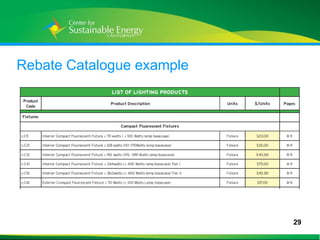
Rebate Catalogue example


                           29
29
Energy Efficiency Business Rebates
Example: Exterior Lighting
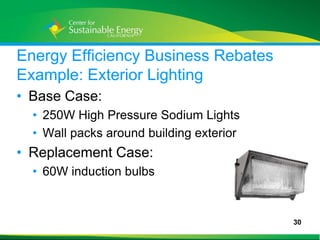
• Base Case:
     • 250W High Pressure Sodium Lights
     • Wall packs around building exterior
• Replacement Case:
     • 60W induction bulbs


                                             30
30
Energy Efficiency Business Rebates
Example: Exterior Lighting
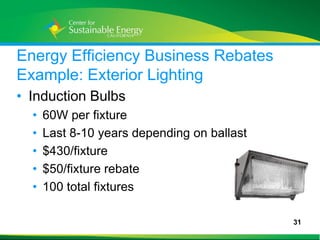
• Induction Bulbs
     •   60W per fixture
     •   Last 8-10 years depending on ballast
     •   $430/fixture
     •   $50/fixture rebate
     •   100 total fixtures

                                                31
31
Energy Efficiency Business Rebates
Example: Exterior Lighting
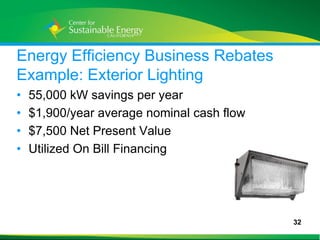
•    55,000 kW savings per year
•    $1,900/year average nominal cash flow
•    $7,500 Net Present Value
•    Utilized On Bill Financing


                                             32
32
Energy Efficiency Business Incentives

• Incentives are paid on kWh, Therm savings
     • CEC sponsored estimation software predicts savings
     • Engineering calculation supplement software
• Two incentive methods:
     • Measured (higher rebate to offset tracking costs)
     • Calculated
• Narrower scope of options

                                                            33
33
Energy Efficiency Business Incentives
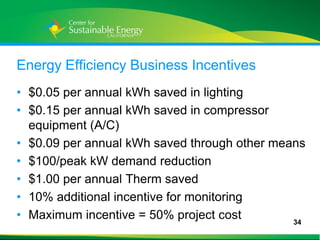
• $0.05 per annual kWh saved in lighting
• $0.15 per annual kWh saved in compressor
  equipment (A/C)
• $0.09 per annual kWh saved through other means
• $100/peak kW demand reduction
• $1.00 per annual Therm saved
• 10% additional incentive for monitoring
• Maximum incentive = 50% project cost        34
34
Energy Savings Bid

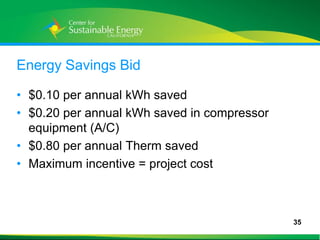
• $0.10 per annual kWh saved
• $0.20 per annual kWh saved in compressor
  equipment (A/C)
• $0.80 per annual Therm saved
• Maximum incentive = project cost


                                             35
35
Energy Savings Bid

• Designed for larger scale projects
• Savings minimums:
     • 500,000 kWh/year OR
     • 25,000 Therms/year
• Can combine projects into one application
• Only for non-res. sites & operable equipment


                                                 36
36
Energy Savings Bid Upgrade example
• Add Variable Frequency Drives to fans
• Upgrade 2 chillers from 6 EER to 18 EER
• Make lighting 10% more efficient:
     • T8 32W to T8 28W conversion.
• Same operations & schedules


                                            37
37
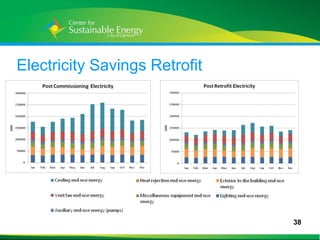
Electricity Savings Retrofit


                               38
38
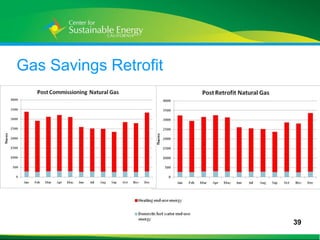
Gas Savings Retrofit


                       39
39
Retrofit Upgrade Costs
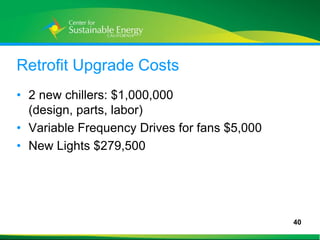
• 2 new chillers: $1,000,000
  (design, parts, labor)
• Variable Frequency Drives for fans $5,000
• New Lights $279,500


                                              40
40
Retrofit Upgrade Savings
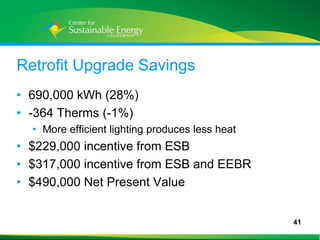
• 690,000 kWh (28%)
• -364 Therms (-1%)
     • More efficient lighting produces less heat
• $229,000 incentive from ESB
• $317,000 incentive from ESB and EEBR
• $490,000 Net Present Value


                                                    41
41
Energy Planning
• Operations & Maintenance (O&M)
     •   Behavioral Changes and Scheduling Improves $$$ Savings
     •   Not directly tied to hardware efficiency upgrade
     •   Example: scheduling maintenance during off-peak hours.
• Energy Efficiency (EE)
     •   High annual operating hours = Best $$$ savings opportunities
• Energy Efficiency + Distributed Generation (DG)
     •   Improved Environmental Bottom Line and Additional $$$ Savings
     •   Mandates and tenants are demanding a greater level of green features.
     •   EE should always be addressed before DG.


                                                                                 42
42
Distributed Generation
• California Solar Initiative (CSI)
     • Solar PV
• CSI Solar Thermal
     • Solar Water Heating
• Self Generation Incentive Program (SGIP)
     • Wind
     • Fuel Cell


                                             43
43
Distributed Generation Benefits
•    Energy Costs Reduction
•    Allows access to different tariffs
•    USGBC LEED Points
•    Reduces peak demand and energy use
•    Increases energy security
•    Very public statement to going green

                                            44
44
Tariffs
• Commercial customers pay for:
     • Energy (kWh)
     • Demand (kW)
• Prices can vary
     • Time of day
     • Amount of use
• Tariffs govern how we pay the bill
     • AL-TOU
     • DG-R
                                       45
45
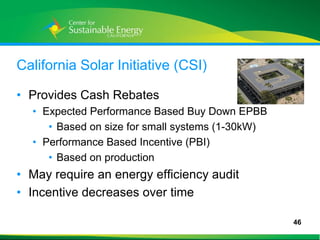
California Solar Initiative (CSI)

• Provides Cash Rebates
     • Expected Performance Based Buy Down EPBB
        • Based on size for small systems (1-30kW)
     • Performance Based Incentive (PBI)
        • Based on production
• May require an energy efficiency audit
• Incentive decreases over time

                                                     46
46
Solar Power: 75kW DC example
• Install a 75kW DC solar PV roof system.
• Switch to DG-R Tariff.
• Simulation makes assumptions about:
     • Weather
     • Efficiency
     • 25 year equipment life
• Cost is assumed to be $390,000
     • $6.50/Watt AC
     • 6.75% interest rate                  47
47
Utility Rate Escalation
• Historically around 3.4%.
• May experience high price volatility.
• Impacts distributed generation cash flows


                                              48
48
75kW DC Solar PV Impacts
• Allows access to advantageous DG-R tariff
     • Tariff changes NPV from -$12,000 to $250,000
•    Reduces yearly electric bill by $46,000 on average
•    Qualifies for MACRS and ITC tax benefits
•    $24,000/year average nominal cash flow
•    NPV: $250,000


                                                      49
49
Self Generation Incentive Program

• Funds Fuel Cells, Wind and Advanced
  Energy Storage
• Minimum size 30kW


                                        50
50
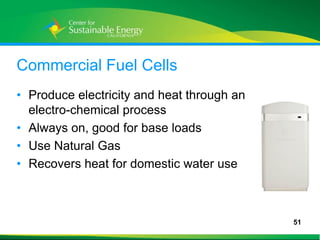
Commercial Fuel Cells
• Produce electricity and heat through an
  electro-chemical process
• Always on, good for base loads
• Use Natural Gas
• Recovers heat for domestic water use


                                            51
51
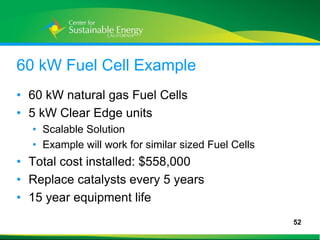
60 kW Fuel Cell Example
• 60 kW natural gas Fuel Cells
• 5 kW Clear Edge units
     • Scalable Solution
     • Example will work for similar sized Fuel Cells
• Total cost installed: $558,000
• Replace catalysts every 5 years
• 15 year equipment life
                                                        52
52
Fuel Cell Incentives
•    Eligible for Federal Tax Credit
•    May receive CA state rebate
•    May qualify for DG-R tariff
•    Heat recovery supplements domestic water


                                                53
53
Fuel Cell Impacts
• Allows access to DG-R tariff
     • Tariff changes NPV from $358,000 to $603,000
•    Avoids $103,000 on average in electricity costs
•    Increased natural gas bill: $27,000 average
•    $60,000/year average nominal cash flow
•    NPV: $603,000


                                                       54
54
The Complete Package
• Facility consumes minimum amount of
  energy for maximum comfort/efficiency.
• Distributed generation provides clean
  power and access to special tariffs.
• Benchmark your building
• IOU programs increase ROI.
• Special financing available.
                                           55
55
Additional Resources

• Energycenter.org
• DSIREUSA.org
• Potentially Free Audits
     • http://energycenter.org/index.php/incentive-
       programs/technical-assistance-technology-incentives-tati
• Utility Programs:
     • http://www.sdge.com/business/rebatesincentives/


                                                                  56
56
Energy Advisory Service
Empowering clients with objective information
and sound analysis to green your bottom line
We provide feasibility consulting for a variety of needs:
     • Energy Efficiency (New/Retrofit)
     • Renewable Energy Projects (DG/Utility Scale)
     • LEED, Energy Star, HERS Verifications

Contact:
     •                            , 858.244.1177


                                                            57
57

Big Savings for Clean Generation Part III

  • 1.
  • 2.
    Vision: Creating aSustainable Energy Future • Areas of Focus • Energy Efficiency • Renewable Energy • Green Building • Climate Change • Transportation 2 2
  • 3.
    CCSE Services • Cash Incentives • Educational Workshops • Resource & Tool Lending Libraries • Technical Assistance • Technology Display Center • Distributed Generation Assessment Services • Carbon Impact Assessment and Management • Technical and Policy support for Local Governments 3 3
  • 4.
    Trash Disposal Compostables Recycle 4 4
  • 5.
    Housekeeping • Online Registration is the best way to guarantee a spot • Restrooms • Phones Off • Shhhh. . . Quiet in Hallway • Sign-in Sheets & Evaluations 5 5
  • 6.
    CCSE Disclaimer Workshops areprovided as a public service with the understanding that the California Center for Sustainable Energy makes no warranties, either expressed or implied, concerning the accuracy, completeness, reliability, or suitability of the information. The California Center for Sustainable Energy does not endorse any particular product, manufacturer or service mentioned and does not represent that any goods or services are fit for any purpose or use. 6 6
  • 7.
    Power Play Part2 Overview • Strategies for Savings: • Retro-Commissioning • Retrofits • Plans for Production • Solar PV • Fuel Cells 7 7
  • 8.
    Do what makeseconomic $ense • Energy Efficiency • Lower first costs • Quick payback • High Net Present Value • Distributed Generation • Producing energy onsite • Positive Net Present Value 8 8
  • 9.
    The Business Plan •Conduct Energy Audit • Energy Audits itemize areas of potential savings. • A third party consultant will give you a fresh set of eyes and ideas, and can tailor your audit to maximize rebates from IOU programs. • Apply for IOU Programs • Californian Investor Owned Utilities (IOU) have comprehensive rebate programs that will pay for portions of your Energy Efficiency upgrades. • Certain programs subsidize energy audits (TA/TI) and others provide cash rebates. • Research Payment Options • Utilities and investors have varying financing and ownership packages available. 9 9
  • 10.
    Energy Efficiency • More energy to core services • Reliable and stable energy supply • Onsite generation takes higher load • Most cost effective way to meet green goals and mandates 10 10
  • 11.
    The Power andPayback of EE • Retrofitting old lights & ballasts can save 32W per fixture. • At $0.10/kWh, that’s $14 per fixture per year. • Installation was estimated at $43/fixture (parts and labor) • Could receive a $9.80 rebate through Energy Savings Bid. • Simple ROI (without federal tax credit): 42% • F40-T12CW with standard magnetic ballast (92W) • Conversion to F32-T8 RE70 Electric I.S. ballast (59W) 11 11
  • 12.
    Distributed Generation • OnsiteEnergy Production • Supplements' Energy Efficiency • High profile environmental statement 12 12
  • 13.
    Strategy for Savings: Retro-Commissioning(RCx) • Retro-Commissioning is a systematic process for improving an existing buildings performance. • It involves rigorous investigation to identify low cost operational improvements to obtain comfort and energy savings. • Works with utility incentive programs and Retrofits 13 13
  • 14.
    Retro-Commissioning (RCx) Pre commissioned Retrcocommissioned building building 14 14
  • 15.
  • 16.
    Retro-Commissioning: What to Expect? • Data release/screening inspection • Contract to join RCx program • A kickoff meeting • Investigation and assessment of building (Audit) • Savings measures and paybacks are documented • Owner installs contractually obligated measures • Program pays owner incentives • Building is Energy Star benchmarked 12 mo. later 16 16
  • 17.
    Retro-Commissioning Summary • Costs:$0.13-$0.45/sq ft • Savings • Energy: $0.11-$0.72/sq ft • Non-energy: $0.10-$0.45/sq ft • Data from California Commissioning Guide • http://www.cacx.org/resources/documents/CA_Commis sioning_Guide_Existing.pdf 17 17
  • 18.
    Strategies for Savings:Retrofits • Replace old systems with new • Enhance controls • Increased efficiency generates savings 18 18
  • 19.
    Investor Owned UtilityPrograms • TA/TI: Technical Assistance with Technology Incentives (Demand Response) • Energy Savings Bid (Large Scale Energy Efficiency)* • Energy Efficiency Business Incentives (Energy Efficiency)* • Energy Efficiency Business Rebates (line item change outs)* • 3rd Party: RCx Retro-Commissioning (SDG&E territory only) • On Bill Financing (Special Financing for EE upgrades) • *Participation in these programs requires Energy Star Benchmarking 19 19
  • 20.
    Benchmarking Overview • Comparesenergy performance of similar buildings nationwide • Scale (1-100) shows % of buildings your building outperforms • Allows access to utility incentives, Energy Star label, and possible LEED certification requirements 20 20
  • 21.
    Benchmarking: What toExpect? • Benchmarking Application Supplement • Determines eligibility • Gather Building Data • Meter/account numbers • Building use • Data Entry: Online Benchmarking Tool • Can be Combined with an Audit 21 21
  • 22.
    Energy Audit Process:TA/TI • Contact Contracting Engineer • Negotiate proposal/obtain utility authorization • Site Audit: itemizes demand response opportunities and documents savings potential. • Customer Review and approval • TI request/agreement with utility • TI Installation, Implementation, Test and Approval 22 22
  • 23.
    Demand Response: Overview •Utility asks rate payers to use less power. • Rate payers can agree to shed a certain amount when the utility needs help. • Example: turn thermostat up for a few hours. • Example: turn off some lights in the afternoon. • Utility will pay to help set up controls. • Utility provides monthly payments based on how much your facility can shed. 23 23
  • 24.
    Energy (kWh) vsDemand (kW) • What is “demand”? • Measuring demand means monitoring and recording the maximum average instantaneous energy need for every 15 minute interval within each billing period (kW). • The maximum rate of energy use a consumer needs available at all times. 24 24
  • 25.
    Energy (kWh) vsDemand (kW) • What is “energy”? • Cumulative electricity consumed over a period of time (kWh) known as “energy” charges. • For the electric industry, energy is the quantity of kilowatt-hours (kWh) supplied or consumed by a customer. It is the product of power in watts and the time during which the power was used. • 1 kW of demand for 1 hour = 1 kWh 25 25
  • 26.
    Energy Efficiency: Overview •Incentives paid based on verified annual energy savings from retrofit. • Generally requires pre install and post install inspections • Participation in Energy Efficiency Programs can qualify project for special financing. • Many incentive programs require Energy Star Benchmarking. 26 26
  • 27.
    Energy Audit Process:Retrofit • Contact Contracting Engineer. • Negotiate proposal. • Site Audit: itemizes energy efficiency opportunities and documents savings potential. • Receive report detailing: • Retrofit line items. • Financial case/paybacks. • Investor Owner Utilities (IOU) incentive submissions. • Utility Pre inspection • Installation and Savings! 27 27
  • 28.
    Energy Efficiency BusinessRebates • Simpler line item replacements • Each item has a fixed rebate • For a complete list of eligible items see: http://www.sdge.com/documents/business/savi ngs/express/EEProductCatalog.pdf • Maximum incentive per meter: $350,000 28 28
  • 29.
  • 30.
    Energy Efficiency BusinessRebates Example: Exterior Lighting • Base Case: • 250W High Pressure Sodium Lights • Wall packs around building exterior • Replacement Case: • 60W induction bulbs 30 30
  • 31.
    Energy Efficiency BusinessRebates Example: Exterior Lighting • Induction Bulbs • 60W per fixture • Last 8-10 years depending on ballast • $430/fixture • $50/fixture rebate • 100 total fixtures 31 31
  • 32.
    Energy Efficiency BusinessRebates Example: Exterior Lighting • 55,000 kW savings per year • $1,900/year average nominal cash flow • $7,500 Net Present Value • Utilized On Bill Financing 32 32
  • 33.
    Energy Efficiency BusinessIncentives • Incentives are paid on kWh, Therm savings • CEC sponsored estimation software predicts savings • Engineering calculation supplement software • Two incentive methods: • Measured (higher rebate to offset tracking costs) • Calculated • Narrower scope of options 33 33
  • 34.
    Energy Efficiency BusinessIncentives • $0.05 per annual kWh saved in lighting • $0.15 per annual kWh saved in compressor equipment (A/C) • $0.09 per annual kWh saved through other means • $100/peak kW demand reduction • $1.00 per annual Therm saved • 10% additional incentive for monitoring • Maximum incentive = 50% project cost 34 34
  • 35.
    Energy Savings Bid •$0.10 per annual kWh saved • $0.20 per annual kWh saved in compressor equipment (A/C) • $0.80 per annual Therm saved • Maximum incentive = project cost 35 35
  • 36.
    Energy Savings Bid •Designed for larger scale projects • Savings minimums: • 500,000 kWh/year OR • 25,000 Therms/year • Can combine projects into one application • Only for non-res. sites & operable equipment 36 36
  • 37.
    Energy Savings BidUpgrade example • Add Variable Frequency Drives to fans • Upgrade 2 chillers from 6 EER to 18 EER • Make lighting 10% more efficient: • T8 32W to T8 28W conversion. • Same operations & schedules 37 37
  • 38.
  • 39.
  • 40.
    Retrofit Upgrade Costs •2 new chillers: $1,000,000 (design, parts, labor) • Variable Frequency Drives for fans $5,000 • New Lights $279,500 40 40
  • 41.
    Retrofit Upgrade Savings •690,000 kWh (28%) • -364 Therms (-1%) • More efficient lighting produces less heat • $229,000 incentive from ESB • $317,000 incentive from ESB and EEBR • $490,000 Net Present Value 41 41
  • 42.
    Energy Planning • Operations& Maintenance (O&M) • Behavioral Changes and Scheduling Improves $$$ Savings • Not directly tied to hardware efficiency upgrade • Example: scheduling maintenance during off-peak hours. • Energy Efficiency (EE) • High annual operating hours = Best $$$ savings opportunities • Energy Efficiency + Distributed Generation (DG) • Improved Environmental Bottom Line and Additional $$$ Savings • Mandates and tenants are demanding a greater level of green features. • EE should always be addressed before DG. 42 42
  • 43.
    Distributed Generation • CaliforniaSolar Initiative (CSI) • Solar PV • CSI Solar Thermal • Solar Water Heating • Self Generation Incentive Program (SGIP) • Wind • Fuel Cell 43 43
  • 44.
    Distributed Generation Benefits • Energy Costs Reduction • Allows access to different tariffs • USGBC LEED Points • Reduces peak demand and energy use • Increases energy security • Very public statement to going green 44 44
  • 45.
    Tariffs • Commercial customerspay for: • Energy (kWh) • Demand (kW) • Prices can vary • Time of day • Amount of use • Tariffs govern how we pay the bill • AL-TOU • DG-R 45 45
  • 46.
    California Solar Initiative(CSI) • Provides Cash Rebates • Expected Performance Based Buy Down EPBB • Based on size for small systems (1-30kW) • Performance Based Incentive (PBI) • Based on production • May require an energy efficiency audit • Incentive decreases over time 46 46
  • 47.
    Solar Power: 75kWDC example • Install a 75kW DC solar PV roof system. • Switch to DG-R Tariff. • Simulation makes assumptions about: • Weather • Efficiency • 25 year equipment life • Cost is assumed to be $390,000 • $6.50/Watt AC • 6.75% interest rate 47 47
  • 48.
    Utility Rate Escalation •Historically around 3.4%. • May experience high price volatility. • Impacts distributed generation cash flows 48 48
  • 49.
    75kW DC SolarPV Impacts • Allows access to advantageous DG-R tariff • Tariff changes NPV from -$12,000 to $250,000 • Reduces yearly electric bill by $46,000 on average • Qualifies for MACRS and ITC tax benefits • $24,000/year average nominal cash flow • NPV: $250,000 49 49
  • 50.
    Self Generation IncentiveProgram • Funds Fuel Cells, Wind and Advanced Energy Storage • Minimum size 30kW 50 50
  • 51.
    Commercial Fuel Cells •Produce electricity and heat through an electro-chemical process • Always on, good for base loads • Use Natural Gas • Recovers heat for domestic water use 51 51
  • 52.
    60 kW FuelCell Example • 60 kW natural gas Fuel Cells • 5 kW Clear Edge units • Scalable Solution • Example will work for similar sized Fuel Cells • Total cost installed: $558,000 • Replace catalysts every 5 years • 15 year equipment life 52 52
  • 53.
    Fuel Cell Incentives • Eligible for Federal Tax Credit • May receive CA state rebate • May qualify for DG-R tariff • Heat recovery supplements domestic water 53 53
  • 54.
    Fuel Cell Impacts •Allows access to DG-R tariff • Tariff changes NPV from $358,000 to $603,000 • Avoids $103,000 on average in electricity costs • Increased natural gas bill: $27,000 average • $60,000/year average nominal cash flow • NPV: $603,000 54 54
  • 55.
    The Complete Package •Facility consumes minimum amount of energy for maximum comfort/efficiency. • Distributed generation provides clean power and access to special tariffs. • Benchmark your building • IOU programs increase ROI. • Special financing available. 55 55
  • 56.
    Additional Resources • Energycenter.org •DSIREUSA.org • Potentially Free Audits • http://energycenter.org/index.php/incentive- programs/technical-assistance-technology-incentives-tati • Utility Programs: • http://www.sdge.com/business/rebatesincentives/ 56 56
  • 57.
    Energy Advisory Service Empoweringclients with objective information and sound analysis to green your bottom line We provide feasibility consulting for a variety of needs: • Energy Efficiency (New/Retrofit) • Renewable Energy Projects (DG/Utility Scale) • LEED, Energy Star, HERS Verifications Contact: • , 858.244.1177 57 57