WORK, ENERGY & POWER
Jeszianlenn L. Plaza
January 14, 2015
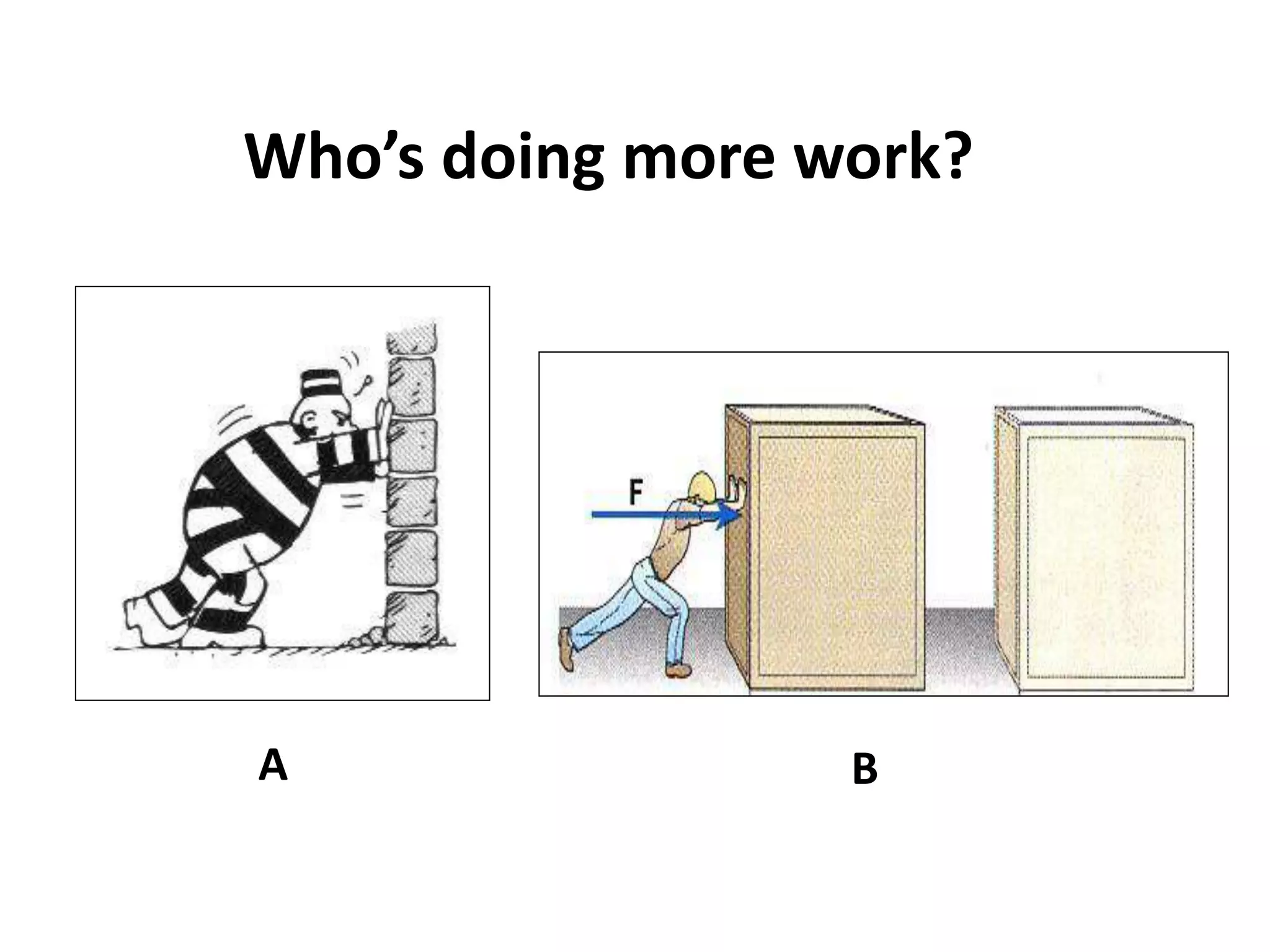
A B
Who’s doing more work?
WORK
Work is defined as the product of the net
force acting on a body and the distance
moved in the direction of the force
Work = force x parallel distance
W = F x d
SI unit: J - joules (1 joules = 1Nm = 1kgm2/s2)
A B
Who’s doing more work?
Only the component of the applied force, F, in
the direction of the motion of the lawn mower,
FHorizontal, is used to do work on the lawn mower
WORK
Practice!
1. An object is moved with a force of 15 N
across a horizontal surface. How much work
is done if the object is moved 50 m?
2. 650 J of work is done in moving a desk a
horizontal distance of 5 m. How much force is
used to move the desk?
3. How much work is done in lifting a 10 kg box
1.5 m off the floor?
How much work is done in lifting a 10 kg
box 1.5 m off the floor?
F=ma : w=mg
w=(10 kg)(9.8 m/s2 )
= ?
W=Fd
W = (100 N)(1.5 m)
= ?
Practice!
Practice!
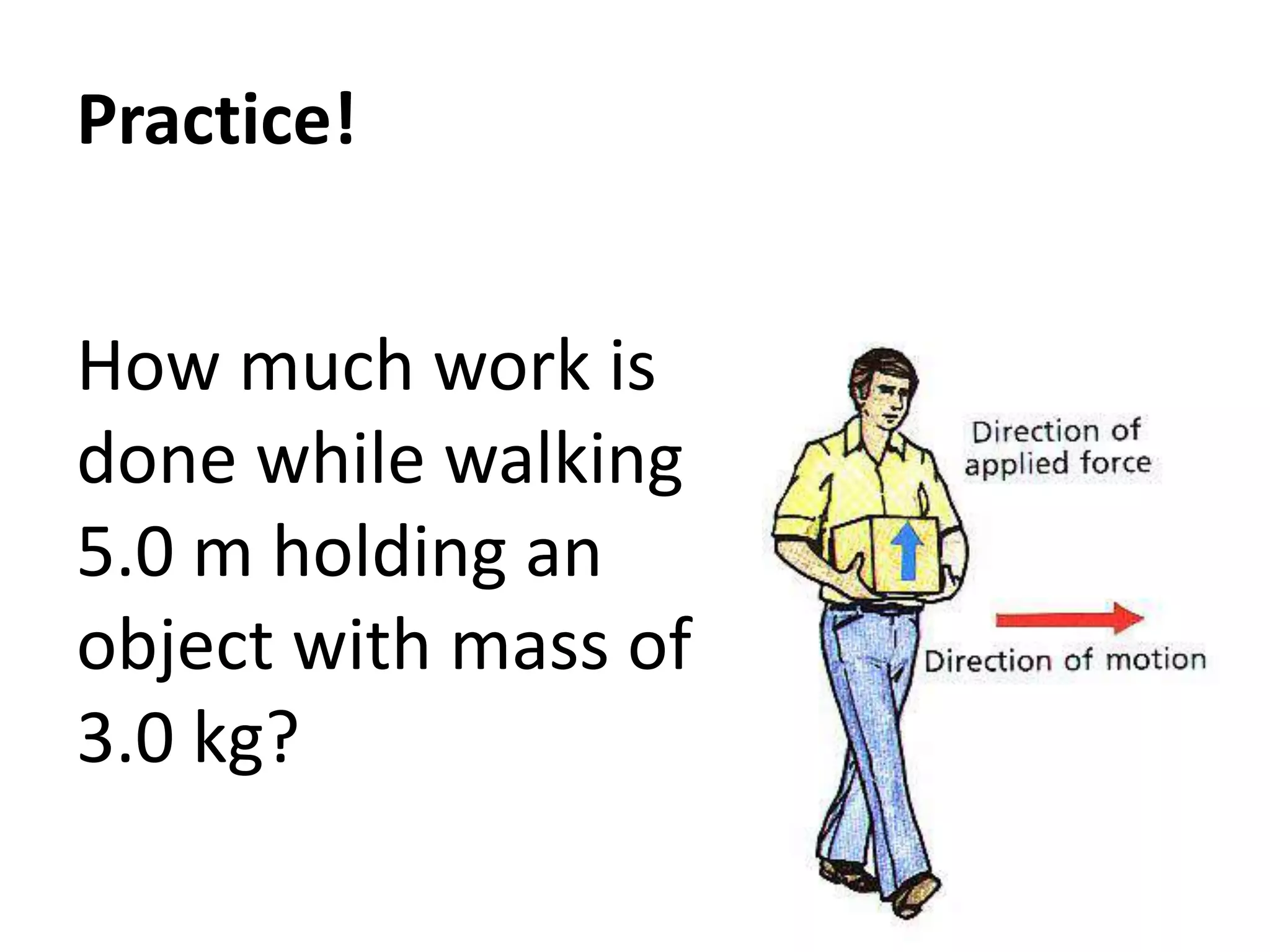
How much work is
done while walking
5.0 m holding an
object with mass of
3.0 kg?
Practice!
POWER
Power is the rate at which work is done
SI unit: watts (1 watt=1 joule/s)
1. A force of 150 N is used to push a motorcycle
10 m along a road in 20 s. Calculate the
power in watts.
2. An 80 kg man runs up a flight of stairs 5.0 m
high in 10 seconds. What is the man’s power
output in watts?
3. A pump lifts 30 kg of water a vertical distance
of 20 m each second. What is the power
output?
Practice!
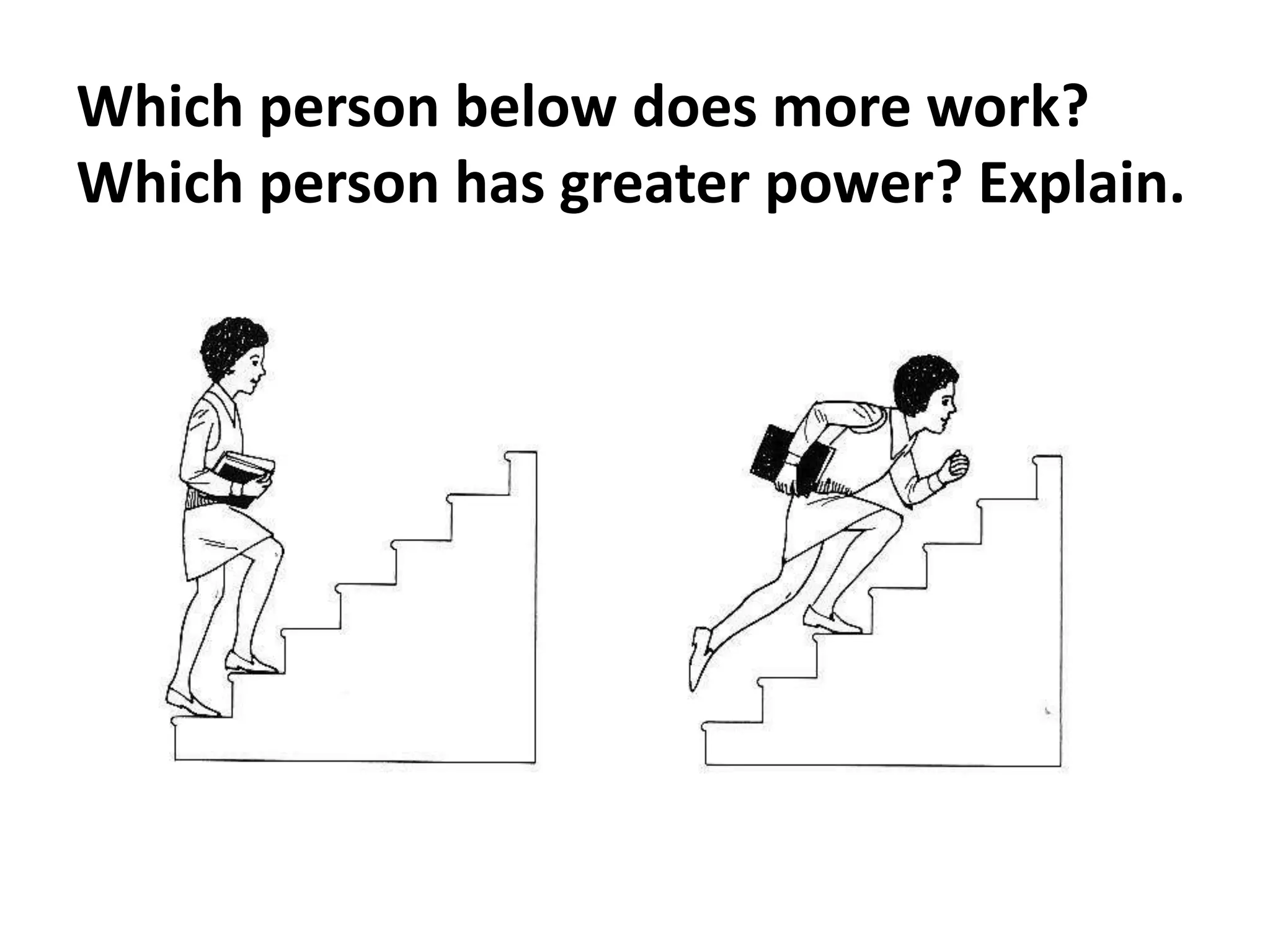
Which person below does more work?
Which person has greater power? Explain.
ENERGY
• Energy is defined as the ability to do work
ENERGY
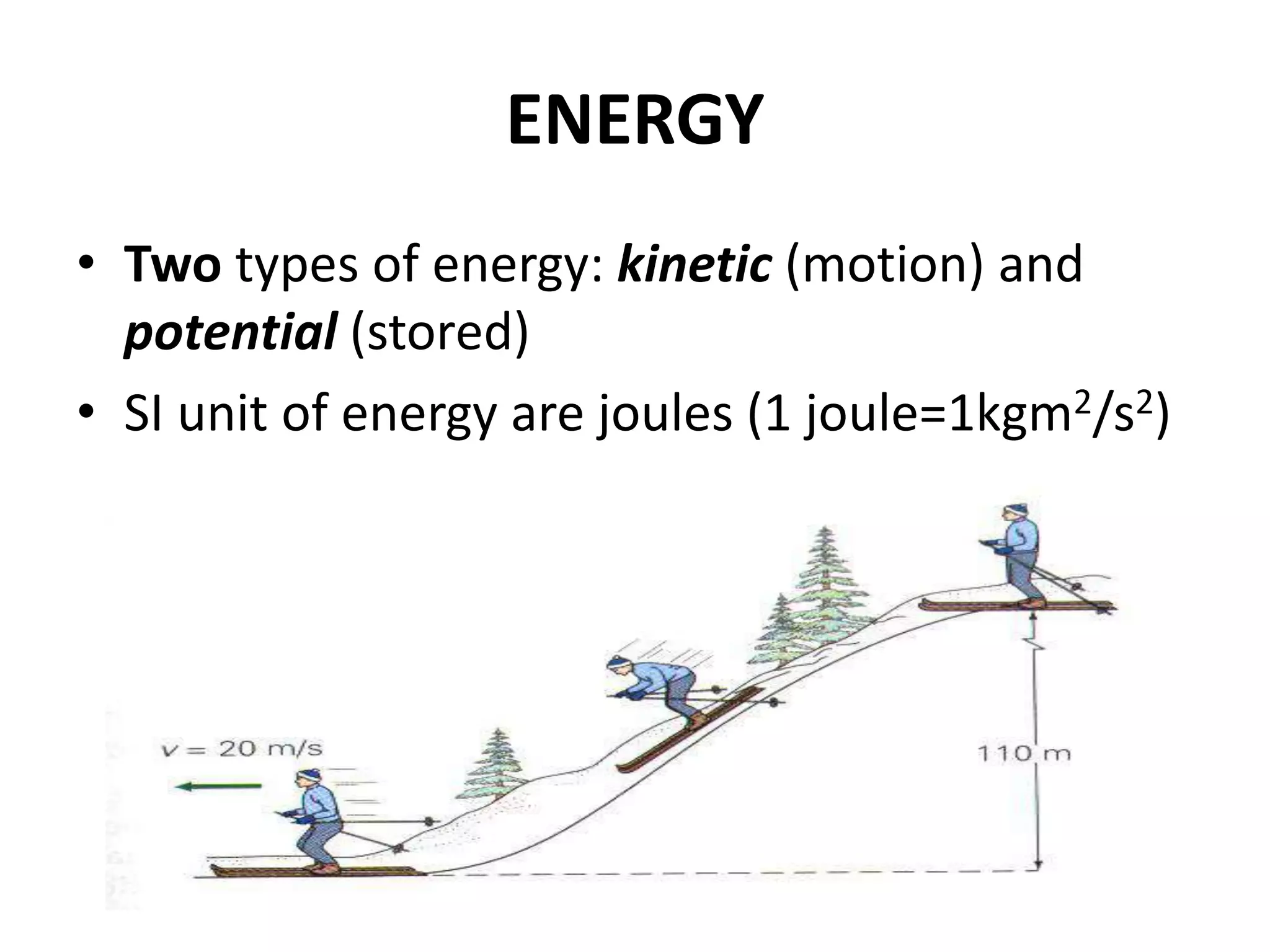
• Two types of energy: kinetic (motion) and
potential (stored)
• SI unit of energy are joules (1 joule=1kgm2/s2)
Kinetic Energy
• KE is energy of motion
• KE is a scalar quantity
Practice!
1. What is the kinetic energy of a 60 kg girl on
skis traveling at 20 m/s?
2. A sports car is moving at 4.0 m/s. If the mass
of the car is 800 kg, how much kinetic energy
does it have?
Potential Energy
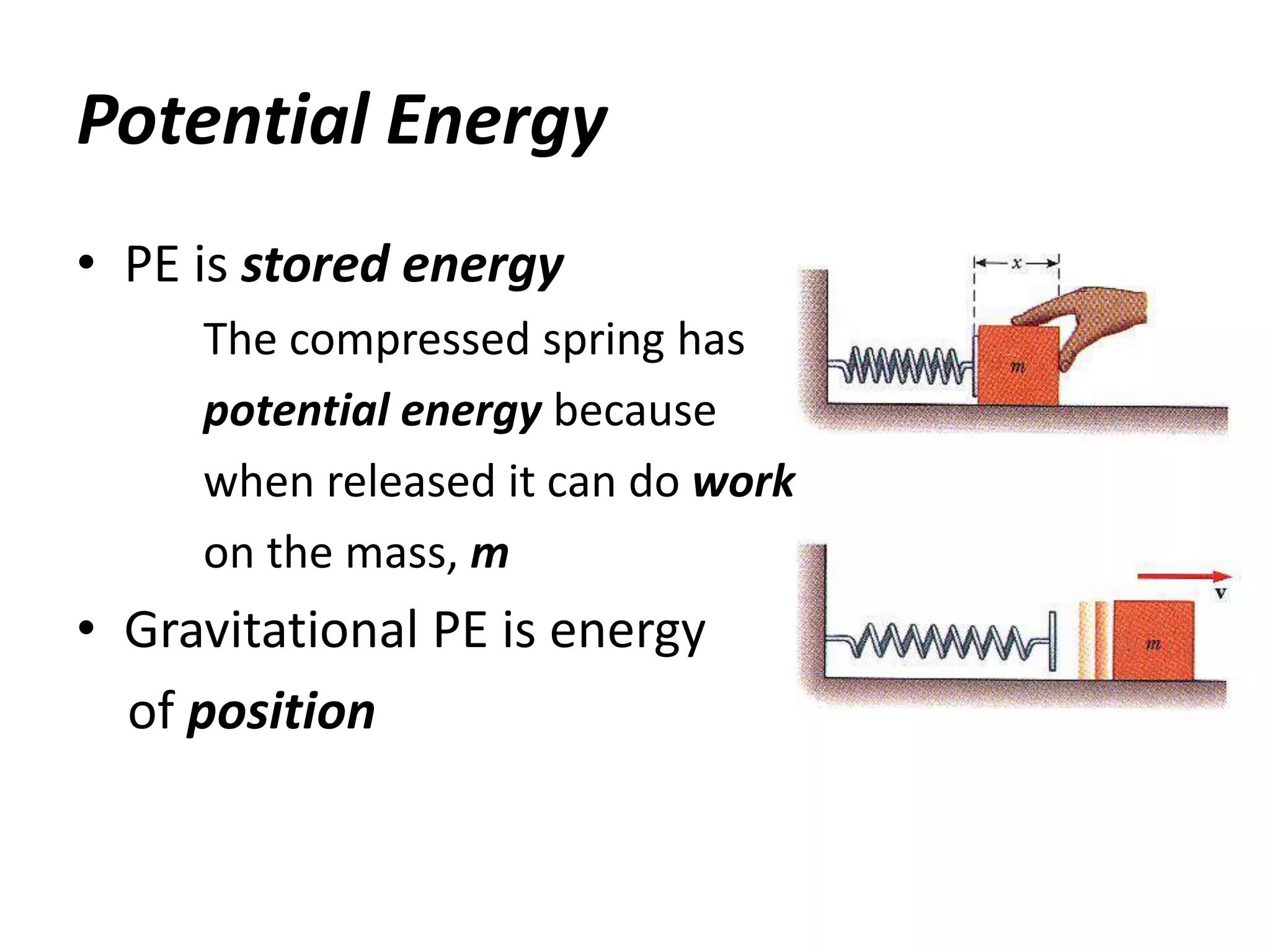
• PE is stored energy
The compressed spring has
potential energy because
when released it can do work
on the mass, m
• Gravitational PE is energy
of position
Potential Energy
• Gravitational PE is energy of position
Practice!
1. A mass of 100 kg is lifted a distance of 50 m.
How much potential energy does it possess?
2. A 70kg diver standing on a diving platform
possesses 35000 J of PE. How high is the
platform?
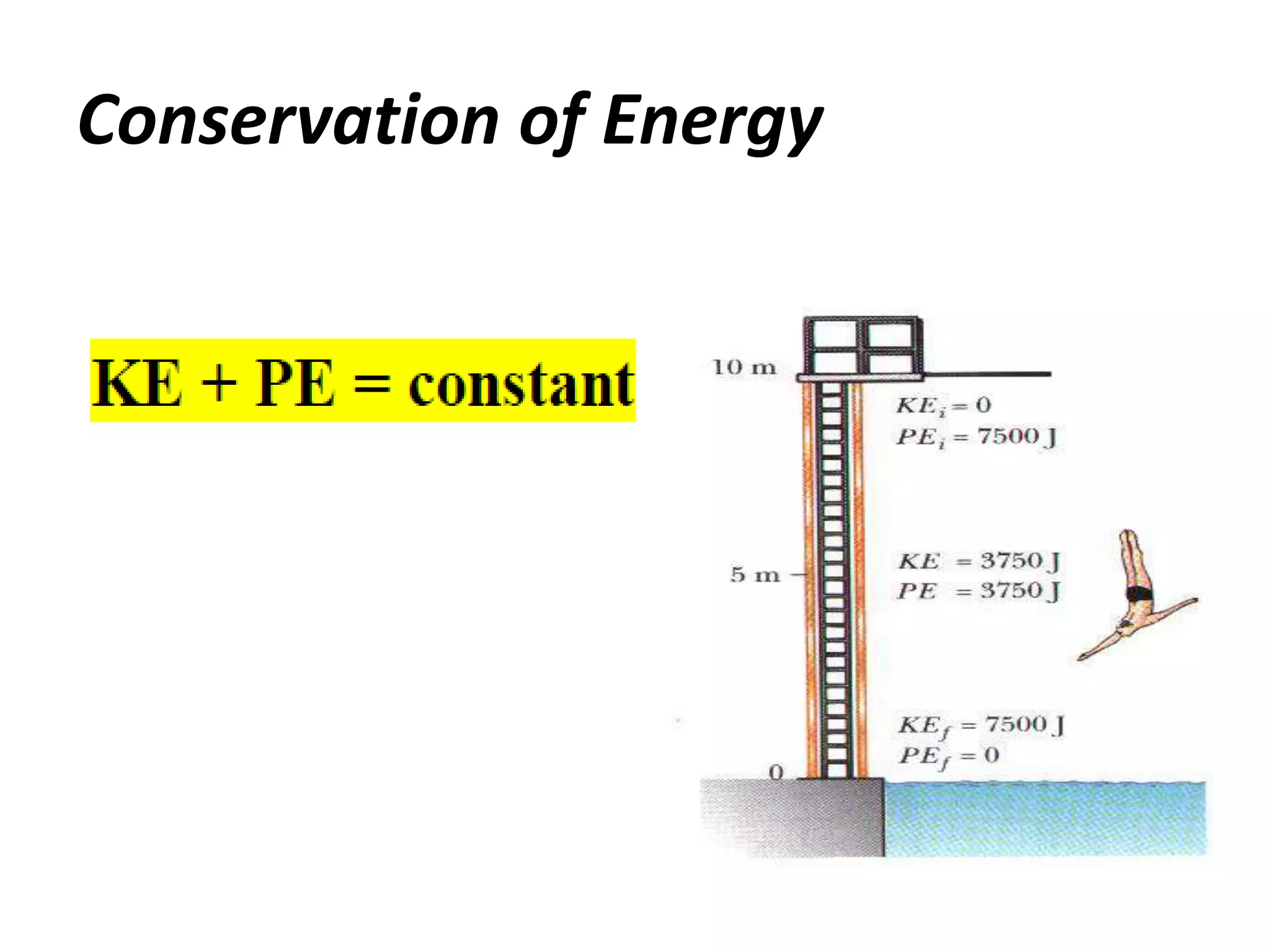
Conservation of Energy
• The sum of kinetic energy and potential
energy in a system is constant, in absence of
friction.
• Energy cannot be created or destroyed; it
may be transformed from one form to
another, but the total amount of energy in a
system remains constant.
Conservation of Energy
Practice!
1. A 10kg boulder rests at the edge of a 100m
cliff.
a. How much potential energy does the rock
possess
b. The rock rolls off the cliff and falls to the
bottom. How much kinetic energy does the
rock possess at the bottom of the cliff?
end
Coverage for Pre Midterm Exam
1. PPT 1 - Introduction to physical science
2. PPT 2 - Scientific notation, significant
digits, Measurements – Conversion of
units
3. PPT 3 – Force and Motion
4. PPT 4 – Work, Power and Energy
EXAM SCHEDULE
JANUARY 21 2015 -
WEDNESDAY

WORK POWER AND ENERGY

  • 1.
    WORK, ENERGY &POWER Jeszianlenn L. Plaza January 14, 2015
  • 2.
  • 3.
    WORK Work is definedas the product of the net force acting on a body and the distance moved in the direction of the force Work = force x parallel distance W = F x d SI unit: J - joules (1 joules = 1Nm = 1kgm2/s2)
  • 4.
  • 5.
    Only the componentof the applied force, F, in the direction of the motion of the lawn mower, FHorizontal, is used to do work on the lawn mower WORK
  • 6.
    Practice! 1. An objectis moved with a force of 15 N across a horizontal surface. How much work is done if the object is moved 50 m? 2. 650 J of work is done in moving a desk a horizontal distance of 5 m. How much force is used to move the desk? 3. How much work is done in lifting a 10 kg box 1.5 m off the floor?
  • 7.
    How much workis done in lifting a 10 kg box 1.5 m off the floor? F=ma : w=mg w=(10 kg)(9.8 m/s2 ) = ? W=Fd W = (100 N)(1.5 m) = ? Practice!
  • 8.
    Practice! How much workis done while walking 5.0 m holding an object with mass of 3.0 kg?
  • 9.
  • 10.
    POWER Power is therate at which work is done SI unit: watts (1 watt=1 joule/s)
  • 11.
    1. A forceof 150 N is used to push a motorcycle 10 m along a road in 20 s. Calculate the power in watts. 2. An 80 kg man runs up a flight of stairs 5.0 m high in 10 seconds. What is the man’s power output in watts? 3. A pump lifts 30 kg of water a vertical distance of 20 m each second. What is the power output? Practice!
  • 12.
    Which person belowdoes more work? Which person has greater power? Explain.
  • 13.
    ENERGY • Energy isdefined as the ability to do work
  • 14.
    ENERGY • Two typesof energy: kinetic (motion) and potential (stored) • SI unit of energy are joules (1 joule=1kgm2/s2)
  • 15.
    Kinetic Energy • KEis energy of motion • KE is a scalar quantity
  • 16.
    Practice! 1. What isthe kinetic energy of a 60 kg girl on skis traveling at 20 m/s? 2. A sports car is moving at 4.0 m/s. If the mass of the car is 800 kg, how much kinetic energy does it have?
  • 17.
    Potential Energy • PEis stored energy The compressed spring has potential energy because when released it can do work on the mass, m • Gravitational PE is energy of position
  • 18.
    Potential Energy • GravitationalPE is energy of position
  • 19.
    Practice! 1. A massof 100 kg is lifted a distance of 50 m. How much potential energy does it possess? 2. A 70kg diver standing on a diving platform possesses 35000 J of PE. How high is the platform?
  • 20.
    Conservation of Energy •The sum of kinetic energy and potential energy in a system is constant, in absence of friction. • Energy cannot be created or destroyed; it may be transformed from one form to another, but the total amount of energy in a system remains constant.
  • 21.
  • 22.
    Practice! 1. A 10kgboulder rests at the edge of a 100m cliff. a. How much potential energy does the rock possess b. The rock rolls off the cliff and falls to the bottom. How much kinetic energy does the rock possess at the bottom of the cliff?
  • 23.
  • 24.
    Coverage for PreMidterm Exam 1. PPT 1 - Introduction to physical science 2. PPT 2 - Scientific notation, significant digits, Measurements – Conversion of units 3. PPT 3 – Force and Motion 4. PPT 4 – Work, Power and Energy
  • 25.
    EXAM SCHEDULE JANUARY 212015 - WEDNESDAY