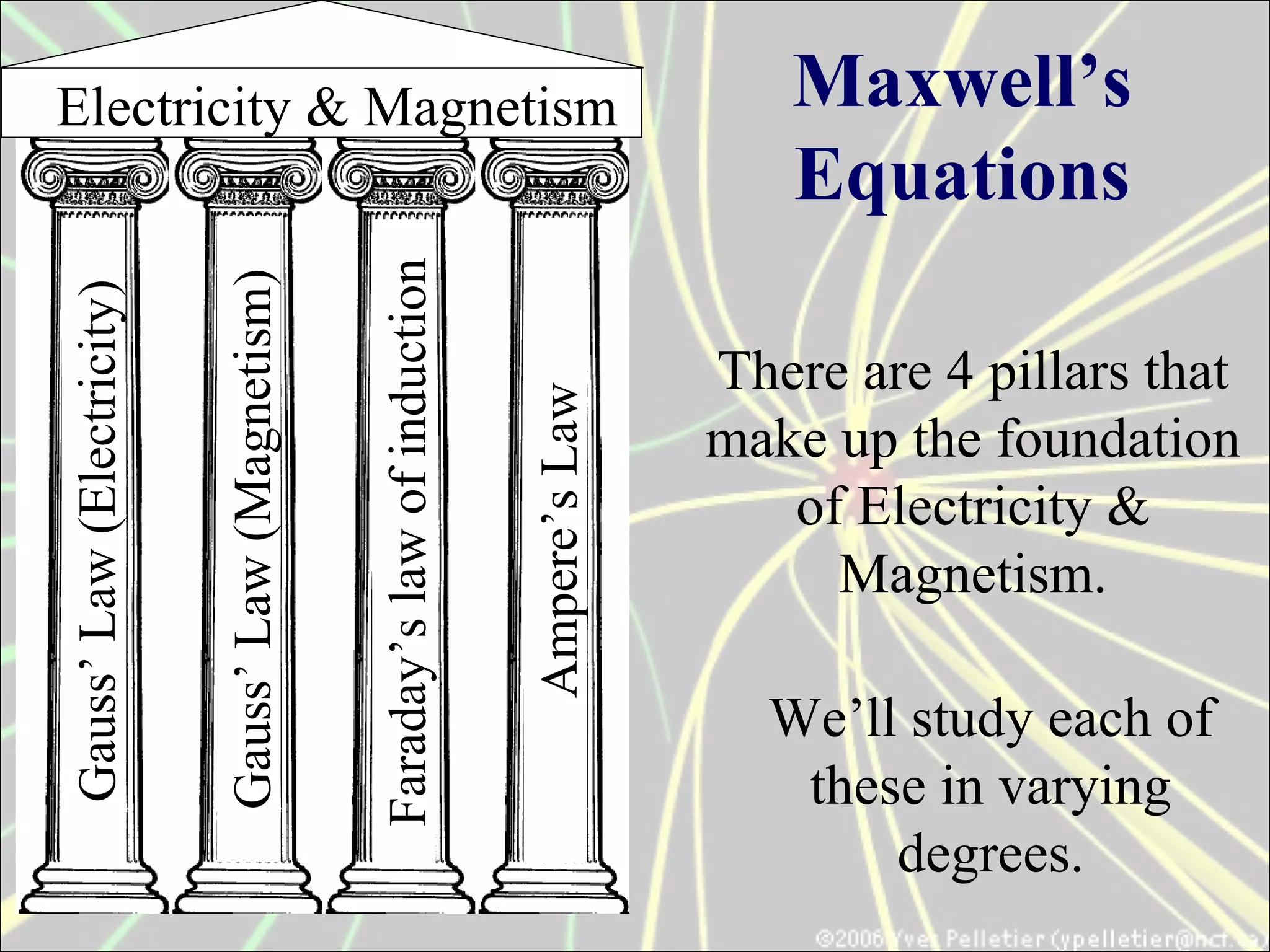
Electricity & Magnetism                                                                            Maxwell’s
                                                                                                   Equations

                                                    Faraday’s law of induction
                           Gauss’ Law (Magnetism)
Gauss’ Law (Electricity)


                                                                                                There are 4 pillars that


                                                                                 Ampere’s Law
                                                                                                make up the foundation
                                                                                                   of Electricity &
                                                                                                     Magnetism.

                                                                                                  We’ll study each of
                                                                                                   these in varying
                                                                                                       degrees.
First Pillar: Gauss’ Law
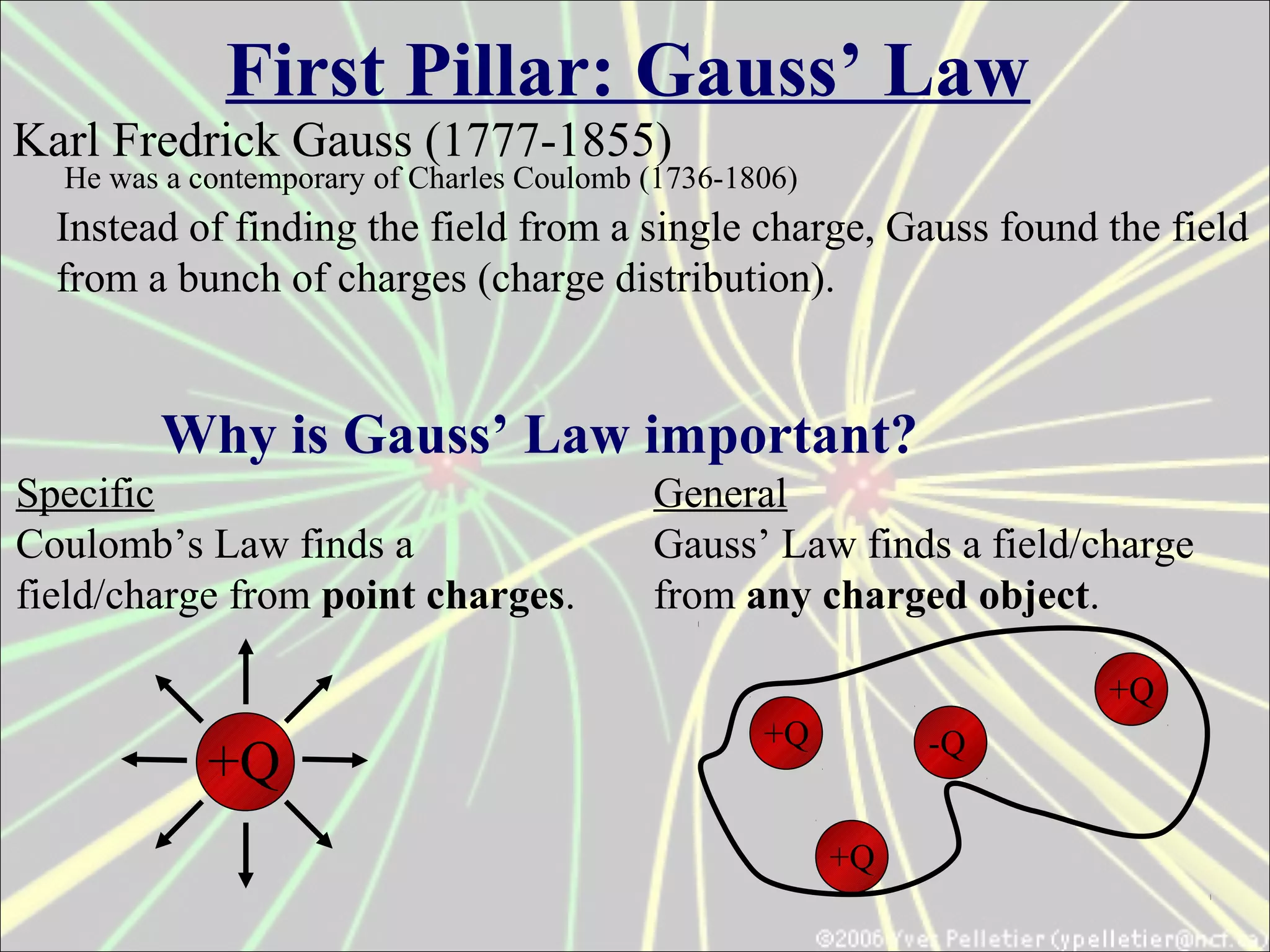
Karl Fredrick Gauss (1777-1855)
  He was a contemporary of Charles Coulomb (1736-1806)
  Instead of finding the field from a single charge, Gauss found the field
  from a bunch of charges (charge distribution).


        Why is Gauss’ Law important?
Specific                                   General
Coulomb’s Law finds a                      Gauss’ Law finds a field/charge
field/charge from point charges.           from any charged object.

                                                                     +Q
                                                   +Q         -Q
            +Q
                                                         +Q
What is Gauss’ Law?
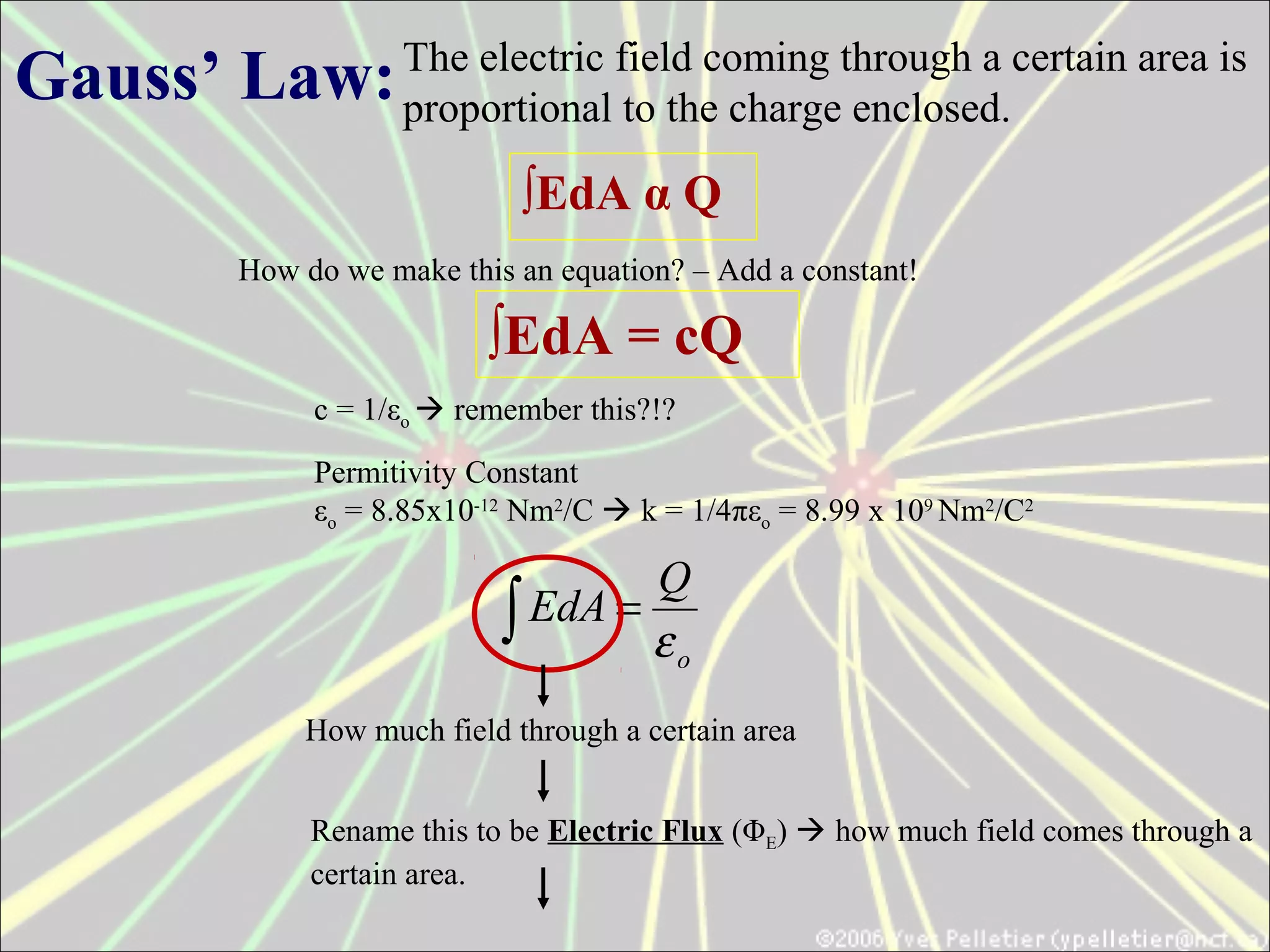
              The electric field coming through a certain area is
              proportional to the charge enclosed.
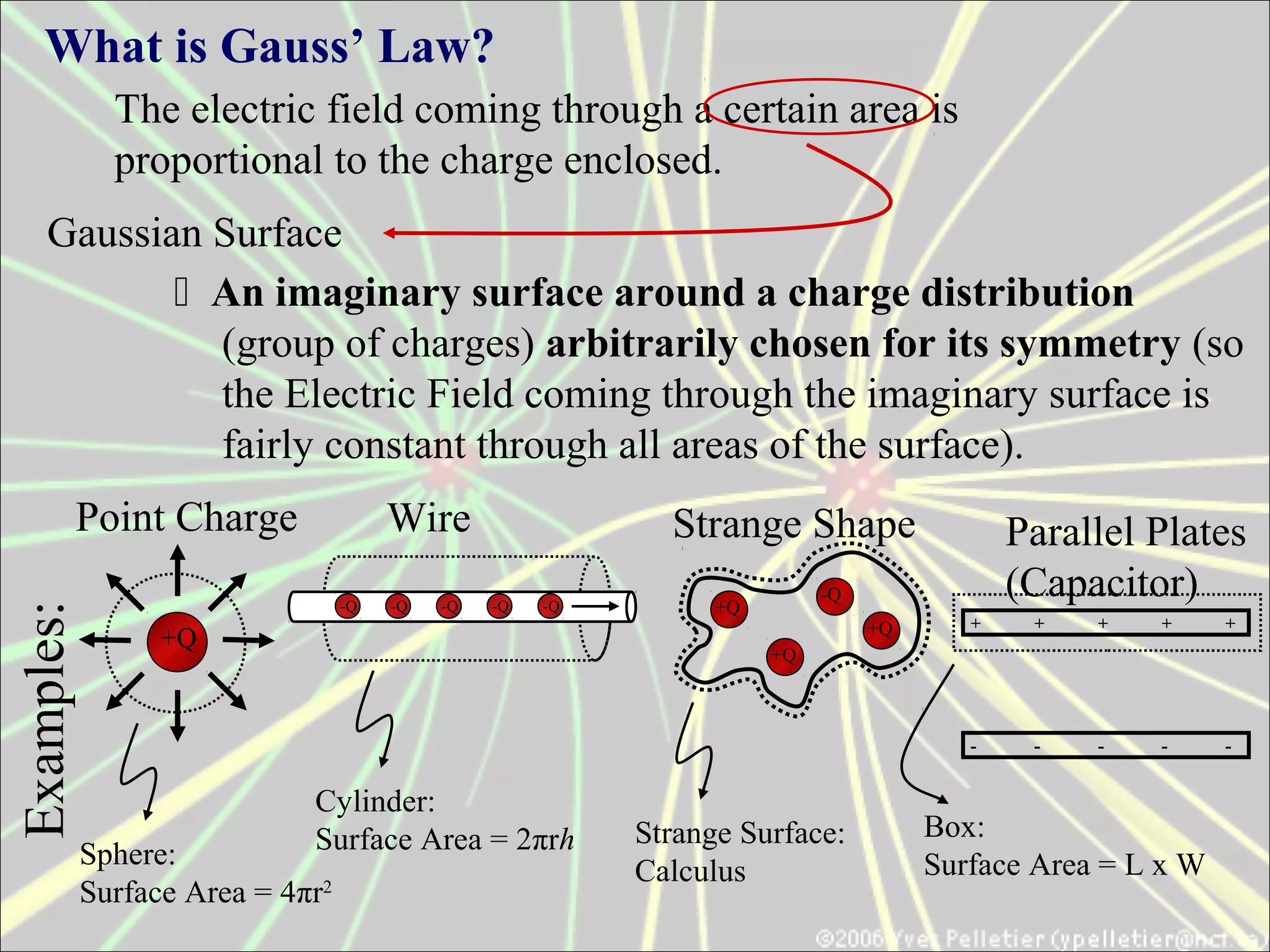
    Gaussian Surface
            An imaginary surface around a charge distribution
             (group of charges) arbitrarily chosen for its symmetry (so
             the Electric Field coming through the imaginary surface is
             fairly constant through all areas of the surface).
            Point Charge               Wire                  Strange Shape                  Parallel Plates
                                  -Q   -Q   -Q   -Q   -Q         +Q
                                                                           -Q               (Capacitor)
Examples:


                                                                                +Q      +    +   +   +      +
                  +Q                                                  +Q


                                                                                        -    -   -   -      -


                             Cylinder:
                             Surface Area = 2πrh           Strange Surface:          Box:
            Sphere:                                                                  Surface Area = L x W
                                                           Calculus
            Surface Area = 4πr2
What is Gauss’ Law?
      2
   The electric field coming through a certain area is
   proportional to the charge enclosed. 3
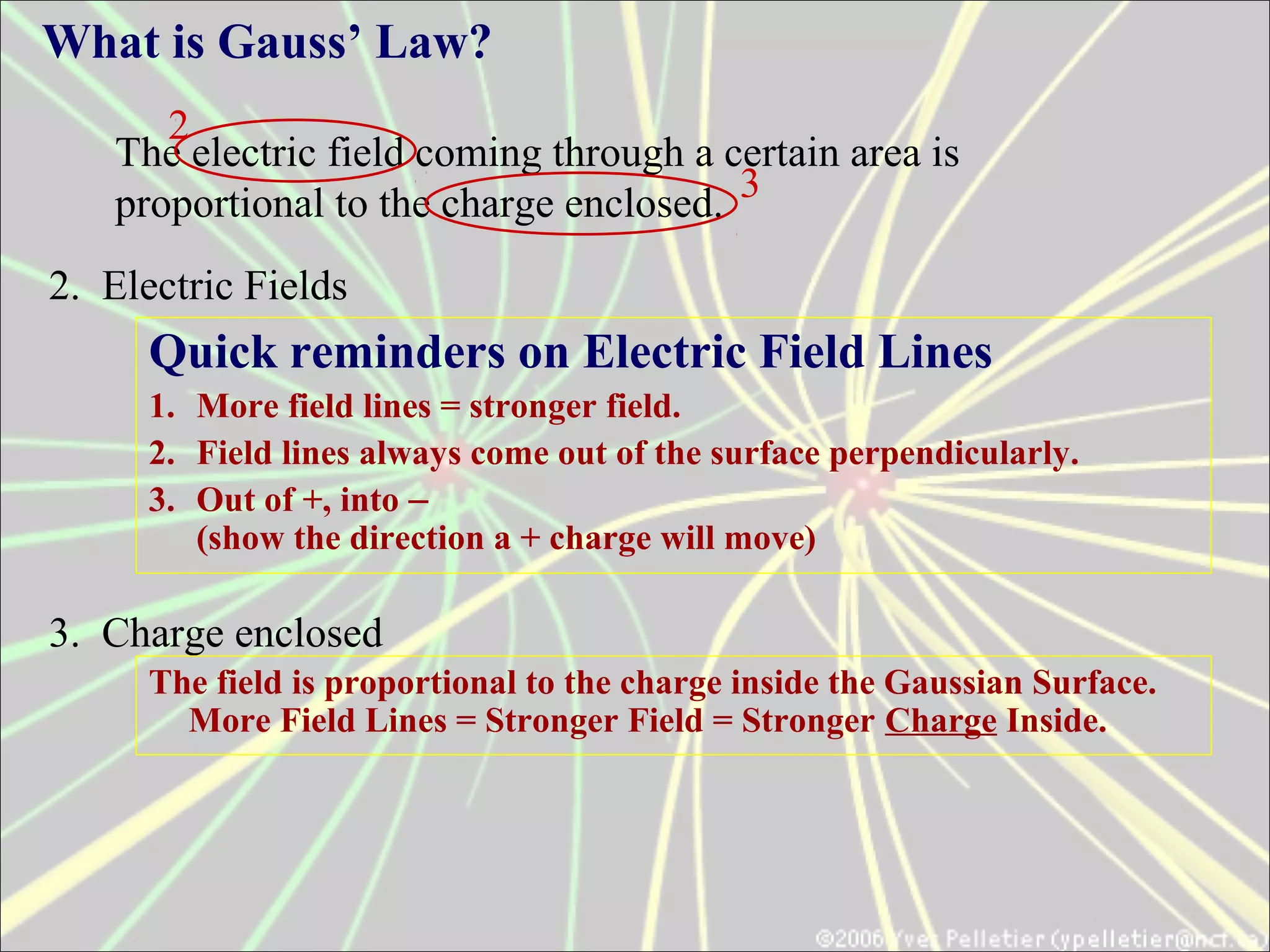
2. Electric Fields
      Quick reminders on Electric Field Lines
      1. More field lines = stronger field.
      2. Field lines always come out of the surface perpendicularly.
      3. Out of +, into ‒
         (show the direction a + charge will move)

3. Charge enclosed
      The field is proportional to the charge inside the Gaussian Surface.
        More Field Lines = Stronger Field = Stronger Charge Inside.
The electric field coming through a certain area is
Gauss’ Law:       proportional to the charge enclosed.

                          ∫EdA α Q
      How do we make this an equation? – Add a constant!

                        ∫EdA = cQ
           c = 1/εo  remember this?!?
           Permitivity Constant
           εo = 8.85x10⁻¹² Nm2/C  k = 1/4πεo = 8.99 x 10⁹ Nm2/C2

                                 Q
                         ∫ EdA = ε o
          How much field through a certain area


           Rename this to be Electric Flux (ΦE)  how much field comes through a
           certain area.
And finally…
          Gauss’ Law Summary
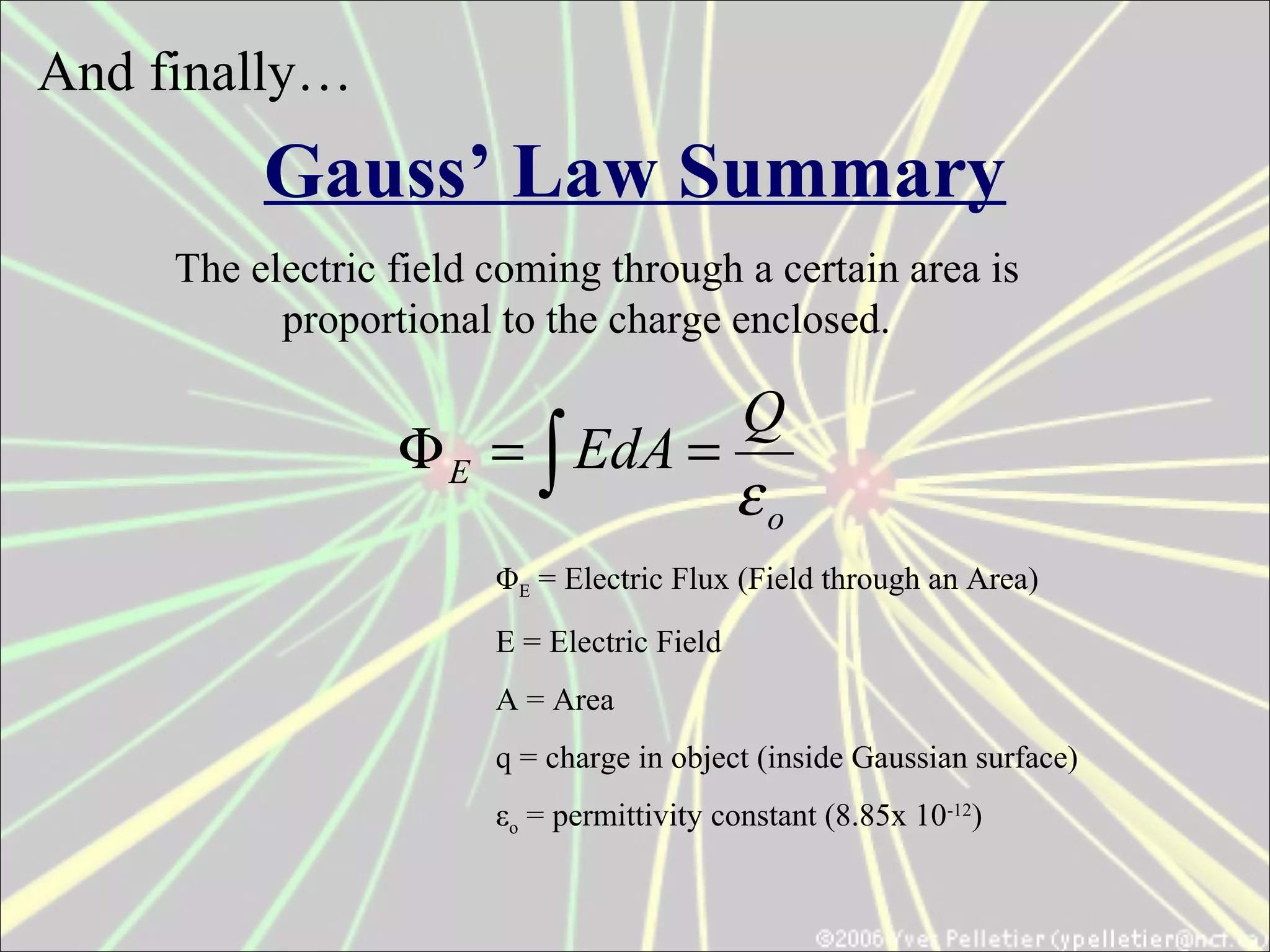
     The electric field coming through a certain area is
           proportional to the charge enclosed.

                                Q
                  Φ E = ∫ EdA =
                                εo
                        ΦE = Electric Flux (Field through an Area)
                        E = Electric Field
                        A = Area
                        q = charge in object (inside Gaussian surface)
                        εo = permittivity constant (8.85x 10⁻¹²)
Sample Problem 1
A Van de Graaff machine with a radius of 0.25 m
  has been charged up. What is the electric field
  0.1 m away from the center of the sphere?
 Hint: Where are all the charges?   On the outside.
      So how much charge is in the center? None.

                         0
              Φ E = EA =    =0
                         εo
        Since all the charge is on the surface, it proves there is no field
        inside a conducting surface!
Sample Problem 2
Find the electric field around a point charge,
  Q.
  Remember the area of a sphere (Gaussian
        Q
  Surface in this case) is 4πr2.
   EA =
        εo

   E (4πr ) =
         2    Q                                             +Q
              εo
        Q                            1
   E=           → don' t forget k =
      4πε o r 2
                                    4πε o
     kQ             What does this look like?
   E= 2             Coulomb’s electric field for point charges!
     r
Sample Problem 3
A solid sphere of radius R = 40 cm has a total positive
charge of 26 μC uniformly distributed throughout its
volume. Calculate the magnitude of the electric field at
the following distances from the center of the sphere.
 (a) 0 cm                (b) 30 cm                      (c) 60 cm

 Inside sphere Q = 0   Still inside sphere
                          ∴Q still = 0                      Q
                                             Φ E = EA =
                                                            εo
             Q                    Q
  Φ E = EA =           Φ E = EA =                       Q
             εo                   εo         E (4πr ) =
                                                    2

                                                        εo
               0                     0
  Φ E = EA =      =0   Φ E = EA =       =0                    26 x10 −6
               εo                    εo      E (4π 0.6 2 ) =
                                                             8.85 x10 −12
                                             E = 6.49 x10⁵ N / C
Sample Problem 3
A solid sphere of radius R = 40 cm has a total positive
charge of 26 μC uniformly distributed throughout its
volume. Calculate the magnitude of the electric field at
the following distances from the center of the sphere.
 (a) 0 cm                (b) 30 cm                      (c) 60 cm

 Inside sphere Q = 0   Still inside sphere
                          ∴Q still = 0                      Q
                                             Φ E = EA =
                                                            εo
             Q                    Q
  Φ E = EA =           Φ E = EA =                       Q
             εo                   εo         E (4πr ) =
                                                    2

                                                        εo
               0                     0
  Φ E = EA =      =0   Φ E = EA =       =0                    26 x10 −6
               εo                    εo      E (4π 0.6 2 ) =
                                                             8.85 x10 −12
                                             E = 6.49 x10⁵ N / C

Gauss' law

  • 1.
    Electricity & Magnetism Maxwell’s Equations Faraday’s law of induction Gauss’ Law (Magnetism) Gauss’ Law (Electricity) There are 4 pillars that Ampere’s Law make up the foundation of Electricity & Magnetism. We’ll study each of these in varying degrees.
  • 2.
    First Pillar: Gauss’Law Karl Fredrick Gauss (1777-1855) He was a contemporary of Charles Coulomb (1736-1806) Instead of finding the field from a single charge, Gauss found the field from a bunch of charges (charge distribution). Why is Gauss’ Law important? Specific General Coulomb’s Law finds a Gauss’ Law finds a field/charge field/charge from point charges. from any charged object. +Q +Q -Q +Q +Q
  • 3.
    What is Gauss’Law? The electric field coming through a certain area is proportional to the charge enclosed. Gaussian Surface  An imaginary surface around a charge distribution (group of charges) arbitrarily chosen for its symmetry (so the Electric Field coming through the imaginary surface is fairly constant through all areas of the surface). Point Charge Wire Strange Shape Parallel Plates -Q -Q -Q -Q -Q +Q -Q (Capacitor) Examples: +Q + + + + + +Q +Q - - - - - Cylinder: Surface Area = 2πrh Strange Surface: Box: Sphere: Surface Area = L x W Calculus Surface Area = 4πr2
  • 4.
    What is Gauss’Law? 2 The electric field coming through a certain area is proportional to the charge enclosed. 3 2. Electric Fields Quick reminders on Electric Field Lines 1. More field lines = stronger field. 2. Field lines always come out of the surface perpendicularly. 3. Out of +, into ‒ (show the direction a + charge will move) 3. Charge enclosed The field is proportional to the charge inside the Gaussian Surface. More Field Lines = Stronger Field = Stronger Charge Inside.
  • 5.
    The electric fieldcoming through a certain area is Gauss’ Law: proportional to the charge enclosed. ∫EdA α Q How do we make this an equation? – Add a constant! ∫EdA = cQ c = 1/εo  remember this?!? Permitivity Constant εo = 8.85x10⁻¹² Nm2/C  k = 1/4πεo = 8.99 x 10⁹ Nm2/C2 Q ∫ EdA = ε o How much field through a certain area Rename this to be Electric Flux (ΦE)  how much field comes through a certain area.
  • 6.
    And finally… Gauss’ Law Summary The electric field coming through a certain area is proportional to the charge enclosed. Q Φ E = ∫ EdA = εo ΦE = Electric Flux (Field through an Area) E = Electric Field A = Area q = charge in object (inside Gaussian surface) εo = permittivity constant (8.85x 10⁻¹²)
  • 7.
    Sample Problem 1 AVan de Graaff machine with a radius of 0.25 m has been charged up. What is the electric field 0.1 m away from the center of the sphere? Hint: Where are all the charges? On the outside. So how much charge is in the center? None. 0 Φ E = EA = =0 εo Since all the charge is on the surface, it proves there is no field inside a conducting surface!
  • 8.
    Sample Problem 2 Findthe electric field around a point charge, Q. Remember the area of a sphere (Gaussian Q Surface in this case) is 4πr2. EA = εo E (4πr ) = 2 Q +Q εo Q 1 E= → don' t forget k = 4πε o r 2 4πε o kQ What does this look like? E= 2 Coulomb’s electric field for point charges! r
  • 9.
    Sample Problem 3 Asolid sphere of radius R = 40 cm has a total positive charge of 26 μC uniformly distributed throughout its volume. Calculate the magnitude of the electric field at the following distances from the center of the sphere. (a) 0 cm (b) 30 cm (c) 60 cm Inside sphere Q = 0 Still inside sphere ∴Q still = 0 Q Φ E = EA = εo Q Q Φ E = EA = Φ E = EA = Q εo εo E (4πr ) = 2 εo 0 0 Φ E = EA = =0 Φ E = EA = =0 26 x10 −6 εo εo E (4π 0.6 2 ) = 8.85 x10 −12 E = 6.49 x10⁵ N / C
  • 10.
    Sample Problem 3 Asolid sphere of radius R = 40 cm has a total positive charge of 26 μC uniformly distributed throughout its volume. Calculate the magnitude of the electric field at the following distances from the center of the sphere. (a) 0 cm (b) 30 cm (c) 60 cm Inside sphere Q = 0 Still inside sphere ∴Q still = 0 Q Φ E = EA = εo Q Q Φ E = EA = Φ E = EA = Q εo εo E (4πr ) = 2 εo 0 0 Φ E = EA = =0 Φ E = EA = =0 26 x10 −6 εo εo E (4π 0.6 2 ) = 8.85 x10 −12 E = 6.49 x10⁵ N / C