Electric Charges, Forces,
and Fields
TOPICS
• Electric Charge
• Insulators and Conductors
• Coulomb’s Law
• The Electric Field
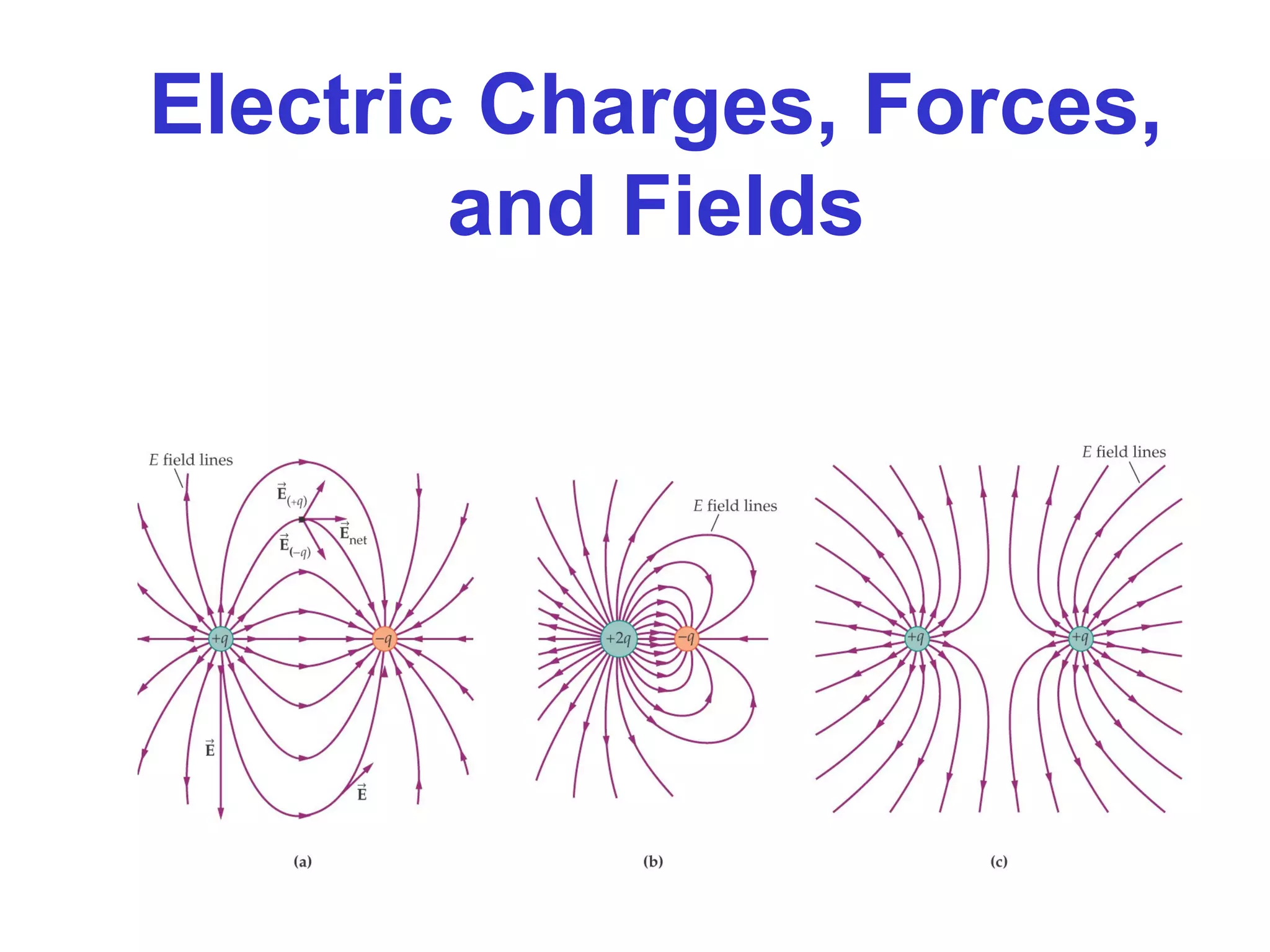
• Electric Field Lines
• Electric Flux and Gauss’s Law
Electric Charge
Electric charge is the physical property of
matter that cause it to experience a force
when placed in an electromagnetic field.
There are two types of charge: positive and
negative
Electric Charge
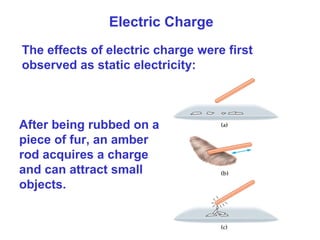
The effects of electric charge were first
observed as static electricity:
After being rubbed on a
piece of fur, an amber
rod acquires a charge
and can attract small
objects.
Electric Charge
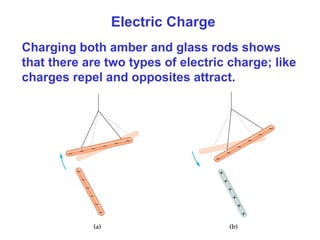
Charging both amber and glass rods shows
that there are two types of electric charge; like
charges repel and opposites attract.
Electric Charge
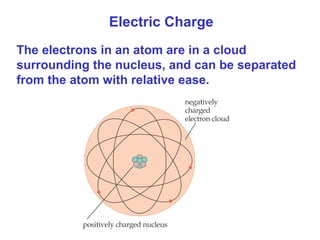
The electrons in an atom are in a cloud
surrounding the nucleus, and can be separated
from the atom with relative ease.
Electric Charge
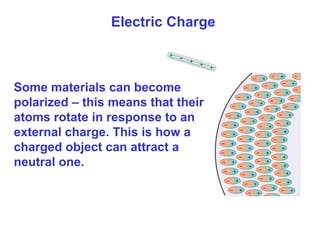
Some materials can become
polarized – this means that their
atoms rotate in response to an
external charge. This is how a
charged object can attract a
neutral one.
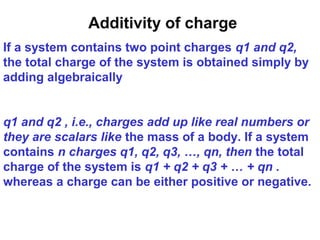
If a system contains two point charges q1 and q2,
the total charge of the system is obtained simply by
adding algebraically
q1 and q2 , i.e., charges add up like real numbers or
they are scalars like the mass of a body. If a system
contains n charges q1, q2, q3, …, qn, then the total
charge of the system is q1 + q2 + q3 + … + qn .
whereas a charge can be either positive or negative.
Additivity of charge
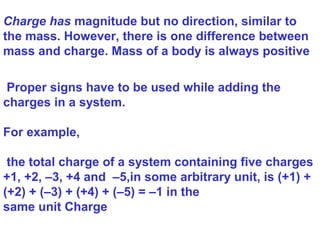
Proper signs have to be used while adding the
charges in a system.
For example,
the total charge of a system containing five charges
+1, +2, –3, +4 and –5,in some arbitrary unit, is (+1) +
(+2) + (–3) + (+4) + (–5) = –1 in the
same unit Charge
Charge has magnitude but no direction, similar to
the mass. However, there is one difference between
mass and charge. Mass of a body is always positive
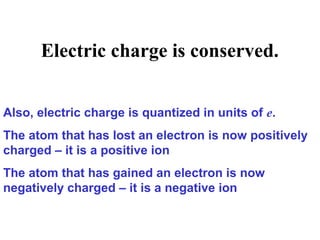
Electric charge is conserved.
Also, electric charge is quantized in units of e.
The atom that has lost an electron is now positively
charged – it is a positive ion
The atom that has gained an electron is now
negatively charged – it is a negative ion
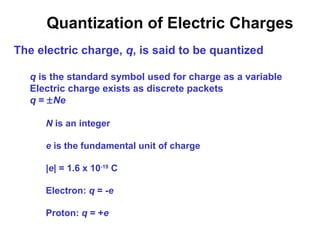
The electric charge, q, is said to be quantized
q is the standard symbol used for charge as a variable
Electric charge exists as discrete packets
q = ±Ne
N is an integer
e is the fundamental unit of charge
|e| = 1.6 x 10⁻¹⁹
C
Electron: q = -e
Proton: q = +e
Quantization of Electric Charges
Charging Objects by Induction
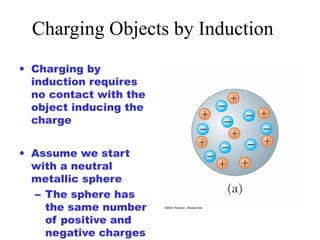
• Charging by
induction requires
no contact with the
object inducing the
charge
• Assume we start
with a neutral
metallic sphere
– The sphere has
the same number
of positive and
negative charges
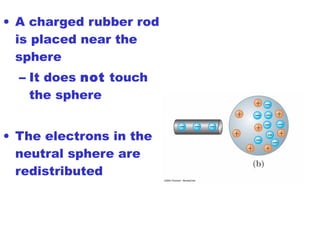
• A charged rubber rod
is placed near the
sphere
– It does not touch
the sphere
• The electrons in the
neutral sphere are
redistributed
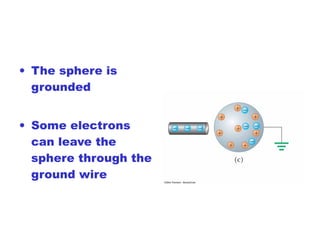
• The sphere is
grounded
• Some electrons
can leave the
sphere through the
ground wire
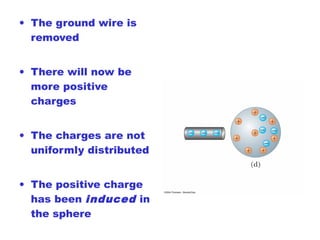
• The ground wire is
removed
• There will now be
more positive
charges
• The charges are not
uniformly distributed
• The positive charge
has been induced in
the sphere
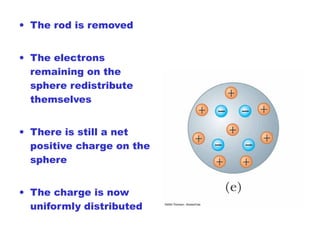
• The rod is removed
• The electrons
remaining on the
sphere redistribute
themselves
• There is still a net
positive charge on the
sphere
• The charge is now
uniformly distributed
Insulators and Conductors
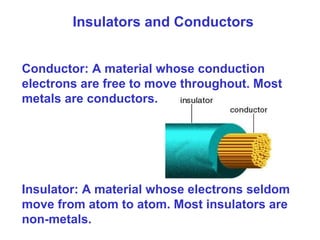
Conductor: A material whose conduction
electrons are free to move throughout. Most
metals are conductors.
Insulator: A material whose electrons seldom
move from atom to atom. Most insulators are
non-metals.
Insulators and Conductors
Semiconductors have properties intermediate
between conductors and insulators; their
properties change with their chemical
composition.
Photoconductive materials become
conductors when light shines on them.
Coulomb’s Law
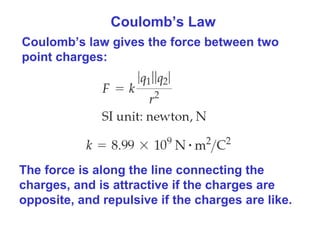
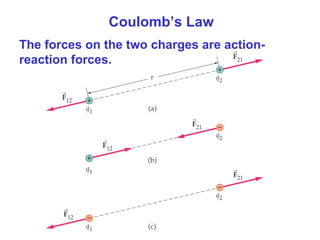
Coulomb’s law gives the force between two
point charges:
The force is along the line connecting the
charges, and is attractive if the charges are
opposite, and repulsive if the charges are like.
Coulomb’s Law
The forces on the two charges are action-
reaction forces.
Coulomb’s Law
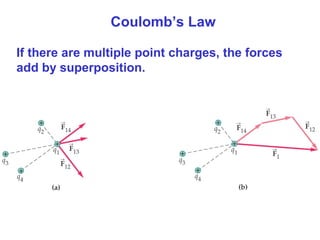
If there are multiple point charges, the forces
add by superposition.
Coulomb’s Law
Coulomb’s law is stated in terms of point
charges, but it is also valid for spherically
symmetric charge distributions, as long as the
distance is measured from the center of the
sphere.
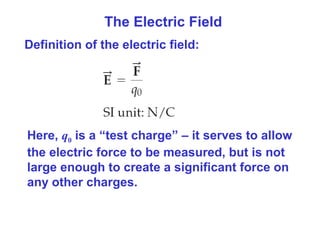
The Electric Field
Definition of the electric field:
Here, q0 is a “test charge” – it serves to allow
the electric force to be measured, but is not
large enough to create a significant force on
any other charges.
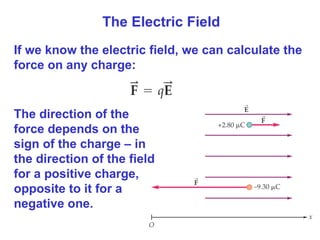
The Electric Field
If we know the electric field, we can calculate the
force on any charge:
The direction of the
force depends on the
sign of the charge – in
the direction of the field
for a positive charge,
opposite to it for a
negative one.
The Electric Field
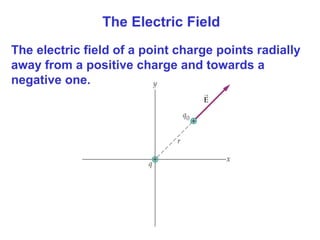
The electric field of a point charge points radially
away from a positive charge and towards a
negative one.
The Electric Field
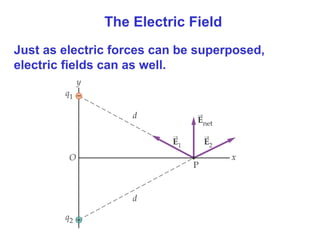
Just as electric forces can be superposed,
electric fields can as well.
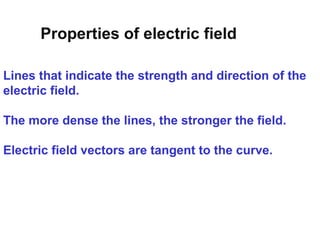
Lines that indicate the strength and direction of the
electric field.
The more dense the lines, the stronger the field.
Electric field vectors are tangent to the curve.
Properties of electric field
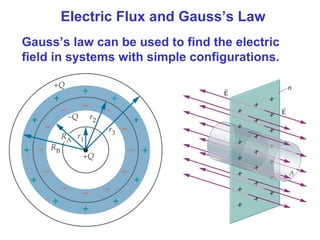
Electric Flux and Gauss’s Law
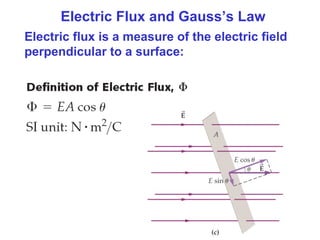
Electric flux is a measure of the electric field
perpendicular to a surface:
Electric Flux and Gauss’s Law
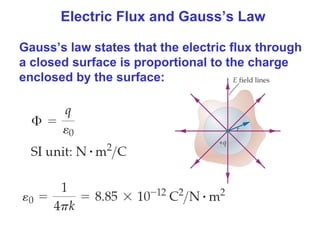
Gauss’s law states that the electric flux through
a closed surface is proportional to the charge
enclosed by the surface:
Electric Flux and Gauss’s Law
Gauss’s law can be used to find the electric
field in systems with simple configurations.
Summary
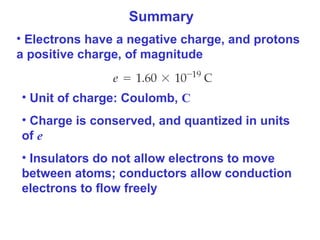
• Electrons have a negative charge, and protons
a positive charge, of magnitude
• Unit of charge: Coulomb, C
• Charge is conserved, and quantized in units
of e
• Insulators do not allow electrons to move
between atoms; conductors allow conduction
electrons to flow freely
Summary
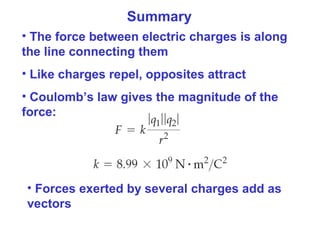
• The force between electric charges is along
the line connecting them
• Like charges repel, opposites attract
• Coulomb’s law gives the magnitude of the
force:
• Forces exerted by several charges add as
vectors
Summary
• A spherical charge distribution behaves from
the outside as though the total charge were at
its center
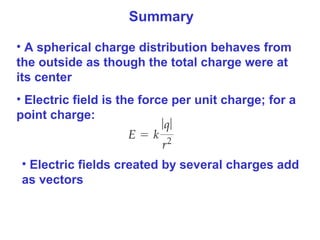
• Electric field is the force per unit charge; for a
point charge:
• Electric fields created by several charges add
as vectors
Summary
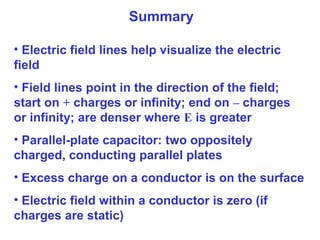
• Electric field lines help visualize the electric
field
• Field lines point in the direction of the field;
start on + charges or infinity; end on – charges
or infinity; are denser where E is greater
• Parallel-plate capacitor: two oppositely
charged, conducting parallel plates
• Excess charge on a conductor is on the surface
• Electric field within a conductor is zero (if
charges are static)
Summary
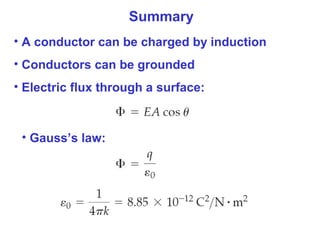
• A conductor can be charged by induction
• Conductors can be grounded
• Electric flux through a surface:
• Gauss’s law:

Final akshay

  • 1.
  • 2.
    TOPICS • Electric Charge •Insulators and Conductors • Coulomb’s Law • The Electric Field • Electric Field Lines • Electric Flux and Gauss’s Law
  • 3.
    Electric Charge Electric chargeis the physical property of matter that cause it to experience a force when placed in an electromagnetic field. There are two types of charge: positive and negative
  • 4.
    Electric Charge The effectsof electric charge were first observed as static electricity: After being rubbed on a piece of fur, an amber rod acquires a charge and can attract small objects.
  • 5.
    Electric Charge Charging bothamber and glass rods shows that there are two types of electric charge; like charges repel and opposites attract.
  • 6.
    Electric Charge The electronsin an atom are in a cloud surrounding the nucleus, and can be separated from the atom with relative ease.
  • 7.
    Electric Charge Some materialscan become polarized – this means that their atoms rotate in response to an external charge. This is how a charged object can attract a neutral one.
  • 9.
    If a systemcontains two point charges q1 and q2, the total charge of the system is obtained simply by adding algebraically q1 and q2 , i.e., charges add up like real numbers or they are scalars like the mass of a body. If a system contains n charges q1, q2, q3, …, qn, then the total charge of the system is q1 + q2 + q3 + … + qn . whereas a charge can be either positive or negative. Additivity of charge
  • 10.
    Proper signs haveto be used while adding the charges in a system. For example, the total charge of a system containing five charges +1, +2, –3, +4 and –5,in some arbitrary unit, is (+1) + (+2) + (–3) + (+4) + (–5) = –1 in the same unit Charge Charge has magnitude but no direction, similar to the mass. However, there is one difference between mass and charge. Mass of a body is always positive
  • 11.
    Electric charge isconserved. Also, electric charge is quantized in units of e. The atom that has lost an electron is now positively charged – it is a positive ion The atom that has gained an electron is now negatively charged – it is a negative ion
  • 12.
    The electric charge,q, is said to be quantized q is the standard symbol used for charge as a variable Electric charge exists as discrete packets q = ±Ne N is an integer e is the fundamental unit of charge |e| = 1.6 x 10⁻¹⁹ C Electron: q = -e Proton: q = +e Quantization of Electric Charges
  • 13.
    Charging Objects byInduction • Charging by induction requires no contact with the object inducing the charge • Assume we start with a neutral metallic sphere – The sphere has the same number of positive and negative charges
  • 14.
    • A chargedrubber rod is placed near the sphere – It does not touch the sphere • The electrons in the neutral sphere are redistributed
  • 15.
    • The sphereis grounded • Some electrons can leave the sphere through the ground wire
  • 16.
    • The groundwire is removed • There will now be more positive charges • The charges are not uniformly distributed • The positive charge has been induced in the sphere
  • 17.
    • The rodis removed • The electrons remaining on the sphere redistribute themselves • There is still a net positive charge on the sphere • The charge is now uniformly distributed
  • 18.
    Insulators and Conductors Conductor:A material whose conduction electrons are free to move throughout. Most metals are conductors. Insulator: A material whose electrons seldom move from atom to atom. Most insulators are non-metals.
  • 19.
    Insulators and Conductors Semiconductorshave properties intermediate between conductors and insulators; their properties change with their chemical composition. Photoconductive materials become conductors when light shines on them.
  • 20.
    Coulomb’s Law Coulomb’s lawgives the force between two point charges: The force is along the line connecting the charges, and is attractive if the charges are opposite, and repulsive if the charges are like.
  • 21.
    Coulomb’s Law The forceson the two charges are action- reaction forces.
  • 22.
    Coulomb’s Law If thereare multiple point charges, the forces add by superposition.
  • 23.
    Coulomb’s Law Coulomb’s lawis stated in terms of point charges, but it is also valid for spherically symmetric charge distributions, as long as the distance is measured from the center of the sphere.
  • 24.
    The Electric Field Definitionof the electric field: Here, q0 is a “test charge” – it serves to allow the electric force to be measured, but is not large enough to create a significant force on any other charges.
  • 25.
    The Electric Field Ifwe know the electric field, we can calculate the force on any charge: The direction of the force depends on the sign of the charge – in the direction of the field for a positive charge, opposite to it for a negative one.
  • 26.
    The Electric Field Theelectric field of a point charge points radially away from a positive charge and towards a negative one.
  • 27.
    The Electric Field Justas electric forces can be superposed, electric fields can as well.
  • 28.
    Lines that indicatethe strength and direction of the electric field. The more dense the lines, the stronger the field. Electric field vectors are tangent to the curve. Properties of electric field
  • 29.
    Electric Flux andGauss’s Law Electric flux is a measure of the electric field perpendicular to a surface:
  • 30.
    Electric Flux andGauss’s Law Gauss’s law states that the electric flux through a closed surface is proportional to the charge enclosed by the surface:
  • 31.
    Electric Flux andGauss’s Law Gauss’s law can be used to find the electric field in systems with simple configurations.
  • 32.
    Summary • Electrons havea negative charge, and protons a positive charge, of magnitude • Unit of charge: Coulomb, C • Charge is conserved, and quantized in units of e • Insulators do not allow electrons to move between atoms; conductors allow conduction electrons to flow freely
  • 33.
    Summary • The forcebetween electric charges is along the line connecting them • Like charges repel, opposites attract • Coulomb’s law gives the magnitude of the force: • Forces exerted by several charges add as vectors
  • 34.
    Summary • A sphericalcharge distribution behaves from the outside as though the total charge were at its center • Electric field is the force per unit charge; for a point charge: • Electric fields created by several charges add as vectors
  • 35.
    Summary • Electric fieldlines help visualize the electric field • Field lines point in the direction of the field; start on + charges or infinity; end on – charges or infinity; are denser where E is greater • Parallel-plate capacitor: two oppositely charged, conducting parallel plates • Excess charge on a conductor is on the surface • Electric field within a conductor is zero (if charges are static)
  • 36.
    Summary • A conductorcan be charged by induction • Conductors can be grounded • Electric flux through a surface: • Gauss’s law: